In the beginning, God fell in love with creation, and pronounced it very good. Like romantic adoration, God’s eternal love is blind to human betrayal, rebellion, and stupidity. When God’s children ignore the prophets and break every covenant offered to us, God continues to love us like a star-struck lover.
We celebrate Advent and Christmas every year to remind us that God still so loves the whole world that He comes to share the risks and sacrifices of being a vulnerable human being.
In the dark days of December, when wars and senseless violence dominate the news, God’s love simply grows brighter and stronger. The Advent candles remind us that we are all created in the image of God, and the essence of our God is unbounded, unconditional love.
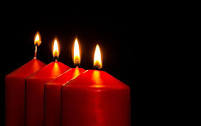
So on this final Sunday of Advent, the circle of the wreath is completed. We relight the candles of Hope, Peace, and Joy. And today we light the Candle of Love, because the greatest of these is Love.
[Light all four candles]
Please join me in the prayer on the screen:
O dear God, lover of our souls, we are undeserving and unworthy of your radical love. Our souls our willing, but our flesh is weak. Please sweep us off our feet again in your loving embrace. Help us to share in your wild and crazy romance with this broken world. Let these candles rekindle in us the dream of your beloved community, so we can throw open the gates of love to all of your weary, hopeless children. Remind us once more that the Babe of Bethlehem still calls us to love one another, in the same reckless, unconditional way that you love us. Amen
This third Sunday of Advent we celebrate the gift of joy. Think of the pure unbridled, squealing, giggling joy of kids on Christmas morning. That’s the joy we want as we anticipate the greatest gift ever given – God incarnate, overflowing with undeserved, indescribable grace.
We await Emmanuel, God with Us, who from our fears and sins releases us so we can dance a happy dance and make angels in the snow. This is the joy that like the North Star is always there, even when hidden by cloudy skies. Nothing, absolutely nothing in all creation can ever snuff out the joy in the hearts of God’s beloved who have knelt at Bethlehem’s manger.
And so today we relight the candles of Hope and Peace, and we add to the growing brightness by lighting the candle of Joy.
(Light 3 candles)
Please pray with me the prayer on the screen:
O merciful God, we confess our joy often gets lost in the hectic schedule of this season. We have so much to do and so little time. All the festivities are wonderful, but it’s so easy to lose track of what the season is all about. Break through our busyness and remind us of Isaiah’s wisdom that a little child shall lead us. Let us feel again childlike wonder, so joy can bubble up in our hearts, and for just a little while let us lose ourselves in the mystery of your holy incarnation. Amen
A couple of Sundays ago when our Ohio October was still summerlike I spent some time in the Chapel in the Woods at our church after Sunday worship. Because of scheduling issues I attended our contemporary service that Sabbath which is not my preference. That Sunday was actually World Communion Sunday, a day that always has special meaning for me, especially in our fractured world today.
On that Sunday our church celebrated World Communion primarily at our traditional service because the contemporary service had been set aside for our annual Blessing of the Animals service. Communion was still celebrated at the contemporary service, along with treats for God’s four-footed critters that came to be blessed.
Needless to say it was a lively and noisy service, which is always fun, but it was not exactly what I needed that day. So, after worship I spent some time praying in our beautiful outdoor chapel and the words that came to me were “Be still and know that I am God.” I have meditated on those words frequently in the days since, seeking the balm they offer in the chaotic world we inhabit just now.
I am embarrassed to admit that I didn’t remember where those words come from in Scripture until I googled them. They are of course in verse 10 of a Psalm I have used dozens of times in funeral services, and the opening verses set the scene powerfully for having faith to be still when life is literally crumbling around us like the East Wing of the White House.
The psalm begins with these words:
“1 God is our refuge and strength, a very present help in trouble. 2 Therefore we will not fear, though the earth should change, though the mountains shake in the heart of the sea, 3 though its waters roar and foam, though the mountains tremble with its tumult.”
Those are the opening verses of Psalm 46 which some scholars believe was written as the armies of Assyria were besieging the city of Jerusalem in 701 BCE. Many of us can easily relate. It feels like all the values we thought our country was founded on are under siege.
I could recite a whole litany of things we’ve lost in the last 10 months, but I will focus instead on one of the most recent and egregious violations of Christian morality and Constitutional order. Because of the government shutdown SNAP benefits that help feed 42 million Americans have been cut off for the last 6 days.
There are contingency funds available to pay those food stamp benefits, and that has always been done in every other shutdown we’ve had. The only difference this time is the one who resides in what’s left of the White House.
Two federal judges have ordered the President to release those funds and provide food for hungry Americans, including the elderly and children. But Donald Trump has decided to ignore those court orders so he can use those 42 million people as political bargaining chips in the high stakes game of chicken he is playing with the democrats.
Meanwhile the President has given $40 million of our tax dollars to Argentina which hurts already desperate American farmers. He’s spent millions on unauthorized military action against Iran and Venezuela, and is threatening to do the same in Nigeria. But he refuses to even negotiate with democrats about skyrocketing health care premiums or to follow court orders and feed hungry people.
It seems useless to remind Washington about what Jesus said about feeding the least of these, although I have done so repeatedly with my three Republicans representatives in Congress. The tone deafness of this administration to calls for empathy and justice for our fellow human beings certainly feels like basic human decency is under siege.
How can we not wonder if God really is our help and refuge? Where is God’s help in this all too real time of trouble? As I typed those words, and I’m not making this up, a notification popped up on the top of my iPad screen that said “Don’t Stop Believein’!” That message came because the rock band Journey is coming to Columbus, OH next summer, but the timing of that message seemed way too relevant to be just a coincidence.
And that seems to be what the psalmist is saying to the besieged, hopeless folks in Jerusalem surrounded by the mighty armies of Sennacherib.
5 “God is in the midst of the city; it shall not be moved; God will help it when the morning dawns. 6 The nations are in an uproar; the kingdoms totter; he utters his voice; the earth melts. 7 The Lord of hosts is with us; the God of Jacob is our refuge.[c]Selah
8 Come, behold the works of the Lord; see what desolations he has brought on the earth. 9 He makes wars cease to the end of the earth; he breaks the bow and shatters the spear; he burns the shields with fire.”
And because of God’s ultimate rule of the whole universe, no matter how bad things seem at this or any moment, personal or in history, we can 10 “Be still, and know that I am God! I am exalted among the nations; I am exalted in the earth.” 11 The Lord of hosts is with us; the God of Jacob is our refuge.”
On Ash Wednesday last year we had an experiential worship service, and one of the things we were asked to do was create something from clay that was symbolic of the meaning of the season of Lent. I made this symbol which is still on my desk:
Some people thought it was a fish, which would be ok; but that is not what I was going for. I started out with an infinity symbol and then made one end into a heart. For me it symbolizes the only thing we can really count on and the only thing we need – God’s Infinite Love.
That ‘s what enables me at times to be still and know God’s in charge, even when the infidels are literally not only at the gates but in the seats of power.
Jerusalem was reborn from the ashes and somehow, someday the land of the free and the brave will be also. Be still and don’t stop believin’.
“Whoever is paying our bills and giving us security and status determines what we can and cannot say or even think.” Fr. Richard Rohr
The quote above recently appeared in Fr. Rohr’s daily meditations from his Center for Action and Contemplation. It struck me as particularly poignant and relevant right now when freedom of expression in the U.S. is under attack. The power of those words is in the very fact that there is truth in them even under the best of conditions. Women can understand that truth better than we males because throughout patriarchal history they have not been free to express themselves.
In my lifetime women could only get a credit card if it was in their husband’s name. In my grandmother’s generation women did not have the right to express themselves through voting until the 19th amendment was ratified in 1920.
A clergy colleague of mine was forced out of his church in the mid-twentieth century for expressing his opinion about an issue on an election ballot, and in this age of social media the number of people who have lost their jobs because of an opinion they expressed on their personal social media account is too many to count.
This quote reminded me of another one that has intrigued me for over 40 years. “I hope for nothing. I fear nothing. I am free.” Those are the words written on the gravestone of Nikos Kazantzakis in Heraklion, Greece. Kazantzakis was the author of “Zorba the Greek,” “The Last Temptation of Christ,” several other novels, and “Saviors of God,” a book of “spiritual exercises” that are often as challenging as his epitaph.
Is being free of fear and hope the secret to having no constraints on what we say or think? Some might say being filthy rich so one does not have a boss or anyone else to report to would be the ultimate freedom, but I suspect that those who are not accountable to anyone because of their ultra-wealth are far from free. I base that judgement on the fact that the vast majority of billionaires we see in the media are never satisfied with what they have and continually strive for more wealth and power instead of enjoying what they have.
When Jesus says, “You will know the truth, and the truth will make you free” (John 8:32) what is the truth he is speaking of? Verse 31 sets some context for the more familiar 32nd:
“Then Jesus said to the Jews who had believed in him, “If you continue in my word, you are truly my disciples.” It is to those believers that he promises the truth that will set them free. That narrows things down a bit, but still raises questions, like free to do/be what? Or freedom from what?
The clue to those answers are found right in these verses. Jesus is talking to those who believe in him, and he says they need to continue in his word to truly be his disciples. In other words they are set free to be true followers of Jesus and his way of peace and justice. And later in John’s Gospel in the farewell discourse (chapter 14) where Jesus is preparing his disciples for life in a post-crucifixion/resurrection world he tells them he is going to prepare a place for them. Thomas says, “Lord, we do not know where you are going. How can we know the way?” Jesus said to him, “I am the way and the truth and the life.” (John 14:5-6)
Jesus himself is the truth that sets us free, and if we know that truth, not as a doctrinal belief but as a deep, in the gut, all-in personal relationship and commitment to follow Jesus’ way no matter what crap the world throws at us, then we are free from fear and even from hope because in that abundant life in Christ there is nothing to fear and nothing more to hope for.
That is the truth that give us the courage to be, to borrow a phrase from Paul Tillich. It’s the courage described by Bertram Cates in the play “Inherit the Wind” when he is on trial for teaching evolution in a small southern town where almost everyone is against him. At one point Cates says, “It’s the loneliest feeling in the world-to find yourself standing up when everybody else is sitting down.”
But those who know the truth that is Jesus’ message of peace and justice understand that we must fear nothing and stand up against the forces of evil and injustice. I like the way our United Methodist Baptismal ritual says it. One of the questions asked of adults being baptized is this: “Do you accept the freedom and power God gives you to resist evil, injustice, and oppression in whatever forms they present themselves?”
Most of us go through the motions of this ritual by saying the prescribed “I do,” but in times like we are living in now it is incumbent upon all of us who know Jesus as our truth to fear nothing and stand up and say a resounding “Here I am, send me!”
O God of all creation, we set aside one Sunday each year as World Communion Sunday. Given the state of our battered and broken world wouldn’t it make more sense to make every Sabbath or Holy Day a time to pray for a beloved world community?
Our Christian Scriptures say you so loved this messed up world so much that you sent your own beloved son to redeem us. Why would you do that knowing how the evil forces in the world routinely kill any prophet who challenges the empire’s gospel of power and violent control by fear and intimidation?
And yet something about that impractical vision of a peaceable kingdom keeps us coming back to your table. It’s a table where we join a motley crew of humanity – those who hunger for power and the powerless who simply hunger; Israeli and Palestinian, Ukrainian and Russian, an assassin and a widow who forgives him, sworn political enemies dipping bread in the same cup, estranged family members sharing tears of joyful reunion, and those who live for revenge breaking bread with the agents of reconciliation.
We don’t understand the mystery of how ordinary broken bread can fan the tiny ember of hope still smoldering beneath an avalanche of broken dreams. Yet somehow the Holy Ruach of Your spirit blows life into a valley of dry bones and we leave the table lighter and brighter with a spring in our step we thought was gone forever.
The chaos of life has not stopped. The existential threats to freedom and the power of greed and short-sightedness threatening our planet are still as awful as ever. People are still starving in Sudan and Gaza, bombs are still dropping in Kiev, and yet the vision of humanity with all its flaws breaking bread together around one godly table stays with us and empowers us to face the future with courage and love.
Because You so loved the world we dare to also, in the name of the humble servant who calls us again and again to come eat and drink of his very essence. In His name we pray and live. Amen
“There is none so blind as he who will not see. We must not close up minds. We must let our thoughts be free.” (From “Everything is Beautiful” by Ray Stevens
I had never heard of Charlie Kirk until two days ago when he was shot and killed in Utah. If I had I would have disagreed with almost everything he stood for. What I have learned about him in the last 24 hours indicates he was instrumental in converting many vulnerable young Americans to the Trump political campaign that gave us a disastrous threat to our democracy.
That saddens me greatly, but it does not in any way justify violence against those who hold different political views, even diametrically opposed ones. Gunning down any young husband and father is cause for grief and one more reason America needs to do serious introspection about the state of our political divisions.
One thing I can heartily agree with Kirk on is his defense of free speech and his willingness to engage in dialogue with those who disagreed with him. I suspect, although I don’t know, that his public debates with those who came to hear him may have been largely political theater. Regardless of that, the principle of our constitutional right to freedom of expression must not be lost in the grief or the debate that will follow this latest mar on America’s image.
The commentaries and testimonials about Charlie Kirk have gotten me thinking about eyes and eyesight, not from an ophthalmological perspective, but from a theological one. Back in 2016 when Donald Trump was running for President the first time I read about an interview where a reporter asked Trump what his favorite Scripture is, and his response confirmed my already low opinion of him. He said his favorite Scripture was “An eye for an eye and a tooth for a tooth,” revealing how stunted and misguided his faith development is. Those who never get past Deuteronomy or even read the first book of the New Testament where Jesus directly repeals that revengeful notion of justice have a very low, un-Christlike theology. (Cf. Deuteronomy 19:21 and Matthew 5:38-39)
I love the quote from Mahatma Gandhi that says, “An eye for an eye will only make the whole world blind.” Gandhi like Jesus knew that violence and retribution never solve anything. One offense leads to a counterattack, verbal or physical. One war only sews the seeds of the next one. Jesus’ unpopular advice to turn the other cheek (Matthew 5:39) when someone hurts you is not about weakness but about the courage to stop the ever-escalating cycle of violence.
One of the other familiar quotes attributed to Jesus about eyes is, “Why do you see the speck in your neighbor’s eye but do not notice the log in your own eye how can you say to your neighbor, ‘Let me take the speck out of your eye,’ while the log is in your own eye? You hypocrite, first take the log out of your own eye, and then you will see clearly to take the speck out of your neighbor’s eye.” (Matthew 7:3-5)
Those words from the Sermon on the Mount should serve as a reminder to all of us to prioritize a careful examination of our own faults and biases before we level criticism at others. I know that when I have even a tiny speck of dirt in one of my eyes it itches and waters and I cannot see clearly until I can get it out. The same is true of our spiritual vision, especially when it comes to our feelings and opinions about the beliefs, words, and actions of those we disagree with.
For example, as soon as I read a news alert on my phone about the death of Charlie Kirk on one of my favorite left-leaning news outlets and learned that he was a big Trump supporter, all of my assumptions and biases about the whole MAGA community kicked in. The fact that I didn’t even know who Kirk was speaks volumes about my failure to listen to voices from opposing political perspectives.
I am still very uncomfortable that this spokesperson for what I believe to be undemocratic and dangerous views is being made into a hero and martyr. I am also incredibly upset that President Trump and his supporters who are speaking eloquently about free speech need to take the logs out of their own eyes. When a government servant shares economic reports that run counter to the Trump narrative and is summarily fired, that is not freedom of speech. When a Federal Reserve governor stands up to the President over economic policy and the President attempts to fire her, that is not freedom of speech.
When the head of the CDC refuses to sign off on policies that fly in the face of scientific evidence and is fired for her integrity, that is not freedom of speech. When the President’s entire cabinet spends whole cabinet meetings offering flowery praises to the President instead of engaging in productive debate and collaboration, that is not freedom of speech. When the entire GOP membership of the House and Senate are too fearful to do their constitutional duty of providing checks and balances on the President, that is not freedom of speech.
And finally, when flags are lowered to half-mast for Charlie Kirk but not for Democratic legislators killed in Minnesota or for dozens of innocent school shooting victims, or for anyone else not aligned with the Trump philosophy, that is not freedom of speech. That is pure partisan propaganda.
We desperately need freedom of speech, but it has to work both ways or it is not free. The future of our democracy is at a scary tipping point. If we demonize and refuse to see our common humanity with even those we feel are political enemies, the death of Charlie Kirk and other political leaders will fuel a continuing spiral of decent into chaos and military take overs of our cities.
But if we remove the proverbial logs out of our own eyes and make a disciplined effort to see every human as a sister or brother then there is still hope that our fragile democracy can be preserved. It’s a choice, as Ray Charles reminds us, “There is none so blind as he/she who will not see. We must not close up minds. We must let our thoughts be free.”
Great and gracious God, as we worship today we all come with personal cares and burdens. And on top of those we have been shaken by images we can’t unsee from the horrendous floods in Texas. The innocent children killed trouble our hearts the most, but we also pray for all the others who have lost loved ones, homes, businesses, and livelihoods.
In times like these we can’t help but ask the question people have been struggling with since the days of Job – where are you, Lord, when walls of water sweep little girls away? Why do you let things like this happen? Why do you let cancer, war, and human cruelty destroy innocent lives? If you are all-powerful and all-loving, why is there so much pain and suffering in our world?
As much as we wish you were a helicopter parent who would sweep in and protect us from anything terrible happening, we know that is not who you are, God. You are a heavenly parent who has given us the freedom to make choices. When we mess things up with selfish or short-sighted decisions, we would often like to give that freedom back to you.
But like earthly parents you know there is a time when children must be set free to make their own choices. Hindsight is always 20/20, but no amount of blaming, no law suits can undo the consequences of our mistakes. We can only learn from them and try to do better in the future.
So we humbly ask, Merciful God, that you would forgive us where we have misused our freedom to choose. Help us accept things we cannot change, and in our experiences empower us to be your presence through prayer and acts of service for those who are hurting next door, and in Texas, and around the world.
When we wonder where you are in the midst of tragedy, Lord, remind us that you are always there in the form of helpers who comfort those who mourn, weeping with those who sob uncontrollably, in the form of first responders and volunteers tirelessly searching for the lost and missing.
Thank you for being with us in every time of need, for being, as the Psalmist says, “close to the brokenhearted and saving those who are crushed in spirit.” For all your mercies we offer our thanks, and especially for Jesus, who lived your presence as one of us, teaching us how to live, how to love, and how to pray. Our Father ….
Northwest United Methodist Church, Columbus, Ohio, July 13, 2025
As I have been shaken by the Texas flood tragedy this week my mind has wandered back to all the times I was responsible for a group of young people at camp or on mission trips. I keep wondering if I would have had the courage, composure, and strength to help save those children and youth entrusted to me by their parents if I awoke in a horror movie of rushing flood water filling our cabin?
I hear people asking as I do where is God in tragedies like this? Why did God let this happen? Why does God let cancer, war, and gun violence destroy innocent lives? Of course, I really don’t know any definitive answers to those age-old questions scholars categorize as theodicy, i.e. how do we explain how an all-powerful, loving God allows evil and suffering to exist in the world.
My answer for this week is that God is not a helicopter parent who swoops in to protect and prevent anything bad from happening to us, God’s children. There comes a point in every parent’s life where you have to let your children make their own mistakes and suffer the consequences. No amount of advice or warning or sharing our own past failures will stop a grown child from blazing their own path.
God has gifted us mortals with free will. Oh how many times I have wished I could return that gift which has allowed me to screw up so many times by pursuing my own pleasure, desires, and goals instead of a higher path.
I’m sure there were many times God wished people would not house innocent young girls in cabins on a flood plain. I’m sure God would have wanted and may have urged people in positions of authority to better prepare for floods like those on the Guadalupe River last week. I’m sure God shook her head in dismay when arguments prevailed that sirens and warning systems were too expensive.
I heard on the news tonight that some people who regularly camped in RV’s along the Guadalupe ignored warnings of potential flooding last week saying, “It floods here all the time.” Basing present precautions on past experience can be dangerous. We don’t live in pre-climate change times, and those of us who trust science know that we are living in a new normal where extreme weather events are more frequent and much more severe.
There will be finger pointing and blaming and many law suits filed because of this tragedy. None of those things will bring back any of the victims or ease the trauma of the survivors. The only redeeming quality of this disaster is that our free will enables us to learn from our past experiences. We can ask what would have helped make this tragedy less horrific? What needs to be in place to prevent or limit future flooding occurrences and to improve rescue and recovery operations?
Where is God in all this? Not zooming in like a master puppeteer to prevent the consequences of poor free will choices; not picking and choosing who will survive and who will not. No, God is there comforting those who mourn, weeping with those who sob uncontrollably, and giving strength to the brave first responders and volunteers who are doing the horrible/wonderful work of searching for those who are still missing.
God is there offering hope to the hopeless, absorbing the hate and pain of the angry, and sitting peacefully and patiently with those for whom there simply are no words – at least not yet.
“The Lord is close to the brokenhearted and saves those who are crushed in spirit.” Psalm 34:18
President Trump’s Big Budget and Policy bill recently passed in the House of Representatives by one single vote, and that was with the considerable power of the Administration advocating for its passage. A procedural matter on that same bill just yesterday passed in the Senate 51-49. These razor thin margins remind us how deeply divided we are as a nation right now. But those votes also reminded me of a piece of early Ohio history that I just learned about five years ago.
This was actually my second reminder of this critical moment in my state’s history. Just last week Bishop Hee-Soo Jung preached at a Juneteenth worship service at our church. Bishop Jung is new to Ohio having been assigned to the Ohio Episcopal Area just nine months ago.
So he has been studying the history of his new home state and reminded us in his sermon that in the 19th century enslaved people in the south thought of the Ohio River as the River Jordan and Ohio as the Promised Land because if they could make it to cross that river they were free.
I told the Bishop after the service of this critical incident in Ohio’s early history that could have changed all of that imagery and reality drastically.
I wrote about that chapter in our history which included a super close vote on approving the Ohio state constitution 222 years ago in an earlier blog post, and with our current political climate being what it is I decided to repost that piece to remind us all that we’ve been here before and that acts of solitary individuals can make a history-altering difference.
The post is from June of 2000 entitled “One Vote Really Matters.”
Until very recently if one of the most important names in Ohio history were to be a Final Jeopardy answer I would have been clueless. And I’m guessing that most of my fellow Ohioans who took the required Ohio History class in middle school would also not be able to identify Ephraim Cutler.
I would still have no idea of the critical role Cutler played in shaping the history of my state if a friend of mine had not recently moved to Marietta, the first white settlement in what became the Buckeye state. Because this colleague of mine now resides in Marietta she made mention on social media of David McCullough’s recent book about Ohio’s beginnings, “The Pioneers: The Heroic Story of the Settlers Who Brought the American Ideal West.”
I am a big fan of McCullough and am very glad to be reading this book. I must say it started slow and took me awhile to get into it, but it was worth the effort for one of the most relevant stories in the book that lit up for me like a Christmas tree because of our most recent unrest about the evil of racism in our nation.
Cutler and his father were prominent leaders in establishing the first settlement in the 1790’s in the newly acquired Northwest Territory and because of their prominence in Marietta Ephraim was elected in the early days of the 1800’s as one of two delegates to represent Marietta and Washington County at the convention responsible for creating a constitution for Ohio statehood.
I was surprised to learn that one of the most heated debates at that convention held in the Territorial Capitol at Chillicothe was over whether slavery would be permitted in Ohio. And even more shocking to my naïveté was how close the vote was on the provision about slavery.
Ephraim Cutler was one of the most vocal opponents of the slavery provision, but on the day of the critical vote on that item Cutler was so gravely ill that he could barely get out of bed. His friends pleaded with him and physically helped him to get to the chamber for the vote, and it was a very important thing they did; because the proposal for Ohio to be admitted to the union as a slave state was defeated by that one single vote.
My mind is still blown by that piece of history. I am shocked at how close my home state came to being a place where human slavery was allowed. I have been self-righteously smug that we Ohioans are better than that, but we came within the narrowest of margins of becoming a slave state.
That history has helped me understand better the depth of the political divisions in our state and our country even today. I knew there have always been deep-seated disagreements about race from day one in these United States — which have never been united on that issue. But realizing how heated that debate was at the very inception of statehood here in Ohio helped me understand at a deeper level why it is so hard to resolve this issue.
Ephraim Cutler also taught me again that one life and even one vote can make all the difference in the world. Imagine what Ohio history would look like if we had become a slave state. Would we have joined the Confederacy? Would we have statues of Robert E. Lee and Stonewall Jackson being removed here in our state capital?
I thank God that brave pioneer dragged himself out of bed to take a stand for justice that day in Chillicothe. His bravery and integrity inspires me to do my part in that on-going struggle for America’s highest ideals today. I hope I do not soon forget who Ephraim Cutler was, and I thank David McCullough for telling his story. It has never been more important to study and learn from our history.
O God of the universe, my retirement funds are in the dumpster, they’re dropping faster than that first big stomach-churning drop on those big roller coasters. I’m so old I don’t know if those funds will have time to recover even if the market does, and I’m scared.
The other stuff I depend on for my well-being, e.g. Medicare and Social Security is also under attack from rogue billionaires in Washington who have no idea what life is like for us common folks. Without medicare I would not have been able to get the life-saving cancer treatment I just finished, and things are much worse for others who are uninsured or underinsured.
But you know all that already, O Holy One, and you know I’m better off than millions of others who are living in fear of real poverty or arrest and/or deportation to a hell hole in El Salvador just because they are the wrong color or dare to exercise their right to free expression.
My friends are losing their jobs as the economy craters. Public and higher education are under attack. I know you don’t intervene directly in human affairs. You have blessed (or cursed) us with free will; so I just pray for strength, courage, and faith for all of us to support and love one another no matter how deep this economic hole becomes.
No matter what happens to our standard of living our standard of loving can thrive and grow because it is not founded on the whims of human greed, but on the bedrock of your eternal love that nothing in all creation can ever take from us.
Clinging to that assurance our fears for the temporary stuff of this life fade as we affirm our real confidence in what it says on the money we used to have, “In God We Trust.” Amen