Holy and gracious creator God, we know you are all-knowing and all-present. We also know, but keep forgetting, that you are God and we aren’t. We all, every last one of us, fall short of your glory over and over again. And so ever since the Garden of Eden we have been trying to play a silly game of hide and seek with you.
Many of us have been taught to fear you. We cut our spiritual teeth on images of you as a judgmental Big Daddy who knows our every thought and action. We have stories in our heads from Scriptures where you are bent on revenge against your enemies and sinners like us.
And so we lie to ourselves, to others, and to you. We project pretty pictures of ourselves as already sanctified and permanently cleansed of all our unrighteousness. But we know better, and we know you know better too. And so we waste so much time and energy pretending to be saints when we are all sinners. We try to hide the dark side of our nature even though the Psalmist has told us that there is nowhere, not even in hell that we can hide from your presence.
Even though you sent Jesus to teach us the truth that sets us free, we still often do not have ears to hear the good news. It seems too good to be true that in spite of our faults and shortcomings you still love and adore us–that you still call us when we are tired and heavy laden to come and rest in the arms of your grace.
And the wildest part is that you commission fallible human beings like us to stop hiding our lights under a bushel. You call us, not to save the world, but to simply reflect your light into our small corner of your creation. Your light can shine through the cracks in us if we let go and allow you to use us. Help us, O God, to share in our words and deeds the heavenly message of love, truth, and justice to the neighbors you give us. Open our eyes to recognize our common humanity with all of your children, the oppressed and the oppressors alike.
So for now we just want to say thank you for your amazing grace, and we pray for the humility and courage to hear the Master’s voice, to come out of hiding and follow him. And to that end we offer again the prayer he taught us to say,
The commemoration of June 6 as D-Day always feels important to me because of its historical significance and the fact that my father fought against Fascism in World War II. My dad wasn’t part of the Normandy Invasion. He was a young enlistee in the war and by the time he went through flight training and officer candidate school the war in Europe was winding down. He did fly a few missions over Germany as a B-17 pilot before VE Day, but his most harrowing experience ironically came after the war. The B-17 he was flying back to the States lost both engines and had to ditch in the North Atlantic. He was one of only four of the 17 on board who survived.
So I take fascists and dictators very seriously, and what is going on in our government today makes me furious. All those brave men and women who risked and thousands who lost their lives will have sacrificed in vain if the MAGA devotees of Donald Trump are allowed to finish destroying our democracy.
In all my years of studying evil governments from Pharaoh to Putin did I ever dream it could happen here. I’m not naive. I am painfully aware of the ugly chapters in our own history, but in all those episodes the leadership has emerged to return our nation to a course based on the critical values of equality and justice our democracy depends on. In the last 18 months under the dictatorial rule of the Trump administration such leadership has not risen up in numbers significant enough to stop the chaos and corruption.
We need examine our current situation through the famous warning that comes from an 1887 letter Lord Acton wrote to Bishop Creighton regarding the moral standards used to judge historical leaders. “Power tends to corrupt, and absolute power corrupts absolutely.”
My fear now is that those with nearly absolute power in the U.S. are so determined to keep it and protect themselves from prosecution for their crimes that they will do anything and everything to rig or cancel the midterm elections. If that happens our experiment with government of the people, by the people, and for the people will be dead for at least a generation. What evil that can happen with absolute power fills volumes of human history, and the last 18 months have shown we are not immune from the dark side of human nature.
And that brings me to a nightmare on this D-Day that I cannot get out of my head. I hope and pray with all my being I am being too pessimistic, but for the first time in my life I can imagine a time when an allied group of nations like those who defeated fascism in 1945 might be necessary to invade the USA and liberate us from our own captivity.
Another famous quote we need to dust off and live into is the one that says “The price of freedom is eternal vigilance.” While frequently misattributed to Thomas Jefferson, the true origin and evolution of the sentiment are fascinating: The sentiment originated with Irish statesman and orator John Philpot Curran, who stated in an 1790 speech: “The condition upon which God hath given liberty to man is eternal vigilance; which condition if he break, servitude is at once the consequence of his crime and the punishment of his guilt.
The shorter version is much easier to pay lip service to, but Curran’s warning about the servitude that we risk if we fail to be very vigilant and act on it packs a much more powerful punch.
This whole situation reminds me of Jesus’ words which are so important they are repeated six times in the Gospels: “Whoever has ears, let them hear.”
The recent war of words between the Trump administration and Pope Leo both infuriates me and makes me very sad. I am astounded that the President and his Roman Catholic Vice-President have so little knowledge and respect for the 2500 year-old tradition of prophetic voices from the faith community speaking as the moral conscience to powerful political leaders. Trump and Vance act as if Pope Leo’s admonitions against war and violence are something new and radical when they are as old as the Moses, Nathan, Micah, Amos, and Jesus himself.
My sadness comes from my own failure as a pastor and preacher and that of the church itself to do a better job of educating our congregations about this age-old tradition of speaking truth to power. I can only speak for myself, but I know that throughout my ministry I have treaded very lightly on the prophetic aspects of my call; and I regret that deeply. My personal journals and conversations with colleagues often reflect my grief that I “sold my soul for a pension and a parsonage.” By that I mean that I avoided controversy and conflict in my congregations to have a “successful” ministry, i.e. keep my job and not create problems for my church superiors.
Far too often that meant going along with or avoiding political views I disagreed with to keep peace with the church members who paid my salary and supported the church’s budget. That is not at all the example set by prophets in the Bible. But before we go on let’s clarify what a biblical prophet is and isn’t. Popular usage of the word “prophet” often equates to one who predicts the future. Biblical prophets do that in a sense because they often warn people what will happen if they refuse to repent and follow God’s will.
But that definition of a biblical prophet is too limited. In the fullest sense the prophets of the Bible are those who are spokespersons for God. And that role often means confronting the powerful rulers of society who are more concerned with profits than prophets. Examples include Moses in the book of Exodus demanding that Pharaoh release the Hebrew people from the slavery which was essential to Egypt’s economic system. Or one of my favorites is Nathan bravely exposing King David’s sinful behavior directly to the King himself. (2 Samuel 12)
Later prophets like Micah and Amos try unsuccessfully to warn the leaders of Israel and Judah that their greed and selfishness will lead to their downfall. Nowhere is what faithfulness to God spelled out more clearly than in Micah 6:8: “He has told you, O mortal, what is good; and what does the Lord require of you but to do justice, and to love kindness, and to walk humbly with your God?” No objective observer of our current political leadership in the United States can deny that we are failing on all three of those measurements for obedience to God. And to his credit Pope Leo as a contemporary prophet is pointing those failures out.
President Trump and his acolytes have particularly taken offense at the Pope’s criticism of the war the President and Benjamin Netanyahu are waging against Iran. They are demanding that the Pope and other religious leaders support the war, failing completely to understand the biblical mandate all of us as Jews and Christians have to be advocates for peace. The Hebrew prophets Micah and Isaiah both make this clear:
“For out of Zion shall go forth instruction and the word of the Lord from Jerusalem. 4 He shall judge between the nations and shall arbitrate for many peoples; they shall beat their swords into plowshares and their spears into pruning hooks; nation shall not lift up sword against nation; neither shall they learn war any more.” (Isaiah 2:3-4, also found in Micah 4:3)
I cannot escape the irony that these verses describe these instructions for peace are to come from Jerusalem. Israel today doesn’t even live up to the limitations for just revenge set down in the Pentateuch. Even AI on my computer knows more about the Scriptures than Trump, Vance, Hegseth, and Netanyahu. Here’s what AI says:
“An eye for an eye” appears in the Old Testament as a legal principle of proportional justice (Lex Talionis), ensuring punishment fits the crime (Exodus 21:24, Leviticus 24:20, Deuteronomy 19:21). Jesus references this in Matthew 5:38-39 to instruct followers against personal retaliation, teaching them to “turn the other cheek” instead.”
One of the best lines I’ve heard this week came from comedian Jimmy Kimmel. He said, “Maybe Trump should read the Bible instead of selling them.” And I’d recommend he start with the Sermon on the Mount in Matthew 5-7 where we can get as close as we can to what Jesus’ philosophy about the faithful life. The heart of those teachings are the Beatitudes which we all need to be reminded of regularly especially in these dangerous times. So I’m going to give Jesus the last word here from Matthew 5:
3 “Blessed are the poor in spirit, for theirs is the kingdom of heaven.
4 “Blessed are those who mourn, for they will be comforted.
5 “Blessed are the meek, for they will inherit the earth.
6 “Blessed are those who hunger and thirst for righteousness, for they will be filled.
7 “Blessed are the merciful, for they will receive mercy.
8 “Blessed are the pure in heart, for they will see God.
9 “Blessed are the peacemakers, for they will be called children of God.
10 “Blessed are those who are persecuted for the sake of righteousness, for theirs is the kingdom of heaven.
11 “Blessed are you when people revile you and persecute you and utter all kinds of evil against you falselyon my account. 12 Rejoice and be glad, for your reward is great in heaven, for in the same way they persecuted the prophets who were before you.”
There are several things I don’t like about going to the gym to work out – the effort it takes to get there, the slim and trim young men who make me look bad, and the swimmers in the pool who do laps twice as fast and twice as many as I can. But the number one objection I have to the gym are the mirrors everywhere. They keep showing me this old man looking back at me!! I think he’s stalking me!
Lent and Good Friday do the same thing if we are brave enough to look in the mirror. 40 days ago many of us got a smudge of ashes on our foreheads and heard those ultimate words of reality “Remember you are dust, and to dust you shall return.” And now the Good Friday narrative holds poor old bumbling, human Peter up to us as a mirror of ourselves. Peter is the ultimate fallible human being. He is the poster child for St. Paul’s confession in Romans 7:15 where he says, “I do not understand my own actions. For I do not do what I want, but I do the very thing I hate.”
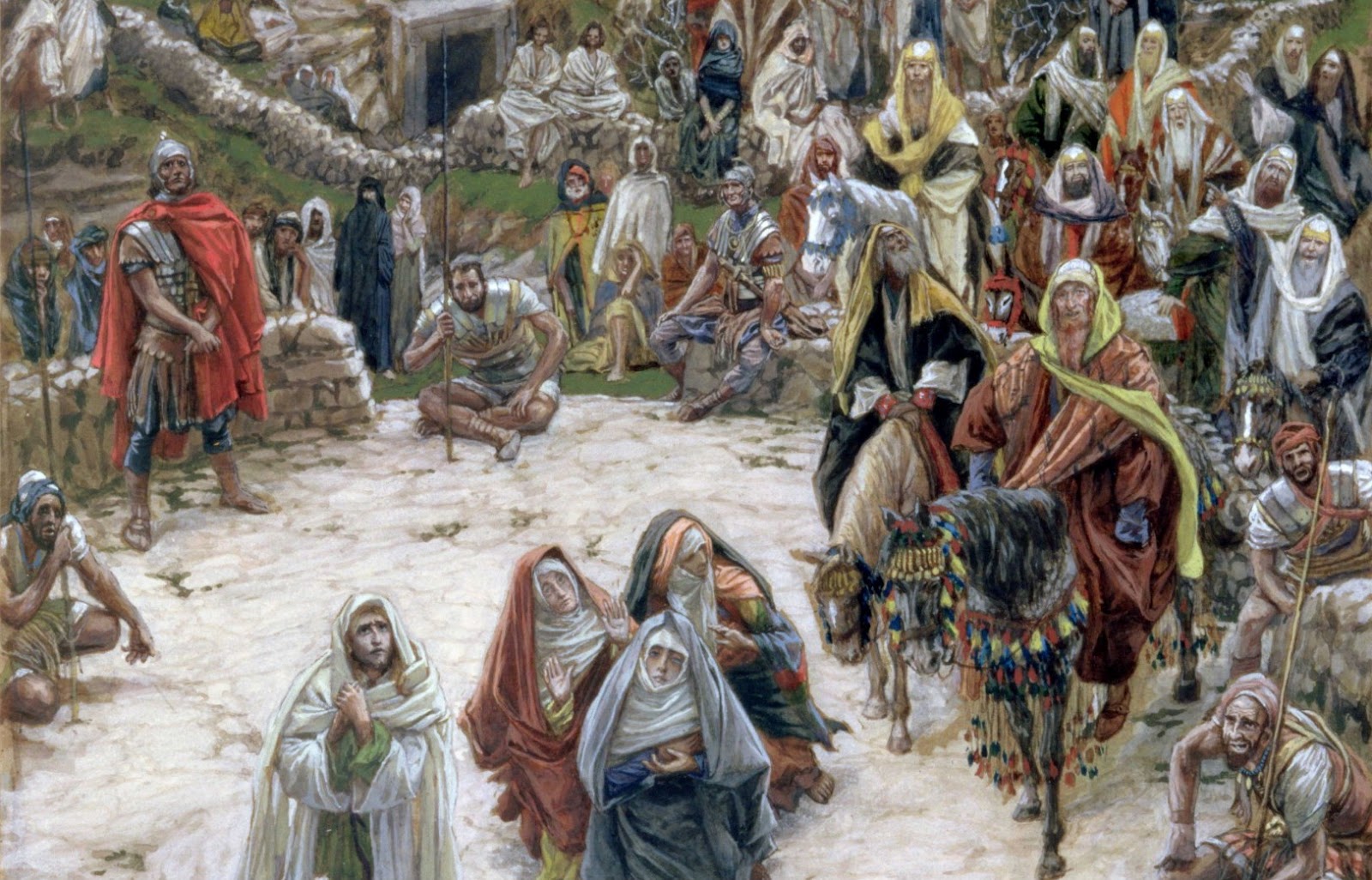
Denise Gorden shared this picture with the Coffee Talk group a few weeks ago. This is artist James Tissot’s depiction of what Jesus’ view from the cross on that dark Friday might have looked like. Last Sunday Rev. Wayne Nicholson reminded us that we often read the Bible to find ourselves in there. Well this picture is a great example of that. Who’s there around the cross? According to John’s Gospel the most faithful and brave ones are up close and personal – three Marys: Jesus’ mother Mary, Mary of Clopas (Mary’s sister-in-law), Mary Magdalene, and John, described as “the beloved disciple.”
Others are there who had cheered Jesus entry into Jerusalem just 5 days earlier – some who have turned against him, maybe out of fear of the Romans, and cried out for Jesus to be crucified instead of the criminal Barabbas. Others who are rubber-neckers who just want to see what’s going on, and some who are ambivalent and curious who just want to see if Jesus is the real deal and might be rescued by a host of heavenly angels.
But it’s also important to notice who’s not there – Peter, and most of the other disciples, unless they’re hiding in the back where the Romans or the religious leaders won’t see them.
Do you see yourself there? What would have brought you to Calvary on that dark Friday? As the choir just asked us, “Were you there when they crucified my Lord?”
But regardless who is there at the cross, there’s one thing we know for sure about everyone, they are all fallible human beings. St. Paul says it plainly in Romans 3:23: “All have sinned and fall short of the glory of God.” All means all; no exceptions. We are all guilty as charged of being fallible human beings, and Peter and the other disciples are the mirrors that remind us, like it or not, that we are among the fallible. We don’t like that role – we want to be heroines or heroes, not examples of fallibility or weakness!
That idea struck me a couple of weeks ago at a meeting of our men’s group called “Men Under Construction,” another way of saying we’re all fallible and God isn’t finished with us yet. Pastor Roger Gorden, who leads that group, described it this way. He said, “Peter gets in the way of Jesus.” Peter gets in the way of Jesus! Isn’t that what we do when Jesus asks more of us than we can or want to live up to? When Jesus says, “Take up your cross and follow me” or “If you love your family more than me you aren’t worthy of me,” those aren’t great recruiting slogans.
At one point earlier in the Gospel story Peter literally gets in Jesus’ way. When Jesus tries to explain to the disciples that he must go to Jerusalem and be crucified, Peter says, “No way, Lord. We can’t let you do that!” And Jesus has to reprimand Peter and tell him, “Get behind me Satan.” That sounds awful, but it’s not if we remember that Jesus doesn’t need or want fair weather friends, he wants brave followers, and in order to follow someone you have to get – that’s right, behind them.
It’s hard to follow someone if we think we know a short cut or easier way to go, and especially hard when carrying a cross.
“Are Ye Able, said the Master, to be crucified with me? Yea, the sturdy dreamers answer, to the death we follow Thee.” All of the Gospels contain the dialogue between Jesus and Peter at the Last Supper where Jesus predicts Peter will deny him, and Peter responds emphatically, “If I must die with you, I will not deny you. And all the disciples said the same.” But when push comes to shove 90% of them aren’t there for Jesus, and Peter says, “No way – not me, I never met the guy.” Not once, but 3 times!
But here’s the deal. We’re not here to judge or blame Peter and the other disciples for what they did or didn’t do 2000 years ago. That’s ancient history. Remember the disciples are in the Gospel narratives as reflections of you and me. They are there to invite us to ask the really hard questions. How do we, you and I, deny we even know Jesus today? When we look in the mirror on the wall what do we see that we try to hide from other people and even from God. Good luck with that one, by the way! What sins of omission and commission gnaw at our consciences when we can’t sleep at night? As Jesus reminds us, we can’t focus on the speck in Peter’s eye when we’ve still got a big old two-by-four in our own.
I identify with Peter because I hate conflict. I will take a five-mile detour to avoid an argument or awkward situation. That’s why Jonah is one of my favorite biblical characters. I can relate. When God tells Jonah to go preach behind enemy lines in Nineveh Jonah hops the first boat going in the exact opposite direction. That would be like one of us getting called to go witness to the people in Tehran today! I’d probably say, “Sorry, God, you’ve got a wrong number.”
OK, let’s consider some more practical, everyday choices we might have to make. One person standing up for someone who is being bullied may stop the cruelty, and even if it doesn’t both the victim and the protector feel the priceless solidarity of friendship. One or two men refusing to laugh at a sexiest or racist joke, or a woman saying no to an unethical business practice can empower others to do the same.
Doing what is right but unpopular is one of the hardest things to do because it puts at risk our own comfort and safety. But what each one of us chooses to do or not do does make a difference.
The familiar quote, “The only thing necessary for the triumph of evil is for good people to do nothing” sums up much of what I’m trying to say. As we all know it takes courage to do the right thing when it is so much easier to go along with the crowd. My favorite quote to describe that is from the play about the famous Scopes monkey trial, “Inherit the Wind”: Defense attorney Henry Drummond says to Bert Cates who is on trial for teaching evolution: “It’s the loneliest feeling in the world to find yourself standing up when everybody else is sitting down.” [repeat]
And to make matters worse, it’s not just individual actions that matter. The mirror here is facing you as a congregation because our collective sins are even more important than individual ones. What’s done in the name of the church, or our government, or any other group we belong to-we bear responsibility for that group’s actions and are called to stand up for what’s right and just and true.
But – we need to shift gears here. Lent and Holy Week are times for soul searching, facing the reality of who we see in the mirror. But the crucifixion and betrayal and denial are not the end of the story and we dare not forget that or we will be overcome with our own guilt and denial. It’s Friday – but Easter’s coming.
Peter denies Jesus 3 times!!! That would be very hard for any of us to forgive! It’s bad enough if a friend, a best friend, like Peter was, betrays us once, but 3 times? How could anyone forgive that! But Jesus isn’t just anyone. When this same disciple, Peter, asks Jesus earlier in Matthew’s Gospel how many times he should forgive someone who sins against him, as many as 7? Jesus says no, 70 times 7.
And of course Jesus practices what he preaches. He not only forgives those who nailed him to the cross; he also forgives poor old Peter. I don’t want to steal the thunder of any Easter sermons, but you already know this; so I don’t think it’s a spoiler alert. Remember it is Peter who is the one Jesus designates as the Rock upon which he will build his church! Peter, the denier, the stumbling block – Peter who is the stand in for us in the Good Friday story, the reflection of our own faithlessness. Yes, that Peter is ultimately the redeemed and forgiven one – just like you and me
Do you remember the line from Snow White – “Mirror, mirror on the wall, who’s the fairest of them all?” The wicked queen keeps asking the mirror the same question because she never likes the answer she gets. The mirror keeps telling her the fairest is Snow White. Likewise we often don’t like what we see when we honestly examine our lives in a spiritual mirror.
Mirrors don’t lie. So Peter’s multiple failures on Good Friday can be an important time of growth on our faith journey if we are brave enough to really see ourselves reflected in Peter. And here’s the good news –we can look in the mirror and see only our faults and shortcomings, our fallibility, our mortality – OR we can look deeper and also see the very one Jesus is counting on to build the kingdom.
Why does God choose the likes of us to build the kingdom? Because fallible human beings are all Jesus has to work with. So tonight and tomorrow we mourn our own guilt and responsibility for denying Jesus, but on Sunday we will rise with him to begin anew the absolutely critical work of following Jesus to the cross. We can do that because when we get behind and follow a risen Savior our faith is stronger than our fear.
Please pray with me:
Dear Creator and Sustainer of all that is good, just, and true, we are living in very sad times. The foolishness of war is robbing your neediest children of food and health care here at home and raining terror and destruction on the Middle East. You have called us to love our neighbors and our enemies. You have taught us that a few courageous people can make a difference. Give us courage to stand up when no one else can or will. Renew a right spirit within us. Show us how we can most faithfully be among those who refuse to deny you. Keep us near the cross and the one who died there for the Peter in all of us. Amen
Genesis 18:22-33: So the men turned from there and went toward Sodom, while Abraham remained standing before the Lord. Then Abraham came near and said, “Will you indeed sweep away the righteous with the wicked? Suppose there are fifty righteous within the city; will you then sweep away the place and not forgive it for the fifty righteous who are in it? Far be it from you to do such a thing, to slay the righteous with the wicked, so that the righteous fare as the wicked! Far be that from you! Shall not the Judge of all the earth do what is just?” And the Lord said, “If I find at Sodom fifty righteous in the city, I will forgive the whole place for their sake.” Abraham answered, “Let me take it upon myself to speak to my lord, I who am but dust and ashes. Suppose five of the fifty righteous are lacking? Will you destroy the whole city for lack of five?” And he said, “I will not destroy it if I find forty-five there.” Again he spoke to him, “Suppose forty are found there.” He answered, “For the sake of forty I will not do it.” Then he said, “Oh, do not let my lord be angry if I speak. Suppose thirty are found there.” He answered, “I will not do it, if I find thirty there.” He said, “Let me take it upon myself to speak to my lord. Suppose twenty are found there.” He answered, “For the sake of twenty I will not destroy it.”Then he said, “Oh, do not let my lord be angry if I speak just once more. Suppose ten are found there.” He answered, “For the sake of ten I will not destroy it.” And the Lord went his way, when he had finished speaking to Abraham, and Abraham returned to his place.”
In these days when it feels so hopeless to to make a difference this story about the threatened destruction of Sodom and Gomorrah speaks to us about the power of each good life. Abraham bravely negotiates with God to try and spare whatever righteous people there may be in these two cities.
Disclaimer: I do not believe the God of grace I know punishes evil by inflicting destruction on individuals or whole cities, although there are times I wish it were so (as long I’m not the guilty party, of course). But that doesn’t mean there isn’t some deeper truth in the story.
For example, what if there were a few brave people had stood up to President George W. Bush in 2003 and demanded proof of weapons of mass destruction in Iraq before committing our troops to a long deadly war? Or what if a handful of founding fathers had stood firm against slavery in 1787 instead of kicking the can down the road to the deadliest war in our history 75 years later?
One child siding with another who is being bullied can stop the cruelty, and even if not both the victim and the protector feel the priceless solidarity of friendship. One or two men refusing to laugh at a sexiest or racist joke, or go along with an unethical business practice can empower others to do the same.
Those who have read Genesis know the unfortunate fate of Sodom and Gomorrah. Apparently Abraham couldn’t find even 10 righteous men, and the two cities were destroyed.
As an aside, I can’t pass on from this story about Sodom and Gomorrah without pointing out a serious misuse of this text which in some circles is used as a condemnation of homosexuality. That charge is not justified by the text and is clarified later in Ezekiel 16:49 where we find: “This was the guilt of your sister Sodom: she and her daughters had pride, excess of food, and prosperous ease but did not aid the poor and needy.” That makes so much more sense because it is consistent with the constant emphasis in all the Scriptures to care for the widows and orphans, to love one’s neighbors as oneself, and Jesus’ stark admonition in Matthew 25 that “just as you did it to one of the least of these, you did it me.”
How often are those same weaknesses in Sodom and Gomorrah the source of our failure to do the right thing, even when we know clearly what we should do. Excess of food and prosperous ease are symbols of comfort and privilege that we Americans should pay careful attention to. Doing what is right but unpopular is one of the hardest things to do because it puts at risk our own comfort and safety. But what we choose to do or not do does make a difference.
The familiar quote, “The only thing necessary for the triumph of evil is for good men to do nothing” sums up much of what I’m trying to say. (My research says this quote is often attributed to Edmund Burke but may actually be a paraphrase of similar words from John Stuart Mill.
As we all know it takes courage to do the right thing when it is so much easier to go along with the crowd. My favorite quote to describe that is from “Inherit the Wind” by Jerome Lawrence and Robert E. Lee:
Attorney Drummond says to Bert Cates who is on trial for teaching evolution: “It’s the loneliest feeling in the world-to find yourself standing up when everybody else is sitting down. To have everybody look at you and say, ‘What’s the matter with him?’ I know. I know what it feels like. Walking down an empty street, listening to the sound of your own footsteps. Shutters closed, blinds drawn, doors locked against you. And you aren’t sure whether you’re walking toward something, or if you’re just walking away.”
But those acts of courage make a huge difference, just as they might have in Sodom and Gomorrah. But that is ancient history. What matters now are the moments today when we are asked to take a stand for righteousness and justice when everyone else is sitting down.
There are so many injustices it feels overwhelming to even try to pick one to address; I know it certainly does to me. But that cannot be our excuse to sit on the sidelines. For me there is also a very real fear of incurring the wrath of those in power if I speak up against them. I wrote a paper in grad school entitled “They Shoot Prophets, Don’t They?,” and the recent murders of Renee Good and Alex Pretti in Minneapolis have done nothing to lessen that fear.
I have never liked conflict of any kind; so speaking truth to power is way out of my comfort zone. But my despair over what’s happening to our democracy is stronger than my fear. I am reminded of the closing scene of Shakespeare’s “King Lear” where the bodies of all the main characters are strewn across the stage and Edgar alone is left to bring down the curtain. He says, “The weight of these sad times we must obey; say what we feel, not what we ought to say.”
Dear Creator and Sustainer of all that is good, just, and true, we are living in very sad times. Unjustified, unconstitutional war is robbing your neediest children of food and health care here at home and raining terror and destruction in the Middle East. You have called us to love our neighbors and our enemies. You have taught us that a few righteous, courageous people do make a difference. Give us courage to stand up when no one else can or will, to speak what we feel and not what the powerful tell us we ought to say. You have put a right spirit within us. Show us how we can most faithfully let that holy light shine into the darkness of this season of our lives until others join us and together our lights expose the evil around us and within us and drive it from our midst in a blaze of resurrection. Amen
The lectionary texts for the first Sunday in Lent this year include Genesis 3:1-7 (“The Fall”) and Matthew 4:1-11(the Temptation of Christ). What a perfect contrast these two Scriptures give us of human frailty and divine strength. In the former Eve and Adam fall like a ton of bricks for a couple of lies from a talking snake! And in the latter the New Testament version of the serpent promises Jesus food (after a 40-day fast!), divine glory and protection (for bungee jumping off the temple without a bungee), and worldly power (over all the kingdoms of the world, including Greenland and Venezuela).
And Jesus, with impeccable theology, politely tells Satan to go fly a kite all three times. And, of course, Peter reprises human frailty again at the end of this drama by denying Jesus three times. Adam, Eve, and Peter all are marked with the Ash Wednesday reminder that we are all dust, and to dust we will return. But Jesus is the Way, Truth, and Life.
These stories remind me of my need again this Lent to examine and resist by own human weaknesses; to be a little less fearful and self-centered, and more faithful to the sacred burden I carry as one created in the image of God. “I believe, Lord. Help my unbelief.” (Mark 9:24)
Nadia Bolz-Weber has shared in her Substack that she is going to observe Lent this year by looking for and recording 40 days of good “stuff,” which if you know Nadia you know she describes that exercise more graphically! As a glass-half-empty kind of person I need all the help with gratitude I can get, especially in these days of doom-scrolling doldrums. So I have decided to launch my own discipline of being aware of at least one good or beautiful thing each day of Lent.
My good stuff for today was seeing a beautiful red headed woodpecker at our bird feeder. The big red head is a gorgeous bird, and I feel especially blessed that we see one fairly regularly at our house. The habitat for the big woodpeckers is being destroyed by urban sprawl, but at least for now we still have enough wooded land around us that the developers haven’t snarfed up that we get to enjoy this one I call Woody. The bad news is he/she doesn’t stay at our feeder very long; so I wasn’t able to get a picture today.
I googled the Red Headed Woodpecker today just for fun and was rewarded with some great Lenten news. What I found is that for some indigenous people the RHW represents the spiritual values of determination, strength, and perseverance. Those seem like exactly the values lacking in the Genesis 3 story which are on full display in Jesus’ replies to Satan in the wilderness.
Humans in paradise still aren’t satisfied with all the blessings they have and are greedy for more. But the Son of God, starving in the wilderness, knows that faith alone is enough to get us through any and all trials and tribulations life throws at us.
[The 4 Advent candles should be lit before the service]
During the Advent season, we have waited like expectant parents for God to deliver – to show up like Amazon with the promised gifts of hope, peace, joy and love. We wait in a world that has never needed those gifts more. And God hides our gifts in plain sight, in Bethlehem, right where the prophets told us they would be. And like every year, we’re surprised, still not convinced that God’s Messiah should be born in a barn.
Tonight our waiting is rewarded, as we celebrate again the gift of unconditional love, and the marvelous ways God breaks through the darkness, and leads us to the Light of the World. God showed the shepherds and the magi the way to Bethlehem. And tonight God is showing us the Way again.
[Light the Christ candle as the next paragraph is read]
We light the Christ Candle on this holy night to celebrate the birth of Jesus Christ, the Light of the World. He has led us here and calls us to follow him on a marvelous journey of seeking, finding, waiting, hoping, and spreading His Holy light.
Prayer: (Please join me in the prayer on the screen)
O eternal God, forgive us when we doubt that a peasant boy of low estate could possibly heal our fearful and divided world. When our skepticism threatens to overwhelm us, wrap us in the warm swaddling cloths of hope, peace, joy and love. We have waited and prayed for your Messiah. Now it’s time for us to receive the most precious gift ever. May Christ be born in us this night. Set us aglow with the light of Christ, to warm and heal broken lives and light our darkened world. In the holy name of the one we celebrate this night, Amen.
In the beginning, God fell in love with creation, and pronounced it very good. Like romantic adoration, God’s eternal love is blind to human betrayal, rebellion, and stupidity. When God’s children ignore the prophets and break every covenant offered to us, God continues to love us like a star-struck lover.
We celebrate Advent and Christmas every year to remind us that God still so loves the whole world that He comes to share the risks and sacrifices of being a vulnerable human being.
In the dark days of December, when wars and senseless violence dominate the news, God’s love simply grows brighter and stronger. The Advent candles remind us that we are all created in the image of God, and the essence of our God is unbounded, unconditional love.
So on this final Sunday of Advent, the circle of the wreath is completed. We relight the candles of Hope, Peace, and Joy. And today we light the Candle of Love, because the greatest of these is Love.
[Light all four candles]
Please join me in the prayer on the screen:
O dear God, lover of our souls, we are undeserving and unworthy of your radical love. Our souls our willing, but our flesh is weak. Please sweep us off our feet again in your loving embrace. Help us to share in your wild and crazy romance with this broken world. Let these candles rekindle in us the dream of your beloved community, so we can throw open the gates of love to all of your weary, hopeless children. Remind us once more that the Babe of Bethlehem still calls us to love one another, in the same reckless, unconditional way that you love us. Amen
This message for this first Sunday in Advent in Matthew’s Gospel is also the motto of the Boy Scouts – “Be prepared.” As an Eagle Scout one could assume that it would fit my life style. I wish it did, but in crisis or stressful situations I’m not at my best. When I was about 14 or 15 my Explorer Post took a canoe trip on an old abandoned canal called the Whitewater Canal in southern Indiana. The name was misleading since there was no white water there, but there was one tricky spot in the concrete remains of an old lock.
Because the current got faster as it narrowed into the lock there was a sign telling canoeists to portage around the lock. Portage means to pull over to the bank, get out, and carry your canoe around to the other side of the lock where it’s ok to put back into the water. The problem was that the portage sign was so close to the lock that there was little time, especially for inexperienced paddlers, to exit the water before being sucked into the lock. The portage sign was on a cable stretched across the water and the first reaction to seeing that sign when it was too late to portage was to grab the cable and try to stop. The problem was the person grabbing the cable stopped, but his canoe didn’t.
Some of us who made the canoe trip in the first of two groups had found out the hard way how this worked and had a good laugh as we scrambled to retrieve our runaway canoes. So, rather than being good Scouts and warning our friends in the second group about this hazard we secretly hiked down to the lock while group 2 was getting ready to set off so we could see how many of them ended up in the drink like we had. Some did, of course, and we had a good laugh until we realized that our Scoutmaster in one of the tipped canoes had gone under and not come back up. He was trapped under the current.
It was truly a life and death moment, and I was frozen in fear. I remember yelling for someone to do something, but it felt like my feet were nailed to the ground. Thank God two of my fellow Scouts did act courageously. They jumped the 8 feet from the top of the lock to the water and pulled our sputtering Scoutmaster to safety. They were both honored for their bravery, but I was not prepared to act.
In less dramatic ways I was not prepared to leave home for college and spent an entire quarter terribly homesick. I was not ready for marriage at age 21 or for parenthood 3 years later – but then who is ever really ready for that responsibility. And now in my “golden years” I am certainly not ready for the challenges of aging!
So if it’s that hard to be prepared for “normal” life events that we know are coming, what in the world can we do to be prepared for the coming of the Lord? Matthew says, “Therefore you also must be ready, for the Son of Man is coming at an hour you do not expect.” (24:44). That verse is about the second coming, but Advent is our warning that we need to be prepared not just for the celebration of Christ’s birth but for the big surprise of his dropping in again any time he feels like it.
Sorry, Lord, I don’t like surprises. I don’t even like unexpected changes to my daily routine. And my weird sense of humor suddenly turns to the lyrics from an old song by Eileen Barton:
“If I knew you were comin’ I’d’ve baked a cake, baked a cake, baked a cake
If I knew you were comin’ I’d’ve baked a cake
Howdya do, howdya do, howdya do?
Had you dropped me a letter, I’d a-hired a band, grandest band in the land
Had you dropped me a letter, I’d a-hired a band
And spread the welcome mat for you
Oh, I don’t know where you came from
’cause I don’t know where you’ve been
But it really doesn’t matter
Grab a chair and fill your platter
And dig, dig, dig right in.”
It’s like dating or meeting someone important for the first time. We can put our best foot forward and be on our best behavior when we are prepared. Even I can clean up pretty well when I am forewarned. I can even tidy up the house when I know when my wife is returning from a trip, but “at any hour you do not expect!” That’s not fair.
But timing is not really the issue. God has known when we’ve been naughty or nice long before Santa or security cameras started tracking us. And it’s not rocket science. Being prepared for Christ is like an open book test. The Book has been telling us for 2500 years what God expects to find when he/she drops in unexpectedly. “He has told you, O mortal, what is good, and what does the Lord require of you but to do justice and to love kindness and to walk humbly with your God?” (Micah 6:8)
That’s pretty straightforward, and yes, much easier said than done. But please notice that last line – humility is the way to grace and mercy. God knows all too well we all flunk at doing justice and loving kindness way more than we like. But as 1 John tells us, “If we confess our sins, he who is faithful and just will forgive us our sins and cleanse us from all unrighteousness. If we say that we have not sinned, we make him a liar, and his word is not in us.” (1:9-10). That first part is humility, the second not so much.
And there’s another wonderful summary of being prepared for Christmas or any Christ coming. The whole Bible is a lot of stuff to digest. There’s not just 10 Commandments but hundreds in the Hebrew Scriptures/Old Testament. So Jesus boiled it all down for us. “Teacher, which commandment in the law is the greatest? He said to him, ‘You shall love the Lord your God with all your heart and with all your soul and with all your mind. This is the greatest and first commandment. And a second is like it: You shall love your neighbor as yourself.’ On these two commandments hang all the Law and the Prophets.” (Matthew 22:36-40)
Simple – love God and all your neighbors and yourself! Do that and you will be prepared. I hear you, but, Steve, how can we do that? We’re just fallible human beings after all! So, here’s the secret I’m counting on, and maybe you should too. “But Jesus looked at them and said, “For mortals it is impossible, but for God all things are possible.” (Matthew 19:26)
As we prepare our hearts for prayer on this All Saints Sunday I want to share some words for our meditation from Linda Hogan in her book “Dwellings.” She says,
“Walking, I am listening to a deeper way. Suddenly all my ancestors are behind me. Be still, they say. Watch and listen. You are the result of the love of thousands.”
O Holy One, God of the present age, of every generation that has enabled our being here today, and of all the multitudes who will follow in our footsteps if we find a way to a sustainable future for the creation we are a part of.
We know All Saints Day may sound pretentious because none of us are truly saintly. We are all a weird mixture of sinner and saint striving to be more the latter as followers of Jesus and good stewards of your creation. We want to be builders of a peaceable kingdom, a beloved community, honest we do.
But you know that our fears and anxieties too often lead us to foolishly put our trust in stuff that promises security but only creates higher walls of tribal suspicion and prejudice. Bigger bombs and battleships only motivate others to make more weapons that steal resources from hungry children.
As we ponder the mysteries of how our ancestors made sense of their lives help us lovingly forgive their mistakes even as we learn from their collective wisdom. We are grateful that we don’t have to reinvent every wheel because we are surrounded by a cloud of witnesses who bless us with their presence. We are never alone, although at times it sure feels like it.
Among those saints are those whose names we all know – Moses, Ruth, Micah, Theresa, Amos, Francis, Jesus and Paul – but those famous ones are totally outnumbered by the ordinary Joes and Judys who quietly have preserved the faith through disasters, depressions, pandemics, and ages of apathy.
Today we remember those dear ones who have passed through the thin veil that divides our reality from eternal peace and truth. We give thanks for those who dwell now in your very heart, O God. We envy their peace and unity with you, even as we humbly give thanks for their love that has produced this community of faith that nurtures us still today.
We are indebted to their example of service. We are inspired by their faith that overcame the doubts and despair that are part of the human condition. Like them we journey ever on toward the cross of Christ and the example he gives us as we join our voices with all the saints in the prayer Jesus taught us to pray ….
Northwest United Methodist Church, Columbus, Ohio, November 2, 2025