Prophet Pope Vs Profit President

The recent war of words between the Trump administration and Pope Leo both infuriates me and makes me very sad. I am astounded that the President and his Roman Catholic Vice-President have so little knowledge and respect for the 2500 year-old tradition of prophetic voices from the faith community speaking as the moral conscience to powerful political leaders. Trump and Vance act as if Pope Leo’s admonitions against war and violence are something new and radical when they are as old as the Moses, Nathan, Micah, Amos, and Jesus himself.

My sadness comes from my own failure as a pastor and preacher and that of the church itself to do a better job of educating our congregations about this age-old tradition of speaking truth to power. I can only speak for myself, but I know that throughout my ministry I have treaded very lightly on the prophetic aspects of my call; and I regret that deeply. My personal journals and conversations with colleagues often reflect my grief that I “sold my soul for a pension and a parsonage.” By that I mean that I avoided controversy and conflict in my congregations to have a “successful” ministry, i.e. keep my job and not create problems for my church superiors.

Far too often that meant going along with or avoiding political views I disagreed with to keep peace with the church members who paid my salary and supported the church’s budget. That is not at all the example set by prophets in the Bible. But before we go on let’s clarify what a biblical prophet is and isn’t. Popular usage of the word “prophet” often equates to one who predicts the future. Biblical prophets do that in a sense because they often warn people what will happen if they refuse to repent and follow God’s will.

But that definition of a biblical prophet is too limited. In the fullest sense the prophets of the Bible are those who are spokespersons for God. And that role often means confronting the powerful rulers of society who are more concerned with profits than prophets. Examples include Moses in the book of Exodus demanding that Pharaoh release the Hebrew people from the slavery which was essential to Egypt’s economic system. Or one of my favorites is Nathan bravely exposing King David’s sinful behavior directly to the King himself. (2 Samuel 12)

Later prophets like Micah and Amos try unsuccessfully to warn the leaders of Israel and Judah that their greed and selfishness will lead to their downfall.  Nowhere is what faithfulness to God spelled out more clearly than in Micah 6:8: “He has told you, O mortal, what is good; and what does the Lord require of you but to do justice, and to love kindness, and to walk humbly with your God?” No objective observer of our current political leadership in the United States can deny that we are failing on all three of those measurements for obedience to God.  And to his credit Pope Leo as a contemporary prophet is pointing those failures out.   

President Trump and his acolytes have particularly taken offense at the Pope’s criticism of the war the President and Benjamin Netanyahu are waging against Iran.  They are demanding that the Pope and other religious leaders support the war, failing completely to understand the biblical mandate all of us as Jews and Christians have to be advocates for peace.  The Hebrew prophets Micah and Isaiah both make this clear:

“For out of Zion shall go forth instruction
    and the word of the Lord from Jerusalem.
He shall judge between the nations
    and shall arbitrate for many peoples;
they shall beat their swords into plowshares
    and their spears into pruning hooks;
nation shall not lift up sword against nation;
    neither shall they learn war any more.” (Isaiah 2:3-4, also found in Micah 4:3)

I cannot escape the irony that these verses describe these instructions for peace are to come from Jerusalem.  Israel today doesn’t even live up to the limitations for just revenge set down in the Pentateuch.  Even AI on my computer knows more about the Scriptures than Trump, Vance, Hegseth, and Netanyahu.  Here’s what AI says:

“An eye for an eye” appears in the Old Testament as a legal principle of proportional justice (Lex Talionis), ensuring punishment fits the crime (Exodus 21:24, Leviticus 24:20, Deuteronomy 19:21). Jesus references this in Matthew 5:38-39 to instruct followers against personal retaliation, teaching them to “turn the other cheek” instead.”

One of the best lines I’ve heard this week came from comedian Jimmy Kimmel.  He said, “Maybe Trump should read the Bible instead of selling them.” And I’d recommend he start with the Sermon on the Mount in Matthew 5-7 where we can get as close as we can to what Jesus’ philosophy about the faithful life.  The heart of those teachings are the Beatitudes which we all need to be reminded of regularly especially in these dangerous times.  So I’m going to give Jesus the last word here from Matthew 5:

“Blessed are the poor in spirit, for theirs is the kingdom of heaven.

“Blessed are those who mourn, for they will be comforted.

“Blessed are the meek, for they will inherit the earth.

“Blessed are those who hunger and thirst for righteousness, for they will be filled.

“Blessed are the merciful, for they will receive mercy.

“Blessed are the pure in heart, for they will see God.

“Blessed are the peacemakers, for they will be called children of God.

10 “Blessed are those who are persecuted for the sake of righteousness, for theirs is the kingdom of heaven.

11 “Blessed are you when people revile you and persecute you and utter all kinds of evil against you falselyon my account. 12 Rejoice and be glad, for your reward is great in heaven, for in the same way they persecuted the prophets who were before you.”
Peacemakers or Warriors?

If I could address a room full of top U.S. generals and admirals it wouldn’t take me two hours to remind them of where the ultimate allegiance of people of faith should lie. Even back in the more militaristic Hebrew Scriptures some prophets knew. Psalm 20:7 says, “Some trust in chariots and some in horses, but we trust in the name of the LORD our God”. Those are not the empty and dangerous words of a “warrior” culture, and I’m pretty sure most of the men in those days were “beardos.”

And speaking of bearded men, how about one Jesus of Nazareth who says among other things in his short and succinct Sermon on the Mount (Matthew 5-7), “Blessed are the Peacemakers,” “Love your enemies,” and “Turn the other cheek.” He came not as one whose calling was to “kill and break things” but as the Prince of Peace.

And then to conclude, rather than a challenge to either serve the warrior culture or abandon decades of hard work, experience, and service, I would offer these words from Joshua at a critical decision point in the history of Israel: “Now if you are unwilling to serve the Lord, choose this day whom you will serve, whether the gods your ancestors served in the region beyond the River or the gods of the Amorites in whose land you are living, but as for me and my household, we will serve the Lord.” (Joshua 24:15)

The Dark Side of the Prosperity Gospel

“Do not be deceived; God is not mocked, for you reap whatever you sow.” (Galatians 6:7).

It’s been a busy week since Monday night’s presidential debate. I don’t have time to say much but feel compelled to address something that struck me Monday night while it is still relatively fresh in our memories. There has been much debate about who “won” the debate and how you vote on that is pretty subjective. I think most of us heard what we expected to hear filtered through our own political lenses and that of the media analysis we choose to rely on for “expert” opinions.

What struck me most were two things. When Donald Trump said that not paying taxes makes him smart and that taking advantage of the foreclosures during the recession was “good business,” he showed again why he is the poster boy for the dark side of the prosperity Gospel and even of Capitalism itself. The prosperity Gospel is the misguided interpretation of Christian theology that emphasizes material blessings and rewards for those who proclaim their faith in Christ. It is responsible for the growth and success of many mega churches and television evangelists, but it is totally contrary to the teachings of Jesus.

There are too many examples to cite them all here but these quickly come to my mind. “No one can serve two masters; for a slave will either hate the one and love the other, or be devoted to the one and despise the other. You cannot serve God and wealth.” (Matt. 6:24, Luke 16:13). The parable of the rich fool (Luke 12:13-21), the rich man and Lazarus (Luke 16:19-31), “Blessed are the poor in spirit” (Matt. 5:3), and numerous times where Jesus says, “leave what you have and follow me.”

Mr. Trump said earlier in the campaign that his favorite Scripture is “An eye for an eye.” When one’s only concern for how to measure one’s worth is material wealth and power, that’s a great motto to live by, but I pray that some of Mr. Trump’s Christian followers will prevail upon him to someday learn what Jesus said about that desire for revenge by reading the Gospels or even just the Sermon on the Mount.

The Gospel of Christ has been twisted into the prosperity Gospel because it sells. Promising people they will have to take up a cross to follow Jesus, or to share what they have with the least of those as judged by the world’s standards, or to love their enemies and turn the other cheek – those just are not good marketing techniques. Promising potential church members they need to sell all they have and give it to the poor doesn’t entice many recruits to sign up. Maybe that’s why Jesus only had 11 faithful ones?

The spread of the prosperity Gospel also explains the conundrum many political commentators have wrestled with this year, namely how to make sense of Trump’s popularity among some Christians. Galatians 6:7 says it so well, “we reap what we sow.” Creating a flock of materialistic, wealth-worshipping “Christians” over the last few decades has produced this strange phenomenon of those who call themselves evangelicals enthusiastically giving their support to a man who is the antithesis of the values and lifestyle Jesus Christ calls us to live.

It also explains how those who claim the name of the Prince of Peace can be devout supporters of the NRA and gun rights. Fear of losing one’s prosperity leads to taking very drastic and unChrist-like measures to protect and defend those “things that thieves can steal and rust and moth can consume.” The rest of that advice from Jesus in the Sermon on the Mount says, don’t put your faith in those perishable things, “but store up for yourselves treasures in heaven, where neither moth nor rust consumes and where thieves do not break in and steal. 21 For where your treasure is, there your heart will be also.” (Matt. 6:19-21).

God is not mocked. We have planted seeds of greed and selfishness, and now we are reaping what we have sown.

Trump: A Joke No Longer

maxresdefaultGiven the state of our nation and world today, I often feel like this: “Yesterday all my troubles seemed so far away, now it looks as though they’re here to stay. Oh, I believe in yesterday. Suddenly I’m not half the man I used to be, there’s a shadow hanging over me. Oh yesterday came suddenly…… Now I need a place to hide away, Oh, I believe in yesterday.” (The Beatles)

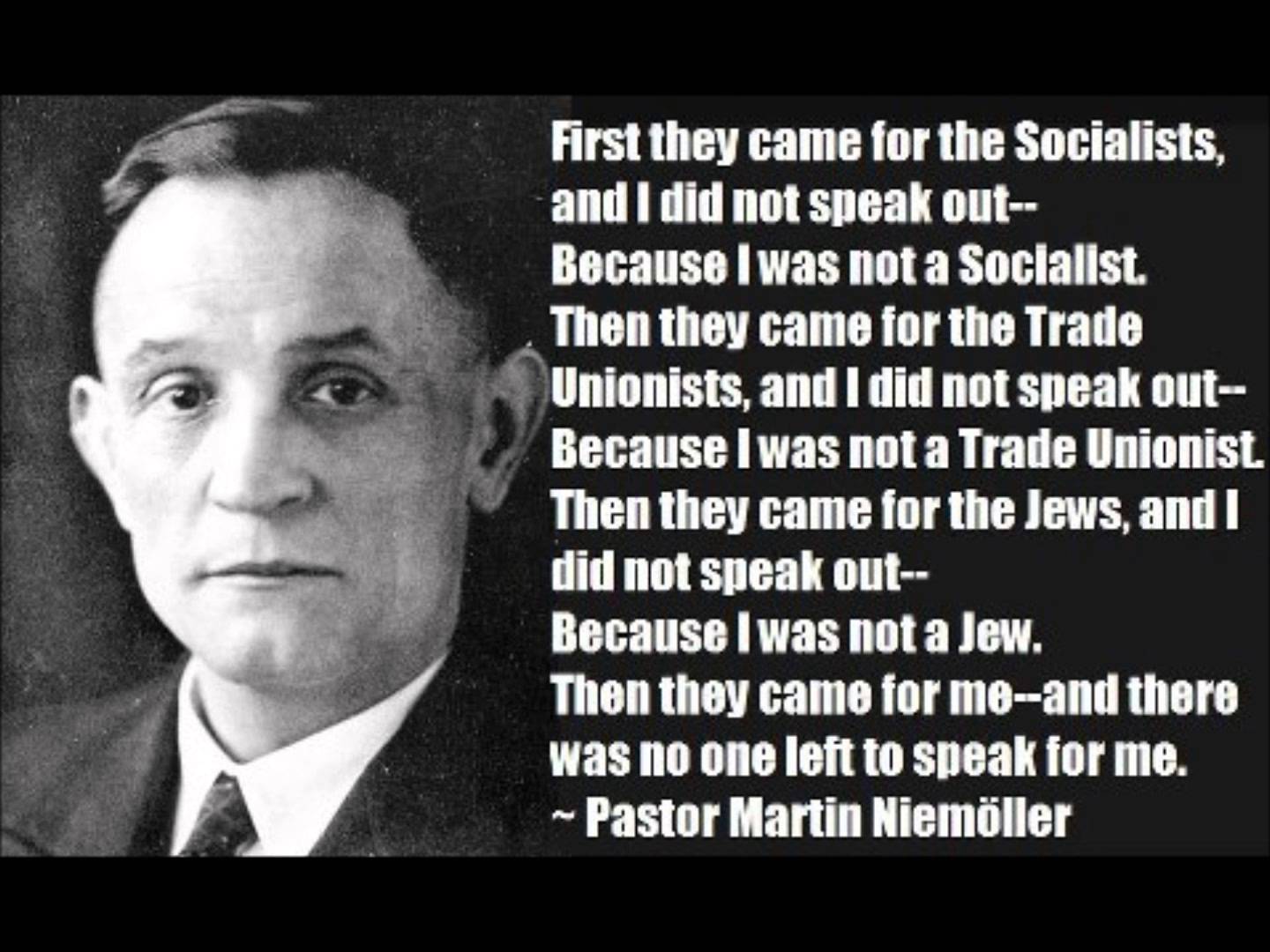
Martin Niemoeller’s words are quoted often and have always inspired me, but until recently they were just a nice philosophical abstraction. Never did I dream they would become an honest to God existential warning for me and my contemporaries living in our blessed democracy. I was wrong.

I learned more about Niemoller last year in a biography about another contemporary clergy of his, in “Bonhoeffer: Pastor, Martyr, Prophet, Spy” by Eric Metaxas‎. It was there I realized even as the storm clouds of Trumpism were gathering that Niemoller’s words were a painful confession of his own failure to act out of Christian compassion to save his sisters and brothers from the Nazis until it was too late for them and for him.

Although he is most famous for the quote above Niemoller was taken in by Hitler along with his fellow Germans. “Niemöller’s sermons reflected his strong nationalist sentiment…. Niemöller believed that Germany needed a strong leader to promote national unity and honor. When Hitler and the National Socialist Party emerged, touting nationalist slogans and advocating autonomy for private worship of the Christian faith, Niemöller voted for the Nazis—both in the 1924 Prussian state elections and in the final national parliamentary elections of March 1933. Hitler espoused the importance of Christianity to German nationality and Christianity’s role in a renewal of national morality and ethics (sound familiar?) leading Niemöller to enthusiastically welcome the Third Reich. Niemöller later confessed that even Hitler’s antisemitism reflected a more extreme version of his own prejudice at that time.” It was only much later after Hitler’s fanatical power was firmly entrenched that Niemoller awoke to the error of his ways and became an active opponent of the Nazi terror. He was imprisoned in several concentration camps for 7 years for his opposition until he was liberated by the Allies at the end of the war. (Above quote and more information available in “Niemoller: A Biography,” http://www.ushmm.org/wlc/en/article.php?ModuleId=10007391).

For good or ill I have tried to avoid public statements about partisan politics in my 40 plus years as a pastor. Call it wisdom or professional survival or cowardice, the truth is that the only two times I am aware of that anyone complained about my ministry to church authorities were two times that I could no longer be quiet about political issues and candidates that I felt strongly were in opposition to Judeo-Christian values and principles. We are now again in one of those “if we are silent the stones will shout out” (Luke 19:40) moments when to paraphrase Lincoln, we are engaged in a great struggle to see if “this nation or any nation so conceived and so dedicated can long endure.” That may sound melodramatic, but I believe it to be true.

I will not be one who regrets not speaking up at this critical juncture of history. The racist, nationalistic, xenophobic rhetoric of Donald Trump and Ted Cruz is too much like that of Hitler to ignore it and hope saner heads will prevail. Trump bragged the other day after his victory in Nevada that he “loves uneducated people.” Of course he does. He is leading a war on critical thinking and shouting down rational, civil discourse verbally and with vulgar, shallow Tweets. His Twitter campaign is brilliant in its strategy. No in depth dialogue can occur when utterances are limited to 140 characters.

A friend and I were discussing in bewilderment yesterday how self-proclaimed Christians can support a candidate who espouses in no uncertain terms blatantly unchristian values. We started listing the values Trump trumpets, and I realized it sounded like a recitation of the 7 Deadly Sins of the Roman Catholic tradition. I double checked the list: greed, lust, wrath, gluttony, pride, envy and sloth/laziness. I’ll give him a pass on the last one, but Mr. Trump certainly seems guilty as sin on the other six. It’s one thing for a secular society to embrace “Greed is Good” as a motto but quite another to allow anger and fear to blind oneself to the crass character of a leading contender to become the most powerful person on the planet. No matter how you feel about any other political or social issue, do you really want someone as volatile and undisciplined as Trump having his finger on the nuclear trigger?

The test for being a Christian is not just claiming the label; it is taking up a cross and following Jesus. As we all make these critical political decisions about the future of our world, let us not confuse what the radical right is peddling with the Christian Gospel. Read the parts of Scripture that say: “Pride goes before destruction and a haughty spirit before a fall” (Proverbs 16:18). “You have heard that it was said, ‘Love your neighbor and hate your enemy.’ But I tell you, love your enemies and pray for those who persecute you” (Matt. 5:43-44). “Those who live by the sword will die by the sword” (Matt. 26:52). “Which commandment is the first of all?” Jesus answered, “The first is, ‘Hear, O Israel: the Lord our God, the Lord is one; you shall love the Lord your God with all your heart, and with all your soul, and with all your mind, and with all your strength.’ The second is this, ‘You shall love your neighbor as yourself.’ There is no other commandment greater than these” (Mark 12:28-31).

These are critical times that call for acts of courage and faith. As tempting as it seems, don’t just seek a “place to hide away” or fail to learn the lessons of history so we are condemned to repeat them. Niemoller waited too long to speak up, but we dare not be silent.