
There are several things I don’t like about going to the gym to work out – the effort it takes to get there, the slim and trim young men who make me look bad, and the swimmers in the pool who do laps twice as fast and twice as many as I can. But the number one objection I have to the gym are the mirrors everywhere. They keep showing me this old man looking back at me!! I think he’s stalking me!
Lent and Good Friday do the same thing if we are brave enough to look in the mirror. 40 days ago many of us got a smudge of ashes on our foreheads and heard those ultimate words of reality “Remember you are dust, and to dust you shall return.” And now the Good Friday narrative holds poor old bumbling, human Peter up to us as a mirror of ourselves. Peter is the ultimate fallible human being. He is the poster child for St. Paul’s confession in Romans 7:15 where he says, “I do not understand my own actions. For I do not do what I want, but I do the very thing I hate.”
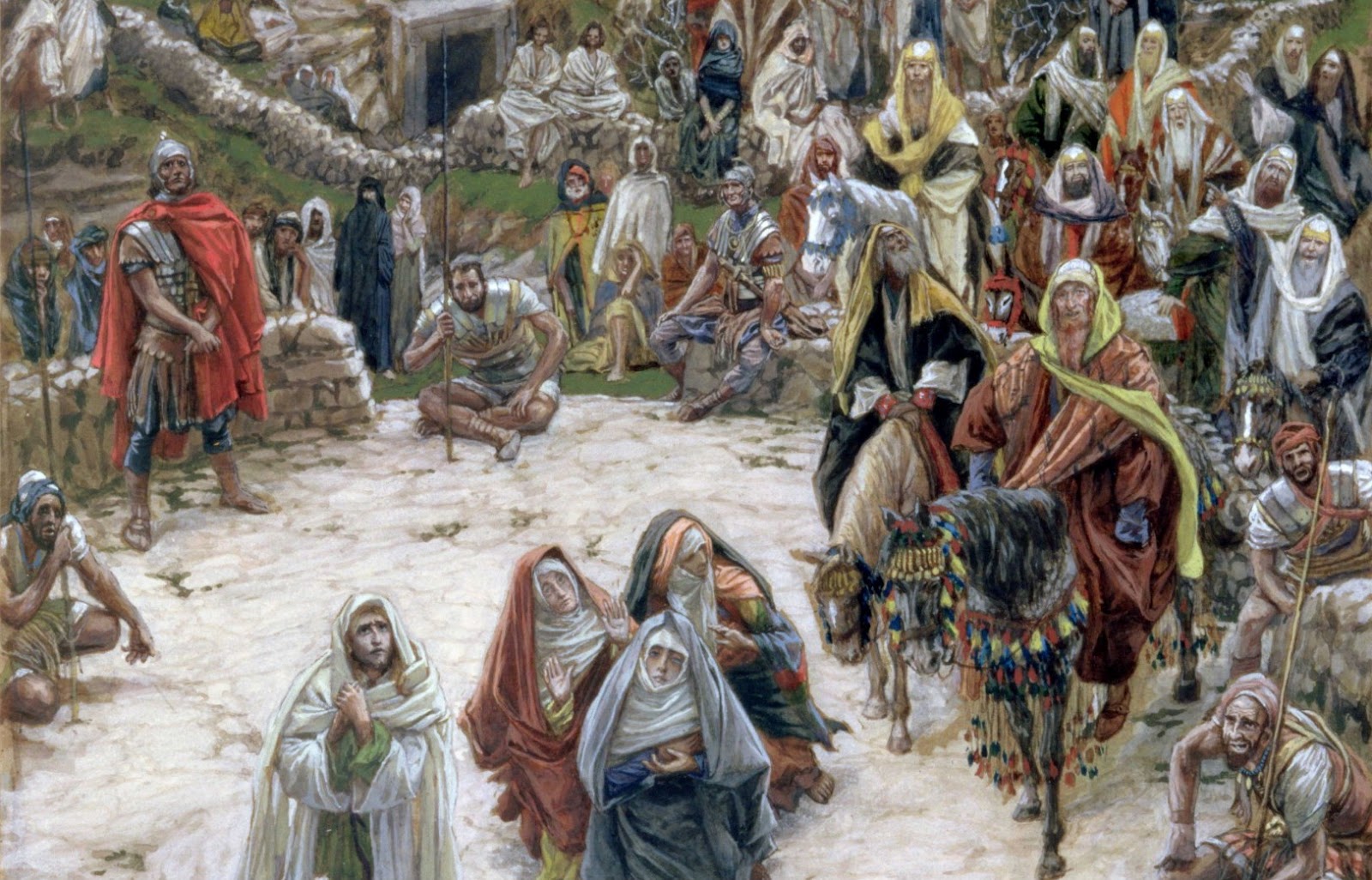
Denise Gorden shared this picture with the Coffee Talk group a few weeks ago. This is artist James Tissot’s depiction of what Jesus’ view from the cross on that dark Friday might have looked like. Last Sunday Rev. Wayne Nicholson reminded us that we often read the Bible to find ourselves in there. Well this picture is a great example of that. Who’s there around the cross? According to John’s Gospel the most faithful and brave ones are up close and personal – three Marys: Jesus’ mother Mary, Mary of Clopas (Mary’s sister-in-law), Mary Magdalene, and John, described as “the beloved disciple.”
Others are there who had cheered Jesus entry into Jerusalem just 5 days earlier – some who have turned against him, maybe out of fear of the Romans, and cried out for Jesus to be crucified instead of the criminal Barabbas. Others who are rubber-neckers who just want to see what’s going on, and some who are ambivalent and curious who just want to see if Jesus is the real deal and might be rescued by a host of heavenly angels.
But it’s also important to notice who’s not there – Peter, and most of the other disciples, unless they’re hiding in the back where the Romans or the religious leaders won’t see them.
Do you see yourself there? What would have brought you to Calvary on that dark Friday? As the choir just asked us, “Were you there when they crucified my Lord?”
But regardless who is there at the cross, there’s one thing we know for sure about everyone, they are all fallible human beings. St. Paul says it plainly in Romans 3:23: “All have sinned and fall short of the glory of God.” All means all; no exceptions. We are all guilty as charged of being fallible human beings, and Peter and the other disciples are the mirrors that remind us, like it or not, that we are among the fallible. We don’t like that role – we want to be heroines or heroes, not examples of fallibility or weakness!
That idea struck me a couple of weeks ago at a meeting of our men’s group called “Men Under Construction,” another way of saying we’re all fallible and God isn’t finished with us yet. Pastor Roger Gorden, who leads that group, described it this way. He said, “Peter gets in the way of Jesus.” Peter gets in the way of Jesus! Isn’t that what we do when Jesus asks more of us than we can or want to live up to? When Jesus says, “Take up your cross and follow me” or “If you love your family more than me you aren’t worthy of me,” those aren’t great recruiting slogans.
At one point earlier in the Gospel story Peter literally gets in Jesus’ way. When Jesus tries to explain to the disciples that he must go to Jerusalem and be crucified, Peter says, “No way, Lord. We can’t let you do that!” And Jesus has to reprimand Peter and tell him, “Get behind me Satan.” That sounds awful, but it’s not if we remember that Jesus doesn’t need or want fair weather friends, he wants brave followers, and in order to follow someone you have to get – that’s right, behind them.
It’s hard to follow someone if we think we know a short cut or easier way to go, and especially hard when carrying a cross.
“Are Ye Able, said the Master, to be crucified with me? Yea, the sturdy dreamers answer, to the death we follow Thee.” All of the Gospels contain the dialogue between Jesus and Peter at the Last Supper where Jesus predicts Peter will deny him, and Peter responds emphatically, “If I must die with you, I will not deny you. And all the disciples said the same.” But when push comes to shove 90% of them aren’t there for Jesus, and Peter says, “No way – not me, I never met the guy.” Not once, but 3 times!
But here’s the deal. We’re not here to judge or blame Peter and the other disciples for what they did or didn’t do 2000 years ago. That’s ancient history. Remember the disciples are in the Gospel narratives as reflections of you and me. They are there to invite us to ask the really hard questions. How do we, you and I, deny we even know Jesus today? When we look in the mirror on the wall what do we see that we try to hide from other people and even from God. Good luck with that one, by the way! What sins of omission and commission gnaw at our consciences when we can’t sleep at night? As Jesus reminds us, we can’t focus on the speck in Peter’s eye when we’ve still got a big old two-by-four in our own.
I identify with Peter because I hate conflict. I will take a five-mile detour to avoid an argument or awkward situation. That’s why Jonah is one of my favorite biblical characters. I can relate. When God tells Jonah to go preach behind enemy lines in Nineveh Jonah hops the first boat going in the exact opposite direction. That would be like one of us getting called to go witness to the people in Tehran today! I’d probably say, “Sorry, God, you’ve got a wrong number.”
OK, let’s consider some more practical, everyday choices we might have to make. One person standing up for someone who is being bullied may stop the cruelty, and even if it doesn’t both the victim and the protector feel the priceless solidarity of friendship. One or two men refusing to laugh at a sexiest or racist joke, or a woman saying no to an unethical business practice can empower others to do the same.
Doing what is right but unpopular is one of the hardest things to do because it puts at risk our own comfort and safety. But what each one of us chooses to do or not do does make a difference.
The familiar quote, “The only thing necessary for the triumph of evil is for good people to do nothing” sums up much of what I’m trying to say. As we all know it takes courage to do the right thing when it is so much easier to go along with the crowd. My favorite quote to describe that is from the play about the famous Scopes monkey trial, “Inherit the Wind”: Defense attorney Henry Drummond says to Bert Cates who is on trial for teaching evolution: “It’s the loneliest feeling in the world to find yourself standing up when everybody else is sitting down.” [repeat]
And to make matters worse, it’s not just individual actions that matter. The mirror here is facing you as a congregation because our collective sins are even more important than individual ones. What’s done in the name of the church, or our government, or any other group we belong to-we bear responsibility for that group’s actions and are called to stand up for what’s right and just and true.
But – we need to shift gears here. Lent and Holy Week are times for soul searching, facing the reality of who we see in the mirror. But the crucifixion and betrayal and denial are not the end of the story and we dare not forget that or we will be overcome with our own guilt and denial. It’s Friday – but Easter’s coming.
Peter denies Jesus 3 times!!! That would be very hard for any of us to forgive! It’s bad enough if a friend, a best friend, like Peter was, betrays us once, but 3 times? How could anyone forgive that! But Jesus isn’t just anyone. When this same disciple, Peter, asks Jesus earlier in Matthew’s Gospel how many times he should forgive someone who sins against him, as many as 7? Jesus says no, 70 times 7.
And of course Jesus practices what he preaches. He not only forgives those who nailed him to the cross; he also forgives poor old Peter. I don’t want to steal the thunder of any Easter sermons, but you already know this; so I don’t think it’s a spoiler alert. Remember it is Peter who is the one Jesus designates as the Rock upon which he will build his church! Peter, the denier, the stumbling block – Peter who is the stand in for us in the Good Friday story, the reflection of our own faithlessness. Yes, that Peter is ultimately the redeemed and forgiven one – just like you and me
Do you remember the line from Snow White – “Mirror, mirror on the wall, who’s the fairest of them all?” The wicked queen keeps asking the mirror the same question because she never likes the answer she gets. The mirror keeps telling her the fairest is Snow White. Likewise we often don’t like what we see when we honestly examine our lives in a spiritual mirror.
Mirrors don’t lie. So Peter’s multiple failures on Good Friday can be an important time of growth on our faith journey if we are brave enough to really see ourselves reflected in Peter. And here’s the good news –we can look in the mirror and see only our faults and shortcomings, our fallibility, our mortality – OR we can look deeper and also see the very one Jesus is counting on to build the kingdom.
Why does God choose the likes of us to build the kingdom? Because fallible human beings are all Jesus has to work with. So tonight and tomorrow we mourn our own guilt and responsibility for denying Jesus, but on Sunday we will rise with him to begin anew the absolutely critical work of following Jesus to the cross. We can do that because when we get behind and follow a risen Savior our faith is stronger than our fear.
Please pray with me:
Dear Creator and Sustainer of all that is good, just, and true, we are living in very sad times. The foolishness of war is robbing your neediest children of food and health care here at home and raining terror and destruction on the Middle East. You have called us to love our neighbors and our enemies. You have taught us that a few courageous people can make a difference. Give us courage to stand up when no one else can or will. Renew a right spirit within us. Show us how we can most faithfully be among those who refuse to deny you. Keep us near the cross and the one who died there for the Peter in all of us. Amen
Northwest United Methodist Church, April 3, 2026

