Where Oh Where is God?

As I have been shaken by the Texas flood tragedy this week my mind has wandered back to all the times I was responsible for a group of young people at camp or on mission trips. I keep wondering if I would have had the courage, composure, and strength to help save those children and youth entrusted to me by their parents if I awoke in a horror movie of rushing flood water filling our cabin?

I hear people asking as I do where is God in tragedies like this? Why did God let this happen? Why does God let cancer, war, and gun violence destroy innocent lives? Of course, I really don’t know any definitive answers to those age-old questions scholars categorize as theodicy, i.e. how do we explain how an all-powerful, loving God allows evil and suffering to exist in the world.

My answer for this week is that God is not a helicopter parent who swoops in to protect and prevent anything bad from happening to us, God’s children. There comes a point in every parent’s life where you have to let your children make their own mistakes and suffer the consequences. No amount of advice or warning or sharing our own past failures will stop a grown child from blazing their own path.

God has gifted us mortals with free will. Oh how many times I have wished I could return that gift which has allowed me to screw up so many times by pursuing my own pleasure, desires, and goals instead of a higher path.

I’m sure there were many times God wished people would not house innocent young girls in cabins on a flood plain. I’m sure God would have wanted and may have urged people in positions of authority to better prepare for floods like those on the Guadalupe River last week. I’m sure God shook her head in dismay when arguments prevailed that sirens and warning systems were too expensive.

I heard on the news tonight that some people who regularly camped in RV’s along the Guadalupe ignored warnings of potential flooding last week saying, “It floods here all the time.” Basing present precautions on past experience can be dangerous. We don’t live in pre-climate change times, and those of us who trust science know that we are living in a new normal where extreme weather events are more frequent and much more severe.

There will be finger pointing and blaming and many law suits filed because of this tragedy. None of those things will bring back any of the victims or ease the trauma of the survivors. The only redeeming quality of this disaster is that our free will enables us to learn from our past experiences. We can ask what would have helped make this tragedy less horrific? What needs to be in place to prevent or limit future flooding occurrences and to improve rescue and recovery operations?

Where is God in all this? Not zooming in like a master puppeteer to prevent the consequences of poor free will choices; not picking and choosing who will survive and who will not. No, God is there comforting those who mourn, weeping with those who sob uncontrollably, and giving strength to the brave first responders and volunteers who are doing the horrible/wonderful work of searching for those who are still missing.

God is there offering hope to the hopeless, absorbing the hate and pain of the angry, and sitting peacefully and patiently with those for whom there simply are no words – at least not yet.

“The Lord is close to the brokenhearted and saves those who are crushed in spirit.” Psalm 34:18

Happy Motherly God‘s Day

My home of origin in the 1950’s and 60’s was a very traditional patriarchal family. And the church family I grew up in was likewise dominated with patriarchal theology and structure. I can’t go back and change any of that, but I regret that my foundational values and theological constructs were void of any feminine images and qualities.

This reality for me was complicated by a strained relationship with my father. My dad survived a painful childhood with an abusive, alcoholic step-father and a near-death experience as a 24 year-old pilot in World War II. No one had discovered PTSD in those days, but I’m sure my dad was a classic case. He compensated by living by a very strict and literal adherence to conservative theological and cultural norms.

I never questioned my father’s love for me, but it always felt conditional on my living up to his high expectations and obedience to his rules. Theologically for me this meant the patriarchal image of God was filtered through my relationship to my earthly father. It never occurred to me or anyone in my circle of influence to question the God as Father theology I learned at church.

One of my regrets about this is that I felt much more comfortable with and closer to my mother but had no model for seeing her as the image of God. She was a good subservient wife as was expected in the culture we lived in, but there was also a quality of unconditional love and acceptance about her that was lacking in my dad. If I had a problem or screwed up, as I did often, I would always go to my mom and confess because she would calmly help me deal with the situation where my dad would either verbally or non verbally convey disapproval. That’s who my parents were. There’s no judgment in that now, although there was for many years as I tried to liberate myself from the conservative world my dad lived in.

My point here is that I wish someone had suggested to me that God is also an expression of the maternal, loving qualities we rightly or wrongly have attributed to the feminine. Because no one dared to think outside the patriarchal box I lived many years of my life with a fear of a judgmental God. And the larger church and even the liberal seminary I went to in my early 20’s was still a prisoner to the male-dominated images of God.

The entire faculty and 96% of my seminary class were white males. That began to change dramatically in the 1970’s after I graduated as women and people of color were added to the seminary community. That’s wonderful, but I missed it! I worked with several great senior pastors in my ministry, but again all white and male.

Finally in the early 2000’s when I was about 60 years old I joined a congregation with a wonderful, creative, vibrant female pastor. I went on to work part-time in retirement with her and other women, and it has opened a whole new world of theological depth and understanding to my image of the divine as full and inclusive of all of God’s creation. I still am blessed to hear the word proclaimed many Sundays and Holy Days from a unique female perspective. Most of the current devotional and theological blogs, podcasts, and books I have benefited most from in the last few years are created by female writers, pastors, and theologians.

And so this Mother’s Day I am giving thanks for all the women who have helped shape my life. Grandmothers, mother, aunts, colleagues, friends, wives, preachers, political leaders and more. Let’s celebrate that special capacity so many women have to nurture, soothe, love, and bless us with those God-given qualities the world so desperately needs right now.

OMG: Good Friday Sermon, 2025

OMG – a common abbreviation used these days on social media and many users don’t know it, but it’s really a prayer, a lament.  It means “O My God,” and in our Good Friday context the emphasis is on the little word “My.”  Because even when we doubt and feel God is absent, we still own and affirm the relationship. My kids are still My kids even when they do stupid stuff I don’t agree with – same with friends, spouse, and colleagues.  Real relationships and friendships have no expiration date, and certainly there is none with the eternal God of all creation who has been with us since the day we were born and will be with us for all eternity after our short sojourn on this earth is over.  

Another common lament today is “Life sucks and then you die!”  That one is not in the Bible, but it could be in the book of Lamentations. When Jesus says from the cross, “My God My God why?”  Hear the My and not just the forsaken.  And of course the lament of Psalm 22 is followed immediately in our Bible by the most familiar Psalm of the whole 150.   Psalm 23 begins with “The Lord is MY shepherd.”

As we remember the brutal crucifixion of Jesus tonight I invite you to make that experience real.  Feel it in your gut.  Imagine or remember a time when you were in unbearable pain – either physical or emotional, and Jesus was certainly in both – a time when God feels as far away as the planet Pluto – at the death bed of someone you don’t think you can live without – when you hear a terminal diagnosis from a doctor – or your heartbreaks over a shattered relationship, or a job loss, or your financial security disappearing, or hearing on the news about unspeakable human cruelty.

Holocaust survivor Elie Wiesel in his book “Night” relates an incident when he was a prisoner in a Nazi concentration camp when a young man was hung and all the other prisoners forced to watch.  Someone asks Wiesel, “Where is your God?” and his answer is, “Right there on the gallows.” Whatever and whenever we suffer God suffers right along with us.

One of my favorite descriptions about human lament is the one Brian and Barbara just sang for us, “Day is Done,” by Peter, Paul, and Mary.  I asked for that song because of these lyrics which say, “Tell me why you’re crying my son; I know you’re frightened like everyone. Is it the thunder in the distance you fear? Will it help if I stay very near – I am here.” And if you take my hand my son, all will be well when the day is done.”

We really want to believe that “all will be well when the day is done,” but we don’t know how long that metaphorical day will last or if we can last that long. But what we do know is that it helps to have someone very near.  It helps to be able to share out loud what our pain is with someone we trust and know will listen and just be present as long as we need them. 

I just learned about a quote from Fred Rogers recently in our Books to Bridges book group.  Mr. Rogers said, “What is mentionable is manageable.” “What is mentionable is manageable.”

Pain that we try to carry alone can suck the very life out of us, but if we can talk about it the power it has over us is shared and diminished – it becomes manageable.

Another lament in Psalm 13 begins with these plaintive words: “How long, O Lord? Will you forget me forever?   How long will you hide your face from me? How long must I bear pain in my soul and have sorrow in my heart all day long?”   The point in sharing these cries for help is not to depress us but simply that it’s OK to lament, to doubt; those feelings are part of the human condition. No matter how strong your faith is it is hard when the foundations of your existence are shaken like an 8.0 earthquake.  Even Jesus who had more faith than all of us put together cries out “My God, My God, why have you forsaken me?” which is even more powerful in the Aramaic that Jesus would have spoken: “Eloi, Eloi, lema sabachthani?”    

And as you heard in our scripture from Psalm 22 tonight we know where Jesus got those words.  Jesus knew his Scriptures very well, and he knew his people for centuries had been no strangers to devastating loss.  They were experts at lament.  We even have a whole book called Lamentations in the Hebrew Scriptures, which is our Old Testament, devoted to nothing but laments.  And part of the prophet Isaiah’s description of God’s Messiah is that he is a suffering servant who “… was despised and rejected by others; a man of suffering and acquainted with grief.”

Ps 22 is typical of another source of laments the Hebrew people used in public worship. Do you know that there are more psalms of lament in the book of Psalms than any other type of Psalm? One of my favorites when I’m having a no good, terrible, awful day is Psalm 130.  It’s called “De Profundis” in Latin and says, “Out of the depths I cry to you, O Lord.  Lord, hear my voice! Let your ears be attentive to the voice of my supplications!”  Out of the depths loosely translated means “we are in deep do do.”

Psalm 63:1 echoes the same song: “O God, You are MY God; early will I seek you; my soul thirsts for You; my flesh longs for you in a dry and thirsty land where there is no water.” I’ll bet most of us have been in such a dry and thirsty land or may even be there right now.  That’s the message of Good Friday.  I still remember vividly one such time in my youth.  It was my Boy Scout Order of the Arrow initiation.  I was maybe 13. I was led out along with my fellow scouts in total silence and darkness until I was tapped on the shoulder and told to stop and sleep right there, left alone in a strange, dark woods overnight with only a sleeping bag. I had no idea if anyone else was close by or where I was. It was the most alone I had ever been at that stage of my life

Kate Bowler, one of my go to devotional sources, wrote this blessing two years ago in 2023, but it is even more relevant today and is part of her Lenten devotions for 2025. 

It’s called “A Blessing for when you need a little hope.”  “These days feel heavy and dark, like hope packed up and left, and forgot to send a postcard. We cry: Where are the good things? And honestly, where are the good people— the sensible ones fighting for what matters? Why does it feel like bad stuff always elbows its way to the front, pushing everything good to the sidelines? We’re tired. Exhausted, really. Desperation is knocking, and it’s tempting to surrender. Blessed are you, who see the world as it is: the sickness and loneliness, the injustice that never seems to end, the greed and misuse of power, the violence and intimidation, the mockery of truth, and disdain for weakness, and worse— the seeming powerlessness of anyone trying to stop it. Blessed are you, worn down by hard-earned cynicism, running on fumes, with no promise of a destination. Maybe hope isn’t so distant. Maybe it’s there—small, persistent, and stubborn. May you grasp something in the heaviness. A glimmer of what could be, and walk, step by step, toward the possibility that goodness exists. Hope is an anchor dropped into the future pulling you forward, toward something better— even if it doesn’t feel like it right now.”

Yes, my friends, there is always hope somewhere.  Even “O My God, My God” still claims God as ours.

 This Good Friday feels more real to me because we are living in a time of great uncertainty in our country and our world.  No matter what your politics you know these are unsettling times.  But we aren’t the first to feel this way.  The women at the foot of the cross and the other disciples hiding out somewhere had no idea what their future held – and neither do we.  I invite you to put yourself in the crucifixion story – pretend we don’t know what happens on Sunday morning, and enter fully into the forsakenness of that moment with Jesus and his followers and friends.   

What do we do when life seems hopeless, empty, dark, alien, and full of fear and uncertainty?  Like Jesus we can call out “O My God, help us!” and God will answer.  Maybe not immediately; we may have to go through a long Saturday of uncertainty, as long as that Saturday lasts, but there will be an answer because God does not forsake us, just as God did not forsake Jesus.

Even here in the darkness we remember that God so loved the world that God sent Jesus to love and save us. When all else fails it is that love that is eternal.  God so loved the world, and as author Sarah Bessey says, we are called to love that world too and everyone in it, even, Sarah says, knowing that it will break our hearts – knowing it will break our hearts.  To love means risking, being vulnerable, feeling pain — but a broken heart is so much better than not having a heart at all. 

Good Friday 2025, Northwest UMC, Columbus, OH

ICU LIFE LESSONS

Three days ago I quite unexpectedly began a crash course in life lessons I didn’t sign up for. Thanks to dangerously low blood pressure and low Hemoglobin I became so dizzy at home and unable to stand that I earned myself a first-ever ride in an ambulance. That bumpy ride landed me two other firsts —two nights in ICU and a first time blood transfusion.

Quite a day and night, and I’m happy to report that within 24 hours and after some bleeding ulcers were discovered and treated I made a remarkable recovery. I am writing this from a regular hospital room just under four days after it all began and am processing it all by trying to capture and share some of what I’ve learned.

First and foremost I have been amazed and humbled by the outpouring of love I’ve felt from family and friends. The hospital EMT’s and hospital staff have been fantastic. I expected that, but am still beyond grateful for how dedicated and wonderful they all have been, and some of what they had to do for me was quite frankly disgusting.

What blew me away however has been the constant stream of visits, texts, and phone calls from family and friends concerned about my welfare. My dear wife, Diana, has been a rock, and I can never repay her for the hours she has spent with me and so thoughtfully brought me things from home that I might need. I can’t imagine going through something like this without her. I hope I will never take her for granted, but I also know we have pledged to care for each other in sickness and in health. It’s a covenant we made with each other 22 years ago, and one we take very seriously.

But it takes a village to hold up the most loving care giver. And that’s where I am in awe at how large and strong my village is. I am not bragging. I am so humbled because I know I am not as supportive of my family and friends as mine have been for me in the last 96 hours. For example, it is about a 30 minute drive from my house to Riverside Methodist Hospital in Columbus, Ohio. I was not in crisis; so my ambulance ride did not feature high speeds or sirens.

I was however in bad enough shape that I was taken immediately into treatment once we arrived at the ER. That was a blessing, but even more so was that within the first 20 minutes I was in the ER in walked my beautiful 25 year old granddaughter. Her mother called her because she was the closest family member to my location, and she was able to leave work and come sit with me during that scariest part of my journey.

It was a powerful reminder to me of how important a ministry of presence is. Olivia was simply there for me, and her maturity and calm demeanor was contagious. She asked questions I didn’t think of and just was an extra pair of eyes and ears for me.

And much to my wondering eyes other family members just kept showing up. Within my first hour in the ER my village blossomed to include my daughter (who is herself recovering from painful foot surgery) and son-in-law, along with their two sons (my grandsons). And to round out my entourage a nephew by marriage who is a surgical nurse at Riverside dropped by to add his medical knowledge and expertise.

They all stayed around until I was admitted and situated in an ICU room and have all been back or called/texted me every day since. And so has my son who was not able to join the welcome party that morning but came to visit with his wife that first evening.

I knew I was loved by my family before Thursday, but quite frankly we don’t always show that love as much as we could. My family members are all very busy people, and it is easy to feel sometimes like we oldsters are not a priority for them; but they have showed me in no uncertain terms this week that when they are needed the most they are there.

Humility. I know everyone jokes about how you surrender your dignity when you become a hospital patient, and that’s true. The first thing the nurses did when I arrived in the ICU was remove every stitch of the clothing I came in with. They wiped me down with baby wipes, and I use that term because I felt like a helpless baby. And that feeling came through even more strongly that night when my bowels did their thing all over me and my bed before I had time to even realize what was happening.

The staff calmly cleaned me and my mess up as if they do it every day, and likely they do. And then it happened again a few hours later, and I was really embarrassed. When I apologized they simply said, “that’s what we’re here for.” What gracious and loving servants!

We are all just a minute away from such a reminder of how interdependent we are. Being helpless and needing assistance with even the most basic of bodily functions is nothing to be embarrassed about. It is part of the cycle of life and our human condition.

I know that my situation here has been nothing compared to people who are battling life-threatening diseases and injuries, but the lessons are similar. I also know I am very privileged to have access to excellent medical care which far too many of my fellow citizens do not have. Those are the sisters and brothers we all have who need us to be their advocates and village members who demand a just and universal health care system.

We are our sisters and brothers keepers, and I will emerge from my experience not just healed of my physical symptoms but with better empathy and awareness of how I can pay forward the wonderful care I have received.

Thank you my dear village.

Pastoral Prayer, June 9, 2024

O Holy God, our Emmanuel.  Here we are in June, about as far from Christmas as we can get; so it seems a good time to remind ourselves that you sent Jesus to us, not just at Christmas, but forever as Emmanuel, which means “God with us.” Sometimes when we need you most, God, we forget you are with us always – on the mountaintops and in the valley of the shadow, when the pain is so bad we don’t think we can stand it anymore, there you are at our bedside.

When we are afraid the storms of life are going to drown us, there you are napping in the back of the boat waking to tell us “Peace, be still; I’ve got this.”  When our legs are so tired we can’t go another step, you carry us.  When it feels like the world is going to hell in a handbasket, you’re right there in the basket with us.

The Psalmist says there is no place in all creation we can flee from your presence.  You’re up there with the astronauts in the Space Station showing off your breathtaking creation.  And if we visit Mars or other planets, you’ll be waiting there for us, too. Even when things are going great and we’re tempted to think we don’t need you, you wait patiently in the wings like a mother hen ready to take care of her chicks.

Forgive us, Holy One, when we forget you are our constant companion and friend.  Life is hard at times.  That’s why we need times of worship and prayer to feel the peace that surpasses anything else life can offer.  How can we thank you, Lord?  We certainly don’t deserve your unconditional love and grace!  We just pray that you will speak to each one of us right now and assure us that whatever cares or concerns are on our hearts just now we do not have to deal with them alone. 

And so we praise you for your presence.  We ask that you show us how to be that same presence with others.    And we thank you most for sending the one called Emmanuel to show us how to live and how to conquer even death itself.  And so we pray together the prayer he taught us to pray. 

O Holy God, our Emmanuel.  Here we are in June, about as far from Christmas as we can get; so it seems a good time to remind ourselves that you sent Jesus to us, not just at Christmas, but forever as Emmanuel, which means “God with us.” Sometimes when we need you most, God, we forget you are with us always – on the mountaintops and in the valley of the shadow, when the pain is so bad we don’t think we can stand it anymore, there you are at our bedside.

When we are afraid the storms of life are going to drown us, there you are napping in the back of the boat waking to tell us “Peace, be still; I’ve got this.”  When our legs are so tired we can’t go another step, you carry us.  When it feels like the world is going to hell in a handbasket, you’re right there in the basket with us.

The Psalmist says there is no place in all creation we can flee from your presence.  You’re up there with the astronauts in the Space Station showing off your breathtaking creation.  And if we visit Mars or other planets, you’ll be waiting there for us, too. Even when things are going great and we’re tempted to think we don’t need you, you wait patiently in the wings like a mother hen ready to take care of her chicks.

Forgive us, Holy One, when we forget you are our constant companion and friend.  Life is hard at times.  That’s why we need times of worship and prayer to feel the peace that surpasses anything else life can offer.  How can we thank you, Lord?  We certainly don’t deserve your unconditional love and grace!  We just pray that you will speak to each one of us right now and assure us that whatever cares or concerns are on our hearts just now we do not have to deal with them alone. 

And so we praise you for your presence.  We ask that you show us how to be that same presence with others.    And we thank you most for sending the one called Emmanuel to show us how to live and how to conquer even death itself.  And so we pray together the prayer he taught us to pray. 

Northwest United Methodist Church, Columbus, Ohio

Where’s the Justice?

Election Day, praying for my tribe to win as much as possible even as I fear the dangerous person just elected Speaker of the House and the Trump circus in a New York court room. Trump has succeeded in taking the media spotlight off the mayhem in Gaza, but the slaughter continues there and elsewhere. A mass shooting in Cincinnati recently barely made the news.

We are having new skylights installed today while millions of people have no roof over their head at all. Where is the justice?

My privilege feels like a millstone tied around my neck, even while I resent working for hours on end the last two days to maintain our wonderful home.

I get wonderful medical care for my puny aches and pains while hospitals are bombed in Gaza. Where’s the justice?

I simply turn the tap and open the fridge whenever I thirst or hunger while millions of climate refugees and war victims around the world are starving and dying. Where’s the justice?

By accident of birth I am a privileged white male in a relatively safe and prosperous nation. My ease and comfort are as undeserved as the suffering of innocent Israelis and Palestinians and Ukrainians is unjustified. Where’s the justice?

If I thank God for providing so bountifully for me and my tribe anyone can see the irony that all these others of God’s children who pray to the same God still suffer so horribly. I am not some worthy saint being rewarded for my good behavior like a school boy getting gold stars for what we used to call “deportment.” If I am graded on keeping the 10 commandments or living by the Boy Scout Law I learned as a youth you better believe I hope God grades on the curve. Where’s the justice?

As we Christians paused ever so briefly this week to observe All Saints Day our grief and memories of those who have passed beyond this mortal coil are tied to the deaths of all those unknown to us but known to God souls lost in recent days to the madness of war. Nadia Bolz-Weber said it so well in her sermon for Sunday, “You’re going to die:”

“The untimely and unnecessary deaths of 10,000 children of God, many of whom are actual children, in just that one tiny area of our planet in one month’s time ripples out into an ocean of grief for the 100,000s of thousands who know their names…their babies, and brothers and wives and friends.

This is their day too.

So as we remember our own dead, may we feel connected to the sorrow of those who are also grieving today. And say as our lord did, Blessed are they who mourn. Blessed are they who have loved enough to know what loss feels like.”

I had never thought about grief as a blessing even though I have read those words from the Beatitudes dozens of times. “Blessed are those who mourn.” My thoughts always jump to the second half of that verse “for they shall be comforted.” Yes, we yearn for our own comfort and those of others. But there is no comfort without grief, just as there is no resurrection without death. So in one of those theological twists of fate there is gratitude even for pain. If we could not feel the pain of grief, even for people 10,000 miles away, we also could not feel love and appreciation for our privilege.

I do not deserve my comfortable life any more than the trapped citizens of Gaza deserve the horrors of modern warfare, any more than the 1400 Israelis deserved to die on October 7, or the 6,000,000 Jewish victims of the Holocaust, or the 3000 Americans deserved to die on 9/11. All of that reminds me that life itself is a privilege to be cherished and lived to its fullest no matter where we have landed by accident of birth on this fragile planet.

May our gratitude for what is take the wings of mercy to act as those who do justice here and now, who love mercy wherever we are planted, and through it all walk humbly and gratefully with the One who gives it all and who alone can fathom the mystery of life and death in our broken and unjust world.

First Sunday in Advent

The first Sunday of Advent comes before the Thanksgiving leftovers are consumed to remind us again of the cares of a weary world. Most of us are more stuffed than our turkeys, and yet we know millions of our sisters and brothers have nothing to be thankful for. We are moved by that suffering and do our best to share out of our abundance; but we wonder if it will ever be enough.

As we prepare our hearts to receive the Christ child this Advent, let us rely on the Scriptures to renew our faith: Words that say, “Comfort, comfort my people” to God’s children in exile. Words that say, “Come to me all who labor and are heavy laden, and I will give you rest.”

Lighting one little candle seems so futile to our weary minds, but we dare to light it again this Advent, not because of the tiny light it gives off, but because of the hope it ignites in our hearts. We dare to be hopeful in a weary world because of a helpless peasant baby who emerges from the darkness of Mary’s womb to become the light of the world.

We know that the world’s cares and woes will pass away, but God’s word of hope will never die. And so today we stand up and raise our arms to light the candle of hope because we know that only in the strength of Christ can we survive these trying times and stand before God as redeemed people of hope. [lights candle]

And so we pray, Holy God, we come humbly to this season of preparation, not asking for the rest of the wealthy and privileged, but rest for our weary souls. We are are distressed and confused by cosmic warning signs of climate change. We are worn out from years of pandemic and paralyzed by partisan political warfare.

We are exhausted from playing the consumption game of our consumer Christmas culture, and frustrated by supply chain issues we can’t comprehend or control. We fall on our knees, O God, for we know that only the humble can hear the angel voices. Hear our prayers, we ask, during these dark December days that lead to great joy to the world. Amen

L’chaim! To Life!

Yesterday morning I woke up in great anticipation. After being in a lot of pain in my back and hip for weeks I was scheduled to get an injection that might give me some relief. There were several inches of new snow on the ground, and most schools had cancelled classes for the day, but I figured that by afternoon when my appointment was the roads would be clear.

And then the phone rang. My doctor’s nurse was calling to tell me the doctor could not make it in, and my appointment would have to be rescheduled. Making matters worse the doctor only does these injections on Tuesdays; so I would have to wait an entire week.

To say I was very disappointed would be an understatement. My long-suffering wife would tell you that I am usually a glass half empty guy, and this unwelcome surprise did not help my general level of frustration with health concerns, COVID restrictions and all that entails.

But then a minor miracle happened, and I can’t explain it, which I guess is true of all miracles. I was looking at my sad sack face in the bathroom mirror, and suddenly out of nowhere I started singing some of the lyrics to “L’chaim” from “Fiddler on the Roof.” No one else was home fortunately, or my embarrassment over my poor singing voice would have probably stopped me from expressing an emotion of joy and optimism.

I haven’t seen or heard “Fiddler” for decades, and when I do think about that musical I usually think about the title song or “Tradition,” or “Do You Love Me?” But from somewhere hidden away in my memory came these words, and there I was singing as if no one was listening, “L’chaim, l’chaim, to life.”

I don’t know all the lyrics to that song so I ad libbed the words I remembered:

“May all your futures be pleasant ones, Not like our present ones; Drink, l’chaim, to life. To life, l’chaim, L’chaim, l’chaim, to life!”

“To us and our good fortune, Be happy, be healthy, long life! And if our good fortune never comes, Here’s to whatever comes; Drink, l’chaim, to life!”

I don’t know what to make of that except I know it lifted my spirits for the rest of that day. Thinking about the context of that musical set in the midst of oppression of the Jews by the Russian authorities put my minor problem of waiting a week for my injection in its proper perspective.

The characters in this wonderful musical are being forced to leave their beloved village of Anatevke for parts unknown. And the lovable protagonist of the drama, Tevye, is trying to cope with a shaking of the foundations of all his traditions as each of his daughters pushes the envelope further to claim her freedom.

And yet in the midst of all this disruption and change the men of Anatevke break into song to celebrate the arranged marriage of Tevye’s eldest daughter, Tzeitel, to the much older town butcher, Lazar Wolfe.

Spoiler alert: the arranged marriage doesn’t happen because Tzeitel protests and Tevye ends the agreement and lets her marry the man she loves, Motel Kamzoil the poor village tailor. Tevye’s daughters 1, traditions 0.

But regardless of what happens eventually the men in that bar spontaneously singing L’chaim are celebrating much more than one marriage. In the midst of all the unrest and uncertainty imposed on them by the hated Russians these men are still celebrating life.

The people of Anitevke have no idea what tomorrow will bring. Their traditions are being challenged by the younger generation as younger generations always do. And yet they celebrate love and hope in the future by marrying and bringing new life into a world of uncertainty and ambiguity.

We live in such a time right now in our pandemiced and polarized nation, and yet we dare to sing with Tevye and his friends:

“Be happy, be healthy, long life. And if our good fortune never comes’ Here’s to whatever comes. Drink, l’chaim, to life!” Amen

.

Waves of Grief

Once upon many times I have heard/read that grief comes in waves, but I have not fully realized until recently how true that is. In the past I managed to keep myself so busy doing multiple jobs, going to school till I was 48, parenting et al, you get the workaholic picture, that I didn’t allow myself to grieve that much over the deaths of my parents. I buried myself in busyness much as I learned to dive under a wave so it would not hit me full force. Thus I was able to keep grief at arm’s length.

My mom died much too young 27 years ago this month and my dad just two years ago. But now I am a stage of life where lots of friends and colleagues are dying regularly, people much to close to my own age. Combine that with living in the suspended animation of 2020 while retired and I have more time to let those waves of grief come ashore.

I had two such experiences in the last two days. Yesterday I participated in a virtual gathering of clergy from our West Ohio Annual Conference. I confess I have not attended many of these annual clergy sessions since I retired, but since I could do so this year from the comfort of my home office I decided to “attend,” if only to see how the technology worked. And it did amazingly well, and attendance was at a record high; which may lead to a new way of conferencing post-pandemic.

This clergy session is where people are approved for ordination and at the other end of the spectrum for retirement. I had forgotten that the agenda also includes recognition of clergy members who have died in the past year. I didn’t know any of the new ordinands, but I certainly new a lot of the names on the list of those who had died, including my dear friend and mentor Russell Sawmiller who I wrote about when he died earlier this year. When those names were read and prayed for, a mini-wave of grief washed over me. It made the deaths more real to see them there in print. Obituaries do the same thing for me.

This evening I got a note on Facebook from a woman I didn’t remember, and when I asked how we knew each other she said she had worked as a secretary for a short time when Russ and I worked together at Indianola UMC in Columbus, Ohio almost 50 years ago. Darla and I chatted for a few minutes on Messenger, reminiscing about the good times we remember from that chapter in our lives, and when we finished I thought “I can’t wait to tell Russ about my conversation with Darla!” And a big old wave knocked me head over heels as I remembered I can’t go tell Russ anything.

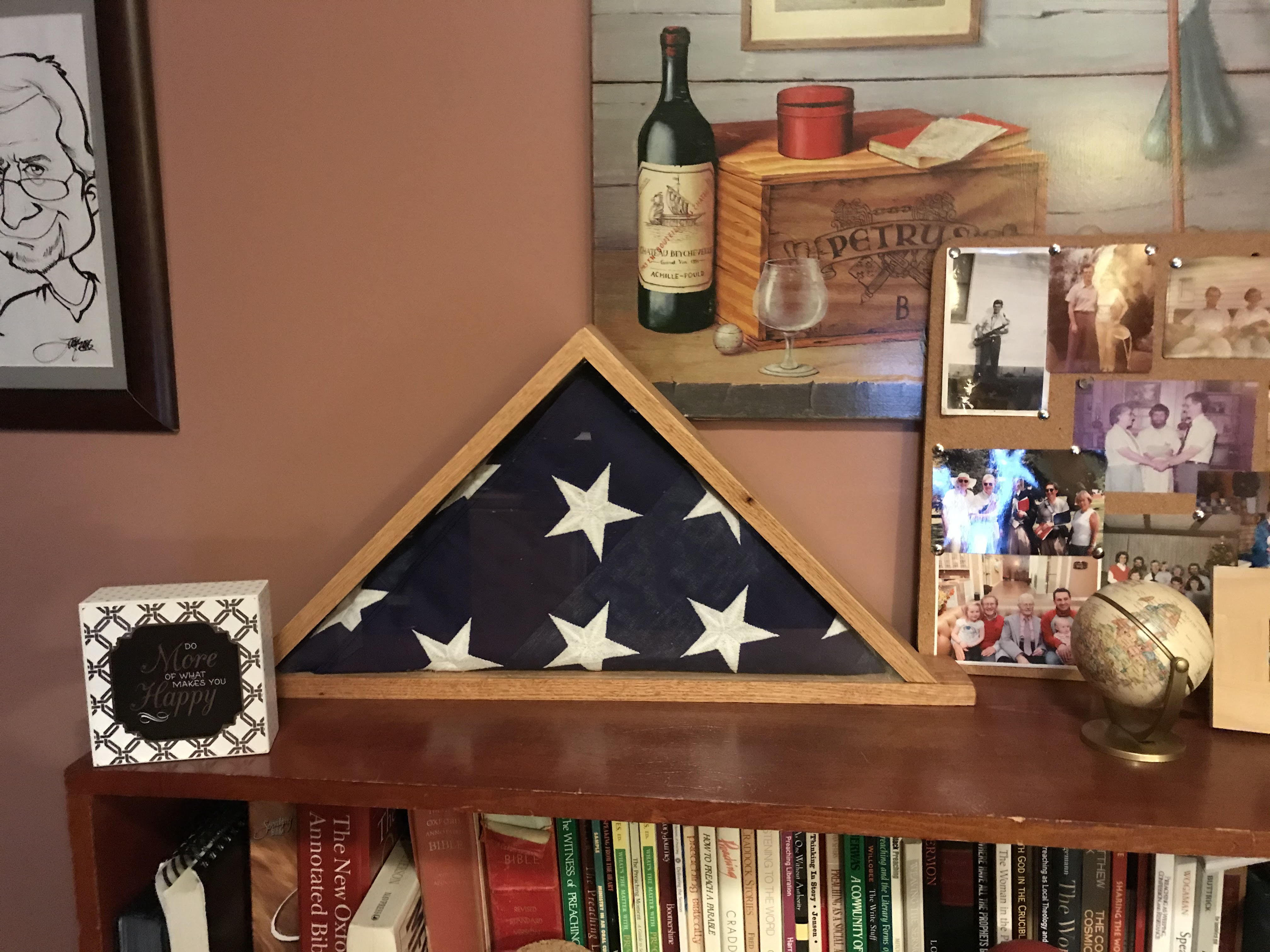
And while I’m on a roll I’ll add another mini-wave incident. I’ve had the flag from my father’s casket for over two years now and it has been in a plastic case provided by the funeral home all that time. A very good friend noticed the flag on a book case in my office recently when we were on a zoom call with a mutual friend. He said he had made wood and glass cases for flags for other people and would like to do one for me. It came via UPS yesterday, and putting the flag in the case and finding some of Dad’s WWII medals in the plastic case all brought up feelings of regret and appreciation for Dad again.

I have spent many vacations near different oceans and have experienced all kinds of waves—gentle ones that just lap at your ankles and angry ones that beat me up and tried to pull me out to sea with strong undertows. When I first thought about writing this post I was thinking more about ocean tides than waves, but I soon realized one major difference. The times for tide changes are so predictable and regular that they are published on charts that tell fisher people and beach goers, back when we could do that, exactly down to the minute when each high and low tide will be on any given day.

Waves are not predictable. They can lull one into a sense of false security, and then when least expected smack you upside the head with a big one. Grief is more like waves than tides. There are certainly times when feelings of grief can be predicted to arise—holidays, anniversaries of memorable events and of the day of death. But more often there are unpredictable waves of grief that just happen—driving by the place a loved one lived, attending the church where a service was held, hearing a particular song, looking at a picture, or just a memory that pops into one’s head uninvited. All of that is normal, and there is no right way to experience those waves or to predict how long they will last.

I knew a woman once who had been told that the normal period of grief for a spouse was two years, and she believed that as gospel. So she expected to grieve for two years, and that became a self-fulfilling prophecy for her. There is no right or wrong way to grieve. It’s great to have people come along side to share the experience when we want company, but each of us has to find our way through the grief journey in our own unique ways. As for me, I wish I had been more receptive and aware of my waves in the past, but I can’t go back and do remedial grief. I can only experience memories and emotions now in the present and welcome them with gratitude whenever they come along and actually choose to pay attention.

COVID COASTER

I know I’ve written about roller coasters as a metaphor for life before (see my post from August 21, 2019), but the emotional dips and twists and turns seem to be more extreme on the ride we call COVID-19. First let me say again that I am now much more a Lazy River kind of guy than a thrill-seeking coaster junkie. Yes, I used to ride coasters, but when I became an adult I gave up childish things, well at least things with names like “Steel Vengeance,” “Wicked Twister,” or “Corkscrew.” Real life is scary enough for me, especially in the midst of a pandemic.

I actually gave up roller coasters and the like many years ago. My junior high youth group back in the ’80’s used to do a mini mission work camp in Southern Ohio Appalachia, and at the end of the trip we would reward the kids with a day at King’s Island, an amusement park near Cincinnati. After several days of scraping, painting or ramp building with rambunctious middle schoolers the last thing we adults wanted was being tossed about on a coaster. So while the kids rode the rides we adults would find a show to watch or simply sit and people watch.

But the highs and lows on the 2020 COVID Coaster are bigger than anything we’ve experienced. It’s a rogue ride on steroids. Sometimes we can’t even see the bottom as we free-fall. And this ride seems to just keep going without an end in sight. The best thing about real roller coasters is that the ride doesn’t last very long. Not so with the emotional ups and downs of this Twilight Zone existence today.

I am thinking about this because I’ve been a very low emotional state for the last few days.
Here’s how I described my depressed mood to a trusted friend and colleague on Messenger the other day when he asked me what I thought the future holds for sporting events he and I both love. I replied, “I’ve been a funk last couple of days so my projections about any future events would be pretty negative right now. Seems like the recommendations on what to do change daily. Sounds like sporting events may come back without fans at first. I’ve been out grocery shopping and am not encouraged by the number of people I see without masks. If people won’t play by the rules I don’t see how any large gatherings of people are likely to happen anytime soon, and I’m afraid it’s going to come down to my deciding what I think is safe vs things I’d like to do. That’s a tough call, but I think I will err on the side of caution. Have to admit I’m feeling cheated out of things I like to do and knowing I have a finite number of years left to enjoy those things depresses me. As for reading I’ve been doing a lot of escapist stuff and very little of any real redeeming value. Sorry to be a downer. Maybe tomorrow I’ll see things in a more hopeful light.”

I think there are several reasons for that gloomy outlook, including lousy Ohio weather, pandemic fatigue, and the cherry on top of that sundae is the grief work I’m doing for a dear friend and mentor who died a couple of weeks ago. Grief is hard work, and it sneaks up on you unexpectedly in something that triggers a memory that seems to come out of left field. I had a dream last night about something I don’t remember now, but for just a second another friend who died suddenly in January was sitting there on my couch. Grief, as my friend reminded me doesn’t proceed in any predictable linear fashion. The stages of anger, denial, bargaining, depression and acceptance don’t march along like little soldiers but are more like a roller coaster.

And grief takes time. Some of mine now is unfinished grief for my father. My friend Russ who died last week was in his 90’s like my father when he died two years ago. The two of them were nothing alike, but the passing of yet another member of that generation is one step closer to that big drop for me.

How do we grieve in the middle of a pandemic? The normal rituals of funerals and memorial services are on hold. Many people tragically can’t even visit their dying loved ones. Just as we have to adjust and be creative with how we celebrate other rites of passage just now, we need outlets to express our grief and loss of people near and dear to us. We need to also grieve over what this pandemic has taken from us. Those feelings are real, and denial is a stage in the process, not a destination.

But here’s the thing, we also need to know that when the coaster ride drops us over one hill or flips us head over heels in suspended animation, there’s another rise to the top of the next hill with a breath-taking view, and finally there’s a blessed end where the ride stops and we can plant our feet on solid ground once more.

One resource I’ve used to keep me grounded are prayers from a book our lead pastor gave all of us on the church staff this past Christmas. Little did she know how much they would be needed. It’s an old book published in 1981 entitled “Guerillas of Grace,” by Ted Loder. I’ve been just opening the book at random as part of my morning devotions and continue to be amazed at how timeless and relevant these words from 30 years ago are. For example this morning I opened the book to a prayer called “Sometimes It Just Seems To Be Too Much.” The whole first half of the prayer is a litany of how there’s too much violence, fear, demands, problems, broken dreams, broken lives, dying, cruelty, darkness and indifference.

And then Loder says, “Too much, Lord, too much, too bloody, bruising, brain-washing much; Or is it too little, too little compassion, too little courage, of daring, persistence, sacrifice; too little of music, laughter and celebration?

O God, make of me some nourishment for these starved times, some food for my brothers and sisters who are hungry for gladness and hope, that being bread for them, I may also be fed and be full.” (p. 72)

That hit me right between the eyes and convicted me again of being too turned in on myself. It reminded me that when Jesus saw the multitude of 5000, plus women and children who were hungry he didn’t ask his disciples to give more than they had. He just asked for all they had, and it was enough. (Mark 6:30-44)

Loder’s phrase “too little compassion” struck a special cord with me. In recent days and weeks I’ve struggled with being angry at protestors who disagree with the governor’s cautious approach to the virus. I’ve been angry at so many people who aren’t wearing masks when I go to the grocery. Those folks are endangering me and those I love by refusing to do things that have proved to work by keeping the infection and death rate here in Ohio among the lowest in the nation.

But then I remembered something from the Holy Week narrative that has always struck me as perhaps the most remarkable thing the Gospels report about Jesus. Hanging there on that cross in unbearable pain Jesus still had compassion on the very people who nailed him up there, and he said, “Father, forgive them for they know not what they do.” (Matthew 27:46)

All of us riding the COVID Coaster are dealing with different circumstances. But we all have one thing in common even though we may express it differently. We are all afraid. Some of us wear masks because we’re afraid of getting the virus or inadvertently giving it someone else, and some of us don’t wear masks because we’re afraid of losing personal freedom, of being told what to do, or fear of admitting the threat is real. Some of us stay home because of fear while others are motivated by a fear of economic disaster to protest or ignore recommendations. It’s easy to judge and much harder to put ourselves in someone else’s shoes and offer compassion.

Anger is a poison that not only harms others but also the one who is angry. Yes, anger is a natural human emotion. Even Jesus expressed his anger in another cry from the cross when he screamed, “My God, My God, why have you forsaken me?” (Luke 23:34) How many of us have felt that way recently? It’s OK. Notice Jesus didn’t forgive his executioners himself. He was in too much agony to do that because he was fully human. But he knew God could forgive them. He trusted God even when he felt as low as humanly possible.

Have you ever noticed how young the people operating the roller coasters are? They don’t have a lot of life experience. They are probably doing that just for a summer job. We don’t know how long they’ve been on the job or how well trained they are, or if they are upset and distracted about just breaking up with someone. And yet we trust them with our lives!

We don’t know how long the COVID Coaster ride is going to last, but we can trust the one who is ultimately in charge of that ride to bring us to a safe finish.

.