Fourth Sunday of Advent 2025 – Candle of Love

In the beginning, God fell in love with creation, and pronounced it very good.  Like romantic adoration, God’s eternal love is blind to human betrayal, rebellion, and stupidity.  When God’s children ignore the prophets and break every covenant offered to us, God continues to love us like a star-struck lover.

We celebrate Advent and Christmas every year to remind us that God still so loves the whole world that He comes to share the risks and sacrifices of being a vulnerable human being. 

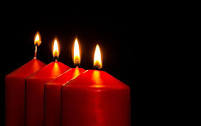
In the dark days of December, when wars and senseless violence dominate the news, God’s love simply grows brighter and stronger.  The Advent candles remind us that we are all created in the image of God, and the essence of our God is unbounded, unconditional love. 

So on this final Sunday of Advent, the circle of the wreath is completed.  We relight the candles of Hope, Peace, and Joy.  And today we light the Candle of Love, because the greatest of these is Love. 

[Light all four candles]

Please join me in the prayer on the screen:

O dear God, lover of our souls, we are undeserving and unworthy of your radical love.  Our souls our willing, but our flesh is weak.  Please sweep us off our feet again in your loving embrace.  Help us to share in your wild and crazy romance with this broken world.  Let these candles rekindle in us the dream of your beloved community, so we can throw open the gates of love to all of your weary, hopeless children.  Remind us once more that the Babe of Bethlehem still calls us to love one another, in the same reckless, unconditional way that you love us.  Amen

Northwest UMC, Columbus, Ohio

Be Still and Don’t Stop Believin’

A couple of Sundays ago when our Ohio October was still summerlike I spent some time in the Chapel in the Woods at our church after Sunday worship. Because of scheduling issues I attended our contemporary service that Sabbath which is not my preference. That Sunday was actually World Communion Sunday, a day that always has special meaning for me, especially in our fractured world today.

On that Sunday our church celebrated World Communion primarily at our traditional service because the contemporary service had been set aside for our annual Blessing of the Animals service. Communion was still celebrated at the contemporary service, along with treats for God’s four-footed critters that came to be blessed.

Needless to say it was a lively and noisy service, which is always fun, but it was not exactly what I needed that day. So, after worship I spent some time praying in our beautiful outdoor chapel and the words that came to me were “Be still and know that I am God.” I have meditated on those words frequently in the days since, seeking the balm they offer in the chaotic world we inhabit just now.

I am embarrassed to admit that I didn’t remember where those words come from in Scripture until I googled them. They are of course in verse 10 of a Psalm I have used dozens of times in funeral services, and the opening verses set the scene powerfully for having faith to be still when life is literally crumbling around us like the East Wing of the White House.

The psalm begins with these words:

“1 God is our refuge and strength,
    a very present help in trouble.
Therefore we will not fear, though the earth should change,
    though the mountains shake in the heart of the sea,
though its waters roar and foam,
    though the mountains tremble with its tumult.”

Those are the opening verses of Psalm 46 which some scholars believe was written as the armies of Assyria were besieging the city of Jerusalem in 701 BCE. Many of us can easily relate. It feels like all the values we thought our country was founded on are under siege.

I could recite a whole litany of things we’ve lost in the last 10 months, but I will focus instead on one of the most recent and egregious violations of Christian morality and Constitutional order. Because of the government shutdown SNAP benefits that help feed 42 million Americans have been cut off for the last 6 days.

There are contingency funds available to pay those food stamp benefits, and that has always been done in every other shutdown we’ve had. The only difference this time is the one who resides in what’s left of the White House.

Two federal judges have ordered the President to release those funds and provide food for hungry Americans, including the elderly and children. But Donald Trump has decided to ignore those court orders so he can use those 42 million people as political bargaining chips in the high stakes game of chicken he is playing with the democrats.

Meanwhile the President has given $40 million of our tax dollars to Argentina which hurts already desperate American farmers. He’s spent millions on unauthorized military action against Iran and Venezuela, and is threatening to do the same in Nigeria. But he refuses to even negotiate with democrats about skyrocketing health care premiums or to follow court orders and feed hungry people.

It seems useless to remind Washington about what Jesus said about feeding the least of these, although I have done so repeatedly with my three Republicans representatives in Congress. The tone deafness of this administration to calls for empathy and justice for our fellow human beings certainly feels like basic human decency is under siege.

How can we not wonder if God really is our help and refuge? Where is God’s help in this all too real time of trouble? As I typed those words, and I’m not making this up, a notification popped up on the top of my iPad screen that said “Don’t Stop Believein’!” That message came because the rock band Journey is coming to Columbus, OH next summer, but the timing of that message seemed way too relevant to be just a coincidence.

And that seems to be what the psalmist is saying to the besieged, hopeless folks in Jerusalem surrounded by the mighty armies of Sennacherib.

“God is in the midst of the city; it shall not be moved;
    God will help it when the morning dawns.
The nations are in an uproar; the kingdoms totter;
    he utters his voice; the earth melts.
The Lord of hosts is with us;
    the God of Jacob is our refuge.[c] Selah

Come, behold the works of the Lord;
    see what desolations he has brought on the earth.
He makes wars cease to the end of the earth;
    he breaks the bow and shatters the spear;
    he burns the shields with fire.”

And because of God’s ultimate rule of the whole universe, no matter how bad things seem at this or any moment, personal or in history, we can
10 “Be still, and know that I am God!
    I am exalted among the nations;
    I am exalted in the earth.”
11 The Lord of hosts is with us;
    the God of Jacob is our refuge.”

On Ash Wednesday last year we had an experiential worship service, and one of the things we were asked to do was create something from clay that was symbolic of the meaning of the season of Lent. I made this symbol which is still on my desk:

Some people thought it was a fish, which would be ok; but that is not what I was going for. I started out with an infinity symbol and then made one end into a heart. For me it symbolizes the only thing we can really count on and the only thing we need – God’s Infinite Love.

That ‘s what enables me at times to be still and know God’s in charge, even when the infidels are literally not only at the gates but in the seats of power.

Jerusalem was reborn from the ashes and somehow, someday the land of the free and the brave will be also. Be still and don’t stop believin’.

All Saints Prayer 2025

As we prepare our hearts for prayer on this All Saints Sunday I want to share some words for our meditation from Linda Hogan in her book “Dwellings.” She says,

“Walking, I am listening to a deeper way. Suddenly all my ancestors are behind me. Be still, they say. Watch and listen. You are the result of the love of thousands.”


O Holy One, God of the present age, of every generation that has enabled our being here today, and of all the multitudes who will follow in our footsteps if we find a way to a sustainable future for the creation we are a part of.

We know All Saints Day may sound pretentious because none of us are truly saintly.
We are all a weird mixture of sinner and saint striving to be more the latter as followers of Jesus and good stewards of your creation. We want to be builders of a peaceable kingdom, a beloved community, honest we do.

But you know that our fears and anxieties too often lead us to foolishly put our trust in stuff that promises security but only creates higher walls of tribal suspicion and prejudice. Bigger bombs and battleships only motivate others to make more weapons that steal resources from hungry children.

As we ponder the mysteries of how our ancestors made sense of their lives help us lovingly forgive their mistakes even as we learn from their collective wisdom.  We are grateful that we don’t have to reinvent every wheel because we are surrounded by a cloud of witnesses who bless us with their presence. We are never alone, although at times it sure feels like it.

Among those saints are those whose names we all know – Moses, Ruth, Micah, Theresa, Amos, Francis, Jesus and Paul – but those famous ones are totally outnumbered by the ordinary Joes and Judys who quietly have preserved the faith through disasters, depressions, pandemics, and ages of apathy.


Today we remember those dear ones who have passed through the thin veil that divides our reality from eternal peace and truth. We give thanks for those who dwell now in your very heart, O God. We envy their peace and unity with you, even as we humbly give thanks for their love that has produced this community of faith that nurtures us still today.


We are indebted to their example of service. We are inspired by their faith that overcame the doubts and despair that are part of the human condition. Like them we journey ever on toward the cross of Christ and the example he gives us as we join our voices with all the saints in the prayer Jesus taught us to pray ….

Northwest United Methodist Church, Columbus, Ohio, November 2, 2025

October 13: A Clash of Cultures

On this second Monday of October we Americans have a controversial federal holiday about the founding of our nation. With that in mind Father Richard Rohr had some interesting thoughts to share last week in one of his daily meditations.

“After touring Indian Territory in 1887, Senator Henry Dawes described the Cherokees in this way:  

The head chief told us that there was not a family in the whole nation that had not a home of its own. There is not a pauper in that nation, and the nation does not owe a dollar. It built its own capitol … and built its schools and hospitals. Yet the defect of the system was apparent. They have got as far as they can go, because they hold their land in common…. There is no selfishness, which is at the bottom of civilization. Till these people will consent to give up their lands, and divide them among their citizens so that each can own the land he cultivates, they will not make much progress.”

“Progress,” according to Senator Dawes, meant individualism, materialism, and even selfishness. None of these ideals are Cherokee values, nor do they represent the values of other Native Americans….”

Compare and contrast those values of “individualism, materialism, and even selfishness” with these from Jesus and Christian Scripture:

Jesus tells a rich young man, “If you wish to be perfect, go, sell your possessions, and give the money to the poor, and you will have treasure in heaven; then come, follow me” (Matthew 19:21)

Luke 6:20, Jesus says, “Blessed are you who are poor, for yours is the kingdom of God.”

Jesus’ mother Mary offers her prayer known as the Magnificat immediately after the birth of Jesus: “

“He has brought down the powerful from their thrones
    and lifted up the lowly;
he has filled the hungry with good things
    and sent the rich away empty.” (Luke 1:52-53)

And then in the Book of Acts we have this description of the early church: “All who believed were together and had all things in common; they would sell their possessions and goods and distribute the proceeds to all, as any had need.” (Acts 2:42-43)

There is no sign of any “individualism, materialism, or selfishness” in any of these descriptions of God’s kingdom. The Christian view of a beloved community sounds a whole lot more like the societies of the indigenous people who lived in the Americas for thousands of years before 1492 than the consumer culture that destroyed who and what was here before the Europeans arrived.

Let’s pray on these things today no matter what we choose to call the second Monday in October.

Truth that Frees Us to Resist Evil

“Whoever is paying our bills and giving us security and status determines what we can and cannot say or even think.” Fr. Richard Rohr

The quote above recently appeared in Fr. Rohr’s daily meditations from his Center for Action and Contemplation. It struck me as particularly poignant and relevant right now when freedom of expression in the U.S. is under attack. The power of those words is in the very fact that there is truth in them even under the best of conditions. Women can understand that truth better than we males because throughout patriarchal history they have not been free to express themselves.

In my lifetime women could only get a credit card if it was in their husband’s name. In my grandmother’s generation women did not have the right to express themselves through voting until the 19th amendment was ratified in 1920.

A clergy colleague of mine was forced out of his church in the mid-twentieth century for expressing his opinion about an issue on an election ballot, and in this age of social media the number of people who have lost their jobs because of an opinion they expressed on their personal social media account is too many to count.

This quote reminded me of another one that has intrigued me for over 40 years. “I hope for nothing. I fear nothing. I am free.” Those are the words written on the gravestone of Nikos Kazantzakis in Heraklion, Greece. Kazantzakis was the author of “Zorba the Greek,” “The Last Temptation of Christ,” several other novels, and “Saviors of God,” a book of “spiritual exercises” that are often as challenging as his epitaph.

Is being free of fear and hope the secret to having no constraints on what we say or think? Some might say being filthy rich so one does not have a boss or anyone else to report to would be the ultimate freedom, but I suspect that those who are not accountable to anyone because of their ultra-wealth are far from free. I base that judgement on the fact that the vast majority of billionaires we see in the media are never satisfied with what they have and continually strive for more wealth and power instead of enjoying what they have.

When Jesus says, “You will know the truth, and the truth will make you free” (John 8:32) what is the truth he is speaking of? Verse 31 sets some context for the more familiar 32nd:

“Then Jesus said to the Jews who had believed in him, “If you continue in my word, you are truly my disciples.” It is to those believers that he promises the truth that will set them free. That narrows things down a bit, but still raises questions, like free to do/be what? Or freedom from what?

The clue to those answers are found right in these verses. Jesus is talking to those who believe in him, and he says they need to continue in his word to truly be his disciples. In other words they are set free to be true followers of Jesus and his way of peace and justice. And later in John’s Gospel in the farewell discourse (chapter 14) where Jesus is preparing his disciples for life in a post-crucifixion/resurrection world he tells them he is going to prepare a place for them. Thomas says, “Lord, we do not know where you are going. How can we know the way?” Jesus said to him, “I am the way and the truth and the life.” (John 14:5-6)

Jesus himself is the truth that sets us free, and if we know that truth, not as a doctrinal belief but as a deep, in the gut, all-in personal relationship and commitment to follow Jesus’ way no matter what crap the world throws at us, then we are free from fear and even from hope because in that abundant life in Christ there is nothing to fear and nothing more to hope for.

That is the truth that give us the courage to be, to borrow a phrase from Paul Tillich. It’s the courage described by Bertram Cates in the play “Inherit the Wind” when he is on trial for teaching evolution in a small southern town where almost everyone is against him. At one point Cates says, “It’s the loneliest feeling in the world-to find yourself standing up when everybody else is sitting down.”

But those who know the truth that is Jesus’ message of peace and justice understand that we must fear nothing and stand up against the forces of evil and injustice. I like the way our United Methodist Baptismal ritual says it. One of the questions asked of adults being baptized is this: “Do you accept the freedom and power God gives you to resist evil, injustice, and oppression in whatever forms they present themselves?”

Most of us go through the motions of this ritual by saying the prescribed “I do,” but in times like we are living in now it is incumbent upon all of us who know Jesus as our truth to fear nothing and stand up and say a resounding “Here I am, send me!”

Peacemakers or Warriors?

If I could address a room full of top U.S. generals and admirals it wouldn’t take me two hours to remind them of where the ultimate allegiance of people of faith should lie. Even back in the more militaristic Hebrew Scriptures some prophets knew. Psalm 20:7 says, “Some trust in chariots and some in horses, but we trust in the name of the LORD our God”. Those are not the empty and dangerous words of a “warrior” culture, and I’m pretty sure most of the men in those days were “beardos.”

And speaking of bearded men, how about one Jesus of Nazareth who says among other things in his short and succinct Sermon on the Mount (Matthew 5-7), “Blessed are the Peacemakers,” “Love your enemies,” and “Turn the other cheek.” He came not as one whose calling was to “kill and break things” but as the Prince of Peace.

And then to conclude, rather than a challenge to either serve the warrior culture or abandon decades of hard work, experience, and service, I would offer these words from Joshua at a critical decision point in the history of Israel: “Now if you are unwilling to serve the Lord, choose this day whom you will serve, whether the gods your ancestors served in the region beyond the River or the gods of the Amorites in whose land you are living, but as for me and my household, we will serve the Lord.” (Joshua 24:15)

World Communion Prayer 2025

O God of all creation, we set aside one Sunday each year as World Communion Sunday. Given the state of our battered and broken world wouldn’t it make more sense to make every Sabbath or Holy Day a time to pray for a beloved world community?

Our Christian Scriptures say you so loved this messed up world so much that you sent your own beloved son to redeem us. Why would you do that knowing how the evil forces in the world routinely kill any prophet who challenges the empire’s gospel of power and violent control by fear and intimidation?

And yet something about that impractical vision of a peaceable kingdom keeps us coming back to your table. It’s a table where we join a motley crew of humanity – those who hunger for power and the powerless who simply hunger; Israeli and Palestinian, Ukrainian and Russian, an assassin and a widow who forgives him, sworn political enemies dipping bread in the same cup, estranged family members sharing tears of joyful reunion, and those who live for revenge breaking bread with the agents of reconciliation.

We don’t understand the mystery of how ordinary broken bread can fan the tiny ember of hope still smoldering beneath an avalanche of broken dreams. Yet somehow the Holy Ruach of Your spirit blows life into a valley of dry bones and we leave the table lighter and brighter with a spring in our step we thought was gone forever.

The chaos of life has not stopped. The existential threats to freedom and the power of greed and short-sightedness threatening our planet are still as awful as ever. People are still starving in Sudan and Gaza, bombs are still dropping in Kiev, and yet the vision of humanity with all its flaws breaking bread together around one godly table stays with us and empowers us to face the future with courage and love.

Because You so loved the world we dare to also, in the name of the humble servant who calls us again and again to come eat and drink of his very essence. In His name we pray and live. Amen

Ramah and Herod: America’s Dual Role in Gun Violence Tragedies

“When Herod saw that he had been tricked by the magi, he was infuriated, and he sent and killed all the children in and around Bethlehem who were two years old or under, according to the time that he had learned from the magi. Then what had been spoken through the prophet Jeremiah was fulfilled: A voice was heard in Ramah, wailing and loud lamentation, Rachel weeping for her children; she refused to be consoled, because they are no more.’” (Matthew 2:16-18)

From Columbine, Uvalde, Sandy Hook, Annunciation Catholic Church, and so many more we can’t even remember we are all in Ramah with Rachel weeping for our children, inconsolable because they are no more. 

But for us Americans it is so much more complicated.  We are parents, grandparents, aunts and uncles, friends, cousins, neighbors, and total strangers who mourn yet more senseless violence, death, and trauma.  But we are also Herod.  There is blood on all of our hands because we have not done enough to end America’s love affair with guns.  We are the only nation in the western world where mass shootings are a regular occurrence, where young children and teachers have to go through the trauma of active shooter drills.  We now have a new generation of shooters who went through active shooter drills as children.  I wonder what impact those drills had on them. And yet our “leaders” refuse to restore assault weapons bans or institute reasonable gun control laws.

We claim to be the “land of the free and the home of the brave” when we are neither.  Our Second Amendment worshippers are so afraid of someone disagreeing with them that they need weapons of war to feel secure.  Our President is such a coward he needs tanks in the streets to prove how tough he is.  And none of us, not even young children praying in a sanctuary, a place defined as the ultimate place of safety, are free from random acts of cold blooded murder.

Yes, this is certainly a mental health problem on so many levels, starting with the fear and paranoia played upon for blood money by the NRA and the gun manufacturers.  It is their ill-gotten gains that bribe legislators to oppose gun control when those Senators and Congress people know fully well that the vast majority of us they supposedly represent support those controls.

And of course the shooters themselves need mental health help, but those same legislators who hide behind that excuse refuse to fund adequate mental health services.  Or worse they try to convince us that immigrants are the problem when we all see with our own eyes on TV that most of these shooters are angry, troubled, young white males. 

I am reminded of the great lament from Bob Dylan:

“Yes, and how many ears must one man have
Before he can hear people cry?
Yes, and how many deaths will it take ’til he knows
That too many people have died?

The answer, my friend, is blowin’ in the wind
The answer is blowin’ in the wind.”

Tonight that wind is blowing through empty bedrooms in Minneapolis, through hospital rooms where helpless parents pray beside young wounded bodies, and through every Ramah across the country where inconsolable Rachels weep for their children.

I only pray that wind is also blowing through the hearts of our country’s leaders till they realize we are all Herod too. 

No Forgiveness Unless We Confess and Face the Truth

“ If we say that we have no sin, we deceive ourselves, and the truth is not in us.  If we confess our sins, he who is faithful and just will forgive us our sins and cleanse us from all unrighteousness. If we say that we have not sinned, we make God a liar, and his word is not in us.” I John 1:8-10

The Bible is very consistently on the side of honesty and truth. That doesn’t mean everyone in the Bible is honest and truthful, far from it. From Adam and Eve’s deceit about the forbidden fruit, to Abraham lying that Sarah was his sister to save his own skin, to Peter’s denying that he even knew Jesus three times, and so many more incidents humanity’s fallible nature shows up in nearly every chapter of the biblical narrative.

That doesn’t mean the standards and values set forward for us in the Scriptures are not high. The 8th commandment is “You shall not bear false witness against your neighbor,” and John 8: 32 tells us that it’s truth, not lies, that sets us free.

God knows we are not going to live up to those high ideals because She made us with free will and knew we would abuse that gift regularly. And knowing that, God built into the system grace and mercy and forgiveness.

But as I John points out, there’s a catch. “If we say we have no sin, we deceive ourselves and the truth is not in us.” But there’s good news because that verse goes on to say “If we confess our sins, he who is faithful will forgive us our sins and cleanse us from all unrighteousness.”

That’s pretty straightforward. We screw up, but if confess our shortcomings and failures instead of trying to hide them from, others, ourselves, or from God, which is a fool’s errand for sure, there is redemption.

I bring that up just now because we Americans are experiencing a real shortage of honesty, truth, and confession right now. Yes, I know that’s always been the case, but just now truth is being exiled and threatened at the highest echelons of American society. Our president is so insecure and ignorant of American and World history, let alone the Christian Gospel, that he is terrified by truth.

He is purging exhibits from the Smithsonian because they make slavery look bad! For God’s sake how can anything make chattel slavery, lynching other human beings for the color of their skin, and 400 years of systemic racism look anything but bad? The truth is that The United States was founded on racism and enslavement of African people and on genocide against Native Americans who were here for centuries before white immigrants arrived.

That’s a hard truth to swallow, I know, but trying to bury it with lies, book burnings, and threats to historians only makes the crime worse. As I John tells us, the only road to forgiveness is through the pain of confession, and confession requires a cold hard look at Truth, no matter how awful it is.

Out of sight may be out mind, but it doesn’t change the truth. Rounding up and imprisoning people experiencing homelessness may make some people more comfortable who don’t have to witness that problem, but it doesn’t change the truth that the wealthiest nation in the world refuses to address the grave social issues of poverty, hunger, health care, and adequate shelter that should be basic human rights

We cannot solve problems we refuse to admit we have. That’s the essence of confession. Climate change is the biggest current disaster caused by denial of its existence. Had we confessed as a nation that we were poisoning our planet decades ago we would not be in the mess we are in today.

The truth can set us free, but only if we have the humility and courage to face it. Until then, “If we say we have not sinned, we make God a liar, and God’s truth is not in us.”