Who Do You Say You Are? Reflections on Identity and Life’s Challenges

“I hope for nothing. I fear nothing. I am free.” Nikos Kazantzakis’ epitaph.

Those words from the Greek Author and philosopher, Nikos Kazantzakis, have both inspired and haunted me since I was first introduced to them as a twenty-something seminary student 53 years ago. Kazantzakis, most famous for his novel, “Zorba the Greek,” wrote many volumes full of such deep and baffling sayings. Many of them have stuck with me my entire adult life, and I was reminded of again of them when my wife and I had a chance to visit Crete on a cruise to several Greek Islands last spring. Crete is both the birthplace of Kazantzakis and where he is buried.

 The epitaph in particular has been on my mind recently as my awful, terrible, no good, horrible summer of 2024 has continued right into the fall. [Please read my posts from August 4th and 12th if you want all the details.]. Quite frankly I do know that my little problems the last 4 months can’t hold a candle to hurricane destruction, people living in war zones, people starving from famine and climate change, people suffering from chronic pain, grief, persecution, broken relationships, addiction, homelessness, and so many more. Is it possible for any of us to truly hope for nothing and fear nothing?

My most recent personal challenge is undergoing chemotherapy for a rare form of lymphoma in my blood. I’ve known this day was coming sooner or later since my oncologist has been tracking the slow increase of a monoclonal glutamate in my blood for over a decade. I was personally hoping for later, like much later. But of course this was the great summer of my discontent, and what better time for my IgM antibodies to set off a siren alerting my doctor that something was wrong. This alarm was as loud as our home security system when I accidentally set if off. When the IgM jumped from around 2000 in January to 6500 in July it was such a loud warning that even my denial mechanisms were overpowered.

Technically I have been a “cancer patient” for about 13 years now because I was diagnosed with a mild prostate cancer in 2011. But that cancer has never needed any kind of treatment. Being told I needed to start getting chemotherapy ASAP for this lymphoma was a whole different ball game. One of my first challenges after this diagnosis was a debate within about how I wanted to think about myself going forward. Naming something helps give us some agency over it.

I knew I didn’t want to think of myself as a “cancer patient” because I am so much more than any diagnosis or label or title can convey. We are complex and complicated beings who defy narrow definitions of ourselves. In other words, I have cancer; it doesn’t have me. But knowing what I didn’t want to identify as didn’t answer the harder question of finding a name for this new, added dimension of my being. I toyed with “victor” (maybe too ambiguous depending on how one defines what victory even looks like. Jesus certainly didn’t look like a victor on the cross, but how our ideas of victory change on Easter morning! Don’t like “survivor” either. I want more from life than just surviving. As an aside, it has taken me 6 weeks or so to reach sporadic bouts of peace where I can live into the words above. In fact I hadn’t been able to express those thoughts and feelings like this until I started writing them. One of the many reasons writing is so therapeutic for me.

At those many other times when I don’t feel good at all about my new blood brother, I have caught myself recalling the title of a 1995 movie, “Dead Man Walking.” As time goes on I have had fewer of those DMW moments and more of the positive ones. After writing this, I’m pretty sure that ratio will continue to improve. Because as I wrote this post I realized that I have a simple and maybe fun way to embrace and integrate my cancer into my “Stevenness.” You see, my cancer has a pretty cool name. It’s Waldenstrom, named after a 20th Swedish Doctor who first described it. But Waldenstrom is a very heavy handle for my little cancer. It sounds like a cousin to Frankenstein. So I have decided to christen my cancer with the nickname, “Waldy,” and that seems like a name I get arms around.

One final thought (or two): Throughout this naming/identity dialogue with myself there was a biblical scene that kept coming to my mind. All three synoptic Gospels (Matt. 16:15, Mark 8:29, Luke 9:20) recount the time Jesus gave his disciples a pop quiz. Like all good teachers Jesus starts with a safe, impersonal question. He asks, “Who do people say that I am?” After the disciples respond with several Hebrew heroes from the past, Jesus stops them and asks the zinger: “and who do you say that I am?’ Jesus went from preaching to meddling in a hurry.

Simon Peter as usual jumps in with the answer: “You are the Christ, the Messiah.” Peter knows the right words, he just doesn’t yet understand what those words really mean or will mean to him. Far too many of us today know “who” Jesus is, but that’s only half the equation. It’s one thing to answer the catechism, or recite the Apostles’ Creed, but quite another to know what those words require of us who claim the identity of Jesus’ followers.

It occurs to me that the unspoken question that Jesus leaves hanging in the air for his disciples to discover for themselves is this: “Who do You say that you are?” Have you wrestled with that question recently? Who do you identify with/as? What name do you give to the totality of the amazing God-created being you are? We humans are more than the sum of our parts. Be gentle with your being. But remember to ask yourself occasionally: “Who do You say that you are?”

The answer to that question is never final; it is dynamic and ever-changing. But the closer we get to an answer we can live with, the closer we are to fearing nothing—not even my new friend Waldy or whatever other demons with which we have wrestle.
ICU LIFE LESSONS

Three days ago I quite unexpectedly began a crash course in life lessons I didn’t sign up for. Thanks to dangerously low blood pressure and low Hemoglobin I became so dizzy at home and unable to stand that I earned myself a first-ever ride in an ambulance. That bumpy ride landed me two other firsts —two nights in ICU and a first time blood transfusion.

Quite a day and night, and I’m happy to report that within 24 hours and after some bleeding ulcers were discovered and treated I made a remarkable recovery. I am writing this from a regular hospital room just under four days after it all began and am processing it all by trying to capture and share some of what I’ve learned.

First and foremost I have been amazed and humbled by the outpouring of love I’ve felt from family and friends. The hospital EMT’s and hospital staff have been fantastic. I expected that, but am still beyond grateful for how dedicated and wonderful they all have been, and some of what they had to do for me was quite frankly disgusting.

What blew me away however has been the constant stream of visits, texts, and phone calls from family and friends concerned about my welfare. My dear wife, Diana, has been a rock, and I can never repay her for the hours she has spent with me and so thoughtfully brought me things from home that I might need. I can’t imagine going through something like this without her. I hope I will never take her for granted, but I also know we have pledged to care for each other in sickness and in health. It’s a covenant we made with each other 22 years ago, and one we take very seriously.

But it takes a village to hold up the most loving care giver. And that’s where I am in awe at how large and strong my village is. I am not bragging. I am so humbled because I know I am not as supportive of my family and friends as mine have been for me in the last 96 hours. For example, it is about a 30 minute drive from my house to Riverside Methodist Hospital in Columbus, Ohio. I was not in crisis; so my ambulance ride did not feature high speeds or sirens.

I was however in bad enough shape that I was taken immediately into treatment once we arrived at the ER. That was a blessing, but even more so was that within the first 20 minutes I was in the ER in walked my beautiful 25 year old granddaughter. Her mother called her because she was the closest family member to my location, and she was able to leave work and come sit with me during that scariest part of my journey.

It was a powerful reminder to me of how important a ministry of presence is. Olivia was simply there for me, and her maturity and calm demeanor was contagious. She asked questions I didn’t think of and just was an extra pair of eyes and ears for me.

And much to my wondering eyes other family members just kept showing up. Within my first hour in the ER my village blossomed to include my daughter (who is herself recovering from painful foot surgery) and son-in-law, along with their two sons (my grandsons). And to round out my entourage a nephew by marriage who is a surgical nurse at Riverside dropped by to add his medical knowledge and expertise.

They all stayed around until I was admitted and situated in an ICU room and have all been back or called/texted me every day since. And so has my son who was not able to join the welcome party that morning but came to visit with his wife that first evening.

I knew I was loved by my family before Thursday, but quite frankly we don’t always show that love as much as we could. My family members are all very busy people, and it is easy to feel sometimes like we oldsters are not a priority for them; but they have showed me in no uncertain terms this week that when they are needed the most they are there.

Humility. I know everyone jokes about how you surrender your dignity when you become a hospital patient, and that’s true. The first thing the nurses did when I arrived in the ICU was remove every stitch of the clothing I came in with. They wiped me down with baby wipes, and I use that term because I felt like a helpless baby. And that feeling came through even more strongly that night when my bowels did their thing all over me and my bed before I had time to even realize what was happening.

The staff calmly cleaned me and my mess up as if they do it every day, and likely they do. And then it happened again a few hours later, and I was really embarrassed. When I apologized they simply said, “that’s what we’re here for.” What gracious and loving servants!

We are all just a minute away from such a reminder of how interdependent we are. Being helpless and needing assistance with even the most basic of bodily functions is nothing to be embarrassed about. It is part of the cycle of life and our human condition.

I know that my situation here has been nothing compared to people who are battling life-threatening diseases and injuries, but the lessons are similar. I also know I am very privileged to have access to excellent medical care which far too many of my fellow citizens do not have. Those are the sisters and brothers we all have who need us to be their advocates and village members who demand a just and universal health care system.

We are our sisters and brothers keepers, and I will emerge from my experience not just healed of my physical symptoms but with better empathy and awareness of how I can pay forward the wonderful care I have received.

Thank you my dear village.

Renaming the YMCA?

One of the few benefits I’ve found of being old is a feature that comes with many Medicare Advantage plans. Silver Sneakers is a program that pays for access to many gyms and exercise facilities as part of one’s health insurance after the age of 65. Insurance companies benefit because people who exercise are healthier and have fewer claims for medical bills from their insurance. And, of course, having access to places to work out benefits senior citizens.

My wife and I have enjoyed Silver Sneakers since we went on Medicare 12 years ago. We are fortunate that with Silver Sneakers we can use 4 different YMCA’s and another gym that are all within 15 miles of our home, and we often decide which one to use depending on what errands or other trips we need to make on a given day. We’ve even been able to use our Silver Sneakers membership to workout when we are traveling.

Having said that I want to give a shout out to my favorite place to workout. My go to exercise since I had back surgery two years ago has been to swim, and my favorite pool is at one of our local Y’s in the nearby suburb of Hilliard, Ohio. It has become my favorite because of very friendly staff who call me by name and make me feel very welcome whenever I walk in. I also like the temperature of the water in their pool, about 82 degrees. But there’s something else I have come to appreciate very much about our Y, and that is the diversity of the staff and those who use that facility.

On any given day at the Y I see several people of different ethnicities. There are Asian Americans, African Americans, Muslim women in hijabs and some in berkas, either working at the front desk or often using the pool by themselves or with their children. The first time I saw two of these women get in the pool fully clothed in berkas and hijabs I must admit I was a bit taken aback. But it has become a common sight now. Recently a new sign was put up by the deep end of the pool warning of the danger for those who can’t yet swim. What struck me about that sign is that it is written in four different languages.

During the recent holiday season I was also pleased to notice that in addition to a Christmas tree in the lobby area there was a Menorah on the counter where members check in. I like the diversity and inclusive message all those things communicate. But here’s the irony in all that. YMCA originally stood for “Young Men’s Christian Association,” but it has obviously outgrown that name. Many of us who workout there are certainly not young, more than half I see are not men, and as I’ve demonstrated above the membership at our Y is certainly much broader than “Christian.”

I’m not proposing a name change. I happen to enjoy singing the YMCA song. I just find the diversity there a bit of good news in a world that needs all of the positivity we can get. So my hat is off to the Hilliard Y and all who help create the hospitality and inclusivity it represents.

It’s fun to play at the YMCA!

Help from Our Friends

“Then some people came, bringing to him a paralyzed man, carried by four of them. And when they could not bring him to Jesus because of the crowd, they removed the roof above him, and after having dug through it, they let down the mat on which the paralytic lay.” (Mark 2:3-4)

I had a very humbling experience last week that reminded me of the story from Mark’s Gospel about the paralyzed man brought to Jesus in a most unusual way. All three other Gospels contain a similar story where someone is carried to Jesus for healing, but only Mark has this most dramatic detail about the man’s friends being so committed and creative that they lowered him down to Jesus through a hole they dug in the roof.

Wouldn’t you love to hear the insurance adjuster’s response when the homeowner explains the hole in the roof with this story? My experience last week was far less dramatic but still very emotional for me.

The back story, no pun intended, is that because of chronic back pain and peripheral neuropathy I sometimes have a difficult time walking any distance. This is especially true after I’ve been sitting in a confined space, like an airplane seat, for any extended period of time. Last Wednesday my wife and I flew from Columbus, Ohio to Houston, Texas to visit family for the Thanksgiving holiday. The flight was delayed for 30-40 minutes while we sat on the tarmac in Columbus waiting for the pilots to arrive on another delayed flight from Houston. That made the total time on the plane around 3 hours.

Upon arriving at the Bush Intercontinental Airport in Houston we had a long walk (and a train ride) from Terminal E to baggage claim in Terminal C, and I was struggling to get there pulling a carry on and wearing a backpack. My dear wife offered to help with my luggage, but she already had plenty of her own; and I stubbornly kept pushing on.

By the time we got to Terminal C I was really tired and unsure how much further we had to go. We stopped to ask for directions from an airport employee who just happened to have an empty wheelchair, and he graciously offered me a ride. He was a life saver, and I was very grateful for his help. He not only pushed me to baggage claim, he took our claim tickets and got our luggage for us and then took us another good distance to where we could catch a shuttle to the car rental center. He even loaded our suitcases on the shuttle bus for us.

But here’s my problem. While I was very grateful for the assistance we received, I still felt helpless and frustrated that I needed that kind of help. I have not come close to mastering St. Paul’s advice in Philippians 4 to ”be content in whatever state I’m in.” I am reminded every time I look in the mirror that I am 77 years old, and if I forget, my aches and pains remind me of that fact; but I still try to deny it.

So I wonder how the paralytic man in the Gospel stories felt about his situation. We aren’t told why or how long he has been paralyzed. We don’t know if he asked these friends to take him to Jesus or if it was their idea. We don’t know how he felt about being carried up on the roof. That had to be little scary for him!

The truth is the story really isn’t about the paralytic, just as my wheelchair ride wasn’t really about me. The Gospel story is primarily about Jesus, and my story if I step back from my own pity party is really about the kind man who helped us. Yes, he was doing a job he is paid to do, but he did it with such kindness and grace that it was obviously more than just a job.

And Mark’s point in sharing this story in just the second chapter of his Gospel is not primarily about the paralytic but about the healing power of God and who Jesus is. We need to read the first chapter of Mark to realize how central that fact is. Mark wastes no time getting to the radical ministry of Jesus. In the very first chapter he includes four specific healing stories, including Simon’s mother-in-law, casting out many demons, a man with an unclean spirit, and a leper. He goes “throughout all Galilee,” and even though he tells them all not to tell about their healing by the time he returns to Capernaum even though there was no social media to promote his good works Mark tells us “the whole city” is crowding around to get to Jesus. He’s a bigger celeb than Taylor Swift.

But here’s the thing about the story in Mark 2; it’s not just another healing story. For the first time Mark tells us Jesus dares to forgive the paralytic’s sins, and that of course ticks off the Scribes who are nearby and take offense that Jesus dares to claim such divine authority. I love Jesus’ response to the Scribes. He basically says, “OK, to show you my power, how about I just say to the man ‘take up your bed and go home?’” Which of course the miraculously healed man does, and the crowd is amazed because “we have never seen anything like this.”

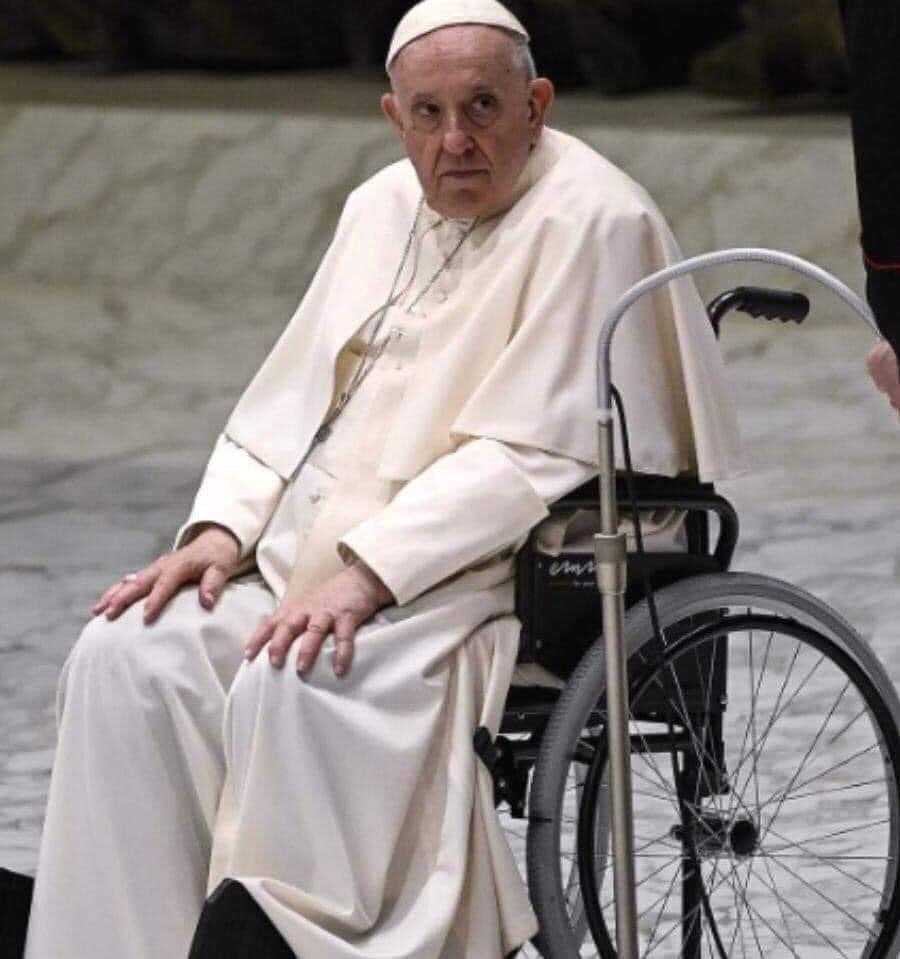
As I was thinking about all of this I came across this picture of Pope Francis, and it hit me again. My story like the paralytic’s story are not about the helpees but the Helper. If a great man like Pope Francis can accept the help of others who am I to think I am somehow better than that. The truth is we are all dependent on the help of others. It may be emotional support or sometimes physically taking us to the spiritual or physical help we need. It may be realizing we are dependent on the farmers, truckers, and grocers who get food on the shelf for us to purchase.

The secret to it all is being humble enough to recognize and ask for whatever help we happen to need at any given point in life. We all come into this life totally dependent on others to nurture, protect, and care for our needs for several years, and the cycle of life means that most of us will end up pretty much in the same need for caregivers at the end of this life. Our choice is how humbly and graciously we accept that care.

Put Out Into the Deep – or Shallow

Because of multiple life contingencies I have gotten out of the habit of swimming for exercise in recent months. After two years of very faithfully swimming 2 or 3 times per week travel, injury, spring yard work, and other forms of exercise have usurped the time previously devoted to time in the pool. I had forgotten that swimming is more than just physical exercise for me. It is also a form of meditation and solitude that other forms of exercise do not readily offer. So as I have begun to swim again in the last two weeks I have been reminded of those other benefits of time in the water. I had two radically different but essentially similar experiences in my swimming last week and this.

Thanks to Silver Sneakers (a wonderful insurance benefit for seniors) I have memberships at both our local YMCA’s and a private gym with a small pool. Last week I swam at the private gym and literally had the 4-lap pool entirely to myself for the 20 minutes I was there. It was as peaceful and quiet as any place I can imagine. By contrast this week I went to one of our Central Ohio YMCA’s and almost left without swimming. The cool weather we are having this week meant that the outdoor pool at the Y was closed and consequently the shallow end of the indoor pool was filled with a gaggle of elementary age kiddos making a joyful noise to the Lord or to someone!!

Being a devout introvert I was at first put off by all the noise. As I hesitantly walked into the pool area to see if there was even a lap lane available one of the life guards said to me, “Welcome to the party!” He also pointed me to an open lane which was of course right next to the semi-organized chaos in the shallows where brave high school-aged counselors were riding heard on the younger kids. The guard said I might get a stray beach ball in my lane but otherwise said it was all mine.

These two diametrically opposed scenarios turned out to be essentially the same however once I put on my snorkel and began swimming my laps. With my head submerged in the water I was totally alone in silence, repeating the mantras I use to turn my swimming time into one that is also meditation.

Finding time and space for solitude is increasingly difficult in our extroverted and fast-paced, multi-tasking culture. It requires a great deal of discipline to carve out such time and space in most of modern life, but nothing I have found works as well for me as donning a snorkel and submerging myself in the amniotic, baptismal water of a pool or pond. It doesn’t require deep sea diving experience or equipment. My head is never more than a few inches below the surface of the water, but those few inches filter out all the external distractions. And if I can also quiet the inner noise of my worrisome mind I am as close to a mystical peace as I have ever been.

It reminds me of Luke 5:4 where the disciples have been out fishing all night and have nothing to show for their labor. Jesus tells them to “put out into the deep and let down their nets.” Peter argues that they have been there and done that, but if you say so we’ll try again. It’s like Peter is humoring this carpenter. It makes no logical sense, just like swimming a few inches below the water should not silence all the noisy children just a few feet away. But it works. The disciples’ nets are filled to the breaking point because they obeyed, and my initial resistance to the chaos in the pool was transformed by the lifeguard’s positive attitude to reframe the child-like exuberance into an invitation to a party.

Your quiet place may be someplace entirely different than mine, but we all need one where we can “put out into the deep” of the mystery of existence.

Wilson!!

“Then the Lord God said, “It is not good that the man should be alone; I will make him a helper as his partner.” (Genesis 2:18)

The recent pandemic has reinforced our knowledge that it is not good for humans to be alone. Our daughter-in-law is a very strong and self-aware introvert. Several months into the pandemic she joked that even a committed introvert like herself had to admit that she was missing human contact. Far more seriously we know that the hiatus from play dates and school has had serious mental health consequences on many children and youth who are behind in their social development and their ability to communicate in ways that are not mediated by technology.

Yes, it is true that technology has helped bridge the human contact gap in significant ways with virtual learning and digital meeting apps like zoom, but anyone who has spent much time using those tools will tell you that kind of meeting or teaching and learning is just not as good as face to face contact.

I was reminded of a wonderful movie that explored the theme of human loneliness when I found this golf ball in my bag last week. I led a men’s retreat several years ago where we watched the 2000 Tom Hanks film, “Cast Away” and then explored what the movie said about the human experience.

In that movie Hanks plays Chuck Noland, a harried FedEx executive, who is cast away as the lone survivor of a company cargo plane crash in the Pacific. The good news is he survived the crash. The bad news is he is washed ashore on a small deserted island where he is totally and completely alone. He manages to survive for years by creatively making use of a few items in packages that wash ashore from the plane crash.

One of the seemingly most useless items that floats into Noland’s island home is a brand new Wilson volleyball. No net, just the ball, and while beach volleyball is a real sport, it does require more than one person. That ball however soon becomes the most important factor in helping Noland maintain his sanity as multiple attempts to sail off the island in makeshift boats end in disaster and even a suicide attempt fails.

Noland discovers a way to meet the need for “human” contact without internet, cell phone, smoke signals, or even written communication. He turns the Wilson volleyball into Wilson, his friend and companion. He paints a face on the volleyball and regularly talks to Wilson about his plight. In the most poignant scene when Noland finally manages to push and paddle beyond the breakers and put out to sea on a makeshift sailboat, his buddy Wilson is washed overboard by a large wave and slowly drifts further and further away. Noland can only cry plaintively, “Wilson! Wilson!” as his faithful friend disappears from his sight.

Our men’s retreat was held at a church camp, and one of the men found a Wilson volleyball in a closet in the lodge where we were meeting. That ball, of course, became our mascot for the weekend, sitting with us as we discussed the film, coming to meals with us, and sleeping on one of the bunks in the dormitory-style room where we slept.

Now I have my own Wilson Jr. golf ball sitting on my desk to remind me again that it is not good to be alone. (And, it helps our bond that I played some very good golf with my Wilson, and he didn’t desert me like so many balls have by disappearing into the woods or splashing down into a water hazard.). Please understand, as an introvert I still regularly need and enjoy solitude. Zoom does make many things easier or even possible, like book clubs, meetings over distances without time-consuming and expensive travel, and especially regular contacts with distant friends.

But nothing, not even a lovable volleyball, can meet our basic need for human contact. My therapist says touch is the first and most basic form of human communication. Research has shown that infants who receive an adequate amount of loving touch not only thrive, but those who are not held and touched literally die.

We can see this phenomenon in other species, many of whom mate for life. Unfortunately many Americans have lost sight of the need for meaningful human contact. Our myth of rugged individualism has turned far too many of our human interactions into a transactional, self-centered dance of using people for our own profit and benefit.

Our consumer driven economy and our fear of an always uncertain future have convinced too many of us that we can never have enough material wealth to feel secure. Perhaps the silver lining in our current inflationary anxiety is that we will learn like Chuck Noland did to be satisfied and live with what we have. Powerful story telling like “Cast Away” is a way of teaching us those life lessons vicariously so we don’t have to actually be stranded on a desert island or isolated in a pandemic to learn them.

Leading with Your Head

“Words alone are cheap.  Breathing deeply is required also.  Connecting to the heart, not just the eyes. Meditation, mindfulness, contemplation, art and creativity–accessing the right hemisphere of our brain, not just the verbal hemisphere, is needed. 

Incorporating and honoring our bodies, breathing deeply, not just leading with our heads.  The heart after all resides in the body and disperses its blood and values from that center.  And breath is the same word as “spirit” in many languages (including Biblical ones).”

Yes, words are cheap, but they are all we have to express our thoughts and feelings.  That quote is from Matthew Fox in his “Daily Meditations” for today, (January 29).  The phrase that jumps off the page for me is “not just leading with our heads.”  We know with our heads and hearts that we are holistic beings and certainly not the Cartesian model of rational-logical critters who only exist because we think.  We also feel and act.

I first really understood that in graduate school working on my doctorate in rhetoric.  It wasn’t until then that I learned that the traditional three-part sermons I grew up with were originally not just three sections of a sermon linked together more or less successfully.  The three point idea originated clear back in the 4th century BCE with Aristotle.  In his classic “Rhetoric” Aristotle describes a holistic approach to persuasive discourse that appeals to “logos, pathos, and ethos,” terms best translated into English as “reason, emotion, and ethics.”  Effective persuasion needs all three elements because humans are rational, emotional and ethical beings.  The latter term applies to our behavior that is shaped by our reason and emotion.

Western philosophy and education have majored ever since Descartes in developing and teaching that primarily addresses the mind to the detriment of emotional and ethical development.  In other words as in the quote I began with we “lead with our heads.” 

As I was writing this piece I saw a very timely post on Facebook that seems relevant.  I can’t verify the source from a Facebook called “Compass,” but it certainly fits my life experience as one who led with my head through twelve plus years of higher education.  Here are the key points of the post:

“According to Psychologists, there are four types of Intelligence:

1) Intelligence Quotient (IQ)

2) Emotional Quotient (EQ)

3) Social Quotient (SQ)

4) Adversity Quotient (AQ)

1. Intelligence Quotient (IQ): this is the measure of your level of comprehension. You need IQ to solve math, memorize things, and recall lessons.

2. Emotional Quotient (EQ): this is the measure of your ability to maintain peace with others, keep to time, be responsible, be honest, respect boundaries, be humble, genuine and considerate.

3. Social Quotient (SQ): this is the measure of your ability to build a network of friends and maintain it over a long period of time.

People that have higher EQ and SQ tend to go further in life than those with a high IQ but low EQ and SQ. Most schools capitalize on improving IQ levels while EQ and SQ are played down.

A man of high IQ can end up being employed by a man of high EQ and SQ even though he has an average IQ.

Your EQ represents your Character, while your SQ represents your Charisma. Give in to habits that will improve these three Qs, especially your EQ and SQ.

Now there is a 4th one, a new paradigm:

4. The Adversity Quotient (AQ): The measure of your ability to go through a rough patch in life, and come out of it without losing your mind.”

The phrase “leading with your head” reminded me of something I’ve been concerned about as I have watched way too much football in recent weeks.  Last weekend was an especially exciting one for National Football League fans.  There were four playoff games last weekend that were all as closely matched as mathematically possible.  Three ended with winning field goals as time expired and the fourth game went to overtime.  

First a confession and/or disclaimer:  I know the game of American football has become dangerously violent.  Players are bigger, faster and stronger than they used to be, and therefore bodies collide with much greater force.  Padding and helmets are certainly much better than the days of leather helmets, but we still know many former players are suffering from traumatic brain injury, dementia, and Chronic traumatic encephalopathy (CTE) because of their years playing football.  Knowing all that makes me uncomfortable watching, but it’s something I’ve been doing for nearly 70 years and is a very hard habit to break.  I also think the way football has replaced our former much more civil national pastime (baseball) is another sign of the toxic masculinity that I wrote about plaguing the American psyche that I wrote about last week.

But I digress a bit.  What I noticed watching so many games last weekend was a troubling difference between college and professional football.  The college game has a rule against “targeting” which is aimed to limit hits to the head and neck area and crashing into an opposing player with the crown of the helmet.  That rule is designed to protect both the player on the receiving end of the targeting and the cranium of the deliverer of the blow.  

Yes, targeting is a judgment call that referees spend much time reviewing replays before enforcing.  They take it very seriously because the penalty for targeting is ejection from the game, and that has and will cut down some on the most dangerous hits in an inherently violent game.  I think the NFL needs to do something similar to prevent more life-threatening injuries from “leading with one’s head.”

I offer that football reflection as a metaphor for the rest of us in real life.  When we lead with our heads, divorced from understanding the emotional, social, and I would add spiritual aspects that are co-partners with the head in human beings we are failing to maximize a healthy comprehension of human behavior.  We are not just rational/thinking beings.  The various components of our humanity need to work in partnership with each other or we are not living up to our potential.  And the huge existential problems facing the human race will not be solved if we are not playing with a full deck. 

Simple Things that Heal

“Father, if the prophet had commanded you to do something difficult, would you not have done it? How much more, when all he said to you was, ‘Wash, and be clean’?” (2 Kings 5:13)

That verse is from the wonderful story of the healing of a Syrian military commander named Naaman.  You can read the whole story in 2 Kings 5, but here’s the abridged version.  Naaman comes down with a dreaded case of leprosy, the grossest curse of biblical times.  But in Naaman’s household is a political prisoner captured in Israel.  The slave girl is Naaman’s wife’s servant.  This nameless girl overhears Naaman whining about his plight and tells him there is a prophet in Israel who can heal him of his leprosy.  Even though this referral comes from an anonymous and powerless slave girl, i.e. someone on the very bottom rung of the cultural ladder, Naaman assumes such healing can only come from an important and powerful ruler.  So he sends a letter to the King of Israel who freaks out assuming this is some kind of political trick to make him look bad.

And then the prophet Elisha hears about the King’s dilemma and says, “Send him to me.”  Naaman shows up at Elisha’s house and gets all upset because Elisha doesn’t even come out to greet him.  He just sends a messenger out who tells Naaman to go wash in the Jordan River 7 times.  Naaman balks at this because he was expecting Elisha to come out and stage a spectacular miracle healing, and besides they have better rivers in Syria where he could have washed without making this long journey.  He is ready to go off in a huff, unhealed, but his servants (note how the least powerful characters in this drama are again the wise ones) deliver the line at the beginning of this post.  And reluctantly Naaman listens to reason, washes in the Jordan and is cured.  

Naaman’s story came to my mind in the midst of this pandemic because like Naaman all of us are being asked to do very simple things that require no special skills or knowledge.  We can all wear a mask and stay a distance from each other, and yet for different reasons masses of Americans refuse to do the only things we can do to combat this virus that has already killed over 225,000 Americans.  

Will we listen to those wise enough now who are saying to us, “Hey, if you had to do some super heroic deed to stop the spread of this deadly disease, wouldn’t you do it?  So how much more should we do the simple things.”

Naaman came to his senses and was humble enough that he listened to his servants and was healed,  Give us ears, O God, to hear and heed the simple things we can do to be restored to health.  

Waves of Grief

Once upon many times I have heard/read that grief comes in waves, but I have not fully realized until recently how true that is. In the past I managed to keep myself so busy doing multiple jobs, going to school till I was 48, parenting et al, you get the workaholic picture, that I didn’t allow myself to grieve that much over the deaths of my parents. I buried myself in busyness much as I learned to dive under a wave so it would not hit me full force. Thus I was able to keep grief at arm’s length.

My mom died much too young 27 years ago this month and my dad just two years ago. But now I am a stage of life where lots of friends and colleagues are dying regularly, people much to close to my own age. Combine that with living in the suspended animation of 2020 while retired and I have more time to let those waves of grief come ashore.

I had two such experiences in the last two days. Yesterday I participated in a virtual gathering of clergy from our West Ohio Annual Conference. I confess I have not attended many of these annual clergy sessions since I retired, but since I could do so this year from the comfort of my home office I decided to “attend,” if only to see how the technology worked. And it did amazingly well, and attendance was at a record high; which may lead to a new way of conferencing post-pandemic.

This clergy session is where people are approved for ordination and at the other end of the spectrum for retirement. I had forgotten that the agenda also includes recognition of clergy members who have died in the past year. I didn’t know any of the new ordinands, but I certainly new a lot of the names on the list of those who had died, including my dear friend and mentor Russell Sawmiller who I wrote about when he died earlier this year. When those names were read and prayed for, a mini-wave of grief washed over me. It made the deaths more real to see them there in print. Obituaries do the same thing for me.

This evening I got a note on Facebook from a woman I didn’t remember, and when I asked how we knew each other she said she had worked as a secretary for a short time when Russ and I worked together at Indianola UMC in Columbus, Ohio almost 50 years ago. Darla and I chatted for a few minutes on Messenger, reminiscing about the good times we remember from that chapter in our lives, and when we finished I thought “I can’t wait to tell Russ about my conversation with Darla!” And a big old wave knocked me head over heels as I remembered I can’t go tell Russ anything.

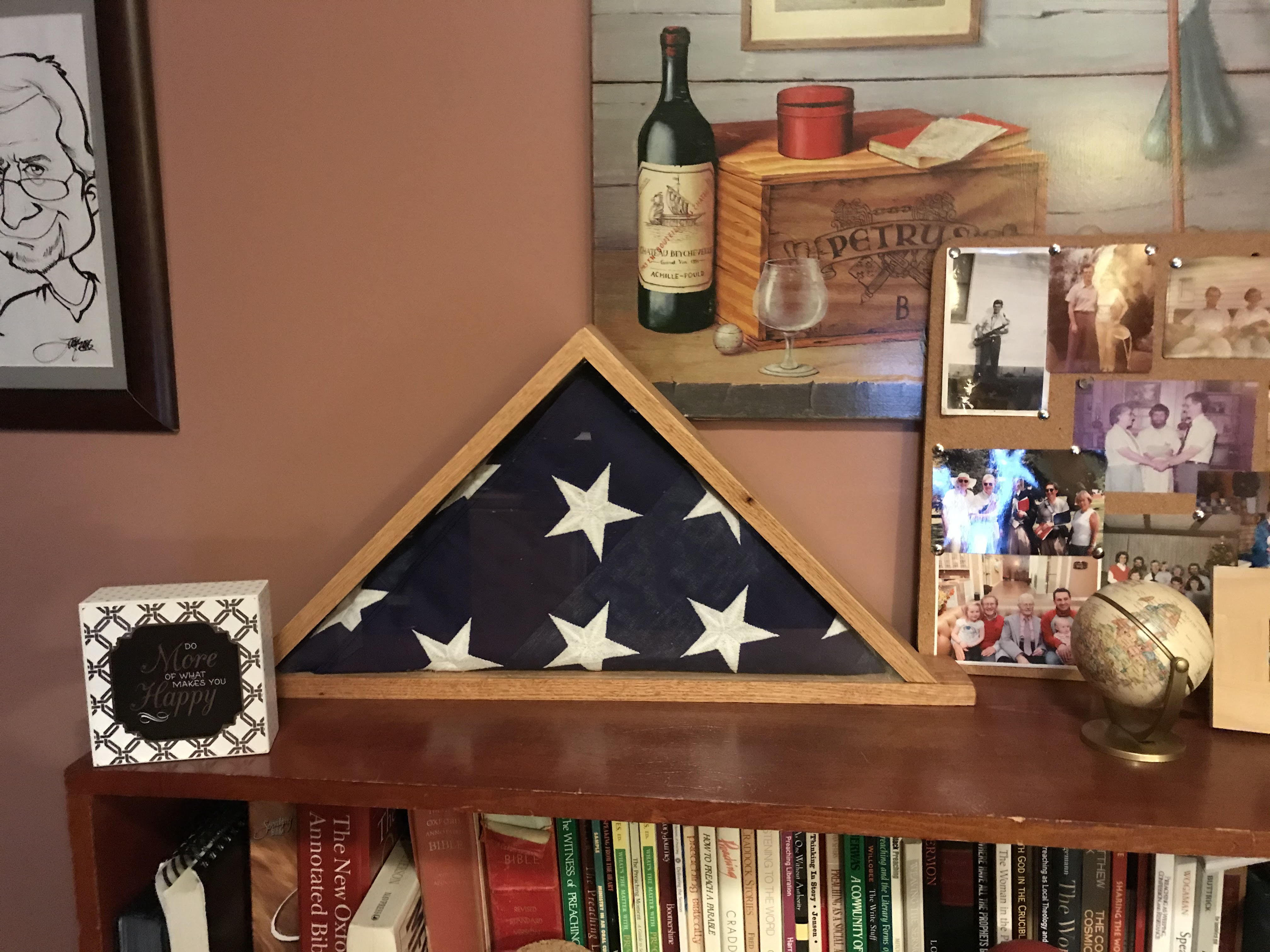
And while I’m on a roll I’ll add another mini-wave incident. I’ve had the flag from my father’s casket for over two years now and it has been in a plastic case provided by the funeral home all that time. A very good friend noticed the flag on a book case in my office recently when we were on a zoom call with a mutual friend. He said he had made wood and glass cases for flags for other people and would like to do one for me. It came via UPS yesterday, and putting the flag in the case and finding some of Dad’s WWII medals in the plastic case all brought up feelings of regret and appreciation for Dad again.

I have spent many vacations near different oceans and have experienced all kinds of waves—gentle ones that just lap at your ankles and angry ones that beat me up and tried to pull me out to sea with strong undertows. When I first thought about writing this post I was thinking more about ocean tides than waves, but I soon realized one major difference. The times for tide changes are so predictable and regular that they are published on charts that tell fisher people and beach goers, back when we could do that, exactly down to the minute when each high and low tide will be on any given day.

Waves are not predictable. They can lull one into a sense of false security, and then when least expected smack you upside the head with a big one. Grief is more like waves than tides. There are certainly times when feelings of grief can be predicted to arise—holidays, anniversaries of memorable events and of the day of death. But more often there are unpredictable waves of grief that just happen—driving by the place a loved one lived, attending the church where a service was held, hearing a particular song, looking at a picture, or just a memory that pops into one’s head uninvited. All of that is normal, and there is no right way to experience those waves or to predict how long they will last.

I knew a woman once who had been told that the normal period of grief for a spouse was two years, and she believed that as gospel. So she expected to grieve for two years, and that became a self-fulfilling prophecy for her. There is no right or wrong way to grieve. It’s great to have people come along side to share the experience when we want company, but each of us has to find our way through the grief journey in our own unique ways. As for me, I wish I had been more receptive and aware of my waves in the past, but I can’t go back and do remedial grief. I can only experience memories and emotions now in the present and welcome them with gratitude whenever they come along and actually choose to pay attention.

Stages of Grief in a Pandemic

I have been angry and depressed a lot lately, and I have been reflecting on how the stages of grief made famous by Elizabeth Kubler-Ross might help us figure out how to navigate a pandemic better. The five stages of grief Dr. Kubler Ross described are: denial, anger, depression, bargaining and acceptance. These stages are not linear or in any particular order and are most often thought of in terms of dealing with grieving the death of a loved one. But they can be helpful in understanding any kind of significant loss, including the loss of freedom, normal routines, contact with friends, family, etc. caused by Covid-19.

Denial: we have all been in this stage from time to time in the last few months, from the President on down. Denial is a normal reaction to bad news. None of us wants to believe a loved one is gone forever or that our health and ability to do normal activities has been drastically curtailed. I remember hearing the news that the Arnold Classic, a huge annual event with huge economic ramifications here in Columbus, Ohio had been cancelled. It was the first real evidence we had a serious problem, and I found it hard to believe when I heard that news. In retrospect it was a great decision made with courage and great insight by our government leaders. An event of that size that brought thousands of people to Columbus from all over the world would have been devastating to Ohio and made the death toll from the Coronavirus so much worse.

Denial is a normal reaction to bad news. It’s a defense mechanism that helps shut our bodies down the way novacaine numbs your gums to withstand the pain of a tooth filling or extraction. But denial is a stage, not a destination. We need to go there to survive a shock, but we can’t pitch a tent and stay there as a way to deny reality on a long term basis. Unfortunately the U.S. has failed in our response to the the pandemic because key leaders, including the President have hindered essential responses to the virus by denying the reality of the crisis. People who follow the lead of those who ignore the uncomfortable advice of experts from the medical and scientific communities are living in denial and get stuck in the grieving process, which in this case has deadly consequences not only for them but for our whole society.

Anger: Like spoiled children we all feel some level of anger when told we can’t do something we really want to do. I was really mad in the spring when my all time favorite sports events were killed off one after another in just a few days in March. College basketball tournaments died first and then in rapid order March Madness and the Masters golf tournament. In a blink of an eye my favorite few weeks of the year were felled like dominoes lined up back to back.

Students and families were robbed of graduations, final sports seasons for seniors dropped like flies, wedding plans trashed and countless other special occasions died painful deaths. And as the whole rest of the school year was cancelled and our economy shuttered the frustrations and anger increased exponentially as weeks dragged into months. Since it’s hard to be angry at an invisible enemy our anger got directed at public health officials who were just trying to do their jobs, at courageous governments leaders who made difficult and unpopular decisions to shut down any and everything we enjoy doing. Throw that kind of anger into an already politically divided society and you have armed protestors descending on state houses and the homes of public health officials, and that anger gets misdirected into rebellion against simple requests for the good of us all like wearing masks.

A friend of mine expressed that anger well when he said he rebelled at being told he had to wear a mask at a local retailer. His response, more fitting for a child than an adult, was to wear his mask on the back of his head. His argument, like those who decry the loss of their personal liberty, was that if asked to wear a mask he would have complied, but when he was told he had to that offended his personal freedom.

Depression: As our ability to deny a loss or lessen the pain with anger prove ineffective it is easy to fall into depression. When we feel powerless to change a situation and helpless to do anything about it depression is a natural and normal emotion to feel. And because we are still not good at talking about mental health issues it is easy for this one to be compounded by denying our depression. I was at the doctor this week and had to fill out a medical history and check any previous or current illnesses, and when I came to “depression” and “anxiety” I was reluctant to check those boxes even though I am currently in therapy and taking medications for both. When we are already feeling down or overwhelmed by other life issues or crises throwing a pandemic into the mix is like putting gas on a fire. Depression and its cousins, fear, worry, and despair in some degree are affecting us all just now, and as we are seeing a new surge of cases it is easy to play the blame game, go into victim mode and be overwhelmed.

Multiple grief over jobs, chronic illness, loss of contact with loved ones and friends, and support communities, loss of physical closeness and contact with others all compound the tendency to despair and surrender to our frustrations. Zoom contacts with friends, teachers, business colleagues, congregations and other significant contacts are a godsend, but they cannot replace real live human contact. Even those of us who are introverts are admitting we need people.

Bargaining: In the case of physical death and mortality this stage is characterized by promises to do x, y, or z if we or a loved one can just live a little longer or a miracle cure can be found to postpone the inevitable. In pandemic grief I’m not sure what this stage looks like. For some of us it may be if we are spared from this plague we will change our ways and correct some flaw in our lives. It may be a bargain for a loved one to be kept safe from the virus in spite of their risky behavior. This stage can take many forms; so it’s just good to be aware of when we find ourselves in that deal making mode with God or whomever we are negotiating with.

Acceptance: There’s no timeline or “normal” prognosis for how long it takes to get to the stage of accepting a loss we are grieving. Every person and every situation and relationship is different. Sometimes when we know a loved one or even oneself is dying there is time to do anticipatory grief, to be prepared, to say good bye, to make peace with the coming reality. Other times loss is sudden and unexpected and all the grieving must be done after the loss of a job or a relationship or a life. But regardless of the circumstances or timeline, good grief moves us toward a state of acceptance and peace with a new reality. This stage does not mean there will not be days when anger or denial come surging back like Covid-19, but those pangs of sadness become less frequent and less painful the more accepting we are of our new normal.

And so it is with this nasty virus. The more we can accept the reality of how pervasive and deadly this disease is, the better we can cope on a daily basis and the sooner we will be free of its hold on our lives. If we are impatient and fall back into denial and angry foolish behavior we jeopardize everyone’s life and prolong the hardship both personal and economic.

Acceptance does not mean being happy with the new reality. I am not happy that my parents are dead but I have learned to accept the reality that I am now an orphan and the oldest living member of my family. Am I sometimes angry or depressed about that, sure, but that doesn’t mean I refuse to believe all those things are true. Am I tired of wearing a mask and debating if it’s safe to go shopping or to see my kids, you bet. I’m exhausted by having my routines in life screwed up for over 3 months and for the foreseeable future.

I know that our collective denial in the early days of the pandemic cost us many lives. I know that on-going denial of the cold hard facts by the President and misinformation by his favorite news outlets is going to cost more lives and economic hardship. If wishing could make this virus go away it would have disappeared months ago. If firing the messengers who bring us inconvenient facts would change reality I’d be all for it. But that’s not how viruses work, and the sooner we as a total society accept the reality of our situation we will begin to win this fight. And if we don’t the awful history of how people rebelled against masks and restrictions during the Spanish Flu in 1918 and created a second and third wave much more deadly than the first will be repeated. So please friends, wear your mask. It won’t kill you, but denying the need to do so may kill us both.