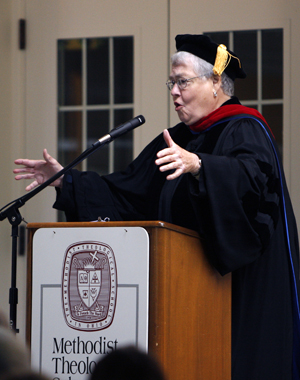
It is Well with My Body, Sermon on II Corinthians 12:7b-10

Those who know me might think the title of this sermon is a belated April fool’s joke. But it’s not. Our Lenten sermon series has been about spiritual wellness that comes not because of but in spite of the brokenness around us – broken systems, broken hearts, or broken bodies. And for some reason when we got to the theme of broken bodies everybody turned to look at me.

I am at the age where it seems the favorite pastime among my peers is to report on our aches and pains – even though we have all sworn we wouldn’t be like that when we got old. But if you are younger or fortunate to have fewer physical ailments than I do this sermon is still for you. When Paul says he asked God to remove the thorn in his flesh we think it must be some physical problem he had—arthritis, glaucoma, neuropathy? No wait that’s my medical chart. Seriously, biblical scholars have tried to figure out what Paul’s thorn was for 2000 years, and we still don’t know.

But it doesn’t matter because this text is not medical, it’s theological. It invites us to wrestle with the question of how we as Christians cope with the pains of life – physical, emotional, or relational, and we all have one or more of those. We even describe other frustrations as physical. We say “she/he’s a real pain in the neck” (or some other body part). A cartoonist depicts one such idea about Paul’s thorn like this.

One of my new year’s resolutions back in January was to be able to cope better with my chronic pain. Instead I learned again that it pays to be careful what one asks for. Less than a week into 2019 I was diagnosed with a torn rotator cuff. That wasn’t exactly what I had in mind, God! Now I’m sure I’ve asked God way more than three times to take away my aches and pains, but the answer I keep getting is the same one Paul got — which is “no.” Paul says God told him “my grace is sufficient for you.”

Today’s text also says, “Therefore, to keep me from being too elated, a thorn was given me in the flesh.” Other translations say “to keep me humble.” I don’t know how long it took but Paul came to understand that his problem served to keep him humble. I do know that when I stop focusing on my own problems and pay attention to people with more severe physical pain than I have that works for me too. I am in awe of those of you who come faithfully to church using a walker or a wheelchair, or wearing a knee brace, or in between chemo treatments–who keep a positive attitude in spite of the slings and arrows life has thrown at you.

What Paul learned from his thorn in the flesh is that we have to learn to deal with the hand we are dealt. It doesn’t have to be fair or even understandable – it just is what it is. God is not some supernatural magician who can pronounce a holy abracadabra and take away our pain. Our God is one who suffers with us and gives us the strength to carry on no matter what.

You’ve probably heard it said that we can’t control things that happen to us; all we can control is how we respond to the challenges of life. If that sounds like a cliché it’s because it is. But it’s also true. I had the privilege to witness that in action over the last few years as my father and mother-in-law both dealt with very similar end of life issues. Diana’s mother, Mary, was confined to a wheelchair and lived in assisted living for 9 years. She didn’t just have a thorn, she had a whole rosebush! She had plenty to be unhappy about, but she was always cheerful, content and pleasant in spite of all that. My dad was in similar physical condition in his final years, but his attitude was entirely different. He was angry and never satisfied with anything. He resented his circumstances and made life difficult for those caring for him and also for himself.

I don’t say that to be judgmental because I’m much more like my father than my mother-in-law. All too often I throw myself a pity party and catastrophize my problems even though I know better. I know that words matter especially how our self-talk shapes our attitude toward the challenges we face in life.

For example, I went to the thesaurus to find another word for “pain” while writing this sermon so I didn’t keep repeating myself. The first three choices my thesaurus gave me were: “discomfort, agony and aching.” What a difference a simple word choice makes in describing the same sensation. To be in “agony” is certainly a whole different ball game than having “discomfort” or “aching.” The good news is we get to choose how we want to label what we’re feeling.

Another way of saying that is that “pain is inevitable, but suffering is optional.” Pain is part of the human condition. No matter how much we wish it wasn’t, it comes with the territory. I find the Buddhist explanation for suffering very helpful. Buddhism says that we suffer because we are too attached to the things of this world which are all temporary, including these mortal bodies we are privileged to inhabit for a while.

My physical limitations remind me constantly that aging is about learning to let go — letting go of stuff I don’t need, letting go of things I can no longer do while humbly asking for help when I need it. Letting go frees up energy to celebrate the things I can do, and to give thanks for more wisdom gained through life experience.

If a picture is worth a thousand words (or has that number gone up with inflation?) then this one is definitely worth that much.

Letting go is important practice for the ultimate letting go that comes with mortality. But I would hasten to add that letting go doesn’t mean surrender. It doesn’t mean quitting all the things that give life meaning. It means finding ways to still do what we enjoy. Remember, nowhere in the Bible is there any talk of letting go of serving God and our neighbors. In fact one sure way to not be turned in on myself and my problems is to find ways to help others.

Humility means letting go of our need to control things. God’s answer to Paul is that our weakness allows God to be our strength. It boils down to God saying, “I’m God and you’re not – so trust me.” Those are great words to remember if you’re heading into surgery or awaiting a birth of a baby. Letting go of our need to control, of having things our way can also free us of anxiety, worry and fear which are all stressors that only make our physical pains hurt more. As the 12 step programs put it, “Let go and let God.”

I realized this week that humility is so central to our faith that it serves as bookends to the season of Lent. Every year we begin the season of Lent on Ash Wednesday. We put the mark of the cross on our foreheads with ashes, and the traditional words that are said are from Genesis 3:19: “Remember you are dust and to dust you shall return.” We don’t say that to be morbid, but to remind us all of our place in creation. Yes, we will all die someday, and making our peace with mortality makes every day of life all that more precious.

And at the end of Lent we have the ultimate example of what humility looks like in Jesus. The night before he was crucified Jesus prays for his thorn to be taken from him. In the Garden of Gethsemane Jesus says, “Father, if it’s possible take this cup from me.” We’ve all prayed that prayer. I know I have many times. But what makes Jesus’ example so important are the words that a come next: “Not my will but yours be done.”

I don’t pretend to have that kind of faith. Paul says he’s achieved contentment with “weakness, insults, hardships, persecutions, and calamities,” and no, Lord, I’m not asking for those so I can learn to deal better with them. But I do believe the secret to abundant life is what Paul describes elsewhere in Philippians 4:11 where he says he has learned to “be content with whatever I have” or as some translations put it “to be content in whatever state I’m in.”

A couple of years ago I chose Psalm 90 as the Scripture I read and meditated on during Lent. Mornings are the worst time for my discomfort; so I really identify with this part of that Psalm: “Turn, O Lord! How long? Have compassion on your servants! Satisfy us in the morning with your steadfast love, so that we may rejoice and be glad all our days.” (vs. 13-14).

Pity-party Steve gravitates to the first phrase “How long, O Lord? Have compassion on your servants. Satisfy us in the morning…” Yes, Lord, especially in the morning. But the compassion I’m asking for isn’t what I really need. I want to feel like a 30 year-old again. I want the pain, ache, discomfort, agony to all go away.

But the Psalmist has a much deeper request that works for every age and stage of life. “Satisfy us in the morning with your steadfast love, so that we may rejoice and be glad all our days.” The pain meds modern science offers are never more than a temporary fix, and because of our overreliance on quick, easy remedies we have an opioid epidemic that can lead to horrific addiction and death. There’s a reason we don’t say “In Big Pharma We Trust.” God’s solution to pain is simply unconditional steadfast love, and it doesn’t just last for a morning. It enables us to rejoice all our days because unconditional love doesn’t say “I love you if you are faithful and brave or if you don’t complain.” Steadfast love says, “I love you, period.”

And that is exactly what Paul means when he says God’s grace is sufficient – it’s all we need, no matter what kind of pain we are dealing with.
I want to leave you with a story from Robert Fulghum about how we deal with pain and suffering. Fulghum is best known for writing “Everything I Needed to Know I Learned in Kindergarten.” In one of his other books he tells about an experience in his early twenties when he worked for a country resort. He had to do the night shift as a receptionist and mind the stables during the day. The owner was not the most likable or the kindest person on the planet and Robert was getting weary of eating the same lunch every day. In addition, the cost of the lunch would get deducted from his paycheck. It got on his nerves.

One night, he could hold it no longer, especially when he found out that the same lunch was going to be served for another couple of days. One of his colleagues, working as a night auditor, was Sigmund Wollman, a German Jew and a survivor of Auschwitz; Sigmund had spent three years at the concentration camp. He was happy and contented in the same hotel where Robert was mad and upset. Finding no one else around to share his frustration, Robert spoke to Sigmund and expressed his anger against the hotel owner.

Sigmund listened patiently before saying: “Lissen, Fulchum, Lissen me. You know what’s wrong with you? It’s not the food and it’s not the boss and it’s not this job.”

“So what’s wrong with me?”

“Fulchum, you think you know everything but you don’t know the difference between an inconvenience and a problem. If you break your neck, if you have nothing to eat, if your house is on fire — then you’ve got a problem. Everything else is an inconvenience. Life is inconvenient. Life is lumpy.”

Fulghum says, “I think of this as the Wollman Test of Reality. Life is lumpy. And a lump in the porridge, a lump in the throat and a lump in the breast are not the same lump. One should learn the difference.”

When we are tempted to turn inconveniences into problems, God says, “Let go. I’ve got this.” And our best response is, “OK, not my will but yours be done.”

Preached on April 7, 2019, Northwest UMC, Columbus, Ohio

CALLED NOW! Luke 5:1-11, Scout Sunday

All of my best friends when I was a kid were my fellow Boy Scouts. Much to my chagrin one of them posted this picture on Facebook a few weeks ago – yes, I’m the short one. This picture is from the day Blaine and I got our Eagle Scout awards. My point is not to brag but to show the Scouts here today that if this 90 pound weakling could make it to Eagle anybody can!

I see a lot of parallels between what I learned in scouting and our Gospel lesson for today, and I want to focus on just two – trust and obedience. A Scout is trustworthy is the first Scout Law. But when I try to remember all 12 points of the scout Law the one I often omit is obedient. There’s probably some deep psychological reason for that, but we aren’t going there today.

When Jesus, a carpenter and itinerant preacher gives Simon the fisherman advice on how to fish Simon’s first response is to say, “Master, we have worked all night and caught nothing.” Simon’s tired, smelly and in bad need of his morning coffee and a shower. But the story doesn’t stop there. Simon goes on to say, “Yet if you say so I will put down the nets.” Why would he do that? Jesus doesn’t know anything about fishing, and yet when he says, “Put out into the deep” Simon obeys. Why?

Luke gives us a clue. Simon begins his response to Jesus by calling him “Master.” He wouldn’t do that if he didn’t already know something about Jesus that makes him respect and Trust him. But before they can catch a boat load of fish they have to translate trust into obedient action and actually “put out into the deep.”

What might putting out into the deep mean for you right now today?? What is God calling you to do that is risky, outside your comfort zone? To fish for people means we all need to spread Christ’s love and mercy to a friend, fellow student, family member, neighbor or co-worker – especially those who are very hard to love.

Another important part of Scouting is the Scout oath which begins, “On my honor I will do my duty to God and my country.” When I was a scout I equated those two things. But with more life experience and deeper study of the Scriptures I have learned God and Country are not one and the same. God is listed first in that oath on purpose. Duty to God is bigger than duty to anything else because God is bigger than anything we can imagine or comprehend. So when our personal desires or interests come into conflict with what God would have us do, our duty is to follow the example of Christ.

That’s what it means to be called to follow Jesus, to be his disciple here and now. The call to discipleship is not just something that happened way back then to Simon and the other fishermen. It is the urging of God’s Holy Spirit calling all of us every day to do our duty to God.

The fishermen were not expecting a call from Jesus. They were just doing their jobs to try and make a living – and out of nowhere Jesus calls them instead to make a life and a life changing decision.

What might that kind of call look like today if it happened to you at work or school? Maybe like this skit:

Cast: Andrea, CEO of a seafood company.
John Thunderson, a friend and client of Andrea’s company
Jamie, John’s sister and business partner

[The scene is a contemporary office – Andrea is the only actor who appears on stage. The others are heard from offstage via microphones. Andrea is at a desk with lap top, papers piled up, disheveled, coffee cups on table, looking very frustrated and harried, coat on back of chair.]

Phone rings – Andrea ignores it for a couple of rings, then answers it, cradles it on shoulder while still working at computer

Hello, yes, this is Andrea.
[Pause]
Hi Bro. Yes, as always, but I’m never too busy for a good idea, what’s up?
[Pause]
Wait a second, Simon; is this another one of your hair-brained pyramid schemes? If I had half the money back I’ve lost on your too-good-to-be-true investment tips I could retire today.
[Pause]
Just give me the bottom line – how much do you need?
[Pause]
No money? OK, I’ll bite, what’s the punch line?

[Cell phone rings] Hang on Simon; I’ve got another call coming in.

[Answers cell phone] Hey John. Can I buzz you back in a sec – I’m on my other phone?
[Pause]
OK, yes, I understand it’s urgent. I’ll get right back to you, I promise. My brother’s on the other line–needs some money or something. I’ll just be a minute. Thanks.

[Disconnects cell phone and goes back to desk phone}

Simon, you still there? Sorry about that. What?
[Pause]
Oh, it was John Thunderson. Probably needs a new jingle for his latest Thunderson Tuna TV campaign. Anyway, what’s the deal here?
[Pause]
You don’t need money, so what do you need? [Pause] My time? That’s even worse. How much time and for what?
[Pause]
Whoa, slow down. I’ve not heard you so excited since you won the singles championship at the club. Let me see if I’ve got this anyways close to straight. You heard this motivational speaker who’s recruiting volunteers, and you want me to go with you to a training session for two weeks — in Buffalo???
[Pause]
Simon, I can’t do that. I’m swamped here. We just opened that new processing plant in Savannah. The shrimpers union is holding me up for a huge increase in benefits. [Looks at calendar] And I promised Mike I’d take care of the kids this weekend so he can visit his mother. I just can’t.
[Pause]
Yes, I’m really glad that he’s attracting big crowds. And I know we can use all the networking and publicity we can get for the business. You go and let me know how it looks when you get back. What kind of time commitment are you looking at after the training session?
[Pause]
Well, you better find out. I need to get someone to cover your territory if you’re going to be a groupie for this guy and save the world.

[Looks at phone] Now what? Text just came in. Gotta go, bye.

[Dials desk phone]

Jamie, it’s Andrea. Got your text. What’s going on?
[Pause]
Yeah, John called awhile ago, but I was on the other phone; so I haven’t really talked to him. You sound excited about something. Is everything OK?

[Cell phone rings] [Pauses and looks at phone] – Yeah, it’s John again, hang on Jamie.

[Answers cell phone]

John, sorry, I haven’t had a second to call you back yet. [Pause] Yeah, matter of fact; she’s on the other phone right now. Listen, let me call you back and we can do a conference call, OK?

[Hangs up cell and picks up desk phone] Jamie, you still there? Good. Listen, that’s John on the other phone. Let me put you on hold a minute while I call him back and we can all talk together on a three-way, OK?

[Punches buttons on phone] OK, you both there now?

John and Jamie: [together, from off stage over mic] Yes, I’m here.

Andrea: Good. What’s going on, you both sound frantic about something? Your folks OK I hope?

John: [excitedly] Yes, they’re fine, thanks, but I called because I’ve got this great idea I need to talk to you about!

Jamie: [interrupting] And I called to warn you about this crazy idea that has relieved John of his senses!

Andrea: Whoa, one at a time, please. Jamie, you go first.
Jamie: Andrea, please talk some sense into my brother will you? He’s gone batty over this guy and wants to run off tilting at windmills!

John: Jamie’s just too conservative, Andrea, not willing to take any chances. This is really big and we need to get in on the ground floor. I mean you have to hear this guy in person to understand. He’s just amazing, the way he can motivate people and inspire loyalty and creativity.

Jamie: But what does he know about the fish business? He’s a building contractor, for god’s sake!

John: For God’s sake–that’s it! I couldn’t put my finger on it, but that’s it! He’s got some kind of extraordinary power. Why take chances with something that awesome? If he’s a phony, he’ll fade away faster than Frosty in the noon day sun. But if he’s the real deal, I don’t want to be on the outside looking in. And I don’t want my friends and family there either.

Andrea: Slow down, you two. Who in the world are you talking about?

John: Didn’t Simon tell you? He said he was going to Buffalo for the training.

Andrea: Oh, that. I didn’t realize you were talking about the same thing. I didn’t listen to him all that carefully I’m afraid, just too much other stuff going on.

Jamie: Good for you, Andrea. I’m glad someone still has at least one foot planted in reality. This guy is a contractor who has had some kind of religious experience and thinks he’s God’s gift to humanity. He’s peddling peace and love and a bunch of feel good stuff that just won’t play in the real world. I hope you didn’t let Simon sell you a bill of goods.

John: I can’t explain it, Andrea. But, trust me, you owe it to yourself to meet this guy and decide for yourself. There’s something about him that I’ve never seen or felt before. He simply exudes this amazing sense of peace. He looks at you, and it’s like he sees right thru to your soul.

Andrea: Sounds like x-ray vision to me. I don’t want anybody getting that close to me, thanks.

John: I know, I didn’t think I did either. But this is different. There’s no sense of threat, no judgment–just affirmation and love. He takes you where you are and draws out the very best in you. I’m going to Buffalo this afternoon, Andrea, and I think you should come along, really.

Jamie: Great and you’re leaving me to take care of Mom and Dad AGAIN?

John: Yes, Jamie. They’ll be OK for a few days. This is more important. I’ve never felt so sure of anything in my life. Please come too, Jamie; give it a chance. The rat race we’re in isn’t making you happy. There has to be more to life than selling fish. This is more important, I just know it is.

[Pause–while Andrea weighs her options, then starts putting her coat on to leave]

Andrea: Sorry Jamie, I’ve known John since high school, I’ve never heard him so psyched before. I’ve got to see what this is about. It’s up to you, but I wish you’d come with us and give it a try.

[Andrea hangs up phone and exits, leaving everything as is on the desk]

I wrote that skit 15 years ago for a clergy gathering that was held here at Northwest over in the ministry center. It was the first time I was ever in this building, and I had no idea that part of my call would bring me here to be part of this great congregation many years later. I want to thank the talented people who made that video possible – you probably recognized Heather Sherrill as Andrea, but off camera were two other wonderful people – Barbara Luke as Jamie and our AV coordinator Eric Gauder who recorded and produced the video. These are very busy people. It took about a week of texts and emails just to find an hour when we were all available. Yet they took time to do this because they know that part of their call is to share their talents with and for God’s church.

God is still calling you and me every day, but like Andrea and John in the skit we stall and procrastinate and rationalize. So why do we resist God’s call upon our lives? When the first disciples haul in that amazing boat load of fish Luke says the crowds were amazed. But notice Simon’s immediate reaction when he suddenly realized who Jesus is. He falls on his knees and says, “Go away from me Lord, for I am a sinful man!”

It’s that feeling you get when going a little over the speed limit and suddenly realize there’s a state trooper with a radar gun aimed right at you. To follow God can be scary because of guilt, sin, insecurity, or the big unknown of just what doing our duty to God might involve. Jesus is calling these fishermen to leave everything they have done, everything they do — their comfort zone, their livelihood. And he offers no detailed job description. He just says, “Follow Me.” That’s scary- like being a federal employee trusting the government won’t be shut down again in five days.

When I first felt my own call to become a pastor I was 15 and at a senior high church camp worship service. We were asked to sign a 3 x 5 card if we felt called to some kind of Christian service. I signed the card, but I didn’t tell a soul – not even my family. In fact it took me 4 years before I was ready to reveal that call publicly. Why? Fear – I was afraid of being ridiculed or shunned by friends who would be afraid to be themselves around me. As you saw in that first picture I was already a little nerd. I didn’t need any other uncool qualities for my peers to judge.

So I said “Sorry God, I’m going to be an aeronautical engineer.” I lived in Neil Armstrong’s hometown so that was a very respectable calling. And it promised a lot more financial security than being a pastor. But God doesn’t play fair. She persisted and even used my first college calculus course to finally convince me to switch majors and plan on going to seminary.

But answering God’s call does not mean you all need to enroll in seminary tomorrow. God’s call is as unique for each one of us as we are all different in many ways. God’s call is very simple- just love each other – and that requires no graduate degree. It can be a ministry of your presence at a funeral, a phone call or a card to lonely friend, taking a meal to a grieving family, donating to charity, praying for someone in need, visiting a nursing home, writing a letter to a legislator about a social justice issue. Opportunities to answer God’s call are all around us, here and now every day. Our call is to pray for wisdom to discern what it is God wants each of us to do right now and then trust that call enough to go into action.

All the church growth experts agree that people are most likely to visit a new church if someone invites them personally. Notice that in the Scripture for today Jesus gives a personal invitation to the fishermen, and for them to respond so quickly he must have done it with urgency. We can’t tell from the written narrative – we don’t have snapchat photos or video so we miss the inflection in Jesus’ voice or how it felt to have Jesus look you in the eye and say “Follow Me.” And he spoke their language. They knew how to catch fish; so he says, “Come with me and I’ll put the talents you’ve already got to work catching people for my Kingdom.”

We have to be smart about discerning when God is calling us and when it’s a wrong number. The best way to be smart is to enlist help. Scouts are organized in troops – there no such thing as a solo scout, and there’s no such thing as a solo disciple.

Obedience to God doesn’t mean taking every problem on personally. Even Jesus needed help and called disciplines to join him. Well, guess what – Jesus needs reinforcements even more today. He’s no longer walking this earth and relies entirely on people like us to Trust and Obey him. If we do God empowers us with the Holy Spirit and will guide us to discern exactly what it is we are each called to do. And when we say yes, God provides the courage for us to do our duty.

God often speaks to us through music, and this week for me the message has been coming through a loveable green frog. Kermit puts it this way: “Have you been fast asleep, and have you heard voices? I’ve heard them calling my name. Is this the sweet sound that calls the young sailors, the voice might be one and the same. I’ve heard it too many times to ignore it. It’s something that I’m supposed to be. Someday we’ll find it, the rainbow connection, the lovers, the dreamers and me.”

May today be that day. Amen

Benediction: What is God calling you to do? God is pretty persistent – so you might as well answer the call, nudge, text, email or personal invitation. You won’t regret it. Go in Peace.

A Tribute to Bishop Judy Craig

The world is a little colder today and not just because the weather outside is frightful. With thousands of people around the world I am mourning today the death of Bishop Judy Craig. When my mother and mother-in-law both died within 3 months of each other Bishop Craig went out of her way to inquire how I was doing when I saw her at a meeting. She was the most pastoral and yet genuinely prophetic human being I have ever known. 15 years later when we were colleagues at the Methodist Theological School in Ohio – I was the director of the Doctor of Ministry program and Judy was Bishop in Residence. She was scheduled to teach a course in that program one weekend and got news on Thursday that her brother had died out of state. I was also out of town and very concerned about who would teach that course, but when I reached Judy on the phone there was not one question about it. She was at peace with human mortality and knew there was a time for mourning, but it would be after she taught that course.

The last time I saw Judy was at a special dinner in her honor at the seminary where a scholarship was established in her honor. She had her portable oxygen with her, her physical being was failing; but it was oh so very well with her soul. When I waited my turn in line to greet her after the dinner I bent down to speak to her and in true Judy Craig style she complained about our making all this fuss over her. But then she did something I’ll never forget. She pulled me down close to her and kissed me on the cheek; and now I will always know what the kiss of peace is.

She was a rebel and a trailblazer for any and all who were marginalized, but she also had spent many years in local church ministry where she learned the art and necessity of balancing pastoral and prophetic ministry. When she gave the best commencement address I’ve ever heard at MTSO in May 2008 she told this story that captures the very essence of her spirit which lives on in all of us who were blessed to be touched by her life.

“I’m reminded of the story of a farmer who hired a builder to come and use the finest materials and build a beautiful barn. Then the farmer went out and got on his tractor and bulldozed down the old barn.

And the next day there was a storm threatening, but the farmer went into town anyway. And the storm hit, and the sleet was going sideways, and as he drove home, he was smiling to himself because he thought of his cattle in that nice, warm barn. He’d left the doors open so they could get in.

But when the farmer got home, he found the new barn empty. He went back out in the sleet and the wind, leaned into it as he walked toward where the old barn had been. And there, huddled in the wind and the sleet, were the cattle – inside the foundation of the old barn.

Recognize that? You’ll encounter people like that. Just then, dig out your patience and your modeling and your best invitational self. Pull out those great biblical illustrations about God’s future and the wonderful stories of church history. And then go and stand with those miserable cattle in that wind and love them anyway until they will finally begin to follow you into the new barn.”

Judy, you will always give us compassion to love because you so loved us.

4th Sunday of Advent, Candle of Love

Like expectant parents we can hardly wait for the miracle of new birth this Advent season. Our spirits are anxious about the labor pain required of us to be reborn in Christ, but the Love of God is stronger than our fears. And so like Mary and Joseph and. Elizabeth we dare to say no to hate in all its ugly forms and a resounding yes to God’s gift of Love wrapped in swaddling clothes.

It is God’s love we celebrate in Joseph’s devotion to Mary, a love so strong that even the baby John feels it while still inside his mother. It is love that dares to believe in the impossible, even a virgin birth. Love is the source of all of the Advent gifts. Hope, Peace, and Joy all flow from God’s love, but the greatest gift is Love. And so on this 4th and final Sunday of Advent we light the Candle of Amazing Love that gives Hope, Peace and Joy to a world that badly needs them all.

Prayer of Confession: Please pray with me: O God of holy expectations, we are humbled when we ponder the faith and trust of all the Christmas story characters who trusted and believed in the power of your incredible love to change the world. We confess we don’t say yes to your Holy Spirit like Mary did, we don’t believe like Joseph, we don’t leap for joy like Elizabeth. The pressure of deadlines and responsibilities are enemies of love. Fear of getting outside our comfort zone keeps us from sharing the most precious gift of your love. Help us in the middle of this hectic season to recognize acts of kindness in others and face honestly our own failures to trust and obey your radical claim upon our lives. Help us keep Christ in us. Give us eyes to see the star, ears to hear the angels and the courage to obey and go where you say. Our Christmas prayer, O giver of life, is that we will be open to your amazing love being conceived in us this Holy Season. Amen

Incomprehensible Incarnation

Amid the cacophony of the mad world, in the darkest days of the year, in times of personal stress or sorrow, when we most need the peace that passes all human understanding, that’s exactly where God chooses to break into our world. Praying that you will feel that holy presence wherever you need it most this Christmas.

THIRD SUNDAY OF ADVENT LITURGY: JOY

First Reader: On the third Sunday of Advent we ponder and celebrate the gift of Joy. We remember that life was not all calm and bright for Mary and Joseph either. The Holy family lived under oppressive Roman rule. Because there was no room in the inn Mary’s labor room was a barn. And yet baby Jesus slept in heavenly peace there in his manger bed.

Second Reader: From day one Jesus shows us that Joy does not come from external circumstances. As he would later sleep through a storm at sea and face crucifixion with steadfast faith, Jesus shows us that joy is an internal state of being, and He is the way to true Joy. He was at home in God’s universe no matter what was going on around him. (As reader 1 lights 3 candles) And so today we relight the candles of Hope and Peace and add the third candle, the candle of Joy.

Unison Prayer of confession: O God who loves us so much you came to a humble stable. You sent John to warn us to turn back from the things that bring us no joy. We confess we have not always listened to your prophets. We have not always lived lives that bear good fruit. We have failed to receive the power of your Holy Spirit. This Advent, fill us to overflowing with true joy. Let us follow the true Messiah who sets us free to share joyfully with our neighbors. Teach us to be humble bearers of Good News so our lives may be signs that proclaim Joy to the World. Amen

ADVENT PEACE

Advent is a season of waiting – not waiting for Christmas, but for Christ to come again. We wait and hope for a Savior to come into a world hungering for peace. We wait for God to set us free from the cares of the world that keep us awake at night. We long for a life that is calm and bright.

But sometimes we look for peace in all the wrong places, or we give up looking at all. We feel trapped in jobs that frustrate us, in classes that seem useless, in negative habits that do not serve us well. We confuse peace with comfort and security.

God’s peaceful kingdom is not anything the world can give us. It is a gift to those who know where to seek it, who follow the right star and listen to the angels instead of King Herod. God’s presence does not spare us from life’s problems, but is a peace of mind available everywhere in any of life’s circumstances if we make room for Christ.

And so today we light the second candle of Advent, the candle of peace, to remind ourselves to prepare while we wait for the Prince of Peace.

PRAYER OF CONFESSION
O Holy one who comes to set the captives free, we confess that for too long we have allowed ourselves to be imprisoned by guilt, shame, fear, anger or hopelessness. We have put our trust in things that thieves can steal and rust can consume, and we are always disappointed. Our souls long for peace, but we have been led astray by false prophets of prosperity. We pity ourselves because of adversity and expect peace to just be provided for us. Speak to us again in the stories and songs of Advent. Come Emmanuel, be with us here and now and help us trust you enough that we can give up our foolish pursuits and find true peace that only comes when we are at home in your kingdom. Amen

Convicted and Needing Grace

Journaling is one of my forms of self-therapy. I regularly vent, ponder, reflect and sometimes just record things I’ve done or the state of my mind and heart. Often I try out ideas I might want to blog about in my journal and then go back and explore them further and in more “polished” form. But today I just want to share what I wrote last evening about an issue that has been troubling me and messing up my faith journey for quite some time. I may return to this later and share my progress on it, but in the meantime I welcome comments and insights. Here’s what I wrote about 10 pm last night:

“Heard an excellent sermon on I Corinthians 13 today from one of our pastors, Mebane McMahon, and even before she preached I heard conviction in the reading of the text about my own failure to “endure, believe, hope all things.” My anger at Trump and his gang is eating at me and that’s not the Gospel. I remember one of my mentors “Bogie” Dunn talking about people we least want to include already being in God’s house – his example was Nixon and for me it’s Donald J. Trump There was a time early in his term that I was able to pray for President Trump by name but haven’t done that in months now. I have also forgotten to remind myself that I am and he is too a child of God. Something has made him the angry, racist, sexist, dishonest person he is and to try and understand that, which I am sure I never will, is more valuable than just anger and hate at his behavior, no matter how evil I think it is. He is still redeemable – if that is not true then the Gospel is false and we are all doomed. Those are hard truths to embrace but if I want that kind of grace for myself then I have to be willing to affirm and share it for everyone. And that means everyone. “I believe Lord, help my unbelief.”

Story/Sermon on Mark 10:17-27

I want to try something different this morning. This sermon will be in the form of a story I’ve written based on this text from Mark’s Gospel. In particular the story deals with the rather shocking response that Jesus gives to the man who asks what he must do to inherit eternal life. We expect Jesus’ questions about keeping the commandments, but after the man assures Jesus that he’s done what the law requires all his life we come to verse 21. “Jesus, looking at him, loved him and said, “You lack one thing; go, sell what you own, and give the money to the poor, and you will have treasure in heaven; then come, follow me.” 22 When he heard this, he was shocked and went away grieving, for he had many possessions.”

So here’s my story:

“I’m afraid I won’t live to tell this tale; so I’m going to write it down.” So begins a journal entry by Marion Browner. I found his journal, a small spiral notebook, sealed in a zip lock bag as I was walking along a Martha’s Vineyard beach. It had apparently been washed ashore by the tide.

The entry dated March 23 continues: “My bed banged into the wall and jolted me awake this morning—seems like a year ago. My first thought was, “Oh, no, an earthquake!” But then as sleep cleared from my head I remembered where I was. I’m still not sure what happened. Our ship must have hit an iceberg or another ship. I don’t know and probably never will.

Obnoxious fog-horn alarms started blaring and mass confusion erupted all over the ship. My stateroom was three levels below the evacuation deck and it was difficult to get up there. Everyone was jamming the passage ways in a state of near panic and the ship was listing rather badly to port. I started out of my room once and heard someone yell that we were taking on water. Fearing we might have to abandon ship I pushed my way back against the flow of the crowd to my room and tried to decide what to take with me. I began throwing some things into a duffle bag—extra clothes, this journal, and a novel I’m writing. Part of the novel was in my laptop, and I hated to lose it. I had just broken through my writer’s block and had done some good writing on this cruise. So I decided to take the computer and put it and my duffle into a carryon suitcase. It was a bit heavy but I couldn’t bear to lose that good work.

I struggled through the crowd of passengers and found pandemonium on deck. It was still dark and cold and the early morning fog made it even harder for crew members to organize the evacuation of the ship. There was a lot of pushing and shoving as everyone jockeyed for position, trying to get to the lifeboats. I’m not sure what happened in the next few minutes, but I finally found myself in a small life raft with several other people and we were quickly lowered over the side into the water.

The cold north Atlantic sloshed over us as we struggled to keep ourselves upright. One man was washed out of the lifeboat, but someone else (I later learned her name was Susan) was able to grab his hand and hold on till the rest of us could pull him back in.
By the time we stabilized ourselves and got our cold wet lifejackets on I realized I could no longer hear other voice. We had drifted away from the ship and the other lifeboats. An hour or two later when the fog lifted there was nothing to see but water—water all around us and ankle deep in our boat.

We are a bedraggled crew: Susan, the lifesaver when John went overboard, is a strong, athletic-looking woman. It turns out she really was a lifeguard in her college days at Duke, and although it wasn’t obvious in the soggy sweat suit she was wearing she is now a professional body builder. Lucky for John—she was probably the only one in the boat strong enough to save him.
John is a CPA for a Madison Ave. conglomerate, an uptight, obsessive-compulsive type. If exposure or thirst doesn’t kill him, having his Brooks Brothers suit ruined probably will.

There are three others in our boat: Brandi, a beautician and wannabe model from New Jersey; Phil, an art museum curator from Montreal, and Carlos, who turned out to be a Roman Catholic priest from Philly—but you would never have guessed it from seeing him in his dripping bathrobe and pjs.

That makes six of us altogether, and the lifeboat could accommodate up to 8 normally, but we are far from a normal crew. In the first few minutes after we realized we had drifted away from the others I knew we had a serious problem. I’m sure most of the others did too, but no one wanted to talk about it.
The lifeboat was still taking on water—in part from the waves washing over the sides, but mostly because we are overloaded—not with people, but with baggage.
I wasn’t the only one who packed before jumping ship. All of my fellow refugees were clutching bags of odd shapes and sizes; and when I pointed out that we really had to lighten our load or we were going to sink, I met with great resistance.
Susan, the body builder, had brought several of her smaller weights with her and was already beginning a limited version of her regular morning workout. The weights are obviously expendable, but after one look at the ease with which she did one-handed curls with a 20-lb. weight, no one was going to tell her so.

John the CPA had a brief case full of important business contracts he was working on, and from the way he was clutching it to his chest like a security blanket, it was obvious he wasn’t going to part with it without a fight.

Brandi had a large suitcase and a matching makeup bag. When I asked her what was in them, she said her make-up, jewelry, clothes, and her portfolio of modelling portraits. She was just beginning to explain why she couldn’t afford to replace any of it because she was only working part-time and none of it was insured when Phil yelled something about what a waste that crap was and lunged across the boat at Brandi. He managed to throw the make-up bag overboard because Brandi couldn’t hold onto both pieces of luggage at once. She would have gone in after it, but Susan grabbed her. So instead Brandi went after Phil and tried to get even by throwing his baggage overboard too.

Phil had a large rectangular package, obviously some kind of painting. He told us later, after the scuffle, that it was a Renoir that had been in his family for generations. But Brandi couldn’t have cared less about art or family heirlooms at that point! She was furious and did her very best to give Phil and his priceless painting a salt-water bath. I thought they were going to capsize us all before order was restored, once again enforced by Susan. We were all relieved when everyone was seated again, but what we failed to notice at the time was that in the struggle the corner of Phil’s picture frame had made a small puncture in the skin of our life raft.

When everyone calmed down a bit I tried again to initiate a rational discussion of which baggage was expendable (hoping no one would notice the suitcase I was sitting on). Everyone of course thought their own prized possessions were more valuable than anyone else’s. Compromise seemed hopeless. Everyone was simply banking on our being rescued before the lifeboat sank of its excessive cargo weight. The best suggestion anyone came up with was to take turns bailing the water out of the boat.

When we started looking for something to bail with we realized that we hadn’t heard a word from one member of our crew. Nobody much cared, except we didn’t know what Carlos had in the small, worn leather bag he had brought with him. We didn’t know yet he was a priest either, but that became very obvious when he showed us the rosary, chalice, Bible and bottle of holy water in his bag.
Phil said sarcastically, “Well, at least he can give us last rites, but this cup will work great for bailing.” Brandi objected and grabbed the chalice from Phil. “You can’t use that, it’s holy!” she said.

Father Carlos smiled and spoke for the first time, “I can’t think of anything holier than saving life. It’s OK Brandi,” he said, making the sign of the cross and handing the chalice to Phil, who started bailing immediately. Carlos continued, “And if we ration this holy water very carefully for drinking it may keep us all alive for a day or two. These other things won’t lighten our load very much, but every little bit will help,” he added as he tossed his rosary and Bible overboard.

“Father! You can’t do that,” screamed Phil as he jumped in after them. Susan did her lifeguard routine once more and fished Phil out, sputtering but empty-handed. While he shivered, John took up the theological debate questioning how Father Carlos could possibly risk doing anything to alienate God at a time like this?
Carlos was still amazingly calm. “At a time like this,” he said, “unless the word of God is in your heart the Bible won’t do you much good anyway. I’m scared too, John, but our situation reminds me of the time someone put a life and death question to Jesus. The six of us are like the man in this story – we want more than anything to be saved. You see, this man asked Jesus, ‘What must I do to inherit eternal life?’ He was a very good man, but Jesus told him he lacked one thing. Jesus told the man he needed to sell what he had and give to the poor.

The man had a lot because he was very rich. But Jesus knew he needed to let go of what was keeping him from really giving his life to God.

There was a deafening silence in the boat, except for the sloshing and scraping of Phil bailing water with the communion chalice. Finally Susan said, “You mean we need to throw this junk overboard, don’t you Father?” But before Carlos could answer John declared, “I’m not giving up contracts until these two broads give up their weights and make up and Marion gives up that suitcase he’s been sitting on! Those things can be replaced, and what good is a stupid painting when your life’s at stake?
Everyone was ready to gang up on John and throw him overboard, but Fr. Carlos intervened again, quietly. He said, “You know, the person in that Bible story goes away full of sorrow. He wasn’t able to let go of his possessions either, and then Jesus says, “How hard it is to enter the kingdom of heaven.”

The last page of the journal was scribbled, like Marion wrote it very quickly. As best as I can tell it says: “I think Fr. Carlos was beginning to get through to some of us, but Susan screamed just then because she noticed the tear in the lifeboat. It must have just gotten bigger and the air is rushing out pretty fast. I don’t know what’s going to happen. Everyone’s throwing their stuff overboard now. I just hope it’s not too late…”


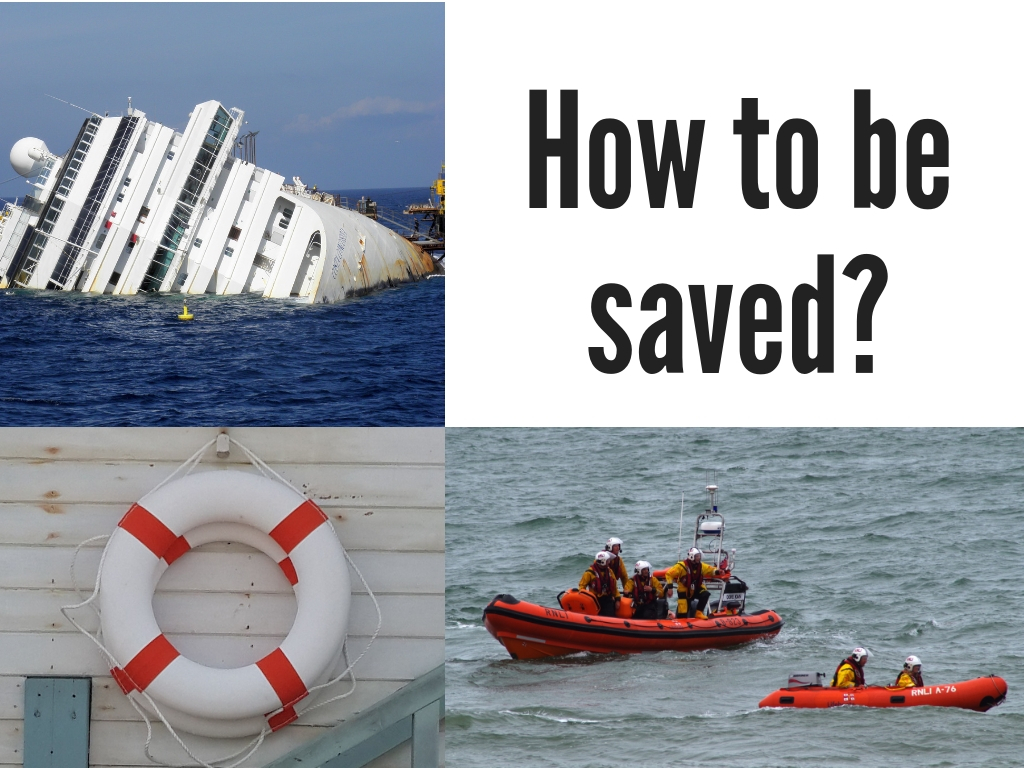
Let us pray: O God, what must we do to be saved? Remind us it’s never too late to give ourselves to you. Speak to us the assurance that grace is a free gift, and that there is nothing we can do to earn it. It is difficult to enter your kingdom because it is so hard for us to let go of our security blankets.

In this moment God, help us to honestly confront the idols we worship:
Be they idols of pride in our looks, or in our strength, ability, portfolios, education, status or power.
Help us throw overboard the material possessions – the new cars, X Boxes and fancy toys, our designer clothes and ever-present electronic devices. Unburden us of whatever holds us back or slows us down on our walk with you, O Lord.

Give us strength to win the battle with the demons of coveting, of our pursuit of houses that are bigger and nicer than our neighbor’s, goals that consume us and keep us from seeing the Gospel truth of how we need to live as Jesus followers.
Let us put away the idols of faith in our own achievements or self-righteousness as ways to save ourselves, ideologies and doctrines that divide instead of unite us.

Help us to see clearly Lord how those idols threaten our relationship with you, and our way to eternal life itself. Please give us strength to let go of those idols before it’s too late. We don’t want to be like the person who came to Jesus. We don’t want to go away full of sorrow because of possessions that posses us, but may we go away rejoicing, like camels, who freed of their burdens can slip through the eye of a needle.

We offer these prayers because we know that with you all things are truly possible. Amen

Northwest UMC, October 14, 2018

A Pastoral letter to Judge Brett Kavanaugh

Dear Brother Kavanaugh,

I write as an American citizen very troubled by your lack of credibility and qualification for a lifetime appointment on our highest court. But suspending my doubts about your character to the best of my ability I write to you as a fellow Christian who is obviously troubled to simply share the good news of the Gospel of Jesus Christ. While I do believe Dr. Ford, I still feel compassion for your suffering, and I am embarrassed for my country that the bitter partisan divide in this country has contributed to your pain.

I do not presume to know what transpired between you and Dr. Ford or other women three decades ago. Those judgments ultimately rest between you and your God. What I do know as a man and from 50 years of Christian ministry is that being confirmed to the Supreme Court will not ease your pain. Jesus Christ famously said, “You shall know the truth and the truth shall set you free.” (John 8:32) Truth is the firm foundation of faith and our system of justice.

I raise the issue of truth because your testimony before the Senate Judiciary Committee, your interview on Fox, and today’s Op Ed in the Wall Street Journal are not consistent with your behavior before the Judiciary committee or with the testimony of multiple people who knew you in your youth. I am not talking about charges of sexual assault or misconduct; those are much more serious accusations that for political reasons have unfortunately not been fully investigated. I am talking about your characterization of yourself in your youth as a model citizen and student and your denial of excessive drinking which multiple friends and acquaintances have contradicted. I am talking about your assertion in the Wall Street Journal that you are non-partisan when you have been a political operative for decades and delivered a very partisan attack on your critics in your prepared testimony to the Judiciary Committee.

Please don’t get me wrong; I am not passing judgment on you for youthful excesses. It is your denial of those incidents and your lying to the Senate about the meaning of certain sexual activities described in abbreviations on your calendar that prompt me to write out of concern for your obviously troubled soul.

Your testimony last week called to my mind some words of Scripture that simply will not leave me and that I feel moved to share with you and any others who want to know the secret of dealing with guilt. Guilt is the heaviest burden any of us can carry around with us. It is a constant presence that takes tremendous amounts of energy. I know this from personal and pastoral experience.

The text from the New Testament that has been in my mind for the last week is I John 1:8 where it says, “If we say that we have no sin, we deceive ourselves, and the truth is not in us.” Sin is a part of the human condition. We are all fallible human beings who “fall short of the glory of God” to put it in the words of the great sinner St. Paul. And because we are all sinners the greatest gift we can give one another and ourselves is the gift of forgiveness. Again from personal experience I know that self-forgiveness is by far the hardest thing of all.

But here’s the truth that sets us free; there is only one road to freedom from guilt, and that road is confession, facing the hard truth about ourselves whatever it may be. Confession is hard, but it is a prerequisite to forgiveness and nothing compared to the agony of carrying the backbreaking burden of guilt. No, I’m not talking about public confession; it’s probably too late for that, and my experience is that public confession is only possible after we experience the forgiveness of God.

So here’s the Good News of the Gospel: In the very next verse after I John tells us there is sin in the best of us come these marvelous words of Grace; “If we confess our sins, he who is faithful and just will forgive us our sins and cleanse us from all unrighteousness.” Yes, it says ALL unrighteousness!!

However the Senate votes, whatever your professional future holds, for the sake of your eternal soul dear Brett, please know that confession before our God of grace and mercy is the ultimate and only truth that will set you or any of us free.

Grace and Peace, Pastor Steve Harsh