GOD’S CHOSEN SERVANT, SERMON ON ISAIAH 42:1-9

Today, the Sunday after Epiphany, is the Sunday in the church year when we celebrate the “Baptism of the Lord.” Matthew, Mark and Luke all report in identical words that Jesus was baptized in the Jordan River and that when Jesus came up from the water “suddenly the heavens were opened to him and he saw the Spirit of God descending like a dove and alighting on him. And a voice from heaven said, “This is my Son, the Beloved, with whom I am well pleased.”

That Scripture tells us who the Messiah is, and the Isaiah Scripture we read today is one of Servant Songs in Isaiah that describe what kind of Messiah this beloved Son of God will be. Listen again to what these words from Isaiah say:

I have put my spirit upon him;
he will bring forth justice to the nations.
2 He will not cry or lift up his voice,
or make it heard in the street;
3 a bruised reed he will not break,
and a dimly burning wick he will not quench;
he will faithfully bring forth justice.
4 He will not grow faint or be crushed
until he has established justice in the earth;

In case we might miss the point this text tells us three times that “he will bring forth justice.” I’ll come back to that later, but I want us also to notice that this Servant Song not only emphasizes the Messianic purpose of justice; it also makes it very clear how justice will be accomplished, and that is in a peaceful, non-violent manner. God’s servant is gentle – does not shout or lift up her voice; does not quench a dimly burning wick or break a bruised reed.

More than ever in the nuclear age we need to remember that the ways of Christ are non-violent and peaceful.

I used to have a bumper sticker on my car that said “Another United Methodist for Peace and Justice.” My son asked me about that slogan one day. To him it seemed contradictory to talk about peace and justice together because like many people his concept of justice was one of punishment and retribution, as in giving people their just desserts. But that is not the biblical meaning of “justice.” In biblical terms justice means wholeness, equality and fairness for all, and when we understand it that way we realize that peace and justice are not contradictory terms at all, but in fact unless there is justice for all there can be no true peace.

Here’s a case in point about what an unending cycle of retribution and revenge produces. The Treaty of Versailles ending WWI was signed 100 years ago last summer. That treaty, over the strong objections of President Woodrow Wilson, extracted harsh and unjust punishment on Germany, and just twenty years later Hitler used the German resentment of that punitive treaty to plunge the world in WWII.

I remember learning that in a college history class, but what I learned recently is that in those same treaty negotiations France also refused to give Viet Nam its freedom, which led to the communist take over there and eventually to our own involvement in the Viet Nam War. And if that’s not enough, that same treaty also carved up the Middle East into countries doomed to failure because people who hated each other like the Kurds, Sunnis and Shiites were forced into impossible situations like the new country of Iraq. I don’t have to tell you how that worked out!

“Vengeance is mine, says the Lord” doesn’t mean God is vengeful. It means we humans shouldn’t play God and dish out our idea of “justice” because that’s way above our pay grade. Jesus repealed the Old Testament law of “an eye for an eye and tooth for a tooth” in the Sermon on the Mount because he knew such misguided justice only creates a world of blind, toothless people. We can and must do a better job of loving our neighbors as ourselves.

I must confess this has been a hard week for me. In addition to the all the bad news bombarding us from Australia, Puerto Rico and the Middle East I have had to deal with personal grief over the death of a friend who died suddenly last Friday and concern for our 11 year-old great niece who had open heart surgery yesterday. Such times as these make preachers dig deeper to find good news to proclaim, and when that happens there is no better source of comfort and strength than to return to the very basic Truth of the Christian Gospel found in the Sacrament of Baptism.

When my son was 7 or 8 we were attending one of my daughter’s piano recitals in a church that had a baptistery for immersion up in the chancel. As curious children are want to do my son was exploring the sanctuary after the recital, and after his reconnaissance mission he came running back to me excitedly and said, “Dad, they’ve got a Jacuzzi up there!”
How different our versions of baptism are today from Jesus’ immersion in the muddy Jordan. We sprinkle a few drops of water or use a heated pool are. We have watered down (pun intended) the significance and the way we do baptism so much that we have forgotten what baptism teaches us about the cost of discipleship.

I can’t remember the source, but I’ll never forget this story about a Roman Catholic Church in Latin America. A young couple presents their infant to the priest for baptism and the Padre submerges the child in the baptismal water and says, “I kill you in the name of Jesus.” An American visitor witnessing this sacrament is aghast, and then the priest lifts the child above his head and proclaims, “And I resurrect you in the name of the living Christ!” That illustrates the total transformation of true baptism. We literally die to our sinful human nature and are resurrected as new beings in Christ. In other words, we are saved from sin and death, but that’s just step one. What we are saved FOR is to be agents of love as citizens of God’s kingdom here on earth.

One of the things I like best about being retired is that it’s so much easier to really worship sitting out there. When I’m leading worship I am busy thinking about what comes next in the service, is my microphone turned off during the hymns so I don’t frighten anyone with my lousy singing; did someone remember to put water in the font, are my sermon pages in the right order?

I experienced real worship one Sunday recently during a service of baptism. The familiar liturgy that I’ve led many times was used, but I heard it like I suddenly had ears to hear. It was the part of the Baptismal Covenant that asks the parents or sponsors of a child or an adult being baptized, “Do you accept the freedom and power God gives you to resist evil, injustice and oppression in whatever forms they present themselves?”

Let me repeat that. “Do you accept the freedom and power God gives you to resist evil, injustice and oppression in whatever forms they present themselves?”

So much power is packed into that short sentence! My first thought about it went to the phrase “resist evil, injustice and oppression.” There is so much evil, injustice and oppression filling my news feed that I want to just say “stop the world I want to get off!” Cancer and dementia and addiction attacking good, innocent people. Refugee families being ripped apart; political contributors being rewarded with government offices they are not qualified to fill, and protections for God’s creation being discarded for greedy short-sighted goals. I look at my young grandchildren and wonder what kind of a world we are leaving for them? It wearies my soul.

Your list of evil and injustice may be very different than mine, but the responsibility of Christians to resist evil in the name of God is the same for all of us. The Christian responsibility I just read is not from a service of ordination or consecration for someone dedicating her life to full-time Christian service. This challenge and empowerment are for all of us at our baptism. This is a bold affirmation of the priesthood of all believers, and it makes me wonder how many Christians would agree to be baptized if we took those words to heart?

Babies often don’t take too kindly to baptism water being poured or sprinkled on their heads. A cartoon circulated on Facebook awhile back showed a baby talking on a phone to someone and saying, “You wouldn’t believe it. This guy in a dress was trying to drown me, and my family just stood around taking pictures!” I remember one baptism where a young child resisted the chilly water by pulling away from the pastor and wailing for all to hear, and I commented “Maybe he understands the significance of baptism better than we do.”

Resisting evil and injustice can be dangerous work, and the coward in me tends to see the baptismal font as half full when I focus on the heavy responsibility those words carry. But then I read the first part of the vow again and I see the meaning of those words in a whole new light. The sentence begins, “Do you accept the freedom and power God gives you….” Working for justice is not a burden to endure; it is a talent to be embraced, a gift of freedom and power to be accepted. God is not asking us to do the impossible all alone but is gifting us with the unstoppable power of the Holy Spirit to do the work God calls all of us to do.

I am reminded of Jeremiah’s call from God when he was just a child. To paraphrase Jeremiah’s response – he says, “Not me, Lord. I’m just a little kid. Nobody will listen to a teen-ager?” And God said, “Don’t worry. You don’t have to go alone. I’ve got your back. I’ll tell you what to say.”

By its very nature, baptism is not an isolated anointing. It is a sacrament of inclusion in the Body of Christ. It is a celebration of the power of community. No one gets baptized alone. The whole congregation promises to be the village that raises a child or a newborn Christian of any age. Baptism is a statement to the world that together we who have heard the call of Christ can and will support and encourage each other. We will celebrate the freedom and power to resist evil, injustice and oppression in whatever form they present themselves, even when that means admitting we are part of the injustice.
The Hebrew prophet who wrote this part of Isaiah knew that way back then. Listen to the second part of our text for today:

I am the Lord, I have called you in righteousness,
I have taken you by the hand and kept you;
I have given you as a covenant to the people,
a light to the nations,
7 to open the eyes that are blind,
to bring out the prisoners from the dungeon,
from the prison those who sit in darkness.
9 See, the former things have come to pass,
and new things I now declare;
before they spring forth,
I tell you of them.

Those words are addressed collectively to the nation of Israel by their creator and sustainer. They are God’s chosen people – not chosen for privilege like a Jacuzzi baptism, but to be God’s servants to open blind eyes, release those who are captives to sin and death, to be a light to the nations. And as followers of Christ we are the New Israel called to that same mission and purpose. Born of water and spirit we are all God’s beloved children given power and freedom by the one who makes all things new to be God’s chosen servants in the world.

This Sunday when we remember the baptism of Jesus is a perfect time to reaffirm our own initiation into the Body of Christ. I know many of you, like me, were baptized as infants or children and don’t actually remember the occasion of your own baptism. I know some of you may not have been baptized yet, and that’s ok because water doesn’t make us children of God. We are all born that way. Water used in baptism is just a symbol of the cleansing and renewing power of the Holy Spirit to make us new creatures as followers of Christ. That commitment to Christ is something we all need to recommit ourselves to on a regular basis because it is not easy to follow the narrow path of discipleship, especially in trying times like these.

So I invite you to reaffirm your commitment to be a faithful follower of Christ by responding to these questions as you are led by the Holy Spirit.

Brothers and sisters in Christ: Through the Sacrament of Baptism we are initiated into Christ’s holy Church. We are incorporated into God’s mighty acts of salvation and given new birth through water and the Spirit. All this is God’s gift, offered to us without price.

Through the reaffirmation of our faith we renew the covenant declared at our baptism,
acknowledge what God is doing for us, and affirm our commitment to Christ’s holy Church.
On behalf of the whole Church, I ask you: Do you renounce the spiritual forces of wickedness, reject the evil powers of this world, and repent of your sin?
I do.

Do you accept the freedom and power God gives you to resist evil, injustice, and oppression
in whatever forms they present themselves?
I do.

Do you confess Jesus Christ as your Savior, put your whole trust in his grace,
and promise to serve him as your Lord, in union with the Church which Christ has opened
to people of all ages, nations, and races?
I do.

According to the grace given to you, will you remain faithful members of Christ’s holy Church and serve as Christ’s representatives in the world?
I will.

THANKSGIVING OVER THE WATER

The Holy Spirit work within you, that having been born through water and the Spirit,
you may live as faithful disciples of Jesus Christ.
Amen.

Thanksgiving Prayer

O Source of all blessings, we know every day should be one of giving thanks because without you we would be and have nothing. Forgive us our foolish pride and individualism. Without migrant workers who cultivate the crops we will feast on this Thanksgiving our tables would be bare. Without the minimum wage labor of those who process, package, ship our food and stock shelves in the grocery we would go hungry. Enjoying the abundant life we take for granted is a team effort, and most of us are barely on the roster.

As we have moved further from living off the land our awareness of how dependent on you we are has decreased. We are clueless about the sacrifices made by the animals gracing our tables. Forgive our shortsightedness about our place in the food chain and our wastefulness of sacred resources that cannot be replaced.

Help us balance our gratitude with humility and compassion for others. Let us multi-task so even as we give thanks for family and friends who gather, we can be mindful of those who are alone, homeless or forgotten. Help us expand our thankfulness to those who work on Thanksgiving—first responders, those in the military, health care providers and others who keep our lights on and houses warm, those who operate public transportation, and retail workers that often cannot afford the products eager shoppers gobble up.

And please Lord we pray for a sense of community around our tables. Let us celebrate our diversity rather than let it be a cause of tension or conflict. We break bread together coming from different generations, lifestyles and world views. As we share a rich variety of life experiences may we value and honor elders who bring the gift of wisdom not learned in school but in the joys and sorrows of existence. May we also cherish the exuberance and energy of youth, the idealism of young adults, and the pure joy and innocence of children. For practical reasons we often designate adult and kids tables, but may our holidays also include intentional intergenerational time to laugh, play and hang out together.

For the food, fun and even the sink full of dirty dishes and willing hands who wash them we give thanks and praise, O God. May the ties that bind us together grow stronger. May the memories shared and the new ones made warm our hearts. May our sense of wonder and gratitude for all the blessings we have be multiplied. And may the strength of family and friendships that we all need to see us through the hard times in life continue to grow stronger this and every day. Amen

Temptation and True Power for Dark Days

“Then the devil led him up and showed him in an instant all the kingdoms of the world. And the devil said to him, “To you I will give their glory and all this authority; for it has been given over to me, and I give it to anyone I please.  If you, then, will worship me, it will all be yours.” Jesus answered him, “It is written, ‘Worship the Lord your God, and serve only him.’” Luke 4:5-8 NRSV

Immediately after his baptism Luke and Matthew give us the account of Jesus 40-day temptation by the devil. After trying and failing to tempt the famished Jesus with food Satan turns to the almost sure fire way to corrupt the best of us in the verses above—worldly power.

The devil must have known the famous line from British historian Lord Acton who said, “Power tends to corrupt, and absolute power corrupts absolutely.” So Satan offers Jesus absolute power/authority over “all the kingdoms of the world.” We know, and Jesus certainly, did that this offer is a boldface lie. The prince of evil is offering a deal that is too good to be true because it is, and Jesus sees right through the clever marketing scheme.

But how often do we mortals fall for snake oil salespersons or ads promising everything from sparkling white teeth to age-defying beauty and sexual prowess? This year the marketing geniuses are hard at work earlier than usual as we approach the holiest of all shopping seasons. This is true for at least two reasons I’m aware of: 1) Because Thanksgiving is as late in November as it can be there are the fewest shopping days between then and Christmas possible; therefore we don’t just have Black Friday, we have had Black November. 2) Retailers are in trouble financially and desperately need to rake in as much loot as possible during this annual spending frenzy.

If you have never spent more on an item than intended or bought something you’d weren’t even shopping for my hat is off to you. I’m embarrassed to admit that my wife and I were suckers for a time share hard sell presentation 15 years ago. We have never used said vacation spot in paradise and only rarely used any of the other perks that we paid for and continue to pay dearly for in maintenance fees.

And just recently I was flattered by an invitation to join a company as a freelance writer. The prestige of that plus a chance to earn some extra income was very tempting. But this time I was smart enough to do a quick Google search and read some very negative reviews of this company which were a good reality check. Modern technology provides us with such tools to research things and do comparison shopping, and that’s good. But all of those tools are also available to all the marketing folks, and they are far better at using those tools for their purposes than I am.

So I personally love this story about Jesus shutting Satan down with one great comeback by quoting Scripture. “It is written, ‘Worship the Lord your God, and serve only him.” The next time I am tempted to bow down to the idols of materialism or self-aggrandizement I hope I can remember that line.

But lets dig a bit deeper into the carrot Satan is dangling in front of Jesus. It’s the same one offered to Adam and Eve–to be like God. And from the earliest days of human kind even when it’s a lie the offer of power can turn the heads of even the strongest among us. And one of the reasons that particular temptation is so effective is that it can shape shift into hundreds of different disguises. It can turn us into workaholics; it can certainly drown us in consumer debt (as a nation or as individuals); it can override basic human decency for the unquenchable thirst for more stuff and more prestige or security. Power hunger can turn simple and just economic systems into stacked decks that result in untenable income equality. The pursuit of power can turn a basic human right like health care into a corrupt billion dollar industry.

The desire to acquire or retain power produces the kind of corruption that makes good people lose their moral and political courage to speak the truth. And the flip side, the fear of losing power is so insidious it can justify genocide or slavery even in the name of the gods of false religion. The Hebrew prophet Amos famously said it can result in selling the poor for a pair of Nikes (my paraphrase, he just said “shoes” which should probably be translated “sandals”. Fear of losing power can even justify putting children in cages! Or if we don’t justify it we can be so easily distracted by other power play drama in our own lives or in politics that we put those kids out of our awareness.

But here’s the rest of Jesus’ temptation story: “When the devil had finished every test, he departed from him until an opportune time. Then Jesus, filled with the power of the Spirit, returned to Galilee, and a report about him spread through all the surrounding country. He began to teach in their synagogues and was praised by everyone.” Luke 4:13-15

Two things of note in those last 3 verses: 1). The forces of evil are never done with us. Temptation to betray our best values doesn’t ever cease. There is no war to end all wars over the power of temptation. Luke tells us the devil left Jesus “until an opportune time.” We all know Jesus would pass each and every one of those tests, unlike you and me. But my point is that we must not ever grow complacent and think we have arrived at a point where we are stronger than evil. If anyone tries to sell us that one, it’s a big, fat lie! There is no vaccination for temptation in all it’s many forms, and when we think we are immune that is when evil sees the most opportune time.

And finally notice how and why Jesus is able to walk away from temptation and carry on his one true purpose. “Filled with the power of the Holy Spirit” he returned to Galilee just as he will later leave the serenity of the Mount of Transfiguration (Mark 9) and go down to face the most humbling and powerless humiliation awaiting him in Jerusalem. But we also know how that turned out!

The take away for is that Jesus was able to withstand evil’s best offers of comfort, fame and power because he was filled with the only power stronger than any and all temptations. That Comforter, that Holy Spirit is God’s gift to us, and it’s better than any Black Friday promise or back room political deal. It’s free for the asking, but here’s the deal — we have to be willing to admit we are powerless without the Holy Spirit.

I’m praying for that kind of humility for myself and for everyone who is tempted to drink the poison kool aid when promised absolute power if we just worship a false god.

Jump Start Prayer

O God, it’s freezing cold outside and my energy level is way below average as well. I know I can’t do a thing about the weather, and I know that prayer about accepting things I can’t change; but this still sucks. I know how to jump start my car when it won’t start, but I’m not as good at firing up my own engine when the battery is low. Yes, I always have to google the battery to remember if the red post is positive or negative, but my own negativity is so much easier to identify.

I’ve run all the virus scans on my computer to avoid starting on my to-do list. With a click of my mouse I’ve quarantined 29 potential threats. I had to reboot my computer. That was easy. I wish it was that simple to debug and reboot my own operating system.

Oh, it’s “Be still and know you are God!” I knew that, but I keep forgetting that the hurrier I go the farther I get from you. My jumper cables won’t reach to the ground of my being when I’m looking for energy in all the wrong places.

They say with computers it’s “garbage in, garbage out.” How true that is for our weary souls, too. We get bombarded by bad news 24/7. It was so much easier to cope with the suffering in the world when it only came in the daily newspaper or the nightly news. Living in the information age is great when I need to know something, but I’m also deluged with drama and disasters from around the globe. Bad news sells; so life feels like a train wreck that I can’t stop watching.

Help me unplug from the cares of the world now and then, God, so I can reconnect to the only true source of peace in which I live and move and have my true being. Help me refocus my attention on things that cannot be stolen from me, eternal things that rust and moth cannot consume and neither can human hate and stupidity. Help me to faithfully be in the world but not consumed by it, to take mini Sabbath breaks where I can be forgiven for my failures and choose again this day, this hour, this moment whom I will serve.

Thanks for listening and Amen.

21 Day Attitude Adjustment

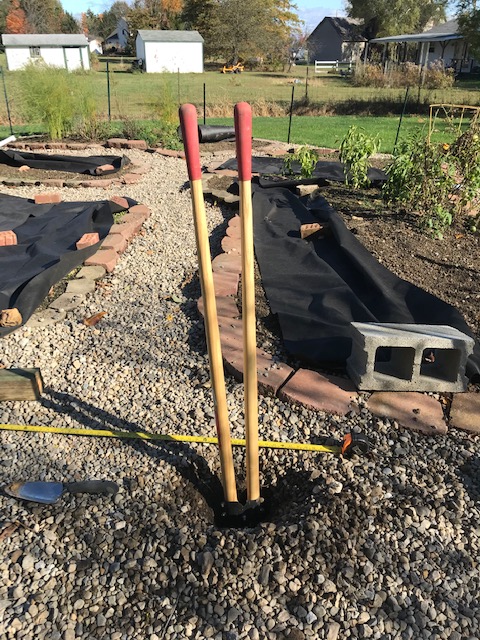
For those who don’t know what this contraption is, it’s a post hole digger. And it doesn’t work. I put it in the ground and waited for it to dig a hole, and the darn thing just sat there. It didn’t dig a lick.

Now it happens I was working on this project on a beautiful fall Sunday afternoon; so maybe my digger was just trying to keep the Sabbath. But I’ve used it on other days of the week with similar results. Yes, I was working on the Sabbath, an occupational hazard for preachers. But I hasten to add that yesterday, a rainy football Saturday, was my day of rest in my recliner in front of the TV. I believe, especially in our crazy busy world, it’s more important to get some regular rest than to be legalistic about which day or days we do so. Jesus thought so too. When criticized for healing on the Sabbath he said, “The sabbath was made for humankind, and not humankind for the sabbath.” (Mark 2:27, NRSV)

But I digress. To be honest, I’m not very adept at manual labor — but even I know tools don’t work by themselves. Maybe someday, but not yet. My project in this case is putting a fence around our garden to deter or at least discourage rabbits, deer, and other critters from nibbling our produce. Fortunately I only need post holes for the gate, but digging even 2 post holes is hard work. So it didn’t take long before I was tempted to go negative about how hard it was and how I’d much rather be watching more football or playing golf on such a glorious day. And then a little voice in my head that sounded strangely like my wife’s was whispering in my ear, “Attitude is a choice. I can either feel put upon for working so hard— or I can enjoy being out in God’s beautiful creation, breathing fresh air, and getting some wonderful (and much needed) exercise!”

To be honest I don’t always or even often listen to that cheerful voice, but I’m trying to practice more gratitude and nourish a more positive attitude. Yes, I know there’s so much in our world today that is way too easy to be negative about, but I do have a choice. I can either focus on the negative or the positive. It’s really as simple, and as hard, as following the Golden Rule, “Do unto others as you would have them do unto you.” Would I rather hang out with some David Downer or someone with a positive approach to life’s challenges? Pretty easy choice isn’t it? So if that’s who I’d rather be with then that’s who I need to be, even when I’m all by myself. Not only does my throwing a pity party for myself do me no good, it’s a bummer for those around me.

I continue to marvel at and be inspired by people who exude faith and positive vibes when life deals them so much unfair pain and suffering: people who are confined to wheel chairs who refuse to stop living and express gratitude for friends and family and good memories of lives well lived; parents who give nothing but unconditional love to children who break their hearts with rebellion and rejection; or someone like President Jimmy Carter who takes brain cancer and the limitations of being 95 in stride and keeps working to make the world a better place for his sisters and brothers. It’ a choice!

I’d be remiss if I didn’t give a shout out to my wife Diana at this point. The reason I said the voice in my head sounds like her is because she is one of the most positive people I’ve ever known. I don’t always appreciate it when she urges me to be more positive, but I know she’s right because she practices what she preaches; and I am blessed to have a front row seat to see how it works for her and the way she influences others.

On this day choosing a more positive attitude worked for me, and like any other discipline each time I practice that behavior it becomes easier to do it next time and eventually will become a habit that I don’t have to talk myself into. Easy? No, or I’d have mastered it long ago. You may have heard as I have many times that it takes 21 days of practicing a new behavior for it to become a habit, but I just learned recently from a Physical Therapist why that’s so. She told me that our brains continually replace old neurons with new ones. That process takes 21 days, and that’s where we get that number. In those 21 days we are actually training these new neurons as they grow to reprogram our brains and attitude, and we either train them to be negative or positive.

It’s a choice; and just like my post hole digger, it’s up to me to make it work.

Kairos Reminder

In my post/sermon on October 13 (“Who gets the last word?”) I talked about the difference between Chronos time and Kairos time. Wouldn’t you know I got another powerful reminder of what those two Greek terms mean just last week.

My wife and I took a vacation trip to the Smoky Mountains hoping to see some wonderful fall colors. Chronos time/the calendar said mid-October was the right time of year for such colors. But as you can see from the picture above kairos time said “Not so fast. We will dazzle you with colors when the time is right and not before.”

That experience reminded me of a professor who once illustrated the difference between Chronos and Kairos by talking about having a white Christmas. He said, “it’s very easy to have a white Christmas every year. You just wait till it snows, and then you have Christmas.”

So next year if we have learned our lesson we will ignore the chronological calendar and wait till the fullness of time when the color is already painting the mountains and then go bask in its glory!

Vita Interruptus

One of my favorite metaphors for ministry is that it’s like being in a tank of piranhas—no one wants much of you, but everyone wants a little piece. Perhaps the best example of that is in Luke 8. There in the space of just 9 verses Jesus is interrupted three times by people who need something from him.

“Now when Jesus returned, the crowd welcomed him, for they were all waiting for him. Just then there came a man named Jairus, a leader of the synagogue. He fell at Jesus’ feet and begged him to come to his house, for he had an only daughter, about twelve years old, who was dying.” (vss. 40-42)

Jesus goes with him, and “As he went, the crowds pressed in on him. Now there was a woman who had been suffering from hemorrhages for twelve years; and though she had spent all she had on physicians, no one could cure her. She came up behind him and touched the fringe of his clothes, and immediately her hemorrhage stopped. Then Jesus asked, “Who touched me?” (vss. 42-45)
Jesus blesses the woman and commends her faith, and “While he was still speaking, someone came from the leader’s house to say, “Your daughter is dead; do not trouble the teacher any longer.” (vs. 49)

These were all very urgent and legitimate requests for Jesus’ time and special power: a man with a sick and then dying daughter and a woman suffering for 12 years with a hemorrhage. Pastors today have similar emergency requests for pastoral care from parishioners or community members when there is a death, accident, life threatening illness, financial crisis, or any number of things that are perceived as a crisis. And that perception is what matters. Yes the woman in Luke had been bleeding for 12 years and we might think, “Couldn’t she have waited another few hours till after Jesus’ could go heal Jairus’ daughter?” After all, while she delayed Jesus with her crisis the little girl died!

Maybe she didn’t mean to delay Jesus. Luke tells us she believed that if she could just touch his robe she would be healed. But Jesus stops and says, “Who touched me?” He felt power go out from him, and that’s important for pastors and parishioners to notice. Each time we make a genuine connection with someone in need it takes emotional and psychic energy to do so. Too many pastors and church workers fail to make time and space for self-care because there is always someone or something that needs our attention.

In Mark’s Gospel we don’t even get through the first chapter before “the whole city was gathered around the door” where Jesus was because he had healed the sick and cast out demons. (Mark 1:33). And in the very next verse Mark says, “In the morning, while it was still very dark, he (Jesus) got up and went out to a deserted place, and there he prayed.” If Jesus needed spiritual renewal and self-care you can bet the rest of us do too. But the respite is short-lived. Next verse—“And Simon and his companions search for him. When they found him they said to him, “Everyone is searching for you.”

Most of my ministry was done before the advent of cell phones; so I can’t imagine how much harder it is for pastors and church staff members to get away from it all in our hyper-connected world today. In the good old days one could actually “get away from the phone,” but now we are all not only available 24/7 but we are also constantly in touch with the mind-numbing, depression inducing stream of bad new and injustices around the globe. Everything is “Breaking News!” Never has the need to unplug and get away to a quiet place been more necessary.

And I know it‘s not just a clergy problem. Being able to work from home can be a blessing at times, but that convenience is a two-edged sword that can cut deeply into family time, recreation and vitally important rest and relaxation.

I have learned the hard way retirement doesn’t solve the problem either. Self-care still requires intentional and disciplined attention. For example, I have been meaning to write this post for over a week now and other things keep interrupting. Those things run the gamut from broken-down lawn mower to chronically stopped up toilet, not to mention the eight health related appointments I’ve had in the last two weeks.

I don’t practice this well, but what I’ve learned over the years is that resenting the interruptions does no good whatsoever, in fact it just makes things worse. If instead we can learn to see the interruptions as the stuff of life itself, the very opportunities to be most alive in service to others, what a difference it makes. Look at one more example from Jesus in Mark 6:
“The apostles gathered around Jesus and reported to him all they had done and taught. Then, because so many people were coming and going that they did not even have a chance to eat, he said to them, “Come with me by yourselves to a quiet place and get some rest.” So they went away by themselves in a boat to a solitary place. But many who saw them leaving recognized them and ran on foot from all the towns and got there ahead of them.” Their much-needed R & R is ruined, and what does Jesus do? Does he say, “Oh crap, look at all those people! I can’t take it anymore! Let’s go somewhere else.”

Not at all. Listen to what Mark says next: “When Jesus landed and saw a large crowd, he had compassion on them, because they were like sheep without a shepherd. So he began teaching them many things.” Jesus embraces the interruption because his compassion was stronger than his weariness.

Where does he get that strength and compassion? Read the rest of that story. After he asks the disciples for what little bit of food they have and feeds the multitude with it, this is how the story ends: “Immediately Jesus made his disciples get into the boat and go on ahead of him to Bethsaida, while he dismissed the crowd. After leaving them, he went up on a mountainside to pray.”

Self-care for our own physical, emotional and spiritual needs is the secret to living abundantly in the reality of Vita Interruptus.

Transforming Grace, Galatians 1:11-16a, 21-24

As many of you know the United Methodist Church as a denomination is in a season of division that came to a head at a special session of General Conference in February. Following that conference our West Ohio Bishop Gregory Palmer invited all the churches in West Ohio to spend time studying Paul’s letter to the Galatians. This sermon is the first of six in a series in response to the Bishop’s request.

Grace is such a central part of our faith but ironically is very hard to explain. Grace is like good art; we recognize it when we see it, and especially when we experience it. But let’s start with a definition so we’re all on same page. The United Methodist Book of Discipline says grace is the “undeserved, unmerited loving action of God in human existence through the ever-present Holy Spirit.”

It may also help to clarify the difference between mercy and grace which are often confused. While the terms have similar meanings, grace and mercy are not the same. As one author says, “mercy is God not punishing us as our sins deserve, and grace is God blessing us despite the fact that we do not deserve it.” In other words, mercy is deliverance from judgment. Grace goes one step further and extends kindness to the unworthy.

Those are good words but it may be better to illustrate what grace is and how it has the power to change lives.
When I was in high school our family car was a Rambler station wagon. It was about the uncoolest car a teenager could be caught driving. I was spared the shame of driving that car most of the time because somehow my parents who were far from wealthy found the money to provide me with a wonderful red and white six-year-old ‘56 Chevy. That was an act of Grace.

But there were times when I still had to drive the Rambler. I don’t remember why I drove it to work on one particular day, but I parked it in my usual spot by a brick building across the street from the flower shop where I worked. One unique feature of that Rambler was that it had a push-button transmission. Don’t ask me why, but for some reason instead of having a gear shift it had a pad of buttons to the left of the steering wheel, one for drive, reverse, neutral, etc. What it didn’t have was a button for “park.” That was normally no problem; you just needed to remember to set the brake. But on the day in question, perhaps subconsciously because of my dislike for that car, I failed to put the parking brake on, and as I was walking across the street to the flower shop I heard a crash and turned to see that the car had rolled down the hill into the brick building. Making matters worse I knew my dad had already traded that car in and was waiting for the new one to arrive.

Needless to say all that day I dreaded facing my dad when I got home. He was not the most gracious person in the world, and I expected him to be very upset. Dad didn’t have to yell or punish me; I just always felt like I didn’t quite measure up to his expectations. But on this day he surprised me by being very understanding and forgiving. That’s grace. I was clearly in the wrong, but instead of a lecture or silent disapproval I got undeserved, unmerited love.

Paul’s letter to the churches in Galatia is all about grace. Galatia was an area in what is now modern day Turkey. It was one of the first places Paul went on his initial missionary journey, and he started churches there in Antioch of Pisidia, Iconium, Lystra, and Derbe. Paul cared so much about these churches that he wrote this epistle to the Galatians because he heard they were straying from the Gospel of Grace he had preached to them, and he returned to Galatia on both of his other missionary journeys. That was an act of grace itself because on their first trip Paul and Barnabas had been stoned, beaten and jailed because they preached salvation came through Christ’s sacrificial love instead of by the traditional Jewish laws Paul had been so zealous for in his previous life.

But I’m getting a little ahead of the story. A few weeks back Pastor Chris preached about Paul’s dramatic conversion to Christ on the road to Damascus; so I won’t spend much time on it today. There are many examples of God’s transformative power in the Bible, but none more dramatic that Paul’s. That story is told in Acts 9 if you want the unabridged version. Paul refers to it in the verses we read this morning when he describes himself as one “proclaiming the faith he once tried to destroy.” He says he persecuted the Christians so viciously because he was “far more zealous for the traditions of his ancestors” than his peers.

Saul, which was Paul’s name before his conversion, was a hard line law and order guy. He believed that rigid compliance to the Jewish laws was the only way to win God’s favor. Period. That Saul would not have been caught dead preaching to the Gentiles in Galatia and would have in fact persecuted anyone who did. But listen to what the transformed Paul says in this letter to the Galatians: “God, who had set me apart before I was born, called me through his grace so that I might proclaim him among the Gentiles.” Paul did a complete 180 about face in his theology. He knew first-hand that he was not saved by his zealous devotion to the law but was set free by Grace; and that grace was so liberating that he literally and repeatedly risked his life to share it with others.

One of my most precious memories as a father is when my son Matt expressed his love for me by saying he was willing to run through a wall for me. Believe me, that’s undeserved grace, and it is just how strong Paul’s devotion to God was because of the power of God’s grace to turn his life around.

I ran across this example of grace in a news story the other day. It was about a young autistic boy who was at an amusement park with his family. The boy’s greatest desire that day was to ride the Spider Man ride. The line for that ride was very long when the family arrived that morning; so they decided to wait for a shorter line later in the day. As luck would have it, when they returned to Spider Man late in the day the ride had broken down and was closed for repairs. The young boy was beside himself and went into a world class melt down, throwing himself on the ground. He was inconsolable, and nothing his parents tried would calm him down. A young woman working in the park witnessed the boy’s meltdown, assessed the situation and simply went over and lay down beside him on the ground and lying there on his level began to talk to him until he was able to calm down. That was an act of grace. The boy’s parents thanked her for her compassion and promised they would return to the park soon, and when they do they will ride Spider Man early in the day. Our God of grace is one who lies down beside us in our worst moments. Author Anne Lamott captures the essence of that story. She says, “I do not understand the mystery of grace-only that it meets us where we are but does not leave us where it found us.”

Methodist founder John Wesley helped clarify how grace works by describing three different expressions of Grace. The first expression of grace is illustrated in Galatians 1:15 where Paul says God “set me apart before I was born.” That’s prevenient grace or the grace that precedes any human action. Prevenient Grace means God pursues us, that God is the initiator of all relationships with her.

The second expression of grace is justifying grace, the grace that pardons and forgives. Paul describes it in the salutation to Galatians where he says, “Grace and peace from God our Father and the Lord Jesus Christ who gave himself for our sins to set us free from the present evil age.” Justifying grace is what reconciles and realigns us with God no matter what we’ve done or who we have been. And it’s free – you can’t earn it and can’t buy it. Christ already paid the bill.

And that leads directly to the third expression of grace, called sanctifying grace. In Galatians we see evidence in Paul’s life of God’s transforming grace. Saul the persecutor has become Paul the proclaimer and witness for Christ. Or as John Wesley puts it, “God’s grace seeks nothing less than a new creation in the likeness of Jesus Christ. Sanctifying grace is God’s freely given presence and power to restore the fullness of God’s image in which we are created.”

Father’s Day is bittersweet for me because I have many regrets about the lack of closeness with my father. I was very late in learning to give him grace for doing the best he could with the life circumstances he had to overcome, and because of that we often did battle over our different world views.

But I want to add that my dad was actually a good example of God’s transforming power, and his conversion was no less dramatic than Paul’s. He was not a person of faith before going off to WW II, but after the war he was co-pilot of a B-17 that was flying 16 other soldiers home from Europe. Shortly after taking off from a refueling stop in the Azore Islands their plane developed engine trouble and they had to ditch, which means crash land, in the dark and fog somewhere in the North Atlantic. Only 4 of the 17 men aboard that plane were still alive when they were rescued after 12 hours in the water. That experience transformed my father into a very devout Christian for the remaining 70 years of his life.

But my dad’s faith was primarily one of laws and rules, and that was at the heart of the tension in our relationship. I wish I had understood earlier that my dad needed the certainty of his legalistic religion because of his childhood growing up with an abusive step-father. He needed the comfort he found in strict rules and structure to compensate for the lack of security he felt in his childhood home where grace was absent.

My father passed his need to strive for perfection on to his children, except for my younger sister – she was his favorite and could get away with murder. But as his eldest child and only son I tried to live up to his expectations. I excelled in school, in scouts, and church but it was never quite enough. I realized recently that I have no pictures of myself as child where I’m smiling. I always look too serious, too afraid to screw up. And so when I left home I rebelled – made stupid mistakes as a young adult I should have made in adolescence and hurt several people in the process.

The good news is that it’s never too late for God’s grace to work its magic. My dad and I didn’t ever agree on politics or theology, but through God’s grace we learned to accept our differences in his later years. We were able to extend grace to each other and stop pushing each other’s buttons.

Can I change this guy into a car? No, Transformers came along well after my childhood, and unlike the movie transformers this one can’t transform itself, and that’s a perfect example of Grace. We can’t transform ourselves either, no matter how many diets or exercise programs, or New Year’s resolutions we try. Grace is the opposite of “self-help.” We don’t want to admit we need help to change ourselves, but when we come to that place when we surrender our inflated notions of our own powers, then and only then – God’s undeserved, unmerited action of the Holy Spirit can transform us.

Have you had the experience of returning a rental car to one of those places where you have to drive over spikes that keep people from stealing cars? The spikes fold down so you can drive forward over them, but if you try to back up the spikes stay upright and, as the sign says, can cause “severe tire damage.”

I’ve never done that with a car, but I know in real life I do often go backward in my faith, as we all do. That’s so common that in the old days the church had a term for it, they called it “back sliding.” And when that happens and we ruin a set of Michelins, God says, “It’s OK, tires can be replaced, or even a whole Rambler.” God made us fallible human beings with free will. That means we all screw up regularly, but grace means that it doesn’t matter how often or how badly we mess up, God our Heavenly Father is still there waiting with open arms for us prodigals to come home.

Northwest UMC, Columbus, OH
June 16, 2019

Mental Meaderings

Sometimes memory is a curse. I’m fast approaching some milestone memories, the kind that end in zero or five. My 55th high school reunion is next month and the 50th anniversary of my ordination is also. Such milestones give me pause to remember the highs and lows of my 70 plus years of life experience.

For example, for some reason I decided to add up how many U.S. Presidents there have been in office during my lifetime. From Truman to Trump adds up to 13 occupants of the White House since I was born. What shocked me about that number is that it means that I have been alive for almost one-third (13/45) of all U.S. Presidents ever. I wish I hadn’t done the math.

One of the most interesting courses I took in seminary back in the Nixon administration was a course called “Theology in the Modern Novel” taught by Professor Don Webb. In that class I began to learn the power of fiction to reveal a truth deeper than fact. That experience was the beginning of my life-long appreciation for the power of narrative to touch people at an emotional level that rational-logical discourse can never reach. I had not realized till I started writing this piece that my whole appreciation and dedication to narrative rhetoric began in that class and shaped my preaching and teaching ever since. Thanks, Don.

Remembering today the work of the author I studied in that class on narrative theology I found this quote that resonates with my own intellectual and theological journey and may explain how I was drawn to his writing. “Having seen that I was not capable of using all my resources in political action, I returned to my literary activity. There lay the battlefield suited to my temperament. I wanted to make my novels the extension of my own father’s struggle for liberty. But gradually, as I kept deepening my responsibility as a writer, the human problem came to overshadow political and social questions. All the political, social, and economic improvements, all the technical progress cannot have any regenerating significance, so long as our inner life remains as it is at present. The more the intelligence unveils and violates the secrets of Nature, the more the danger increases and the heart shrinks.” (As quoted in Nikos Kazantzakis (1968) by Helen Kazantzakis, p. 529)

As an aside let me throw in here an observation about the mystery of memory and how it leads to different and I hope deeper reflection than expected. By the way, that only happens if we take the time to explore our inner journey—and more importantly to learn from the insights we uncover there. It is a rare journey we don’t usually take time for in our hectic 5G world, and that may be an excuse, at least it is for me, because I may not like what I find if I go spelunking down memory lane. As Barbra Streisand sings in “The Way We Were:” Mem’ries, may be beautiful and yet, what’s too painful to remember we simply choose to forget.”

This all started because I’ve been feeling my age more than usual this week as a head cold has been added to my “normal” aches and pains. The memory I thought was going to result in a light-hearted blog post about the joys of aging was the lyrics to a song in the musical “Zorba,” called “Grandpapa.” The setting for the song is one where the elderly Zorba is being ridiculed for his age by some younger men in a bar. The banter back and forth between Zorba and his tormentors goes like this:

“A young man with no money is better than an old man with no money. Goodbye, Grandpapa!

Grandpapa? Grandpapa? I’ll show you who’s Grandpapa! Zorba! Zorba! Listen! There are two Zorbas. The inner Zorba is as slender as a reed!

Look at that, look at that, poor old man is weak and fat!

He has thirty-two teeth!

Look at that, there’s no doubt, every tooth is falling out!

He wears a red carnation behind his ear!

Look at that, over there, golden beard but long white hair.

This is the outside Zorba!

Look at that, old and feeble Grandpapa”

Trust me, I know the many joys of being a grandfather; I just wish it could come at an earlier age when I could play ball and shoot hoops and get down on the floor to rough house or play like I used to. But all that aside, that “Grandpapa” song led me down a memory trail that resulted in this much longer rambling about the influence on my life of the creator of Zorba, Nikos Kazantzakis.
I don’t remember how I chose Kazantzakis to focus on for that seminary class, but I’ve always been glad I did. My life and thinking have been and continue to be enriched by that decision. Yes, Kazantzakis died in 1953; so many today would not consider his work “modern,” but remember this class was in 1971, just 18 years after Kazantzakis’ prolific writing stopped. I only scratched the surface of Kazantzakis’ work in that class, reading “Zorba the Greek,” “The Last Temptation of Christ,” “The Greek Passion,” and “Saviors of God: Spiritual Exercises.” The latter is described this way by Simon Friar, the English translator of many of Kazantzakis’ writings, “Saviors of God” occupies a central role in the work of the Greek author….where in a passionate and poetic style, yet in systematic fashion, he set down the philosophy embedded … in everything he has written.”

One of the thoughts that has stayed with me all these years from “Saviors of God” is this one about prayer: “My prayer is not the whimpering of a beggar nor a confession of love. Nor is it the petty reckoning of a small tradesman: Give me and I shall give you. My prayer is the report of a soldier to his general: This is what I did today, this is how I fought to save the entire battle in my own sector, these are the obstacles I encountered, this is how I plan to fight tomorrow.”

I have often turned to that passage for inspiration when I am weary of the struggle for social justice, even though I don’t like the military metaphors. Too often human struggles to comprehend the mysteries of existence have led to violent conflict because in order to manage our discomfort with ambiguity religious and political get hardened into concrete symbol systems that must be defended at all costs. But the struggle Kazantzakis is talking about is not for one ideology or belief structure about God and the universe. Kazantzakis says in that same work: “We do not struggle for ourselves, nor for our race, not even for humanity. We do not struggle for Earth, nor for ideas. All these are the precious yet provisional stairs of our ascending God, and they crumble away as soon as he steps upon them in his ascent.

In the smallest lightning flash of our lives, we feel all of God treading upon us, and suddenly we understand: if we all desire it intensely, if we organize all the visible and invisible powers of earth and fling them upward, if we all battle together like fellow combatants eternally vigilant — then the Universe might possibly be saved.

It is not God who will save us — it is we who will save God, by battling, by creating, and by transmuting matter into spirit.”

One of the things that keeps attracting me to such abstract thoughts and images is how my finite little mind is stretched by Kazantzakis’ spiritual language. And like my muscles I often resist such stretching. Even as I write this I kick myself for starting down this path. I am feeling cornered by the impossible notion that I need to somehow wrap this post up with some neat summary of what this all means. But of course I can’t. Any God I could “explain” or capture in human language would be woefully inadequate.

So I will leave you here with one of Kazantzakis’ most mysterious quotes that has tugged at my soul for all these 50 years. This one is also from “Saviors of God.”

“Blessed be all those who hear and rush to free you, lord, and who say: “Only you and I exist.”

Blessed be all those who free you and become united with you, lord, and who say: “You and I are one.

And thrice blessed be those who bear on their shoulders and do not buckle under this great, sublime, and terrifying secret:
That even this one does not exist!”

I can’t explain why that image appeals to me, but I recently found another quote from “Saviors” where Kazantzakis at least hints at what it meant to him:

“Nothing exists! Neither life nor death. I watch mind and matter hunting each other like two nonexistent erotic phantasms — merging, begetting, disappearing — and I say: “This is what I want! I know now: I do not hope for anything. I do not fear anything, I have freed myself from both the mind and the heart, I have mounted much higher, I am free. This is what I want. I want nothing more. I have been seeking freedom.”

Most appropriately that passage was used for Kazantzakis’ epitaph: “I hope for nothing. I fear nothing. I am free.”

Hide and Seek, Sermon on John 20:19-31

A young boy was out walking with his mother and out of the blue asked, “Mom, how big is God?” The mother thought a moment and noticed a plane flying overhead high in the sky. She pointed to it and asked her son, “How big does that plane look, Ryan?” He said, “It looks really small.” “Remember that when we go out to the store later today,” was the mother’s reply.

I’ve been thinking this week about a question Pastor Mebane asked in her Easter sermon last week. The text for last week’s sermon told how two of the disciples run to the empty tomb and find only Jesus’ grave clothes there. John tells us, “Then the other disciple, who reached the tomb first, also went in, and he saw and believed.” Mebane’s question was about how long it took between when the disciple “saw” and when he “believed.”

It wasn’t a total transformation at the grave because just a few verses later we are told “When it was evening on that day, the first day of the week … the doors of the house where the disciples had met were locked for fear of the Jews.” They are playing hide and seek with the wrong guy. Even locked doors can’t stop Jesus from finding them.

And Jesus’ command to the disciples and to us is that it’s our turn. Believing in the resurrected Christ is just step one. We need to be sent, to shed our grave clothes and go be the church in the world that is dying for Good News.
That does not diminish the fact that our fears are real. Doubting Thomas usually gets most of the attention in this story. I like Thomas. I identify with his honest doubt. Frederick Beuchner says, “Doubt is the ants in pants of faith.” Honest doubt keeps us alive and growing.

There is no faith without doubt; they are two sides of same coin. Beucnher goes on to say that is not the presence of God that keeps us coming back to church – but the absence, the seeking of true peace in the midst of our broken world.

We don’t know where Thomas was. John just tells us he wasn’t there the first time Jesus appears to the other 10 disciples. Maybe Thomas was the most scared. The disciples are hiding – but Thomas is even afraid to hide in the same place with them. That’s ironic because Thomas earlier in the story where Jesus raises Lazarus from the dead is the disciple who says, “Let’s go to Jerusalem and die with Jesus!” What happened? Maybe Thomas realized it’s easier to die with Jesus than to live with or for him? After all, the Jews or other oppressors can only kill the body. Jesus wants our souls too.

But see what happens when we give into fear and hide from God? God breaks down the barriers anyway – even thru locked doors. And when Thomas is not there Jesus doesn’t give up on him; he comes back a week later specifically to address Thomas’ doubt and fear. Faith is not a one-time deal like a polio vaccine. It’s a lifelong journey. One of my favorite biblical characters is the man in Mark’s Gospel who asks Jesus to heal his son of an evil spirit. When Jesus inquires of the man’s faith his honest response is, “Lord I believe, help my unbelief.” Both Thomas and this father remind us that faith and doubt dwell in creative tension in all of us.

But I don’t want to focus on Thomas today. Instead I want us to look carefully at what Jesus says and does in these first post-resurrection encounters with his disciples.

John says the doors are locked in that upper room and Jesus comes right into the room anyway. How he did that is an interesting question we could explore, but that’s not really the point. Jesus coming into that locked room means that God breaks through whatever barriers we try to put up – whatever excuses we offer: I’m too old, too young, too poor, too busy, not good enough, too scared. “Sorry,” Jesus says, “it’s your turn now.”

One of the best Easter sermons I ever heard was by Bishop Dwight Loder, and the phrase I remember from that sermon is this. Bishop Loder said, “Jesus was not resurrected by the church. He was not resurrected for the church. He was resurrected AS the church.” We are the body of Christ, and as such God sends us in mission and service to the least and the lost. We are transformed by the salvation of Christ, but the story doesn’t end there. We are transformed so we can go out and change the world into the Kingdom of God.

How in God’s name can we do that? Exactly – we can only do it if we do it in God’s name and with God’s power. And here’s the good news – that power is ready and available for anyone who is willing to accept it and surrender to it.
Do you want peace in your life? Don’t we all? We long for real peace that only God can give, the peace that passes all human understanding. And the secret to finding that peace is right here in John 20. The first thing Jesus says to the disciples is “Peace be with you.” He doesn’t send them out looking for peace on E-bay or Craig’s list; he imparts it into their hearts and then sends them out. We don’t find or create that kind of peace; it finds us, in the midst of our doubts, not after all our doubts are resolved.

How does that work? Notice what happens right after Jesus says “As God has sent me, so I send you.” “When he had said this, he breathed on them and said to them ‘receive the Holy Spirit.’” He breathed life into them just as God breathed life into humankind in the creation story. God’s Holy Spirit empowers before it sends us out to serve.

But here’s the catch – that powerful spirit only comes in surrender. True peace only happens when we are vulnerable enough to get up close and personal with God. You have to get very close to let someone breathe on you. The question is do we want Jesus getting that close? Invading our personal space, meddling with our priorities? That’s scary. But, if we let down our barriers and allow Christ into our hearts we are empowered by the Holy Spirit to humbly and obediently do justice and act mercifully – outside our comfort zones in the world God sends us into. To say with all the saints that have gone before us, “Here I am, Lord, send me!”

Now I want to circle back to young Ryan’s question about how big God is. That afternoon Ryan’s mom took him with her to go grocery shopping, but on the way she took a slight detour to drive by the city’s airport. She parked near a fence where the planes on the tarmac were visible and said to Ryan, “Do you remember how small that plane looked when we saw it today way up in the sky? Ryan nodded. “And how big do these planes on the ground look?” “They’re really big!” her son replied. And Ryan’s mom said, “That’s how God is. The closer we are to God, the bigger God is.”

Peace comes only when we get close enough to Jesus that he can breathe on us. I’m not sure I want Jesus or anyone to get that close. We have to really trust someone to let them invade our personal space. If we let Jesus get that close we might have a have heartwarming experience like John Wesley. We might get called out of our comfort zone to put our faith into action!

I don’t know what Jesus is calling you to do. That’s between you and God, but I do know that we will only find the peace and power to fulfill our calling if we let the risen Christ get close enough to breathe the power of the Holy Spirit into us.

Benediction – God is big enough to help our unbelief if we allow God to get close enough. Jesus finds us when we foolishly try to play hide and seek, and he says, “You’re it. I send you out, but only after I breathe the power of the Holy Spirit into your hearts.” Go in Peace. Amen