Fourth Sunday of Advent 2025 – Candle of Love

In the beginning, God fell in love with creation, and pronounced it very good.  Like romantic adoration, God’s eternal love is blind to human betrayal, rebellion, and stupidity.  When God’s children ignore the prophets and break every covenant offered to us, God continues to love us like a star-struck lover.

We celebrate Advent and Christmas every year to remind us that God still so loves the whole world that He comes to share the risks and sacrifices of being a vulnerable human being. 

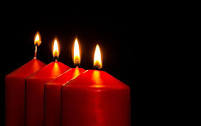
In the dark days of December, when wars and senseless violence dominate the news, God’s love simply grows brighter and stronger.  The Advent candles remind us that we are all created in the image of God, and the essence of our God is unbounded, unconditional love. 

So on this final Sunday of Advent, the circle of the wreath is completed.  We relight the candles of Hope, Peace, and Joy.  And today we light the Candle of Love, because the greatest of these is Love. 

[Light all four candles]

Please join me in the prayer on the screen:

O dear God, lover of our souls, we are undeserving and unworthy of your radical love.  Our souls our willing, but our flesh is weak.  Please sweep us off our feet again in your loving embrace.  Help us to share in your wild and crazy romance with this broken world.  Let these candles rekindle in us the dream of your beloved community, so we can throw open the gates of love to all of your weary, hopeless children.  Remind us once more that the Babe of Bethlehem still calls us to love one another, in the same reckless, unconditional way that you love us.  Amen

Northwest UMC, Columbus, Ohio

Advent 1, 2025 Matthew 24:36-44, BE PREPARED!

This message for this first Sunday in Advent in Matthew’s Gospel is also the motto of the Boy Scouts – “Be prepared.” As an Eagle Scout one could assume that it would fit my life style. I wish it did, but in crisis or stressful situations I’m not at my best. When I was about 14 or 15 my Explorer Post took a canoe trip on an old abandoned canal called the Whitewater Canal in southern Indiana. The name was misleading since there was no white water there, but there was one tricky spot in the concrete remains of an old lock.

Because the current got faster as it narrowed into the lock there was a sign telling canoeists to portage around the lock. Portage means to pull over to the bank, get out, and carry your canoe around to the other side of the lock where it’s ok to put back into the water. The problem was that the portage sign was so close to the lock that there was little time, especially for inexperienced paddlers, to exit the water before being sucked into the lock. The portage sign was on a cable stretched across the water and the first reaction to seeing that sign when it was too late to portage was to grab the cable and try to stop. The problem was the person grabbing the cable stopped, but his canoe didn’t.

Some of us who made the canoe trip in the first of two groups had found out the hard way how this worked and had a good laugh as we scrambled to retrieve our runaway canoes. So, rather than being good Scouts and warning our friends in the second group about this hazard we secretly hiked down to the lock while group 2 was getting ready to set off so we could see how many of them ended up in the drink like we had. Some did, of course, and we had a good laugh until we realized that our Scoutmaster in one of the tipped canoes had gone under and not come back up. He was trapped under the current.

It was truly a life and death moment, and I was frozen in fear. I remember yelling for someone to do something, but it felt like my feet were nailed to the ground. Thank God two of my fellow Scouts did act courageously. They jumped the 8 feet from the top of the lock to the water and pulled our sputtering Scoutmaster to safety. They were both honored for their bravery, but I was not prepared to act.

In less dramatic ways I was not prepared to leave home for college and spent an entire quarter terribly homesick. I was not ready for marriage at age 21 or for parenthood 3 years later – but then who is ever really ready for that responsibility. And now in my “golden years” I am certainly not ready for the challenges of aging!

So if it’s that hard to be prepared for “normal” life events that we know are coming, what in the world can we do to be prepared for the coming of the Lord? Matthew says, “Therefore you also must be ready, for the Son of Man is coming at an hour you do not expect.” (24:44). That verse is about the second coming, but Advent is our warning that we need to be prepared not just for the celebration of Christ’s birth but for the big surprise of his dropping in again any time he feels like it.

Sorry, Lord, I don’t like surprises. I don’t even like unexpected changes to my daily routine. And my weird sense of humor suddenly turns to the lyrics from an old song by Eileen Barton:

“If I knew you were comin’ I’d’ve baked a cake, baked a cake, baked a cake

If I knew you were comin’ I’d’ve baked a cake

Howdya do, howdya do, howdya do?

Had you dropped me a letter, I’d a-hired a band, grandest band in the land

Had you dropped me a letter, I’d a-hired a band

And spread the welcome mat for you

Oh, I don’t know where you came from

’cause I don’t know where you’ve been

But it really doesn’t matter

Grab a chair and fill your platter

And dig, dig, dig right in.”

It’s like dating or meeting someone important for the first time. We can put our best foot forward and be on our best behavior when we are prepared. Even I can clean up pretty well when I am forewarned. I can even tidy up the house when I know when my wife is returning from a trip, but “at any hour you do not expect!” That’s not fair.

But timing is not really the issue. God has known when we’ve been naughty or nice long before Santa or security cameras started tracking us. And it’s not rocket science. Being prepared for Christ is like an open book test. The Book has been telling us for 2500 years what God expects to find when he/she drops in unexpectedly. “He has told you, O mortal, what is good, and what does the Lord require of you but to do justice and to love kindness and to walk humbly with your God?” (Micah 6:8)

That’s pretty straightforward, and yes, much easier said than done. But please notice that last line – humility is the way to grace and mercy. God knows all too well we all flunk at doing justice and loving kindness way more than we like. But as 1 John tells us, “If we confess our sins, he who is faithful and just will forgive us our sins and cleanse us from all unrighteousness. If we say that we have not sinned, we make him a liar, and his word is not in us.” (1:9-10). That first part is humility, the second not so much.

And there’s another wonderful summary of being prepared for Christmas or any Christ coming. The whole Bible is a lot of stuff to digest. There’s not just 10 Commandments but hundreds in the Hebrew Scriptures/Old Testament. So Jesus boiled it all down for us. “Teacher, which commandment in the law is the greatest? He said to him, ‘You shall love the Lord your God with all your heart and with all your soul and with all your mind. This is the greatest and first commandment. And a second is like it: You shall love your neighbor as yourself.’ On these two commandments hang all the Law and the Prophets.” (Matthew 22:36-40)

Simple – love God and all your neighbors and yourself! Do that and you will be prepared. I hear you, but, Steve, how can we do that? We’re just fallible human beings after all! So, here’s the secret I’m counting on, and maybe you should too. “But Jesus looked at them and said, “For mortals it is impossible, but for God all things are possible.” (Matthew 19:26)

All Saints Prayer 2025

As we prepare our hearts for prayer on this All Saints Sunday I want to share some words for our meditation from Linda Hogan in her book “Dwellings.” She says,

“Walking, I am listening to a deeper way. Suddenly all my ancestors are behind me. Be still, they say. Watch and listen. You are the result of the love of thousands.”


O Holy One, God of the present age, of every generation that has enabled our being here today, and of all the multitudes who will follow in our footsteps if we find a way to a sustainable future for the creation we are a part of.

We know All Saints Day may sound pretentious because none of us are truly saintly.
We are all a weird mixture of sinner and saint striving to be more the latter as followers of Jesus and good stewards of your creation. We want to be builders of a peaceable kingdom, a beloved community, honest we do.

But you know that our fears and anxieties too often lead us to foolishly put our trust in stuff that promises security but only creates higher walls of tribal suspicion and prejudice. Bigger bombs and battleships only motivate others to make more weapons that steal resources from hungry children.

As we ponder the mysteries of how our ancestors made sense of their lives help us lovingly forgive their mistakes even as we learn from their collective wisdom.  We are grateful that we don’t have to reinvent every wheel because we are surrounded by a cloud of witnesses who bless us with their presence. We are never alone, although at times it sure feels like it.

Among those saints are those whose names we all know – Moses, Ruth, Micah, Theresa, Amos, Francis, Jesus and Paul – but those famous ones are totally outnumbered by the ordinary Joes and Judys who quietly have preserved the faith through disasters, depressions, pandemics, and ages of apathy.


Today we remember those dear ones who have passed through the thin veil that divides our reality from eternal peace and truth. We give thanks for those who dwell now in your very heart, O God. We envy their peace and unity with you, even as we humbly give thanks for their love that has produced this community of faith that nurtures us still today.


We are indebted to their example of service. We are inspired by their faith that overcame the doubts and despair that are part of the human condition. Like them we journey ever on toward the cross of Christ and the example he gives us as we join our voices with all the saints in the prayer Jesus taught us to pray ….

Northwest United Methodist Church, Columbus, Ohio, November 2, 2025

Truth that Frees Us to Resist Evil

“Whoever is paying our bills and giving us security and status determines what we can and cannot say or even think.” Fr. Richard Rohr

The quote above recently appeared in Fr. Rohr’s daily meditations from his Center for Action and Contemplation. It struck me as particularly poignant and relevant right now when freedom of expression in the U.S. is under attack. The power of those words is in the very fact that there is truth in them even under the best of conditions. Women can understand that truth better than we males because throughout patriarchal history they have not been free to express themselves.

In my lifetime women could only get a credit card if it was in their husband’s name. In my grandmother’s generation women did not have the right to express themselves through voting until the 19th amendment was ratified in 1920.

A clergy colleague of mine was forced out of his church in the mid-twentieth century for expressing his opinion about an issue on an election ballot, and in this age of social media the number of people who have lost their jobs because of an opinion they expressed on their personal social media account is too many to count.

This quote reminded me of another one that has intrigued me for over 40 years. “I hope for nothing. I fear nothing. I am free.” Those are the words written on the gravestone of Nikos Kazantzakis in Heraklion, Greece. Kazantzakis was the author of “Zorba the Greek,” “The Last Temptation of Christ,” several other novels, and “Saviors of God,” a book of “spiritual exercises” that are often as challenging as his epitaph.

Is being free of fear and hope the secret to having no constraints on what we say or think? Some might say being filthy rich so one does not have a boss or anyone else to report to would be the ultimate freedom, but I suspect that those who are not accountable to anyone because of their ultra-wealth are far from free. I base that judgement on the fact that the vast majority of billionaires we see in the media are never satisfied with what they have and continually strive for more wealth and power instead of enjoying what they have.

When Jesus says, “You will know the truth, and the truth will make you free” (John 8:32) what is the truth he is speaking of? Verse 31 sets some context for the more familiar 32nd:

“Then Jesus said to the Jews who had believed in him, “If you continue in my word, you are truly my disciples.” It is to those believers that he promises the truth that will set them free. That narrows things down a bit, but still raises questions, like free to do/be what? Or freedom from what?

The clue to those answers are found right in these verses. Jesus is talking to those who believe in him, and he says they need to continue in his word to truly be his disciples. In other words they are set free to be true followers of Jesus and his way of peace and justice. And later in John’s Gospel in the farewell discourse (chapter 14) where Jesus is preparing his disciples for life in a post-crucifixion/resurrection world he tells them he is going to prepare a place for them. Thomas says, “Lord, we do not know where you are going. How can we know the way?” Jesus said to him, “I am the way and the truth and the life.” (John 14:5-6)

Jesus himself is the truth that sets us free, and if we know that truth, not as a doctrinal belief but as a deep, in the gut, all-in personal relationship and commitment to follow Jesus’ way no matter what crap the world throws at us, then we are free from fear and even from hope because in that abundant life in Christ there is nothing to fear and nothing more to hope for.

That is the truth that give us the courage to be, to borrow a phrase from Paul Tillich. It’s the courage described by Bertram Cates in the play “Inherit the Wind” when he is on trial for teaching evolution in a small southern town where almost everyone is against him. At one point Cates says, “It’s the loneliest feeling in the world-to find yourself standing up when everybody else is sitting down.”

But those who know the truth that is Jesus’ message of peace and justice understand that we must fear nothing and stand up against the forces of evil and injustice. I like the way our United Methodist Baptismal ritual says it. One of the questions asked of adults being baptized is this: “Do you accept the freedom and power God gives you to resist evil, injustice, and oppression in whatever forms they present themselves?”

Most of us go through the motions of this ritual by saying the prescribed “I do,” but in times like we are living in now it is incumbent upon all of us who know Jesus as our truth to fear nothing and stand up and say a resounding “Here I am, send me!”

Pastoral Prayer, July 13, 2025

Great and gracious God, as we worship today we all come with personal cares and burdens.  And on top of those we have been shaken by images we can’t unsee from the horrendous floods in Texas.   The innocent children killed trouble our hearts the most, but we also pray for all the others who have lost loved ones, homes, businesses, and livelihoods. 

In times like these we can’t help but ask the question people have been struggling with since the days of Job – where are you, Lord, when walls of water sweep little girls away?  Why do you let things like this happen? Why do you let cancer, war, and human cruelty destroy innocent lives?  If you are all-powerful and all-loving, why is there so much pain and suffering in our world?

As much as we wish you were a helicopter parent who would sweep in and protect us from anything terrible happening, we know that is not who you are, God.  You are a heavenly parent who has given us the freedom to make choices.  When we mess things up with selfish or short-sighted decisions, we would often like to give that freedom back to you. 

But like earthly parents you know there is a time when children must be set free to make their own choices.  Hindsight is always 20/20, but no amount of blaming, no law suits can undo the consequences of our mistakes.  We can only learn from them and try to do better in the future. 

So we humbly ask, Merciful God, that you would forgive us where we have misused our freedom to choose.  Help us accept things we cannot change, and in our experiences empower us to be your presence through prayer and acts of service for those who are hurting next door, and in Texas, and around the world.

When we wonder where you are in the midst of tragedy, Lord,  remind us that you are always there in the form of helpers who comfort those who mourn, weeping with those who sob uncontrollably, in the form of first responders and volunteers tirelessly searching for the lost and missing. 

Thank you for being with us in every time of need, for being, as the Psalmist says, “close to the brokenhearted and saving those who are crushed in spirit.”  For all your mercies we offer our thanks, and especially for Jesus, who lived your presence as one of us, teaching us how to live, how to love, and how to pray.  Our Father ….

Northwest United Methodist Church, Columbus, Ohio, July 13, 2025

Biblical Reflections on Greed and Social Justice: A Note from Amos and Jesus to the U.S. Congress

I’m at a loss as to what to say with regard to the Big Hateful Bill the Republicans in Congress just passed by one lousy vote. I don’t understand how those 215 people who voted for this bill to literally take food and healthcare from the most needy Americans and give that money to the most wealthy 1 % of our population can live with themselves.

But since greed and hate have been around as long as humans have I think these these words from the Judeo-Christian Scriptures should speak loud and clear to our 100 Senators who now have the fate of this cruel and ugly bill in their hands.

“Listen to this, you who walk all over the weak,
    you who treat poor people as less than nothing,
Who say, “When’s my next paycheck coming
    so I can go out and live it up?
How long till the weekend
    when I can go out and have a good time?”
Who give little and take much,
    and never do an honest day’s work.
You exploit the poor, using them—
    and then, when they’re used up, you discard them.

God swears against the arrogance of Jacob:
    “I’m keeping track of their every last sin.” (Amos 8, The Message)

Or since so many of you Senators claim to be Christians, how about these words from Jesus himself:

“You who are accursed, depart from me into the eternal fire prepared for the devil and his angels, for I was hungry and you gave me no food, I was thirsty and you gave me nothing to drink, I was a stranger and you did not welcome me, naked and you did not give me clothing, sick and in prison and you did not visit me.’ Then they also will answer, ‘Lord, when was it that we saw you hungry or thirsty or a stranger or naked or sick or in prison and did not take care of you?’  Then he will answer them, ‘Truly I tell you, just as you did not do it to one of the least of these, you did not do it to me.’  And these will go away into eternal punishment but the righteous into eternal life.” (Matthew 25:41-46 NRSV)

OMG: Good Friday Sermon, 2025

OMG – a common abbreviation used these days on social media and many users don’t know it, but it’s really a prayer, a lament.  It means “O My God,” and in our Good Friday context the emphasis is on the little word “My.”  Because even when we doubt and feel God is absent, we still own and affirm the relationship. My kids are still My kids even when they do stupid stuff I don’t agree with – same with friends, spouse, and colleagues.  Real relationships and friendships have no expiration date, and certainly there is none with the eternal God of all creation who has been with us since the day we were born and will be with us for all eternity after our short sojourn on this earth is over.  

Another common lament today is “Life sucks and then you die!”  That one is not in the Bible, but it could be in the book of Lamentations. When Jesus says from the cross, “My God My God why?”  Hear the My and not just the forsaken.  And of course the lament of Psalm 22 is followed immediately in our Bible by the most familiar Psalm of the whole 150.   Psalm 23 begins with “The Lord is MY shepherd.”

As we remember the brutal crucifixion of Jesus tonight I invite you to make that experience real.  Feel it in your gut.  Imagine or remember a time when you were in unbearable pain – either physical or emotional, and Jesus was certainly in both – a time when God feels as far away as the planet Pluto – at the death bed of someone you don’t think you can live without – when you hear a terminal diagnosis from a doctor – or your heartbreaks over a shattered relationship, or a job loss, or your financial security disappearing, or hearing on the news about unspeakable human cruelty.

Holocaust survivor Elie Wiesel in his book “Night” relates an incident when he was a prisoner in a Nazi concentration camp when a young man was hung and all the other prisoners forced to watch.  Someone asks Wiesel, “Where is your God?” and his answer is, “Right there on the gallows.” Whatever and whenever we suffer God suffers right along with us.

One of my favorite descriptions about human lament is the one Brian and Barbara just sang for us, “Day is Done,” by Peter, Paul, and Mary.  I asked for that song because of these lyrics which say, “Tell me why you’re crying my son; I know you’re frightened like everyone. Is it the thunder in the distance you fear? Will it help if I stay very near – I am here.” And if you take my hand my son, all will be well when the day is done.”

We really want to believe that “all will be well when the day is done,” but we don’t know how long that metaphorical day will last or if we can last that long. But what we do know is that it helps to have someone very near.  It helps to be able to share out loud what our pain is with someone we trust and know will listen and just be present as long as we need them. 

I just learned about a quote from Fred Rogers recently in our Books to Bridges book group.  Mr. Rogers said, “What is mentionable is manageable.” “What is mentionable is manageable.”

Pain that we try to carry alone can suck the very life out of us, but if we can talk about it the power it has over us is shared and diminished – it becomes manageable.

Another lament in Psalm 13 begins with these plaintive words: “How long, O Lord? Will you forget me forever?   How long will you hide your face from me? How long must I bear pain in my soul and have sorrow in my heart all day long?”   The point in sharing these cries for help is not to depress us but simply that it’s OK to lament, to doubt; those feelings are part of the human condition. No matter how strong your faith is it is hard when the foundations of your existence are shaken like an 8.0 earthquake.  Even Jesus who had more faith than all of us put together cries out “My God, My God, why have you forsaken me?” which is even more powerful in the Aramaic that Jesus would have spoken: “Eloi, Eloi, lema sabachthani?”    

And as you heard in our scripture from Psalm 22 tonight we know where Jesus got those words.  Jesus knew his Scriptures very well, and he knew his people for centuries had been no strangers to devastating loss.  They were experts at lament.  We even have a whole book called Lamentations in the Hebrew Scriptures, which is our Old Testament, devoted to nothing but laments.  And part of the prophet Isaiah’s description of God’s Messiah is that he is a suffering servant who “… was despised and rejected by others; a man of suffering and acquainted with grief.”

Ps 22 is typical of another source of laments the Hebrew people used in public worship. Do you know that there are more psalms of lament in the book of Psalms than any other type of Psalm? One of my favorites when I’m having a no good, terrible, awful day is Psalm 130.  It’s called “De Profundis” in Latin and says, “Out of the depths I cry to you, O Lord.  Lord, hear my voice! Let your ears be attentive to the voice of my supplications!”  Out of the depths loosely translated means “we are in deep do do.”

Psalm 63:1 echoes the same song: “O God, You are MY God; early will I seek you; my soul thirsts for You; my flesh longs for you in a dry and thirsty land where there is no water.” I’ll bet most of us have been in such a dry and thirsty land or may even be there right now.  That’s the message of Good Friday.  I still remember vividly one such time in my youth.  It was my Boy Scout Order of the Arrow initiation.  I was maybe 13. I was led out along with my fellow scouts in total silence and darkness until I was tapped on the shoulder and told to stop and sleep right there, left alone in a strange, dark woods overnight with only a sleeping bag. I had no idea if anyone else was close by or where I was. It was the most alone I had ever been at that stage of my life

Kate Bowler, one of my go to devotional sources, wrote this blessing two years ago in 2023, but it is even more relevant today and is part of her Lenten devotions for 2025. 

It’s called “A Blessing for when you need a little hope.”  “These days feel heavy and dark, like hope packed up and left, and forgot to send a postcard. We cry: Where are the good things? And honestly, where are the good people— the sensible ones fighting for what matters? Why does it feel like bad stuff always elbows its way to the front, pushing everything good to the sidelines? We’re tired. Exhausted, really. Desperation is knocking, and it’s tempting to surrender. Blessed are you, who see the world as it is: the sickness and loneliness, the injustice that never seems to end, the greed and misuse of power, the violence and intimidation, the mockery of truth, and disdain for weakness, and worse— the seeming powerlessness of anyone trying to stop it. Blessed are you, worn down by hard-earned cynicism, running on fumes, with no promise of a destination. Maybe hope isn’t so distant. Maybe it’s there—small, persistent, and stubborn. May you grasp something in the heaviness. A glimmer of what could be, and walk, step by step, toward the possibility that goodness exists. Hope is an anchor dropped into the future pulling you forward, toward something better— even if it doesn’t feel like it right now.”

Yes, my friends, there is always hope somewhere.  Even “O My God, My God” still claims God as ours.

 This Good Friday feels more real to me because we are living in a time of great uncertainty in our country and our world.  No matter what your politics you know these are unsettling times.  But we aren’t the first to feel this way.  The women at the foot of the cross and the other disciples hiding out somewhere had no idea what their future held – and neither do we.  I invite you to put yourself in the crucifixion story – pretend we don’t know what happens on Sunday morning, and enter fully into the forsakenness of that moment with Jesus and his followers and friends.   

What do we do when life seems hopeless, empty, dark, alien, and full of fear and uncertainty?  Like Jesus we can call out “O My God, help us!” and God will answer.  Maybe not immediately; we may have to go through a long Saturday of uncertainty, as long as that Saturday lasts, but there will be an answer because God does not forsake us, just as God did not forsake Jesus.

Even here in the darkness we remember that God so loved the world that God sent Jesus to love and save us. When all else fails it is that love that is eternal.  God so loved the world, and as author Sarah Bessey says, we are called to love that world too and everyone in it, even, Sarah says, knowing that it will break our hearts – knowing it will break our hearts.  To love means risking, being vulnerable, feeling pain — but a broken heart is so much better than not having a heart at all. 

Good Friday 2025, Northwest UMC, Columbus, OH

Lighting of the Christ Candle

We know the Christmas story so well it doesn’t shock us like it should. God in human form born in a barn! What kind of delivery room is that for a Holy Child?  But that is what happens when we think outside the box like that humble innkeeper in Bethlehem.  He made room when there was no room, and his stable became a home for the Holy. 

All during the four weeks of Advent this year we have been exploring what it means to create a home for the Holy in 2024. We have lit a candle on our Advent Wreath for each of the core values needed to house the Holy: Hope, Peace, Joy, and Love. Those are the necessary human qualities for God to set up camp in our hearts.

Tonight we are adding the final piece of our home for the Holy. As the letter to the Ephesians tells us: “with Christ Jesus himself as the cornerstone; in him the whole structure is joined together and grows into a holy temple in the Lord.”

Christ is the cornerstone who holds any home for the Holy together and preserves it against all threats the forces of evil can muster. The Christ child is born in a stable, not in a mansion or a palace, because God favors the poor and humble over the high and mighty. And the message from Bethlehem is that we can all become a home for the Holy if we make room in our hearts for the strangers and the outsiders in our midst.

And so tonight on this Holy Night we light the Christ Candle to celebrate the coming again of the Light of the World.

Please pray with me:

O God, with grateful hearts we once more give thanks for the gift of a helpless baby who comes to save us from ourselves and from the temptations of the world. He is our cornerstone, the solid foundation upon which we stand when everything else fails us. He will live in our hearts when all the Christmas lights are turned off.  His light will never be out of season. It never burns out or goes dark. Calm our fears on this silent night. Make us brave enough to let Christ into our hearts, that we may all be one small part of his Holy home tonight and forever. Amen

Northwest UMC, Columbus, OH, Christmas Eve 2024