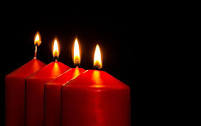
Fourth Sunday of Advent 2025 – Candle of Love

In the beginning, God fell in love with creation, and pronounced it very good.  Like romantic adoration, God’s eternal love is blind to human betrayal, rebellion, and stupidity.  When God’s children ignore the prophets and break every covenant offered to us, God continues to love us like a star-struck lover.

We celebrate Advent and Christmas every year to remind us that God still so loves the whole world that He comes to share the risks and sacrifices of being a vulnerable human being. 

In the dark days of December, when wars and senseless violence dominate the news, God’s love simply grows brighter and stronger.  The Advent candles remind us that we are all created in the image of God, and the essence of our God is unbounded, unconditional love. 

So on this final Sunday of Advent, the circle of the wreath is completed.  We relight the candles of Hope, Peace, and Joy.  And today we light the Candle of Love, because the greatest of these is Love. 

[Light all four candles]

Please join me in the prayer on the screen:

O dear God, lover of our souls, we are undeserving and unworthy of your radical love.  Our souls our willing, but our flesh is weak.  Please sweep us off our feet again in your loving embrace.  Help us to share in your wild and crazy romance with this broken world.  Let these candles rekindle in us the dream of your beloved community, so we can throw open the gates of love to all of your weary, hopeless children.  Remind us once more that the Babe of Bethlehem still calls us to love one another, in the same reckless, unconditional way that you love us.  Amen

Northwest UMC, Columbus, Ohio

Eternal Love: A Journey Through Lent

I was not in the mood for Lent this year. With everything going on in the world and my own ever-nearing 80th birthday in just 19 months the last thing I wanted to hear was “You are dust, and to dust you shall return.” I already felt lost in the wilderness and didn’t think I needed to add any more of lostness to my weary soul.

But even good habits die hard and this annual tradition kept nagging at me; so my wife and I decided to attend our church’s Ash Wednesday service on line, and I’m very glad we did. On-line worship is not usually the best way to worship for me, but I am grateful for that option when I need it. The service at Northwest UMC on Ash Wednesday was an exception to the rule for both Diana and me. It was a very well done service that was contemplative, and being at our kitchen table with only candle light to illumine the room was ideal for that particular kind of worship.

Our church had provided packets for the service that included ashes and a small piece of clay. At one point in the service, after hearing the traditional Scriptures for Ash Wednesday read, we were asked to take the clay and form it into something symbolic that would have meaning for us during the 40 day journey of Lent.

We were give time to pray about that assignment while soft guitar music played. Thanks to the wisdom of several authors I’ve been reading in the chaotic days since January 20 (Richard Rohr, Kate Bowler, Diana Butler Bass, Nadia Bolz-Weber, Brian McLaren, and Sarah Bessey) my mind was led to think about the one constant and trustworthy thing in any time of crisis, namely God’s eternal love.

So I formed my clay into the symbol for infinity which always looks like an 8 lying down to me. Then as I had time to ponder that a little longer it came to me that what I was thinking and feeling was not just a mysterious concept of never-ending infinity or even in Buzz Lightyear’s famous quote “To infinity and Beyond.”

What I was trying to capture in clay was something quite tangible and real – Love. I’ve felt that love more powerfully than ever before through my family and friends who rallied around me during my health crises in the last 8 months. I discovered that my village is a lot bigger and deeper than I realized before. The ministry of presence took on a more beautiful meaning for me in the physical and spiritual companionship that surrounded me and got me through a wilderness journey of my own.

So I decided to shape one end of my clay infinity symbol into a heart (pictured above), and it is still sitting on the kitchen table to remind me several times a day that St. Paul got it right in I Corinthians 13:7-10 when he wrote: ” Love bears all things, believes all things, hopes all things, endures all things. Love never ends. But as for prophecies, they will come to an end; as for tongues, they will cease; as for knowledge, it will come to an end. For we know only in part, and we prophesy only in part, but when the complete comes, the partial will come to an end.”

That worship experience was a much needed reminder for me of that eternal love which is the constant, solid ground under our feet even when the foundations of everything we thought we could trust are shaking like an earthquake, to borrow a phrase from the great theologian Paul Tillich. The Ash Wednesday service I didn’t think I wanted helped me to surrender a lot of the anger and frustration I’ve been dealing with about our current political crisis, and I am very grateful.

Today I put that picture of my clay symbol on my watch and phone as wallpaper to be an even more frequent reminder for me the power of eternal love.

A funny thing happened after that Ash Wednesday service. When my wife Diana looked at my art work she said, “I like your fish.” After I explained to her what I intended my symbol to be I realized that the fish is also a great symbol for eternal love. I was also reminded that art is also mysterious and can mean different things to different people at different times.

The fish symbol has been a Christian symbol for 2000 years because the early Christians used it as a secret code to identify themselves as Jesus followers to one another in a way that they hoped would not be recognized by their Roman persecutors. The origin of the symbol came from the Greek word for fish, Ichthus. It was and still is used because the letters of the word ichthus are the first letters of the Greek phrase “Iēsous Christos theou hy ios sōtēr”, which translates to “Jesus Christ Son of God Savior”. 

So whether I see a fish or an infinity symbol when I see this piece of clay doesn’t matter. They both speak to me of God’s eternal love that will sustain me through these 40 days of Lent and through whatever the future holds until I return to dust and beyond. I hope it might do the same for you.

Trump’s Ukraine Negotiations: A Recipe for Disaster

“Blessed are the peacemakers, for they will be called children of God.” Jesus, Matthew 5:9

If you haven’t seen the video of the Trump-Vance vs. Zelensky “negotiations” in the Oval Office yet, please stop here and see it for yourself.  Try to suspend whatever opinions about the encounter you have heard or read about from commentators, although I know that is hard to do.  It is even harder to divorce oneself from personal bias, and if you have read any of my posts in the last few months you probably know my political bias.  These thoughts however came to me as I watched the White House meeting live and before I had heard other commentary.

President Trump has said repeatedly and again today that he wants peace in Ukraine.  By that he means he wants the killing to stop; he wants the credit; and he also wants to be paid back for what the U.S. has provided to Ukraine in the last three years, even though that was never part of the deal.  The Biden administration and a bipartisan Congress gave armaments to Ukraine so they could defend themselves from a Russian invasion.  Yes, Russia is to blame for this war, even though that is not the case in Trump’s alternative facts universe.  The point here is that the military aid was a gift, not a loan.  There is nothing to repay to the U.S. or the other nations who have supported Kyiv through these three long, bloody years. We did it because it was the right thing to do, period. 

And yet here we are again with Trump trying to coerce a deal with Ukraine for some rare earth minerals in exchange for continued support just like he did in his first term when he tried to get dirt of the Bidens from Zelensky as pay back for U.S. support.  That was the reason Trump was impeached the first time, remember? 

So enter these three key players today – Trump, Vance, and Zelensky.  I said to my wife as soon as I saw J.D. Vance was there that he had no business being there, and if Trump really wanted peace he would not have included his Vice-President in this delicate meeting.  The inexperienced Vance has already insulted Ukraine and most of Europe in his disastrous speech in Munich a couple of weeks ago.  He has so little political experience that his fellow Republicans called his Munich blunder “a rookie mistake.”  So why have this rookie even in this critical meeting in the first place? Apparently so he and Trump could gang up on Zelensky, and in fact it was Vance’s intrusion into the conversation when the meeting was nearly over that set off the shouting match.  Vance is the apprentice who should be fired.

Side bar: I heard later that someone had the audacity to criticize Zelensky for how he was dressed, saying it was disrespectful for him not to wear a suit and tie for this important meeting.  Have you seen how Elon Musk dresses for cabinet meetings and other events in the Oval Office?  Methinks Zelensky was set up to be ambushed from the get go, and that’s what bullies do, not what peacemakers do.

The other Scripture that came to mind as I watched is the very familiar passage from I Corinthians 13 where Paul says, “Love is patient; love is kind; love is not envious or boastful or arrogant or rude. It does not insist on its own way; it is not irritable; it keeps no record of wrongs; it does not rejoice in wrongdoing but rejoices in the truth.”  Both our President and VP were boastful, arrogant, and rude.  They both insist on their own way and keep records of every real or imagined wrong ever done to them.  And let’s not forget the matter of truth.  Trump has repeatedly said that the U.S. has provided Ukraine $300-360 billion in aid when the real number appropriated by Congress is less than $200 billion.  Trump was caught on video last week calling Zelensky a “dictator,” but when asked by a reporter Thursday if he still thought the Ukrainian president was a dictator, Trump straight-faced said, “Did I say that? I can’t believe I ever said that.” He never did answer the question.  As for the demand from both Americans that Zelensky needed to be grateful for our aid the fact checkers tell us the Ukranian President has already expressed gratitude publicly over 30 times. 

You will of course get two different assessments of how President Trump did in this made for television spectacle.  His Republican allies loved his “tough” handling of Zelensky while his Democratic critics saw what transpired as a disaster for our country and for our former Western Allies.  But here’s all you need to know about the impact yesterday’s events will have on the future of democracy.  First, a Russian reporter was allowed into the oval office for this delicate meeting (which should have been held in private) so Trump’s reprise of his role in the Apprentice could be reported directly back to the Kremlin.  Second, the loudest cheers for the Trump-Vance tag team performance came from Putin and his oligarchs in Moscow, and all the while the bombing and destruction of Ukraine continues into a fourth year.

My father and all the other brave men and women who risked their lives to defeat fascism in WWII are turning over in their graves. 

March 1, 2025

Advent 4, 2023: Love

We have made our way this Advent from prophesy and promise to stand now on the cusp of fulfillment.  This very night we will celebrate again the birth of love incarnate in the form of a helpless infant.  Like that baby, love is vulnerable.  Both require careful nurture and handling.  Love is a gift entrusted to common people like Mary and Joseph, like you and me.  Of all the gifts we may give or receive this week, none is more precious than the simple gift of love.  That is what inspired St. Paul to write: “And now these three remain: faith, hope and love. But the greatest of these is love.”

God’s love is a spirit that requires embodiment to become real.  God’s love must become flesh to dwell among us.  At Bethlehem that love came to life in the infant Jesus.  Today, if we are open to the mystery, it can come to life in you and me as the church, the body of Christ.  We can be the light of the world because of Christmas. So today we live between the warm feeling of God’s love and the choice to put that sentiment into concrete action.   We humbly receive God’s most precious gift as we light the 4th candle of Advent, the Candle of Love. 

[Light the 4th Candle]

Please pray with me as I share this Advent prayer from Kate Bowler and Jessica Richie from their book, “The Lives We Actually Have:”

God, we are waiting for love,

not the simple kind or the sweep-you-off-your-feet kind,

but the absurd kind.

The kind wrapped in rags, resting in a bucket of animal feed.

Love enough to save us all.

Blessed are we who look for Love,

deeper, fuller, truer—than we have ever known,

than we could have ever hoped for.

Blessed are we who seek you,

the light that dawned so long ago in that dark stable.

Love given.                                                    

Love received.

Dear God, Hold us in that love these last few hours of Advent till that love is born again in our hearts this very night. Amen

Northwest UMC, Columbus, OH; December 24, 2023

Righteous Anger: Cymbal or Symbol

We are half way through March, and I can’t remember a day this year that I have not have read about another shooting in Columbus every time I open the local newspaper or turn on the local news.  Gun violence in upscale malls and communities of color, hate crimes against my sisters and brothers who are Asian Americans,  the pain of illness and aging my family members are going through!  I’m mad and I don’t know what to do with my anger.

The violence became more personal this morning when a beloved Asian American sister and friend invited our church staff to a prayer vigil tomorrow to pray for an end to the fear and violence against Asian Americans.  And yes I am angry at Donald Trump and those who cannot see or refuse to see the harm they are doing.   I know I need to love them and forgive them, but this crap lies squarely at Trump’s feet for his racist speeches about the pandemic and China.  Forgive 70 x 7?  He’s gone way over that total years ago, and I feel helpless about letting that anger eat at me!

But I don’t know what to do with the anger that would be constructive.  I want the temple-table turning-over Jesus right now, not the “love your enemies” one. And yet that same Jesus says “put away your swords” to those who would protect him, who forgives his executioners and their ignorance.  It’s too much.  I can’t love like that, and I’m ashamed to admit it.  If I cannot be part of the solution I am part of the problem.  If I can’t confess my white privilege and witness against the systemic racism in our country “I am a noisy gong and a clanging cymbal” (I Corinthians 13) instead of a symbol for love and justice.

I’m so longing for Easter but know we are a long way from the empty tomb, and the path that leads there goes through Gethsemane and the place of the skull.  Isn’t there a short cut, a way around the passion and suffering, a way to avoid the mess and the command to take up a cross and follow Jesus?

I know the answer to that question.  So I just keep praying to the source of all being to “Grant us wisdom, grant us courage, for the living of these days1” and for the faith and strength

“To dream the impossible dream
To fight the unbeatable foe
To bear with unbearable sorrow
To run where the brave dare not go

To right the un-rightable wrong
To love pure and chaste from afar
To try when your arms are too weary
To reach the unreachable star.2

  1. “The Impossible Dream,” Mitch Leigh and Joe Darian
  2. “God of Grace and God of Glory,” Harry Emerson Fosdick

Convicted and Needing Grace

Journaling is one of my forms of self-therapy. I regularly vent, ponder, reflect and sometimes just record things I’ve done or the state of my mind and heart. Often I try out ideas I might want to blog about in my journal and then go back and explore them further and in more “polished” form. But today I just want to share what I wrote last evening about an issue that has been troubling me and messing up my faith journey for quite some time. I may return to this later and share my progress on it, but in the meantime I welcome comments and insights. Here’s what I wrote about 10 pm last night:

“Heard an excellent sermon on I Corinthians 13 today from one of our pastors, Mebane McMahon, and even before she preached I heard conviction in the reading of the text about my own failure to “endure, believe, hope all things.” My anger at Trump and his gang is eating at me and that’s not the Gospel. I remember one of my mentors “Bogie” Dunn talking about people we least want to include already being in God’s house – his example was Nixon and for me it’s Donald J. Trump There was a time early in his term that I was able to pray for President Trump by name but haven’t done that in months now. I have also forgotten to remind myself that I am and he is too a child of God. Something has made him the angry, racist, sexist, dishonest person he is and to try and understand that, which I am sure I never will, is more valuable than just anger and hate at his behavior, no matter how evil I think it is. He is still redeemable – if that is not true then the Gospel is false and we are all doomed. Those are hard truths to embrace but if I want that kind of grace for myself then I have to be willing to affirm and share it for everyone. And that means everyone. “I believe Lord, help my unbelief.”

Myth Busters: Everything Happens for a Reason, I Corinthians13:8-13

When my son was in high school one of his friends was killed in a terrible car crash. Like most preachers’ kids Matt struggled with the expectations placed on him, especially in the small community where we lived. Unfortunately a well-intended preacher at his friend Shane’s funeral added to Matt’s frustration with the church by telling the folks at the funeral that “everything happen for a reason.”

Like all the myths we’re looking at in this sermon series this one contains some truth and is well-intended but not always helpful. There are several scriptures that can be used to support this myth: Ecclesiastes 3:1 “For everything there is a season, and a time for every matter under heaven.” Proverbs 16:4 says, “The Lord has made everything for its purpose,
even the wicked for the day of trouble.” Romans 8:28, where Paul says, “We know that all things work together for good for those who love God, who are called according to his purpose.” But as with all theological statement these verses need to be read in context and with the understanding that the biblical authors were all fallible human beings like us struggling to understand things that just don’t make sense.

At one level it is certainly true that everything happens for a reason. Actions have consequences and they are often unintended or unanticipated. Genetically engineering food and pumping animals full of antibiotics have increased our food supply which is good, but we are learning the hard way the unintended consequences are super bugs resistant to all known medications. Cancer is one of the most difficult plagues on humanity to understand, and we applaud the advances research has made. But we are still not doing enough to prevent various cancers by changing our lifestyles and especially the way we eat. Actions have consequences, and until we stop poisoning our food and air and water we will not find a magic bullet to cure cancer.

Health care in general is a hot topic, and again we can’t just blame God or fate for illnesses but must take proactive steps to live healthier lifestyles. Our aging population in particular is a big challenge. 30% of what is spent on our healthcare in a lifetime occurs in the last year of life, and that is often because our focus is too much on the quantity of life and not its quality. A friend told me recently about his mother. When she was 92 years old and in failing health some of her doctors wanted to amputate both of her legs to keep her alive a little longer. These kinds of costly and unnecessary procedures occur because we are afraid to face the reality that we are all dust and to dust we will return. We need to have important conversations about end of life issues based on values and not economics or fear of our inevitable death.

The good part of this myth that everything happens for a reason is that it is really about trust and faith. When our ability to make sense of things reaches its limits that’s when faith kicks in. The mysteries of life and death challenge us to accept our limitations and to make friends with ambiguity, but too easily accepting this myth short circuits that important process. It can be used to avoid taking a leap of faith into the unknowable mystery of God.

The beautiful words of I Corinthians 13 are most often heard at weddings couched in the romantic notion of love that bears all things and never ends, but that’s not what Paul was about when he wrote this beautiful passage. Remember Paul advised people not to get married if they could avoid it. The preceding Chapter 12 of I Corinthians sets the stage for chapter 13. In Chapter 12 Paul addresses jealousy and arguments the church in Corinth was having about which spiritual gifts were the best. Paul uses the metaphor of the human body to describe different spiritual gifts and challenges the church members to accept their own limits and value the gifts of others. And then at the end of that chapter about the body of Christ, Paul says I will show you a better way to achieve spiritual maturity, the way of love.

In chapter 13 Paul says all the spiritual gifts are temporary and partial. This earthly life, including all of our knowledge will pass away – but inquiring minds want to know now. We don’t to wait! We did the whole wait training thing in Advent and we’re tired of waiting. We want answers to life’s mysteries right now. The human search for knowledge and truth is good up to a point but it always gets us in trouble when we overreach our limits. Ever since Adam and Eve couldn’t resist the forbidden tree of knowledge of good and evil we’ve wanted to know more than our pay grade qualifies us to handle.

Look at what Paul says: “For we know only in part, and we prophesy only in part; but when the complete comes, the partial will come to an end. When I was a child, I spoke like a child, I thought like a child, I reasoned like a child; when I became an adult, I put an end to childish ways. For now we see in a mirror, dimly, but then we will see face to face. Now I know only in part; then I will know fully, even as I have been fully known. And now faith, hope, and love abide, these three; and the greatest of these is love.”

Now we see only in a mirror dimly, like when you get out of the shower and the mirror is so fogged up you can’t see a thing. But we don’t want to know in part, we want shiny clean mirrors. We want certainty not ambiguity especially when it comes to matters of eternal importance to us. The frustration is that it is those very questions about death and life after death that we cannot have certainty about.

Paul says that to be adults in our faith is to give up our need for certainty. Those who study human development know that at different stages of maturity we are capable of handling different levels of truth. Small children are helpless and need the certainty that concrete and solid answers to their questions provides. They need to know they are cared for and will not be abandoned by the important figures in their lives. They expect parents and other significant adults in their lives to know stuff they don’t understand. Who hasn’t experienced the inquisitive mind of a three year old who wants to know why the sky is blue, and why she needs to brush her teeth and how the dish washer works, and why grandpa is bald? There is no end to their questions. We have a gas fireplace at our house that has no chimney, and every Christmas our grandsons ask us again how Santa can get into our house if there’s no chimney.

A great deal of our education system is based on that same kind of concrete, factual pursuit of knowledge. In school the test questions usually have one correct answer. For instance, if I asked you which letter comes after the letter A in the alphabet, what would the correct answer be? If you said “B” that is correct, but it is only one of 25 correct answers. Young Albert Einstein was asked that question by one of his teachers early in his life, and the teacher was not pleased when he replied, “They all do.” Most of us are not encouraged to think outside the box of concrete certainty as children, but when we become adults we need to adopt grown up thinking which sometimes means admitting we don’t know and can’t know some things yet.

What Paul is telling us is that when it comes to matters of theology a mature faith is one that can look into the ambiguity of a cloudy mirror and still be at peace with the uncertainty of faith. The statement that everything happen for a reason is meant to provide peace of mind by telling us that God is in charge and everything will be ok in the end. But we don’t live at the end of God’s drama when things make sense, we live in the confusion of the present and those words meant to comfort often backfire. Let’s look at some of the reasons that’s the case.

Number 1: If God’s in charge of everything, then we have to blame God for both the good and bad stuff too. This problem is a cousin to the myth that Mebane covered two weeks ago, namely that “God won’t give you more than you can handle.” Both myths imply that God makes bad things happen for some reason we can’t understand. When we are scared and feel out of control, we need assurance that God is, but the downside of that is we have to hold God accountable for all the bad stuff too and there goes any comfort we get from God. Even Wesley’s familiar Covenant service prayer we used here just 3 weeks ago to begin the new year falls into that trap when it says “I am no longer my own, but thine. Put me to what thou wilt… Put me to doing, put me to suffering.”

Does God cause suffering? There are certainly places in the Bible that indicate that’s the case, for example the whole book of Job, or God’s punishment by death of Ananias and Sapphira for cheating on their church pledge in Acts 5. Some people are sure God is responsible for the election of Donald Trump, and others of us are wondering if this is God’s punishment for the sins of our nation. It obviously can’t be both. Did God give Clemson a victory in the Fiesta Bowl and cause the agony of defeat for OSU? Is God causing the unbelievable suffering in Syria or for the refugees trying to escape that mayhem?

Of course not. We worship a God of love, and the biblical accounts of God’s direct intervention in punishing people were the best answers the people in biblical times could give to some of the most mysterious and difficult questions in creation. We still struggle with those same questions today, and will until we see God “face to face.” Until then we can only know in part.

Number 2: The second problem with this myth is that if we surrender all control of everything that happens to God we absolve ourselves of all responsibility for human causes of suffering or injustice. Rev. Adam Hamilton who has written about these myths in his book “Half Truths” says a friend sent him this comment from a Facebook meme: “Yes, everything happens for a reason, but sometimes the reason is you’re stupid and make bad decisions.” Our actions have consequences. My son’s friend died not because an all-powerful God willed it so, but because of poor judgment and excess speed by a teen aged driver.

Blaming God or the devil or someone else for all our problems pushes us into the dangerous territory of going into victim mode. Woe is me, everybody hates me! The world is against me! We cannot control external events that happen to us, but with God’s help we can control how we react. Do we learn from our mistakes and those of others or waste a learning opportunity? To go victim robs us of chances to reflect and learn and to use adversity to strengthen instead of weaken our faith. It’s hard to increase our faith when we’re angry and blaming the very God who could be our greatest source of strength in time of trouble. That’s not to say we can’t be angry at God or our circumstances. Anger is one of the natural stages of grief. God can handle our anger and isn’t going to abandon us or punish us for being mad. It’s just when we stay angry too long that we multiply our suffering.

Blaming God for our suffering is also costly because it robs us of one of the greatest gifts God has given us, our free will. Sure, sometimes it feels like we’d be better off without free will if we could avoid suffering, but that’s not true. We cannot achieve our full humanity if God is just a puppeteer and we are robots or marionettes. God gives us freedom of choice so we can experience the joy of growth and doing good. Without freedom there is no ability to choose love, and as Paul teaches us, Love is the greatest gift of all that lasts when knowledge and prophesy are no more.

Number 3: And that brings us to the 3rd problem with the myth that everything happens for a reason. When we see knowledge and the ability to explain everything as our purpose in life we are treading on the thin ice of wanting to be like God. We want answers and we want them right now. Adam and Eve had everything they could ever need in the Garden of Eden, but their desire to be like God cost them everything. Worshipping absolute answers makes it impossible for us to live by faith and put our trust in the God who is beyond all human comprehension.

So what do we do instead of telling people in pain that “everything happens for a reason?” We recently attended a funeral for a 33 year old army vet who got hooked on pain meds because of a back injury he got in the service. On New Year’s Day Alex finally lost his battle with addiction. He left a young widow and a sweet four-year-old daughter named Hope. How do you tell his friends and family that all this happened for a reason and expect that to help? You don’t. It was the first Jewish funeral I’ve ever attended and I was impressed with what the Rabbi said instead. He quoted Rabbi Harold Kushner who published a book entitled “When Bad Things Happen to Good People” 20 years ago. It’s still the best thing I’ve ever read on this subject.

The title of the book is not WHY bad things happen but WHEN because they happen to everyone sooner or later. And essentially what Kushner says is that “Why” is not really a question in these cases, it is a cry of pain. And we all know what to do when someone is in pain. They don’t need answers, they need comfort. They need someone to love them, to walk with them through the valley of the shadow of death. We don’t have to say anything; we just have to love.

If we had the answers to suffering we could use them, but we don’t. We are not God. We see in a mirror dimly, and that’s ok, because Paul assures in Romans 8, just us as Jesus did, that God is with us always and nothing in all creation can ever separate us from that love. So “faith, hope and love abide these three, but the greatest of these is love.”

In his play “J.B.” based on the book of Job, Archibald McLeish puts it this way. J.B.’s wife is trying to help him struggle with the why question about his unbelievable suffering, and she says to him “The problem J.B. is that you are looking for justice and there is none. There is only love.” When we are hurting or those close to us, that love is all we need, and it lasts forever.

Northwest UMC, Columbus, Ohio, January 22, 2017

Freeway Theology

IMG_0048 (2) I saw this graffiti spray-painted on a freeway overpass several years ago, and my immediate thought was “I guess forever was longer than John expected!” After wondering how and why people hang over the side of an overpass and paint upside down, my next thought was “that’ll preach.” I’ve used it often in preaching class as an example of the kinds of ordinary observations in daily life that can have theological significance.

Jesus did that, of course, using mustard seeds, lost sheep and coins, yeast, candles, a valuable pearl, and even a hated Samaritan to weave parables that reveal truth about the nature of God that declarative sentences can’t illuminate in the same holistic way. Stories and images reach beyond the intellect and move us at a deeper emotional level.

John obviously fell out of love with whoever’s name was beneath that paint. It happens all the time in human relationships, but we cannot convert that unfortunate reality that sometimes leaves deep scars on the human psyche into what God’s relationship to us looks like. How unfortunate if we let false teachings about a wrathful, judgmental God scare us away from the only source of truly unconditional love there is.

We often hear Paul’s marvelous words about love read at weddings: 4 “Love is patient; love is kind; love is not envious or boastful or arrogant 5 or rude. It does not insist on its own way; it is not irritable or resentful; 6 it does not rejoice in wrongdoing, but rejoices in the truth. 7 It bears all things, believes all things, hopes all things, endures all things. 8 Love never ends.” (I Corinthians 13). I try to warn starry-eyed couples that those words do not describe human love, no matter how strong that love is. Paul is writing about God’s love revealed to us in Christ, and it is the backup we can always turn to when we want to remove the tattoo of our beloved from our arm or spray paint over his or her name on the overpass.

God’s love is forever. It’s not a 5 year or 50000 or mile guarantee. It’s not even “till death do us part,” as great as that deep love is. There is no fine print in God’s covenant with us. We can break the contract or think we have by our own sinfulness or stupidity, but God won’t ever stop loving us, period. Like the prodigal son’s father, God waits patiently for us to come home, no matter how badly we’ve messed up our lives or how long we’ve been gone.

That message is repeated in a multitude of ways in the Hebrew Scriptures and the New Testament. Two of my favorites are: “Come now, let us argue it out, says the LORD: though your sins are like scarlet, they shall be like snow; though they are red like crimson, they shall become like wool.” (Isaiah 1:18). And “If we say that we have no sin, we deceive ourselves, and the truth is not in us. 9If we confess our sins, God is faithful and just will forgive us our sins and cleanse us from all unrighteousness.” (I John 1:8-9)

That’s pretty straight forward and clear. Don’t let disappointments with human love confuse you about God’s love. With God, forever really means forever.