Spiritual Cardiology


After I wrote my meditation on “A Wise Heart” earlier this week it very quickly became apparent that Psalm 90:12 isn’t finished with me. That verse says, “So teach us to count our days that we may gain a wise heart,” and the focus of my earlier post was on having a compassionate and caring heart. It occurred to me shortly after I posted that piece that the heart is also the seat of courage. While head knowledge is incomplete without heart knowledge, neither is adequate without courage.

The hymn “God of Grace and God of Glory” points that out when it says, “Grant us wisdom, grant us courage for the living of these days,” and the turbulent early weeks of 2017 certainly seem like the kinds of days the great preacher Harry Fosdick had in mind when he penned those words. In fact Fosdick wrote that hymn in 1930 just as the Great Depression was beginning and the Nazis were coming to power. I am praying the parallel ends there, but given the political instability and unrest here and around the world present days certainly qualify as those that require wise and brave hearts.

So if we really want wisdom and courage for facing trying hours and days, be they personal or corporate, maybe what we need for Lent is a heart transplant. A few years ago a good friend of mine was scheduled for open heart surgery. I had not been able to visit him in the hospital because I had a cold at the time and my germs were persona non grata. The night before the surgery my friend called me and we talked a few minutes. I don’t remember the content of the conversation, but he told me after the surgery that I was one of many calls he made that night. He understandably had trouble sleeping knowing surgeons were going to cut his chest open the next morning. He was nervous and felt a need to reach out and talk to people who were important in his life not knowing if it might be his last chance to do so.

It seems to me that the act of asking God to give me a new heart is also pretty risky business. My peers remind me often of the wisdom of Mae West who once said, “Aging is not for sissies.” Neither is following Jesus. We are in denial; at least I often am, when I tell myself that when Jesus said, “Take up your cross and follow me” he was just speaking metaphorically. Living faithfully as Jesus followers in a world gone crazy over materialism, militarism, fear-inspired violence, and self-centered hedonism is not for the faint of heart. To offer the prayer of Psalm 51 asking “Create in me a clean heart, O God, and put a new and right spirit within me” is a radical prayer and should not be uttered by rote or taken lightly. It’s asking for a spiritual heart transplant.

I always enjoy March Madness of the basketball variety, but this year it is an especially welcome diversion from the madness going on in the world. As I was browsing at our public library this week I came upon a timely and enjoyable audio book about three legendary basketball coaches who all coached in the Atlantic Coast Conference in the 1980’s. The book is appropriately entitled “The Legends” by John Feinstein and is about Dean Smith (UNC), Jimmy Valvano (NC State), and Mike Krzyzewski (Duke). One story early in the book struck me as an excellent example of a brave heart. Dean Smith was one of the greatest coaches in the history of college hoops, but long before he was a legend with a basketball arena named after him, when he was a young, unknown assistant coach at the University of North Carolina in the late 1950’s he put his job and career on the line off the court. He and his pastor took an African American divinity student with them into a segregated restaurant where his basketball team ate frequently and quietly broke down one small racial barrier. When John Feinstein heard about that incident when he was writing his book decades later he asked Coach Smith why he had never heard that story. Feinstein said, “You must have been very proud of doing that.” But Coach Smith said, “You should never be proud of doing the right thing. Just do the right thing.”

Brave and humble hearts don’t need to boast about acting justly, they just do it. Actions speak louder than words about the kind of heart one has. One of my favorite more recent hymns describes how a spiritual heart transplant works. I can’t sing “Here I Am” by Dan Schutte without feeling my heart and faith grow stronger. In one verse Schutte has God say, “I will break their hearts of stone, give them hearts for love alone.” The courage to live boldly and take the narrow unpopular road that leads to salvation and justice comes from hearts filled with so much love that there is no room for fear and doubt.

The journey from fear to faith is often like the one Dorothy and her friends take in “The Wizard of Oz.” Those four pilgrims on the yellow brick road are looking for a heart, for courage, for a brain and a way to go home. Isn’t that a great metaphor for the human condition? Aren’t’ those the things we all long for to live a full and satisfying life?

Dorothy, the tin man, the scarecrow and the lion think they are on an external journey to the promised land of Oz to find themselves. What they discover is that the faith journey is first an internal journey. The Wizard can’t give them what they are seeking, but the pilgrimage they take to the Emerald City provides them a much more transformative trip inward where they all discover that they already have courage, heart, and wisdom; and Dorothy’s red shoes are her ticket back to Kansas.

So the good news is that we don’t need to undergo an actual heart transplant to find our brave voices. Our factory equipment hearts provided by God are full of wisdom, love and courage. But like our physical hearts our spiritual cardio-vascular system can also get clogged up by fear and weakened by lack of use. But no matter how weak or spiritually dead we think we are, no matter how long or how often we have failed to walk the walk of courageous and compassionate faith, Lent is another opportunity to take the inward journey to rediscover the depths of wisdom and courage God provides for the living of this day and every day.

To pray to God for a wise and brave heart is a first step on the journey, like when we realize we need to see a health care provider and live a more heart-healthy lifestyle. And even if we feel spiritually dead with a heart of stone, God is always ready and willing to do CPR or jolt us back to life with a defibrillator. God has an impressive record of bringing people back from both spiritual and physical death.

God nurtured Elijah back to health and courage on Mt. Horeb; gave Jesus the strength he needed to carry on in the Garden of Gethsemane; and turned that bunch of cowering fishermen hiding in the upper room into a band of leaders who turned the world upside down. God gave Ruth the courage to stay with Naomi; helped the Samaritan woman at the well bare her soul to Jesus, and blessed Mary Magdalene with a whole new demon-free life. Brave hearts pray “Not my will but thy will be done. Brave hearts beat to the rhythm of Isaiah’s response to God’s call in the year that King Uzziah died (Isaiah 6) or Mary’s brave response to God’s most incredible request to bear his son. The brave peasant girl said: “I am the Lord’s servant. May your word to me be fulfilled.” (Luke 1:38).

And in Lent 2017 God still asks, “Whom shall I send?” and brave hearts sing (and mean it) the chorus to “Here I am Lord:”

“Here I am Lord! Is it I Lord? I have heard you calling in the night. I will go Lord, if you lead me. I will hold your people in my heart.”

Do we mean it? Do I mean it? Our actions and lives will show the world what kind of hearts we have.

“How Can We Love Our Enemies?” Matthew 5:38-48

“God makes the sun rise on the evil and on the good, and sends rain on the righteous and on the unrighteous.” I heard Dr. Fred Craddock preach on this text once, and he observed most of us would not be so generous toward the evil and unrighteous. He said if he were in charge the rain would fall on the good farmer’s field and stop abruptly when it came to the property line of the evil farmer. He went on to say if God were really just that every golf ball hit by a Sunday golfer playing hooky from church would go straight up in the air and fall at the feet of the golfer.

This whole passage from the Sermon on the Mount is one of the most challenging in all of Scripture. And in particular Jesus telling us to love our enemies has to be high on the list of those things we wish Jesus hadn’t said. But those words are much needed in our bitterly divided nation and world today.

Before we dig into the practical problems of how in the world to live up to these teachings of Jesus I want to set the context by sharing a quote from Dallas Willard, a teacher of spiritual formation. Willard says, “The Gospel is less about how to get into the Kingdom of Heaven after you die and more about how to live in the Kingdom of Heaven before you die.” Let me repeat that: “The Gospel is less about how to get into the Kingdom of Heaven after you die and more about how to live in the Kingdom of Heaven before you die.” Those words are especially true of the Sermon on the Mount where Jesus is describing to his followers what it looks like to live as faithful disciples and citizens of his kingdom here and now in a world that teaches the very opposite. In other words, too many Christians focus on what Jesus did for us on the cross but not enough on what he requires of us as his disciples. That is a little strange since it is Jesus’ high standard of ethical living that got him in trouble with the authorities who killed him.

And so Jesus begins by repeating what previous Scriptures have taught about living in the worldly kingdom. “You have heard it said…” Don’t get mad, get even! Revenge is a natural human reaction, and I’m guessing most of us have been there in one degree or another in recent days or weeks. “You have heard it said, an eye for and a tooth for a tooth.” Sounds fair, doesn’t it? Let the punishment fit the crime. In fact, at the time those words were written hundreds of years before Jesus they were designed to limit revenge; so victims would not demand two eyes for an eye, or a whole mouthful of teeth for a tooth. As someone has said, if we follow the eye for an eye and a tooth for a tooth philosophy to its logical conclusion, we end up with a world full of blind, toothless people, and the cycle of violence and pain continues forever.

So Jesus reminds his disciples of the ancient law and continues, “But I say to you…” Look out whenever Jesus starts out with that phrase; brace yourself for a zinger. “But I say to you, love your enemies and pray for those who persecute you. If anyone strikes, you on the right cheek, turn the other as well.” O, Jesus, you’ve got to be kidding! We can’t do that! You can’t be serious. How can we possibly love those responsible for horrific acts of death and destruction? You don’t mean for us to love ISIS, or that creep who murdered and raped Reagan Tokes, or our political enemies do you? And you can fill out the rest of your list of those we find it hard if not impossible to love.

Let’s look at the big picture of how our understanding of God’s will changes and grows. God doesn’t change, but our ability to grasp the enormity of God’s grace and love increases as we grow in faith both as individuals and as a faith community. We’ve already seen how that process unfolds from the days of Moses to Jesus, but let’s look at some other examples of how God surprises us throughout the Scriptures. I found this wonderful summary of that process in a Facebook post from Bixby Knolls Christian Church:

“In Deuteronomy 23 we read that the people of Moab are bad and not allowed to dwell among God’s people. But later in the Old Testament we meet Ruth the Moabitess (who becomes the grandmother of David and one of the women listed in Matthew’s genealogy of Jesus).
Jeremiah 25 tells us that people from Uz are evil, but then comes story of Job, a man from Uz who is the “most blameless man on earth.”
No foreigners or eunuchs allowed, again from Deuteronomy, and then comes the story in Acts 8 of an African eunuch welcomed into the church.
God’s people hate Samaritans, but Jesus tells one of his most famous stories where a Samaritan is the hero and the model for what it means to be a good neighbor.
The story may begin with prejudice, discrimination, and animosity, but the Spirit moves God’s people toward openness, welcome, inclusion, acceptance and affirmation.”

And our Judeo-Christian Scriptures aren’t when it comes to non-violent responses to those who hurt us. The Dali Lama, a leader of another of the world’s great religions, wrote these words shortly after 9/11, certainly one of the most trying times in our lifetime for those who take Jesus seriously. The Dali Lama was commenting on how America should respond to 9/11 and wrote, “It may seem presumptuous on my part, but I personally believe we need to think seriously whether a violent action is the right thing to do and in the greater interest of the nation and people in the long run. I believe violence will only increase the cycle of violence.”

The tragic fact that we are still involved in the longest war in U.S. history in Afghanistan 16 years after 9/11 underscores the truth that violence increases the cycle of violence. We’re not going to solve that eternal question today, especially on the international level, but let’s take a look at what Jesus is asking of us in our personal lives and relationships when it comes to living peaceful Christ-like lives.

It is hard to find silver linings in some clouds, but even in tragedy there are often some benefits. We see it in extended families that rally around each other when there is a death of illness. We saw it the sense of unity in the U.S. after 9/11. Patriotism was higher than at any time since WWII. That kind of unity as a family or church or a nation is wonderful, but Jesus asks us to take that sense of community one giant step further–to include even our enemies in the circle of God’s family.

The sense of unity and patriotism after 9/11 didn’t last long, and part of the division in our nation is because we differ over how to respond to evil. Some insist on an eye for an eye response and others advocate a gentler approach. Those differences have hardened into partisan political lines that make it more important than ever to love those we differ with politically. One way to do that is to pray for those we disagree with by name, and the stronger our disagreements, the more important those prayers become. Whoever you see as on the wrong side of the political fence or some other contentious issue, pray for them, and I find it helpful to do so by using first names. That makes the prayers more personal and meaningful, and I find it hard to be angry when praying for someone.

Fear of others is the biggest barrier to love. In today’s political climate immigrants of all kinds fear for their future. We can’t solve the immigration policy debate here today, but each of us can engage in simple acts of kindness, go out of our way to smile and be kind to others who are different from us. Let them experience the radical hospitality of Christ so they know they are welcome in this country.

As individuals we can also listen to those we have political disagreements with. Just this week I heard from a friend who is cancelling his newspaper subscription because his local paper took an editorial position he disagrees with. I also heard that political divisions are showing up in personal ads on dating sites where profiles include such phrases as “no Trump haters need respond,” or “No Trump supporters welcome.” People unfriend people on social media and refuse to watch news channels they disagree with. The battle lines are drawn, and important functions of government like feeding starving children, rebuilding crumbling dams and bridges, and fixing the water supply in places like Flint – things we all agree need to be done are the causalities of partisan gridlock. It seems so obvious but still needs to be said, the first step to loving our enemies is communication and sharing our common human needs. Until that happens the bigger issues that divide us can never be addressed.

Jesus did it. He practiced what he preached. He walked the walk all the way to Golgotha. He loved his enemies and forgave those who nailed him to the cross. But how can we mere mortals love our enemies, even while we deplore their horrible deeds?

I certainly don’t have all the answers–not even all the questions; but it seems to me there are two things that are necessary for us to have any hope of following Jesus down this path of loving our enemies.
1) We need to understand who are enemies are and who they aren’t so we don’t over-react in fear against all Muslims or against everyone who looks different and is therefore suspicious. There was an incident in my hometown in northwest Ohio last year where some parents pulled their children out of a middle school social studies class because there was a unit on the history of Islam. That kind of fear of knowledge is tragic. There is no hope for peace without understanding. We need to learn all we can about Islam so we understand better the complicated political and religious realities we are caught up in. We don’t dare oversimplify or stereotype.
2) Perhaps most important, we need to practice forgiveness. Someone has written that forgiveness is the key to happiness. The pursuit of happiness is one of our most cherished American ideals, and forgiveness is what it takes to be free of the burdens of anger and hostility that make happiness impossible.

Logan Cole is a student at West Liberty High School who was shot at school a few weeks ago by a fellow student, Ely Serna. After Ely shot Logan, Ely handed the shot gun to Logan and asked him to shoot him as well. But Logan refused to shoot his attacker because he knew an eye for an eye doesn’t solve anything. And a few days later Logan forgave Ely from his hospital bed at Children’s Hospital with buck shot still lodged near his heart. Fortunately the shot gun damaged Logan’s body, but it didn’t damage his heart and ability to love his enemy.

What about Brian Golsby, the ex-convict who raped and killed Reagan Tokes, the OSU senior from Maumee a few weeks ago. Does Jesus want us to love killers and rapists? The Scripture is pretty clear the answer to that question is “yes.” We don’t have to like them or approve of what they do, but no matter how awful life circumstances has made someone like Brian Golsby and deformed his basic humanity– he is still a child of God and invited to accept God’s amazing grace.

Where does the ability to love someone who has done us great harm come from?

My favorite story about that kind of love comes from another period of unspeakable terror and suffering in human society, the Holocaust. After the war, a young Christian woman traveled around Europe proclaiming the good news of God’s grace and love for everyone who would repent and give their life to Christ. Corrie Ten Boom was a death camp survivor. Her entire family had died in the Nazi death gas chambers, and yet she was filled with God’s love and anxious to tell her story. Until one night when she was giving her testimony and looked out into the congregation where she saw a face that made her blood run cold. Sitting there staring at her from the pew was one of the former Nazi concentration camp guards who had helped to execute her family. She could barely finish her talk and hurried toward the side door of the church as soon as she was finished, hoping to avoid any further contact with this awful man.

But he was anxious to talk to her and met her at the door. He extended his hand as he told her that he had repented and become a Christian, but, he added, it was so good to hear someone like her proclaim the unbelievable good news that God’s love was available even to such a terrible sinner as he had been. His hand was there, waiting for Corrie to take it in Christian fellowship. But her hand was paralyzed, frozen at her side for what seemed like an eternity. The silence was awkward, and even though she knew she should shake his hand, she could not. Finally, she said a prayer. She said, “Lord, if you want me to forgive this man, you’re going to have to do it, because I can’t.”

And just then, Corrie said her hand moved of its own accord. She took the former Nazi’s hand and says she felt the most amazing surge of warmth and power pass between them that she had ever felt in her life.
How can we love our enemies? On our own, we can’t. But with God’s help as followers of Jesus Christ, relying on and empowered by God’s Holy Spirit, we can, we must, and we will because we are already part of God’s kingdom.
Thanks be to God who gives us the victory!

Rev. Steve Harsh, Preached at Epworth United Methodist Church, Columbus, Ohio, February 19, 2017

Prayer for the Human Family

As my regular readers know I have strong political opinions about the current situation in Washington and its repercussions around the world. I strive to make sure those opinions are theologically grounded. After prayerful consideration of the crisis over immigration policy that has unfolded over the weekend I have decided to offer a prayer for unity and compassion for everyone involved rather than add to the often polarizing debate about political positions and constitutional interpretation. The inspiration for this prayer comes from my understanding of Judeo-Christian Scripture but also from a very secular source.

That secular source is from a marketing slogan used by one of my favorite breakfast restaurants, Bob Evans. (Full disclosure note: My son is a V-P in marketing for Bob Evans, but I would like this slogan regardless of family ties.) Our church has been doing a sermon series on myths and sayings that aren’t in the Bible, and I’d like to propose that this one could very well be. The slogan which is on the walls of many of Bob’s restaurants is this: “We treat strangers like friends and friends like family.”

Dear God, creator and sustainer of all creation, God of radical hospitality, you have taught us in Scripture and through Christ and faithful Jesus followers to be people of love. You warn us that it is not enough to love those who love us back, but to love even our enemies and those who persecute us. You have instructed us via prophets and parables all the way back to Leviticus to love our neighbors as ourselves. But we often forget that love of neighbor extends to all the Samaritans and Syrians and Somalis longing to be free.

Forgive us when we forget that your inclusive love requires us to welcome dialogue with our political foes and to enter into those conversations with open minds free from judgment about the motives of others. Help us temper our zeal for justice with open ears that can hear the concerns and fears of those we disagree with. Help us to lower the decibel level of the discourse as we strive to treat others with the same respect we want for ourselves and those we advocate for. Forgive us when we are more concerned with being right than reaching peaceful solutions to complex problems. Gently remind us when we are more determined to win an argument than to know the truth.

Teach us your patience, Lord, and remind us to double and triple check our facts before we post or tweet or share any information that may be counterproductive to the ultimate cause of peace and justice for all of your children. Give us minds that thirst for truth and learn from history, to see the many logs in our own eyes before we judge others about the specks in theirs. We have much in our American history for which we need to repent, O God of mercy. You know us better than we know ourselves. Grant us the courage to search the depths of our own sin. Remind us of our own shameful record of injustice against people of color, women, and our LGBT sisters and brothers. Send your Spirit to help us not be shamed by guilt but to benefit from our past transgressions and from those of others so we can learn and grow in our faith from this political crisis.

Touch our hearts O God in ways that empower us to live up to your high expectations for us. May your Spirit burn within us with a compassion for families that are separated, for students and business travelers stranded in foreign lands, for everyone who fears for their uncertain future. Let us not become so embroiled in the political struggles of our own nation that we surrender to 24/7 news fatigue. Do not let us lose sight of the fact that millions of human lives are at stake and will be impacted by our own action or lack thereof. Do not let us belittle our own significance with a false humility that can silence the voices of the many crying in the wilderness. Do not cease to remind us that we are to treat the stranger in our midst as we would treat our own family and friends, that radical hospitality is not an unreachable ideal or a clever marketing slogan but Gospel Truth.

Lord, there is much fear consuming our nation and world. There is fear for safety and security, fear of political impotence and fear of excessive power. Help us acknowledge and face all those fears with the confidence of your children who know that only perfect love casts out fear. You are the unshakable foundation of our faith and the only true source of perfect love. Without you we cannot imagine how the overwhelming crises of our world can be resolved. But you are the God of exodus and exile, of crucifixion and resurrection. No political crisis has ever silenced your voice. In the tumult and chaos of protests and partisanship, whisper again to us the assurance once more that neither powers nor principalities, death nor life, nor anything else in all creation will ever separate us from your love. Thanks be to God.

Advent IV, Unextinguishable Love

advent-waiting-img_1492 The decorations are up, the stockings are hung with care, and children are bursting with anticipation. The nativity scene is set in its special place, but the manger is still empty. The nursery is stocked by Babies R Us, but the guest of honor has not yet arrived. Like expectant parents we can’t wait to cuddle the tiny new life in our arms. We are so close we can feel the baby kicking in the womb, and we are filled with a rich mixture of joy and anxiety. As we wait, let’s remember how different Jesus’ arrival was from birth today, and yet how similar. Parenting is a universal gift of love. In a birthing suite or a stable, to hear that first cry melts our hearts with instant love. Birth is worth every second of the long wait. And so today we light the 4th Advent candle, a light no darkness can extinguish, the candle of Love.

Prayer:
O God, our heavenly parent, we are so close we can see the lights of Bethlehem reflecting on icy roads. Forgive us when we get distracted from the destination of our Advent journey. With trees and houses and malls ablaze with Christmas decorations, it’s easy to get lost on our way to the manger. Disturbing news from inhumane places like Aleppo threaten to extinguish our hope for humankind. Winter storms cancel much needed Sabbath worship services. Remind us again O God that even in the shortest, darkest of days the light of the world awaits us in Bethlehem’s modest manger, and that light is constant and unfailing. It is the light of love; a love that makes room for a mother in labor in a strange place; a love that hears angels sing of peace on earth and joy to the world. As the lights from on the Advent wreath grow brighter, help us welcome the gift of love into our hearts; so we can be midwives in a dark and weary world, helping give birth to the miracle of love. In the name of the one who is Love in human form we pray. Amen.

The Dark Side of the Prosperity Gospel

“Do not be deceived; God is not mocked, for you reap whatever you sow.” (Galatians 6:7).

It’s been a busy week since Monday night’s presidential debate. I don’t have time to say much but feel compelled to address something that struck me Monday night while it is still relatively fresh in our memories. There has been much debate about who “won” the debate and how you vote on that is pretty subjective. I think most of us heard what we expected to hear filtered through our own political lenses and that of the media analysis we choose to rely on for “expert” opinions.

What struck me most were two things. When Donald Trump said that not paying taxes makes him smart and that taking advantage of the foreclosures during the recession was “good business,” he showed again why he is the poster boy for the dark side of the prosperity Gospel and even of Capitalism itself. The prosperity Gospel is the misguided interpretation of Christian theology that emphasizes material blessings and rewards for those who proclaim their faith in Christ. It is responsible for the growth and success of many mega churches and television evangelists, but it is totally contrary to the teachings of Jesus.

There are too many examples to cite them all here but these quickly come to my mind. “No one can serve two masters; for a slave will either hate the one and love the other, or be devoted to the one and despise the other. You cannot serve God and wealth.” (Matt. 6:24, Luke 16:13). The parable of the rich fool (Luke 12:13-21), the rich man and Lazarus (Luke 16:19-31), “Blessed are the poor in spirit” (Matt. 5:3), and numerous times where Jesus says, “leave what you have and follow me.”

Mr. Trump said earlier in the campaign that his favorite Scripture is “An eye for an eye.” When one’s only concern for how to measure one’s worth is material wealth and power, that’s a great motto to live by, but I pray that some of Mr. Trump’s Christian followers will prevail upon him to someday learn what Jesus said about that desire for revenge by reading the Gospels or even just the Sermon on the Mount.

The Gospel of Christ has been twisted into the prosperity Gospel because it sells. Promising people they will have to take up a cross to follow Jesus, or to share what they have with the least of those as judged by the world’s standards, or to love their enemies and turn the other cheek – those just are not good marketing techniques. Promising potential church members they need to sell all they have and give it to the poor doesn’t entice many recruits to sign up. Maybe that’s why Jesus only had 11 faithful ones?

The spread of the prosperity Gospel also explains the conundrum many political commentators have wrestled with this year, namely how to make sense of Trump’s popularity among some Christians. Galatians 6:7 says it so well, “we reap what we sow.” Creating a flock of materialistic, wealth-worshipping “Christians” over the last few decades has produced this strange phenomenon of those who call themselves evangelicals enthusiastically giving their support to a man who is the antithesis of the values and lifestyle Jesus Christ calls us to live.

It also explains how those who claim the name of the Prince of Peace can be devout supporters of the NRA and gun rights. Fear of losing one’s prosperity leads to taking very drastic and unChrist-like measures to protect and defend those “things that thieves can steal and rust and moth can consume.” The rest of that advice from Jesus in the Sermon on the Mount says, don’t put your faith in those perishable things, “but store up for yourselves treasures in heaven, where neither moth nor rust consumes and where thieves do not break in and steal. 21 For where your treasure is, there your heart will be also.” (Matt. 6:19-21).

God is not mocked. We have planted seeds of greed and selfishness, and now we are reaping what we have sown.

Life as Improv

drama masks
As a retired pastor I have often joked that I cannot find the concept of retirement anywhere in the Bible, but not being employed by a church during busy and important seasons like Holy Week reminds me of both the benefits and challenges of being “retired.” It is certainly nice to be more relaxed and not put in an extra-long work week with preparation for 3 or 4 worship services on top of dealing with routine responsibilities and any pastoral emergencies. It’s great to have more time for personal and family activities that pastors sacrifice even more than usual during the busiest times of the church year.

On the flip side retirement often lends itself to a feeling of being less relevant and important, maybe like being the maid of honor or mother of the bride, though I confess I’ve never been in either of those roles. And speaking of roles, I was reminded today of Shakespeare’s line from “As You Like It”: “All the world’s a stage, and all the men and women merely players; they have their exits and their entrances, And one man in his time plays many parts…” Some days retirement for me feels like I am still on stage but I no longer have a script. Some days I have trouble remembering which act or scene I’m in or even what play. I miss cues and interactions with other actresses and actors who are no longer in the cast.

When I was a child I had a blind trust in my parents and others in authority to direct my life and give me wise counsel. I made my way through much of my education playing the part quite well of one who learned my lines and fed them back to teachers on exams. With age comes an increasing realization that life is more improv than memorizing lines or taking direction. Many of my mentors have made their final exit from this stage of life, and the need to write my own script and take responsibility for the meaning and purpose of my life without a boss or other authority figure directing my play is both intimidating and liberating.

Sometimes we fall into the trap of thinking of God as the great director or playwright of our lives. It sounds comforting to think God has predetermined our fate and knows the outcome of our lives. But then we realize the terrible cost we pay for that escape from freedom and responsibility. If we surrender our free will to a notion of such a controlling God or any false gods we become more like puppets than actors and lose the very essence of our humanity.

Life as improv means cutting the puppeteer’s strings that bind and control us, being open to new challenges as adventures to be embraced instead of wasting our time looking for a script to tell us what we should be doing at any given stage of life. We humans don’t come with an owner’s manual. Lots of people try to usurp the role of producing and directing our lives for us, but ultimately the stage lights go up again every day and we get to improvise.

Unfortunately religion is often used as a tool to stifle creativity and freedom. Yes, we need guidance and direction from a higher power, but we do not need a micro-manager for a God. The Judeo-Christian Scriptures can be viewed as a guide book or a rule book, but in reality they are really a collection of scripts from the lives of those who have gone before us in the faith journey. We can learn from the lives of the heroines and heroes of faith in the Hebrew and Christian Scriptures (and also from the villains who show us what not to do). But their lives and contexts are not the same as ours. We have to write our own scripts that account for the unique circumstances of the scenes we are called to perform in the 21st century. That does not mean we start from scratch. The basic guidelines for living a faithful life of integrity don’t change. Very few of us can memorize a long script or recite multiple chapters and verses from the Bible. But the essence of God’s direction for our lives is neatly summarized in key verses. Among the favorites that I fall back on when I can’t remember my part or all my lines are these:

“He has told you, O mortal, what is good; and what does the Lord require of you but to do justice, and to love kindness, and to walk humbly with your God?” Micah 6:8

“In everything do to others as you would have them do to you; for this is the law and the prophets.” Matthew 7:12

“Which commandment is the first of all?” 29 Jesus answered, “The first is, ‘Hear, O Israel: the Lord our God, the Lord is one; 30 you shall love the Lord your God with all your heart, and with all your soul, and with all your mind, and with all your strength.’ 31 The second is this, ‘You shall love your neighbor as yourself.’ There is no other commandment greater than these.” Mark 12:28-31

Those words do not dictate stage directions for what I should do in a particular situation, but they describe the quality of the character we are all called upon to play no matter what our role is. The roles change from time to time as Shakespeare tells us, but how we are to play our parts is very clear. God as director says, “Love me and love your neighbor.” The details and nuances of how we do that is where we get to improvise.

Not With Swords, Matthew 26:52

Tuesday of Holy Week 2016 and we awake again to news of unspeakable violence – this time in Brussels. My heart breaks for the victims, of course, but it also aches for all of us who now suffer from a new wave of fear, anger and despair. The death toll will be much higher than whatever the final gruesome body count is in Belgium because fear and anger will spawn new and very natural responses of revenge. Violence begets violence. We know, but we seem powerless to respond in any other way. I get that, but I also know that if we continue down that wide well-traveled road the only destination is more destruction.

If we demand an eye for an eye, blood for blood, it will not make us safer. We have the power as some have suggested to bomb the enemy into oblivion and in doing so we would lose our soul. Terrorism would win and it would be reborn somewhere else while we waste our resources on more instruments of death instead of spending our time and money and energy on education and humanitarian efforts that make for peace and understanding.
I would suggest we use this latest attack as a motivation to take the passion of Holy Week more seriously. Let’s ask the hard questions about what Jesus’ death and resurrection really mean in a world gone mad in 2016. Is it more than an ancient story we re-enact in bad bathrobe dramas? Is it more than jumping easily from Palm Sunday to Easter morning because the middle part of the story is too hard to swallow?

I believe that the popular substitutionary atonement theology of the cross is largely to blame for our failure to apply the hard parts of the Gospel to our lives. The abridged version of that theology says that Christ died in our place as a substitute for our sins in order to offer eternal salvation to everyone who accepts Christ as his or her Savior. There are several problems with that theology, but the basic one is that it lets us off the hook too easily so we don’t have to take the hard truths of Jesus’ teaching seriously. It makes the cross something Jesus did once and for all, but that Gospel ignores the fact that the Scriptures tell us multiple times that Jesus said, “Take up your cross and follow me” (Matt. 10:38, 16:24; Mark 8:34; Luke 9:23). Luke even adds we have to do it “daily.”

Jesus doesn’t need or want worshippers or Sunday only Christians, he wants followers; and that means just what it says—imitating how he lived and practicing what he taught. And here’s the intersection between Brussels and Gethsemane that we don’t want to hear. Matthew (26: 47-56) tells us that when they came to arrest Jesus in the Garden of Gethsemane on Thursday night “one of Jesus’ companions reached for his sword, drew it out and struck the servant of the high priest, cutting off his ear. ‘Put your sword back in its place,’ Jesus said to him, ‘for all who draw the sword will die by the sword.’” He doesn’t invoke the second amendment or argue for peace through strength. He says, “My way is not the way of the world. The way of the sword has never brought peace and it never will because one cannot bring life through the instruments of death.”

We don’t want to hear it because we’re afraid, but we must grow some ears that can hear Christ’s truth before it is too late and the way of the sword continues to fester and spread like a plague. Doing the right thing is easy for most of us when there is little to lose by doing so. Jesus followers do it when it’s seemingly impossible and impractical according to the ways of the world. Real Jesus followers make hard choices when everyone around them and their own instincts insist on the way of the sword.

It comes down to practicing what Jesus preached even when it’s unbelievably difficult. For example, in both the Sermon on the Mount and Luke’s Sermon on the Plain Jesus says we are not to resist evil but to turn the other cheek when someone strikes us (Matt. 5:39; Luke 6:29). It’s very easy to say that in a safe sermon by the seashore or from a comfortable pulpit. I’ve preached and taught those words hundreds of times, but how often have I lived them when the going got really rough? Jesus does. As he is about to be arrested and most certainly executed, he lives what he taught. With his earthly life on the line he is true to the eternal truth he came to show us and says, “Put away your sword.”

That’s the Gospel, the good news, during this Holy Week when the sword seems to be winning. Is cheek turning and pacifism practical? Will it work against a hurricane of hate? We don’t know because it has never really been tried on any global scale. A few martyrs have followed Jesus’ example, and they inspire us from afar. But Brussels is real life here and now, and if we let the way of the sword prevail again, if we let fear and anger triumph over peace and love, even for our enemies, then terror wins and Jesus loses.

I don’t pretend to have the faith I need to lay down my life for my faith. But I wrestle with these hard truths from Holy Week because I still believe deep in my soul that it is the way and the truth and the life. The way of the sword has been tried forever in human history, and it has failed to bring about a lasting peace. Jesus followers are called to wrestle with both the words and example of Christ who is still saying to us during this Holy Week “Put away your sword.”

I don’t have the answers, but we who call ourselves Christians must wrestle with the questions. We desperately need meaningful dialogue on this topic. Please share any thoughts or suggestions or questions you have about what peacemaking looks like on a personal or global scale for you.

“A Broken Jar,” Sermon on Mark 14:3-11

We’ve been talking about all kinds of brokenness during this Lenten season. Most of the brokenness has been about things that we cannot control – stuff that just happens to us or is going on out there in that scary world. When I started working on this sermon for some strange reason one of the broken things that first came to my mind was my aging body. I did hear a great line recently about aging. It said, “Don’t worry about getting older; you will still do stupid stuff, just more slowly.”

One thing I’m learning about aging is that it does no good to complain. I am much better off, and so is everyone else, if I embrace my brokenness and celebrate what still works instead of moaning what doesn’t.
And we all know something about broken relationships. I recently read a novel called “The Burgess Boys” by Elizabeth Strout, and near end of the book one of the title characters, Jim Burgess is depressed about a whole series of life events including separation from his wife, estrangement from his kids, and loss of his job. He’s hit bottom and says to his brother, Bob: “I don’t even have any family.”

Bob says, “Yes you do. You have a wife who hates you. You have kids who are furious with you, a brother and sister who make you insane, and a nephew who used to be a drip but apparently is not so much of a drip now. That’s called family.”

A prison ministry volunteer from our church told me about an inmate at the correctional facility where he does his ministry. This man has a tattoo over his eyebrow that says “Broken.” Maybe we all need one of those! We are all broken in one way or another because we are fallible human beings who live in a world created by other fallible human beings. That’s just the way it is, and no amount of regret, anger, complaining or wishing it weren’t so will change that. In the words of Ernest Hemingway, “We are all broken, that’s how the light gets in.”

Today we have heard Mark’s Gospel describe the story of a broken jar, a jar of very expensive ointment. 300 denarii were equal to a whole year’s wages for a worker– think a very large bottle of Chanel #5. This costly ointment was used by an unnamed woman to anoint the head of Jesus shortly before his final trip into Jerusalem. Unlike most brokenness in our lives which we try to avoid at all costs – this one is a voluntary act of a costly sacrifice. There is no crying over spilled ointment here because this jar was not dropped accidentally – the brokenness here was intentional and chosen for a very clear purpose.

We don’t know who this woman is. Like most of the women in Mark’s gospel who are followers of Jesus, her name is unknown. But as the text points out, her actions are remembered for posterity because she, unlike the men who hang out with Jesus all the time, recognizes who Jesus is and does the one thing she can do to honor his Messiahship. She anoints Jesus’ head – an act normally reserved for kings, and as they say, “no good deed goes unpunished.” She is immediately criticized for wasting such a valuable asset that could have been used in more practical ways, like being sold at the silent auction to feed the poor. A few drops of the ointment would have been plenty to anoint Jesus, but she chooses to be extravagant like our God who pours out grace and mercy on all people. So she gives Jesus everything’s she got.

Then comes what is for me the most curious part of this story. Jesus says, “Let her alone; why do you trouble her? She has performed a good service for me. For you always have the poor with you, and you can show kindness to them whenever you wish; but you will not always have me.”

Compassionate Jesus who normally is a chief advocate for the poor seems to be saying, “Forget the poor – you can take care of them anytime you want. This is about me for once.” The context is important here. Jesus knows what awaits him in Jerusalem while the Disciples are still in denial about his impending demise. So Jesus tells them yet again, “She has done what she could; she has anointed my body beforehand for its burial. Truly I tell you, wherever the good news is proclaimed in the whole world, what she has done will be told in remembrance of her.”

Like most of life, this situation is not an Either/Or but a Both/And. We know from the consistency of Jesus teaching and actions throughout his entire ministry that he is not saying we should not feed the poor. That’s a given. It’s depressing but true that we have the poor with us always – that’s part of our broken world that favors the haves over have nots. To suggest we can choose between honoring Jesus and caring for the least of our brothers and sisters is a false dichotomy. In fact, we can’t really do one without the other. Without the love of God to empower us in the face of all the brokenness around us, we burn out like a candle in the wind.

Have you ever felt powerless in the face of someone’s brokenness to know what to do or say? How often do we hesitate or fail to go the funeral home or visit someone recently divorced or suffering from some other brokenness because we feel awkward and don’t know what to do or say. How often do we fail to give to a charitable cause or ministry or volunteer to help because the problems of society and the world seem too overwhelming. It doesn’t mean we don’t care – in fact it feels like we care too much but feel inadequate to do anything that really matters. Because as unfair as it seems, some brokenness just cannot be fixed.

That should not come as news to us – most of us learned that lesson at a very early age from that great philosopher, Mother Goose:
Humpty Dumpty sat on a wall,
Humpty Dumpty had a great fall;
All the king’s horses and all the king’s men
Couldn’t put Humpty together again.

But we never learn from Mother Goose or Dr. Seuss what to do when we are in one of those hopelessly broken places. Fortunately we don’t need to learn that because we all come hardwired to respond to the pain of others.
A little boy came home from visiting his elderly neighbor who had recently buried his wife of many years. The lad’s mother was curious what the two of them had done, and so she asked, “Did you play catch with Mr. Benson?” No, said Bradley. Did you help him in his garden? No. Did you watch TV or play checkers? Brad shook his head. “Well, what did you do?” she finally asked in frustration. “Oh, we didn’t do anything. I just sat on the porch and helped him cry.”

We innately know how to care but often our compassion gene gets overridden by our own brokenness, and we need to remember again that childlike, natural way to just be there with and for someone.
The woman with the jar is in one of those situations in Bethany where there’s little she can do for Jesus. His fate is sealed. Jesus’ unconditional love and faithfulness to God will not be compromised even in the face of death on a cross.

The woman at Bethany can’t fix that problem. She is apparently a woman of some means or she would not have a jar of very expensive ointment. But no amount of earthly wealth can stop the wheels of hate and oppression that are about to consume Jesus’ earthly life. But that does not mean there is nothing she can do. She takes what she has available and acts on her recognition of who Jesus is. She honors him while he is living instead of waiting until the funeral.

I listened to a very helpful webinar recently about empathy and compassion that this story illustrates for me. Thupten Jinpa, a colleague of the Dali Lama was talking about the emotional part of our reaction to the brokenness of others. We identify with the pain and suffering of someone else, and we call that empathy. But as Jinpa pointed out, while empathy is necessary and important, we can’t get stuck there or we suffer from empathy burnout. We can feel all the empathy in the world for the kids at Avondale School without adequate heat, or the thousands of Syrian refugees, or the flood victims in Louisiana & Mississippi, or people living in Flint. We can have great empathy and all of us here do, but that empathy needs an outlet. Our emotions have to translate into an action step or they can weigh us down like we are carrying the weight of the world on our shoulders and in our hearts.
That is especially true in the 24/7 news cycle world we live in. We know about more brokenness in the world than any generation before us has ever known, and it wears us down. We can’t fix all the brokenness, and we have to pray for guidance to know where and how we can respond – with cookies for Kairos, or money for UMCOR, or just crying with someone who needs a friend. Some problems require action to right an injustice or build a handicap ramp or fix meals for the hungry folks at Manna café. Others just need our presence – either physically or spiritually to be with the broken hearted.

My dear mother-in-law is one of the most caring Christian people I know. She’s 98 years old and has been confined to a wheel chair for several years, but her awareness of what’s going on in the world is far better than younger people. We were talking about some big global problem one day or probably more than one, and she asked me, “What can someone like me do?” She is one of the most generous people I know when it comes to charitable giving, and she’s one amazing prayer warrior. She has empathy in spades, but she also puts that empathy into acts of compassion through her giving and prayer.

Compassion is the action step inspired by empathy, and we need both. The woman at Bethany had empathy for Jesus’ plight, but there wasn’t anything she could do to change the situation; so she did the only act of compassion she could think of. She moved from empathy to compassion.
By comparison Jesus’ band of disciples react by criticizing her or in the extreme case where empathy was absent Mark tells us, “ Judas Iscariot, who was one of the twelve, went to the chief priests in order to betray him to them.“

What’s the difference? Judas, in arrogant pride thought he knew better than Jesus what needed to be done. Many believe he was bitter and disappointed that Jesus was not the military liberator he expected the Messiah to be. In all fairness to Judas, we don’t know what brokenness he was dealing with that was crying out for compassion, but we do know the woman with the jar came in humility to honor the servant king.

It’s a funny thing about humility and brokenness. Back on Ash Wednesday we read from Psalm 51 which says, “My sacrifice, O God, is a broken spirit; a broken and contrite heart you, God, will not despise.” Why would God want us broken-hearted and contrite? Because then God can work with us and mold us like the potter’s clay. But when we are full of ourselves and hiding behind a phony image of ourselves as all-knowing and successful, afraid to let our brokenness and vulnerability show, not even God can get through that wall to reach us with a healing touch.
But when we recognize and admit our own brokenness – when we confess our need for forgiveness, we are broken open to give and receive the compassion and love of God and others. That expensive ointment could do absolutely nothing for Jesus or anyone else sealed up safe and sound in its fancy container. But when the jar was broken open it anointed a Messiah and filled the house with the sweet aroma of loving compassion.
Each of us is a beautiful jar created in the image of God, and inside all of us is the precious ointment of compassion. Don’t hoard that priceless gift. In the name of Christ, break it open and pour God’s love freely on someone’s brokenness. Be extravagant because that precious ointment comes from an eternal source and it will never run out.

Preached March 13, 2016, Northwest United Methodist Church, Columbus, Ohio

Trump: A Joke No Longer

maxresdefaultGiven the state of our nation and world today, I often feel like this: “Yesterday all my troubles seemed so far away, now it looks as though they’re here to stay. Oh, I believe in yesterday. Suddenly I’m not half the man I used to be, there’s a shadow hanging over me. Oh yesterday came suddenly…… Now I need a place to hide away, Oh, I believe in yesterday.” (The Beatles)

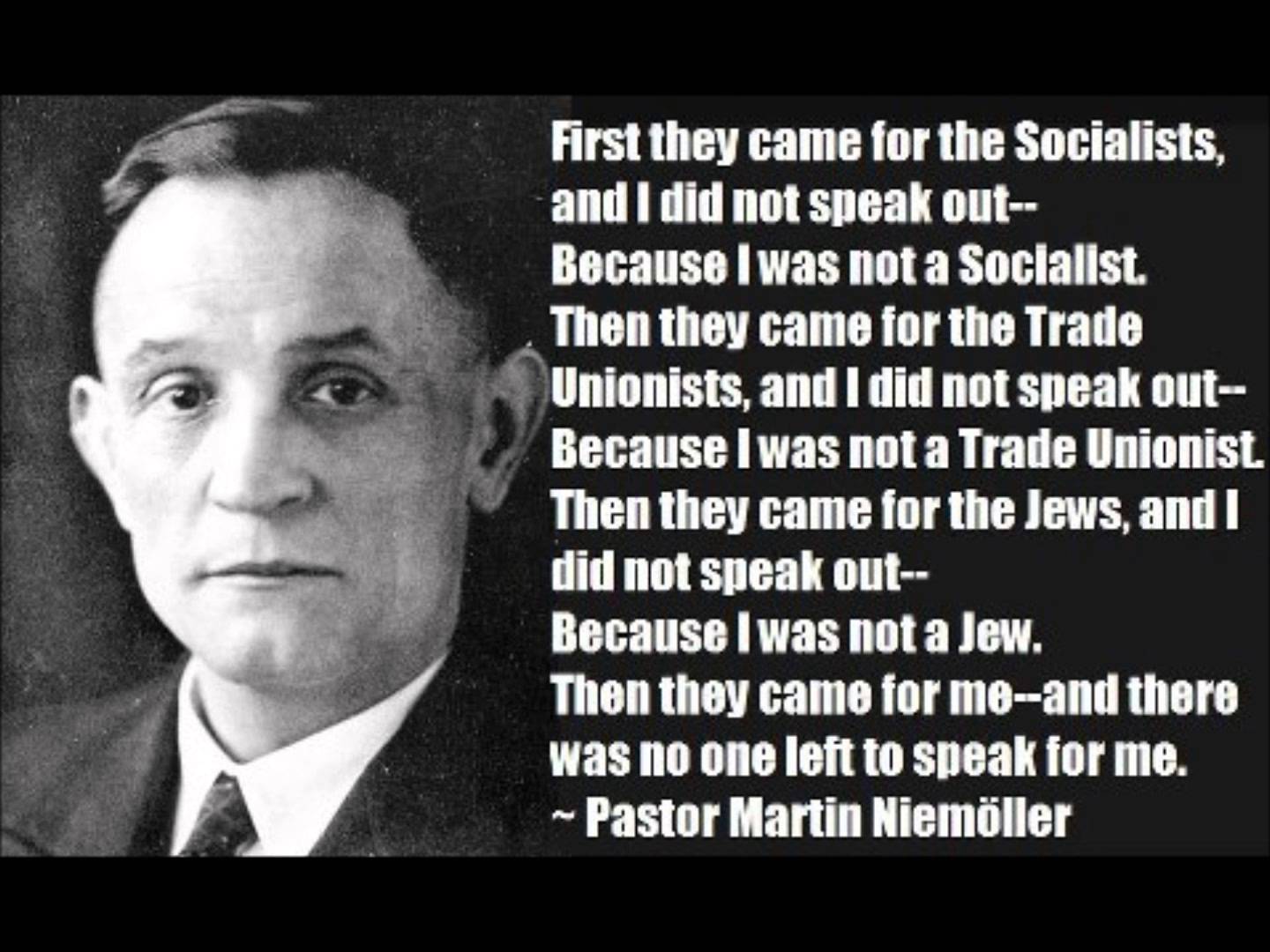
Martin Niemoeller’s words are quoted often and have always inspired me, but until recently they were just a nice philosophical abstraction. Never did I dream they would become an honest to God existential warning for me and my contemporaries living in our blessed democracy. I was wrong.

I learned more about Niemoller last year in a biography about another contemporary clergy of his, in “Bonhoeffer: Pastor, Martyr, Prophet, Spy” by Eric Metaxas‎. It was there I realized even as the storm clouds of Trumpism were gathering that Niemoller’s words were a painful confession of his own failure to act out of Christian compassion to save his sisters and brothers from the Nazis until it was too late for them and for him.

Although he is most famous for the quote above Niemoller was taken in by Hitler along with his fellow Germans. “Niemöller’s sermons reflected his strong nationalist sentiment…. Niemöller believed that Germany needed a strong leader to promote national unity and honor. When Hitler and the National Socialist Party emerged, touting nationalist slogans and advocating autonomy for private worship of the Christian faith, Niemöller voted for the Nazis—both in the 1924 Prussian state elections and in the final national parliamentary elections of March 1933. Hitler espoused the importance of Christianity to German nationality and Christianity’s role in a renewal of national morality and ethics (sound familiar?) leading Niemöller to enthusiastically welcome the Third Reich. Niemöller later confessed that even Hitler’s antisemitism reflected a more extreme version of his own prejudice at that time.” It was only much later after Hitler’s fanatical power was firmly entrenched that Niemoller awoke to the error of his ways and became an active opponent of the Nazi terror. He was imprisoned in several concentration camps for 7 years for his opposition until he was liberated by the Allies at the end of the war. (Above quote and more information available in “Niemoller: A Biography,” http://www.ushmm.org/wlc/en/article.php?ModuleId=10007391).

For good or ill I have tried to avoid public statements about partisan politics in my 40 plus years as a pastor. Call it wisdom or professional survival or cowardice, the truth is that the only two times I am aware of that anyone complained about my ministry to church authorities were two times that I could no longer be quiet about political issues and candidates that I felt strongly were in opposition to Judeo-Christian values and principles. We are now again in one of those “if we are silent the stones will shout out” (Luke 19:40) moments when to paraphrase Lincoln, we are engaged in a great struggle to see if “this nation or any nation so conceived and so dedicated can long endure.” That may sound melodramatic, but I believe it to be true.

I will not be one who regrets not speaking up at this critical juncture of history. The racist, nationalistic, xenophobic rhetoric of Donald Trump and Ted Cruz is too much like that of Hitler to ignore it and hope saner heads will prevail. Trump bragged the other day after his victory in Nevada that he “loves uneducated people.” Of course he does. He is leading a war on critical thinking and shouting down rational, civil discourse verbally and with vulgar, shallow Tweets. His Twitter campaign is brilliant in its strategy. No in depth dialogue can occur when utterances are limited to 140 characters.

A friend and I were discussing in bewilderment yesterday how self-proclaimed Christians can support a candidate who espouses in no uncertain terms blatantly unchristian values. We started listing the values Trump trumpets, and I realized it sounded like a recitation of the 7 Deadly Sins of the Roman Catholic tradition. I double checked the list: greed, lust, wrath, gluttony, pride, envy and sloth/laziness. I’ll give him a pass on the last one, but Mr. Trump certainly seems guilty as sin on the other six. It’s one thing for a secular society to embrace “Greed is Good” as a motto but quite another to allow anger and fear to blind oneself to the crass character of a leading contender to become the most powerful person on the planet. No matter how you feel about any other political or social issue, do you really want someone as volatile and undisciplined as Trump having his finger on the nuclear trigger?

The test for being a Christian is not just claiming the label; it is taking up a cross and following Jesus. As we all make these critical political decisions about the future of our world, let us not confuse what the radical right is peddling with the Christian Gospel. Read the parts of Scripture that say: “Pride goes before destruction and a haughty spirit before a fall” (Proverbs 16:18). “You have heard that it was said, ‘Love your neighbor and hate your enemy.’ But I tell you, love your enemies and pray for those who persecute you” (Matt. 5:43-44). “Those who live by the sword will die by the sword” (Matt. 26:52). “Which commandment is the first of all?” Jesus answered, “The first is, ‘Hear, O Israel: the Lord our God, the Lord is one; you shall love the Lord your God with all your heart, and with all your soul, and with all your mind, and with all your strength.’ The second is this, ‘You shall love your neighbor as yourself.’ There is no other commandment greater than these” (Mark 12:28-31).

These are critical times that call for acts of courage and faith. As tempting as it seems, don’t just seek a “place to hide away” or fail to learn the lessons of history so we are condemned to repeat them. Niemoller waited too long to speak up, but we dare not be silent.

Giving Up ALGAE for Lent

HolyLentThere are plenty of things I could give up for Lent this year that would improve my health and well-being, both physically and spiritually, but the one I have chosen to focus on is anger and frustration. This is a life-long struggle for me as a highly competitive and perfectionistic person. Those qualities are not all bad and even useful when trying to achieve some goals in life, but when it comes to being at peace and satisfied with my life, not so much. Maybe it’s an age thing, but being at peace has become much more important to me than winning a golf game or achieving economic or academic “success.”

I’ve done a pretty good job of concealing my angry side from most people. My professional persona is one of a caring, compassionate pastor and teacher. But my family and close friends have seen me break golf clubs in frustration, chase referees down the court at a high-school basketball game, or pitch temper tantrums when the difficulty of a home improvement project exceeds my limited skills or problem-solving ability far more often than I would like. So for all the times I have embarrassed any of you, my sincere apologies.

My decision to focus on anger as a barrier to peace this Lent is in large part because of an excellent course I am participating in called “Peace Ambassador Training 2.0.” Sponsored by the Shift Network, this is a 12-week web-based series of seminars focused on Mindfulness Meditation as a way to achieving more inner peace that can lead to peacemaking in the world. We are almost half way through the 12 weeks, and I had a breakthrough aha while meditating this morning as some things from our classes came together for me in a powerful way.

Last week’s class, led by Colin Tipping, was about radical forgiveness as a necessary ingredient in the recipe for peace. My insight this morning was how well forgiveness fits into the overall framework of this class. In our very first session Sister Jenna shared a helpful way to remember some basic shifts that are necessary to achieve a more peaceful state of being. She says we need to remove the ALGAE from our lives. ALGAE is an acronym that stands for Anger, Lust, Greed, Attachment and Ego. The quick, easier-said-than-done version of Sister Jenna’s teaching is that we need to replace Anger with Peace, Lust with Innocence/Purity, Greed with Satisfaction/ Joy, Attachment with Love, and Ego with Self-respect.

That’s obviously a God-sized transformation, but in my meditation today I saw more clearly how other the parts of that ALGAE formula contribute to anger for me: ego – not ever wanting to be wrong or out of control – being disrespected for my opinion or actions and not having “all my wisdom” given its due. If I replace ego with self-respect then I am not dependent on the praise or respect of others. To have self-respect I have to let go of regrets and painful memories, i.e. forgive myself and others. If I have self-respect I don’t need things I am attached to that feed my ego an unhealthy diet. There is also no need to lust after others or things if I’m at peace with myself, and therefore no need to be angry about not getting what I want/deserve, i.e. what I think I am entitled to. I love how that all comes together – now to just learn to live it and get it out of my head and into my being. “I believe Lord, help my unbelief.” (Mark 9:24)

Footnote: I was reminded how challenging this can be even as I was writing this piece. In a hurry to capture my thoughts before they left me and dealing with competing family commitments that were impinging on my consciousness as I wrote, I made numerous spelling errors as my brain tried to rush faster than my fingers could type. My old default reaction of frustration and anger quickly kicked in, only making the typing that much worse. New habits take time. The experts in self-help say it takes 21 days to change a behavior pattern. My personal experience is that it takes longer to teach old dogs like me new tricks. And the bigger the changes, the more time and the more spiritual help I need. That’s why the 40 days of Lent are a great time for me to ask for God’s help in giving up the ALGAE in my life.

To that end I draw hope and inspiration from “Guide My Feet,” a wonderful African American spiritual we sang at a recent worship service:

Guide my feet while I run this race.
Guide my feet while I run this race,
for I don’t want to run this race in vain!

Search my heart while I run this race.
Search my heart while I run this race,
for I don’t want to run this race in vain!

Amen!