Dueling Psalms, 130-19

Note: As I said in my “Breaking Silence” post yesterday I decided to go to the lectionary to look for some inspiration about the depressing state the world is in right now, and as usual the Word is there if we choose to look. One of the texts for this Sunday in the Revised Common Lectionary is Psalm 130, a never-failing, classic writing on coping with difficult situations. I found this post on that Psalm from 2017 which still seems quite relevant, and so I share it first before turning to another great text from Mark 5, the healing of Jairus’ daughter, which is the Gospel lesson in this Sunday’s lectionary.

No, that 130-19 is not a lopsided NBA finals basketball score! It’s the score of my attitude adjustment a few days ago when I awoke in one of those woe-is-me moods and thought of the lament known as De Profundis in Psalm 130. That’s Latin for “O crap I have to face another day of aches and pains and bad news!”

My arthritis was nagging at me, my chronic back trouble was moving up the pain scale, and the news was full of more terrorist attacks and hate crimes. Reading the newspaper over my morning coffee used to be one of my favorite times of the day. I still do it out of a sense of duty to be an informed citizen, but it has become an increasingly depressing task.

Psalm 130 begins “Out of the depths I cry to you, O Lord. Lord, hear my voice! Let your ears be attentive to the voice of my supplications!” As tensions between our nation and others mount, as our president foolishly believes his own nationalistic rhetoric that we can shrug off our responsibility for climate change and go it alone, as fears of terror attacks increase, and partisan politics paralyze any attempt to address critical domestic and international issues responsibly, I often wonder if God or anyone is listening to the voice of my supplications.

Later that same morning I went out to work in our lawn and gardens still down in the depths. We are blessed to live on a beautiful property decorated with my wife’s gardening handiwork, a pond, trees and flowers. But the beauty requires hard work, especially this time of year when the grass and the weeds are being very fruitful and multiplying. It’s the work that prompts me at times to say that “yard work” is made up of two four-letter words.

But the birds were in good humor that morning and serenaded me as I went forth to mow the lawn. And then I looked up at the blue sky dotted with huge languishing cotton ball clouds pictured above, a sight not seen nearly often enough in central Ohio, and my heart shifted gears from Psalm 130 to 19: “The heavens are telling the glory of God; and the firmament proclaims God’s handiwork. Day to day pours forth speech, and night to night declares knowledge. There is no speech, nor are there words; their voice is not heard; yet their voice goes out through all the earth, and their words to the end of the world.” (Psalm 19:1-4).

In basketball 19 doesn’t beat 130, but in the game of faithful living it does. God’s presence is all around us no matter how far down in the depths we are feeling. We just have to look for it with all our senses. No, the skies are not always breathtakingly beautiful, but the loving God of all creation is always surrounding us if we have eyes to see and ears to hear.

Even the author of De Profundis knew that while in the depths, and Psalm 130 ends with this statement of faith and hope: “I wait for the Lord, my soul waits, and in his word I hope; my soul waits for the Lord more than those who watch for the morning, more than those who watch for the morning. O Israel, hope in the Lord! For with the Lord there is steadfast love, and with him is great power to redeem. It is he who will redeem Israel from all its iniquities.”

It is necessary to cry out for help, to admit our helplessness to cope with the slings and arrows of life. It is also necessary to wait patiently and hopefully because the arc of moral justice bends ever so slowly. But we are also called to take action to collaborate in our own healing, and that’s exactly what Jairus and the woman with the 12-year flow of blood do in the Gospel lesson for this week.

Their story in Mark 5:21-43 describes two people in the depths of despair. Jairus, a powerful leader of the synagogue is helpless to save his gravely ill daughter and seeks Jesus out and humbles himself by kneeling at Jesus’ feet, begging for healing for his little girl. But as often happens in ministry, Jesus is interrupted right in the middle of this crisis by a person from the other end of the socio-economic spectrum.

A woman who is unclean because she has had a flow of blood for 12 years is also desperate. So much so that she risks coming out in public seeking healing because a multitude of doctors have only made her worse. She humbles herself in a different way, only wanting to touch the hem of Jesus’ garment; and immediately she feels her body healed.

Jesus, of course, feels power go out from him and seeks the woman out – not to scold or condemn her, but to praise her for her faith which has healed her.

But alas, news comes that Jairus’ daughter has died while Jesus was busy healing the woman. When Jesus assures Jairus that his daughter is not really dead the crowd laughs at him. That happens to people who dare to believe in God’s power in spite of evidence that evil and suffering have prevailed.

And Jesus goes to Jairus’ home, tells the little girl to get up, and when she does he instructs those there to give the girl something to eat. Just another day’s work for Jesus because he believes and heals those who dare to believe with him and through him.

Like Jairus and the woman we often have much suffering and fear we need to be healed of. These texts make it clear the formula for healing is to admit the mess we’re in, cry out for help, wait patiently for deliverance, and when Jesus’ is in the neighborhood (which is always) take action to find him so faith can make us whole too.


Pastoral Prayer, June 9, 2024

O Holy God, our Emmanuel.  Here we are in June, about as far from Christmas as we can get; so it seems a good time to remind ourselves that you sent Jesus to us, not just at Christmas, but forever as Emmanuel, which means “God with us.” Sometimes when we need you most, God, we forget you are with us always – on the mountaintops and in the valley of the shadow, when the pain is so bad we don’t think we can stand it anymore, there you are at our bedside.

When we are afraid the storms of life are going to drown us, there you are napping in the back of the boat waking to tell us “Peace, be still; I’ve got this.”  When our legs are so tired we can’t go another step, you carry us.  When it feels like the world is going to hell in a handbasket, you’re right there in the basket with us.

The Psalmist says there is no place in all creation we can flee from your presence.  You’re up there with the astronauts in the Space Station showing off your breathtaking creation.  And if we visit Mars or other planets, you’ll be waiting there for us, too. Even when things are going great and we’re tempted to think we don’t need you, you wait patiently in the wings like a mother hen ready to take care of her chicks.

Forgive us, Holy One, when we forget you are our constant companion and friend.  Life is hard at times.  That’s why we need times of worship and prayer to feel the peace that surpasses anything else life can offer.  How can we thank you, Lord?  We certainly don’t deserve your unconditional love and grace!  We just pray that you will speak to each one of us right now and assure us that whatever cares or concerns are on our hearts just now we do not have to deal with them alone. 

And so we praise you for your presence.  We ask that you show us how to be that same presence with others.    And we thank you most for sending the one called Emmanuel to show us how to live and how to conquer even death itself.  And so we pray together the prayer he taught us to pray. 

O Holy God, our Emmanuel.  Here we are in June, about as far from Christmas as we can get; so it seems a good time to remind ourselves that you sent Jesus to us, not just at Christmas, but forever as Emmanuel, which means “God with us.” Sometimes when we need you most, God, we forget you are with us always – on the mountaintops and in the valley of the shadow, when the pain is so bad we don’t think we can stand it anymore, there you are at our bedside.

When we are afraid the storms of life are going to drown us, there you are napping in the back of the boat waking to tell us “Peace, be still; I’ve got this.”  When our legs are so tired we can’t go another step, you carry us.  When it feels like the world is going to hell in a handbasket, you’re right there in the basket with us.

The Psalmist says there is no place in all creation we can flee from your presence.  You’re up there with the astronauts in the Space Station showing off your breathtaking creation.  And if we visit Mars or other planets, you’ll be waiting there for us, too. Even when things are going great and we’re tempted to think we don’t need you, you wait patiently in the wings like a mother hen ready to take care of her chicks.

Forgive us, Holy One, when we forget you are our constant companion and friend.  Life is hard at times.  That’s why we need times of worship and prayer to feel the peace that surpasses anything else life can offer.  How can we thank you, Lord?  We certainly don’t deserve your unconditional love and grace!  We just pray that you will speak to each one of us right now and assure us that whatever cares or concerns are on our hearts just now we do not have to deal with them alone. 

And so we praise you for your presence.  We ask that you show us how to be that same presence with others.    And we thank you most for sending the one called Emmanuel to show us how to live and how to conquer even death itself.  And so we pray together the prayer he taught us to pray. 

Northwest United Methodist Church, Columbus, Ohio

Jesus and Stages of Grief

As we made our way through the passion story of Holy Week this year it occurred to me that the Gospel accounts of Jesus’ last week are an interesting case study in the classic stages of grief proposed by Dr. Elizabeth Kubler-Ross in her 1969 book “On Death and Dying.”

The stages do not occur in a linear order but ebb and flow like the phases of the moon, and we always need to remind ourselves that the Gospels are theological works, not historical biography; but given that, it strikes me that we can learn about the universal human experience of grief by studying what the Gospel writers tell us about the final days of Jesus’ earthly life.

Kubler-Ross’ stages include anger and depression which are often two sides of the same emotion – one expressed outwardly and the other turned in upon oneself. Because of that anger is easier to identify and that is true with Jesus also. The cleansing of the temple which is described in all four Gospels is one of the few times we ever see Jesus angry. He sometimes is verbally angry with the Scribes and Pharisees, but when he overturns tables and drives the money changers out of the temple with a whip that is the rare incident where Jesus is obviously and physically very angry.

Another scene which could be motivated by either anger or depression would be one of the “last words” from the cross where Jesus cries out, “My God, My God, why have you forsaken me?” Hearing the tone of voice and seeing Jesus’ body language when he uttered these words might help us better understand his mental state at the time, but both Matthew 27 and Mark 15 describe his tone as “crying out with a loud voice,” and that is the best evidence we have.

Depression can certainly not be diagnosed from a few 3rd person accounts of Jesus’ actions, but the three incidents that come to mind when I think about that stage of grief are when Jesus weeps over the death of his friend Lazarus, when he weeps over Jerusalem and says, “Would that you, even you, had known on this day the things that make for peace! But now they are hidden from your eyes.  For the days will come upon you, when your enemies will set up a barricade around you and surround you and hem you in on every side and tear you down to the ground, you and your children within you. And they will not leave one stone upon another in you, because you did not know the time of your visitation.” (Luke 19:42-44). And perhaps in all four Gospels where Jesus refuses to answer any questions in his trials before Pilate, Herod, and the Chief Priests. Those incidents however I interpret more as a strong, silent resistance to the unjust power of oppression rather than depression or resignation.

The stage of grief that stymies me when it comes to Jesus is denial. If you readers have ideas about this one I would love to hear them, but for now I cannot think of examples of times where I see Jesus being in denial about his fate. He sets his face toward Jerusalem in spite of the protestations of his disciples. He stages a protest entrance into Jerusalem riding on a humble donkey, and he returns daily to teach and heal in Jerusalem that last week and to celebrate the Passover, all of which seem like acts of faithful determination and not ones of denial in any form.

The stage of bargaining seems to me to only appear in the Garden of Gethsemane when Jesus says, “If this cup can pass from me, please make it so,” but those words are immediately followed by “But not my will but yours be done,” which move us toward the final stage of acceptance.

It should come as no surprise that examples of acceptance are easier to find with Jesus. When Peter pulls out his sword to resist the soldiers in the garden Jesus sternly tells him to put it away. And then on the cross where it would require the greatest amount of acceptance and courage, at least 4 of the recorded “seven last words” reflect the confidence that only comes with acceptance of death as the final stage of human life.

Those four include Jesus commending his mother into the care of one of his disciples, assuring the repentant thief that he will be with Jesus in paradise that very day, commending his spirit into the hands of God, and finally saying “It is finished.” I suppose one could also make a case that forgiving his executioners is also an act of acceptance, but that amazing act of grace really defies categorization.

Grief is a very complicated emotional process, and the Kubler-Ross stages are one very helpful lens through which to understand it. I find it comforting to find connections between my own experiences of grief and those of the incarnate life of God in Jesus. For me sharing the human condition of these grief stages with Jesus affirms the reality of his humanity and also the hope for achieving some degree of acceptance of my own mortality that he exemplifies for us.

I welcome your comments and insights on any of the above.

Into Your Hands

I am one of the narrators for our church’s Good Friday cantata, “The Shadow of the Cross.” At the conclusion of the cantata each narrator will share one of Jesus’ last words from the cross. My line is “Father, into your hands I commend my spirit.” This opportunity has forced me to think about how to interpret those words.

Were they uttered in exasperation? “I give up God. You’ll have to take it from here!” Or maybe just a plea for help? Another way of expressing a feeling of abandonment or defeat, even anger? Luke 23:46, the only Gospel that contains this particular phrase, prefaces the words with “Jesus cried out with a loud voice,” which might support that kind of interpretation.

But Psalm 31:5, a source Jesus could have drawn upon, says, “Into your hand I commit my spirit; you have redeemed me, O Lord, faithful God.” That context seems to support what feels right to me. I believe this phrase expresses a surrendering and acceptance of death in all its forms to a mysterious power that makes all things new. They are uttered in the sure and certain belief in resurrection.

For Luke that is all there is to say, and he adds: “Having said this, he breathed his last.” For Luke this is the last of Jesus’ last words. That’s a great exit line, but how do average folks like us truly believe and trust that mystery? As one feeling much too close to the daunting age of 80 that question has taken on more and more significance for me.

Delivering these important words from the cross reminds me of the characters in Nikos Kazantzakis’ novel, “The Greek Passion,” where people in a Greek village take on the various roles in the story of Christ’s passion and so identify with their characters that they become them. The man portraying Judas is driven out of town for his betrayal of Jesus, and the man portraying Jesus, offers himself as a sacrificial lamb, confessing to a murder he didn’t commit to save others from being executed.

Obviously my one liner is not nearly as intense, but it feels like it can still be powerful and transforming for me and maybe others if the Holy Spirit works through me. It is always a heavy responsibility to speak hope into darkness, and God knows things are plenty dark just now, even days before the solar eclipse passes through our state. 

Help me Holy One.  I believe; help my unbelief.

Darkness Will Not Prevail

Black History Month and Lent

Black History month and Lent go well together. Jesus’ 40 days in the wilderness and our 40 days of Lent pale in comparison to 400 years of slavery and systemic racism, but the determination to not let the darkness prevail requires the same kind of faith.

Darkness and Balance

Darkness has taken on a new significance for me personally in recent years. I was diagnosed ten years ago with peripheral neuropathy which causes numbness in my feet and legs, meaning my sense of balance leaves a lot to be desired.

My physical therapist has taught me some things that help in coping with my impaired balance. There are basically two senses that send information to our brains that help us feel steady on our feet. One is the feel of our feet on what ever surface we are standing or walking upon. Neuropathy plays havoc with that input.

Secondly we get signals from our eyes about our surroundings that help orient us in space. For that sensory data to compute obviously requires our being able to see where we are and where we’re going, and that vision requires enough natural or artificial light to illuminate our path. Simply put it is much harder to maintain a sense of balance in the dark.

That explains why you will find nightlights in every room in our house and why I use a cane to steady myself when walking on uneven surfaces or in the dark. And yes, getting up to make my way to the bathroom in the middle of the night is still sometimes an adventure, even with motion sensor night lights and my cane. It is also why I am very grateful for the flashlight app on both my iPhone and my Apple Watch. I am almost never without at least a small source of light.

Cultural and Political Darkness

On a more macro level Lent 2024 feels really dark to me, even with the blessing of sunshine and above average temperatures here in Ohio. Technology has not invented an app that can brighten the dark night of the soul I feel when witnessing the suffering in Gaza and Ukraine. Natural disasters are still heartbreaking to watch, but I understand the science of how climate change is causing the devastation on the California coast. I cannot however wrap my mind around the evil of modern warfare or the hatred that inspires it.

I despair at the insecurity and depravity that justifies a Putin killing his political enemies or invading a neighboring country just because he can. And I weep over the ignorance about our history that blinds people to the threat of authoritarian leaders and the cult-like devotion to those who blatantly practice it.

Being the Light

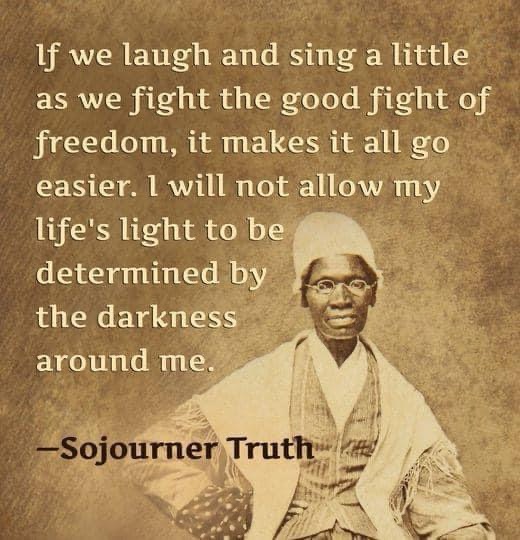
When the darkness of sin and evil threatens to drown out the light, God has always called on those like Sojourner Truth to step up and refuse to let the darkness determine our life’s light. That quote reminded me that I am always inspired by the words of another black woman, Amanda Gorman, whose marvelous poem, “The Hill We Climb,” ends with these powerful words:

“When day comes, we step out of the shade aflame and unafraid. The new dawn blooms as we free it. For there is always light. If only we’re brave enough to see it. If only we’re brave enough to be it.”

Action Steps

A Lenten challenge might be to find what God wants each of us to actually do to be the light. It may be relating to family members or co-workers in a more caring way, or volunteering for some group that you’ve always meant to get involved in, getting involved in local politics, advocating for justice by writing letters to representatives, or supporting marginalized groups. There’s plenty of darkness to go around and every ray of light does make a difference.

Prayer

O God of eternal light, the darkness scares me. I know in my head the words from the Gospel of John that assure us the darkness will not overcome the Light of the World. But my heart is not so sure! Rather than just spout pious platitudes that fall flat on their face, please give me the courage to really feel your light in my soul and the guts to go out into the darkness and be it. Amen

Epiphany – Herod Lives

“Then Herod secretly called for the magi and learned from them the exact time when the star had appeared. Then he sent them to Bethlehem, saying, “Go and search diligently for the child, and when you have found him, bring me word so that I may also go and pay him homage.” Matthew 2:7-8

I am embarrassed to admit this. It took me till the third anniversary of January 6 to realize that horrible event took place on Epiphany, the twelfth day of Christmas. So for the last 24 hours since that light went on in my head I’ve been trying to think of some way to make theological sense of that convergence of those two radically different events. I don’t believe in coincidences; so I knew there had to be a connection, but all I was coming up with was that the attack on the very core of our democracy was even worse because it happened on Epiphany.

There are just a handful of dates in my lifetime that burned such a mark on my psyche that I will always remember where I was when I first heard about them: the assassinations of JFK, MLK, and RFK; the explosion of the Challenger space shuttle; 9/11; the election of Donald Trump; and the insurrection against our government on January 6, 2021.

I was working my home office that day but had the TV on fearing there might be trouble around the certification of Joe Biden’s election as President. But even though I was worried there might be some kind of trouble at the Capitol that day I never in my wildest imagination expected what played out on my TV screen that awful afternoon. As I watched the badly outnumbered Capitol police be overrun by an angry mob that began scaling the walls of the Capitol building, smashing windows, and swarming into the halls of Congress I sat there in stunned silence. Feeling helpless I finally did the only thing I could think to do. I got on Facebook, and I still remember exactly what I said: “Whatever you are doing, stop and pray. Our democracy is under attack.”

During worship this morning at our church it finally dawned on me what the connection was between the insurrection and. Epiphany. After preaching about the light of the star that leads us to Jesus our pastor, Chris Rinker, went on to say that we also need to remember that there are always forces of darkness that try to snuff out the light. There are always Herods who are so insecure and so desperate to preserve their own power that they will do anything to put down any threat real or imagined to their fragile egos.

Of course there are. I remember as a young pastor many years ago preaching on Matthew’s story of the Magi and Herod, and the title of that sermon was “Be Sure You Follow the Right King.” There are always Herods and the person fulfilling that role on January 6, 2021 was none other than President Donald Trump. Just as Herod told the Magi to go find the Christ child so he could go worship him too, our 45th President urged his angry followers to march to the Capitol and stop his Vice President from fulfilling his Constitutional duty to certify the legitimate electoral colleges votes from the 2020 election.

Three long years later we are still dealing with the fallout from that awful day, and I must admit I am often very discouraged about that and what it means for the future of our nation. But here’s my takeaway from this Epiphany 2024 message from Matthew. I can’t say it any better than Maltbie Babcock said it in 1901 in his great hymn, “This is My Father’s World;” so I will just end here with the third verse of that hymn:

“This is my Father’s world:
O let me ne’er forget
That though the wrong seems oft so strong,
God is the Ruler yet.
This is my Father’s world:
Why should my heart be sad?
The Lord is King: let the heavens ring!
God reigns; let earth be glad!”

Advent I 2023: Hope

Today is the first Sunday in the season of Advent.  It is a time of preparing our hearts to receive once more God’s promise of healing for our broken world.  Advent is a season of waiting and hoping for what is already but not yet.  It is a time of living in between – between promise and fulfillment, between hope for and receiving.  

This Advent it is harder than usual to be people of hope. The skies over the Holy Land are full of rockets and bombs instead of an angel chorus. We live between Christmas carols on the airways and horrific images of war on our news feeds.

But here, even in this time between hope and despair, we gather to reaffirm our faith in the eternal light that cannot be extinguished by any amount of human sin and suffering. As people of faith have done for hundreds of years we claim the gift of hope once more by lighting the first candle of Advent.

[Light Candle]

Please pray with me as I share this Advent prayer from Kate Bowler and Jessica Ritchie, from their book, “The Lives We Actually Have:”

“God, these are darkening days, with little hope in sight.

Help us in our fear and exhaustion. Anchor us in hope.  Bless us who cry out: ‘Oh God, why does the bad always seem to win?

When will good prevail?

We know you are good, but we see so little goodness.’

God, show us your heart, how you seek out the broken.

Lift us on your shoulders and carry us home—no matter how strong we think we are.

God, seek us out, and find us, we your tired people, and lead us out to where hope lies. where your kingdom will come and your will be done, on earth as it is in heaven.

Fill us with your courage. Calm us with your love. Fortify us with your hope.”

We pray in the name of the One we Hope for who already walks with us every day. Amen

Northwest UMC, Columbus, Ohio, December 3, 2023

A Prayer for Peace in a World Gone Mad

Dear Holy One, my soul is weary from the weight of suffering and war hanging over the world since October 7.  My mind cannot comprehend the depth of the hate that drives people to inflict such cruelty on other humans.  The centuries-old hatred between Palestinians and Jews is so horrific it defies human understanding.  I want to offer even a tiny bit of wisdom or hope, but the well of inspiration is dry.  There simply seem to be no good solutions.  When our own members of Congress cannot overcome their differences to elect a leader what hope is there for peace in the Middle East?  Anger and hate veto any desire to make peace or even to limit the wrath of retribution to just one eye for an eye or one life for a life.  To turn the other cheek to the evil represented by Hamas or Putin is almost laughable at worst or hopelessly naïve at best.  We all live in glass houses and none dare cast stones because we are none of us without sin.  My own nation’s history of genocide and racism is a log in our eyes that disqualify us from passing judgment on anyone else. 

Human history is one horror saga after another full of wars, bloodshed, and tears.  Out of the depths we cry peace, peace, but there is no peace.  Widows in Ramah are still weeping for their children while it takes excruciating days to even open a gate to deliver food and water to starving masses in Gaza.  I want to turn my mind and eyes away from the atrocities, but my heart yearns to know the awful news, even though I feel hopeless to respond.  The ties of sisterhood and brotherhood that bind me to my siblings in Ukraine, Gaza, and Israel are too strong for me to just escape into apathy or hopelessness.  My prayer is that when we hit the bottom of our grief we will surrender to the reality that peace is beyond our human reach.  For it is only in surrender to our weakness that you can fill us with courage and strength for the living of these days.  Fill my weary spirit with your eternal peace and love, O Ground of all Being, and let me be a flicker of light in the darkness.    Amen

How Long, O God?

Oh My God, how can you stand the insanity of gun violence in this country. If you are truly omniscient and know everything then you already know about the headlines I just read detailing four separate mass shootings in four different states this weekend, and my wife told me about another that I haven’t even seen on my news feeds yet. That makes over 470 mass shootings in this country so far in less than 8 months of 2023!! That’s about two every day! It’s so common all this bloodshed doesn’t even make the news most of the time.

I know you want us to love our enemies, Lord, but I have to tell you I am having a hard time with the gun lobby folks who refuse to consider any common sense gun control legislation. They hide their greed behind the second amendment like it is some sacred edict when in fact it was produced over 200 years ago by frightened white men who feared their enslaved persons would rebel like their sisters and brothers did in Haiti a few years earlier.

Why can’t anyone see that we live in a totally different time when all the wrong people can easily get military style assault weapons. And yet we are hamstrung by a law adopted when guns were single shot muzzle loaders. And the only people who could change our antiquated laws are blinded by greed for the campaign contributions for which they have sold their souls. How can they not see the carnage their lust for power is causing?

Please, dear God, break through the denial and ignorance that are killing innocent people at parades, retail stores, and high school football games. Where can anyone go that is safe from an argument or road rage turning into a gun battle? What more can we do to raise this issue above the clamor of the political circus and the genuine tragedies of climate crisis everywhere?

Dear God, we know common sense gun laws work. They have worked here in the past, and they continue to work almost everywhere else in the world. How can we end America’s love affair with fire arms? Are we so frightened that we need deadly weapons to feel secure? If that’s the problem how can we create a just society where there is no need to feel threatened by others? I am in despair, Lord, that such a dream is even possible in our bitterly divided and broken country.

Scripture tells us that with you, Holy One, all things are possible. I want to believe that, God, I really do. Please raise up for us new leaders with the vision and courage to bind up our nation’s wounds and unite us in creating a culture of compassion where fear is no longer the driving force in our lives.

Please call and empower a new generation of visionary leaders who still believe that we can beat our AR-15’s into wind turbines, and turn our disagreements and fear into communities of collaboration. In the name of Jesus, the Prince of Peace, please, oh please hear our prayer. Amen.

Culture War Games While the Planet Burns

Sometimes things are so bad I just have to laugh to keep from completely losing my mind. This Monday night was one of those times. I watched way too much tv and internet news that day as I spent hours prepping and recovering from a colonoscopy. Fires, floods, scorching heat waves, mass shootings, and Putin’s madness are not the kind of news designed to improve my outlook on life after a less than chipper day.

But then came the icing on the cake from our local newscast at 10pm. With all the other problems threatening our very existence on this planet guess what critical legislation our beloved Republican Ohio legislature is spending their time and energy on? 50 of them are co-sponsors on a bill banning Drag Shows where children might be present! Our illegally gerrymandered legislature is a laughing stock, but they have outdone themselves this time.

I am not one who is likely to ever attend a drag show, but this proposed legislation, blatantly aimed at threatening the LGBTQ+ community, shows yet again how threatened so many people are about any hint of sexuality that is different or unfamiliar to them. I am frustrated but also feel empathy for those legislators and the constituents they are pandering to for votes. The world is going mad so fast that people are retreating into the armor of clinging to anything that even vaguely resembles a past that seemed stable and secure in comparison to all the frightening developments elsewhere in urban centers and around the world.

Most of our Ohio Republican legislatures come from small towns and counties where much of life still resembles a slower and simpler 20th century existence. I grew up in one of those rural counties and have served churches in two others; so I have some empathy for people who live and vote there. For the most part these people are still living with a worldview they learned in those conservative communities. Most have not been exposed to diversity in race, theology, sociology, or politics. The values they cherish have been handed down for generations and are reinforced by their political representatives and news outlets like Fox News.

People who look different, speak a different language, worship in different ways, and those who challenge even our most intimate sexual identities are a threat to a way of life that is changing at the speed of light. Politicians have learned to use the fear of change people are experiencing to manipulate them into voting for their conservative political reps and keeping them in power.

These frightened people are a minority in our country, a shrinking minority, which fans the flames of their fear, and unfortunately the right wing demagogues have outsmarted most of us by using antiquated systems of government, like gerrymandering and the Electoral College, to grab and hold power for their own benefit and especially for the benefit of their political donors.

Change is difficult, but the backlash to change we have been experiencing in this country ever since Barack Obama was elected President is truly frightening. At the heart of that backlash and the unshakeable support shown for a twice impeached and twice indicted former President I believe is the systemic racism upon which this country was founded 400 years ago. That fear of people of color is so strong that millions of people are willing to destroy our democracy over it.

We of course survived a bloody civil war over racism, but this attack from within the halls of Congress on our system of justice and our electoral procedures is far more insidious and dangerous. I write this dire post because I truly believe the next 16 months will determine the fate of American democracy. Our allies are amazed and frightened that a second Trump presidency is even a possibility. There is speculation that Putin will try to extend the war in Ukraine long enough to see his friend Trump elected and pull the rug out from under Ukraine and NATO.

Republicans like Kevin McCarthy who were sharply critical of Trump after the January 6th insurrection are now attacking the Department of Justice for investigating the traitors who staged that bloody attempted coup. Trump’s defenders are trying to convince the American people that what we all saw live on our televisions that day didn’t really happen. If that strategy works 2024 will become 1984 and the great American experiment will crash and burn like the wildfires caused in part by the deniers of climate change. If those climate change deniers regain control of our government the whole planet is toast. I am just praying that this summer of extreme weather will awaken enough voters to avert further damage to our planet and our democracy before it is too late.