Time to Stand Up and Be Counted

Twice in my ministry that I know of I had parishioners complain to church superiors about political issues I took a stand on. I’m embarrassed by that, not about those two incidents, but ashamed there weren’t a lot more of them.

When people argue that pastors shouldn’t express political opinions that usually means they disagree with said opinions. 

It also means they don’t understand how political Jesus and the biblical prophets were. Not to mention that pastors are citizens too with equal rights to their own opinions.

Some would add those opinions must be expressed outside their role as pastor. But the problem with that approach is that clergy are really never able to step outside their ordination vows and be just a normal citizen. Clergy as spokespersons for God are constantly in the crucible where secular and sacred clash.

I say that now because the United States is at a very critical crossroads in our history. We are on the verge of civil war because of the brutal and unjust occupation of Minneapolis by thugs posing as federal law enforcement agents. No one operating outside the bounds of federal law and Constitutional safeguards can claim law enforcement authority. 

Today another American citizen, a VA nurse no less, was gunned down while simply trying to hold these vigilantes accountable by taking pictures of their activities. If ICE is operating within the law why would they object to photographic evidence of what they are doing? Or why do they hide their identity behind masks? 

The ICE occupation of Minneapolis is just one symptom of Donald Trump’s Emperor Complex. His appetite for raw power is insatiable – from Venezuela to Gaza to Greenland he is trying to assert his faux power at the cost of destabilizing the world’s balance of power.

He enjoys destroying things like NATO, the East Wing, and the Constitution just to prove he can.
The biblical scene this dangerous farce calls to mind is the temptation of Jesus in the wilderness at the beginning of his ministry. In particular Satan’s third temptation reminds me of Trump’s and any dictator’s moment of truth.

Matthew’s Gospel tells it this way: “Again, the devil took him (Jesus) to a very high mountain and showed him all the kingdoms of the world and their glory, and he said to him, “All these I will give you, if you will fall down and worship me.” Then Jesus said to him, “Away with you, Satan! for it is written, ‘Worship the Lord your God, and serve only him.’ ” Then the devil left him, and suddenly angels came and waited on him.” (4:8-11)

We know what Jesus did in that moment of testing. Without hesitation he sent Satan packing with a clear statement of his core beliefs. By contrast I think we all know what kind of transactional deal Donald Trump would make given that offer of world domination. Never mind that the one offering the deal is as phony as a three dollar bill.

More importantly however is this question: what would I do if tempted like that? Will I go along with cruelty and injustice so I can keep my privileged and comfortable life? Or will I speak up for God’s ways of truth, justice and mercy in whatever way I can? Will I keep contacting my cowardly congressional reps or give up because they have been accomplices with injustice so far? Will I keep hope alive for the salvation of our democratic way of life or throw up my hands in surrender?

There’s a great line in the play “Inherit the Wind” where Henry Drummond tells Bert Cates “It’s the loneliest feeling in the world – to find yourself standing up when everybody else is sitting down. To have everybody look at you and say, ‘What’s the matter with him?'” But that is exactly what Jesus calls us to do when he says, “Take up your cross and follow me.” (Matthew 16:24 and Luke 9:23). 

And that choice is not new with Jesus or Bert Cates or you and me today. Way back in the history of the Hebrew people there is such a moment where the refugees from Egypt are about to enter the Promised Land, and their leader Joshua challenges them with these words, just as God challenges us today:

“Now if you are unwilling to serve the Lord, choose this day whom you will serve, whether the gods your ancestors served in the region beyond the River or the gods of the Amorites in whose land you are living, but as for me and my household, we will serve the Lord.” (Joshua 24:15)

That’s not an idle or ancient question. It’s as current and urgent as the blood stains in the snow of Minneapolis. Whom will we choose to serve?

Be Still and Don’t Stop Believin’

A couple of Sundays ago when our Ohio October was still summerlike I spent some time in the Chapel in the Woods at our church after Sunday worship. Because of scheduling issues I attended our contemporary service that Sabbath which is not my preference. That Sunday was actually World Communion Sunday, a day that always has special meaning for me, especially in our fractured world today.

On that Sunday our church celebrated World Communion primarily at our traditional service because the contemporary service had been set aside for our annual Blessing of the Animals service. Communion was still celebrated at the contemporary service, along with treats for God’s four-footed critters that came to be blessed.

Needless to say it was a lively and noisy service, which is always fun, but it was not exactly what I needed that day. So, after worship I spent some time praying in our beautiful outdoor chapel and the words that came to me were “Be still and know that I am God.” I have meditated on those words frequently in the days since, seeking the balm they offer in the chaotic world we inhabit just now.

I am embarrassed to admit that I didn’t remember where those words come from in Scripture until I googled them. They are of course in verse 10 of a Psalm I have used dozens of times in funeral services, and the opening verses set the scene powerfully for having faith to be still when life is literally crumbling around us like the East Wing of the White House.

The psalm begins with these words:

“1 God is our refuge and strength,
    a very present help in trouble.
Therefore we will not fear, though the earth should change,
    though the mountains shake in the heart of the sea,
though its waters roar and foam,
    though the mountains tremble with its tumult.”

Those are the opening verses of Psalm 46 which some scholars believe was written as the armies of Assyria were besieging the city of Jerusalem in 701 BCE. Many of us can easily relate. It feels like all the values we thought our country was founded on are under siege.

I could recite a whole litany of things we’ve lost in the last 10 months, but I will focus instead on one of the most recent and egregious violations of Christian morality and Constitutional order. Because of the government shutdown SNAP benefits that help feed 42 million Americans have been cut off for the last 6 days.

There are contingency funds available to pay those food stamp benefits, and that has always been done in every other shutdown we’ve had. The only difference this time is the one who resides in what’s left of the White House.

Two federal judges have ordered the President to release those funds and provide food for hungry Americans, including the elderly and children. But Donald Trump has decided to ignore those court orders so he can use those 42 million people as political bargaining chips in the high stakes game of chicken he is playing with the democrats.

Meanwhile the President has given $40 million of our tax dollars to Argentina which hurts already desperate American farmers. He’s spent millions on unauthorized military action against Iran and Venezuela, and is threatening to do the same in Nigeria. But he refuses to even negotiate with democrats about skyrocketing health care premiums or to follow court orders and feed hungry people.

It seems useless to remind Washington about what Jesus said about feeding the least of these, although I have done so repeatedly with my three Republicans representatives in Congress. The tone deafness of this administration to calls for empathy and justice for our fellow human beings certainly feels like basic human decency is under siege.

How can we not wonder if God really is our help and refuge? Where is God’s help in this all too real time of trouble? As I typed those words, and I’m not making this up, a notification popped up on the top of my iPad screen that said “Don’t Stop Believein’!” That message came because the rock band Journey is coming to Columbus, OH next summer, but the timing of that message seemed way too relevant to be just a coincidence.

And that seems to be what the psalmist is saying to the besieged, hopeless folks in Jerusalem surrounded by the mighty armies of Sennacherib.

“God is in the midst of the city; it shall not be moved;
    God will help it when the morning dawns.
The nations are in an uproar; the kingdoms totter;
    he utters his voice; the earth melts.
The Lord of hosts is with us;
    the God of Jacob is our refuge.[c] Selah

Come, behold the works of the Lord;
    see what desolations he has brought on the earth.
He makes wars cease to the end of the earth;
    he breaks the bow and shatters the spear;
    he burns the shields with fire.”

And because of God’s ultimate rule of the whole universe, no matter how bad things seem at this or any moment, personal or in history, we can
10 “Be still, and know that I am God!
    I am exalted among the nations;
    I am exalted in the earth.”
11 The Lord of hosts is with us;
    the God of Jacob is our refuge.”

On Ash Wednesday last year we had an experiential worship service, and one of the things we were asked to do was create something from clay that was symbolic of the meaning of the season of Lent. I made this symbol which is still on my desk:

Some people thought it was a fish, which would be ok; but that is not what I was going for. I started out with an infinity symbol and then made one end into a heart. For me it symbolizes the only thing we can really count on and the only thing we need – God’s Infinite Love.

That ‘s what enables me at times to be still and know God’s in charge, even when the infidels are literally not only at the gates but in the seats of power.

Jerusalem was reborn from the ashes and somehow, someday the land of the free and the brave will be also. Be still and don’t stop believin’.

Happy Motherly God‘s Day

My home of origin in the 1950’s and 60’s was a very traditional patriarchal family. And the church family I grew up in was likewise dominated with patriarchal theology and structure. I can’t go back and change any of that, but I regret that my foundational values and theological constructs were void of any feminine images and qualities.

This reality for me was complicated by a strained relationship with my father. My dad survived a painful childhood with an abusive, alcoholic step-father and a near-death experience as a 24 year-old pilot in World War II. No one had discovered PTSD in those days, but I’m sure my dad was a classic case. He compensated by living by a very strict and literal adherence to conservative theological and cultural norms.

I never questioned my father’s love for me, but it always felt conditional on my living up to his high expectations and obedience to his rules. Theologically for me this meant the patriarchal image of God was filtered through my relationship to my earthly father. It never occurred to me or anyone in my circle of influence to question the God as Father theology I learned at church.

One of my regrets about this is that I felt much more comfortable with and closer to my mother but had no model for seeing her as the image of God. She was a good subservient wife as was expected in the culture we lived in, but there was also a quality of unconditional love and acceptance about her that was lacking in my dad. If I had a problem or screwed up, as I did often, I would always go to my mom and confess because she would calmly help me deal with the situation where my dad would either verbally or non verbally convey disapproval. That’s who my parents were. There’s no judgment in that now, although there was for many years as I tried to liberate myself from the conservative world my dad lived in.

My point here is that I wish someone had suggested to me that God is also an expression of the maternal, loving qualities we rightly or wrongly have attributed to the feminine. Because no one dared to think outside the patriarchal box I lived many years of my life with a fear of a judgmental God. And the larger church and even the liberal seminary I went to in my early 20’s was still a prisoner to the male-dominated images of God.

The entire faculty and 96% of my seminary class were white males. That began to change dramatically in the 1970’s after I graduated as women and people of color were added to the seminary community. That’s wonderful, but I missed it! I worked with several great senior pastors in my ministry, but again all white and male.

Finally in the early 2000’s when I was about 60 years old I joined a congregation with a wonderful, creative, vibrant female pastor. I went on to work part-time in retirement with her and other women, and it has opened a whole new world of theological depth and understanding to my image of the divine as full and inclusive of all of God’s creation. I still am blessed to hear the word proclaimed many Sundays and Holy Days from a unique female perspective. Most of the current devotional and theological blogs, podcasts, and books I have benefited most from in the last few years are created by female writers, pastors, and theologians.

And so this Mother’s Day I am giving thanks for all the women who have helped shape my life. Grandmothers, mother, aunts, colleagues, friends, wives, preachers, political leaders and more. Let’s celebrate that special capacity so many women have to nurture, soothe, love, and bless us with those God-given qualities the world so desperately needs right now.

Squads of Love

The following words of wisdom hit me today right where I needed them. I had another morning when I struggled to get out of bed because I didn’t want to face another day of the awful mess our world is in. And this message by one of my favorite spiritual guides quoting another of my favorites helped me face the day.

Father Richard Rohr shared this insight in his daily meditation from the Center for Action and Contemplation:

Religion scholar Diana Butler Bass ponders the crowd’s outrage after Jesus’ first sermon in Nazareth (Luke 4:18–30)—and the courage required to resist it:  

A preacher gets up, quotes scripture, and reminds the gathered congregation that God loves the outcast—those in fear for their lives—the poor, prisoners, the disabled, and the oppressed. 

In response, an outraged mob tries to kill the preacher…. 

Jesus spoke directly to the congregation saying that God loved widows and those stricken with leprosy—implying that his neighbors had not treated widows and lepers justly. They praised God’s words about justice but were not acting on God’s command to enact mercy toward outcasts. 

That’s when they “all” got angry and turned into a mob. At least, the majority of them didn’t want to hear this. They flew into a rage. 

When they heard this, all in the synagogue were filled with rage. They got up, drove him out of the town, and led him to the brow of the hill on which their town was built, so that they might hurl him off the cliff. But he passed through the midst of them and went on his way. [Luke 4:28–30] 

… What do you do when the mob turns ugly? When widows and lepers, when LGBTQ people and immigrants, are afraid and treated cruelly—and when a brave prophet calls out the self-righteous? What do you do when there’s a lynch mob or a cross-burning? 

I suspect the unnamed heroes of this story stepped outside of the “all,” not willing to be part of the totality, and made a way for the intended victim to pass safely. Did they spot one another in the angry throng? A furtive glance, seeing another hesitant face across the room? Maybe they moved toward one another, hoping to keep each other safe. Did a few others notice the two and the small band then began to multiply? The “all” was furious; the few didn’t understand how it had come to this. 

It was frightening for them; it must have been hard to go against their family, friends, and neighbors. As they followed the mob to the bluff, they must have worried that if they spoke up they could be thrown off, too. But instead of submitting to the tyranny of the “all,” maybe they formed a little alternative community in solidarity with each other. When Jesus was herded to the cliff, perhaps it was they who saw an opening—made an opening—and helped him escape. He passed through the midst of them and went on his way. 

That is, indeed, a miracle. The bystanders find the courage to do something. 

If Jesus needed that, so do we…. We must form squads of love and make a path through together … no matter how fearsome the mob. 

And that’s the overlooked miracle of Luke 4: Only a community—even one that goes unnoticed in the crowd—the band that refuses to join the rabble—can keep us from going completely over the edge.

Jimmy Carter, Servant Leader Par Excellence

I came of age politically in the bloody year of 1968, a year of political assassinations and a violent Democratic National Convention in Chicago. Hubert Humphrey, badly weakened by those events and the increasingly unpopular Viet Nam War, lost that year’s Presidential election to Richard Nixon, who won a landslide re-election over George McGovern four years later. I was 0-2 in presidential election votes.

Nixon was forced to resign in disgrace by the Watergate scandal just two years later in 1974, setting the stage for a little-known Georgia governor/peanut farmer to launch an unlikely presidential campaign in 1975. Elected by a razor slim margin in 1976, that 39th U.S. President was Jimmy Carter who died recently at the age of 100.

I have great admiration for this President who was one of the most honest and compassionate to ever serve as our Commander in Chief. His record of human rights promotion and tireless work for peace and justice while in office and for forty years afterward is an example of faith-based servant leadership that few have achieved; but all of us should emulate if we want our badly broken world to survive the current political, economic, and ecological crises facing us.

Much more eloquent tributes than mine have poured in from all over the world since President Carter’s death, but I have a personal memory in addition to all of his remarkable accomplishments. Jimmy Carter was the first presidential candidate I ever voted for who actually won the election. In fact in my first six presidential election cycles Jimmy Carter was my only winner.

In retrospect Carter was too honest and kind to survive in the dog-eat-dog world of Washington politics. So he will not go down in history as a very successful President in spite of remarkable legislative accomplishments, significant civil rights and women’s rights actions, and the Camp David peace accords between Egypt and Israel.

I had forgotten that the two things that doomed Carter’s re-election in 1980, the Arab oil embargo and the hostage take over of the U.S. embassy in Tehran, were done in retaliation for Carter’s peacemaking efforts and his compassionate welcome of the former Shah of Iran to the U.S. for medical treatment.

There was also some underhanded dealing by Carter’s Republican challenger, Ronald Reagan, who struck a deal with Iran to hold the hostages until after the election. As I said before, Carter was too honest and kind for political infighting.

As I have listened and read about President Carter in the last week I have been humbled by his faith-based commitment to a life of service in spite of illness and advancing age. He created a new vision of what it means to continue to serve humanity after “retirement” from public service.

He and Rosalyn did more for humanity after the age of 90 than most of us ever accomplish in a lifetime. At the age of 78 I personally have trouble making it through one day at a time, and yet as a cancer surviving octogenarian Jimmy and Rosalyn circled the globe building houses, curing diseases, and promoting democracy.

And in his spare time Carter taught Sunday School for decades and wrote 30 books! How he managed that much writing given his schedule is way beyond me. I self-published one small book 13 years ago and haven’t had the discipline or energy to attempt another one since.

As a pastor I also have great admiration for Carter’s prophetic witness about human rights for women and LGBTQA+ people. He humbly credits his mother Lillian for his inclusive attitude toward all people, and they were both way ahead of their time. Carter was such a man of principle that he left his life-long membership in the Southern Baptist Convention over his denomination’s discrimination against women pastors and leaders.

If anyone has ever deserved to hear the words, “Well done, you good and faithful servant,” it is James Earl Carter, Jr., humble peanut farmer, 39th President, and exemplary servant leader. As I begin 2025 one of my goals is to in some small way live a life worthy of Jimmy Carter’s example.

ICU LIFE LESSONS

Three days ago I quite unexpectedly began a crash course in life lessons I didn’t sign up for. Thanks to dangerously low blood pressure and low Hemoglobin I became so dizzy at home and unable to stand that I earned myself a first-ever ride in an ambulance. That bumpy ride landed me two other firsts —two nights in ICU and a first time blood transfusion.

Quite a day and night, and I’m happy to report that within 24 hours and after some bleeding ulcers were discovered and treated I made a remarkable recovery. I am writing this from a regular hospital room just under four days after it all began and am processing it all by trying to capture and share some of what I’ve learned.

First and foremost I have been amazed and humbled by the outpouring of love I’ve felt from family and friends. The hospital EMT’s and hospital staff have been fantastic. I expected that, but am still beyond grateful for how dedicated and wonderful they all have been, and some of what they had to do for me was quite frankly disgusting.

What blew me away however has been the constant stream of visits, texts, and phone calls from family and friends concerned about my welfare. My dear wife, Diana, has been a rock, and I can never repay her for the hours she has spent with me and so thoughtfully brought me things from home that I might need. I can’t imagine going through something like this without her. I hope I will never take her for granted, but I also know we have pledged to care for each other in sickness and in health. It’s a covenant we made with each other 22 years ago, and one we take very seriously.

But it takes a village to hold up the most loving care giver. And that’s where I am in awe at how large and strong my village is. I am not bragging. I am so humbled because I know I am not as supportive of my family and friends as mine have been for me in the last 96 hours. For example, it is about a 30 minute drive from my house to Riverside Methodist Hospital in Columbus, Ohio. I was not in crisis; so my ambulance ride did not feature high speeds or sirens.

I was however in bad enough shape that I was taken immediately into treatment once we arrived at the ER. That was a blessing, but even more so was that within the first 20 minutes I was in the ER in walked my beautiful 25 year old granddaughter. Her mother called her because she was the closest family member to my location, and she was able to leave work and come sit with me during that scariest part of my journey.

It was a powerful reminder to me of how important a ministry of presence is. Olivia was simply there for me, and her maturity and calm demeanor was contagious. She asked questions I didn’t think of and just was an extra pair of eyes and ears for me.

And much to my wondering eyes other family members just kept showing up. Within my first hour in the ER my village blossomed to include my daughter (who is herself recovering from painful foot surgery) and son-in-law, along with their two sons (my grandsons). And to round out my entourage a nephew by marriage who is a surgical nurse at Riverside dropped by to add his medical knowledge and expertise.

They all stayed around until I was admitted and situated in an ICU room and have all been back or called/texted me every day since. And so has my son who was not able to join the welcome party that morning but came to visit with his wife that first evening.

I knew I was loved by my family before Thursday, but quite frankly we don’t always show that love as much as we could. My family members are all very busy people, and it is easy to feel sometimes like we oldsters are not a priority for them; but they have showed me in no uncertain terms this week that when they are needed the most they are there.

Humility. I know everyone jokes about how you surrender your dignity when you become a hospital patient, and that’s true. The first thing the nurses did when I arrived in the ICU was remove every stitch of the clothing I came in with. They wiped me down with baby wipes, and I use that term because I felt like a helpless baby. And that feeling came through even more strongly that night when my bowels did their thing all over me and my bed before I had time to even realize what was happening.

The staff calmly cleaned me and my mess up as if they do it every day, and likely they do. And then it happened again a few hours later, and I was really embarrassed. When I apologized they simply said, “that’s what we’re here for.” What gracious and loving servants!

We are all just a minute away from such a reminder of how interdependent we are. Being helpless and needing assistance with even the most basic of bodily functions is nothing to be embarrassed about. It is part of the cycle of life and our human condition.

I know that my situation here has been nothing compared to people who are battling life-threatening diseases and injuries, but the lessons are similar. I also know I am very privileged to have access to excellent medical care which far too many of my fellow citizens do not have. Those are the sisters and brothers we all have who need us to be their advocates and village members who demand a just and universal health care system.

We are our sisters and brothers keepers, and I will emerge from my experience not just healed of my physical symptoms but with better empathy and awareness of how I can pay forward the wonderful care I have received.

Thank you my dear village.

Help from Our Friends

“Then some people came, bringing to him a paralyzed man, carried by four of them. And when they could not bring him to Jesus because of the crowd, they removed the roof above him, and after having dug through it, they let down the mat on which the paralytic lay.” (Mark 2:3-4)

I had a very humbling experience last week that reminded me of the story from Mark’s Gospel about the paralyzed man brought to Jesus in a most unusual way. All three other Gospels contain a similar story where someone is carried to Jesus for healing, but only Mark has this most dramatic detail about the man’s friends being so committed and creative that they lowered him down to Jesus through a hole they dug in the roof.

Wouldn’t you love to hear the insurance adjuster’s response when the homeowner explains the hole in the roof with this story? My experience last week was far less dramatic but still very emotional for me.

The back story, no pun intended, is that because of chronic back pain and peripheral neuropathy I sometimes have a difficult time walking any distance. This is especially true after I’ve been sitting in a confined space, like an airplane seat, for any extended period of time. Last Wednesday my wife and I flew from Columbus, Ohio to Houston, Texas to visit family for the Thanksgiving holiday. The flight was delayed for 30-40 minutes while we sat on the tarmac in Columbus waiting for the pilots to arrive on another delayed flight from Houston. That made the total time on the plane around 3 hours.

Upon arriving at the Bush Intercontinental Airport in Houston we had a long walk (and a train ride) from Terminal E to baggage claim in Terminal C, and I was struggling to get there pulling a carry on and wearing a backpack. My dear wife offered to help with my luggage, but she already had plenty of her own; and I stubbornly kept pushing on.

By the time we got to Terminal C I was really tired and unsure how much further we had to go. We stopped to ask for directions from an airport employee who just happened to have an empty wheelchair, and he graciously offered me a ride. He was a life saver, and I was very grateful for his help. He not only pushed me to baggage claim, he took our claim tickets and got our luggage for us and then took us another good distance to where we could catch a shuttle to the car rental center. He even loaded our suitcases on the shuttle bus for us.

But here’s my problem. While I was very grateful for the assistance we received, I still felt helpless and frustrated that I needed that kind of help. I have not come close to mastering St. Paul’s advice in Philippians 4 to ”be content in whatever state I’m in.” I am reminded every time I look in the mirror that I am 77 years old, and if I forget, my aches and pains remind me of that fact; but I still try to deny it.

So I wonder how the paralytic man in the Gospel stories felt about his situation. We aren’t told why or how long he has been paralyzed. We don’t know if he asked these friends to take him to Jesus or if it was their idea. We don’t know how he felt about being carried up on the roof. That had to be little scary for him!

The truth is the story really isn’t about the paralytic, just as my wheelchair ride wasn’t really about me. The Gospel story is primarily about Jesus, and my story if I step back from my own pity party is really about the kind man who helped us. Yes, he was doing a job he is paid to do, but he did it with such kindness and grace that it was obviously more than just a job.

And Mark’s point in sharing this story in just the second chapter of his Gospel is not primarily about the paralytic but about the healing power of God and who Jesus is. We need to read the first chapter of Mark to realize how central that fact is. Mark wastes no time getting to the radical ministry of Jesus. In the very first chapter he includes four specific healing stories, including Simon’s mother-in-law, casting out many demons, a man with an unclean spirit, and a leper. He goes “throughout all Galilee,” and even though he tells them all not to tell about their healing by the time he returns to Capernaum even though there was no social media to promote his good works Mark tells us “the whole city” is crowding around to get to Jesus. He’s a bigger celeb than Taylor Swift.

But here’s the thing about the story in Mark 2; it’s not just another healing story. For the first time Mark tells us Jesus dares to forgive the paralytic’s sins, and that of course ticks off the Scribes who are nearby and take offense that Jesus dares to claim such divine authority. I love Jesus’ response to the Scribes. He basically says, “OK, to show you my power, how about I just say to the man ‘take up your bed and go home?’” Which of course the miraculously healed man does, and the crowd is amazed because “we have never seen anything like this.”

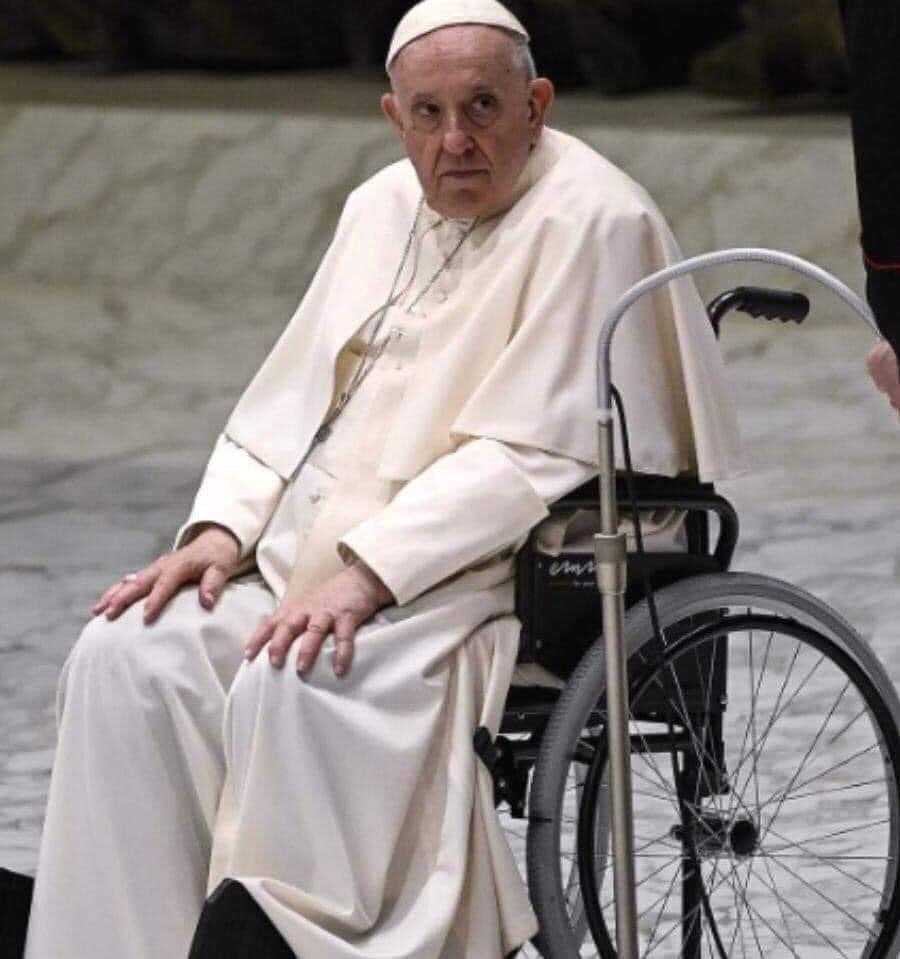
As I was thinking about all of this I came across this picture of Pope Francis, and it hit me again. My story like the paralytic’s story are not about the helpees but the Helper. If a great man like Pope Francis can accept the help of others who am I to think I am somehow better than that. The truth is we are all dependent on the help of others. It may be emotional support or sometimes physically taking us to the spiritual or physical help we need. It may be realizing we are dependent on the farmers, truckers, and grocers who get food on the shelf for us to purchase.

The secret to it all is being humble enough to recognize and ask for whatever help we happen to need at any given point in life. We all come into this life totally dependent on others to nurture, protect, and care for our needs for several years, and the cycle of life means that most of us will end up pretty much in the same need for caregivers at the end of this life. Our choice is how humbly and graciously we accept that care.

Where’s the Justice?

Election Day, praying for my tribe to win as much as possible even as I fear the dangerous person just elected Speaker of the House and the Trump circus in a New York court room. Trump has succeeded in taking the media spotlight off the mayhem in Gaza, but the slaughter continues there and elsewhere. A mass shooting in Cincinnati recently barely made the news.

We are having new skylights installed today while millions of people have no roof over their head at all. Where is the justice?

My privilege feels like a millstone tied around my neck, even while I resent working for hours on end the last two days to maintain our wonderful home.

I get wonderful medical care for my puny aches and pains while hospitals are bombed in Gaza. Where’s the justice?

I simply turn the tap and open the fridge whenever I thirst or hunger while millions of climate refugees and war victims around the world are starving and dying. Where’s the justice?

By accident of birth I am a privileged white male in a relatively safe and prosperous nation. My ease and comfort are as undeserved as the suffering of innocent Israelis and Palestinians and Ukrainians is unjustified. Where’s the justice?

If I thank God for providing so bountifully for me and my tribe anyone can see the irony that all these others of God’s children who pray to the same God still suffer so horribly. I am not some worthy saint being rewarded for my good behavior like a school boy getting gold stars for what we used to call “deportment.” If I am graded on keeping the 10 commandments or living by the Boy Scout Law I learned as a youth you better believe I hope God grades on the curve. Where’s the justice?

As we Christians paused ever so briefly this week to observe All Saints Day our grief and memories of those who have passed beyond this mortal coil are tied to the deaths of all those unknown to us but known to God souls lost in recent days to the madness of war. Nadia Bolz-Weber said it so well in her sermon for Sunday, “You’re going to die:”

“The untimely and unnecessary deaths of 10,000 children of God, many of whom are actual children, in just that one tiny area of our planet in one month’s time ripples out into an ocean of grief for the 100,000s of thousands who know their names…their babies, and brothers and wives and friends.

This is their day too.

So as we remember our own dead, may we feel connected to the sorrow of those who are also grieving today. And say as our lord did, Blessed are they who mourn. Blessed are they who have loved enough to know what loss feels like.”

I had never thought about grief as a blessing even though I have read those words from the Beatitudes dozens of times. “Blessed are those who mourn.” My thoughts always jump to the second half of that verse “for they shall be comforted.” Yes, we yearn for our own comfort and those of others. But there is no comfort without grief, just as there is no resurrection without death. So in one of those theological twists of fate there is gratitude even for pain. If we could not feel the pain of grief, even for people 10,000 miles away, we also could not feel love and appreciation for our privilege.

I do not deserve my comfortable life any more than the trapped citizens of Gaza deserve the horrors of modern warfare, any more than the 1400 Israelis deserved to die on October 7, or the 6,000,000 Jewish victims of the Holocaust, or the 3000 Americans deserved to die on 9/11. All of that reminds me that life itself is a privilege to be cherished and lived to its fullest no matter where we have landed by accident of birth on this fragile planet.

May our gratitude for what is take the wings of mercy to act as those who do justice here and now, who love mercy wherever we are planted, and through it all walk humbly and gratefully with the One who gives it all and who alone can fathom the mystery of life and death in our broken and unjust world.

Try this in a small town

“When he (Jesus) came to Nazareth, where he had been brought up, he went to the synagogue on the Sabbath day, as was his custom. He stood up to read, and the scroll of the prophet Isaiah was given to him.” (Luke 4:16-17)

All the discussion of country singer Jason Aldean ’s song, “Try That in a Small Town” reminded me of Jesus’ return to preach in the small town where he grew up. I flunked my first sermon in seminary preaching class, but Jesus got a much harsher response to his first message that day in Nazareth. Luke tells us Jesus read from the prophet Isaiah, and that part of his Sabbath was very well received. Verse 11 says, “All spoke well of him and were amazed at the gracious words that came from his mouth.”

But then Jesus goes ahead and interprets the text and tells his audience that the good news he brings to the captives, the blind and the oppressed is not just for them but for all of God’s children with examples of how the prophets Elijah and Elisha went specifically to minister to gentiles in Sidon and Syria instead of to those in Israel. And just like that the crowd does a 180 and turns on him. “When they heard this, all in the synagogue were filled with rage.” (Verse 28). And where the Gospels of Mark and Matthew just have Jesus leaving town at that point, Luke adds these words: “They got up, drove him out of the town, and led him to the brow of the hill on which their town was built, so that they might hurl him off the cliff. But he passed through the midst of them and went on his way.” (Vss. 29-30)

I did a lot of research in graduate school on such negative reaction to public speaking and wrote a paper I titled “They Shoot Prophets Don’t They?” I had a personal interest in that topic having come of age in the last turbulence in American history which saw the assassinations of the two Kennedy brothers and Dr. King, all within a five year period. In my research, I became impressed with the work of Lawrence Kohlberg on moral development and the role of cognitive dissonance in persuasive communication. To my great pleasure that very research was mentioned by one of my favorite author’s, Father Richard Rohr, in his book, “Everything Belongs,” which I just happened to be listening to on the very day I started thinking about this topic again. I am humbled and thrilled that Fr. Rohr’s use of Kohlberg’s theory of moral development is almost verbatim what I wrote about that research in my Ph.D. dissertation 40 years ago. The application of Kohlberg’s theories about how to effectively communicate with people who have very different moral and ethical values formed the heart of my own theory of preaching which I shared with seminary students in preaching classes over a 20 year period from 1991-2012.

I believe that theory can help us understand and bridge some of the vast divide we are experiencing in our country today. The country song controversy is very illustrative of how volatile and dangerous that divide is and has been throughout American history. I grew up in a small town and can identify with the good, bad, and ugly aspects of what that experience was and still is like. There were many positive aspects to spending the first 20 years of my life in Wapakoneta, Ohio, a small, county-seat town in very rural, very white, and very conservative northwestern Ohio. It was a very safe place where kids were free to roam all over town on our bikes. Everyone knew everyone else; so people looked out for each other’s kids. I am grateful for that age of innocence and the freedom it provided for me to enjoy a carefree childhood and adolescence.

But I am also angry about the flip side of that experience. We didn’t know what we didn’t know about the broader world outside our comfort zone. Our fathers and uncles who were survivors of the Great Depression and/or veterans of World War II certainly knew more than they shared with us about issues of race and political divisions, at least in my family. All I remember being told about why there were no people of color in our town is that “we aren’t prejudiced; those people just don’t choose to live here.” It turns out there was good reason for that. I learned many years later that one of my great uncles was a leader in the local chapter of the KKK, and just this week heard from a high school classmate that for some time there was a sign outside our town that said something to the effect “Get Your Black Ass Out of Town Before Dark.” That’s the ugly kind of small town life Aldean certainly alludes to in his song and accompanying video.

One major factor in the political chasm threatening our democracy is the rural-urban divide Aldean sings about. The life experience of small town and rural people in this country is so different from urban life that it is like living in two different countries. I addressed some of that in my post on July 18, “Culture War Games While the Planet Burns,” but I want to focus here on how to approach that reality in a constructive way. In an oversimplified description, Kohlberg’s theory of moral development I mentioned above is that there are 6 stages of moral development numbered 1-6. Stage 1 is a very self-centered stage we all start out in because that kind of selfishness is necessary for infants to survive. People in stage 1 say what is morally good is whatever is good for me. Stage 6 is the other extreme where morality is defined in a universal way to mean that moral goodness is determined by what is good for everyone and for the whole world/universe. Only people like Jesus, Mohammad, Gandhi, Mother Teresa, and Dr. King ever come close to stage 6.

Most people, and this is just fact, not judgment, never grow beyond a stage 3 or 4 in moral development, and that’s the problem prophets like Jesus have in small towns like Nazareth. Kohlberg’s research found that when there is a gap of 2 stages or greater in moral development between a speaker and an audience there is a major breakdown in communication. That gap creates so much cognitive dissonance, which is the perception of contradictory information and the mental stress it causes, that we consistency-loving humans will do whatever we can to reduce that stress. That often means simply ignoring the one causing the cognitive dissonance or, as the gap widens, arguing, disparaging or insulting the speaker, and ultimately, if the gap is too great either driving the speaker out of town as happens to Jesus, or in the most tragic situations actually killing him or her, which again finally happens to Jesus on the cross.

The major lesson for us Americans right now is to turn down the heat in our political discourse by bridging the gaps in our cultural, moral, worldviews. Kohlberg concludes that we cannot communicate with each other until the gap between us is one stage of moral development or less. In other words a speaker who is a stage 4 trying to communicate with a stage 2 or 3 person must meet that person where he or she is and communicate respectfully with that person in ways that are not threatening to them. We must find common ground to stand on before we can hope to understand one another. For example, all humans have a basic need for what Abraham Maslow calls psychological and physical security and safety. People in small towns and big cities all share that need, and to understand that we all express that need in different ways goes a long way toward bridging our differences on other values and beliefs. And when our feeling of safety is threatened by people who look, act, and think differently than we do, we need to resist the temptation to attack, blame, ridicule, or judge them. The Golden Rule to treat others as we want to be treated is always a good first step in building a bridge or tearing down a wall that separates us from others.

Unfortunately it seems our human instinct is to do just the opposite when confronted with the discomfort of cognitive dissonance. Social media is full of memes these days making fun of small town people and calling each other names instead of trying to understand where others are coming from. We live in very scary times and most of us don’t know how to express that fear. To do so makes us feel vulnerable and cowardly. It’s much easier and more fun to attack those we disagree with, but it only turns up the heat and the fear on both sides.

I had a very simple example of a change of just one word making a huge difference just last week. I try to avoid debates on social media because they are often unproductive and can seem endless in their back and forth nature. I expressed that reluctance to a friend that I felt a need to respond to by saying that I hate “arguing.” Her very helpful response to me was, “This is not an argument, it’s a discussion.” That one shift in perspective moved the conversation from a win-lose situation to a productive exploration of where we could find common ground.

We need more discussion and less arguing, more willingness to meet others where they are in a spirit of understanding. From there we can both learn and grow from each other and help each other move to a higher stage of moral development where we all strive to do what is best for everyone. The alternative is to end up like “The two cats of Kilkenny. Each thought there was one cat too many. So they fought and they fit; they clawed and they bit, until except for their nails and the tips of their tails, instead of two cats there weren’t any.”

From Worst to Best: Kindness of Strangers

We always share a good news story as part of our prayer time at Northwest UMC to remind us that amidst all the bad news in our broken world there are many acts of kindness being done every day that don’t make headlines. My wife and I recently returned from a two-week trip to Italy and Greece, and as soon as we returned I sent a message to our pastors that I had a personal good news story from our trip that I wanted to share with the congregation. This is that story.

Our trip was wonderful. Everything worked like clockwork. No delays. We were never terribly lost anywhere, and the weather was wonderful. We were in Athens, Greece the day before our return flight to the States. We spent the morning sightseeing and ate lunch at a quaint hole-in-the-wall seafood restaurant; and THEN came the low point of our whole trip – I realized when getting ready to pay for lunch that I had lost my wallet somewhere that morning. We thought it might have been on one of the hop-on-hop-off buses we rode that morning; so we called that company, and they said no one had turned it in, but we could call back later and check.

It took us 20 minutes or more of panic to figure out what to do next and find a place quiet enough that we could hear. I have trouble hearing so Diana did most of the phone talking. Before we started calling credit card companies I got a call from our hotel answered by Diana. I didn’t realize who had called and was confused about how our hotel got involved, but they said someone had found my wallet and called them. They gave us number for a man named Mario.

I was overwhelmed with relief. But we were not home free quite yet. When Diana called Mario she quickly found out he spoke not a word of English; so we could not communicate. Diana asked several people passing by on the street if they spoke Greek and none did – but one young man suggested going into a local market to see if some one there could help us. The first young woman we asked could not speak English, but she got her manager who took my phone and spoke with Mario. She said he would take the wallet to our hotel in about 20 minutes.

It was then I realized I had the hotel room key card in my billfold and that is how he knew to call them. We got a taxi to take us to our hotel, but it was now rush hour on Friday afternoon and traffic was terrible. It seemed to take us forever and when we did arrive, Mario had not arrived and my heart sank again. The report at the hotel was that Mario found the wallet in the national park near our hotel. I had sat on a low bench there and even though my pocket has a Velcro cover on it, the wallet must have fallen out.

Mario called my phone again just then, and someone at the hotel desk served as our interpreter this time, talked to him and said he was on his way. He showed up very soon with his whole family with him. He told a doorman at the hotel that the same thing had happened to them before. That was why they went out of their way to make sure we got my wallet back.

When he handed me the wallet my heart sank again. All of my cash was gone. Someone had gotten to the wallet before Mario, but the good news is all of my credit cards, insurance cards, driver’s license, etc. were all there. I lost about $80 in cash but was so relieved to have every thing else back I didn’t really care. I was going to offer Mario a reward but had no cash to do so. He didn’t seem to expect one. I was very very lucky these total strangers took all that time and trouble to find me and so grateful to all the people who helped us overcome the language barrier and connect us. What could have ruined our trip turned into a celebration of basic human kindness and goodness.

Diana and I did our best without being able to speak Greek to tell Mario, his wife and two daughters how grateful we were. In all the emotion of the moment I forgot to take a picture of Mario and his family, something I would love to have; but trust me, we will never forget those kind new friends we made in Greece.