Vote for Jesus over Leviticus

In a recent blog post (Oct. 9, “Why I Vote the Way I Do”) I told the story of a very satisfying, respectful political argument I had with a friend who holds very different political views than I do. That story ended happily as we agreed to respect and affirm each other’s points of views.

Fast forward to 4 days before Election Day and emotions are running high on both sides of the political spectrum because there is so much uncertainty about how the votes will come out and how supporters of either candidate will respond to the results. I used to love staying up late on election night to watch the returns come in, but I have no illusions this time that we will have a clear winner Tuesday or for several days or weeks thereafter.

Given that context I have been posting everything I think might make any difference in stopping Trump from reclaiming the White House, and my friend from October took strong objection to a post I shared about old rich white men destroying our planet by ignoring climate change to protect their fortunes. I respect her right to disagree, but then she said that I should basically shut up and stop posting because my intelligence level is very low.

I am hurt, angry and disappointed by that attack. I thought we had a better relationship than that. So a few days later I am still pondering how or if to respond. My first instinct was to respond in anger and then hide her responses on Facebook. Then this still, small voice in my head reminded of Jesus’ command in the Sermon on the Mount that we are to “love our enemies.”

That’s probably great advice in these contentious days; so I am praying about what that might look like in this situation.

Meanwhile, the Sermon on the Mount, also was on my mind a lot with regard to Trump’s most egregious threat to date, namely a detailed comment he made on a Fox News interview recently. Trump zeroed in on one of his “enemies within” and suggested former Republican Congresswoman Liz Cheney should face a firing squad for her opposition to his fitness for office.

The closer we get to Election Day the more paranoid and unhinged Trump becomes. But his threats against his political foes come from a logical progression of his abysmal knowledge of the Christian faith he has co-opted to gain political leverage.

I first noticed this basic theological flaw in Trump’s use of the Scripture to fit his own narcissistic values way back in the 2016 campaign. Trump was asked what his favorite Scripture is. His response was “An eye for any eye and a tooth for a tooth” from the Hebrew Bible book of Leviticus.

Had he read the New Testament where Jesus corrects and updates our notions of God, he might have noticed in the Sermon on the Mount this direct dismissal of the Hebrew commandment.

“You have heard that it was said, ‘An eye for an eye and a tooth for a tooth.’ But I say to you: Do not resist an evildoer. But if anyone strikes you on the right cheek, turn the other also, and if anyone wants to sue you and take your shirt, give your coat as well, and if anyone forces you to go one mile, go also the second mile. Give to the one who asks of you, and do not refuse anyone who wants to borrow from you.” (Matthew 5:38-42)

And if we dare to read the next verses Jesus ups the ante even more.

“You have heard that it was said, ‘You shall love your neighbor and hate your enemy.’ But I say to you: Love your enemies and pray for those who persecute you.” (Matthew 5 43-44)

The Gospel of Jesus Christ is not for sissies. We who claim Jesus as Lord and Savior strive for a higher standard; so no matter what unfolds after next Tuesday’s election, Jesus needs to win out over Leviticus.
Why I Vote the Way I Do

Recently I got into a friendly political argument with a friend who helps keep me honest when I get carried away and tune out my better angel. She, my friend, asked me to give her reasons to support my political views, and below is what I wrote to her after a few days of wrestling with that challenge.

“I want to respond to a question you raised a few days ago about reasons to support my political positions. I’ve been giving that a lot of thought, and here’s what I’ve decided.

First, I grew up in a very conservative, Republican family and community in deep red NW Ohio. I don’t think I ever met a Democrat until I left home for college at age 20. I was exposed to a whole new world view at Ohio State and then in seminary, and that broader, more liberal world view made much more sense to me than what I grew up with.

I was converted by that exposure to a new way of thinking and became convinced that the Democratic Party, even with all it’s flaws, is much closer to my theological beliefs about the Kingdom of God than the Republican Party. The Democratic Party as I was coming of age supported Civil Rights and women’s rights, and continues to stand for more programs that help the poor and marginalized members of society than the GOP. Those are the people I believe Jesus calls us to care most about.

The differences between the two parties are more clearly visible now than ever before. I find it hopeless to argue over campaign promises or to fact check either party because they all exaggerate and lie to make their points.

The bottom line is that I vote democratic because those candidates in general are more in harmony with the values I try to live by shaped by the life and teachings of Jesus. I hope that makes sense, and I do thank you for pushing me to think more deeply about these issues and for helping me realize when I’ve screwed up when you call me out. Peace and grace, my friend.”

And the best part of this story? My friend replied with a beautiful emoji shower of hearts.

A New Independence Day

How ironic that Donald Trump’s handpicked Maga Supreme Court should choose 3 days before Independence Day to eviscerate the founding documents that have been the foundation of our freedom for 248 years! At least now the stakes are clear for what the 2024 election is all about, and there can be no excuse for anyone ignoring the danger posed by our only President who has ever staged an insurrection to try and cling to power and overthrow a free and fair election.

Lost in the obvious failure last week of President Biden to withstand the barrage of Trump’s lies is the appalling lack of honesty coming from Trump’s mouth. He is such an accomplished liar that only the well-informed listener would see through the bull crap he spouted for the entire 90 minutes. And sadly we do not have a well-informed electorate. A dangerous portion of our population have been so indoctrinated by the right-wing media to believe Trump’s lies uncritically. He has cult-like control over just enough minds to possibly win another election while again losing the popular vote.

There is no time to correct the flaws in the Electoral College which is protected by the very system it perpetuates. There is no time to re-educate the Maga base. The biased court system created by Trump and Mitch McConnell has successfully prevented any legal recourse happening before the November election. The only defense of democracy we have left is exactly what President Biden called for tonight in his forceful and courageous dissent from today’s Maga Court ruling. That defense is ironically what the Trump supporters have also been calling for — let the voters decide.

Well, by God, we will. Today’s court decision is discouraging, and it is very tempting to just give in to despair. But instead what I plan to do is let the rockets’ red glare of our July 4th fireworks inspire me to renew my commitment to the “self-evident truths” that gave birth to this great nation. I will celebrate the vision that all people are created equal, which means no one, NO ONE is above the law. It matters not that six Maga Court justices have forgotten that sacred truth – what matters is that “we the people” have not forgotten.

Those brave men in Philadelphia 248 years ago pledged “their lives, their fortunes, and their sacred honor” to the dream of equality and independence for all. Now it’s our turn to do the same.

Jesus and Stages of Grief

As we made our way through the passion story of Holy Week this year it occurred to me that the Gospel accounts of Jesus’ last week are an interesting case study in the classic stages of grief proposed by Dr. Elizabeth Kubler-Ross in her 1969 book “On Death and Dying.”

The stages do not occur in a linear order but ebb and flow like the phases of the moon, and we always need to remind ourselves that the Gospels are theological works, not historical biography; but given that, it strikes me that we can learn about the universal human experience of grief by studying what the Gospel writers tell us about the final days of Jesus’ earthly life.

Kubler-Ross’ stages include anger and depression which are often two sides of the same emotion – one expressed outwardly and the other turned in upon oneself. Because of that anger is easier to identify and that is true with Jesus also. The cleansing of the temple which is described in all four Gospels is one of the few times we ever see Jesus angry. He sometimes is verbally angry with the Scribes and Pharisees, but when he overturns tables and drives the money changers out of the temple with a whip that is the rare incident where Jesus is obviously and physically very angry.

Another scene which could be motivated by either anger or depression would be one of the “last words” from the cross where Jesus cries out, “My God, My God, why have you forsaken me?” Hearing the tone of voice and seeing Jesus’ body language when he uttered these words might help us better understand his mental state at the time, but both Matthew 27 and Mark 15 describe his tone as “crying out with a loud voice,” and that is the best evidence we have.

Depression can certainly not be diagnosed from a few 3rd person accounts of Jesus’ actions, but the three incidents that come to mind when I think about that stage of grief are when Jesus weeps over the death of his friend Lazarus, when he weeps over Jerusalem and says, “Would that you, even you, had known on this day the things that make for peace! But now they are hidden from your eyes.  For the days will come upon you, when your enemies will set up a barricade around you and surround you and hem you in on every side and tear you down to the ground, you and your children within you. And they will not leave one stone upon another in you, because you did not know the time of your visitation.” (Luke 19:42-44). And perhaps in all four Gospels where Jesus refuses to answer any questions in his trials before Pilate, Herod, and the Chief Priests. Those incidents however I interpret more as a strong, silent resistance to the unjust power of oppression rather than depression or resignation.

The stage of grief that stymies me when it comes to Jesus is denial. If you readers have ideas about this one I would love to hear them, but for now I cannot think of examples of times where I see Jesus being in denial about his fate. He sets his face toward Jerusalem in spite of the protestations of his disciples. He stages a protest entrance into Jerusalem riding on a humble donkey, and he returns daily to teach and heal in Jerusalem that last week and to celebrate the Passover, all of which seem like acts of faithful determination and not ones of denial in any form.

The stage of bargaining seems to me to only appear in the Garden of Gethsemane when Jesus says, “If this cup can pass from me, please make it so,” but those words are immediately followed by “But not my will but yours be done,” which move us toward the final stage of acceptance.

It should come as no surprise that examples of acceptance are easier to find with Jesus. When Peter pulls out his sword to resist the soldiers in the garden Jesus sternly tells him to put it away. And then on the cross where it would require the greatest amount of acceptance and courage, at least 4 of the recorded “seven last words” reflect the confidence that only comes with acceptance of death as the final stage of human life.

Those four include Jesus commending his mother into the care of one of his disciples, assuring the repentant thief that he will be with Jesus in paradise that very day, commending his spirit into the hands of God, and finally saying “It is finished.” I suppose one could also make a case that forgiving his executioners is also an act of acceptance, but that amazing act of grace really defies categorization.

Grief is a very complicated emotional process, and the Kubler-Ross stages are one very helpful lens through which to understand it. I find it comforting to find connections between my own experiences of grief and those of the incarnate life of God in Jesus. For me sharing the human condition of these grief stages with Jesus affirms the reality of his humanity and also the hope for achieving some degree of acceptance of my own mortality that he exemplifies for us.

I welcome your comments and insights on any of the above.

Darkness Will Not Prevail

Black History Month and Lent

Black History month and Lent go well together. Jesus’ 40 days in the wilderness and our 40 days of Lent pale in comparison to 400 years of slavery and systemic racism, but the determination to not let the darkness prevail requires the same kind of faith.

Darkness and Balance

Darkness has taken on a new significance for me personally in recent years. I was diagnosed ten years ago with peripheral neuropathy which causes numbness in my feet and legs, meaning my sense of balance leaves a lot to be desired.

My physical therapist has taught me some things that help in coping with my impaired balance. There are basically two senses that send information to our brains that help us feel steady on our feet. One is the feel of our feet on what ever surface we are standing or walking upon. Neuropathy plays havoc with that input.

Secondly we get signals from our eyes about our surroundings that help orient us in space. For that sensory data to compute obviously requires our being able to see where we are and where we’re going, and that vision requires enough natural or artificial light to illuminate our path. Simply put it is much harder to maintain a sense of balance in the dark.

That explains why you will find nightlights in every room in our house and why I use a cane to steady myself when walking on uneven surfaces or in the dark. And yes, getting up to make my way to the bathroom in the middle of the night is still sometimes an adventure, even with motion sensor night lights and my cane. It is also why I am very grateful for the flashlight app on both my iPhone and my Apple Watch. I am almost never without at least a small source of light.

Cultural and Political Darkness

On a more macro level Lent 2024 feels really dark to me, even with the blessing of sunshine and above average temperatures here in Ohio. Technology has not invented an app that can brighten the dark night of the soul I feel when witnessing the suffering in Gaza and Ukraine. Natural disasters are still heartbreaking to watch, but I understand the science of how climate change is causing the devastation on the California coast. I cannot however wrap my mind around the evil of modern warfare or the hatred that inspires it.

I despair at the insecurity and depravity that justifies a Putin killing his political enemies or invading a neighboring country just because he can. And I weep over the ignorance about our history that blinds people to the threat of authoritarian leaders and the cult-like devotion to those who blatantly practice it.

Being the Light

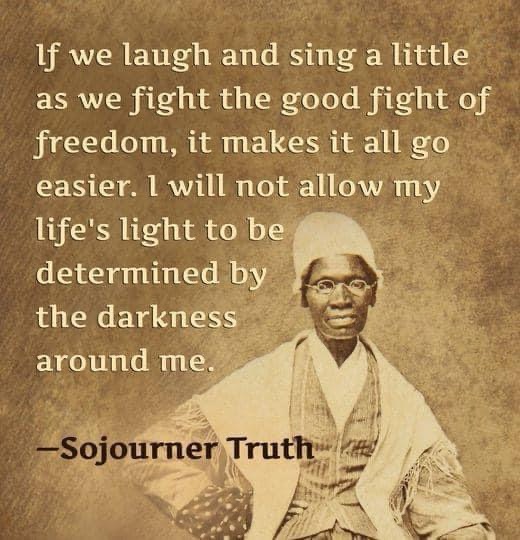
When the darkness of sin and evil threatens to drown out the light, God has always called on those like Sojourner Truth to step up and refuse to let the darkness determine our life’s light. That quote reminded me that I am always inspired by the words of another black woman, Amanda Gorman, whose marvelous poem, “The Hill We Climb,” ends with these powerful words:

“When day comes, we step out of the shade aflame and unafraid. The new dawn blooms as we free it. For there is always light. If only we’re brave enough to see it. If only we’re brave enough to be it.”

Action Steps

A Lenten challenge might be to find what God wants each of us to actually do to be the light. It may be relating to family members or co-workers in a more caring way, or volunteering for some group that you’ve always meant to get involved in, getting involved in local politics, advocating for justice by writing letters to representatives, or supporting marginalized groups. There’s plenty of darkness to go around and every ray of light does make a difference.

Prayer

O God of eternal light, the darkness scares me. I know in my head the words from the Gospel of John that assure us the darkness will not overcome the Light of the World. But my heart is not so sure! Rather than just spout pious platitudes that fall flat on their face, please give me the courage to really feel your light in my soul and the guts to go out into the darkness and be it. Amen

SB LVIII: Service vs. Materialism

The “He Gets Us” television ad that aired during Super Bowl LVIII has prompted a lot of criticism from many of my liberal/progressive friends because of the huge cost of the ads. Those critics argue that all those millions of dollars could have been put to much better use feeding and housing people experiencing homelessness for example.

I understand those concerns, and upon learning that the ads are funded by theologically and politically conservative donors I get it even more. I must admit however that when I first watched the ad of people of different races and ethnicities washing each others feet I was favorably moved by that message, and I am sorry to have that positive narrative spoiled by knowing the back story.

The commercials that bothered me much more on the other hand were the hyper-materialistic message of the “shop like a billionaire” spots offered from the Chinese company Temu. That self-centered prosperity gospel message is a full 180 degrees opposite to the foot washing images of the “He Gets Us” commercials, and yet I have seen no objections being raised at all about that troubling message.

Not only is materialism a huge threat to basic Christian values, these commercials come from a company notorious for undercutting prices of American manufacturers by using what amounts to slave labor.

So the question for me is one of ethics. Is it better to promote a good message for the wrong reasons or to spout a false message blatantly? The “shop like a billionaire” ads seem totally wrong-headed. God knows we already have too many billionaires (Taylor Swift being one of a few notable exceptions) using their ill-gotten wealth for nefarious purposes. Promoting the prosperity gospel to the masses of gullible people only spreads that total distortion of Jesus’ message. I don’t know if the “He gets us” sponsors get Jesus or not, and I am reluctant to sit in judgment of them. What is obvious to me is that the Temu folks most certainly don’t get Jesus, and it bothers me that no one seems to be pointing that out.

And of course the bottom line, the hard question we all need to ask is “Do I get Jesus?” Lent is a good time to ask oneself, “How much time do I spend washing feet and how much chasing after the idols of materialism?”

Epiphany – Herod Lives

“Then Herod secretly called for the magi and learned from them the exact time when the star had appeared. Then he sent them to Bethlehem, saying, “Go and search diligently for the child, and when you have found him, bring me word so that I may also go and pay him homage.” Matthew 2:7-8

I am embarrassed to admit this. It took me till the third anniversary of January 6 to realize that horrible event took place on Epiphany, the twelfth day of Christmas. So for the last 24 hours since that light went on in my head I’ve been trying to think of some way to make theological sense of that convergence of those two radically different events. I don’t believe in coincidences; so I knew there had to be a connection, but all I was coming up with was that the attack on the very core of our democracy was even worse because it happened on Epiphany.

There are just a handful of dates in my lifetime that burned such a mark on my psyche that I will always remember where I was when I first heard about them: the assassinations of JFK, MLK, and RFK; the explosion of the Challenger space shuttle; 9/11; the election of Donald Trump; and the insurrection against our government on January 6, 2021.

I was working my home office that day but had the TV on fearing there might be trouble around the certification of Joe Biden’s election as President. But even though I was worried there might be some kind of trouble at the Capitol that day I never in my wildest imagination expected what played out on my TV screen that awful afternoon. As I watched the badly outnumbered Capitol police be overrun by an angry mob that began scaling the walls of the Capitol building, smashing windows, and swarming into the halls of Congress I sat there in stunned silence. Feeling helpless I finally did the only thing I could think to do. I got on Facebook, and I still remember exactly what I said: “Whatever you are doing, stop and pray. Our democracy is under attack.”

During worship this morning at our church it finally dawned on me what the connection was between the insurrection and. Epiphany. After preaching about the light of the star that leads us to Jesus our pastor, Chris Rinker, went on to say that we also need to remember that there are always forces of darkness that try to snuff out the light. There are always Herods who are so insecure and so desperate to preserve their own power that they will do anything to put down any threat real or imagined to their fragile egos.

Of course there are. I remember as a young pastor many years ago preaching on Matthew’s story of the Magi and Herod, and the title of that sermon was “Be Sure You Follow the Right King.” There are always Herods and the person fulfilling that role on January 6, 2021 was none other than President Donald Trump. Just as Herod told the Magi to go find the Christ child so he could go worship him too, our 45th President urged his angry followers to march to the Capitol and stop his Vice President from fulfilling his Constitutional duty to certify the legitimate electoral colleges votes from the 2020 election.

Three long years later we are still dealing with the fallout from that awful day, and I must admit I am often very discouraged about that and what it means for the future of our nation. But here’s my takeaway from this Epiphany 2024 message from Matthew. I can’t say it any better than Maltbie Babcock said it in 1901 in his great hymn, “This is My Father’s World;” so I will just end here with the third verse of that hymn:

“This is my Father’s world:
O let me ne’er forget
That though the wrong seems oft so strong,
God is the Ruler yet.
This is my Father’s world:
Why should my heart be sad?
The Lord is King: let the heavens ring!
God reigns; let earth be glad!”

Advent 4, 2023: Love

We have made our way this Advent from prophesy and promise to stand now on the cusp of fulfillment.  This very night we will celebrate again the birth of love incarnate in the form of a helpless infant.  Like that baby, love is vulnerable.  Both require careful nurture and handling.  Love is a gift entrusted to common people like Mary and Joseph, like you and me.  Of all the gifts we may give or receive this week, none is more precious than the simple gift of love.  That is what inspired St. Paul to write: “And now these three remain: faith, hope and love. But the greatest of these is love.”

God’s love is a spirit that requires embodiment to become real.  God’s love must become flesh to dwell among us.  At Bethlehem that love came to life in the infant Jesus.  Today, if we are open to the mystery, it can come to life in you and me as the church, the body of Christ.  We can be the light of the world because of Christmas. So today we live between the warm feeling of God’s love and the choice to put that sentiment into concrete action.   We humbly receive God’s most precious gift as we light the 4th candle of Advent, the Candle of Love. 

[Light the 4th Candle]

Please pray with me as I share this Advent prayer from Kate Bowler and Jessica Richie from their book, “The Lives We Actually Have:”

God, we are waiting for love,

not the simple kind or the sweep-you-off-your-feet kind,

but the absurd kind.

The kind wrapped in rags, resting in a bucket of animal feed.

Love enough to save us all.

Blessed are we who look for Love,

deeper, fuller, truer—than we have ever known,

than we could have ever hoped for.

Blessed are we who seek you,

the light that dawned so long ago in that dark stable.

Love given.                                                    

Love received.

Dear God, Hold us in that love these last few hours of Advent till that love is born again in our hearts this very night. Amen

Northwest UMC, Columbus, OH; December 24, 2023

An Eye for An Eye?

Ever since October 7 I have been pondering the irony of the Israeli response to the horrific massacre of 1200 Israelis by Hamas.  One of the most familiar tenets of the Hebrew law found in Leviticus says, “Anyone who maims another shall suffer the same injury in return: fracture for fracture, eye for eye, tooth for tooth; the injury inflicted is the injury to be suffered.” (24:19-20). I learned two things about that Scripture in seminary: 1) It is very similar to another ancient law, The Code of Hammurabi, a Babylonian King in the 1700’s BCE, and 2) both the Code of Hammurabi and the Hebrew law were meant not to justify revenge but to limit the amount of revenge one could seek for an offense to an equitable amount.  So, for example, if someone poked out one of my eyes I could not in return poke out both of his or hers. 

Jesus came along 3000 years after Hammurabi and 1400 years after Moses and raised the bar to a whole new level in the Sermon on the Mount where he says, “You have heard that it was said, ‘An eye for an eye and a tooth for a tooth.’ But I say to you: Do not resist an evildoer. But if anyone strikes you on the right cheek, turn the other also,and if anyone wants to sue you and take your shirt, give your coat as well,and if anyone forces you to go one mile, go also the second mile.Give to the one who asks of you, and do not refuse anyone who wants to borrow from you.“You have heard that it was said, ‘You shall love your neighbor and hate your enemy.’  But I say to you: Love your enemies and pray for those who persecute you,” (Matthew 5:38-43).

Now, I’m not expecting the Israelis to live up to Jesus’ ethics.  I can’t, and I’m not sure anyone but Jesus could ever do that.  But it seems like not killing your enemy’s innocent women and children might be a start.  And it does seem fair to hold the Israelis to their own Scriptural standards.  At last count the Israelis have killed 16000 Palestinians in Gaza.   That’s more than 10 for every Israeli killed on 10/7.  That’s a lot more than “an eye for an eye.”

I understand the horror of that dark day.  No, I don’t.  Thank God, I have never experienced anything like it.  I was even far removed from any personal suffering on 9/11.  So, I know I have no right to judge.  I don’t know what I would do in the Israeli shoes.  Nor do I have any idea how I would survive the God awful inhumane conditions the people of Gaza have been living under for the last 60 days.  I just know the insane suffering I see on my TV screen has got to stop.  Not just because it is morally unjustifiable but mostly because it is just plain counterproductive.

War and killing have never solved anything.  If the Israelis could actually eliminate Hamas and terrorism by use of force there might be an argument for their military campaign.  But it won’t work.  The anger being fanned in the Muslim world by the war in Gaza will produce far more terrorists can ever kill.  If history has taught us anything it is that revenge only begets more violence in return.  That’s the point of Jesus’ teaching above about turning the other cheek.  To resist the natural human urge to strike back in anger, as impossible as that seems, is the only way the cycle of violence can ever be stopped in its tracks. 

As progressive as it was in the days of Hammurabi, as Gandhi once pointed out, “An eye for an eye and a tooth for a tooth just creates a world of blind, toothless people.”

I know that too criticize Israel opens me to charges of antisemitism, but I assure you I am not anti-Semitic.  I am a Christian nurtured in the Judeo-Christian tradition.  Jesus was a Jew.  I am constantly challenged and inspired by the Hebrew prophets.  I grieve for the hostages still in captivity, for the suffering of the Jewish people throughout history and on 10/7, but the killing needs to stop; the suffering of the people of Gaza must stop. 

December 5, 2023

Eucharistic Blackmail

“Then he took a loaf of bread, and when he had given thanks, he broke it and gave it to them, saying, “This is my body, which is given for you. Do this in remembrance of me.” And he did the same with the cup after supper, saying, “This cup that is poured out for you is the new covenant in my blood. But see, the one who betrays me is with me, and his hand is on the table.”  (Luke 22:19-21)

I heard something from a friend this week that has left me adrift in a sea of incredulity.  Given the bitter divisions in our nation and my denomination I should not have been shocked, but I was.  This friend is a former member of a United Methodist church I used to serve.  She is one of the casualties of the great United Methodist schism of 2022-23.  She told me that a relative who still attends the now Global Methodist Church reported the following from their worship service last Sunday:  prior to communion the pastor told the congregation that anyone planning to vote for Issue One in the upcoming Ohio general election should probably not take communion.

Issue One is a constitutional amendment that will protect reproductive rights and access to abortion.  This is a very controversial and emotionally charged issue, and while I respect the opinion of those who oppose Issue One I do not think access to the Sacrament of Holy Communion should be used to persuade or intimidate anyone to vote in any particular way. 

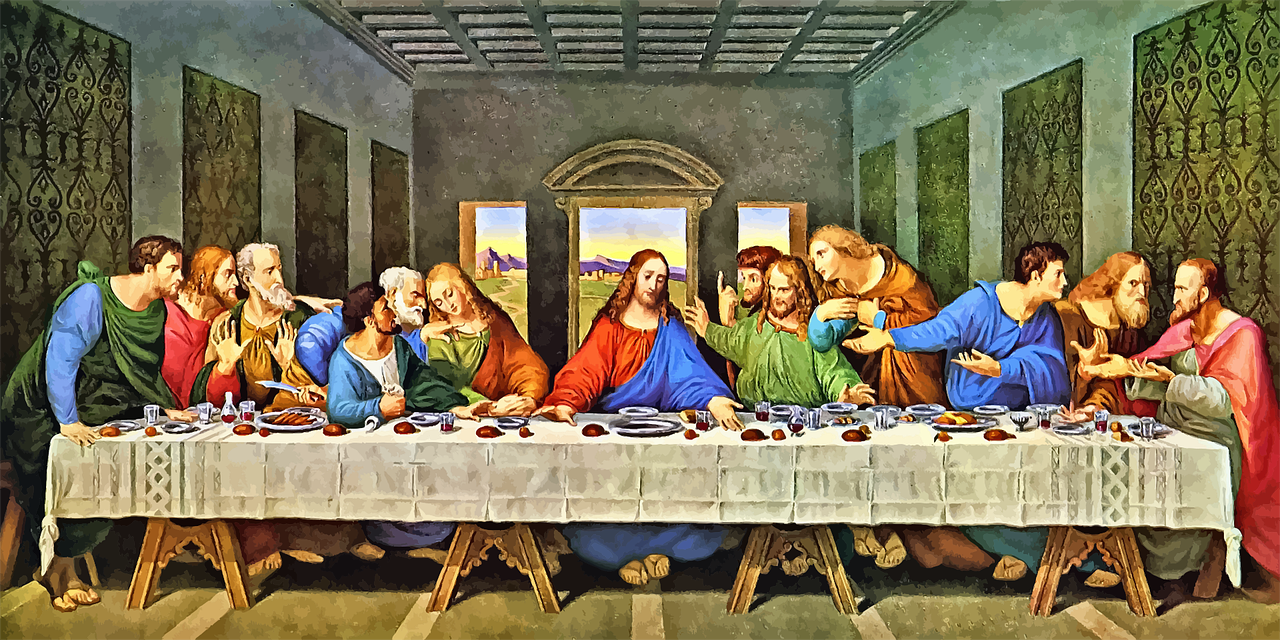
I don’t know what the position of the Global Methodist denomination is on who may or may not receive this sacrament, but in the United Methodist Church we practice an open table.  As a pastor I would never presume to judge who is worthy or unworthy to come to the Lord’s table because it is the Lord’s table, not mine or my church’s.  The exemplar for that inclusive table is the Upper Room itself on the night before Jesus is crucified.  The Gospels make it very clear that all 12 disciples are there to celebrate the Passover with Jesus.  You can count them all in Da Vinci’s painting.

But seriously, check the Gospel accounts in Matthew 26, Mark 14, and Luke 22. 

According to all of these retellings of what transpired in the Upper Room Jesus not only knew that Judas would betray him and Peter would deny him 3 times, but also that all the other disciples would run and hide in his hour of greatest need. “Then Jesus said to them, “You will all become deserters because of me this night; for it is written, “I will strike the shepherd, and the sheep of the flock will be scattered.'(Matthew 26:31). Does that disqualify any of the 12 from sitting at the table with Jesus? No, they all are there to receive this sacrament of remembrance.

Jesus is very clear about whose job it is and isn’t to judge others – and it isn’t mine or any clergy person’s.  “Do not judge, so that you may not be judged. For with the judgment you make you will be judged, (Matthew 7:1)   Or check the parable of the weeds in the wheat in Matthew 13 where Jesus says, “Let both of them grow together until the harvest; and at harvest time I will tell the reapers, ‘Collect the weeds first and bind them in bundles to be burned, but gather the wheat into my barn.’” Or my favorite, the billboard that says, “Just love them all.  I’ll sort them out later.” –  God. 

When Jesus says, “Come to me all who are weary and heavy laden, and I will give you rest,” (Matthew 11:28) all means all; and this sinner is darn glad we are all invited to the table.  When we all get on one side of the table for a remake of Da Vinci’s picture there will be Donald Trump next to Alexandria Ocasio-Cortez, Hamas Palestinians next to Netanyahu, Putin next to Zelenskyy, and in the middle Jesus asking, “What took you so long to get here?”

And in the background John Lennon is singing:

“You may say I’m a dreamer,

But I’m not the only one.

I hope someday you’ll join us

And the world will be as one.”