Not a Spectator Sport: Matthew 7:24; James 1:22-27

One of my favorite literary characters is Zorba the Greek. Zorba is a daring, brash, risk-taking, fun-loving rascal—all things I admire but am too chicken to try. Zorba is described in the novel bearing his name by Nikos Kazantzakis. The novel is narrated by a character Zorba calls “Boss” because the boss hires Zorba, ostensibly to manage a mining operation for him. In reality, The boss hires Zorba so he can live vicariously through him for a little while.

Zorba is based on a real life Yorgis Zorba that Kazantzakis met on an actual mining venture and the boss, a writer and spiritual seeker/philosopher, is Kazantzakis himself. Zorba chides the boss for being a book worm and “quill driver” because he merely writes about life instead of living it. My love affair with Zorba and Kazantzakis’ other work began 45 years ago when I discovered them in the syllabus of a course on “Theology and the Modern Novel.” I fell for Zorba, but I identified with the boss. I’m much better at observing and reflecting on life than living it in person with gusto.

That same theme shows up in a much more controversial Kazantzakis work, “The Last Temptation of Christ.” Critics of that novel and the movie of the same name mistakenly assume it’s about Jesus being sexually tempted by Mary Magdalene, but they miss the point. Our suppressed attitudes about sex often distract us from more subtle and deeper issues. In The Last Temptation what entices Jesus to abandon his divine mission is not lust, it is the desire to live a “normal,” safe life as a husband and father. Those roles are not wrong, of course, they were just not what Jesus was called to do and be.

On a trip to Boston recently I visited the John F. Kennedy Presidential Library and Museum. As a child of the ‘60’s it was good to relive a bit of that turbulent period of history. There is the expected pro-Kennedy bias to the museum, of course. There was no mention of the young, martyred president’s human frailties or moral weaknesses. Like all mortals, especially powerful ones, he had has share. But there was also a sense of altruism and service in the Kennedy-Johnson policies so sorely lacking in today’s populist political posturing. JFK’s “ask not what your country can do for you; ask what you can do for your country” may sound like a cliché or hopelessly naïve today, but it is far nobler and more Christian than racist slogans to “make America great again.” And it has endured as one of the most famous lines in an inaugural address because Kennedy lived those words he wrote.

No one short of Jesus or Mother Theresa has totally pure motives, but with all their faults, there’s a quality of public service and commitment to justice exemplified in the Kennedys and others of wealth and privilege all the way back to Washington and Jefferson that seems lacking in today’s political atmosphere. JFK failed his physical for military service for a variety of chronic health issues that would have kept most of us on the sidelines. He didn’t have to and probably should not have gone to war. But he used his privileged status, not to avoid service, but to pull strings and join the navy in spite of his medical problems because he felt it was his duty. He’d lived in Europe as a young man in the ‘30’s and knew first-hand the evils of Nazism while most of America was still in favor of isolationism.

After the war Kennedy felt called into politics, not for what it could do for him, but for what he could do for his country. He was already a twice published author and Pulitzer Prize winner (for “Profiles in Courage”) but chose not to be a safe and comfortable spectator/quill driver and instead became an active participant in causes he believed in passionately.

Kennedy’s achievements in his 1000 day presidency are truly remarkable: avoiding nuclear disaster in Cuba, signing the first nuclear arms control agreements, launching the Peace Corps, taking on organized crime, and advancing civil rights and social justice causes than extended American ideals in very significant ways.
He made mistakes in Southeast Asia and domestically, but one does not have to agree with every action or consequence of his policies or legacy to affirm the altruistic spirit of his life. He overcame great physical pain and ultimately gave his life for the country he loved because he chose to be a “profile in courage” instead of just writing about others who did.

In another part of the JFK library is a display I didn’t expect devoted to the life and works of Ernest Hemingway. I was surprised by that until in good quill driver fashion I had time to reflect on why the two share that space. The factual/historical explanation is that Hemmingway’s tragic suicide in 1961 occurred during JFK’s presidency and Kennedy helped assure that Hemmingway’s papers and original manuscripts were collected and preserved.
With all the cold war, domestic and political turmoil on Kennedy’s plate, I asked myself, why would he take time to preserve some quill driver’s papers? My guess is because like Kennedy, Hemmingway was not just a writer; he was a larger than life Zorbatic actor in the narratives he wrote about. He was able to write about the horrors of war because he lived them as an ambulance driver for the Red Cross in WWI. Like Kennedy he foresaw the coming of WWII because he lived in Europe and described the Spanish Civil War as a precursor to another world war.

Why does all that matter to me? Other than the obvious political connections between then and now, a lot of “normal” life has been going on for me since I last wrote here. Grandchildren graduating, having birthdays, my beloved United Methodist Church going through its quadrennial soul searching and public embarrassment about social justice issues, spring time challenges of yard work and gardening chores, coping with the challenges of aging – mine and my father’s; and all the while wrestling with my own temptation to play it safe, enjoy a “well-deserved” retirement, and avoid the conflicts and confrontations of social activism.

All that is far from a new struggle. Twenty plus years ago I wrote a paper about that tension in graduate school and called it “They Shoot Prophets, Don’t They?” Fear is a great excuse for cowardice. “Normal” life concerns and creature comforts are seductive temptresses to avoid faithful living and prophetic witness. Before retirement I often thought I was compromising my values for a parsonage and a pension. Now that only one of those two remains I feel somewhat less constrained to say what I think and feel.

All of that surfaced for me as I reflected on my Boston trip and the realization that “normal” life has kept me from writing here for the last few weeks. With all the critical issues confronting our world and the church right now, that seems like a shirking of my responsibility as a citizen and disciple. Life is a balancing act of tending to both personal and communal needs, and that is very hard work, at least for me.

Part of our responsibility to the larger community is to be informed and think critically about issues that affect the common good. Far too often we have a very limited perspective and base our beliefs and values on what is best for me and those close to me. It’s much harder to think across class, race and social boundaries to ponder and act on what is the just and right thing to do for all of humankind and beyond that to all of creation. We have a tendency to stay within our different comfort zones because, well, they’re comfortable. Intentionally or unintentionally we tend to live, work, go to school and socialize with people who look and think like we do. Historically when immigrants have come to this country, and that includes all of us or our forebears unless we are Native Americans, from the first settlements in this “New World” different ethnic groups, different faith groups, different classes settled together in different locations.

The American melting pot has in reality been more of a collection of separate but unequal boroughs, ghettos, subdivisions, colonies, and territories, from our inception. Now we are engaged again in that struggle Lincoln described so well at Gettysburg to see if a nation conceived and dedicated to unity in diversity can long endure. Unity does not mean conformity. We tend to forget that when we choose up sides and turn our differences into debates instead of opportunities to learn from each other. Our win-lose culture is based on economic and political systems where in order for one side to win someone else has to lose, even though that “losing” side might be 49% of the population.

We saw this win-lose struggle again at the recent United Methodist General Conference where stalemate and status quo left no one satisfied. A truce was called by the Council of Bishops to prevent division of the church and a special commission authorized to study the issues of sexuality that have consumed far too much time and energy and prevented other critical kingdom work for more years than Moses and the Hebrews wandered in the wilderness. I hope that commission will practice what Krista Tippett calls “generous listening” in her book, “Being Wise: An Inquiry into the Mystery and Art of Living.” Her insights are so important I want to quote several passages from Chapter 2: “Words: The Poetry of Creatures.”

“Generous listening is powered by curiosity, a virtue we can invite and nurture in ourselves to render it instinctive. It involves a kind of vulnerability—a willingness to be surprised, to let go of assumptions and take in ambiguity.”

“Our cultural mode of debating issues by way of competing certainties comes with a drive to resolution. We want others to acknowledge that our answers are right. We call the debate or get on the same page or take a vote and move on. The alternative is a different orientation to the point of conversing in the first place: to invite searching—not on who is right and who is wrong and the arguments on every side, not on whether we can agree; but on what is at stake in human terms for us all. There is value in learning to speak together honestly and relate to each other with dignity, without rushing to common ground that would leave all the hard questions hanging.”
“But the pressure of coming to agreement works against really understanding each other. And we don’t understand each other.”

“More importantly, you have got to approach differences with this notion that there is good in the other. That’s it. And if we can’t figure out how to do that, and if there isn’t a crack in the middle where there’s some people on both sides who absolutely refuse to see the other as evil, this is going to continue. There’s a lot of pressure, and it’s much easier to preach to the choir versus listening to people who agree with you. But the choir is already there; the choir doesn’t need us. The crack in the middle where people on both sides absolutely refuse to see the other as evil—this is where I want to live and what I want to widen.”

Not bad advice for Congress and our political process either! But generous listening takes time and critical thinking skills that cannot be achieved in a 5 minute speech or a 140 character tweet. It requires a willingness to practice what we write/preach, to be in the words of Jesus and James, “doers of the word and not just hearers.” I want to simply close with those words and encourage all of us to read them with new eyes and generous ears and pray for inspiration and guidance to be both wise observers and daring actors on the stage of life.

“Everyone then who hears these words of mine and acts on them will be like a wise man who built his house on rock.” Matthew 7:24

“But be doers of the word, and not merely hearers who deceive themselves. 23 For if any are hearers of the word and not doers, they are like those who look at themselves[a] in a mirror; 24 for they look at themselves and, on going away, immediately forget what they were like. 25 But those who look into the perfect law, the law of liberty, and persevere, being not hearers who forget but doers who act—they will be blessed in their doing. 26 If any think they are religious, and do not bridle their tongues but deceive their hearts, their religion is worthless.27 Religion that is pure and undefiled before God, the Father, is this: to care for orphans and widows in their distress, and to keep oneself unstained by the world.” James 1:22-27

Musings of a Curious Introvert

inherit the wind
I am not by nature a curious person. Until recently I did not see that as a big problem. What sparked my interest in curiosity now is two-fold: 1) the Peace Ambassador Training I just participated in raised the issue a few weeks ago in two sessions, one on Nov-violent Communication and one on bridging cultural divides. The point was that curiosity is necessary for not being judgmental and fearful of things or people we don’t understand. Asking questions is an important part of active listening so others feel that one is genuinely interested in them, respectful of their point of view and willing to try and understand where they are coming from. The essential qualities for transforming a situation on an interpersonal or international level are self-awareness, nonjudgment, and curiosity. The speakers acknowledged that this is not a natural way to be for many of us and requires effort and courage. Especially in our polarized society, we need to remember that the basic human need is not to be right but to be heard and respected. To create a safe place for that kind of communication people need to know that we are willing to stay in connection with them, even if we disagree.

I can’t speak for extroverts, but I know for this introvert that kind of behavior feels risky. If I have to ask for information it means I have to admit I don’t know everything and I can’t figure it out in my own head. It means admitting that I need other people, and that means outgrowing the two-year old inside of me that still wants to say “do it self.”

2) My wife frequently comments on my lack of curiosity, e.g. when I fail to ask doctors important questions about my medical conditions, or when I am content to be unaware of what’s going on in the lives of friends and family members. She is much more of the “inquiring minds want to know” school while I often subscribe to the “ignorance is bliss” philosophy of life. I have often used my introverted personality as an excuse for not being curious, but when the Peace Ambassadors from the Shift Network made such a strong case for the value of curiosity to be a peacemaker, I got curious enough to explore that issue further.

My first question was why curiosity often has a negative connotation and that resulted in a quick Google search of the phrase “curiosity killed the cat.” I will summarize what I found but if you are curious and want more information the sites quoted from below are: http://www.phrases.org.uk/ and http://www.knowyourphrase.com/. The familiar proverb that curiosity can be fatal for felines began with a slight but very significant difference. “The ‘killed the cat’ proverb originated as ‘care killed the cat’. By ‘care’ the coiner of the expression meant ‘worry/sorrow’ rather than our more usual contemporary ‘look after/provide for’ meaning. That form of the expression is first recorded in the English playwright Ben Jonson’s play Every Man in His Humour, 1598: “Helter skelter, hang sorrow, care’ll kill a Cat, up-tails all, and a Louse for the Hangman.” One of the actors in that play was a chap by the name of William Shakespeare, and he borrowed the phrase for a line in “Much Ado About Nothing;” and the phrase stayed in that form for 400 years.

“The proverbial expression ‘curiosity killed the cat’, which is usually used when attempting to stop someone asking unwanted questions, is much more recent. The earlier form was still in use in 1898, when it was defined in Brewer’s Dictionary of Phrase and Fable: ‘Care killed the Cat. It is said that a cat has nine lives, but care would wear them all out.’” That same year, the earliest of the precise current form of the proverb in print is from The Galveston Daily News, 1898: It is said that once “curiosity killed a Thomas cat.”

The original phrasing seems to recognize the well-established negative impact of worry on the human spirit and body. Even felines with their nine lives can worry themselves to death. I get that, but why the switch to curiosity? I found no hard evidence to satisfy my curiosity about that question but I agree with The Phrase Finder, http://www.phrases.org.uk/ site when it says the phrase is “usually used when attempting to stop someone asking unwanted questions.” Anyone who has experienced a toddler’s persistent asking “why?” about everything from observing a stranger’s behavior to why the sky is blue understands that motivation.

When she was just learning about the differences in male and female anatomy our then three-year-old’s favorite question when seeing a male out in public was “Does he have a penis, Daddy?” Her curiosity didn’t kill any cats but it did create some embarrassing situations.

But stifling curiosity has much more serious ramifications, and while discouraging some curiosity may be for good reasons, e.g. sticking a metal object into an electric socket to see what happens, when we overgeneralize and frown on all curiosity the negative consequences outweigh the benefits.

Christian theology has been a major contributor to negative attitudes toward curiosity. As early as 397 CE Augustine wrote in “Confessions:” that, in the eons before creating heaven and earth, God “fashioned hell for the inquisitive”. John Clarke, in Paroemiologia, 1639 suggested that “He that pryeth into every cloud may be struck with a thunderbolt”. In Don Juan, Lord Byron called curiosity “that low vice”. That attitude is easily traced back to the dangers of temptation and resulting sin with its roots in the Genesis 3 account of the fall because of humanity’s access to the “knowledge of good and evil” (Gen. 3:5). It is interesting to note that the explanation of the tree’s appeal comes from the serpent, not from God. God just said, “Don’t eat from that tree.” It’s the serpent who convinces Eve they can become wise “like God, knowing good and evil” if they disobey and partake.

It’s not seeking wisdom that’s the problem; it’s trying to be like God. We are not like God. I have long been enamored with the other creation story in Genesis 1 where God creates humankind in God’s image (Gen. 1:27), but of late the overwhelming forces of human evil and cruelty in the world have forced me to seriously rethink what that doctrine of Imago Dei means. The divine spirit is within all of creation. It’s part of our genetic makeup, but that spirit has to be nourished to even begin to tap its potential. And curiosity and the pursuit of knowledge to be the caretakers and stewards of creation and of each other, seasoned with a healthy dose of humility, are all part of our human responsibility. (See my post from 12-13-15, “Fear of Knowledge.”)

My own experience with education and my family of origin was heavily influenced by the cat killer curiosity mentality. I didn’t learn to do any critical thinking till I got to grad school, and yet I was always praised as an excellent student. Why? Because I knew how to play the school game. I am blessed with a good ability to memorize, and I learned early on that “learning” what the teacher wanted on tests was the path to success in our educational system. Obedience to the rules kept me out of trouble at home and at school because I learned quickly to be accountable for what was expected of me. But there is huge difference between being accountable and being responsible. Responsibility requires critical thinking, adjusting to situations and applying knowledge and principles to new and unfamiliar circumstances. It means asking the right questions and pursuing where they lead rather than just obeying or repeating what we have been taught to do.

That reality struck me hard when I turned 18 and got ready to leave the safety of a well ordered, structured environment. My parents had always made it very clear what the rules were in our house and what was expected of us. Rarely did I test those limits but magically on my 18th birthday I was told it was now up to me to make my own decisions. It’s like handing the car keys to a kid and saying “here, you’re old enough to drive now” without providing any driver’s education.

When I got ready to enroll at the Methodist Theological School in Ohio some of our church members discouraged me because that school had a reputation for being too liberal. There was too much freedom of thought and curiosity there. But faith is strengthened by doubt. Our spiritual muscles or intellectual ones are strengthened by being exercised, just like other muscles. I didn’t know any of that 45 years ago. I wasn’t curious enough to ask good questions about the college and seminary I chose to attend. I went to Ohio State University and MTSO because they were close to home, i.e. not too far outside my comfort zone. Would I make different choices today about my education knowing what 69 years of life experience have taught me? Probably, but I am forever grateful for the grace of God or dumb luck that led me to both of those places where curiosity and inquiry were instilled in me.
Do I sometimes wish I could go back to not being curious? Sometimes I do because life was easier when the boundaries of my world were smaller and less filled with ambiguity. But curiosity is like toothpaste, you can’t put it back in the tube.

The other reason curiosity and non-violent communication seem especially important to me right now is the divisive and hateful tone of the political process in this country. It seems more and more people on both sides of the political spectrum are talking/yelling at each other and not much active listening is going on. Our instant gratification attention spans are much to blame. Curiosity takes time and a willingness to dig deeper than catch phrases, sound bites, and campaign slogans. Curiosity asks questions like what does “Make America Great Again” or “Hillary for America,” or “Feel the Bern” really mean? Curiosity requires working at understanding, not just reacting emotionally to grandiose promises.
Honest curiosity is not taking short cuts or settling for easy answers to complex problems. The Gospel of John (8:32) says, “You will know the truth, and the truth will make you free.” But that truth isn’t free and curiosity is the price tag.

One of my favorite quotes from literature about critical thinking and curiosity comes from “Inherit the Wind,” by Lawrence and Lee. The play depicts the Scopes evolution trial, but at a deeper level it’s about freedom of curiosity. Henry Drummond tells the following story near the end of the play in Act III to encourage the young teacher, Bert Cates, who is on trial for teaching evolution, to never lose his curiosity and zeal for seeking the truth. It’s about a toy horse in a department store window.

“I was seven years old, and a very fine judge of rocking horses. Golden Dancer had a bright red mane, blue eyes, and she was gold all over, with purple spots. When the sun hit her stirrups, she was a dazzling sight to see. But she was a week’s wages for my father. So Golden Dancer and I always had a plate glass window between us. But—let’s see, it wasn’t Christmas; must’ve been my birthday—I woke up in the morning and there was Golden Dancer at the foot of my bed! Ma had skimped on the groceries, and my father’d worked nights for a month. I jumped into the saddle and started to rock—And it broke! It split in two! The wood was rotten, the whole thing was put together with spit and sealing wax! All shine and no substance! Bert, whenever you see something bright, shining, perfect-seeming—all gold, with purple spots—look behind the paint! And if it’s a lie—show it up for what it really is!”

They say cats have nine lives, but we have only one; and this introvert is planning to use his one to look beneath some paint and show things for what they really are.

p.s. If you’re curious about the picture at the top, that’s a much younger me playing Bert Cates in “Inherit the Wind”.

Not With Swords, Matthew 26:52

Tuesday of Holy Week 2016 and we awake again to news of unspeakable violence – this time in Brussels. My heart breaks for the victims, of course, but it also aches for all of us who now suffer from a new wave of fear, anger and despair. The death toll will be much higher than whatever the final gruesome body count is in Belgium because fear and anger will spawn new and very natural responses of revenge. Violence begets violence. We know, but we seem powerless to respond in any other way. I get that, but I also know that if we continue down that wide well-traveled road the only destination is more destruction.

If we demand an eye for an eye, blood for blood, it will not make us safer. We have the power as some have suggested to bomb the enemy into oblivion and in doing so we would lose our soul. Terrorism would win and it would be reborn somewhere else while we waste our resources on more instruments of death instead of spending our time and money and energy on education and humanitarian efforts that make for peace and understanding.
I would suggest we use this latest attack as a motivation to take the passion of Holy Week more seriously. Let’s ask the hard questions about what Jesus’ death and resurrection really mean in a world gone mad in 2016. Is it more than an ancient story we re-enact in bad bathrobe dramas? Is it more than jumping easily from Palm Sunday to Easter morning because the middle part of the story is too hard to swallow?

I believe that the popular substitutionary atonement theology of the cross is largely to blame for our failure to apply the hard parts of the Gospel to our lives. The abridged version of that theology says that Christ died in our place as a substitute for our sins in order to offer eternal salvation to everyone who accepts Christ as his or her Savior. There are several problems with that theology, but the basic one is that it lets us off the hook too easily so we don’t have to take the hard truths of Jesus’ teaching seriously. It makes the cross something Jesus did once and for all, but that Gospel ignores the fact that the Scriptures tell us multiple times that Jesus said, “Take up your cross and follow me” (Matt. 10:38, 16:24; Mark 8:34; Luke 9:23). Luke even adds we have to do it “daily.”

Jesus doesn’t need or want worshippers or Sunday only Christians, he wants followers; and that means just what it says—imitating how he lived and practicing what he taught. And here’s the intersection between Brussels and Gethsemane that we don’t want to hear. Matthew (26: 47-56) tells us that when they came to arrest Jesus in the Garden of Gethsemane on Thursday night “one of Jesus’ companions reached for his sword, drew it out and struck the servant of the high priest, cutting off his ear. ‘Put your sword back in its place,’ Jesus said to him, ‘for all who draw the sword will die by the sword.’” He doesn’t invoke the second amendment or argue for peace through strength. He says, “My way is not the way of the world. The way of the sword has never brought peace and it never will because one cannot bring life through the instruments of death.”

We don’t want to hear it because we’re afraid, but we must grow some ears that can hear Christ’s truth before it is too late and the way of the sword continues to fester and spread like a plague. Doing the right thing is easy for most of us when there is little to lose by doing so. Jesus followers do it when it’s seemingly impossible and impractical according to the ways of the world. Real Jesus followers make hard choices when everyone around them and their own instincts insist on the way of the sword.

It comes down to practicing what Jesus preached even when it’s unbelievably difficult. For example, in both the Sermon on the Mount and Luke’s Sermon on the Plain Jesus says we are not to resist evil but to turn the other cheek when someone strikes us (Matt. 5:39; Luke 6:29). It’s very easy to say that in a safe sermon by the seashore or from a comfortable pulpit. I’ve preached and taught those words hundreds of times, but how often have I lived them when the going got really rough? Jesus does. As he is about to be arrested and most certainly executed, he lives what he taught. With his earthly life on the line he is true to the eternal truth he came to show us and says, “Put away your sword.”

That’s the Gospel, the good news, during this Holy Week when the sword seems to be winning. Is cheek turning and pacifism practical? Will it work against a hurricane of hate? We don’t know because it has never really been tried on any global scale. A few martyrs have followed Jesus’ example, and they inspire us from afar. But Brussels is real life here and now, and if we let the way of the sword prevail again, if we let fear and anger triumph over peace and love, even for our enemies, then terror wins and Jesus loses.

I don’t pretend to have the faith I need to lay down my life for my faith. But I wrestle with these hard truths from Holy Week because I still believe deep in my soul that it is the way and the truth and the life. The way of the sword has been tried forever in human history, and it has failed to bring about a lasting peace. Jesus followers are called to wrestle with both the words and example of Christ who is still saying to us during this Holy Week “Put away your sword.”

I don’t have the answers, but we who call ourselves Christians must wrestle with the questions. We desperately need meaningful dialogue on this topic. Please share any thoughts or suggestions or questions you have about what peacemaking looks like on a personal or global scale for you.

Trump: A Joke No Longer

maxresdefaultGiven the state of our nation and world today, I often feel like this: “Yesterday all my troubles seemed so far away, now it looks as though they’re here to stay. Oh, I believe in yesterday. Suddenly I’m not half the man I used to be, there’s a shadow hanging over me. Oh yesterday came suddenly…… Now I need a place to hide away, Oh, I believe in yesterday.” (The Beatles)

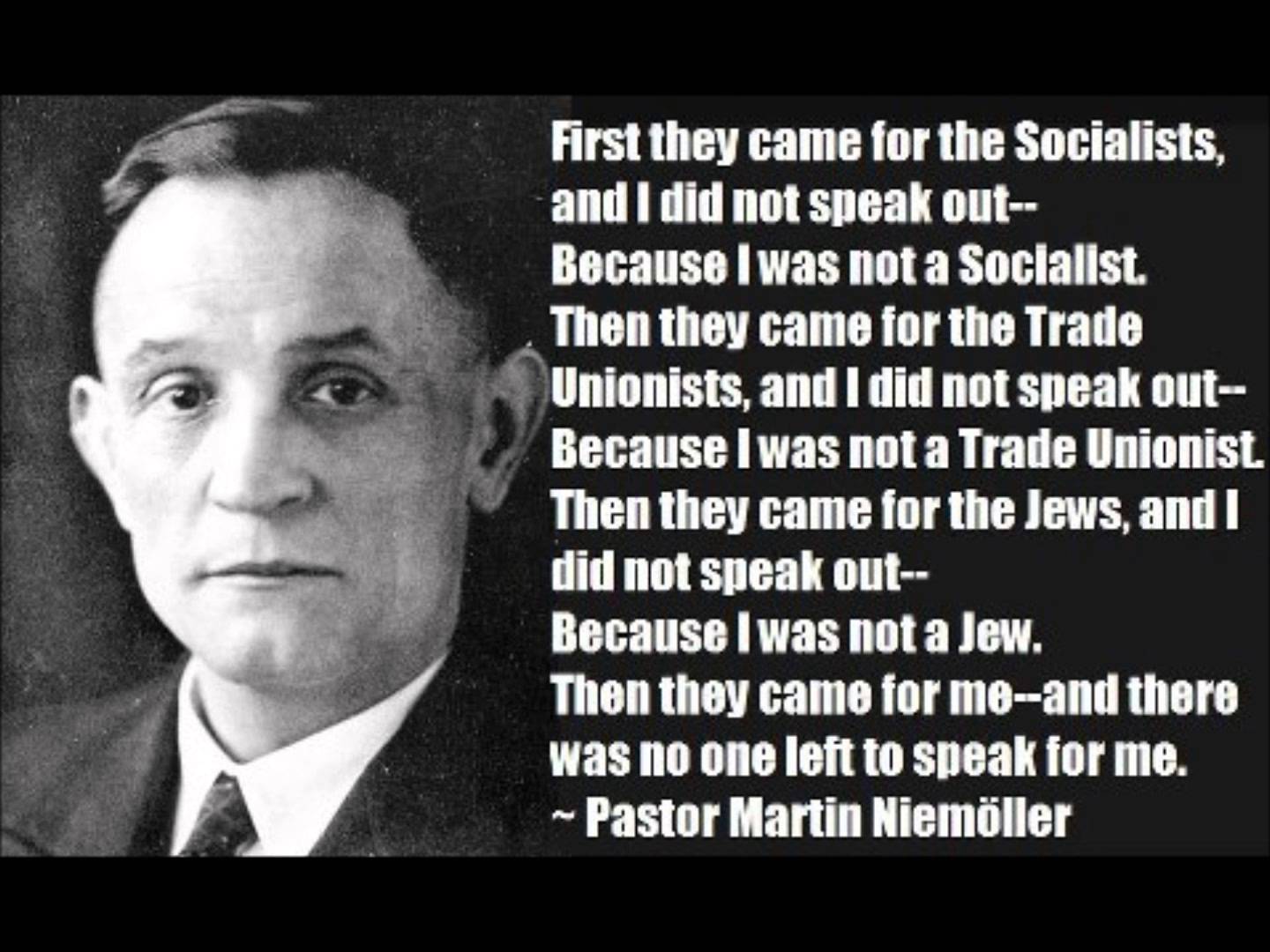
Martin Niemoeller’s words are quoted often and have always inspired me, but until recently they were just a nice philosophical abstraction. Never did I dream they would become an honest to God existential warning for me and my contemporaries living in our blessed democracy. I was wrong.

I learned more about Niemoller last year in a biography about another contemporary clergy of his, in “Bonhoeffer: Pastor, Martyr, Prophet, Spy” by Eric Metaxas‎. It was there I realized even as the storm clouds of Trumpism were gathering that Niemoller’s words were a painful confession of his own failure to act out of Christian compassion to save his sisters and brothers from the Nazis until it was too late for them and for him.

Although he is most famous for the quote above Niemoller was taken in by Hitler along with his fellow Germans. “Niemöller’s sermons reflected his strong nationalist sentiment…. Niemöller believed that Germany needed a strong leader to promote national unity and honor. When Hitler and the National Socialist Party emerged, touting nationalist slogans and advocating autonomy for private worship of the Christian faith, Niemöller voted for the Nazis—both in the 1924 Prussian state elections and in the final national parliamentary elections of March 1933. Hitler espoused the importance of Christianity to German nationality and Christianity’s role in a renewal of national morality and ethics (sound familiar?) leading Niemöller to enthusiastically welcome the Third Reich. Niemöller later confessed that even Hitler’s antisemitism reflected a more extreme version of his own prejudice at that time.” It was only much later after Hitler’s fanatical power was firmly entrenched that Niemoller awoke to the error of his ways and became an active opponent of the Nazi terror. He was imprisoned in several concentration camps for 7 years for his opposition until he was liberated by the Allies at the end of the war. (Above quote and more information available in “Niemoller: A Biography,” http://www.ushmm.org/wlc/en/article.php?ModuleId=10007391).

For good or ill I have tried to avoid public statements about partisan politics in my 40 plus years as a pastor. Call it wisdom or professional survival or cowardice, the truth is that the only two times I am aware of that anyone complained about my ministry to church authorities were two times that I could no longer be quiet about political issues and candidates that I felt strongly were in opposition to Judeo-Christian values and principles. We are now again in one of those “if we are silent the stones will shout out” (Luke 19:40) moments when to paraphrase Lincoln, we are engaged in a great struggle to see if “this nation or any nation so conceived and so dedicated can long endure.” That may sound melodramatic, but I believe it to be true.

I will not be one who regrets not speaking up at this critical juncture of history. The racist, nationalistic, xenophobic rhetoric of Donald Trump and Ted Cruz is too much like that of Hitler to ignore it and hope saner heads will prevail. Trump bragged the other day after his victory in Nevada that he “loves uneducated people.” Of course he does. He is leading a war on critical thinking and shouting down rational, civil discourse verbally and with vulgar, shallow Tweets. His Twitter campaign is brilliant in its strategy. No in depth dialogue can occur when utterances are limited to 140 characters.

A friend and I were discussing in bewilderment yesterday how self-proclaimed Christians can support a candidate who espouses in no uncertain terms blatantly unchristian values. We started listing the values Trump trumpets, and I realized it sounded like a recitation of the 7 Deadly Sins of the Roman Catholic tradition. I double checked the list: greed, lust, wrath, gluttony, pride, envy and sloth/laziness. I’ll give him a pass on the last one, but Mr. Trump certainly seems guilty as sin on the other six. It’s one thing for a secular society to embrace “Greed is Good” as a motto but quite another to allow anger and fear to blind oneself to the crass character of a leading contender to become the most powerful person on the planet. No matter how you feel about any other political or social issue, do you really want someone as volatile and undisciplined as Trump having his finger on the nuclear trigger?

The test for being a Christian is not just claiming the label; it is taking up a cross and following Jesus. As we all make these critical political decisions about the future of our world, let us not confuse what the radical right is peddling with the Christian Gospel. Read the parts of Scripture that say: “Pride goes before destruction and a haughty spirit before a fall” (Proverbs 16:18). “You have heard that it was said, ‘Love your neighbor and hate your enemy.’ But I tell you, love your enemies and pray for those who persecute you” (Matt. 5:43-44). “Those who live by the sword will die by the sword” (Matt. 26:52). “Which commandment is the first of all?” Jesus answered, “The first is, ‘Hear, O Israel: the Lord our God, the Lord is one; you shall love the Lord your God with all your heart, and with all your soul, and with all your mind, and with all your strength.’ The second is this, ‘You shall love your neighbor as yourself.’ There is no other commandment greater than these” (Mark 12:28-31).

These are critical times that call for acts of courage and faith. As tempting as it seems, don’t just seek a “place to hide away” or fail to learn the lessons of history so we are condemned to repeat them. Niemoller waited too long to speak up, but we dare not be silent.

John Wesley for the Supreme Court

John_Wesley_by_George_Romney
It is a sad but expected reality that Justice Scalia’s vacant seat on the Supreme Court has become a political hot potato while it is still warm from his long years of influential service. My appreciation for Scalia has grown immensely since his death as I have read moving stories about his friendships and respect that bridged ideological divides with Justices Ruth Bader Ginsberg and Elena Kagan. Such bipartisanship is an endangered species in our polarized world and needs to be recognized and celebrated. I must confess that I was guilty of stereotyping Justice Scalia based on his conservative and often controversial legal opinions, and I vow to relearn yet again the danger of such narrow thinking.
(Follow this link to read Ginsburg’s tribute to her friend and legal rival: http://www.slate.com/blogs/the_slatest/2016/02/14/read_justice_ruth_bader_ginsburg_s_touching_statement_on_scalia.html, and http://www.cnn.com/2016/02/14/opinions/david-axelrod-surprise-request-from-justice-scalia/ for Scalia’s respect for Justice Kagan.)

Having said that, this unexpected vacancy on the court creates a valuable opportunity in this election year for all of us to learn and grow in our understanding of the importance of the court and the different philosophies represented in the selection process that have tremendous impact on the direction our nation will go moving forward.

I don’t know much about the judges who have been mentioned to fill this vacancy thus far, but it occurred to me that we United Methodists have a great candidate in one of the founders of our denomination, John Wesley. As you can see from his picture he has the wardrobe for the job. The problem of course is that Wesley is not available since he died over 300 years ago. But I would still like to propose that Wesley’s thinking can shed some valuable light on the selection process.

Wesley developed a very useful paradigm for making ethical decisions. Wesley’s quadrilateral, as it is known, lists four sources of input that should be consulted when making ethical decisions: Scripture, Experience, Reason, and Tradition. The balanced model Wesley provides honors the importance of all four components while realizing that they are all created by fallible humans and therefore can be found to be in need of correction by the other three legs of the quadrilateral.

Making ethical decisions with fewer than all four components of the quadrilateral is like sitting at a table that has one leg shorter than the others, and therefore wobbles like a teeter totter every time anyone leans on it.
There are many examples of complex ethical dilemmas that we postmodern 21st century citizens must come to grips with. Laws and traditions that worked in previous generations may no longer be viable when new knowledge provided by reason and experience is factored into the equation. Examples include biomedical decisions, the viability of military force to solve differences in a nuclear age, and attitudes toward people with a different sexual orientation. (I wrote about some of these issues in more detail in a July 22. 2014 post, “Tradition: Only Part of the Formula.”)

“Originalism” or “Textualism” are the labels used to describe Justice Scalia’s approach to the legal system and the Constitution. I am certainly no legal scholar, but my understanding of that philosophy is that it strives to interpret legal questions according to the original intent of the framers of the Constitution. That approach is loaded with biblical and theological implications, and Wesley’s quadrilateral speaks directly to the need to in both law and theology to keep learning and growing in our understanding of justice in the rapidly changing world we live in.

My problem with Originalism is that it seems to argue that a group of wealthy white men who accepted slavery and denied equal rights to women should have the final word on how to live in a democracy today. That’s like trying to live by Levitcal law in the 21st century. The framers of the constitution were men of tremendous vision and courage, but limited as we all are by our cultural and historical context they knew nothing about Aids, Zika, climate change, AR-15’s, black holes and gravitational waves, globalization, or nuclear annihilation, just to name a few. But like Wesley the authors of the Constitution did have the wisdom to know that the laws of the land must be flexible in the face of changing revelations about human nature and the natural order. Realizing the need for reason and experience to make mid-course corrections they made provisions for amending the constitution and did so immediately with the addition of the Bill of Rights.

With the same wisdom Wesley’s inclusion of reason, experience and tradition as necessary qualities for interpreting the Scriptures recognizes the on-going process of revelation. As the United Church of Christ reminds us, “God is still speaking.” Jesus did the same thing when he said repeatedly “You have heard it said…but I say to you…” (Matthew 5:21-48). Without the constant deepening of our understanding of God’s creation and God’s will as both our scientific and theological wisdom increases we would still live in a flat earth society with a vengeful, fearsome God and would celebrate the Sabbath on Saturday.

Does that mean reason and experience represent a straight line of upward progress toward a perfect just and peaceful world? Obviously not. We cannot escape our human fallibility in matters of faith or of law. There is no perfect candidate for the Supreme Court or any other office, but seeking persons who balance respect for our foundational documents, be they Scripture or Constitution, with the value of applying our God-given ability to reason and learn from our experience and past traditions would be my litmus test in the selection proces

Why We Must Render unto Caesar

The water crisis in Flint has been troubling me on many levels for days, but I had one of those ah hah moments about it while listening to any NPR piece in the car today about a related but different issue. I’ve been having a depression inflicted writer’s block for several weeks, and was so glad when this light bulb lit up. I couldn’t wait to get home to write down my thoughts. Sorry church, Sunday’s sermon will be on hold for just a little longer.

The NPR story was about New Jersey’s former governor, Chris Christie, and his political career. Christie is a Republican I had hope for back in the Super Storm Sandy days, and have been dismayed as he has swung to more extreme right-wing views for obvious political reasons. Such views are what sell in our fear-laden society. But I got new insights into the pressures that cause such shifts in political positions and ambitions listening to the radio. (I apologize that I cannot cite the author who was being interviewed, but I believe it was on the “Fresh Air” program, January 25, 2016.)

The author described the great success Christie had early in his term as a Republican governor in a very Democratic state, and his skill at bi-partisan compromise, the very thing that is so sorely needed in government at every level these days. In particular Christie negotiated a deal with public employees that was designed to address the financial crisis in the state employees’ pension funds which had been created by government “borrowing” those funds for other purposes. As a public retiree in Ohio and a Social Security recipient, my ears perked up on that all too familiar and personal topic.

To oversimplify, the agreement was that the public employees agreed to take some cuts to their benefits from the state in exchange for Christie’s promise to put more money into the pension funds to stabilize them. It was lauded as a wonderful, pragmatic, bi-partisan solution that other states and federal governments should emulate. Combined with Christie’s exemplary leadership in the aftermath of Hurricane Sandy in the fall of 2012, his success in New Jersey launched him into the national spotlight as a potential Presidential candidate.

And that’s where personal ambition enters stage right (pun intended). The brilliant solution to the pension crisis was derailed. The public employees kept their end of the bargain, but in order to keep his Christie would have had to raise taxes. That of course is the kiss of death for any one hoping to succeed as a Presidential candidate in the increasingly conservative Republican Party. (Eisenhower, Lincoln, and even Reagan would not recognize the Grand Old Party they proudly represented, but that’s a topic for another day.)

You are probably wondering by now what this has to do with clean water for Flint, Michigan’s 100,000 predominantly black and poor citizens. (And Flint is just the most egregious example of this problem. A school system in Northeastern Ohio is closed today as I write this because of testing for lead in their water system.) These very serious health problems are just symptoms of a much larger crisis facing the American people. They are the tip of an iceberg of crumbling infrastructure that is being ignored while politicians fiddle. Instead of addressing failing bridges, highways, underground sewer and water lines, public transportation, and a host of other critical issues that would create jobs and put people back to work, politicians on both sides of the aisle are held hostage by an ideology that makes raising taxes so we can pay for essential public services an eighth deadly sin.

And in the process we are ignoring one of the real deadly sins, greed, or even promoting it as the private “free” market-driven solution to what are complex public problems. There is no free lunch. Like it or not, we need government to provide essential public services and structures that profit-driven companies cannot provide. And that’s why when asked about paying taxes, Jesus said, “Render unto Caesar what is Caesar’s.” (Mark 12:17, Matthew 22:21) The answer is not to kill government but to reform it and make it work.

Bottom line, companies resent government regulation, but human greed and selfishness require it. Dostoevsky’s famous line from The Brothers Karamazov is applicable here, “If God does not exist all things are permitted.” The same is true without good government. A recent article in The Columbus Dispatch pointed out that the Ohio Department of Natural Resources was charged with developing regulations for the rapidly expanding fracking operations in Ohio in 2014. Nearly two years later they have created one minor regulation and are mired in political and bureaucratic wrangling over any significant attempt to address the potential health risks and dangers of this new technology. So do we throw the baby out with the bath because government is not working well? Or do we find a way to address the gridlock caused by political ambition, unfair gerrymandering of political districts, and fights over voter rights? I didn’t say it would be easy. Nothing worth doing ever is.

The truth is, we don’t have a choice. As appealing as it sounds, we cannot live without government. The streak of selfishness in human nature requires a structure of public responsibility and accountability. No human-created governmental system or structure has ever been or ever will be perfect. Anger and extremism are not the answer. Holding the responsible parties accountable for poisoning the water in Flint or creating earthquakes and contaminated ground water from fracking accountable should be done–but not just for retribution and punishment. The real reason for digging into such messes is not for revenge or political advantage, but to learn from our mistakes so we don’t make them again.

To play the blame game and demonize our political opponents simply makes the necessary work of bipartisan, collaborative communication more difficult once the much-too-long season of mud-slinging and character assassination is over. That’s why Benjamin Franklin said, “We must all hang together or we will certainly hang separately.” And it’s why Jesus said, to paraphrase, “I didn’t say you had to like it, but taxes are a necessary evil to maintain a workable society. So pay up and realize that to solve this country’s problems and the world’s is not going to be cheap. But ignoring them is not a viable option.”

The Unbroken Circle of Life II

IMG_1150 I have rarely reposted a previous blog here, but in searching for some inner wisdom to cope with life today I was drawn to one I wrote just 3 months ago in October of 2015. It still sounds good and maybe even more relevant now than it did then; so it is copied as written below. My only additional preface is a comment I made in my journal recently as 2016 has gotten off to a bumpy start for me, my family, and the world: “The cycle of life keeps turning and there are no stations to get off till you get to the terminal.”

Will the Circle Be Unbroken?
I attended a Bluegrass Festival with some friends a few weeks ago and have been singing or humming “May the Circle Be Unbroken” ever since. Bluegrass is not my music of choice; so I’ve been pondering why that song has stuck in my head. There are good memories of singing that song around campfires when I was a youth minister many years ago. But it has taken on a deeper more pervasive meaning lately. Some of that became clearer to me this week after a depressing visit with my 94 year old father who has outlived his mental and physical faculties and is miserable. Is there a better day coming for him and his wife suffering from dementia?

I don’t think it’s in the sky but where? What? How? Those questions become more relevant as morality pounds harder on my door each day, in aches and pains, friends in surgery, cancer diagnoses and biopsies, longer list of things I can no longer do. I’ve toyed with the lyrics of that song by changing the “e” to an “i” in “better,” i.e., “There’s a bitter day a coming….” That’s what happens when we turn in on ourselves, we get bitter and go victim. “Why me?” “It’s not fair!” “Why didn’t I take better care of myself?” “Let’s try one more miracle supplement that flows out of the fountain of youth!” Fear springs from the unknown “in the sky” or in some place of darkness, from regrets over a lifetime of sin or just dumb mistakes we can never erase.

Fear is epidemic in our society. I was at a wedding reception recently where I was told one of the men at my table was carrying a concealed weapon “because you never know what might happen.” The next week my relatives at a family gathering were discussing preparedness drills for an active shooter at their little country church and in their schools where children are being taught to throw anything they can find at a shooter ala David versus Goliath–only Goliath didn’t have his NRA sanctioned AR 15.

A father was shot dead last Friday in front of his six kids and wife in a burglary in our affluent “safe” suburb. And today Ted Koppel was on the morning news talking about his new book Lights Out, about the coming cyber-attack that will paralyze our society. The temptation to buy some guns and a generator and become a survivalist is so strong even I feel it tugging at me. There is a little solace for me that I’m old enough I may not have to deal with the worst of the Hunger Games scenario, but I fear for my kids and grandkids and feel hopeless and helpless to do anything significant to help them.

Will the circle be unbroken? Or has human depravity and selfishness reached epic proportions that strain the bonds of civility beyond the breaking point? Is Jesus’ pacifist advice to turn the other cheek and put away our swords just naïve idealism? Those are not verses that fearful Christians cite when they turn to Scripture for comfort. I quoted Isaiah (2:4) and Micah (4:3) once to a life-long Christian, the verses about “beating our swords into plowshares and our spears into pruning hooks,” and she said that in 60 years of going to church she didn’t remember ever hearing those words! Unless prophetic voices stand up to the fear mongers and proclaim a message of hope and reason to a world gone mad, the circle may indeed be broken.

I remember being this depressed about the state of the world back in 1972 after Nixon’s landslide victory in spite of Watergate and the protests about the Vietnam War. I wrote a letter to the editor saying that all we could do now was “wait for the inevitable judgment of God.” 43 years later we are still here. We’ve survived that war in SE Asia, the resignation of Nixon and his Vice President, 9/11 and a host of other terrorist attacks, too many mass shootings to count, a huge economic recession, and at least so far several ill-advised wars in the Middle East that have only fanned the flame of hatred in that cauldron of religious and ideological conflict that is the eternal flame of human strife and animosity.

The circle is frayed and contorted out of shape, but it is still unbroken; and that last paragraph is a micro-second in the eternity of the cosmic circle viewed from God’s perspective. As we scroll backward in time through Holocaust, Civil War, Slavery, Genocide of native people, the Dark Ages, the Crusades, Roman, Greek, Syrian, Egyptian, Ottoman Empires, the rise and fall of numerous Dynasties in China and Japan, Exile and Exodus, Stone Age and Ice Ages, and all the other eras of our planet’s history that I missed in history class, our current fears and woes are put in better perspective.

In every generation there have been concerns about the elasticity and tenacity of the circle, and it is still unbroken. That is not an excuse to blithely bury our heads in the sand or in our parochial platitudes. We must counter the fear mongers with words and lives of hope and visions of peace in any way we can. And remembering the great circle maker and sustainer gives us the courage to witness to our faith even when fear and doubt threaten to overwhelm us.

[originally written October 27, 2015]

THE PERSISTENT PRINCESS OF PEACE

As the season of Christmas continues into a new year, my hope for the birth again of God’s messengers of peace in unexpected times and places, even here and now, lives on in spite of all the bad news 2015 has been able to muster. And to that end I share a short story I wrote years ago and included in my book, Building Peace from the Inside Out.

“Blessed are the Peacemakers, for they shall be called Children of God.” Matthew 5:9

Sally was sitting next to the window over the left wing of a 737. The lights of the city would have been pretty as they left O’Hare, but a snowstorm was brewing and the clouds quickly engulfed the plane. Sally was going to spend Christmas with her grandmother in Richmond, Virginia. She was a little scared. She was 14, and this was her first flight by herself. In her nervousness, she had neglected to use the restroom at the airport; so as soon as the seatbelt light went out, she was out of her seat.

In her haste Sally bumped against the brief case of the man in the aisle seat, knocking it off his lap. She reached down politely to pick it up for him, but he grabbed it quickly and gruffly warned her to be more careful. When Sally returned from the restroom she apologized again for the brief case incident. She tried to strike up a conversation with her seat mate. He was in no mood to talk. Sally put her IPod headphones on and turned to the window. There was nothing out there in the darkness but one blinking red light, way out on the end of the wing. Sally thought it was bouncing up and down way too much.

“What makes grownups so darn grumpy, especially at Christmas?” she wondered. But her thoughts were rudely interrupted by an explosion in the rear of the plane. They began to lose altitude rapidly. Everyone panicked and screamed. NO one heard the captain’s voice over the P.A. system urging everyone to “please remain calm.”
The next thing Sally remembered was coming to in a snow covered field. She was 300 yards from the flaming wreckage of the plane. She seemed to be OK except for some cuts and bruises. The man who had been sitting next to her was a few yards away. He was badly hurt and calling for help. Sally was tempted to ignore him but knew she couldn’t. He was barely able to talk, but Sally understood that he was still concerned about his brief case. Wondering what could possibly so important about that stupid brief case; she half-heartedly began to look for it as she searched the area for other survivors. The fire was too intense to get close to the plane. She saw no other signs of life.

Sally found a briefcase. She took it back to the man, but it was the wrong one. She was about to just leave and go for help, but the man pleaded with her. He was desperate. So she looked again. This time she found the briefcase under a piece of the fuselage. She took it to the man, and he motioned for her to bend down so she could hear him. He said he had a very important letter that had to get to Washington. He stressed how urgent it was, begging her to promise him she would see that was delivered. He fell back unconscious before she had time to respond. She took the letter and put it in her coat pocket, half wondering if he was on the level.

Ambulances came. Sally was taken to a hospital where she learned she was in Bellefontaine, Ohio. Her cuts were cleaned and bandaged. The doctors said she had suffered a mild concussion. The next morning she remembered the letter. It was still in her coat pocket. Sally decided she would try and find the man before she opened it. When she asked about him, the nurses told her there were only two other survivors. They were both women.

Back in her room, Sally opened the letter. It was a very official looking dispatch from the CIA in Los Angeles, warning the President about a plot to assassinate several foreign heads of state when they visited Camp David for a summit conference after Christmas. If the assassins were not stopped the possibilities for starting World War III were staggering. Sally was overwhelmed. She didn’t know what to do. She wasn’t sure who she could trust. If the letter fell into the wrong hands…. She wasn’t sure what might happen. But she did know that she had been charged with delivering it, and she would.

Sally asked the nurses when she could leave the hospital. She discovered that because she was a minor, they would not release her without parental consent. Sally tried in vain to convince the charge nurse that she had to leave. Seeing that was hopeless, she simply went back to her room, got dressed and left after the night shift came on duty.

Sally’s cell phone had a GPS on it that would have been really helpful had she not lost it in the crash. So resorting to older technology, she picked up a map at a convenience store. She discovered she was 60 miles from Columbus, the state capital. There must be an airport there, right? She had also lost her purse and had no money; so she decided to hitch a ride. Being young and attractive, she didn’t have to wait long for a ride. She was really glad to get out of the sub-freezing weather when a man in a Beamer stopped for her. She would have been more comfortable with a woman or a couple but was in no position to be picky.

The man seemed friendly enough. In fact he had ideas of being a lot friendlier than Sally wanted. A few miles down the highway, he turned off on a county road and tried to force himself on her. Sally resisted so fiercely that he finally just slapped her hard across the face, called her a bitch, and pushed her out into the cold. Sally didn’t mind at all. She was just glad to be rid of him.

Two hours later, nearly frozen from wandering in a blinding snow storm, she saw car lights coming toward her. She flagged the car down and discovered it was a sheriff’s deputy. The deputy, of course, wanted to know what Sally was doing there. She told him that she needed to get to Columbus. He insisted on taking her to the hospital to make sure she was OK. She protested but to no avail.

Sally didn’t realize she had gone far enough to be in different county. She was relieved to discover that she was not going back to Bellefontaine, but to another town called Marysville. The ER staff there treated her for frostbite and gave her a good meal. They could not understand why she was in such a hurry to be on her way. Sally tried making up a story about a sick uncle in Columbus who needed her. Didn’t fly. Finally, she decided she would just have to tell them the truth. She did. They laughed. So, reluctantly, she decided she had no choice but to show them the letter. That would convince them. But the letter was gone. It had fallen out of her pocket somewhere in the snow.

Sally began to feel trapped. The trauma of the crash, the cold, the exhaustion—all began to get to her. She had to get that message to Washington. The peace of the world depended on her, and these stupid people wouldn’t even listen to her. She began to scream at them hysterically.

The next morning, Sally woke up staring at the cold, barren walls of a Columbus psychiatric hospital. She was confused and scared. She tried the door to her room. It was locked. She pounded on the door. No one came. She was about to cry when she suddenly became aware of another person in the room. Sally had not noticed her roommate sleeping in the other bed—an African American girl, about Sally’s age. The sign on bed said “Paula.” As soon as she was fully awake, Paula gave Sally some very important advice: “Hey, girlfriend. You keep that up and they’ll put you on the back ward for keeps. You gotta play it cool if you ever want out of here.”

Sally was still frightened, but she recognized the truth in Paula’s words. Sally told her story to Paula. For the first time she found someone who believed her. Paula suggested that Sally try to call Washington; since there was no way of knowing how long they might keep her here. Paula told Sally she would show her where there was a pay phone when they went down to the dining room for breakfast.

Paula introduced Sally to some of her friends at breakfast, and Sally began to feel a little less scared and alone. But her frustration soon returned. When she tried to make her call, an attendant pulled rank on her—said she had an important call to make. And the attendant was still there talking when it was time for the patents to go back on the ward. Sally tried to convince the nurses to let her go back down that morning, or to let her use the phone in the nurse’s office. They refused. They laughed at her and said they were sure the president could wait until lunch time to talk to her.

Sally was about to lose her temper again, but Paula managed to calm her down. They spent the morning talking. Sally was surprised how quickly the time passed. After lunch she hurried back to the phone. She got as far as a White House operator who dismissed her as a crank call. She tried the local FBI office—same response.
Sally was ready to give up. She was beginning to question her own sanity. But Paula had been hard at work. She figured Sally would have a better chance if she could get to D.C. in person. Sally agreed but had no hope of making it in time. Paula did. She got the nurse to let Sally go with her to Occupational Therapy that afternoon. Paula told Sally what she had planned. They had to go outside to get to OT. Paula said she would distract the attendant so Sally could slip away. Sally begged Paula not to do anything foolish. Paula gave her the address of a friend who would help her get to the airport.

There was not time for further discussion. The only good-bye and thank you Sally could give Paula was a squeeze of her hand as they walked downstairs. As soon as they were outside, Paula screamed and took off running. The attendant went after her. Sally froze. She wanted to know what was going to happen to Paula. But one of the other patients knew what the plan was. She gave sally a friendly shove and told her to get going while she could.
Sally left reluctantly, trying to look as nonchalant as possible as she walked toward where Paula had told her the front gate was. She was still worried about Paula. She was also amazed at the lack of security. There were no guards, just as Paula had promised. Sally got on a city bus, trying hard to act calm. She knew for sure that everyone would recognize her as an escaped mental patient—even though she didn’t look a bit different than two days before—it seemed like two years—when she left Chicago.

The bus driver told her where to change buses to get to the address Paula had given her. It was in the University district, which was nearly deserted during Christmas break. Sally had forgotten all about Christmas. She found the apartment on 11th Avenue. It was in a run-down neighborhood, and Sally was uneasy. It seemed to be getting dark awfully early, but then she had lost all sense of what time it was. A huge African American man answered the door. He was about half drunk and Sally started to leave. But then a much friendlier face appeared.

As soon as Sally mentioned Paula’s name, Billy, the sober one, invited her in and asked what he could do to help. Sally told him her story. Billy agreed it did sound far-fetched. But like Paula, he sensed something in Sally’s eyes and her voice that made him trust her, in spite of his doubts. In a matter of minutes, Billy called the airport and Sally booked on a flight leaving for Reagan National in two hours. He said he knew someone who worked for United Airlines who pulled some strings for him. Otherwise things were all booked up with Christmas travelers.

After sharing some warmed-over pizza, Billy drove Sally to Port Columbus in his ’92 Cavalier. It was better than walking, but not much. Billy’s friend, Tracy, met them and produced a one-way ticket under an assumed name since Sally was not a fugitive in 3 counties. Tracy also used her airport ID to get Sally around the security check point. Billy slipped her a little cash to live on when she got there. Sally promised she would come back and repay him when she could. She was also hoping to see Paula again.

This flight was uneventful. Sally relived the nightmare of the last two days. For the first time since the crash she thought about her parents and her grandmother. They would be worried sick! But there was nothing she could do about that now. She would call them as soon as her unbelievable mission was over. And then she fell into a deep sleep of exhaustion.

Sally woke up as the plane was on its final descent over the Potomac. For a scary minute she thought they were going to land in the river and said a little prayer of appreciation when the wheels touched down safely on the other side. She was in Washington at last—exactly 48 hours later than her original flight should have been…. But that was all past now. She was here. Surely somebody here would listen to her. They just had to.

Fear of Knowledge?

I usually enjoy seeing news about my home town, but not today. An article in the Columbus Dispatch via the Dayton Daily News caught my eye today when I saw “Wapakoneta” in the headline. Wapak, as the natives call it, is a small county-seat town in Northwest Ohio where I graduated from high school 50 years ago. The headline brought home to me literally how insidious Islamophobia is affecting not only our present world crisis but future generations as well.

The story reported that 21 7th-graders in Wapak are boycotting history lessons that include Islam. (Note: I have since learned from the editor of the Wapakoneta Daily News that the official number of students according to the School Superintendent is 10; so I want to share that bit of good news.) In particular they are opting out of one of 21 sections in their world history class that focuses on Islamic civilization from A.D. 500-1600. The good news is that world history is part of curriculum. It certainly wasn’t when I was a student there. For us history didn’t begin until Columbus “discovered” America in 1492.

According to the news article “Ohio’s state learning standards call for study of numerous civilizations and empires, and the impact of Christianity, Islam and other religions on history.” The section in question “focuses on the impact of Islamic civilization as it spread throughout most of the Mediterranean in the period following the fall of Rome and its later impact on the European Renaissance. Attention is paid to achievements in medicine, science, mathematics and geography.”

The bad news is that “the school policy that allows the Wapakoneta students to opt out is shared in some form by hundreds of other school districts statewide.” The policy does not allow students to opt out of entire classes, just certain sections if “after careful, personal review of the lesson and materials a parent determines that it conflicts with their religious beliefs or value system.” Maybe some of these 21 students have parents who know enough about Islam to make a careful review of this material, but I’m betting most of them only know what Donald Trump and Fox News have told them about these people who comprise 1 billion members of the human race.

I get the fear caused by recent world events, but even if we have reason to fear a designated “enemy,” doesn’t it make sense to know as much about them as we can. The impact of Islam on the European Renaissance has direct influence on our history in this country. Their story is part of our story, and if we fail to understand our history we are indeed condemned to repeat it. Like it or not we live in a multicultural international community. People who are different from us are literally our neighbors here and around the world.

The alma mater of Wapak High School has a phrase that sounds way off key to my ears today. It says, “Hail to thee dear Alma Mater, temple reared by God’s own hand.” I’m sure the author of those words many decades ago had only the Christian God in mind as the builder of said temple of learning. The God of the entire universe I know is weeping for those 21 students and everyone else who is being robbed of a chance to better understand the world we live in by fear and ignorance.

The final paragraph of the Columbus Dispatch article is especially poignant. It quotes the state’s seventh-grade history standard on civic skills which makes a case against opting out of lessons like this. It reads, “Skills in accessing and analyzing information are essential for citizens in a democracy. The ability to understand individual and group perspectives is essential to analyzing historic and contemporary issues.”

The American democratic experiment is founded on an informed citizenry, and ignoring important aspects of world and American history because we are afraid of what we might learn reminds me of the old adage, “Don’t confuse me with the facts. My mind is already made up.” Saddest of all is what these students are being taught, not by the schools, but by parents who are passing on their own fears and biases to their children.

This situation reminded me of a great song that I first heard at Wapak High over 50 years ago when our high school chorus performed Rodgers and Hammerstein’s great musical “South Pacific.” The song “Carefully Taught” in that show is about how people learn their prejudices. It’s long before we get to formal education. One line of that song says it so well, “You’ve got to be taught before it’s too late, before you are six or seven or eight, to hate all the people your relatives hate, You’ve got to be carefully taught!” (I wrote a full article on that topic last year entitled “Life Lessons I Didn’t Learn in Class,” posted February 24, 2014).

Fear of people and things outside our comfort zone is a learned behavior. Innocent children don’t come into the world with preconceived notions. We learn subtly or directly to label differences as “other” instead of understanding and appreciating the basic human needs and desires that make us part of one common species. I love it whenever I see the suggestion about how to answer the question we get on medical forms and other documents that asks for “race”? The answer that is never one of the choices is the one that really matters, and it is “human.”
All of us share the same basic needs for love and acceptance, for food and water and shelter, for clean air to breath, for a sense of security and safety. Maslow’s hierarchy of needs knows no ethnic or ideological distinctions. When we isolate ourselves from “others” geographically, socially, economically, and even by refusal to study our common history, those needs and commonalities are obscured by fear, ignorance and bigotry. Fear of violence is understandable. Fear of knowledge is tragic.

I became aware just recently of the peacemaking work of a fellow Ohio native, Marshall Rosenberg, a psychologist who died earlier this year. He was the creator of Nonviolent Communication, a communication process that helps people to exchange the information necessary to resolve conflicts and differences peacefully. One of the tenets of non-violent communication is that humans act out of unmet needs. So one of the first steps toward understanding our own behavior or that of others is to ask what unmet needs we may have. (I would add especially in this season of hectic holiday consumerism, these are real needs, not desires created by clever marketing or peer pressure.)

One of Rosenberg’s insights that speak so clearly to our current world situation is that “violence is the tragic expression of unmet needs.” That is not easy to remember when we are afraid for ourselves or others, but it is critical because it is hitting the pause button on our natural flight or fight emotions long enough to put ourselves in the place of another and ask what unmet needs that person has that might explain his or her actions. That understanding is what makes compassion possible in interpersonal and international relationships. And it is only possible when we take time to know about and understand others. That happens in multiple ways, from really listening to each other to cultural competence that comes from taking the time to learn about the history and customs and beliefs of our fellow travelers on spaceship earth.

That’s the way to unlearn those hurtful, dangerous things we were “carefully taught…. before we were six or seven or eight.” Those prejudices and fears passed on from one generation to the next by well-meaning but uninformed people. We can learn and change and grow, but not if we are afraid of knowledge and are AWOL from class.

Peace that Passes All Understanding

So many competing emotions in Advent 2015! Consumerism has almost ruined the holiday season for me in a “normal” year, but the epidemic of fear fed by the recent wave of terrorist attacks makes it especially challenging and necessary for me to dig deep and find the bedrock of faith and gratitude in 2015.

I struggled for days with what, if anything, to say about the attacks in Paris on November 13, partly because so much has already been said, both wise and foolish, but mostly because I have been very depressed about the state of the world and not sure what to say that can make any contribution. I finally gave up and said nothing.

That Friday the 13th for me was a metaphor for the tug of war between hope and fear. One of our beautiful grandchildren spent that day at our house. I’m very biased, of course, but little things she did that day made my papa pride swell for what a sweet, caring, smart little girl she is.

Shortly after I took her home I heard the first reports about the attacks in Paris on a TV in a fast food restaurant. Unlike 9/11 when the world stopped to watch the horror unfold, I seemed to be the only one in the McDonald’s paying any attention to the news. Everyone else was chatting and carrying on as usual because these kinds of events have become chillingly commonplace.

That evening I went to a meeting to watch a film entitled “Climate Refugees,” which in painful detail describes how millions of people have been driven from their homes by storms, floods and draughts related to climate change. The whole film, which was made long before the current refugee crisis in Europe, was alarming, but one segment especially so given the chaos in Paris that very evening. That segment talked about how desperate, frightened refugees are easy prey for sex traffickers and terrorist organizations looking for new recruits. I was so overwhelmed by the scope of the problem that I couldn’t bring myself to stay for the discussion after the film.

The level and frequency of violence in our world since then has shaken the foundations of my faith. I am questioning my long-held belief in humans being created in the image of God. I am afraid for my family and for the future of the planet. And my first reaction to that fear and anger was to join the chorus of politicians who want to bomb our way out of the ISIS problem and arm ourselves and close our borders. I know better, but it scares me even more that some of our “leaders” or wannabes don’t. Instead they see these tragedies as an opportunity to sell more guns and generate more fear and fan the flames of their own political fortunes with abhorrent ideas borrowed from Hitler’s playbook.

On the bright side there have been wonderful statements of faith and hope from those with a greater understanding of human history and a better vision of human potential. One of those reminded me that love is ultimately the victor over hate. I believe that’s true in the long run, but for now hate has a big lead and the clock is ticking.

The paragraphs above were written during Thanksgiving week, and wisely, I believe, I chose not to share them then because they felt too hopeless and negative. Then yesterday came news of the biggest U.S. mass shooting since Sandy Hook. I was still wrestling with depression and feared this latest killing spree would only deepen my despair. Much to my surprise I am not as pessimistic 24 hours after San Bernardino as I have been for 2.5 weeks. I am very sad and determined to do more to be the solution to the dis-ease strangling our nation and world. But I am not depressed, and that feels very strange.

On the one hand I feel a bit guilty for not being discouraged, and on the other I am afraid to analyze my hopeful feeling for fear I will awaken from a dream and it will be gone. But unlike Ebby Calvin “Nuke” LaLoosh in my favorite baseball movie “Bull Durham,” I am cursed with self-awareness. And most days that’s a good thing – and today is one of those.

I had noticed ironically yesterday that the last thing I posted in this blog was a piece about being “content in whatever state I am in” based on the words of St. Paul in Philippians 4. I posted that 4 days before the Paris terrorist attacks. How quickly I forgot those words to live by when the chips were down.

But tonight, several mass shootings later, some other words from that same 4th chapter popped into my awareness as I was pondering why I was not as depressed by these latest killings much closer to home. In particular verse 7 came to mind, and I had a warm feeling because what had been just words and ideas 3 weeks ago was actually a reality for me. I was experiencing the “peace that passes all understanding,” and it was very good.

So I revisited Philippians 4, and here’s the context for verse 7: “Rejoice in the Lord always; again I will say, Rejoice. 5Let your gentleness be known to everyone. The Lord is near. 6Do not worry about anything, but in everything by prayer and supplication with thanksgiving let your requests be made known to God. 7And the peace of God, which surpasses all understanding, will guard your hearts and your minds in Christ Jesus. 8 Finally, beloved, whatever is true, whatever is honorable, whatever is just, whatever is pure, whatever is pleasing, whatever is commendable, if there is any excellence and if there is anything worthy of praise, think about these things. 9Keep on doing the things that you have learned and received and heard and seen in me, and the God of peace will be with you.”

How relevant and practical those old words are for this particular Advent. Rejoice, in spite of our fear. Be gentle to everyone, including ourselves. Know that Emmanuel (“God with Us”) is near. Replace worry with prayer and supplication and thanksgiving. Prayer is not enough in our struggle with death and destruction and violence, but it is the foundation, the source of strength that sustains us when “our arms are too weary” to be carriers of hope to a frightened world.

And Paul gives attitude adjustment advice better than the best self-help guru. He says to focus on what is good and true and excellent and worthy of praise. Because even in the dark days of Advent 2015 there is much goodness in the world. We may just have to work a little harder to find it, but it is more necessary than ever to find it and share it.

One such image for me that is stronger than the non-stop horrific news coverage from California is that of a simple gesture by my granddaughter that Friday the 13th. She came down to my office that morning with two juice boxes in her hands that she had gotten from the lunch box she brought with her. When I asked her if she was going to drink them both she said, “No, this one’s for you.” A simple pure act of caring and sharing, unprompted and natural. It was the best juice box I’ve tasted in a long time!

She was doing in her six-year-old way what the final advice is in that passage from Paul. It says, “Keep on doing the things that you have learned and received and heard in me, and the peace of God will be with you.” Don’t abandon the ways of love and peace. Don’t fall into the temptation to fight fire with fire. Be forgiving and compassionate, even when those things make no sense and seem impossible. There is no peace in following the ways of King Herod, another mass murderer. The peace of God came “not with swords loud clashing, nor roll of stirring drum, but with deeds of love and mercy” in a helpless refugee child born in a barn.

No matter how loud our leaders and our hearts want to shout fear and hate, the still small voice of God says, “Fear not, I am still bringing you good news of great joy.” Don’t miss it!