Prayer for the Human Family

As my regular readers know I have strong political opinions about the current situation in Washington and its repercussions around the world. I strive to make sure those opinions are theologically grounded. After prayerful consideration of the crisis over immigration policy that has unfolded over the weekend I have decided to offer a prayer for unity and compassion for everyone involved rather than add to the often polarizing debate about political positions and constitutional interpretation. The inspiration for this prayer comes from my understanding of Judeo-Christian Scripture but also from a very secular source.

That secular source is from a marketing slogan used by one of my favorite breakfast restaurants, Bob Evans. (Full disclosure note: My son is a V-P in marketing for Bob Evans, but I would like this slogan regardless of family ties.) Our church has been doing a sermon series on myths and sayings that aren’t in the Bible, and I’d like to propose that this one could very well be. The slogan which is on the walls of many of Bob’s restaurants is this: “We treat strangers like friends and friends like family.”

Dear God, creator and sustainer of all creation, God of radical hospitality, you have taught us in Scripture and through Christ and faithful Jesus followers to be people of love. You warn us that it is not enough to love those who love us back, but to love even our enemies and those who persecute us. You have instructed us via prophets and parables all the way back to Leviticus to love our neighbors as ourselves. But we often forget that love of neighbor extends to all the Samaritans and Syrians and Somalis longing to be free.

Forgive us when we forget that your inclusive love requires us to welcome dialogue with our political foes and to enter into those conversations with open minds free from judgment about the motives of others. Help us temper our zeal for justice with open ears that can hear the concerns and fears of those we disagree with. Help us to lower the decibel level of the discourse as we strive to treat others with the same respect we want for ourselves and those we advocate for. Forgive us when we are more concerned with being right than reaching peaceful solutions to complex problems. Gently remind us when we are more determined to win an argument than to know the truth.

Teach us your patience, Lord, and remind us to double and triple check our facts before we post or tweet or share any information that may be counterproductive to the ultimate cause of peace and justice for all of your children. Give us minds that thirst for truth and learn from history, to see the many logs in our own eyes before we judge others about the specks in theirs. We have much in our American history for which we need to repent, O God of mercy. You know us better than we know ourselves. Grant us the courage to search the depths of our own sin. Remind us of our own shameful record of injustice against people of color, women, and our LGBT sisters and brothers. Send your Spirit to help us not be shamed by guilt but to benefit from our past transgressions and from those of others so we can learn and grow in our faith from this political crisis.

Touch our hearts O God in ways that empower us to live up to your high expectations for us. May your Spirit burn within us with a compassion for families that are separated, for students and business travelers stranded in foreign lands, for everyone who fears for their uncertain future. Let us not become so embroiled in the political struggles of our own nation that we surrender to 24/7 news fatigue. Do not let us lose sight of the fact that millions of human lives are at stake and will be impacted by our own action or lack thereof. Do not let us belittle our own significance with a false humility that can silence the voices of the many crying in the wilderness. Do not cease to remind us that we are to treat the stranger in our midst as we would treat our own family and friends, that radical hospitality is not an unreachable ideal or a clever marketing slogan but Gospel Truth.

Lord, there is much fear consuming our nation and world. There is fear for safety and security, fear of political impotence and fear of excessive power. Help us acknowledge and face all those fears with the confidence of your children who know that only perfect love casts out fear. You are the unshakable foundation of our faith and the only true source of perfect love. Without you we cannot imagine how the overwhelming crises of our world can be resolved. But you are the God of exodus and exile, of crucifixion and resurrection. No political crisis has ever silenced your voice. In the tumult and chaos of protests and partisanship, whisper again to us the assurance once more that neither powers nor principalities, death nor life, nor anything else in all creation will ever separate us from your love. Thanks be to God.

A Requiem for Truth?

Every pastor has had one or more difficult funerals to preach where it is hard to find something good to say about the deceased. As we bury 2016 that’s how I’m feeling. So many celebrity deaths, so much death in Aleppo and the Sudan, in Orlando and Brussels and Berlin that we are in danger of becoming numb to grief as a survival mechanism. While Prince and Princess Leia made the headlines, there was another casualty last year of greater magnitude than all of the other losses combined, and we are in grave danger of that death causing a plague that could bring about the demise of democracy in the U.S.

I’m talking about “truth.” The date of death is unclear because truth died a slow death by inches as 2016 progressed (or regressed). It may have been on November 8 or early on the 9th, or maybe Truth was taken off life support on December 19 by the Electoral College.

Saturday Night Live was one of first to recognize it on November 12 with a brilliant tribute to Leonard Cohen who died that week with Kate McKinnon’s mournful singing of “Hallelujah.” There’s a multitude of things the exegesis of that song could include, but the phrase that refuses to let go of me is “Love is not a victory march; it’s a cold and broken Hallelujah.” At the end of the song McKinnon, speaking both for herself and the character she portrayed during the election campaign, looked into the camera and said, “I’m not done fighting and neither should you.”

Perhaps like Mark Twain the reports of Truth’s demise are greatly exaggerated. As a pastor I said all the right words during the Advent season about hope, and light shining in the darkness, even as my heart was breaking for my country and for those who were so blinded by their fear and anger that they watched Truth die and didn’t raise a finger to help.

The Gospel of John (8:31-32) addresses Truth this way: “Then Jesus said to the Jews who had believed in him, “If you continue in my word, you are truly my disciples; 32 and you will know the truth, and the truth will make you free.” Truth will set you free? Free from what, sin? Free from false religiosity? If we read further in that chapter we find that Jesus leaves the temple at the end of John 8 – not just physically but spiritually. He shakes the dust off his feet and walks away from liars who cannot handle the truth of his Messiahship.

There’s been a lot of talk in the political arena about conflict of interests, and it’s a bipartisan issue. It includes not only the President Elect and his cabinet nominees, questions about the Clinton Foundation, and a Democratic Governor Elect, Jim Justice, the richest man in the state with deep investments in the coal and gas industry just to name a few. But there is also a huge issue of conflicts of interest for clergy and other faith leaders. We are called to perform both priestly and pastoral functions, to do the impossible job of simultaneously comforting the afflicted while afflicting the comfortable with words and actions that speak truth to ecclesiastical and secular power in the name of God’s reign of justice. In some situations speaking truth may set a faith leader free from a paycheck, a parsonage, and a pension or even from life itself. The reason that calls to ministry require such courage and faith are seen comfortably from a distance in the early Christian martyrs, but when more recent prophets like Martin Luther King Jr. and Dietrich Bonhoeffer come to mind the cost of discipleship and truth become much more challenging. We don’t like to be reminded that the same word in Greek is translated as both “witness” and “martyr.” As we celebrate his birthday this weekend there is no more fitting or powerful tribute to the power of Truth than Dr. King’s “Free at last, free at last. Thank God Almighty, I’m free at last.”

I also find hope for Truth in the young. We often hear Isaiah’s words at Christmas that “a little child shall lead them” and apply them to Jesus. But there’s another child in the Christmas story, and without her courage and faith the story would be drastically different. Mary the mother of Jesus was just a teen when she accepted God’s outlandish news about her impending pregnancy. And once the unbelievable news is confirmed by the witness of her kinswoman Elizabeth, it is in the mouth of this innocent youth that Luke puts the powerful words of truth we have come to know as the Magnificat: “God has shown strength with his arm; he has scattered the proud in the thoughts of their hearts. He has brought down the powerful from their thrones, and lifted up the lowly; he has filled the hungry with good things, and sent the rich away empty. He has helped his servant Israel, in remembrance of his mercy, according to the promise he made to our ancestors, to Abraham and to his descendants forever.” (Luke 1:51-55)

That is Truth, and it is ignored at great peril by those in power who fail to heed its warning. It is ignored at great peril by Christians who focus their attention only on the cross and resurrection and ignore the prophetic teachings and actions of Jesus that got him crucified.

Everyone knows churches are packed on Christmas and Easter and much less so the other 50 Sundays of the year. That is unfortunate for many reasons, but the one that bothers me the most is that C & E Christians miss out on the whole truth of the Gospel that can truly set us free from the idolatries of worldly materialism and the refusal to face the truth of our individual and corporate sins. People who hear only the stories of Easter and Christmas either consciously or not skip the passion and just show up for the resurrection – celebrate the birth of sweet little Jesus boy, and then drop out for the rest of the story about the slaughter of innocents, and the flight into Egypt to avoid the assassins of truth. (Read or reread the rest of the Christmas story in Matthew 2:7-18.)
And it’s not just an old story but one that is as relevant as today’s headlines. The Magi today would show up at Trump Tower, and God knows we don’t need more gold there. We worship false gods of power like those of King Herod when we threaten to restart the nuclear arms race. Sure making more weapons of death is good for Wall Street, but at what cost? Over 50 years ago a Republican President and World War II hero warned us about the death-dealing military-industrial complex: “In the councils of government, we must guard against the acquisition of unwarranted influence, whether sought or unsought, by the military-industrial complex. The potential for the disastrous rise of misplaced power exists and will persist.” Dwight D. Eisenhower.

It’s not easy but we must search hard for hope in the ashes of Truth’s funeral pyre. When I look hard enough I see a few embers still glowing in the rubble – young colleagues and elders still willing to fight for truth at all costs. Too often it seems to me that liberal Christians are hamstrung by our sense of ethics. The religious right has no scruples about broadcasting a false prosperity gospel of hate and fear, but when truth tellers walk the fine line of non-partisanship we contribute by omission to the death of Truth itself. We are not free. Perhaps it’s time to give up our tax-free status as non-profits in order to be prophets of truth?

I am still hopeful that a renewed and stronger prophetic voice will be awakened by the rattling of nukes and the building of divisive walls. The great hymn’s words are truer than ever, “O young and fearless prophet, we need your presence here.” And some old prophets too that are set free by no longer having conflicts of interests that silence our voices.

Cohen’s lyrics about a “cold and broken hallelujah” sound forlorn if we focus only on the “cold and brokenness” around us, but they are not the final word. Even as we acknowledge the brokenness of our lives and our world, the final word, the refrain is still HALLELUJAH, praise to God from the depths to give us wisdom and courage for the living of these days. Truth will survive if those who can handle it dare to proclaim it even when and especially when we feel cold and broken.

Good riddance 2016, and praise God for a new year full of promise to those who refuse to bow the knee to Herod.

Advent II, Candle of Peace

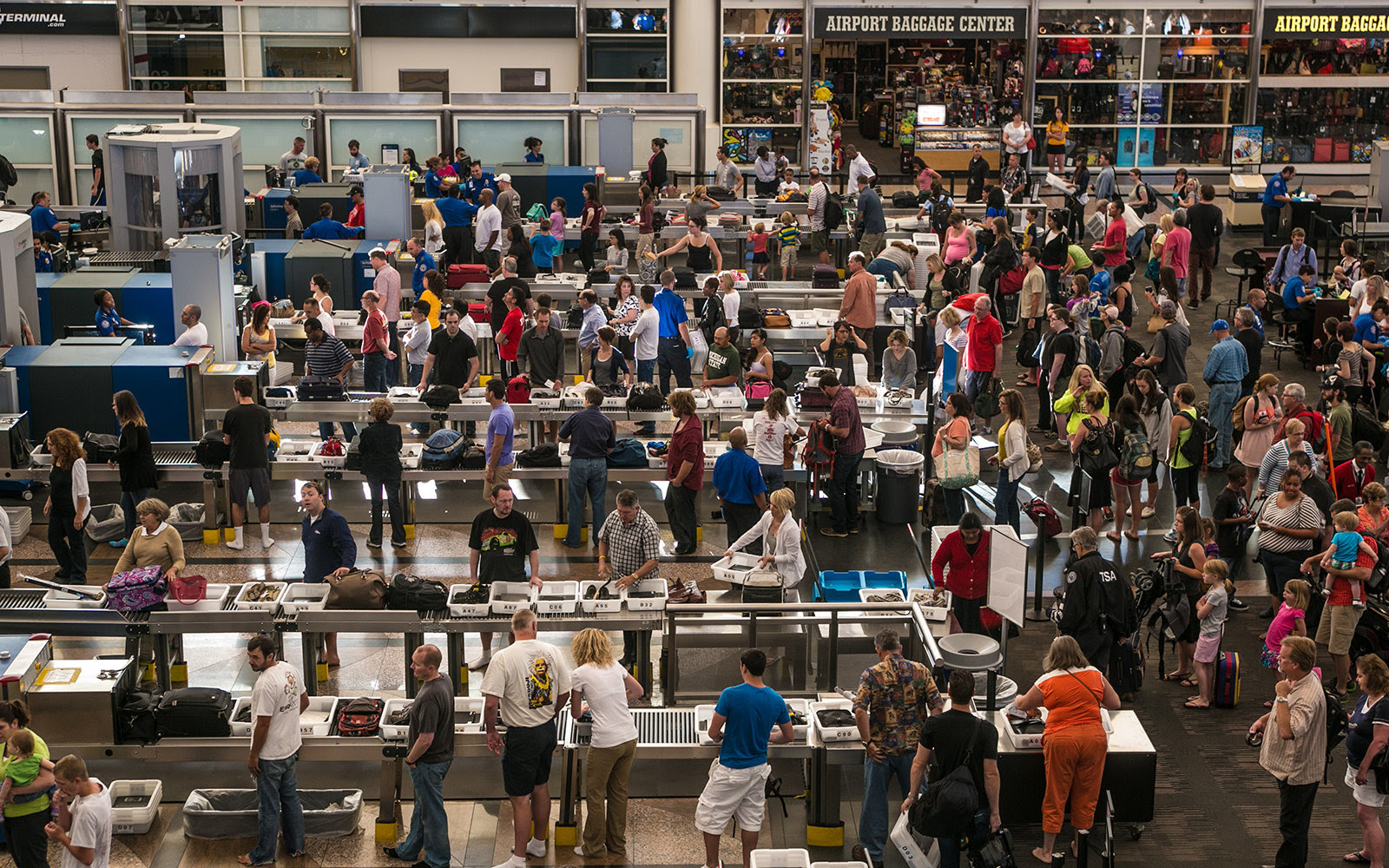
Denver International Airport (Photo by George Rose/Getty Images)

[Traveler enters with suitcase] Oh no! Look at those lines at security! Why is it every time I’m running late at the airport the security lines are out the door?? TSA must have been designed to prove Murphy was an optimist!!
Do you suppose these security people can move any slower? I’ll never make it to my gate on time.

Just look at all those people! All those families with kids! They’ll take forever to get through the line. And that couple over there with the deer in the headlights look. They don’t have a clue how to manage this system. You have to take off your jacket, your belt, your shoes, and get everything out of your pockets. Even a quarter may set off the metal detector! Put away my cell phone, no, can’t do that yet my boarding pass is on my phone. And if you’ve got an artificial joint you get a free pat down.

Stupid terrorists. We didn’t have to do all this stuff before 9/11. It wouldn’t be so bad to wait if it made me feel safe and secure, but it doesn’t. We’re vulnerable anywhere. Look at what happened just this week at Ohio State!

[Sits on suit case]

OK Steve, calm down. Breathe. I know it’s not all about me. All those other passengers—they’re all trying to get somewhere just like I am. They aren’t here just to aggravate me. And the TSA folks are doing their very difficult job the best they can. I’m sure they aren’t getting paid enough to put up with grumpy travelers like me. And I’ll even bet a little respect and being nice to them gets me through faster than complaining!

It helps if I don’t just see the crowd but see other people like me. Look at that poor mother traveling with two little kids. She’s probably trying to get home for Christmas or maybe to see a sick relative or bury a loved one. And those soldiers are likely being deployed to somewhere dangerous far away from their families for the holidays.

Sure, waiting a few minutes is inconvenient, but we’re all in the same boat. I’m old enough I remember a time when it wasn’t like this. We could walk leisurely to the gate and other people could go with you to say goodbye. How long do you suppose we will have to wait till the world is peaceful enough that we can do that again, till we just learn to get along as friends and neighbors? I wonder how long. [Exits]

Lighting the Advent Candle:

As usual, the second Sunday of Advent comes as we enter the final month of our calendar year, but 2016 has been far from ordinary. The long, long campaign season is finally over, but the political and social strife continues unabated. We are promised security and peace from all sides, but we are still waiting for those promises to be fulfilled. And so we wait for God’s light to break into the darkness just as it did so long ago in another time torn by strife and oppression. Today we light a second candle, the candle of peace, to witness to the world that the light is still growing in all of us who dare to wait and hope and believe. Together our lights can make a difference, and in due time our waiting will be rewarded with the peace that passes all understanding.

Prayer:
O God, waiting is so hard. We read the words of Scripture from centuries ago that promise peace, and we start celebrating Christmas earlier every year desperately hoping that this is finally the year. We long for true peace but often settle for false security that doesn’t satisfy the yearning in our hearts. We take our shoes off at airports and go through metal detectors; security cameras record our activities all over town, and we install security systems at home. Our military is the mightiest ever known in the world. And yet people carry guns and pepper spray, and we lock down our schools on a regular basis. Even police officers are not safe from senseless acts of violence. Enlighten us O God to the ways of the Prince of Peace. Teach us again that we will not find true peace until our hearts find rest in you. Remind us that your eternal peace does not come with “swords loud clashing or roll of stirring drums, but with deeds of love and mercy.” Remind us again in the small glimmer of these candles that the light still shines in the darkness, and the darkness will never overcome it. We wait and pray in the name of the Prince of Peace, Amen.

Memories and Life Lessons from November 22, 1963

When I asked my grandchildren this week if they knew what important event in American history happened on November 22 they of course didn’t know. They weren’t born until 40 years after JFK was gunned down on that dark day 53 years ago. And what’s more the parents of my grandchildren weren’t alive in 1963 either. What a difference a generation or two makes.

It was a watershed moment in American history for those of us who were alive and old enough to understand or sense that something big had happened. Memories of where we were when we first heard about the assassination are indelible. I was a senior in high school sitting in 7th period Algebra class next to a window that overlooked the faculty parking lot of our school. I happened to be looking out the window (apologies to Mr. Gross our teacher) when I saw Mr. Ratliff our principal pull into the parking lot at well over the speed limit and run from his car into the office. I knew that something major was wrong. I had never seen Mr. Ratliff run anywhere before. In just a few seconds the PA system in our class room crackled to life. Mr. Ratliff told us he had just heard on the radio that President Kennedy and Governor John Connally had been shot in Dallas.

Mr. Ratliff turned the radio on over the PA and for the rest of that school day all we did was listen to the news as it emerged from Dallas. When the bell rang to change classes we moved in solemn silence to our next classroom and continued quietly listening to the unbelievable news that the president was dead. I don’t remember any teachers or students saying anything. When the final bell of the day rang we again moved quietly to our lockers and left the building to go home and continue watching non-stop coverage on TV as Vice-President Johnson took the oath of office on Air Force One and into the night until we witnessed the President’s blood stained widow and his brothers escort the casket off of the Presidential jet in Washington D.C.

I just finished my previous blog post yesterday when I saw a picture on Facebook of the iconic screen shot of CBS television breaking into a soap opera so Walter Cronkite could tell the nation what was unfolding in the nation’s turbulent political atmosphere which was a soap opera in its own right. These were the days of Civil Rights movement and the Cold War. The McCarthy crusade on “un-American activities” was still a recent memory and the Cuban missile crisis had us all on the brink of nuclear destruction only a year before. Kennedy had won a highly contested bitter election three years earlier with charges of voter fraud and a torrent of religious prejudice because he was a Roman Catholic. He was in Dallas that day running for reelection.

What I didn’t know in 1963 as a naïve teenager in a rural Ohio community was that there were plenty of signs of danger in Dallas. Hatred of Kennedy was not hidden, and JFK’s closest advisers urged him not to make that campaign trip because they feared for his safety. That hatred and its tragic outcome are eerily reminiscent of today’s political atmosphere and how much we need to learn from the lessons of history.

We learned too late that November that it was not safe for the President to ride around in an open convertible. Denial of obvious dangers because of the animosity toward Kennedy was a factor in his death just as denial of the dangers of violence against the President contributed to the assassination of James Garfield just months after he took office in 1981. Even though Lincoln’s assassination was only 15 years earlier people we reluctant to believe that it could happen again. Lincoln’s death was written off as a casualty of the Civil War, and that conflict was over, right? So Garfield had no real protection in the D.C. train station where he was shot.

There have been dozens of conspiracy theories about if and why Lee Harvey Oswald killed JFK and why he was gunned down on live television just two days after Kennedy died. We may never know all of the answers to those questions, but this we do know and it’s a lesson we need to learn and relearn in every generation. Words and images have power. They can be used to heal or harm. Actions have their conception in thoughts and feelings expressed in language. Hateful words, chants, and slogans when taken to their logical conclusion give birth to acts of violence. In our social media age where many people’s primary source of “information” comes from posts and tweets the power of images and words is magnified 100’s of times more than they were in 1963. As hard as it is for my grandchildren to believe, there were only three major networks that provided us with our news 50 years ago.

Today rumors and propaganda go viral in a matter of minutes, and, as I said in an earlier post this week, the word “viral” is loaded with ironic significance. A virus in our bodies is harmful or even deadly, and a virus in my hard drive can be fatal to my computer. Both kinds of viruses can be contagious and have devastating consequences, e.g. Zika and HIV. Posts on social media can also have disastrous effects when they go viral. They are immediately out of the control of the author because even if one offers a correction or an apology or deletes the item it is already at large in cyber space and cannot be stopped from spreading across the country and around the world in a matter minutes.

The only vaccine for cyber viruses is to use extreme caution in fact-checking and verifying information before sending in out. None of us is immune from getting caught up in the emotion of a heated campaign or argument and saying things we regret. In an old fashioned face-to-face argument we have non-verbal or verbal feedback from other participants in the interchange that are not available to us if we go on an on-line rant. Face-to-face I know who is involved in the discussion and can reach out to those people to apologize or continue the discussion in a more rational moment. But if I post or share something hurtful on Facebook I have no idea who will see it or how many times it will get reposted. WordPress stats tells me that my blog posts get read at times as far away as South Africa and China, and while that is very exciting it is also a daunting reminder of the power and responsibility we all have to use our words with great care.

So now 53 years after those shots heard around the world from Daley Plaza in Dallas we can still learn critically important lessons. Modern communication techniques are a huge blessing that no one in my Algebra class that day in 1963 could even begin to imagine. They empower us with access to information at our fingertips that could only be found in encyclopedias and libraries back then. That information was obviously out of date before it could be printed and distributed. Today’s apps can translate languages to build bridges of communication across culture, enhance education, transform global commerce, and help us find where we are and how to get where we’re going, even in unfamiliar territory. I was in Boston earlier this year and might still be lost there today if it were not for the amazing ability of my phone to tell me how to get anywhere I wanted to go in that challenging maze of streets. It even told me which bus or subway to take and when it would arrive at my stop.

In 1963 no one but the creator of Dick Tracy could even dream of what we take for granted today. We all carry with us in our phones more computer power than Neil Armstrong, Buzz Aldrin, and Mike Collins took with them to the alien surface of the moon in 1969. In many ways the world we live in today is as strange and confusing to us as the lunar surface was to those Astronauts. And yet some things about our human condition remain constant through the ages and we forget them at our peril. Ever since his thoughts and feelings of jealousy drove Cain to kill his brother Abel way back in the second generation of humankind we have known that what we think and say affects what we do and how we treat each other.

In today’s multicultural, diverse global village our devices that we rely on today for most of our knowledge and information should all come with a big warning: “Use With Extreme Caution.” And for us Christians there should be a footnote citing Jesus in the Sermon on the Mount: “You have heard that it was said to those of ancient times, ‘You shall not murder’; and ‘whoever murders shall be liable to judgment.’ But I say to you that if you are angry with a brother or sister, you will be liable to judgment; and if you insul a brother or sister, you will be liable to the council; and if you say, ‘You fool,’ you will be liable to the hell of fire. So when you are offering your gift at the altar, if you remember that your brother or sister has something against you, leave your gift there before the altar and go; first be reconciled to your brother or sister, and then come and offer your gift.” (Matthew 5:21-24, NRSV)

Patience and Perspective: Why Thanksgiving and Advent Matter More than Ever

“For a thousand years in thy sight are but as yesterday when it is past, and as a watch in the night.” Psalm 90:4

The joke says “Wisdom comes with age, but sometimes wisdom comes alone.” There’s some truth in that, but as one who is learning the hard way, I can attest that age does come with some perspective and experience. I am going to resist the temptation to do a general rant about the rush to Santa Claus that turns the time between Halloween and December 25 into a blur. But I do regret the de-emphasis of Thanksgiving and Advent. We need more than ever times of gratitude and patience in this anxious age of instant gratification that doesn’t satisfy. Gratitude and patience are what Thanksgiving and Advent are all about, or should be.

I heard from several disenchanted voters and analysts of all persuasions that the recent election was all about a desire for change because of voter frustration with the current political situation. While I understand that sentiment and agree that much of what goes on in government is corrupt and broken, I was struck by a phrase I heard several times from Millennials and Gen Xers who said “nothing has changed in 50 years.”

I can’t begin to address the solution to what’s ailing our democratic system, but since I’ve voted in the last 13 Presidential elections beginning in 1968 I do feel somewhat qualified to address what’s changed in the last 50 years. In the 90th Congress, elected in 1966, there were only 11 women in the House of Representatives and 1 in the Senate. In this year’s election those numbers are 83 in the House and 21 in the Senate. I have not found exact data on racial minorities for 90th Congress, but one source said there were fewer than 10 until 1969. By contrast the new Congress in 2017 will have the greatest racial diversity in the history of the republic – 102 members of color in the House and 10 in the Senate. Those numbers equal an 867% increase for women and 1120% for racial minorities in the last 50 years.

Does that mean we have achieved equality in D.C. or in our nation? Of course not; we all know we are a very long way from achieving the high ideals of “liberty and justice for all” that we all profess to believe in, but where we are today on the long journey to equality for all is a far cry from saying nothing’s changed in 50 years.
There are many examples of progress toward social justice if we take time to look for them, and gratitude requires an intentional commitment to focus our attention on what there is to be thankful for, especially in this 24/7 news cycle and social media world where we are bombarded with mostly bad news constantly and can overreact to something and make it viral before bothering to check it’s veracity. Isn’t it interesting that the word “viral” comes from a term that used to mean something contagious that makes us sick?

We can all do something about the virus of untrue and biased information besides just complaining. There have been times in the last 2 weeks that I have simply had to turn off the TV and all my devices (de-vices?) to keep from being overwhelmed and depressed about the “news” coming at me from all directions. A fast from consuming the viral spread of anger, hate and fear is good preventative health from time to time. Perhaps more importantly, we can all stop and verify information before we spread it around by reposting or retweeting. Social media makes it far too easy to just hit a button and spread a virus before we have time to evaluate the information and its source. In the heat of political conflict it is not always easy to remember that, but if we would all pause and reflect on what the consequences might be and how images and words might affect others who become our unintended audience when we hit that button we can all help in a small way to heal the growing divisions in our nation and world. If we aren’t part of the solution we are part of the problem, and if we aren’t helping create positive change in our nation we shouldn’t expect our elected leaders to do it for us.

Mr. Rogers’ has been quoted a lot lately about “looking for the helpers” in a bad situation. Please, in this week of overeating and overshopping and overfootballing, let’s all take time to look for the positive signs of change in our world and be thankful. To do that requires backing up to get a better perspective on the big picture instead of focusing entirely on our problems. Yes, health care costs and jobs and our own civil liberties are important, and we must keep working as fast and justly as possible to change those situations. But to do so requires patience and perseverance and an appreciation of how far we’ve already come. The big picture gives us a better perspective on progress while at the same time reminding us that there are millions of other people in the world who are homeless and refugees and orphans, addicted and incarcerated that we must not ever forget. From Cain’s question “Am I my brother’s keeper?” in Genesis 4 to the lawyer’s question “Who is my neighbor?” to Jesus in the Good Samaritan story (Luke 10), God’s answer is “What you do to the least of these you do to me.” (Matt. 25)

As we have seen this week in the Trump vs. Hamilton tweet storm, artists and artistic works have great power to give us a glimpse of the bigger picture. Good drama and fiction can transport us out of our own swamp of alligators for a time and move us emotionally in ways that pure “facts” or logical arguments never will. It is no coincidence that the musical “Hamilton” celebrating diversity has taken Broadway by storm in this season of division and bigotry. And it is likewise no coincidence that the movie “Loving” began showing in theaters 4 days before the 2016 election. I haven’t seen it yet, but “Loving” is based on a landmark Supreme Court case, yes 50 years ago, in 1967. It’s the story of Mildred and Richard Loving who were sentenced to prison for violating a Virginia law against interracial marriage. In a unanimous decision (imagine that?) the US Supreme Court ruled that “the freedom to marry, or not marry, a person of another race resides with the individual, and cannot be infringed by the State.”

Yes, a great deal has changed in the last 50 years, and much of it for the better. But here’s where patience and Advent come into play, and the turmoil and anxiety about what a Trump presidency may do to impede the cause of justice and equality only underscores this point. We’re not sure who actually coined the phrase “eternal vigilance is the price of liberty” but it is certainly true. A major reason for the necessity of patience and vigilance in our democratic system is that what is seen as progress by some is always seen as a threat to others. The balance between individual liberty and universal justice is in constant tension, and that tension is usually part of the creative process. When the tension becomes bitter and partisan, when one or both sides want to be right more than they want justice for all, when the tension becomes more like a competitive tug-of-war instead of a cooperative teeter totter the tension can become destructive. We have had cycles of both productive and destructive tension throughout our history, and keeping the total picture in mind helps us to be patient with the process and not resort to oppressive or violent means to demand change to get our way.

The truth of the matter is that some people, not all, who voted for Trump and Pence under the banner of change do not want change at all. That minority of white voters really want to undo the changes we’ve made in the last 50 or 100 years that don’t benefit their privileged status. The reality is that in addition to seasons of gratitude and patience the USA desperately needs a season of reflection and repentance to remember all of our history. Only when we admit that this nation was built on a foundation of racism and genocide can we appreciate how far we’ve come and why we’ve got so far to go before “liberty and justice” for all is more than a pious platitude.

The struggle we are now in for the heart and soul of our democracy is so difficult because it is so old and so deeply ingrained in our history and DNA that we don’t recognize it. We learn at an early age about the early European immigrants coming to America in search of liberty and freedom, but most of our schools, families, churches and other civic organizations fail to teach white Americans the rest of our history. We don’t learn about the evils of slavery or we naively think it is a nasty little problem that was resolved by President Lincoln. We don’t learn about the founding fathers being slave holders. We don’t learn about the rape and pillage of Native American lands from people who were here for centuries before the first Europeans “discovered” America.

Why? Because our parents and their parent before them didn’t learn those lessons either because to learn the whole truth about who we really are is too painful. But ignorance is more painful in the long run. Without knowing our past we are condemned to repeat it generation after generation. Our lack of knowledge and the successful use of fearmongering racist tactics to win an election are an indictment of our education system, but even more they are an indictment of the church of Jesus Christ for being co-opted into a conspiracy of silence instead of proclaiming a John the Baptist Gospel of repentance for our sins. John and Jesus told it like it really is. Contrary to Jack Nicholson’s famous line in “A Few Good Men,” not only can we handle the truth only truth and the whole truth can set us free. As Frederick Buechner said so well in “Telling the Truth: The Gospel as Tragedy, Comedy and Fairy Tale,” “The Gospel is bad news before it is good news.”

Ironically the bad news of the Gospel and of our current political state is something that we should be thankful for. I’m not one bit thankful for hatred and racism ever, but as one commentator pointed out nothing new happened on November 8. The anger and divisions have always been a part of our history, clear back at least to the Continental Congress. The silver lining in the Trump election is that the dark underbelly of hate and anger is out in the open where it can be dealt with.

The struggle for liberty and justice is never easy, but when we look at the big picture and understand why change is so hard and how long it has been going on, we can appreciate and be thankful for the progress we’ve made; and we can be confidently patient that from God’s perspective the outcome of the battle between justice and evil is not in doubt. The road to justice is not linear but full of curves and detours and switchbacks, but we have a roadmap from a God who is always on the side of the oppressed and downtrodden. Justice probably won’t happen in our time, but because we also live in God’s time where a thousand years are but as yesterday, we live in gratitude and hope even as we continue to wait and work for liberty and justice for all.

All In: Many Members, One Body, I Corinthians 12:12-27

[Note: This sermon was preached Nov. 13, 2016, the Sunday after the Presidential Election, at Northwest UMC, Columbus, Ohio]

There’s a 1969 British movie called “The Royal Hunt of the Sun” which sounds like it could be about the final days of autumn in Ohio. It’s not of course; it’s about the Spaniard Francisco Pizarro’s conquest of Latin America in the 1500’s. There’s one scene in the movie where Pizarro and his men come upon a huge chasm between two mountains. The only way to get across is on a very rickety swinging bridge built by the Inca natives.
Pizarro looks over his band of men and no one will meet his eye. Even the bravest of his soldiers are afraid they will be chosen to lead the way across the bridge. Pizarro surveys the crowd again and his eyes fall on a priest who is part of the expedition, and he says, “The Church goes first.”

Whether you are happy or sad about the outcome of Tuesday’s vote, this historic campaign and election has revealed that the fracture in our national unity is much wider and deeper than most of us realized. That chasm of anger and mistrust seems to have widened even more in the days following the election, and it needs to be bridged for our democracy to survive. That healing process will require lots of people to be all in for that task. Guess what? The Church goes first!

Our text this morning was written by Paul to the church at Corinth, a deeply divided conglomeration of people who were a quarrelsome lot. In I and II Corinthians we have parts of at least 3 letters Paul wrote to the church at Corinth and a reference to an earlier one that was not preserved. A good portion of those letters, like the verses we just read, is devoted to trying to resolve conflicts among the believers and with the larger cosmopolitan community in which this church lived. Corinth, a city in Greece was located at the crossroads of almost all commerce between Rome and the provinces in the Eastern Mediterranean. People from all over the known world passed thru there and many stayed bringing with them their own culture and religion. Archeologists have found evidence of over 2 dozen temples in Corinth where many different gods were worshipped. And within the Christian fellowship there were strong feelings and theological divisions.

So Paul in this 12th chapter compares the human body to the church. He is trying to combat the jealousies and ego-driven points of view that were setting one part of the body of the church against another because each faction is more concerned with being right than with working together for the Kingdom of God.

In our own American history one of the most eloquent calls for unity among warring factions is found in Abraham Lincoln’s 2nd inaugural address just a few weeks before the end of a bloody civil war that killed 620000 soldiers and left much of the country in economic ruin. Lincoln knew this was not a time to dance on graves or boast of victory, so he closed that address by making this appeal to all Americans. “With malice toward none, with charity for all, with firmness in the right as God gives us to see the right, let us strive on to finish the work we are in, to bind up the nation’s wounds, to care for him who shall have borne the battle and for his widow and his orphan, to do all which may achieve and cherish a just and lasting peace among ourselves and with all nations.”

Lincoln’s words about binding up the nation’s wounds to create a just and lasting peace among ourselves could have been written for us today as we have just been through one of the most brutal and ugly election campaigns in American history. Political gridlock, racial and class tensions, fear of domestic and global violence divide us from one another and keep us from acting collectively to achieve the highest goals we profess to want for everyone. The challenge facing us is how to be all in for the good of our nation and the world when feelings are so raw and trust so fragile.

Paul tells the Corinthians that each part of the body needs to be content with its own role. Feet are made for walking, not trying to speak or think; you can’t hear with a kidney, and if the mouth goes on a hunger strike, the whole body is in serious trouble. To each body part Paul says, “It’s not all about you!”

Unity in the midst of diversity requires great commitment and a willingness to sacrifice personal interests for the greater good. There is no better example of that kind of sacrifice and service than the Veterans we honor this week. The success of any military unit depends on every member of any rank doing his or her job even under the most difficult circumstances. In another example from the early days of American history the signers of the Declaration of Independence demonstrate what it means to be all in for something we believe in. Listen to these final words of the Declaration:
“With a firm reliance on the protection of Divine Providence, we mutually pledge to each other our Lives, our Fortunes, and our sacred Honor.”

The seriousness of that pledge prompted Ben Franklin to say, “We must all hang together or we will surely hang separately.” For those men the choice to sign that document was literally a matter of life and death. They were committing treason against the British crown and the punishment for that was death. And for us the future of our democracy may depend on people of faith being willing to assume the task of binding up the nation’s wounds.
If you wonder what the source of such courage is, notice how that final sentence of the Declaration begins “With a Firm reliance on the protection of Divine Providence.” Those brave men in Philadelphia did not all agree on theology, they were not all Christians, but they knew that faith alone can give us the courage and strength to be all in. What are we that devoted to? Are we more all in for our favorite sports team or our business than we are for the well-being of everyone in our nation? What kinds of sacrifices are we willing to make for God so the church can be the body of Christ and help heal the divisions in our nation?

We have a granddaughter who is a freshmen in college this year, and her first quarter has reminded me that sharing a room with someone for the first time have requires the art of compromise. According to you tube, one student left a note for his roomie that said, “Sorry, I drank your Red Bull. Please tell me what you want in the blank below.” The roommate wrote back, “A new roommate.” That’s a clever response but avoidance and separation are not usually the best way to deal with conflict. To heal the pain and divisions in our country will require honest communication between opposing factions and groups. That won’t happen unless we take time to get to know and understand people who disagree with us. We all tend to socialize and hang out and get our information from people we like and are comfortable with. Unless we intentionally find ways to change that pattern the gaps between us will just keep getting wider.

Marriage may be the best of example where people promise to be all in, for richer or poorer, in sickness and in health. We say that in marriage two become one flesh, and that’s a great metaphor for describing the closeness and selflessness marriage represents, but the truth is that even in that most intimate covenant, we are still individuals with unique needs and wants. Someone once said that if two people become exactly alike, one of them is reduncnt. So even or especially in marriage, compromise is necessary for a just and lasting peace.
Marriage partners or business colleagues, athletic team members all contribute different talents and attributes to make a group work. The most brilliant play diagramed by a football coach will never succeed if the players are on the field arguing about who gets to run the ball. A 300 lb. lineman’s job is to block, not to dazzle the crowd with fancy footwork and long touchdown runs.

Diversity in groups enriches the experience and learning for everyone. Paul says a body can’t be all feet, or all eyes and function. A car can’t be all tires or engine or transmission; it takes the whole thing functioning as intended for it to work – and a church or any community of people is doomed to failure sooner rather than later if jealousy or grudges or personal differences make one or more parts of the body dysfunctional. President Harry Truman summed up the value of collaboration very well. He said “It’s amazing what you can accomplish if you don’t care who gets the credit.”

The early church described in Acts 2 sets the bar very high for Jesus followers. Those early Christians were so all in they sold all of their personal property, pooled their resources and shared what they had collectively with those in need. If that model is too socialistic for you, we also know that Paul raised funds on his missionary journeys from churches he founded in places like Corinth and Ephesus to support the church in Jerusalem which was in dire needs of funds. From day one the Christian Church has been a connectional church, knowing that none of us can meet all the spiritual and material needs of the world, but by combining resources we can all be part of ministries around the world. Northwest church can’t start a university in Africa or respond to natural disasters all over the world, but the United Methodist church as a whole can.

So, what does that all mean for us here at Northwest? To take any journey, we have to begin know where we are now. To be all in as part of a faith community means we begin by acknowledging we are not all in for the things we value most – family, church, God. To be all in means admitting when we’re wrong and asking for help when we need it.

It also means we have to pray and examine our hearts to see how we ourselves may be a part of the problems in our nation. And then ask what we are willing to do in order to be more all in. Surrendering something of ourselves for the good of the community is never easy. Worldly values teach us to be strong, invincible, and self-sufficient. But there are no self-made men or women. None of us would have survived the first few weeks of life without people who were all in for us and sacrificed sleep and personal comforts and leisure to care for us.
Paul tells us what the purpose of the church is in v. 25 – it is simply to care for each other. In that same verse Paul talks about the ideal of there being no dissension among the faithful. I preached a few weeks ago at another church in Columbus, and one of the members there commented to me that their congregation is like a family, and then she added, “And we fight like a family too.” Being all in doesn’t mean we all have to agree. A healthy church or family or democracy needs diverse points of view and experiences and a willingness to listen and learn from each other.

Like the parts of the human body, we each need to be who God has made us and do our part as best we can instead of being jealous of others. I would love to be able to sing and play like Mary/Brandon/Joe and the band, but if my mic ever stays on during a hymn you’ll know music’s not my gift. When we get to heaven God is not going to ask us why we weren’t like Paul or Mother Theresa. God isn’t going to ask me why I didn’t preach from memory like Tom does. No, God is going to ask each of us if we were all in with whatever gifts and talents God gave us.
To be the body of Christ, especially in uncertain times is to be present for each other and embrace our common humanity. Where there are divisions and fractures in the fabric of human relationships bridges of compassion and understanding need to be built, lines of communication need to be restored or established. We’re all in because healing and reconciliation is what the body of Christ does. At this moment in time more than ever, the church goes first!

Benediction:
Times of uncertainty often remind me of an old Peter, Paul and Mary song, “Day is Done.” One verse of that song says:
“Tell me why you’re crying, my son
I know you’re frightened, like everyone
Is it the thunder in the distance you fear?
Will it help if I stay very near?
I am here
And if you take my hand my son
All will be well when the day is done.”

No earthly parent or President can guarantee that promise. But we know one who can and his name is Emanuel, God with Us. This week reach out to friends and strangers who need a hand, and together take God’s hand.
And all will be well when the day is done.

The Dark Side of the Prosperity Gospel

“Do not be deceived; God is not mocked, for you reap whatever you sow.” (Galatians 6:7).

It’s been a busy week since Monday night’s presidential debate. I don’t have time to say much but feel compelled to address something that struck me Monday night while it is still relatively fresh in our memories. There has been much debate about who “won” the debate and how you vote on that is pretty subjective. I think most of us heard what we expected to hear filtered through our own political lenses and that of the media analysis we choose to rely on for “expert” opinions.

What struck me most were two things. When Donald Trump said that not paying taxes makes him smart and that taking advantage of the foreclosures during the recession was “good business,” he showed again why he is the poster boy for the dark side of the prosperity Gospel and even of Capitalism itself. The prosperity Gospel is the misguided interpretation of Christian theology that emphasizes material blessings and rewards for those who proclaim their faith in Christ. It is responsible for the growth and success of many mega churches and television evangelists, but it is totally contrary to the teachings of Jesus.

There are too many examples to cite them all here but these quickly come to my mind. “No one can serve two masters; for a slave will either hate the one and love the other, or be devoted to the one and despise the other. You cannot serve God and wealth.” (Matt. 6:24, Luke 16:13). The parable of the rich fool (Luke 12:13-21), the rich man and Lazarus (Luke 16:19-31), “Blessed are the poor in spirit” (Matt. 5:3), and numerous times where Jesus says, “leave what you have and follow me.”

Mr. Trump said earlier in the campaign that his favorite Scripture is “An eye for an eye.” When one’s only concern for how to measure one’s worth is material wealth and power, that’s a great motto to live by, but I pray that some of Mr. Trump’s Christian followers will prevail upon him to someday learn what Jesus said about that desire for revenge by reading the Gospels or even just the Sermon on the Mount.

The Gospel of Christ has been twisted into the prosperity Gospel because it sells. Promising people they will have to take up a cross to follow Jesus, or to share what they have with the least of those as judged by the world’s standards, or to love their enemies and turn the other cheek – those just are not good marketing techniques. Promising potential church members they need to sell all they have and give it to the poor doesn’t entice many recruits to sign up. Maybe that’s why Jesus only had 11 faithful ones?

The spread of the prosperity Gospel also explains the conundrum many political commentators have wrestled with this year, namely how to make sense of Trump’s popularity among some Christians. Galatians 6:7 says it so well, “we reap what we sow.” Creating a flock of materialistic, wealth-worshipping “Christians” over the last few decades has produced this strange phenomenon of those who call themselves evangelicals enthusiastically giving their support to a man who is the antithesis of the values and lifestyle Jesus Christ calls us to live.

It also explains how those who claim the name of the Prince of Peace can be devout supporters of the NRA and gun rights. Fear of losing one’s prosperity leads to taking very drastic and unChrist-like measures to protect and defend those “things that thieves can steal and rust and moth can consume.” The rest of that advice from Jesus in the Sermon on the Mount says, don’t put your faith in those perishable things, “but store up for yourselves treasures in heaven, where neither moth nor rust consumes and where thieves do not break in and steal. 21 For where your treasure is, there your heart will be also.” (Matt. 6:19-21).

God is not mocked. We have planted seeds of greed and selfishness, and now we are reaping what we have sown.

Is It Well with your Soul?

“It is Well with My Soul” has long been a favorite hymn of mine, but it has taken on a new twist for me in this year of apocalyptic election scenarios. Twice in recent months I have been in worship services where that great old hymn has been part of the liturgy. All of the lyrics to that hymn are powerful statements of faith, but the verse that has caught my ear in this election year is the last verse which says:
“And Lord, haste the day when the faith shall be sight,
the clouds be rolled back as a scroll;
The trump shall resound, and the Lord shall descend,
Even so, it is well with my soul.”

In particular I’m referring to the phrase, “The trump will resound, and the Lord will come down.” Sorry, but I can’t hear the word “trump” without being reminded of the Republican Presidential candidate. And the eschatological imagery in that line reminds me that many on both extremes of the political spectrum are feeling like the world may come to end if the “other” candidate is elected. I don’t really expect the end of the world on November 9, but regardless of your feelings about Trump or Clinton, most of us would agree the outcome of this election will have serious consequences for the future of our nation and the world. As an antidote to our anxieties about that, Horatio Spafford’s great hymn repeats the refrain, “It is well with my soul.”

If you don’t know the story behind this hymn, it was written in 1873 by Horatio Gates Spafford, a prominent American lawyer, after he had experienced multiple tragic events, including the death of a son in the great Chicago fire, financial ruin, and a storm at sea in which four of his daughters died. (More details at https://en.wikipedia.org/wiki/It_Is_Well_with_My_Soul.) Knowing the history of Stafford’s Job-like tragedies, any one of which could undo most of us, we know lyrics like these are not merely pious platitudes.
“When peace like a river, attendeth my way,
When sorrows like sea billows roll,
Whatever my lot, thou hast taught me to say
It is well, it is well, with my soul”

At different times in my life words of faith like this speak more to me than others. This is one of those times, in part because of my grave concern over the deeply divided world we live in typified by the Presidential election rhetoric and the hate inspired violence from Syria to San Bernardino and far too many points in between. And on a more personal level I’m dealing with some chronic pain that makes it hard for me to function, including finding time and energy to write.

I was humbled and shamed about how easy I give into pain or despair over the state of the human condition the other day in physical therapy. A young woman was there who could barely walk, even with her cane. As she slowly made her way from the aquatic therapy pool through the main therapy room I noticed she is bald and wore a colorful bandana on her head. I assume she has lost her hair from chemo therapy. And beneath that colorful bandana she smiled at me, and that smile lit up the room as a powerful witness that though her body is betraying her, it is well with her soul.

This stranger’s smile and Spafford’s 143 year-old words, written out of tragedy and sorrow far greater than mine continue to comfort, challenge and inspire me. They remind me of a very helpful definition of faith I read many years ago by a Canadian theologian, Wilfred Cantwell Smith. At the risk of oversimplifying, my summary of Smith’s thought is that he delineates an important difference between belief and faith. We sometimes use those words synonymously, but they are not. Belief is an intellectual ascent to a proposition or idea, while faith is a deep trust in a power that can give us the “peace that passes understanding” (Philippians 4:7) no matter what external circumstances threaten to make us fearful and anxious, be they personal, existential or political.

One of my favorite stories that illustrate the difference between belief and faith as trust is this one by an unknown author about Charles Blondin, a famous French tightrope walker:

Blondin’s greatest fame came on September 14, 1860, when he became the first person to cross a tightrope stretched 11,000 feet (over a quarter of a mile) across the mighty Niagara Falls. People from both Canada and America came from miles away to see this great feat.
He walked across, 160 feet above the falls, several times… each time with a different daring feat – once in a sack, on stilts, on a bicycle, in the dark, and blindfolded. One time he even carried a stove and cooked an omelet in the middle of the rope!
A large crowd gathered and the buzz of excitement ran along both sides of the river bank. The crowd “Oohed and Aahed!” as Blondin carefully walked across – one dangerous step after another – pushing a wheelbarrow holding a sack of potatoes.
Then at one point, he asked for the participation of a volunteer. Upon reaching the other side, the crowd’s applause was louder than the roar of the falls!
Blondin suddenly stopped and addressed his audience: “Do you believe I can carry a person across in this wheelbarrow?”
The crowd enthusiastically yelled, “Yes! You are the greatest tightrope walker in the world. We believe!”
“Okay,” said Blondin, “Who wants to get into the wheelbarrow?”

The story says no one took Blondin up on that invitation. But when things are truly well with my soul I know it’s safe to get in God’s wheelbarrow, even if I have to muster my courage like the father whose epileptic son had just been healed by Jesus. He said, “I believe Lord, help my unbelief!” (Mark 9:24).

Which is to say that faith is a journey, not a destination. John Wesley, founder of Methodism, knew that well. He asked new clergy as United Methodist Bishops still do today at ordination, “Are you going on to perfection?” That’s a not too subtle reminder to walk humbly with God and other faith seekers who know that faith and doubt wage an eternal battle in us all. Wesley also advised preachers to “Preach faith until you have it.” I believe that’s why the word “retirement” does not appear in the Bible. We’re all still preaching and seeking that trusting faith that no matter what curve balls life throws sings out, “It is well with my soul.”

A Lament for Unity

“Some take pride in chariots, and some in horses,
but our pride is in the name of the LORD our God.
They will collapse and fall,
but we shall rise and stand upright.” Psalms 20:7-8

I don’t have time to write much today but feel an urgency to respond to the disheartening news coming out of the UK this week. ISIS must be dancing in the streets. Their epidemic of fear has toppled the British Prime Minister and dealt a terrible blow to European unity. I find it very ironic and sad that it was the older population in Britain who voted in favor of leaving the EU. They should be the ones who remember how well Nationalism worked for Europe throughout history and most recently in the 20th Century.

European Nationalism engulfed the entire planet in two horrible world wars and left a trail of death and destruction throughout European history. Why would we want to try it again? Fear does terrible things to the human mind, and there is much to fear in this rapidly changing world we inhabit. But putting our trust in chariots and horses, i.e. strength and force and defensive isolation that turns its back on millions of refugees is not the answer. To resort to abandoning the most hopeful effort at unity and cooperation the world has seen in centuries because of current fear and hardship is short-sighted and tragic.

Those who put their faith in chariots and horses will collapse and fall, but those who put their pride in the peaceful, loving, cooperative ways of the Lord will rise and stand upright. It takes faith and a lot of it to believe that, but the alternative is to try and return to methods that have proven hundreds of times to fail. Come, Holy Spirit, and breathe courage and faith into every trembling heart.

Post Script: I went out to mow my grass after writing the above. I do some of my best thinking on the lawn tractor. Today I had one mowing meditation I want to add. It may be because I am neither young nor fearless, although it was a favorite of mine even when I was young and fearful, but a line from a great old hymn came to mind as I reflected more on the rise of nationalism in both Europe and here in the U.S. It was written in 1931 as nationalism was raising its ugly head in Germany. I’ve never served a church where it is a popular hymn because it is too challenging and uncomfortable, but I think it’s time we listen. The whole hymn is profound, but what echoed in my mind today is the third verse:

“O help us stand unswerving
against war’s bloody way,
where hate and lust and falsehood
hold back Christ’s holy sway;
forbid false love of country
that blinds us to his call,
who lifts above the nations
the unity of all.” “O Young and Fearless Prophet,” by S. Ralph Harlow

A Response to the Orlando Massacre

“Put your sword back into its place; for all who take the sword will perish by the sword.” Jesus

Another mass shooting, another record broken for innocent lives snuffed out, more prayers and tears and hand wringing. This one is worse because it targeted the LGBT community and people of color – an all-purpose hate crime. My heart is broken again, but I haven’t yet heard the expected hateful tweets from Trump and his ilk calling for more violence and stronger defense. Trump recently said his favorite Scripture is “An eye for an eye;” which says volumes about his lack of Christian faith. I have intentionally avoided Fox News all day, as I do most days, because I’m not sure I can take much more vitriol and fear-mongering.

I fully expect this tragedy to be used for political gain by Trump, and anticipate he will blame the work of ISIS on President Obama’s “weakness;” so I want to counter that bogus argument right now. To blame the rise of terrorism here and abroad on “weakness” and to call for more guns and more military action in response is to forget recent history and to engage in bad theology. The full context of the Scripture above is as follows:

“ While he was still speaking, Judas, one of the twelve, arrived; with him was a large crowd with swords and clubs, from the chief priests and the elders of the people. 48 Now the betrayer had given them a sign, saying, “The one I will kiss is the man; arrest him.” 49 At once he came up to Jesus and said, “Greetings, Rabbi!” and kissed him. 50 Jesus said to him, “Friend, do what you are here to do.” Then they came and laid hands on Jesus and arrested him. 51 Suddenly, one of those with Jesus put his hand on his sword, drew it, and struck the slave of the high priest, cutting off his ear. 52 Then Jesus said to him, “Put your sword back into its place; for all who take the sword will perish by the sword.” Matthew 26:47-52

You can twist the interpretation of that text, and many do, to mean that Jesus was saying those who commit violence deserve to suffer in turn. But that is not consistent with the full life and teaching of Jesus that blesses peacemakers, advises turning the other cheek, loving one’s enemies, and praying for those who persecute you.

Human history is so full of violence against creation and humankind that I don’t know where the origin of that cycle of vengeance could ever be identified. We only get four chapters into Genesis before the first murder occurs! And in that story God marks Cain, the murderer, not to punish him but to protect him from retribution. That lesson was lost immediately.

The warfare in the Middle East goes back before recorded history; so it is difficult to assess blame or to solve that Gordian knot. But that is no excuse to twist more recent history to justify a dangerous political ideology. I would argue that the rise of terrorism in recent years is not because of American weakness but because of unjustified invasions of that region by former President Bush. Those of course were in response to 9/11, which was I’m sure justified in the eyes of the terrorists by US imperialism and the decadence of our society. My point is that there are always those who can find an excuse to get revenge on those we label as “enemies.” But military strength does not bring peace. We are the strongest military power in the history of humankind, and we are still not safe and secure. Violence can never bring peace. World War I sowed the seeds of WWII, which created the Cold War and the nuclear arms race. And on it goes.

And Jesus said, “Put away your sword.” Till the cycle of violence is broken, till we confess our own guilt for profiting from fear by selling more guns and security systems, and selling arms to other countries, the military-industrial complex President Eisenhower warned us about 50 years ago will continue to beget more violence. The U.S. currently gives $5 Billion dollars a year in military aid to Israel, and ¾ of that money is spent back in the US to buy weapons produced by US manufacturers; and the US Congress, which can’t agree on anything else, wants to increase that amount! What price are we paying as our infrastructure and education system collapses while we profit from bigger and better ways to kill each other?

People who are afraid have a hard time hearing Jesus’ words to be peacemakers; so I don’t expect this reminder to be popular in another moment of tragedy. But what we are doing is obviously not working and to double down on violence and power as the solution is not the answer.