“Beloved Knows No Zip Code” Luke 3:15-22

Here we are, nine days into a new year.  We’ve changed the numbers on the calendar, but things look the same as year one and two of what one young child calls the Pandamnic.  We’re still wearing masks, the Omicron numbers are scary high.   New Year’s used to be more a time of out with the old and in with the new, but 2022 feels a lot like the movie Groundhog Day, like we’re stuck in a very deep rut.

You may have seen the cartoon of a baby talking on a cell phone about her baptism.  She says, “I tell you this guy in a dress tried to drown me, and my family didn’t do anything but stand around and take pictures!”  I saw another one where Jesus is complaining to John the Baptist that he was trying to drown him.  John replies, “Sorry, if you wanted to be sprinkled you should have gone to John the Methodist.”

How many of you were baptized as infants or as a small child?  For that many of us at least we have no conscious memory of that important event that was a major force in shaping our faith journey.  That’s one reason this Sunday after Epiphany is called the Baptism of the Lord; so we can all reflect on the promises that we made or were made for us at our baptism. 

One of the best things about studying the Scriptures to prepare to preach or doing Bible study is noticing things we’ve not seen before in familiar stories.  All of us are somewhat guilty of making what a friend of mine calls Gospel Stew.  We take the different accounts of Jesus’ life and mix them all up together into one almost Bible narrative.  But each of the Gospels is a unique testimony by its author, and it’s important to take time to focus on each one to see what treasures we can find when we do just that.

For example the account of Jesus’ baptism in the Gospel of Luke we read today has one big difference from the other three Gospels.  Did you notice it?  Listen again to these words from verses 19-21: “…because of all the evil things that Herod had done, added to them all by shutting up John in prison. [pause]  Now when all the people were baptized, and when Jesus also had been baptized…”

In the three other accounts in the Gospels John plays a much more central role in baptizing Jesus.  John’s role is implied here, but Luke seems to make a point of getting John out of the spotlight in prison before Jesus hears the heavenly voice proclaiming his belovedness. 

Luke gives John a lot of time on stage prior to this, but now it’s time for a new beginning for putting away the old wine skins that can’t contain the Gospel of Grace that God has come in Jesus came to proclaim.  Now, it’s a new year and time to clean out the old to make room in our hearts for the incarnation of God’s spirit.  The Holy Spirit comes not just in Jesus, but in all of us who have been claimed as God’s beloved. 

When I was teaching a preaching class at the Methodist Theological School in Delaware one of my students, Mike Doak, dug into this text and did a really creative look at this story from the perspective of John the Baptist who is cooling his heels in jail when Jesus emerges as the Messiah John has been proclaiming. 

My student imagined what it might look like if John the Baptist wrote us a Letter from the Jerusalem Jail: 

“Stunned… I tell you I was stunned as these events unfolded.  You could have heard a single drop of rain fall at that moment, in the midst of that gathering.  As for me, one touch of a feather would have keeled me over.  Where was the winnower, fork in hand, striding onto the threshing floor?  What of the fire, the unquenchable fire, into which the chaff was to be cast?  Was there no axe to be laid to the root?  We expected a Messiah, a ruler grown from the tree of David would Lord it over Israel with a strong hand and a mighty arm.  Why were there no trumpets to announce the coming king; why did thunder not clap as heavens rent open? What manner of king is coroneted with a dove in place of a crown?  If I may appropriate a few of your own symbols, I preached Rambo but behold Gandhi.  I expected God’s unparalleled judgment yet beheld God’s unparalleled grace.  I preached unquenchable fire, but witnessed unquenchable hope.  Self-doubt overtook me as days passed into weeks in the solitude of my prison cell.  Though I had thrived in the wilderness all my grown life, I was then never so alone.  How was it that one called “forerunner” could become “forlorn.” 

John has been the star of the show.  Huge crowds have come to hear him preach.  Some people even think he might be the Messiah himself. That’s pretty heady stuff.  But Luke makes it clear John is the forerunner, the warm up act, not the featured attraction.  It’s time for a changing of the guard. 

Have you ever resented someone who made the team while you got cut?  Or some whippersnapper got the promotion you thought you deserved?  Or becoming a big sister or brother and all of sudden not getting attention from Mom and Dad or your grandparents who only have eyes for this new little stranger who has invaded your home?  If so we can understand how John might have felt.

John says he is preparing the way for Jesus, but Jesus doesn’t turn out to be the Messiah John and most of the Jews were expecting.  John was a hell fire and brimstone preacher, a little on the wild and crazy side.  He preached a Gospel of repentance based on fear of God’s wrath.  He expected the bad dudes to get their comeuppance and the chaff of society to be burned and the sooner the better.  We all have our own list of who those bad dudes and dudesses are don’t we!

But John didn’t find in Jesus what he hoped for and expected.  This most unlikely carpenter’s son is named God’s beloved son, the one with whom God is well pleased.  Baptism is all about new beginnings, but John’s new beginning is a stark reminder that God is the boss and we aren’t.  No matter how much we want to pass judgment on people we think are sinners, that’s not our job.  Our job is to be messengers of repentance and hope, the good news of new beginnings, and leave the judgment to God. 

Baptism is still a sacrament of new beginnings, even in yet another Covid year.  But it’s important to see baptism as a beginning and not the end of a journey.  Baptized children are preparatory members and it’s the job of all of us– parents, teachers, grandparents, fellow church members – to be their village and help prepare them for full membership and claiming their belovedness for themselves.  Now don’t go guilt tripping yourselves about your shortcomings or failures as parents because your kids or grandkids haven’t turned out as you hoped they would.  Imagine how Elizabeth and Zechariah felt about this miracle child of theirs living in the wilderness eating locusts and wild honey!  Our job as role models for the younger generation is to show them they are beloved even if they are covered in tattoos and have green hair.  The rest is up to them and God. 

I want to pause here to acknowledge everyone involved in the amazing children’s ministry here at Northwest.  I’ve been part of 8 different congregations in my life and the amazing job Doris Ing and all her servant leaders do with our kids here is by far and away the best I’ve ever seen.  Our children get a balanced spiritual diet of hearing the stories of the Bible, and then they practice those values by living them out working in the children’s garden alongside adults and a whole host of other service projects that teach them to treat all of God’s children as the beloved people they are.

Those kids grow up before our eyes oh so fast.  Diana and I have been part of the Northwest family for almost 8 years now, and I am amazed when I see children who were toddlers back in 2014 who are now singing in the children’s choir, and teaching us elders what love in action looks like.  They grow in wisdom and stature like Jesus to help deliver brown bag lunches and go on youth mission trips.  One of my favorite projects in recent months came out of the concern from youth in our confirmation class about climate change.  They’ve helped us implement new recycling opportunities and designed these wonderful reusable cups so we can stop adding to the problems Styrofoam cups cause for mother earth.  And best of all they put on these cups words that remind us whenever we drink from it that “Love Has No Zip Code.”

I already knew in my head how unjust our society is based on which zip code you happen to be born into.  But I really learned about that in a heartfelt way when I was working at Ohio State several years back.  I was helping facilitate a partnership between OSU and Columbus City Schools.  Many of us at OSU volunteered to be tutors and my school was Medary, one of the  elementaries in the University District.  At the same time my grandkids were in elementary school in the Olentangy School District.  I loved working with the kids at Medary, but it hurt my heart when I would go from there to visit the Olentangy schools on grandparent’s day or other occasions.  The differences between the new school buildings and the resources available to my grandchildren were like visiting another planet.

I am grateful for the amazing experiences my grandkids have had at Olentangy, but very troubled that the urban kids are not getting the same benefits.

I’m using Olentangy as an example, but we know the same stark differences apply to Dublin and Hilliard and other suburban schools.  The way we fund education via property tax, i.e. by zip code, is inherently unjust.  That system has resulted in the resegregation of our schools and perpetuated and widened the gap between the privileged and the marginalized.  And those disparities have only been multiplied by Covid. 

Climate change and education are just two of many injustices we are called to address.  None of us can make a big difference in any or all of them, but we can start by asking God how we can make a difference wherever we are. Luke describes the baptism of Jesus in 2 verses and then devotes 12 verses to the temptation of Jesus in the wilderness that immediately follows.  This warns us that we are all tempted forever as Jesus was to cave in to the seduction of worldly comfort and power, but because we are followers of Christ we can say no to Satan’s clever sales pitches.  

I don’t know about you, but when we baptize cute babies up here I don’t pay much attention to the words of the baptism ritual.  I’m just oohing and aahing over a precious beloved child of God.  Babies are such a miracle that they melt our hearts.  But there are important words in the ritual that we all need to hear.  As a congregation we promise to help raise those children in the faith; so we shouldn’t just sign on for that important job like we click agree without reading all the fine print on a new app. 

Listen to what one of those vows asks us to agree to:  “Do you accept the freedom and power God gives you to resist evil, injustice, and oppression in whatever forms they present themselves?”  That’s a heavy promise, and it comes before the next promise where we are asked: “Do you confess Jesus Christ as your Savior and put your whole trust in his grace…?” We can’t renounce and resist the forces of evil on our own.  We can only do that through the power of the Holy Spirit descending on us and declaring we are God’s beloved children.   

The last line of the baptismal vow says we “promise to serve him as our Lord, in union with the Church which Christ has opened to people of all ages, nations, and races?”  Brothers and sisters, all means all.  Just as we can’t choose our relatives, even the crazy uncles and the weird cousins, we can’t exclude anyone from the body of Christ.  I know how hard that is.  The partisan paralysis in our government that has made this pandemic last so much longer than it needed to and taken so many beloved family members and friends from us makes me furious.  But the Gospel message is that even those I vehemently disagree with about vaccines and masks, yes, even those people are God’s beloved children.

Baptism means we all belong to a great and mysterious God who created this vast universe long before any humans ever set foot on this tiny planet.  God created us, male and female, and declared us good and blessed from day one.  And no matter how badly we or anyone else screw things up, our blessedness doesn’t expire. 

In one of those special God incidents, I got a wonderful idea for how we can all practice our baptismal vows and celebrate our blessedness every day.  It came just yesterday in a daily devotion I get from Father Richard Rohr, and it suggests this simple practice.

The exercise goes like this; looking, really looking lovingly, not staring or seeing any flaws, look at yourself in a mirror or at another person, and as you breathe in and out pray silently these words:

Breathe in:      I see you with love

Breathe out:   gifted, cherished.

Breathe in:     Grateful

Breathe out:   for who you are.  [Repeat this with congregation, looking at another or imagining someone]

And here’s the best part–Father Rohr goes on to say,

“We can also bring this practice out into the world. How often do we really see another person beneath their role, under our expectations? What if we paused at the grocery store and for a moment brought eyes of love to the stock clerk or the cashier. They don’t have to know what you’re doing. You don’t have to stare, just take in their image, then close your eyes for a moment, breathe, and bathe them with love. Pause and see the other person as beloved and beautiful as they indeed truly are.”

My beloved sisters and brothers, this is a day of new beginnings because God’s “Belovedness Knows No Zip Code.”  Amen

Preached at Northwest UMC, Columbus, OH, January 9, 2022

Recorded from Livestream @  https://youtu.be/bLS32pkXHAU

Second Advent Candle: Peace

John, the wild forerunner of the Messiah calls us out of our comfortable sanctuaries and living rooms into the wilderness of our weary world. Our mission is to level the playing field where our poor sisters and brothers struggle to survive. We are called to be peacemakers who do justice, not peacekeepers who protect the status quo.

John foresees the birth of a new day when the first will be last and the last first.  He calls us to comfort the afflicted and afflict the comfortable, even when  we are the latter.  And we are invited to be the bearers of that good news, welcoming Christ to transform our lives; so we can build peace from the inside out and be prepared whenever the Messiah returns. 

In that hope we light this second Advent candle, the Candle of Peace.  [Light Candle]

Let us pray: Holy God, We light the candle of peace to say, yes, we accept your invitation to be bearers of light into the dark places where there is no justice and no peace. We do so with grateful hearts for the example of Christ who came to dwell among us to show us the true way to a world of inner and outer peace for all creation. We will proclaim your peace from the housetops and our laptops until all flesh shall see your salvation as a new day dawns to usher in the peaceable reign of your universal love and grace. We pray in the name of the Prince of Peace, Amen.

Unbound: Lazarus was, are we?

What do tennis, hiking, golf, biking, jogging, working on a ladder, and skiing all have in common? They are all things I have had to give up in the last 10 years due to the aging process. I was talking to a friend my age who has given up even more things than I, and when I described my emotional state as “feeling empty” and not having anything to fill the space left by all I’ve lost. The words were barely out of my mouth when my friend said, “That’s exactly how I feel!” Like all of my friends, we have often joked in years past about old people always complaining about their aches and pains all the time, but more and more as we navigate our 70’s we find ourselves doing exactly the same thing.

I remember about 12 years ago asking an “older” gentleman what he was doing in retirement. Without missing a beat he said, “Going to doctor appointments and funerals.” I thought that was funny back then, but I’m not laughing anymore. When I told my friend that I was seeing a counselor about my feelings of emptiness and depression his response surprised me. After asking if the therapy was helping he said, “Thanks for sharing that. I always thought you had it all together. But knowing you are feeling the same things that I am makes me feel not so alone.” That wasn’t a “misery loves company” response; that was the blessing of letting down our armor and being vulnerable.

I’m not patting myself on the back, mind you. I have been good friends with this man for over 50 years. We have gotten together for golf and/or lunch monthly for decades until old age took our clubs away. Now like many oldsters we just go to Bob Evans. We’ve developed a trust over the years, but the fact that he still thought I “had it all together” means I’m either a better actor than I thought or I’ve been much less honest with him than I wish I had. I’m hoping this recent conversation will help us stay on a more vulnerable level going forward.

Here’s the good news. In addition to my therapist I am also working with a spiritual adviser, and when I shared this story with him he reminded me that until we empty ourselves of all the busyness and activities that keep our minds off our pain God can’t fill us up with anything else. A light bulb went on for me when he said that because when you hear truth it illumines things around and within you. He helped me realize that instead of resenting the emptiness I am feeling I can choose to embrace it as a gift from God. That doesn’t mean the UPS is going to arrive at my doorstep with God’s gifts anytime soon, and no that’s not because of a supply chain issue. Spiritual growth takes time and a willingness to sit with pain or emptiness awhile.

The Hebrews were in the wilderness for 40 years, not because it takes that long to travel from Egypt to Israel or because Moses refused to ask for directions. Even Jesus spent 40 days in the wilderness wrestling with Satan because deep spiritual growth takes time to mature and ripen. The advice to “be still and know I am God” may sound really simple, but it’s not just a matter of shutting up for a few minutes so God can speak. It means prioritizing time for prayer and silence, and not the kind of prayer where we just tell God what we want or need.

Jacob wrestled with God all night long and was changed forever by that experience. Moses and Elijah both had to go up to Mt. Sinai/Horeb to hear God’s still small voice. I confess I am not good at silence. Even when writing these posts I frequently have a ball game on TV or music on some device. I know I write so much better when I am in a quiet place as I am while I write this, but like Paul I often fail to do the things I want to do and don’t practice what I preach.

The Gospel lesson for All Saints day this year is from John 11, the familiar story of Jesus raising Lazarus from the dead. There are many rich veins of truth to mine in that story, but two stand out for me just now. This chapter contains what every kid in Sunday School loves to memorize, namely the shortest verse in the Bible: “Jesus wept.” This is one of several times in the Gospel narratives that we see Jesus vulnerable and allowing his humanity to show through. Like us he grieves over a loss, even though we and he all know he’s going to restore Lazarus to life.

The second verse in that lesson that grabbed my attention this year was the last one where Lazarus emerges from the tomb all bound up like a mummy. He’s alive but not really. His movement and sight and vision are all hampered by his grave clothes???, and Jesus says, “Unbind him and let him go.”

What are the things that bind you and me and keep us from living abundantly in the reign of God? Are we so stuck in our old ways that as Martha so indelicately puts it in the King James Version, “He stinketh,”. My wife sells a very good air purifier that kills germs and removes odors, even in cars or houses that have been skunked. But even those machines will not remove the kind of stench that comes from us who are spiritually dead and don’t know it.

My prayer is for God to unbind me from the anger, fear and regret that I feel for all the things I’ve lost in this stage of my life. Unbind me, Holy one. Roll away the stone that keeps me trapped in a pity party for my past. Unbind me and let me embrace what is and what will be if I trust you to lead me.

What’s your prayer for new life?

Election Blues and Faithful remnants

“The lame I will make the remnant, and those who were cast off a strong nation.”  Micah 4:7

Is it possible to be very pessimistic about the future of American democracy and simultaneously confident in the future of its ideals drawn from the best of Judeo-Christian values?  It is on the horns of that dilemma I find myself as I near the end of my 75th orbit around the sun.  The euphoria I felt a year ago when Donald Trump was soundly defeated in his bid to be re-elected dictator of the U.S. has given way to despair as I watch the democratic party described by Will Rogers when he said, “I don’t belong to any organized political party; I’m a democrat.”  Now that inter-party warfare threatens to doom the Biden presidency and in the process throw open the doors of the US Capitol so the failed coup attempt of January 6 can be successfully completed at the polls in 2022 and 2024.

I have voted faithfully in every election since 1968, but this year I am so discouraged by the way the bitter politicization in our country has infected even local elections for school boards, city councils, and township trustees that I am tempted to throw up my hands and not even vote. Politicians have always exaggerated and lied about reality to get votes, but this year 90,000 Americans have died unnecessarily because political lies have become more deadly than the Delta variant of COVID-19.

As the news plays on my radio or TV I hear Amos warning against the sins of Israel. I see Jesus weeping over Jerusalem because she would not listen to his words of salvation and peace. I see shock on the faces of those who have bought the lie of American exceptionalism as they try to wipe the mark of the beast off their faces on the day of Armageddon.

But deeper than my despair I also know that the reign of God is not dependent on sinful mortals. I feel in my dry bones the salvation history revealed throughout the Scriptures that there has always been a faithful remnant preserved from any tragedy that rises from the ashes of earthly kingdoms to carry on the eternal torch of God’s holy shalom.

There are 82 references to “remnant” in the Hebrew Scriptures.  These references are not about left-over pieces of fabric, but about those who are left out and powerless according to worldly ways.  Through flood, slavery, exile and even execution of the Messiah the solid rock of truth has survived as the foundation of life itself. The earthly power of Pharaohs, Jezebel, Nebuchadnezzar, Herod, Pilate, Hitler, Stalin, Pol Pot, and all the others named and unnamed in our history books is as flimsy as the fakery of the Wizard of Oz.

The creator of our universe will still prevail with or without us, even if we succeed in our blind foolishness and destroy the earth itself. Dr. King was right that the arc of the moral universe is long, so long that we cannot see the end. It is as unattainable for mere humans as the pot of gold at the end of a rainbow. So just now we despair because that arc of morality seems twisted and malformed in our finite ability to envision the mystery of the future. But I still dare to believe that it bends toward justice, maybe not in the dwindling short term of my lifetime, but in God’s eternal kairos.

From the perspective of 3/4 of a century of life on this planet this much I know, maybe not in my feeble brain but “deep in my heart,” the great old protest song “We Shall Overcome” is true. That “someday” of justice may not be on any human calendar, but it will come in God’s good time; and on that hope I must hang my hat, especially in such trying days as these.

OMG!

Oh My God, I am bone-tired weary. I am already physically and emotionally exhausted from personal challenges and the chaos in the world is more than I can even bear to hear about. 8000 plus new COVID cases in Ohio today, 240 COVID deaths Statewide just this week alone — all so unnecessary and down right stupid. Throw in a tsunami of gun violence and deaths, probably in part caused by the stresses of the pandemic that refuses to end. Are we stronger and smarter than this ever-changing corona virus? According to the overflowing ICU numbers and the number of foolish, misinformed people still refusing to get vaccinate it would seem the virus is definitely winning.

On a more cosmic scale I hear that the hole in ozone layer over the South Pole is now larger than the entire continent of Antarctica. Floods, fires, and hurricanes of epic proportions still cannot convince most of us to admit our addiction to fossil fuel that, like most addictions, is killing us in bigger numbers every year. Yes, I know you showed Elijah that you were not in the earthquake, wind, or fire* but in the still small voice. You tell us to be still and know you are God, but Lord, it is so hard to be still in the midst of chaos. Yes, I know Jesus slept through the storm in the boat, but I am like the disciples who were afraid and chastised Jesus for napping while they were in mortal danger.

There is no off switch on my worrisome brain. Yes, I can sometimes shut off all my devices and not listen to the 24/7 news, but it is so much harder to still my mind and soul. Speak to me, Lord of the universe. Reassure me you are walking through this difficult time with me, carrying me or (dragging me if necessary) when my legs are too weary to keep going. Speak to the storm and calm the turbulent sea within my heart. I believe O God, help my unbelief. Amen

PS: I’m grateful to report that as it often does when I “take it to the Lord in prayer” I feel much better. I can’t explain how that works. I just know it does.

*Bible references: I Kings 19:12, Psalms 46:10, Matthew 8:24, Mark 9:24

No Short Cuts

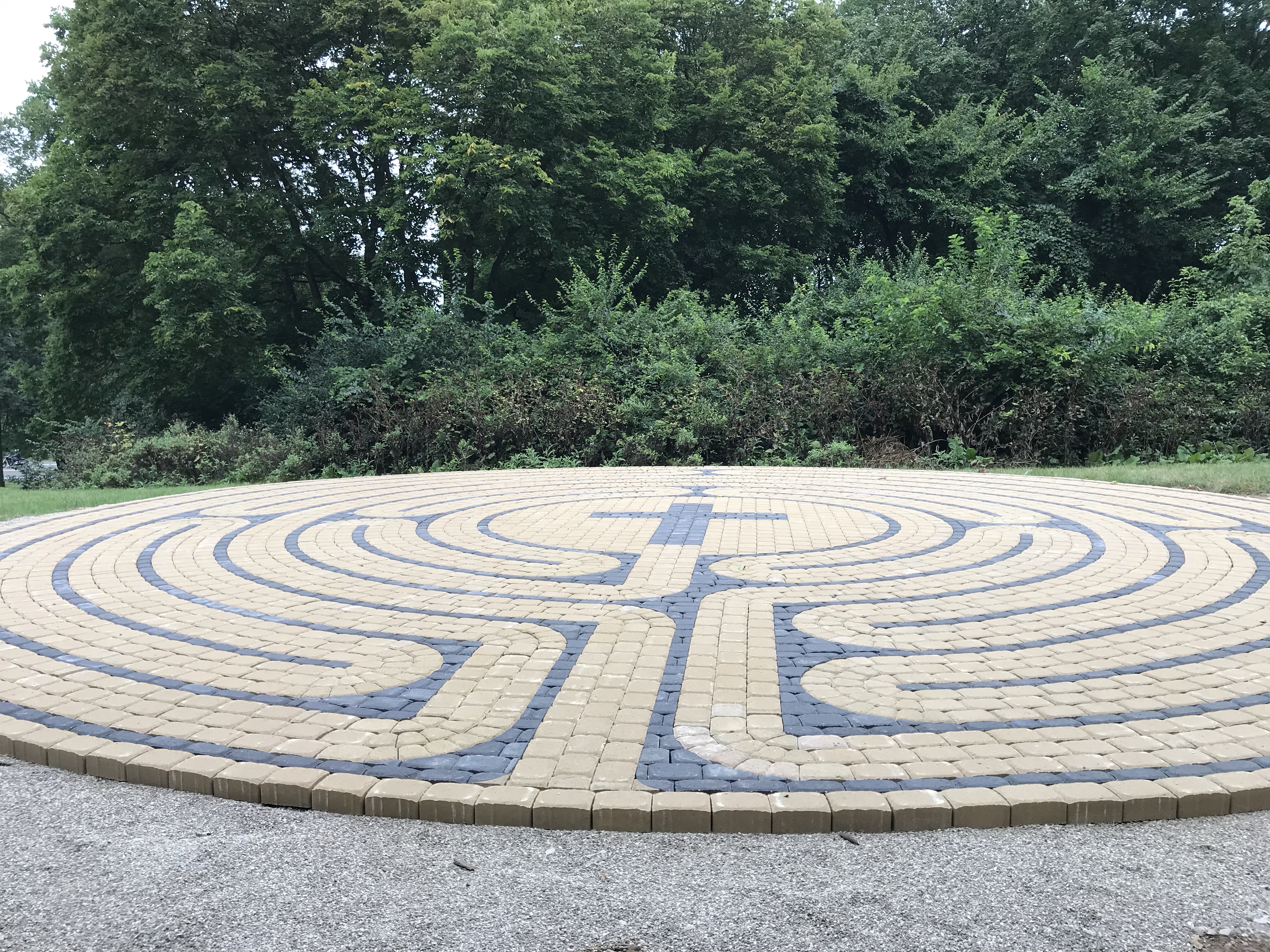
I walked our church’s new labyrinth this morning after church. I think it is the most beautiful one I’ve ever seen and am so grateful to those who worked to build it. I know it’s true of all labyrinths, but I was struck again today by how close one gets to the cross in the center on numerous occasions only to turn away and double back in the other direction. Isn’t that true of our faith journey? We feel especially close to God one minute, and the very next life hits us with a body blow we didn’t see coming; and all of a sudden God seems so distant that we feel lost and confused. That’s when spiritual discipline is needed to stay the course and trust that road less travelled will eventually lead us back to the cross.

There are no short cuts in our faith journey, only perseverance and trusting the Holy Spirit to lead us home. If you notice in the picture the entry path very quickly takes you within a few feet of the cross before it takes a sharp left turn that leads to the far side of the labyrinth. It would be so easy to step right over that blue line and in two steps be right at the foot of the cross. No one else was there to see if I cheated when I took my walk, but I knew that those who promise a short easy way to salvation are false prophets. To take a short cut would have robbed me of precious time for communion with God and defeated the whole purpose of being there.

The Dangerous Pursuit of “Happiness”

The current heated debates in the U.S. about personal freedom vs. the greater good for society when it comes to masks and vaccines has had me pondering for some time about a key phrase in the Declaration of Independence. That document authored by Thomas Jefferson and edited by a committee of five states in these familiar words: “We hold these truths to be self-evident, that all men are created equal, that they are endowed by their Creator with certain unalienable Rights, that among these are Life, Liberty and the pursuit of Happiness.”

As I have said numerous times lately I have been blessed during the pandemic by being introduced to the work of Dr. Brene Brown by my spiritual director and a book club I have been in. I am currently re-reading Brown’s 2011 book, “The Gifts of Imperfection” where she shares among other things the results of her research into joy and gratitude and describes what she has learned about the difference between two words we normally equate as synonymous, happiness and joy.

I was particularly pleased that Brown quotes a United Methodist pastor, Anne Robertson, Executive Director of the Massachusetts Bible Society, to explain the meaning of the Greek words for happiness and joy. Robertson says the Greek word for happiness
is Makarios, which was used to describe the freedom of the rich from normal cares and worries,
or to describe a person who received some form of good fortune, such as money or health. Robertson compares this to the Greek word for joy which is chairo. Chairo was described by the ancient Greeks as the “culmination of being” and the “good mood of the soul.” Robertson writes, “Chairo is something, the ancient Greeks tell us, that is found only in God and comes with virtue and wisdom. It isn’t a beginner’s virtue; it comes as the culmination. They say its opposite is not sadness, but fear.” (“Joy or Happiness?” St. John’s United Methodist Church, http://www.stjohnsdover.org/99adv3.html)

That understanding of those two words presents challenges to Jefferson’s “pursuit of happiness,” and our American obsession with doing so. I think it is no coincidence that Jefferson owned far more slaves (600) than any of the other 15 of our other U.S. Presidents who were slave owners. According to Statista.com only Washington and Jackson owned even 200 slaves. Given the Greek definition of happiness it’s pretty obvious to me that Jefferson was quite free of many normal “cares and worries” most of us experience. That in no way diminishes all of Jefferson’s amazing accomplishments, but it does help to explain how he had time to create all of the advanced technologies at Monticello along with his diplomatic and political accomplishments.

It also explains his favoring the philosophy of John Locke when he included “the pursuit of happiness“ as one of three unalienable rights. I would argue that our American settling for happiness instead of joy is at the heart of our current manipulation by consumerism, materialism, individualism and elevating personal freedom over community and compassion. And this all contributes to the attitude of those who refuse to be vaccinated against a deadly pandemic because it violates their personal liberty. If the value of joy that comes with compassion and caring for others were more central to our cultural values fewer people would be willing to risk harm to themselves and the most vulnerable in our nation and world for their own personal liberty and “happiness.”

Our mistaken notions of happiness as the absence of pain or suffering is fed by consumerism and the prosperity gospel, and these fail to satisfy because in those models there is never enough of anything in these individual, self-centered pursuits that will ultimately satisfy our deep human hunger for human or divine connection. Our failure to grasp the true meaning of the Gospel of Christ as one of compassion, which means suffering with others has led us down the wide path that leads to destruction; and we are dangerously close to the point of no return on that path.

As I am writing this I again found today’s (August 7, 2021) daily devotion from Father Richard Rohr to be right on point. He quotes Buddhist teacher Cuong Lu: “The way to free yourself from pain is to feel it, not to run away, as difficult as that may be. Pain and suffering make life beautiful. This might be hard to believe while you’re suffering, but the lessons you can learn from hardships are jewels to cherish. If you’re suffering, it means you have a heart. Suffering is evidence of your capacity to love, and only those who understand suffering can understand life and help others.”

Jesus teaches the same in word and example by urging his followers in all three synoptic Gospels to “Take up your cross and follow me” (Matthew 16, Mark 8, Luke 9), and by his own courage to practice what he preached. Brene Brown addresses the same phenomenon from a psychological-emotional perspective in “The Gifts of Imperfection:” “We cannot selectively numb emotions. When we numb the painful emotions, we also numb the positive emotions.”

All of that wisdom from diverse perspectives is supported by our contemporary headlines. The Delta variant is running rampant threatening to overwhelm exhausted health care systems, a fragile economy, and kill thousands of more vulnerable people. What we are doing simply is not working, and unless we learn very soon to put aside our thirst for political power at all costs and our fear of each other we are headed for another bleak and dark winter of death and/or lonely isolation.

Dear God, give us ears to hear the truth that can set us free from fear and the pursuit of “happiness” that does not satisfy.

Critical Race Theory and the Road to Reconciliation

I spent part of the pandemic studying and discussing systemic racism with other Christians concerned about living out our faith as anti-racists. In that process I have learned many hard lessons about the dark side of American history that most of us did not learn about in our schools or churches. It is very uncomfortable work, and while there are signs of hope, the current pseudo-debate over Critical Race Theory reminds us how far we have to go to heal 400 years of injustice and the wounds caused by racism.

I know much of the anti-CRT rhetoric coming from the Republican Right is just more red meat for the Trumpist base, but it also occurs to me that part of the problem that has gotten us where we are must be owned by the Christian church. A large part of the reason we have not learned about the horrors of lynchings as public spectacles or events like the Tulsa massacre is a failure by the church to teach and live out the true good news of the Christian Gospel.

Most of us can think of events in our own lives or of our families that we would be very embarrassed to have made public. I certainly have plenty in my life. It’s no different for a nation to want to put the best face on our actions and accomplishments as a country. For example, if we are writing a history of 1969 we Americans would much rather focus on the Apollo 11 moon landing than the My Lai massacre. But both are part of that year’s history, and we can’t get an honest picture of American culture in the ‘60’s without knowing about both.

Criticism is never easy to swallow. A favorite push back against critics of the Viet Nam war was the slogan “America: Love it or Leave it.” Such a defensive reaction to having unattractive aspects of our history exposed is easy to understand, but unless we can get comfortable with being uncomfortable about those embarrassing parts of our lives as individuals or as a nation we can never learn from them or move beyond them.

Much of our failure to embrace all of our history stems from a misunderstanding of God and God’s justice. Father Richard Rohr describes the difference between human and divine understandings of “justice” this way in his daily meditation this week (7/6/21): “When we think of justice, we ordinarily think of a balance: if the scales tip too much on the side of wrong, justice is needed to set things right. But God’s justice does not make sense to human ideas of justice! We define justice in terms of what we’ve done, what we’ve earned, and what we’ve merited. Our image of justice is often some form of retribution, which we then project onto God. When most people say, ‘We want justice!’ they normally mean that bad deeds should be punished or that they want vengeance. But Jesus says that’s simply not the case with God. The issue is how much can we trust God? How much can we stand in the flow of God’s infinite love? How much can we let God love us in our worst moments?”

This means that understanding God’s grace as unconditional love, even if we can’t wrap our minds around it completely, frees us from the fear of being punished for our sin. It is what Jesus means in John 8:32 when he says “the truth will set us free.” The truth is God’s love for us is so much greater than our worst behavior, even centuries of systemic racism, that we can face the truth, confess our sin and be set free to live in right relationships with our sisters and brothers.

When we read the many stories in the Bible about God’s relationships with sinful humans we can experience for ourselves what God’s grace feels like. Time after time in Scripture God calls and uses fallible human beings to further God’s reign of righteousness. Jacob deceived his blind father to steal his brother’s birthright, Moses murdered an Egyptian, David was an adulterer and murderer, Rahab was a prostitute, Saul was a vicious persecutor of Christians before God turned him around on the road to Damascus. These stories and what we hear on the nightly news are all examples of how all of us fall short of the glory of God (Romans 3:23).

The pantheon of American heroes is no different. Most of the brave men who pledged their “their lives, their fortunes, and their sacred honor” by signing the Declaration of Independence owned other human beings. Even our patriotic songs recognize that we are always in need of creating a more perfect union. “America the Beautiful” includes a line asking God to “mend our every flaw.”

We are a flawed nation made up of flawed human beings, but there is no shame or fear in showing God and ourselves that contrary to the famous line in the movie “A Few Good Men” we can and we must handle the truth. The alternative is that the lies about our history that we have passed down from generation to generation by commission or omission will continue to fester and poison our nation with hate and fear.

I John 1:9 Says it best: “If we confess our sins, God who is faithful and just will forgive us our sins and cleanse us from all unrighteousness.” But confession is the key word in that verse. Admitting our failure is the only way to be free of the burden of guilt and move on to a place that is closer to the peaceable kingdom God intends for all of creation. Friends, there is no reason to fear confession or humbly learning about the dark side of our history because God’s love and mercy are guaranteed. Thanks be to God!

Free At Last!

“And you will know the truth, and the truth will make you free.” (John 8:32) Last week as we at long last commemorated the first official Juneteenth these familiar words from John’s Gospel took on new meaning for me. When the news finally reached Galveston on June 19, 1865 that our black sisters and brothers were free from the bondage of slavery the truth is that they had already been free for a year and a half and didn’t know it.

The Emancipation Proclamation was issued by President Lincoln on January 1, 1863, and the fact that it took 18 months to reach Texas is hard for us in the 5G Information Age to imagine. But technology aside it is even more embarrassing to realize that it has taken 156 years for America to officially recognize this historic event.

The parallel observation for me when thinking about John 8:32 is that far too many of us who strive to follow Jesus Christ have been prisoners to sin, guilt, fear and the spiritual death those things bring for all our lives without knowing the good news that we are already free. In the words of Father Malcolm Boyd‘s book by the same title we are “Free to Live, Free to Die” because the chains of death were broken once and for all in the death and resurrection of Jesus Christ.

What will we do with that freedom? It is not a gift to be hoarded as a personal prize, for if we do our efforts to protect our own privileges will poison the well of eternal life. If any of God’s children are enslaved none of us are truly free.

So recognizing Juneteenth is not an end in itself. It is one more step on the long road to liberty and justice for all, to the day when we all can say together, “Free at Last, Free at Last. Thank God Almighty we are free at last!”

Swimming for My Life

This post is either a little late for memorial day or a little early for Father’s Day or maybe both. As part of my rehab from back surgery last fall I have been spending a lot of time in the YMCA pool. I am not a good swimmer, but I have greatly increased my stamina over the last two months. I am swimming because it is low impact and about the only kind of aerobic exercise I can do because of my back.

While swimming I’ve had an unexpected revelation of admiration for my father who died a little over three years ago at the age of 96. Dad was a bomber pilot in World War II. Because our relationship was always rather strained there are lots of questions now that I wish I had asked my dad, among those are questions about his military service. I don’t know if he would have wanted to talk about a very traumatic experience he had in the war or not, and now I will never know.

I know he only made a few actual bombing runs because he got to Europe near the end of the war. I wish I had asked him about those, but because I grew up in the Vietnam war era I have always been a little anti-militaristic. The one biggest event that happened to my dad which I wish I could talk to him about occurred when he was co-pilot on a B-17 that was bringing him and 16 others back to the states after the war.

My sisters and I discovered after Dad died that he had written an article about this event for the newsletter at the retirement community where he lived for the final 28 years of his life. He titled his article “The Big Splash” because the B-17 those men were on developed engine trouble shortly after leaving the Azores in the North Atlantic Ocean and had to “ditch,” which is pilot speak for crash landing in water.

They ditched at midnight in a heavy fog, which caused them to hit the water too fast, breaking the plane in two. My dad was unconscious for a bit but was revived by the pilot and able to escape the sinking plane. Unfortunately most of his crew mates were not so fortunate, and by the time they were rescued only 4 survived the crash and 12 hours in the cold water.

Dad wrote that he thought part of the reason their rescue was delayed might have been because the radio man, in the pressure of the moment, sent the wrong coordinates for their location when the May Day signal went out.

What we do know for sure is that my dad and his buddies spent 12 long hours in the dark in cold water where sharks were known to roam. I did not remember all that while swimming in the comfortable 84-degree water at the Y, but when I did my amazement at what that experience must have been like truly inspired me. I remember telling myself, “OK, Steve, if Dad could do this for 12 hours, you can certainly do it for 30 minutes.” And I have reminded myself of that frequently ever since when I get tired in the pool or inhale at the wrong time. It’s those times I ask Dad and my Abba Father to help me finish my swim.

I don’t know if my dad and those guys had life jackets on or were in life rafts. I doubt if they had time to deploy the latter, and I know from first-hand experience that having a life jacket on while out of control in a strong current is still quite unsettling. (See my post, “When Oceans Rise,” May 9, 2019 for that story).

These recollections have not only helped keep me swimming when I needed motivation, they have also helped me understand and appreciate who my dad was as a result of that experience. I know there was no treatment for PTSD in 1945, and I wish I had been more aware of that and given my dad the credit he deserved for coping as well as he did for his remaining 70 plus years of life. I was much too judgmental of his rigid and legalistic coping skills, and I hope he can forgive me for that.

My dad was not religious growing up, and I know this big splash story was a baptism of sorts (and a baptism of fire) for him which made him a Christian; and that meant being a part of the larger Christian family began for me immediately when I was born 15 months after Dad’s near-death ordeal.

I don’t know for sure, but I’m guessing there was a lot of praying during that long night in 1945; prayers that no sharks would be attracted by the blood in the water; prayers for the men who died from exposure before the rescuers arrived, and lots of bargaining with God and promises to change if they could be spared.

My prayers while swimming in the pool under the watchful eye of a lifeguard are pretty trivial by comparison. Mostly my prayers take the form of remembering biblical stories about Jesus napping in the boat during a storm and then calming the sea (Mark 4:35-40), or Jesus walking on the water and Peter’s short-lived attempt to do the same (Matthew 14: 25-32).

So, when you need a faith booster, be it in actual water or in the metaphorical oceans we call life, draw strength from the biblical or personal stories that inspire you to just keep swimming. That kind of faith is described so well in these words from the praise song “When Oceans Rise” by Jake R. Sanderson:

“You call me out upon the waters
The great unknown
Where feet may fail
And there I find You in the mystery
In oceans deep
My faith will stand

And I will call upon Your name
And keep my eyes above the waves
When oceans rise
My soul will rest in Your embrace
For I am Yours
You are mine

Your grace abounds in deepest waters
Your sovereign hand
Will be my guide
Where feet may fail and fear surrounds me
You’ve never failed
And You won’t start now

So I will call upon Your name
And keep my eyes above the waves
When oceans rise, my soul will rest in Your embrace
For I am Yours and You are mine

Spirit lead me where my trust is without borders
Let me walk upon the waters
Wherever You would call me
Take me deeper than my feet could ever wander
And my faith will be made stronger
In the presence of my Savior.”