“A Broken Jar,” Sermon on Mark 14:3-11

We’ve been talking about all kinds of brokenness during this Lenten season. Most of the brokenness has been about things that we cannot control – stuff that just happens to us or is going on out there in that scary world. When I started working on this sermon for some strange reason one of the broken things that first came to my mind was my aging body. I did hear a great line recently about aging. It said, “Don’t worry about getting older; you will still do stupid stuff, just more slowly.”

One thing I’m learning about aging is that it does no good to complain. I am much better off, and so is everyone else, if I embrace my brokenness and celebrate what still works instead of moaning what doesn’t.
And we all know something about broken relationships. I recently read a novel called “The Burgess Boys” by Elizabeth Strout, and near end of the book one of the title characters, Jim Burgess is depressed about a whole series of life events including separation from his wife, estrangement from his kids, and loss of his job. He’s hit bottom and says to his brother, Bob: “I don’t even have any family.”

Bob says, “Yes you do. You have a wife who hates you. You have kids who are furious with you, a brother and sister who make you insane, and a nephew who used to be a drip but apparently is not so much of a drip now. That’s called family.”

A prison ministry volunteer from our church told me about an inmate at the correctional facility where he does his ministry. This man has a tattoo over his eyebrow that says “Broken.” Maybe we all need one of those! We are all broken in one way or another because we are fallible human beings who live in a world created by other fallible human beings. That’s just the way it is, and no amount of regret, anger, complaining or wishing it weren’t so will change that. In the words of Ernest Hemingway, “We are all broken, that’s how the light gets in.”

Today we have heard Mark’s Gospel describe the story of a broken jar, a jar of very expensive ointment. 300 denarii were equal to a whole year’s wages for a worker– think a very large bottle of Chanel #5. This costly ointment was used by an unnamed woman to anoint the head of Jesus shortly before his final trip into Jerusalem. Unlike most brokenness in our lives which we try to avoid at all costs – this one is a voluntary act of a costly sacrifice. There is no crying over spilled ointment here because this jar was not dropped accidentally – the brokenness here was intentional and chosen for a very clear purpose.

We don’t know who this woman is. Like most of the women in Mark’s gospel who are followers of Jesus, her name is unknown. But as the text points out, her actions are remembered for posterity because she, unlike the men who hang out with Jesus all the time, recognizes who Jesus is and does the one thing she can do to honor his Messiahship. She anoints Jesus’ head – an act normally reserved for kings, and as they say, “no good deed goes unpunished.” She is immediately criticized for wasting such a valuable asset that could have been used in more practical ways, like being sold at the silent auction to feed the poor. A few drops of the ointment would have been plenty to anoint Jesus, but she chooses to be extravagant like our God who pours out grace and mercy on all people. So she gives Jesus everything’s she got.

Then comes what is for me the most curious part of this story. Jesus says, “Let her alone; why do you trouble her? She has performed a good service for me. For you always have the poor with you, and you can show kindness to them whenever you wish; but you will not always have me.”

Compassionate Jesus who normally is a chief advocate for the poor seems to be saying, “Forget the poor – you can take care of them anytime you want. This is about me for once.” The context is important here. Jesus knows what awaits him in Jerusalem while the Disciples are still in denial about his impending demise. So Jesus tells them yet again, “She has done what she could; she has anointed my body beforehand for its burial. Truly I tell you, wherever the good news is proclaimed in the whole world, what she has done will be told in remembrance of her.”

Like most of life, this situation is not an Either/Or but a Both/And. We know from the consistency of Jesus teaching and actions throughout his entire ministry that he is not saying we should not feed the poor. That’s a given. It’s depressing but true that we have the poor with us always – that’s part of our broken world that favors the haves over have nots. To suggest we can choose between honoring Jesus and caring for the least of our brothers and sisters is a false dichotomy. In fact, we can’t really do one without the other. Without the love of God to empower us in the face of all the brokenness around us, we burn out like a candle in the wind.

Have you ever felt powerless in the face of someone’s brokenness to know what to do or say? How often do we hesitate or fail to go the funeral home or visit someone recently divorced or suffering from some other brokenness because we feel awkward and don’t know what to do or say. How often do we fail to give to a charitable cause or ministry or volunteer to help because the problems of society and the world seem too overwhelming. It doesn’t mean we don’t care – in fact it feels like we care too much but feel inadequate to do anything that really matters. Because as unfair as it seems, some brokenness just cannot be fixed.

That should not come as news to us – most of us learned that lesson at a very early age from that great philosopher, Mother Goose:
Humpty Dumpty sat on a wall,
Humpty Dumpty had a great fall;
All the king’s horses and all the king’s men
Couldn’t put Humpty together again.

But we never learn from Mother Goose or Dr. Seuss what to do when we are in one of those hopelessly broken places. Fortunately we don’t need to learn that because we all come hardwired to respond to the pain of others.
A little boy came home from visiting his elderly neighbor who had recently buried his wife of many years. The lad’s mother was curious what the two of them had done, and so she asked, “Did you play catch with Mr. Benson?” No, said Bradley. Did you help him in his garden? No. Did you watch TV or play checkers? Brad shook his head. “Well, what did you do?” she finally asked in frustration. “Oh, we didn’t do anything. I just sat on the porch and helped him cry.”

We innately know how to care but often our compassion gene gets overridden by our own brokenness, and we need to remember again that childlike, natural way to just be there with and for someone.
The woman with the jar is in one of those situations in Bethany where there’s little she can do for Jesus. His fate is sealed. Jesus’ unconditional love and faithfulness to God will not be compromised even in the face of death on a cross.

The woman at Bethany can’t fix that problem. She is apparently a woman of some means or she would not have a jar of very expensive ointment. But no amount of earthly wealth can stop the wheels of hate and oppression that are about to consume Jesus’ earthly life. But that does not mean there is nothing she can do. She takes what she has available and acts on her recognition of who Jesus is. She honors him while he is living instead of waiting until the funeral.

I listened to a very helpful webinar recently about empathy and compassion that this story illustrates for me. Thupten Jinpa, a colleague of the Dali Lama was talking about the emotional part of our reaction to the brokenness of others. We identify with the pain and suffering of someone else, and we call that empathy. But as Jinpa pointed out, while empathy is necessary and important, we can’t get stuck there or we suffer from empathy burnout. We can feel all the empathy in the world for the kids at Avondale School without adequate heat, or the thousands of Syrian refugees, or the flood victims in Louisiana & Mississippi, or people living in Flint. We can have great empathy and all of us here do, but that empathy needs an outlet. Our emotions have to translate into an action step or they can weigh us down like we are carrying the weight of the world on our shoulders and in our hearts.
That is especially true in the 24/7 news cycle world we live in. We know about more brokenness in the world than any generation before us has ever known, and it wears us down. We can’t fix all the brokenness, and we have to pray for guidance to know where and how we can respond – with cookies for Kairos, or money for UMCOR, or just crying with someone who needs a friend. Some problems require action to right an injustice or build a handicap ramp or fix meals for the hungry folks at Manna café. Others just need our presence – either physically or spiritually to be with the broken hearted.

My dear mother-in-law is one of the most caring Christian people I know. She’s 98 years old and has been confined to a wheel chair for several years, but her awareness of what’s going on in the world is far better than younger people. We were talking about some big global problem one day or probably more than one, and she asked me, “What can someone like me do?” She is one of the most generous people I know when it comes to charitable giving, and she’s one amazing prayer warrior. She has empathy in spades, but she also puts that empathy into acts of compassion through her giving and prayer.

Compassion is the action step inspired by empathy, and we need both. The woman at Bethany had empathy for Jesus’ plight, but there wasn’t anything she could do to change the situation; so she did the only act of compassion she could think of. She moved from empathy to compassion.
By comparison Jesus’ band of disciples react by criticizing her or in the extreme case where empathy was absent Mark tells us, “ Judas Iscariot, who was one of the twelve, went to the chief priests in order to betray him to them.“

What’s the difference? Judas, in arrogant pride thought he knew better than Jesus what needed to be done. Many believe he was bitter and disappointed that Jesus was not the military liberator he expected the Messiah to be. In all fairness to Judas, we don’t know what brokenness he was dealing with that was crying out for compassion, but we do know the woman with the jar came in humility to honor the servant king.

It’s a funny thing about humility and brokenness. Back on Ash Wednesday we read from Psalm 51 which says, “My sacrifice, O God, is a broken spirit; a broken and contrite heart you, God, will not despise.” Why would God want us broken-hearted and contrite? Because then God can work with us and mold us like the potter’s clay. But when we are full of ourselves and hiding behind a phony image of ourselves as all-knowing and successful, afraid to let our brokenness and vulnerability show, not even God can get through that wall to reach us with a healing touch.
But when we recognize and admit our own brokenness – when we confess our need for forgiveness, we are broken open to give and receive the compassion and love of God and others. That expensive ointment could do absolutely nothing for Jesus or anyone else sealed up safe and sound in its fancy container. But when the jar was broken open it anointed a Messiah and filled the house with the sweet aroma of loving compassion.
Each of us is a beautiful jar created in the image of God, and inside all of us is the precious ointment of compassion. Don’t hoard that priceless gift. In the name of Christ, break it open and pour God’s love freely on someone’s brokenness. Be extravagant because that precious ointment comes from an eternal source and it will never run out.

Preached March 13, 2016, Northwest United Methodist Church, Columbus, Ohio

Trump: A Joke No Longer

maxresdefaultGiven the state of our nation and world today, I often feel like this: “Yesterday all my troubles seemed so far away, now it looks as though they’re here to stay. Oh, I believe in yesterday. Suddenly I’m not half the man I used to be, there’s a shadow hanging over me. Oh yesterday came suddenly…… Now I need a place to hide away, Oh, I believe in yesterday.” (The Beatles)

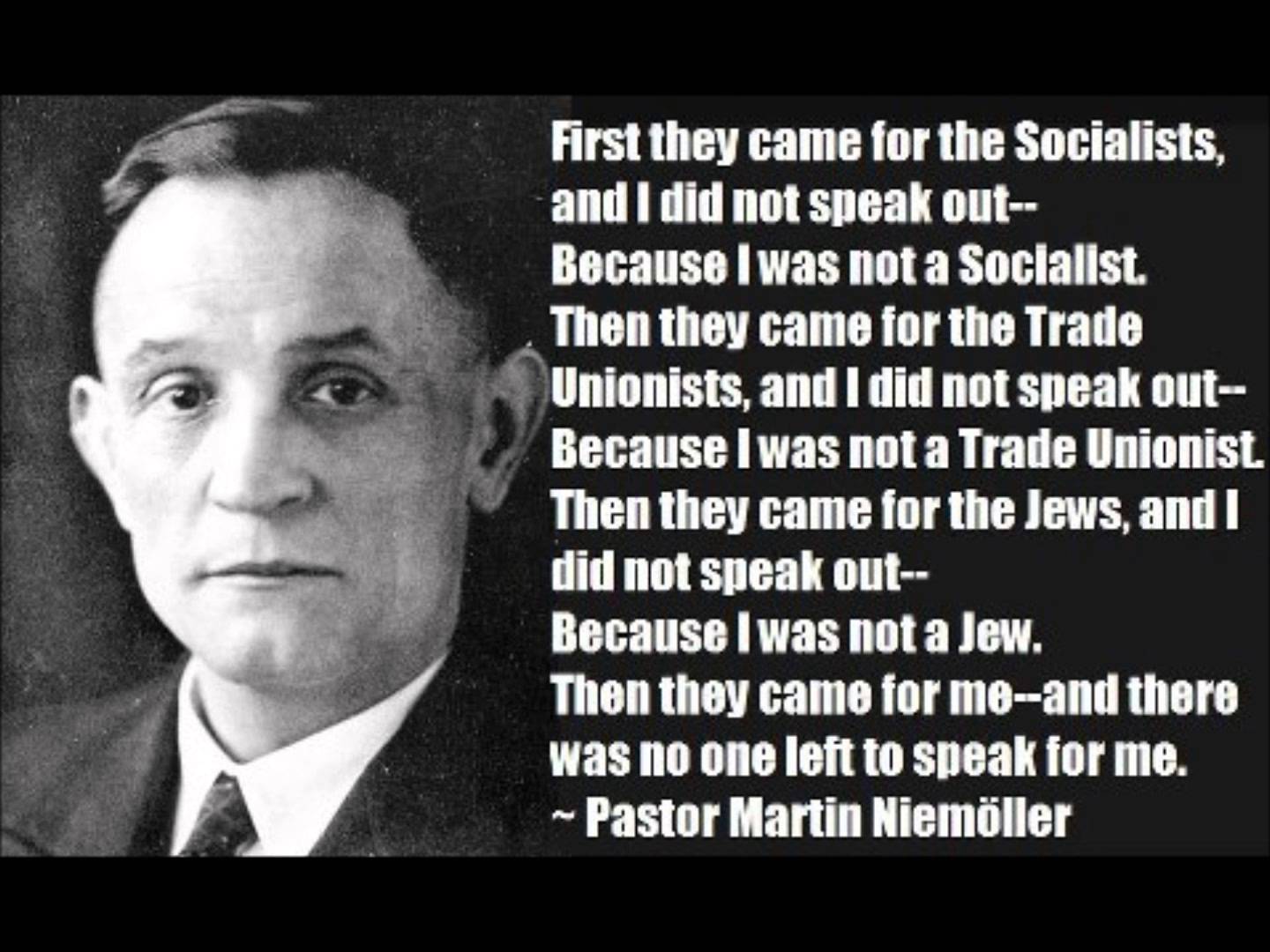
Martin Niemoeller’s words are quoted often and have always inspired me, but until recently they were just a nice philosophical abstraction. Never did I dream they would become an honest to God existential warning for me and my contemporaries living in our blessed democracy. I was wrong.

I learned more about Niemoller last year in a biography about another contemporary clergy of his, in “Bonhoeffer: Pastor, Martyr, Prophet, Spy” by Eric Metaxas‎. It was there I realized even as the storm clouds of Trumpism were gathering that Niemoller’s words were a painful confession of his own failure to act out of Christian compassion to save his sisters and brothers from the Nazis until it was too late for them and for him.

Although he is most famous for the quote above Niemoller was taken in by Hitler along with his fellow Germans. “Niemöller’s sermons reflected his strong nationalist sentiment…. Niemöller believed that Germany needed a strong leader to promote national unity and honor. When Hitler and the National Socialist Party emerged, touting nationalist slogans and advocating autonomy for private worship of the Christian faith, Niemöller voted for the Nazis—both in the 1924 Prussian state elections and in the final national parliamentary elections of March 1933. Hitler espoused the importance of Christianity to German nationality and Christianity’s role in a renewal of national morality and ethics (sound familiar?) leading Niemöller to enthusiastically welcome the Third Reich. Niemöller later confessed that even Hitler’s antisemitism reflected a more extreme version of his own prejudice at that time.” It was only much later after Hitler’s fanatical power was firmly entrenched that Niemoller awoke to the error of his ways and became an active opponent of the Nazi terror. He was imprisoned in several concentration camps for 7 years for his opposition until he was liberated by the Allies at the end of the war. (Above quote and more information available in “Niemoller: A Biography,” http://www.ushmm.org/wlc/en/article.php?ModuleId=10007391).

For good or ill I have tried to avoid public statements about partisan politics in my 40 plus years as a pastor. Call it wisdom or professional survival or cowardice, the truth is that the only two times I am aware of that anyone complained about my ministry to church authorities were two times that I could no longer be quiet about political issues and candidates that I felt strongly were in opposition to Judeo-Christian values and principles. We are now again in one of those “if we are silent the stones will shout out” (Luke 19:40) moments when to paraphrase Lincoln, we are engaged in a great struggle to see if “this nation or any nation so conceived and so dedicated can long endure.” That may sound melodramatic, but I believe it to be true.

I will not be one who regrets not speaking up at this critical juncture of history. The racist, nationalistic, xenophobic rhetoric of Donald Trump and Ted Cruz is too much like that of Hitler to ignore it and hope saner heads will prevail. Trump bragged the other day after his victory in Nevada that he “loves uneducated people.” Of course he does. He is leading a war on critical thinking and shouting down rational, civil discourse verbally and with vulgar, shallow Tweets. His Twitter campaign is brilliant in its strategy. No in depth dialogue can occur when utterances are limited to 140 characters.

A friend and I were discussing in bewilderment yesterday how self-proclaimed Christians can support a candidate who espouses in no uncertain terms blatantly unchristian values. We started listing the values Trump trumpets, and I realized it sounded like a recitation of the 7 Deadly Sins of the Roman Catholic tradition. I double checked the list: greed, lust, wrath, gluttony, pride, envy and sloth/laziness. I’ll give him a pass on the last one, but Mr. Trump certainly seems guilty as sin on the other six. It’s one thing for a secular society to embrace “Greed is Good” as a motto but quite another to allow anger and fear to blind oneself to the crass character of a leading contender to become the most powerful person on the planet. No matter how you feel about any other political or social issue, do you really want someone as volatile and undisciplined as Trump having his finger on the nuclear trigger?

The test for being a Christian is not just claiming the label; it is taking up a cross and following Jesus. As we all make these critical political decisions about the future of our world, let us not confuse what the radical right is peddling with the Christian Gospel. Read the parts of Scripture that say: “Pride goes before destruction and a haughty spirit before a fall” (Proverbs 16:18). “You have heard that it was said, ‘Love your neighbor and hate your enemy.’ But I tell you, love your enemies and pray for those who persecute you” (Matt. 5:43-44). “Those who live by the sword will die by the sword” (Matt. 26:52). “Which commandment is the first of all?” Jesus answered, “The first is, ‘Hear, O Israel: the Lord our God, the Lord is one; you shall love the Lord your God with all your heart, and with all your soul, and with all your mind, and with all your strength.’ The second is this, ‘You shall love your neighbor as yourself.’ There is no other commandment greater than these” (Mark 12:28-31).

These are critical times that call for acts of courage and faith. As tempting as it seems, don’t just seek a “place to hide away” or fail to learn the lessons of history so we are condemned to repeat them. Niemoller waited too long to speak up, but we dare not be silent.

Finding Our Way Back to God: The Search for Meaning, Micah 6:1-8

Many years ago I overheard a dinner table conversation between my in-laws that stuck with me. This was back in the days before bucket seats and consoles with gear shifts and cup holders began dividing the front seats of cars like the Berlin wall. For those who don’t remember those good old days, the front seat was a bench seat and dating couples could snuggle up close to each other while driving. We didn’t need cell phones to be guilty of distracted driving. My in-laws had been married for many years at this point, and my mother-in-law was reminiscing about their dating days and how she used to sit over in the middle right next to her beloved. And she asked, “Why don’t we do that anymore?” Her husband got a mischievous grin on his face and said, “Well, I’m not the one who moved.”

As we consider how we find our way back to God the first thing we need to remember is that God isn’t the one who moved either. And our text from Micah addresses the question of how we make that journey.

We sometimes move away from God because we are searching for purpose and meaning for life in a scary confusing world. What is our passion, our purpose for living? What gets us out of bed in the morning saying? And how we answer that question is one of the keys to finding our way back to God when we feel lost and like running away.

The most familiar verse in the book of Micah is one attempt to wrestle with the search for the meaning of life and our relationship with God. Micah 6:8 says, “God has told you, O mortal, what is good; and what does the LORD require of you but to do justice, and to love kindness, and to walk humbly with your God? That verse is Micah’s reply to the question raised two verses earlier – “With what shall I come before the LORD, and bow myself before God on high?” This is familiar format for an entrance litany as Jews prepare themselves for worship – asking what must we do to please God, to make ourselves worthy of God’s presence and blessing?

Part of our struggle when we feel removed from God is centered in that basic question – am I good enough? And when we feel like we are not, what does God do about that? When we mess up do we get what we deserve from God? I hope not. And if we feel like we don’t have a clear purpose for our lives or we are failing to achieve it, it’s hard to feel all warm and fuzzy about God.

What is your why for living? Unless we can answer that question we are just going through the motions in some kind of cosmic rat race, and that feeling of meaninglessness is not conducive to closeness with God.

Micah prophesied at the beginning of that time when Israel and Judah were in the deep trouble that eventually led to the Exile. The Assyrian empire was threatening their very existence; the rulers of Israel had put their trust in foreign alliances instead of in the ways of God, investing vast sums in armaments instead of taking care of their own citizens, going into crippling debt by borrowing from the Assyrians. Sound familiar?

Listen to how the NRSV introduces the book of Micah: “Micah offered a theological interpretation of the dizzying events near the end of the 8th century: the fall of Samaria, the expansion of Jerusalem fueled by emigrants from the north, and the international situation made unstable by an aggressive superpower, Assyria.” So this question about the meaning of life and what we must do to please God was not some idle Sunday School discussion topic for Micah – it was a matter of life and death, and it still is.

Micah begins chapter 6 with an Imperative – “Listen up people to what the Lord says.” He then portrays the situation of Israel being on trial for breaking her covenant relationship with God. Then follows a quick review of God’s salvation history with Israel. Micah begins with the seminal event in Israel’s history, how God chose Moses, Aaron and Miriam to lead the people out of slavery in Egypt. Secondly he highlights a much less familiar, at least to us, story of Balaam’s encounter with King Balak of Moab during the long wilderness journey of the Exodus, and wraps it up with a reference to two cities representing the crossing of the River Jordan, Shittim on the east side of the Jordan and Gilgal on the west in the Promised land.

If you’re like me, the exodus from Egypt and the crossing of the Jordan are familiar stories, but the Balaam and Balak reference, not so much. We’ll come back to it because it’s a really cool story, but for now let’s just say Micah uses it to remind the people of one of many times during the 40 years in the wilderness that God rescued the Israelites and helped them overcome obstacles and enemies that stood in their way to freedom and promise.
So with a God who has done all that for his people, people are asking why have things gone so sour? Their world is going to hell in a handbasket. They feel abandoned and alienated from this God who has been their deliverer and savior for centuries.

They need to remember, God isn’t the one who moved – God is faithful and just forever; so when we feel separated from God, the question is what do we need to do to get back next to God.

Micah responds by turning to the question of worthiness and atonement. Verse 6 says “With what shall I come before the Lord.” How can I find my way back to God? And then follows a litany of sacrifices that gets increasingly ridiculous – the best calves, 1000 rams, 10000 rivers of oil, and first born children. You see, the Jews are big on laws. We’re familiar with the top ten list from Mt. Sinai, but those tedious books of Leviticus and Numbers that we don’t often read spend a lot of time explaining the 10 commandments and trying to legislate specific rules and regulations for daily life in order to fulfill what God requires. There are 613 laws the Jews tried to live up to –- and they didn’t’ have any apps to keep track of those. So obviously, being the imperfect fallible human beings they were, they needed a way to make amends with God when they messed up, which was often.

And their system for getting back in God’s graces was offering sacrifices to God. These were ritualistic acts of worship, but as Micah and the other prophets point out, to attend church regularly and perform all the necessary rituals doesn’t mean squat if you go on living unjust, sinful lives the rest of the time.

So finally we get to verse 8 where Micah summarizes what the faithful life looks like in three short phrases – what does the Lord require? – do justice, love mercy or kindness, and walk humbly with God. That’s the way to a life of meaning and purpose, that’s the way back to God. It’s not just something we can do but encompasses who we are called to be. I heard a wonderful sermon once that took its theme from a Frank Sinatra song, “Strangers in the Night,” and in particular from the profound refrain to that song that just says, “do be do be do.” The preacher said if you change that phrase and take out the “be” all you have left is “do do.”

We are not human doings – we are human beings, and faithful living is a holistic process that encompasses all that we are, not just some segmented religious part of our life. Micah lists justice, mercy and humility, qualities that include active doing – working for justice, treating others with mercy and kindness as a way of being –not out of sense of duty or obligation, but simply because in a faithful, loyal relationship with God, we take on those qualities of being.

Pope Francis is a fascinating example of what Micah describes here. The Pope is beloved by so many people because of his humility. He has rejected the usual pomposity of his office, traveling in a little Fiat, taking time to listen to a little girl trying to keep her immigrant parents in this country, spending time with the homeless, washing stinky feet. He walks the walk and because he does so he can also advocate for justice in the halls of Congress and get a standing ovation for the golden rule from a badly broken and partisan legislature.
Francis has been criticized for being too political, but that’s where justice has to happen, in the political arena where too often the rules that perpetuate poverty are passed by the powerful for the benefit of the powerful.

We sometimes use separation of church and state as an excuse for not getting our hands dirty in the messy business of politics, but that’s a misunderstanding of the first amendment to our constitution. It says, “Congress shall make no law respecting an establishment of religion, or prohibiting the free exercise thereof.” It doesn’t say religion can’t influence the making and implementation of the laws and policies we live by. In fact Micah and the prophets and Jesus are all very clear that God wants laws that are just and that part of the free exercise of our faith is to help make that happen.

Speaking of church and state, let’s go back to King Balak and Balaam for a moment. The whole story is in Numbers 22-24, and I’d encourage you to read it. It is no accident that Micah uses this story in this section about justice and mercy and humility. The short version of the story is that the Israelites are on their way through the wilderness on their way to the Promised Land and one of the many hostile territories they have to pass through is Moab. King Balak sees the vast number of these illegal immigrants heading into his country and orders the prophet Balaam to curse them and drive them away. (Sort of like building a big fence?) But Balaam consults a higher authority, and God tells him, don’t curse these people for they are blessed. In a humorous scene, when Balaam’s faith wavers a bit his faithful donkey sees God’s angel blocking their path when Balaam can’t see the angel, and the donkey prevents Balaam from giving in to King Balak.

Three times Balak pleads and begs with Balaam to curse the Hebrew people, trying to bribe him with great wealth and power, but Balaam holds fast and tells this powerful ruler that he must do and say only what God has told him. Instead of cursing the Israelites he blesses them and they continue on their way toward the Promised Land.
What does the Lord require of us? Balaam and his donkey’s kind of courage and steadfast faithfulness – refusing to give into unjust, unethical demands of the world, even when it would seem to benefit us to do so. And how do we do that? By walking humbly with God as our constant companion and spiritual guide.
Finding God’s meaning and purpose for most of us is not about one burning bush moment. It’s a journey not a destination. It’s about a total body of work, a life of working for justice for the least and lost, of being kind and merciful to everyone, and doing it all not to earn brownie points with God but to simply share God’s love with the world.
John Wesley famously said when he was kicked out of the Church of England, “The World is My Parish.” And he took his ministry to the streets and to the open fields where people who did not feel welcome and worthy in the church were looking for their purpose and trying to find their way back to God.

On this World Communion Sunday, when our world seems to be on the way to the same destruction that befell Samaria and Jerusalem, the Word from God is this: Listen up People, I have not moved, trust my ways. Do not be overwhelmed or despair. I know your sins and they have not driven me away and never will. Don’t worry about paying for your sins, that has already been done by Jesus Christ, and your mission, should you choose to accept it, is to be Christ-like in humble, merciful service, to work for justice in whatever part of my world you are in – I’m right here with you always.

Benediction: May God grant us the vision of Balaam’s donkey to see that God is not the one who has moved. God is on this journey with us to empower and lead us. By our own strength we cannot live just and merciful lives all the time, but if we humbly walk with God, he will show us the way. That is our purpose. Let’s go.

Prayer Inspired by Solomon’s Request, I Kings 3:9

God, I bet you get tired of my whining and begging and calling it prayer. You don’t need a laundry list of all the things I think I need or deserve since you already know what I’m thinking, what I’m coveting, even when I wish you didn’t. We worry a lot these days about privacy and who has access to our information when we really should be more concerned about what you know about the secret desires of our hearts and minds.

Every time we pray you offer us the same deal the young King Solomon got – to ask for whatever we want. And if we ask for the right thing, the answer is guaranteed. But if we ask for wealth, status, power, comfort or other selfish rewards, no matter what the prosperity gospel advocates say, the answer will be ‘No, try again.’

Solomon could have written the great old hymn, “Be Thou My Vision.”* It says “Be thou my wisdom and thou my true word…. Riches I heed not nor man’s empty praise, Thou mine inheritance now and always.” Solomon doesn’t ask for riches or power, he asks for the wisdom to govern God’s people, “an understanding mind…able to discern between good and evil.” O how we need such wisdom in our troubled world today, O Lord!

God, you know that we need the real necessities of life. Help us to trust you to provide those while we seek after the truth that sets us free from our worries and cares and concerns. Don’t let us confuse knowledge with wisdom. This isn’t about education and degrees – but true insight and discernment. As you blessed Solomon because he humbly asked for wisdom, the prayer of our hearts is that you will also “Grant us wisdom, grant us courage for the living of these days.”** Amen and Amen.

*Old Irish hymn, translated by Mary E. Byrne, 1905 (original poem attributed to St. Dallan Forgaill, 530-598 C.E.)
** From “God of Grace and God of Glory,” by Harry Emerson Fosdick, 1930.

Prayer for 11th Sunday after Pentecost

O Eternal One, the beauty of the summer season at my peaceful home battles in my mind with the harsh realities of life in our broken world. I feel like E.B. White when he said, “I arise in the morning torn between a desire to save the world and a desire to savor the world. This makes it hard to plan the day.”

The 24/7 news cycle bombards us with news of desperate migrants from Africa overwhelming a Greek and European economy teetering on the brink. The next news story describes nursing homes in Japan exclusively for survivors of atomic bombs dropped on them as children 70 years ago this week. Wildfires destroy homes and force evacuations in draught stricken California while typhoon Soudelor ravages Taiwan and China. I turn the page of my newspaper, hoping for some good news, and read that 2000 Iraqis have reportedly been executed by ISIS.

My God, have you forsaken us? The scope and number of world crises is overwhelming, and that doesn’t even begin to count our individual concerns about illness, grief, employment, relationships, and our failures to be the kinds of caring people we want to be. We know we are supposed to respond to the needs of others, God, but the needs are more than we can cope with; and sometimes it all seems so hopeless we don’t even know how to pray.

Help us not to despair and lose faith. We are not the first to feel overburdened and lost, nor will be the last. Even Jesus on the cross drew on the lament of Psalm 22 when he felt forsaken. St. Paul, who is always so strong and certain in his faith, acknowledges times of doubt in Romans 8 and assures us “the Spirit helps us in our weakness; for we do not know how to pray as we ought, but that very Spirit intercedes with sighs too deep for words.” Yes, God’s Holy Spirit intercedes for us. When we are at the end of our ropes, God prays for us!

But we have to be open to that intercession to receive it. Draw us close in our times of fear and uncertainty, God, like a loving mother comforting a child shivering in terror from a nightmare. Do not let doubt and fear drive us from you, Holy One, for it is exactly in such times that we need you more than ever.

We believe, Lord, help our unbelief. Let our weakness and helplessness in the face of everything happening in our lives and world be the motivation that brings us humbly back to you, admitting we can neither save nor savor the world without your divine guidance and eternal strength.

Pray with us and for us, O God, our hope and salvation. Amen.

Encouraged and Inspired: Signs of Resurrection Living

IMG_1150
I’ve been thinking about this topic for a long time and ironically the reasons for my reflections are also the obstacles and excuses for not getting my thoughts and feelings written down. I am at that awkward age when most topics of conversation veer automatically to aches and pains. My list is not unique: arthritis, back pain, glaucoma, neuropathy—nothing noteworthy. Just this week I found a medicated pain patch that helped my nagging back, and I was feeling optimistic about tackling some yard work and playing some golf; and then in one innocent move I twisted my knee and the simplest of tasks became a new challenge.

So, as the final installment in this Eastertide series on the enemies of living resurrected lives I give you “discouragement.” God knows there are far more major issues to be concerned about in the world than a few minor aches and pains. Yes, I know they (whoever “they” are) say, “What doesn’t kill you makes you stronger.” St. Paul expresses that positive spin on suffering in Romans 5: “We also boast in our sufferings, knowing that suffering produces endurance, and endurance produces character, and character produces hope. “ (Vs. 3-4).

Maybe in Disney movies, but not always in real life. Sometimes suffering just beats us down. The 24/7 news cycle bombards us with such bad news around the clock that I hear many people saying they can’t bear to watch the news, especially before retiring for the night. I won’t add to the bad news by reciting the litany of CNN headlines, but you know them, from Nebraska to Nepal the very foundations of the earth and of our faith seem to be on shaky ground.

It’s almost impossible to turn off the news in the information age. Even when I want to watch a recorded sporting event I almost always get an alert or see a post on Facebook telling me the outcome before I want to know it. And even if we could unplug ourselves, the only way to escape tales of suffering would be to disengage from all personal relationships. Friends dealing with unexpected cancer diagnoses, families dealing with substance and physical abuse, mental health issues, and at the same time caring for a loved one wasting away with stage-4 cancer.

One definition of sin that I learned in seminary was “to be turned in on oneself,” and though it didn’t make the church’s top 7 list it is one of the deadliest sins. It is sneaky deadly because focusing on my own problems depletes me of energy needed to care about the personal needs of others and the larger systemic problems of the world. Most people would agree, at least in theory, that compassion is one of the unique and greatest of human virtues. The word “compassion” comes from the Greek words meaning “to suffer with,” and it is almost impossible to be concerned about the problems of others when I am wallowing in a pity party about my own pain.

There has been much wisdom written about human suffering. The first of the four noble truths of Buddhism is that “Life is suffering.” (The second by the way is that our suffering is caused by attachment to the temporary things of this world, but that’s a topic for another day.) Translated into the language of the human potential movement, those two truths are summed up in the catch phrase that “Pain is inevitable. Suffering is optional.” Simply put, pain is part of the human condition – physical, emotional, spiritual – they all go with the territory. None of us can control things that happen to us in life. Bad things do happen to good people. What we have a choice about is how we respond to the “slings and arrows of outrageous fortune” of life, as Shakespeare describes them in Hamlet’s famous soliloquy.

Here’s how St. Paul describes his own struggle with being turned in on his own problems. “Therefore, to keep me from being too elated, a thorn was given me in the flesh, a messenger of Satan to torment me, to keep me from being too elated. Three times I appealed to the Lord about this, that it would leave me, but he said to me, ‘My grace is sufficient for you, for power is made perfect in weakness.’ So, I will boast all the more gladly of my weaknesses, so that the power of Christ may dwell in me. Therefore I am content with weaknesses, insults, hardships, persecutions, and calamities for the sake of Christ; for whenever I am weak, then I am strong.” (II Corinthians 12:7-10).

We don’t know what Paul’s “thorn in the flesh” was, and we don’t need to know. We all have personal problems, challenges, aggravations, misfortunes that we have no solution for. When it comes to physical ailments we are tempted to think that modern medicine should be able to fix any problem our bodies throw at us with just the right pill or procedure. The undeniable truth that becomes clearer as our mortal bodies age, however, is that we are all “dust and to dust we shall return.” (Genesis 3:19).

And that brings us full circle in the Lent to Pentecost cycle. Those words from Genesis are traditionally used as ashes are imposed on Christians on Ash Wednesday –not to be morbid, but to give us a wakeup call. When Paul says “Take this thorn from me,” or Jesus says in the Garden of Gethsemane, “Take this cup from me,” God’s reply is, “Sorry, this is the hand you’ve been dealt, deal with it.” Prayers are always answered, but sometimes the answer is not the one we are hoping for.

The best cure for being turned in on oneself is to be more aware of the needs and lives of our fellow human beings. And that won’t happen if we cut ourselves off completely from the bad news in the world. We need a healthy balance of reality and inspiration from others who truly live resurrection lives. Those people can encourage us so we can be encouragers for others, witnesses to the power of faith that overcomes every thorn, every tragedy and every temptation to give in to the suffering that the world throws at us.

To that end I offer two stories of inspiration that humble and encourage me to trust and believe in the Gospel of resurrection:
download
The first was a simple post on Facebook from the Blue Street Journal. “Against all odds, both of these women survived gunshot wounds to the brain. One of them at the hands of the Taliban and one of them at the hands of a mentally ill mass-shooter. Malala Yousafzai and Gabrielle Giffords inspire and give me hope.”

The second is a great story from Robert Fulghum about a critical life lesson we don’t learn in kindergarten. During his early twenties Fulghum used to work for a countryside resort. He had to do the night shift as a receptionist and mind the stables during the day. The owner was not the most likable or the kindest person on the planet and Robert was getting weary of eating the same lunch every day. In addition, the cost of the lunch would get deducted from his paycheck. It got on his nerves.

One night, he could hold it no longer, especially when he found out that the same lunch was going to be served for another couple of days. One of his colleagues, working as a night auditor, was Sigmund Wollman, a German Jewish guy. A survivor of Auschwitz, Sigmund had spent three years at the concentration camp. He was happy and contented in the same hotel where Robert was mad and upset. Finding no one else around to share his frustration, Robert spoke to Sigmund and expressed his anger against the hotel owner, he was mad because of eating the same food day-in-day-out and for having to pay for it. Worked up, he was really cross.

Sigmund, however, listened patiently before saying: “Lissen, Fulchum, Lissen me, lissen me. You know what’s wrong with you? It’s not the food and it’s not the boss and it’s not this job.”

“So what’s wrong with me?”

“Fulchum, you think you know everything but you don’t know the difference between an inconvenience and a problem. If you break your neck, if you have nothing to eat, if your house is on fire — then you’ve got a problem. Everything else is an inconvenience. Life is inconvenient. Life is lumpy.”

Robert Fulghum had a realization and he further wrote in his story, “I think of this as the Wollman Test of Reality. Life is lumpy. And a lump in the porridge, a lump in the throat and a lump in the breast are not the same lump. One should learn the difference.”

Thanks for a Spiritual Giant, Bill Croy

Today I was privileged to attend a magnificent celebration of the life of Rev. Bill Croy, a colleague and friend. We all knew Bill was dying, but that didn’t stop him from living to the end. He planned his own service, and I again vowed to do the same, as soon as I come to grips with my own mortality or at least quiet my fear long enough to think about it. Bill helped me get a good start. He chose some of my favorite Scriptures – Micah 6 and Matthew 25 – about justice and mercy and humility and service. He also picked some of my favorite hymns, including a jazz version of “Amazing Grace,” “Great is Thy Faithfulness,” “It is Well with My Soul,” and ended the service with “Hymn of Promise.”

We were challenged today to give ourselves away and use all the gifts God has given us, as Bill did all his life, even as ALS slowly took away most of the tools he had used before to share his love for all of God’s children. These last few years Bill refused to give in to ALS and just found new ways, mostly Facebook and the internet, to keep inspiring and supporting others. He humbled me and shamed me when I was tempted to throw a pity party for some minor problems in my life which were laughable compared to what he and his family were dealing with.

One of Bill’s colleagues, Rev. Laurie Clark, described Bill well as a Spiritual Giant who lived a life of integrity that had authority because he embodied the Gospel. (She said it much better than that.) I came away inspired from Bill’s service but also humbled, wondering and maybe a bit jealous, if people would say anything half so great about me when I die. I am reminded of reading somewhere that when I come to that great transition time in my existence, God won’t ask me why I wasn’t Bill Croy, or Mother Theresa, or Martin Luther King, or Gandhi. God will only ask if I was the best Steve Harsh I could be.

The answer to that question for me today would have to be a resounding “NO.” But I am grateful for days like today when I am reminded of that and for the tomorrows I still have to change my life so I change that answer.

Rev. Clark closed her remarks today about Bill with the observation that when a spiritual giant no longer walks among us, he or she passes on the torch to those left behind. Bill, I may have to carry a small torch or a candle compared to yours, but if we all live a life that gives away all of whatever gifts God has given us, together we can brighten the darkest corners of our world.

Well done, good and faithful servant.

Thanks: 2014 Blog in Review

I am humbled and grateful for everyone who reads my posts. The report below about my readership this year shocked me with yet another reminder of the global village we are privileged to live in. With all the pain and suffering in the world, with all the aggravation that modern technology creates, the potential of the information age to build bridges instead of walls between people is a shining ray of hope. Blessings and peace to you all as we link arms and walk faithfully into the new year.

The WordPress.com stats helper monkeys prepared a 2014 annual report for this blog.

Here’s an excerpt:

A San Francisco cable car holds 60 people. This blog was viewed about 1,300 times in 2014. If it were a cable car, it would take about 22 trips to carry that many people.

Click here to see the complete report.

The Journey from Bah to Aha

I am not a fan of the way we Americans do Christmas. Most everything about this season bugs me, as in Bah Hum-bug! How do I hate it? Let me count the ways: Black Thanksgiving week consumer mania, Christmas lights that mysteriously become tangled and dysfunctional while tucked in their storage boxes, frozen fingers putting said lights up outdoors, and temporary outbursts of December charity to quiet guilty consciences for another year so we can ignore the injustices in our society that keep people trapped in poverty, just to name a few.

I used to think my negativity about the Holidays was because my employment for most of my adult life required a lot of extra effort in November and December. I worked my way through college working for a florist and put in many long hours from before Thanksgiving until Christmas Eve preparing, selling, and delivering floral finery for festive occasions. And then I jumped out of the frying pan into the fire of being a pastor – writing sermons, planning worship services, caroling parties, collecting donations for those in need, visiting the homebound. Non-stop activity for the entire Advent season leaves little time or energy for doing all the “normal” things people do at home and with family and friends. The last church I served we had Christmas Eve services at 4, 7, 9, and 11, and by the time I crawled into bed early Christmas morning any Christmas spirit I had was pretty well spent. In fact, just writing that paragraph makes me want to go take a long winter’s nap!

There are of course many rewards to the Christian observances of Christmas, and I don’t mean to belittle those. Seeing the joy in a mother’s eyes when we made it possible for her family to have food and gifts for Christmas, sharing carols or communion with a nursing home patient, or singing “Silent Night” with my church family all holding lighted candles at midnight on Christmas Eve are priceless experiences.

2014 is my first year of full retirement from pastoral ministry, and what I’ve discovered is that it wasn’t my various holiday-intensive jobs that made me Grinchy. I still don’t like the way we do Christmas, and that realization helped me come to an Aha moment as I sat in worship on the 2nd Sunday of Advent this year. The sermon by Rev. Tom Slack was based on Mark 1 and stressed the urgency of John the Baptist’s call for repentance in preparation for the imminent appearance of the Christ. To repent means to turn around, to change the way I’m going, and when I applied that to my Ebeneezer Scrooge approach to Christmas I realized, as anyone else could have told me, that my attitude is a choice. I can continue to be a moaning and groaning critic of all the things that are wrong with the way we do Christmas, or I can do as Gandhi suggests and “Be the change I want to see in the world.”

The serenity prayer came to mind and as usual is very good advice. It asks God for “the serenity to accept the things I cannot change.” I can’t change the way other people choose to spend their time or money at Christmas, and if I could, complaining and criticizing is never the most effective way to persuade anyone to change. Secondly, that prayer asks for “the courage to change the things I can.” The only thing I really can change directly is me and my attitude, and that is far more likely to affect others either positively or negatively than any words ever will. As someone once said, “What you do speaks so loudly I can’t hear what you say,” or as St. Francis put it, “Preach the Gospel at all times and when necessary use words.”

How I relate to others one-on-one, be in a homeless stranger or family and friends, those I love most, or how I treat harried sales clerks and UPS drivers and restaurant servers who are just trying to scratch out a living is a powerful example of either Christ-like compassion or Grinchy grouchiness – and both are contagious. God not only loves a cheerful giver, God knows any other giving is not generosity at all.

Is turning an attitude around easy to do? Not for me. I need a guiding star or Rudolph with his red nose to guide me through the fog of clever marketing and the frustrations of crowded calendars and freeways and malls. Rudolph goes down in history for rescuing Christmas. That’s not my goal. I simply want to do my small part to share the Good News of God’s unconditional love for us by the way I choose to live in spite of and because of the holy busyness of this season.

Everyone in the Christmas story makes individual choices that are critical to the outcome. Some of those choices are blatantly selfish and evil. Caesar Augustus decrees that a poor peasant girl in the final days of her pregnancy must make a dangerous journey to Bethlehem and deliver her precious infant in a barn. Herod’s insecurity drives him to order the murder of innocent children. But those choices from people in power aren’t the choices we celebrate. An overwhelmed innkeeper provides the best shelter he has when there is no room in the inn. A frightened Mary says “yes” to God’s plan for her when she could have ignored or laughed at the audacity of that angelic announcement. And her amazing fiancé loves her enough to trust her unbelievable explanation of how she came to be pregnant. These are all simple individual choices that changed the course of human history.

Mark’s Gospel doesn’t waste any time with genealogies and background stories. John the Baptist and a grown up Jesus both burst on the scene in chapter one demanding that we repent and believe the Gospel. They call me to follow Jesus no matter how busy or frustrated I am or what fantastic doorbuster bargains Walmart and Amazon are dangling in front of me. They remind me that my job is not to judge how others celebrate the birth of Christ. God or Santa can decide who’s naughty or nice. My job is to know what I can control (me) and be the best star-following disciple I can be.

Human and Divine Collaboration, Judges 4:1-7

I preached this sermon at Northwest UMC on November 16, 2014

As is often the case in the biblical narrative, in Judges 4 Israel is in deep do do, and this time even deeper than usual. The enemy threatening Israel this time is not Kent State or Indiana. The Canaanites are not some distant enemy as previous foes in the era of the judges have been – these are next door neighbors, and they are armed as no foe of Israel’s has ever been armed before – with 900 chariots of iron. Those chariots indicate a big change historically as humankind is moving from the Bronze Age to the Iron Age. There were benefits to those changes, but it also meant people had bigger and better ways to kill each other.

In the midst of all that change there is a predictable pattern to this story that readers of earlier chapters of Judges have seen before. 1. Ehud, the former judge has died. The judges were a series of leaders of Israel during the period before the monarchy was established. They were prophets, spokespeople for God, and when a vacuum in that leadership occurred with Ehud’s death Israel again goes astray. It’s a classic ‘when the cats away the mice will play’ scenario. The text tells us simply that Israel did evil, which leads to step two in the pattern. 2. Bad things happen. The text says “God sold them into the hand of King Jabin of Canaan.” I don’t believe God is a puppeteer who directly causes bad things to punish wayward people; we have freedom of choice. But I do believe there is a natural order to things that results in painful consequences when we are unfaithful to God’s will.

When there is a lack of leadership and vision, as Proverbs tells us, the people of God perish. And when we are in trouble we come to phase 3 in the pattern, we cry out to God to save us. And (4) God raises up a new leader or leaders who help save the day.

When I first looked at this lectionary passage my first reaction was to look elsewhere for a text – especially when I read the rest of Chapter 4 which is full of more twists and turns than a Cedar Point roller coaster. But then as I thought about Ebola and ISIS and some of the other messes our world is in I realized this pattern is still with us today. When we forget God’s ways we face seemingly insurmountable problems. What do we do when that happens? It seems to me we need to do two things: (1) we need to admit we’ve got a problem, and (2) we need to ask for help from other people and from God.

When our granddaughter Kaitlyn was a baby her parents taught her some very simple baby sign language. Most of the signs were pretty obvious – like one for “I’m hungry,” or “no more,” but my favorite was the one for “I don’t know.” There’s a ton of stuff a one-year old doesn’t know, and they aren’t hung up on pretending they know things they don’t. So I would play a game asking Kaitlyn questions I knew she would not be able to answer, and she would laugh and do the sign for “I don’t know.” Why is it that as we get older we are reluctant to ask for directions or to ask for help with some question or project that is beyond our scope of experience or expertise? Judges tells us that King Jabin had oppressed the Israelites cruelly for 20 years before they realized they better ask God for help!

Rugged individualists that we are, and this may be more of a male problem, I admit, we often add time and stress to a job by our reluctance to simply admit, “I don’t know.” One of my favorite stories about that kind of attitude is described in this letter from a man writing to his insurance company to explain an insurance claim:

“I am writing in response to your request for more information concerning block #11 on the insurance form which asks for “cause of injuries” wherein I put “trying to do the job alone”. You said you need more information, so I trust the following will be sufficient.

I am a bricklayer by trade and on the day of the injuries, I was working alone laying bricks around the top of a four story building when I realized that I had about 500 pounds of bricks left over. Rather than carry the bricks down by hand, I decided to put them into a barrel and lower them by a pulley which was fastened to the top of the building. I secured the end of the rope at ground level and went up to the top of the building and loaded the bricks into the barrel and swung the barrel out with the bricks in it. I then went down and untied the rope, holding it securely to insure the slow descent of the barrel.

As you will note on block #6 of the insurance form, I weigh 145 pounds. Due to my shock at being jerked off the ground so swiftly, I lost my presence of mind and forgot to let go of the rope. Between the second and third floors, I met the barrel coming down. This accounts for the bruises and lacerations on my upper body.
Regaining my presence of mind, I held tightly to the rope and proceeded rapidly up the side of the building, not stopping until my right hand was jammed in the pulley. This accounts for the broken thumb.

Despite the pain, I retained my presence of mind and held tightly on to the rope. At approximately the same time, however, the barrel of bricks hit the ground and the bottom fell out of the barrel. Devoid of the weight of the bricks, the barrel now weighted about 50 pounds. I again refer you to block #6 and my weight.

As you would guess I began a rapid descent. In the vicinity of the second floor, I met the barrel coming up. This explains the injuries to my legs and lower body. Slowed only slightly, I continued my descent landing on the pile of bricks. Fortunately, my back was only sprained and the internal injuries were minimal.

I am sorry to report, however, that at this point, I finally lost my presence of mind and let go of the rope, and as you can imagine, the empty barrel crashed down on me.

I trust this answers your concern. Please know that I am finished “trying to do the job alone”.

Back to our Scripture: Deborah appears as the next Judge of Israel, and she is the one to whom the Israelites finally turn to for advice. She summons a general named Barak – did you catch that? I’m not making that up, that’s what it says in verse 6. So no matter what your political preferences, don’t get hung up on his name. Barak is just one of God’s agents in this drama. Deborah gives him explicit directions on how to confront the Canaanites, who, where, when, how, and promises him that God will deliver Jabin into his hands.

If the story ends there it would be sort of like a very predictable Hallmark movie. Sure, God wins, God always wins, with or without our cooperation; but whom God uses and what happens along the way raises some surprising and difficult questions. In the verses immediately after Deborah guarantees Barak a victory, he says a curious thing, Barak said to her, “If you will go with me, I will go; but if you will not go with me, I will not go.” And Deborah said, “I will surely go with you; nevertheless, the road on which you are going will not lead to your glory, for the LORD will sell Sisera (Jabin’s Commanding General) into the hand of a woman.” (Judges 4:8-9)

If someone guaranteed you success at a difficult task that would save your people and make you a great hero or heroine, wouldn’t you do it? Barak’s refusal to go without Deborah raises questions the story doesn’t answer. Is he insecure about his own leadership ability? Is he lacking in faith that God will truly prevail against this powerful enemy? We don’t know, and Deborah’s reply only adds to the intrigue. She says, OK I’ll go, but you aren’t going to get the glory – a woman is.

In the sexist world of that time, that could be a real put down. A real leader wouldn’t need help and certainly not from a woman. But as a judge, Deborah is God’s representative –maybe Barak just wants her along as assurance of god’s presence. We don’t know. We also may think we know that Deborah is tooting her own horn, assuming she is the woman in question who will get the glory for this victory. Don’t jump to that conclusion too quickly.

The battle with Sisera’s army is waged and it’s like Pharaoh’s army at the Red sea – no contest. Verse 16 says, “All the army of Sisera fell by the sword; no one was left.” But here comes the next twist in this tale – one person did escape we are told. Sisera jumped down from his iron chariot and fled on foot, He seeks refuge in the tent of a non-Israelite woman named Jael, who is the wife of an ally of King Jabin.

Warning, here’s where the story gets a bit R-rated but not in the way you may be thinking. Neither Sisera nor Jael have romance in mind. He is just looking for a safe place to hide, and Jael, even though she is not an Israelite, welcomes him according to the customs of hospitality for strangers we find in Hebrew Scriptures. She shelters him, covers him with a rug, and gives him a drink of milk. And then when he falls asleep she turns on him in a most inhospitable and brutally murders him by driving a tent peg into his temple.

What are we followers of the Prince of Peace supposed to do with that gory detail? As my granddaughter would say, “I don’t know.” But at least one mystery is solved – Jael shows Barak what she has done, and we realize that she is the woman into whose hands Sisera has been delivered, not Deborah. But the bigger mystery of why Jael did what she did is left unanswered. Barak and Deborah just sing a victory song and give thanks to God for delivering them from their enemy. And we the readers are left to wrestle with the moral dilemma of whether the ends justify the means, even when God has ordained the victory.

The ambiguity is because the Bible is not an answer book. It is an interactive narrative of God’s actions in human history. Issues are raised in Scripture that are uncertain and complicated because life is complex. God’s middle name is ambiguity because there is always something mysterious about God’s nature that will forever be beyond the grasp of our finite minds. In our human condition we will always see in a mirror dimly.

But having said that there are some lessons we can draw from this curious story. This is a story about human and divine collaboration. Deborah, Barak and Jael all three play critical roles in this story, but none of the three can claim total credit for the victory. All of them contributed and the whole was greater than the sum of its parts. Harry Truman once said, “We can accomplish great things if no one is worried about who gets the credit,” and that’s what happens here. Like any team effort, the contributions of every player are necessary for success. Imagine the scientific and international collaboration it took to land a spacecraft on a comet 300 million miles away!

A second take away from this story is that God uses unexpected actors to accomplish God’s goals. And not just in this story. God is very consistent. No matter whom God taps to carry the ball at any given time – uneducated fishermen, tax collectors and prostitutes, adulterous kings or sneaky self-centered rascals like Jacob – God wins. When God sends a redeemer to deliver Israel from the exile in Babylon, God doesn’t choose an Israelite – but Cyrus, King of Persia, as in modern day Iran! And the ultimate redeemer – because we know the story so well we forget what a surprise that peasant kid born in a barn was.

God wins – always – but that does not eliminate the need for human responsibility and accountability. We can’t just sit back and wait for God to take care of us. Deborah promises Barak the victory, but he still has to round up his troops and confront the enemy. God’s ultimate victory is a given. The question is when that victory comes will we be among those on God’s side. If we want to be part of the victory we have to do our part.

To be sure that happens we need to be open to God’s leaders from unexpected places. Like Deborah, a female leader, heretofore unheard of in the Hebrew Scriptures where Noah and Moses and the patriarchs are always the prime actors. Judges is a book full of strong women, and sometimes, like men, they make mistakes or behave in questionable ways, like Delilah or Jael in this story. But the point is that God can use us all if we are willing to trust and obey what we believe God is calling us to do as best we can discern.

And that’s the final lesson learned here. Human collaboration and shared leadership is necessary and sorely needed in our day. To say the least I am skeptical but still praying for collaboration and compromise to break out in Washington D.C. instead of the partisan bickering and backstabbing that accomplishes nothing. To achieve that dream more than human collaboration is needed. Collaboration with the will of God that supersedes human pettiness and selfishness is required if we are to face the complex issues our nation and world must confront.

We need leaders with vision who speak the will of God. Who are those leaders today? Look in the mirror, it might be you! Pray and really listen to what God is asking you to do to make a difference. We spend so much of our prayer time telling God things God already knows instead of listening for what God wants us to know.

When we take time to listen to God, even in the midst of all life’s challenges we can embrace the mystery of God wrapped in faithful assurance of the ultimate outcome. We can dwell in God’s peace that passes human understanding that enables us to act faithfully without knowing the details of what happens in short run because we do know who holds the future.

Life is like a game of tag. When God taps us and says “You’re it!” we can say like Barak, “Yes, Lord, I’ll go, but you have to go with me.” And God will.