Look, We CAN Communicate: Pentecost, Part 2, Acts 2:5-13

My Ph.D. in Communication is both a blessing and a curse. The curse is that when people know I studied communication at the graduate level they actually expect me to be able to communicate. My excuses that my research was theoretical and in rhetoric and public speaking, not in “normal” interpersonal discourse always fall on deaf ears. I sometimes feel like the undergrad who signed up for a course in interpersonal communication only to be very disappointed the first day of class when he discovered that the course catalogue description of a course about “human intercourse” was not exactly what he expected.

You don’t need a doctorate to know that communication is hard. Words are just symbols that represent objects or feelings or relationships. As symbols they can only point to the reality they represent. Communication goes through different filters of both the sender and receiver of the communication, and those filters are unique to each person. And of course communication occurs on multiple levels – verbal, non-verbal, emotional, rational, and all of those are culturally conditioned and affected by other environmental and genetic factors. This explains the popular success of John Gray’s book, Men are from Mars, Women are from Venus.

Sometimes the challenges of communication produce humorous and embarrassing results. For example, “The V-for-victory sign was immortalized by Winston Churchill in the early, dark days of World War II, and the proper form is with the palm facing outward. But, a simple twist of the wrist puts you in dangerous cultural waters. Throughout much of Her Majesty’s realm, the palm-in V sign is the equivalent of the more infamous middle-digit salute.” (See the article by William Ecenbarger of the Philadelphia Enquirer for many other valuable tips on cultural competence, http://articles.philly.com/2009-02-22/news/25280966_1_taxi-driver-mumbai-desk-clerk.)

The Hebrew Scriptures explain the origins of different languages in various parts of the world via the Tower of Babel story in Genesis 11. In that story it is human pride, a belief that humans could build a tower tall enough to reach to the heavens and establish their importance that leads to this judgment from God: 6 And the LORD said, “Look, they are one people, and they have all one language; and this is only the beginning of what they will do; nothing that they propose to do will now be impossible for them. 7 Come, let us go down, and confuse their language there, so that they will not understand one another’s speech.”

That story is a mythical way of explaining the reality that languages are unique to different cultures, countries and ethnicities. While I don’t believe God would throw that kind of monkey wrench into the communication machinery as a punishment for our pride, the language barrier is a major challenge to communication. There is a joke that defines “multi-lingual” as a person who speaks 3 or more, “bilingual” as a person who speaks two languages, and someone who speaks only one language as “an American.” That unfortunate state of affairs was demonstrated in a grocery checkout line when a woman finished a cell phone conversation in her native tongue. The man behind her in line said to her, “Excuse me, ma’am, but this is America and we speak English here. If you want to speak Spanish, go back to Mexico.” The woman calmly replied, “Sir, I was speaking Navajo. If you want to speak English, go back to England.”

The task of bridging cultural differences and communication challenges in our global village is very daunting. Technology offers help through on-line language lessons, apps and programs that automatically translate text from one language to another, and systems like the one at the United Nations where people from all over the world can hear a translation of a speaker’s words into their own language through a set of headphones. But those technologies do not solve the deeper spiritual divisions at the root of human suffering that manifests itself in prejudice, racism, economic injustice, terrorism and full scale war.

The on-going cultural and religious conflicts in our world are proof that we’ve a long way to go to overcome our failures to communicate. The Pentecost story in Acts 2 addresses those concerns, not from a technological or academic perspective, but from a spiritual point of view. Acts 2: 5-13 describes it this way: 5 Now there were devout Jews from every nation under heaven living in Jerusalem. 6 And at this sound the crowd gathered and was bewildered, because each one heard them speaking in the native language of each.7 Amazed and astonished, they asked, “Are not all these who are speaking Galileans? 8 And how is it that we hear, each of us, in our own native language?9 Parthians, Medes, Elamites, and residents of Mesopotamia, Judea and Cappadocia, Pontus and Asia, 10 Phrygia and Pamphylia, Egypt and the parts of Libya belonging to Cyrene, and visitors from Rome, both Jews and proselytes,11 Cretans and Arabs—in our own languages we hear them speaking about God’s deeds of power.” 12 All were amazed and perplexed, saying to one another, “What does this mean?” 13 But others sneered and said, “They are filled with new wine.”

Jews and non-Jews from all over the world hear the apostles sharing their faith story in their own language. This is not some ecstatic, unintelligible speaking in tongues, but genuine communication made possible by the power of the Holy Spirit. These apostles are not educated linguists. They are common fishermen and tax collectors. They have not suddenly been empowered by Rosetta Stone; they are filled with the only force capable of overcoming human fear and division. At Pentecost the confusion of tongues from the Tower of Babel story is reversed and the response of those who have ears to hear the Gospel is both amazing and confusing.

People from all over the world have come to Jerusalem for the Pentecost Festival and some are apparently there on other business – Romans, Cretans and Arabs. The story shows us that as insurmountable as our communication barriers are, be they religious, cultural or political, we cannot just throw up are hands and say “we can’t do that!” Whatever happened in Jerusalem that day, this story makes it very clear the “this is impossible, we give up” excuse simply will not fly. It is easy to despair and say the hatred and divisions in our world today between Islam and the West, for example, are not amenable to any simple communication skills. Anyone who thinks so must be filled with new wine or smoking those funny weeds.

But this story counters with evidence that the Acts 2 audience is exactly like our multi-cultural world. A cross section of the whole world, people from Asia Mesopotamia, Judea, Egypt and Libya are identified; and the message is clear. Because they have received the gift of God’s spirit, a spirit of unity and love that is universal and offered to all of God’s creation, these apostles are able to overcome all of the cultural and communication barriers and share their amazing transformation stories in ways that are heard and understood.

That is a word of hope that our war-weary world desperately needs to hear. We may see no hope for peace and justice because we rely too much on human ways of dealing with our problems. We still think we can build towers or systems or networks that will make us the heroes and heroines of our story. The problem is it’s not our story. And when our best efforts fail, in desperation and fear we think destroying our enemies will bring peace in spite of centuries of evidence that violence and death only beget more of the same.

God’s answer that is blowing in the wind of Pentecost is that the transforming power of the God of the whole universe is the only hope for overcoming human differences and conflicts. The God of Parthians, Medes, Elamites, and residents of Mesopotamia, Judea and Cappadocia, Pontus and Asia, Phrygia and Pamphylia is still the God of Americans and Syrians, of Islam and ISIS, of every soul that breathes; and those who dare to believe that are not crazy or filled with new wine. We are filled with the Holy Spirit of the Source of our being, and we speak a language of peace and grace that everyone can understand because it is the message that the world is longing to hear.

Peter’s summary of that message follows in Acts 2:14-36 and will be addressed in the next segment of this series on Pentecost.

(All Scriptures are quoted from the New Revised Standard Version)

Encouraged and Inspired: Signs of Resurrection Living

IMG_1150
I’ve been thinking about this topic for a long time and ironically the reasons for my reflections are also the obstacles and excuses for not getting my thoughts and feelings written down. I am at that awkward age when most topics of conversation veer automatically to aches and pains. My list is not unique: arthritis, back pain, glaucoma, neuropathy—nothing noteworthy. Just this week I found a medicated pain patch that helped my nagging back, and I was feeling optimistic about tackling some yard work and playing some golf; and then in one innocent move I twisted my knee and the simplest of tasks became a new challenge.

So, as the final installment in this Eastertide series on the enemies of living resurrected lives I give you “discouragement.” God knows there are far more major issues to be concerned about in the world than a few minor aches and pains. Yes, I know they (whoever “they” are) say, “What doesn’t kill you makes you stronger.” St. Paul expresses that positive spin on suffering in Romans 5: “We also boast in our sufferings, knowing that suffering produces endurance, and endurance produces character, and character produces hope. “ (Vs. 3-4).

Maybe in Disney movies, but not always in real life. Sometimes suffering just beats us down. The 24/7 news cycle bombards us with such bad news around the clock that I hear many people saying they can’t bear to watch the news, especially before retiring for the night. I won’t add to the bad news by reciting the litany of CNN headlines, but you know them, from Nebraska to Nepal the very foundations of the earth and of our faith seem to be on shaky ground.

It’s almost impossible to turn off the news in the information age. Even when I want to watch a recorded sporting event I almost always get an alert or see a post on Facebook telling me the outcome before I want to know it. And even if we could unplug ourselves, the only way to escape tales of suffering would be to disengage from all personal relationships. Friends dealing with unexpected cancer diagnoses, families dealing with substance and physical abuse, mental health issues, and at the same time caring for a loved one wasting away with stage-4 cancer.

One definition of sin that I learned in seminary was “to be turned in on oneself,” and though it didn’t make the church’s top 7 list it is one of the deadliest sins. It is sneaky deadly because focusing on my own problems depletes me of energy needed to care about the personal needs of others and the larger systemic problems of the world. Most people would agree, at least in theory, that compassion is one of the unique and greatest of human virtues. The word “compassion” comes from the Greek words meaning “to suffer with,” and it is almost impossible to be concerned about the problems of others when I am wallowing in a pity party about my own pain.

There has been much wisdom written about human suffering. The first of the four noble truths of Buddhism is that “Life is suffering.” (The second by the way is that our suffering is caused by attachment to the temporary things of this world, but that’s a topic for another day.) Translated into the language of the human potential movement, those two truths are summed up in the catch phrase that “Pain is inevitable. Suffering is optional.” Simply put, pain is part of the human condition – physical, emotional, spiritual – they all go with the territory. None of us can control things that happen to us in life. Bad things do happen to good people. What we have a choice about is how we respond to the “slings and arrows of outrageous fortune” of life, as Shakespeare describes them in Hamlet’s famous soliloquy.

Here’s how St. Paul describes his own struggle with being turned in on his own problems. “Therefore, to keep me from being too elated, a thorn was given me in the flesh, a messenger of Satan to torment me, to keep me from being too elated. Three times I appealed to the Lord about this, that it would leave me, but he said to me, ‘My grace is sufficient for you, for power is made perfect in weakness.’ So, I will boast all the more gladly of my weaknesses, so that the power of Christ may dwell in me. Therefore I am content with weaknesses, insults, hardships, persecutions, and calamities for the sake of Christ; for whenever I am weak, then I am strong.” (II Corinthians 12:7-10).

We don’t know what Paul’s “thorn in the flesh” was, and we don’t need to know. We all have personal problems, challenges, aggravations, misfortunes that we have no solution for. When it comes to physical ailments we are tempted to think that modern medicine should be able to fix any problem our bodies throw at us with just the right pill or procedure. The undeniable truth that becomes clearer as our mortal bodies age, however, is that we are all “dust and to dust we shall return.” (Genesis 3:19).

And that brings us full circle in the Lent to Pentecost cycle. Those words from Genesis are traditionally used as ashes are imposed on Christians on Ash Wednesday –not to be morbid, but to give us a wakeup call. When Paul says “Take this thorn from me,” or Jesus says in the Garden of Gethsemane, “Take this cup from me,” God’s reply is, “Sorry, this is the hand you’ve been dealt, deal with it.” Prayers are always answered, but sometimes the answer is not the one we are hoping for.

The best cure for being turned in on oneself is to be more aware of the needs and lives of our fellow human beings. And that won’t happen if we cut ourselves off completely from the bad news in the world. We need a healthy balance of reality and inspiration from others who truly live resurrection lives. Those people can encourage us so we can be encouragers for others, witnesses to the power of faith that overcomes every thorn, every tragedy and every temptation to give in to the suffering that the world throws at us.

To that end I offer two stories of inspiration that humble and encourage me to trust and believe in the Gospel of resurrection:
download
The first was a simple post on Facebook from the Blue Street Journal. “Against all odds, both of these women survived gunshot wounds to the brain. One of them at the hands of the Taliban and one of them at the hands of a mentally ill mass-shooter. Malala Yousafzai and Gabrielle Giffords inspire and give me hope.”

The second is a great story from Robert Fulghum about a critical life lesson we don’t learn in kindergarten. During his early twenties Fulghum used to work for a countryside resort. He had to do the night shift as a receptionist and mind the stables during the day. The owner was not the most likable or the kindest person on the planet and Robert was getting weary of eating the same lunch every day. In addition, the cost of the lunch would get deducted from his paycheck. It got on his nerves.

One night, he could hold it no longer, especially when he found out that the same lunch was going to be served for another couple of days. One of his colleagues, working as a night auditor, was Sigmund Wollman, a German Jewish guy. A survivor of Auschwitz, Sigmund had spent three years at the concentration camp. He was happy and contented in the same hotel where Robert was mad and upset. Finding no one else around to share his frustration, Robert spoke to Sigmund and expressed his anger against the hotel owner, he was mad because of eating the same food day-in-day-out and for having to pay for it. Worked up, he was really cross.

Sigmund, however, listened patiently before saying: “Lissen, Fulchum, Lissen me, lissen me. You know what’s wrong with you? It’s not the food and it’s not the boss and it’s not this job.”

“So what’s wrong with me?”

“Fulchum, you think you know everything but you don’t know the difference between an inconvenience and a problem. If you break your neck, if you have nothing to eat, if your house is on fire — then you’ve got a problem. Everything else is an inconvenience. Life is inconvenient. Life is lumpy.”

Robert Fulghum had a realization and he further wrote in his story, “I think of this as the Wollman Test of Reality. Life is lumpy. And a lump in the porridge, a lump in the throat and a lump in the breast are not the same lump. One should learn the difference.”

Resurrection Flowers: Eastertide Week 4

dandelions

Surveying the lush green of new life this morning I was reminded of a profound theological discussion I had with my then 3-year old daughter Joy some 40 years ago about this time of year. She was out in the yard with me on a warm April afternoon. She was enjoying some outdoor freedom after a long Ohio winter of indoor captivity. I was fighting the perennial and hopeless battle with an army of yellow weeds again invading my lawn.

As I dug each dandelion from my lawn by hand, trying to pry their persistent roots from the soil, Joy stopped me in my tracks with a childlike innocent question. She said, “Daddy, why don’t you like the pretty yellow flowers?” Offering the lame explanation that someone had arbitrarily decided to label this part of God’s creation a “weed” did nothing to satisfy her curiosity, but her question got me thinking and wrestling with issues that resurface as regularly as the pretty yellow flowers.

How often do we label other people or other parts of God’s creation “weeds” that need to be controlled or eliminated? What is the collateral damage to others and to ourselves when we waste time and energy or poison relationships or the environment with pesticides and herbicides to make our lawns and our lives conform to the expectations of the world instead of to God’s vision?

As the suffering in Nepal filled the news and the pain of injustice boiled over again in the streets of Baltimore this week I had to fight the despair echoed at least 16 times where the Psalmists ask, “How long, O Lord?” “How long, will you forget me forever? How long must I bear a pain in my soul?” (13:1-2). “How long, O Lord? Will you be angry forever?” (79:5). “How long, O Lord? Will you hide yourself forever?” (89:46). That litany is summed up most powerfully in Psalm 22:1 in the words Jesus’ quotes on the cross, “My God, my God, why have you forsaken me?”

We’ve all been there and done that. Despair about personal pain or social injustice and unrest is another powerful enemy of resurrection living. Our Easter faith is often as fragile as the Easter lilies that decorate our sanctuaries on Easter morning. I worked for a florist when I was in college and learned how delicate and tempermental lilies are. We had to keep them at just the right temperature before Easter so they wouldn’t bloom too soon or too late. Not so the mighty dandelion. When the snow melts after a long harsh winter, dandelions not only rise up from their slumber as temperatures rise, there are often a few yellow heads already in bloom that emerge from under the snow.

We have an entire industry we employ to declare war every year on the pesky weeds, but even as they die they put forth thousands of fluffy white seeds that are scattered everywhere by the wind, and a la the Arnold, they mock us with their dying words, “We’ll be back!” And they always are. That’s why the pretty yellow flowers are a better symbol of resurrection than the fragile, short-lived lily.

So each time I behold another hardy, resilient dandelion, I am reminded of the power of resurrection. Death and despair, pain and injustice, hate and violence may seem to be victorious, in the short run, but the ultimate, eternal victory belongs to the God of justice, peace and love.

The logical, rational realm of prose is inadequate to capture the power of resurrection. So it is better experienced in a pretty yellow flower or in poetic imagery like these from “Hymn of Promise” by Natalie Sleeth:

“In the bulb there is a flower; in the seed, an apple tree;
In cocoons a hidden promise, butterflies will soon be free!
In the cold and snow of winter, there’s a spring that waits to be,
Unrevealed until its season, something God alone can see.

In our end is our beginning; in our time, infinity;
In our doubt there is believing; in our life, eternity,
In our death a resurrection; at the last a victory,
Unrevealed until its season, something God alone can see.”

dandelion seeds

LIVING RESURRECTION: EASTERTIDE WEEK 3

As I continue to ponder what it is that keeps me from living into the power of resurrection, fear and doubt keep bubbling to the top of my list. And the Gospel post-resurrection stories speak directly to both of those experiences. John 20:18-31 is perhaps the best example of how fear and doubt can be transformed into faith and belief.

Fear and doubt are like the proverbial chicken and egg question; it’s hard to decide which comes first, but the two certainly seem to usually come in tandem. John’s Gospel tells us that the disciples are hiding in a locked room on the night of Jesus’ resurrection because they are afraid. Earlier in Chapter 20 Peter and John have seen the empty tomb, but we get conflicting reports about what that experience meant to them: “Then the other disciple, who reached the tomb first, also went in, and he saw and believed; for as yet they did not understand the scripture, that he must rise from the dead. Then the disciples returned to their homes.” (20:8-10). Verse 8 says they believed, 9 says they didn’t understand; and 10 says they were so unmoved they simply go back home.

But Mary Magdalene, who was the first one at the tomb remains behind and personally encounters the risen Christ (vs. 11-17), and in verse 18 she goes to tell the disciples, “I have seen the Lord.” They must not have believed Mary’s tall tale. Women are still often ignored as being overly emotional in such situations. So that evening all the fearful disciples (except Thomas), even though they heard the amazing news of the resurrection, are still locked away in a self-imposed prison of doubt and fear. Jesus comes to them, brings them the peace of the Holy Spirit, shows them the proof of his scarred hands and side, and they see, believe and rejoice.

My friend and colleague, Mebane McMahon, pointed out in last Sunday’s sermon that even though “Doubting Thomas” gets a bad rap for his lack of faith, at least he was out somewhere in Jerusalem while the other ten were in hiding. There’s some evidence of Thomas’ bravery earlier in John (11:16) when Jesus puts his own life in even more danger from his powerful enemies by raising Lazarus from the dead. It is Thomas who says to the other disciples, “Let us also go, that we may die with him.”

But courage is not the same as faith. When told by his friends later that they have seen and touched the risen Christ, Thomas says, “Sorry guys, unless I see this with my own eyes I cannot believe this impossible story.” His rational doubt is stronger than his hope, bolder than his experience of seeing Lazarus resurrected. He, like us, wants evidence, tangible take-to-the bank proof.

Don’t we all? In life’s darkest moments don’t we want certainty? When I was a very naïve college student a co-worker of mine learned of my decision to finally accept my call to ministry. Thinking that one small step gave me insider theological information, she asked me a tough question one day at lunch. Her husband of many years had died suddenly several years before, and even though she seemed to be getting along well as a widow, she was still troubled by something that her pastor had said to her when her husband died. She had asked the pastor an honest doubting question, namely would she see her husband again in heaven. Like all of us, no matter how strong our faith, she wanted some assurance about what happens when we die. The pastor gave her an equally honest answer which was, “I don’t know.” I’m sure he said some other words to comfort her, words of hope and faith in what he believed the answer to her question was, but what she heard and remembered was the doubt.

Of course, unless one has had a near-death experience, “I don’t know” is the only honest answer to that question, and I admire that pastor for his honesty. I do, however, have serious questions about whether he picked the most teachable or pastoral moment to demythologize my friend’s concept of heaven. But the point of the story is that knowledge cannot be the solution to theological doubt. Knowledge about God is important, but living into the power of resurrection requires more than facts to empower a leap of faith.

I am still learning that lesson. I remember walking into my first intro theology class in seminary many years ago thinking, “Finally, I am going to know the answers to all my nagging questions about God!” Remember I said I was even more naïve back then. I had been educated in a system where there was always a 1:1 ratio between questions and answers, not in the mysterious realm of theology where ambiguity is the normal state of being. I wanted concrete answers and instead was taught to seek a faith in things unseen. I felt like Einstein’s teacher the day she asked him “what letter comes after ‘A?’“ His reply was not the “correct” answer she expected. He said, “They all do.”

Like that teacher we want one correct answer to our faith questions. We want faith to eliminate our doubt, but in this life we must learn to be content and trust God when we barely “see in a mirror dimly.” (I Cor. 13:12). Part of our humanity is living with the paradox expressed by the man whose son was healed by Jesus and proclaims, “I believe, help my unbelief!” (Mark 9:24). Jesus has his moment of doubt on the cross, Peter’s doubt sinks him when he tries to walk on the water; the women at the end of Mark’s Gospel are scared into silence about the resurrection. So how do we live in the power of resurrection, even when doubt threatens to overwhelm us in fearful situations? Is the answer information and education and knowledge, or is it faith and belief? Is it a matter for the head or the heart?

It is, of course, both/and. From the perspective of 68 years of life experience, I am now much more afraid of dogmatic certainty than honest ambiguity. Dogmatic religious certainty in any form results in the kind of bloody conflicts we see all around us today between Sunnis and Shiites, Jews and Palestinians, and yes, the ideological wars between different factions within Christianity. Dogmatism declares exclusion for those with different perspectives and experiences of God, and that exclusion threatens the security and survival of the human race. Paul O’Neill, former Secretary of the Treasury under President George W. Bush, described that danger by comparing philosophy with ideology. The former he said is open to dialogue, change and growth, but ideology is impenetrable by new ideas or facts. Questions of faith belong in the realm of philosophy, but we too often turn them into matters of ideology.

Frederick Buechner says, “Doubt is the ants in the pants of faith,” it is what keeps us alive and growing. Faith and doubt are two sides of the same coin. As good as certainty may appear as a cure for doubt, the reality is that it also kills faith. As Buechner also says, it is not the presence of God in our lives that keeps us coming back to church each week but the absence, the need for assurance to balance our doubt.

But here’s the good news. When it appears that doubt and fear have the upper hand, resurrection comes to the rescue. God breaks through whatever barriers we have created, appearing in a locked room, not once but twice. The second time is a full week later but notice Thomas is still there – his doubt has not driven him away, nor has it excluded him from the Christian community. And Jesus comes right to Thomas and offers him the same peace and power he gave to the 10 a week before.

Does our search for information, for knowledge about resurrection keep us from experiencing it? One of my personal problems with spending much of my adult life in academic settings is that intellectual pursuits can become doors that lock God’s mystery and ambiguity out. Heavy doses of education can make one suspicious of simple childlike faith. When we sing the great old hymn, “In the Garden,” it’s comforting to walk and talk with Jesus, but then it says, “He tells me I am His own,” and my degreed self cries out, “No, I don’t want to belong to anyone, I am my own person. I can think and reason things out for myself.”

I value my education highly, but I also know the limitations of the human intellect. Jesus doesn’t send Thomas off to seminary or grad school to resolve his doubt, but neither does he send him to an extremely dogmatic faith community on the emotional end of the religious spectrum. Jesus knows Thomas. He accepts him and his inquiring mind that is not afraid to ask hard questions. He has experienced Thomas’ doubts before. In the famous “farewell discourse” in John 14, after Jesus says, “I go to prepare a place for you, and you know the way,” it is honest Thomas who raises his hand and says, “Wait a minute, Jesus. We don’t know the way.” And Jesus, to paraphrase, perhaps showing a little frustration says, “How long have I been with you? How many parables have I taught you? How many signs and miracles have I given you? But you do know the way Thomas because you know me, and I am the way.”

Jesus doesn’t want or need disciples who just know about him; he needs followers who know him so personally that we are willing to be like him, resurrected people who embrace fear and doubt and are not crippled by them. Academics would say faith is not simply about epistemology (knowledge) but about ontology (Being). God’s response to fear and doubt is not an on-line course in theology. God doesn’t text us the answers to life’s hard questions. God inserts God’s self into the very midst of our doubting, fearful world to transform our whole being—body, mind and spirit, to resurrect the church, the body of Christ, and through us to transform the world.

God’s peace in Christ finds us, not vice versa, in the midst of our doubt and fear, not after all doubts are resolved. That peace finds us behind locked doors, in classrooms, factories, offices, in churches and seminaries, and even sometimes in the halls of Congress.

But here’s the catch – God’s peace comes only in surrender and relationship with God, to the power of Being itself. “Jesus said to them again, ‘Peace be with you. As the Father has sent me, so I send you.’ When he had said this, he breathed on them and said to them, ‘Receive the Holy Spirit.’” (Vs. 21-22). Peace and faith come only when we get close enough to Jesus that he can breathe on us. That’s really close. But we don’t like anyone invading our personal space, not even and maybe especially Jesus. I sometimes wonder if the disciples were hiding not just from the Jews that day but also from Jesus.

If Jesus gets close to us, really close, there’s a good chance we will never be the same again. They say that a child dies from poverty and hunger somewhere in the world every 3 seconds. 700-800 children have died in the time it takes to read these few pages. If Jesus gets too close to me I might have to actually do something about that, about those 20 that died in the last minute!

If Jesus gets close enough to breathe on us we might have to get out of our heads and into our hearts and out into the world. Faith is a very personal issue, not an intellectual one. It is not what we know but who we know and who knows us. It is who we allow to know us, doubts and all. And if we let Jesus get close enough to get into our hearts, faith trumps doubt and even we who have not seen but still believe can proclaim as Thomas does, “My Lord and My God!”

Invitation to Dialogue: Historical and/or Spiritual Resurrection

[I apologize for posting this twice. I had a typo to correct and ended up needing to repost]
A friend asked me a great theological question during Lent about Biblical literalism, specifically about those who question the historical validity of Biblical events like the resurrection of Jesus. My last post, “Going with the Easter Tide,” was a challenge to continue living as resurrection people after the big Easter Parade and celebration is over. One question I raised in that post was, “Do we struggle with the resurrection because it defies all scientific and logical experience we’ve had with death?”

In pondering that question and others about what practical actions Christian Disciples can take to keep the spirit of resurrection alive in the season of Eastertide, I’ve decided to ask for your feedback and ideas. Blogs have the potential of being interactive; so I’m inviting comments and suggestions from your experience.

What do you personally or in your faith community do in the “post Easter season” to demonstrate to
the world that Jesus is the living Christ and not just a great heroic martyr? How do you celebrate the season of Eastertide? What does being a child of resurrection look like or should it look like for 21st century Christians?

One thought I’ve had that I’d also like reactions to is this: As I wrestle with the question of what really happened 2000 years ago in that tomb I am more convinced than ever that the historical, factual answer to that question is less important than the spiritual one. In other words, I believe that trusting in the power of resurrection right now is more important than what we believe about the historical resurrection of Jesus. We cannot ever know for sure the answer to the latter, but we cannot live fully in our broken world today without the former.

How do you respond to that? Heresy? Helpful? Please join the dialogue and leave a comment to share your insights and experience.

Going with the Easter Tide

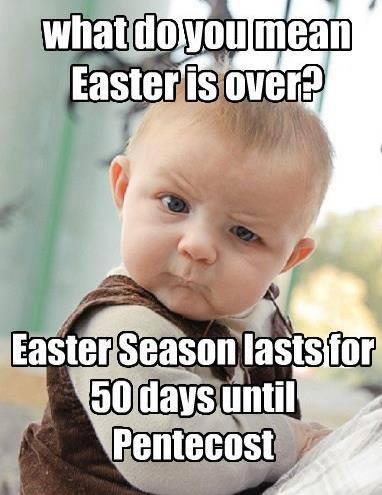
Eastertide 50 daysEastertide = the ebb and flow of the ocean level on the first Sunday after the first full moon after the vernal equinox. Not exactly! But that’s a more likely answer than most people might give if asked for a definition of that word. Eastertide is in fact the liturgical season in the Christian calendar that begins on Easter Sunday and ends seven weeks later on Pentecost. (April 5 – May 24 this year). Just as Christmas doesn’t officially end till Epiphany, the season of Easter lasts much longer than the peeps and chocolate bunnies, but one would never know it to observe most Christians or most churches.

The standing room only crowds last Sunday will shrink to a “low Sunday” attendance like that first big drop on a roller coaster, the lilies and Easter finery and decorations will be gone. It’s almost as if Jesus goes back into the tomb like the groundhog that sees his shadow on February 2nd.

The resurrection of Jesus is central to the Christian faith and ironically one of the hardest things for Christians and non-Christians to believe. St. Paul says, “But we proclaim Christ crucified, a stumbling block to Jews and foolishness to Gentiles.” (I Cor. 1:23). The original version of Mark’s Gospel, the earliest one written, ends with the women fleeing from the empty tomb “because terror and amazement had seized them; and they said nothing to anyone, for they were afraid.” (Mark 16:8).

Do we do the same thing by failing to move into Eastertide with no significant changes to our way of living? Do we struggle with the resurrection because it defies all scientific and logical experience we’ve had with death? We’ve all lost beloved relatives, even pets that leave a huge hole in our hearts, and no matter how much we wish it weren’t so, they don’t come back.

So often we approach Eastertide from that perspective, and it keeps us from being able to trust the unbelievable news that resurrection is real, that it can make a lasting difference in our lives. We want to change, we want to live by faith, we want to take that leap of faith; but we don’t want to look foolish, we don’t want to be disappointed.

I remember a day many years ago when I was a student at the Methodist Theological School in Ohio. I don’t remember details of what happened in class that day, but I remember the ecstatic feeling of something extraordinary being said or done that transformed deadness in my heart and soul to a new enthusiastic spirit-filled joy. As I was leaving class that day I came out the front door of the building where we had met onto a large front porch of one of the beautiful Georgian buildings there so excited and full of life that instead of going left and down the porch steps I ran forward and took a flying leap over the large hedge that grew along the length of the porch. As I was air-born I remember suddenly realizing I wasn’t sure what was on the other side of that hedge.

So it is with death-defying faith. Faith is not intellectual belief – it is radical trust in a wild and crazy God who rolls away any boulder that keeps us imprisoned in doubt and fear, that keeps us from taking the leap of faith. When we play it safe, when we go along to get along, when we refuse to challenge political, economic, and environmental practices that kill dreams and perpetuate injustice, we are in effect rolling the stone back in front of the tomb and trying to keep Jesus from challenging the status quo of our broken world where fear silences faith. Just celebrating Easter Sunday and ignoring Eastertide is like locking the barn door after the horse has already escaped. It’s too late. God’s verdict has already declared life the victor over death and nothing we do or fail to do can ever put that genie back in the bottle.

One of my all-time favorite statements of what Easter living means came from the late Dwight Loder who was my bishop here in Ohio from 1976-1984. In a sermon he preached in the mid-1980’s Bishop Loder said, “Jesus was not resurrected by the church. Jesus was not resurrected for the church. Jesus was resurrected as the church.” Faith in resurrection is so much more than a personal assurance about our own salvation and eternal life. If we as individual Christians and collectively as the church, the body of Christ, fail to be changed by Easter, we are sending a terrible message to the world and to those longing for Good News that it’s back to business as usual after Easter Sunday.

Don’t believe it. Those frightened women at the tomb and Jesus’ other followers were scared into silence for a while, but God wasn’t finished with them. God always has the last word, and the stories in the Gospels during Eastertide are even more remarkable than the empty tomb. Skeptics could say the tomb was empty because someone simply came and took the body away. But the risen Christ appears over and over again to those who have eyes and ears to see and believe — on the road to Emmaus, in a locked upper room, on the beach. He continues to challenge his followers to be living witnesses that his spirit endures as the resurrected, life-giving, justice and peace promoting force for all that is good and pure in a world dying for Good News.

Easter Sunday is over, but Eastertide has just begun; and the life-giving Holy Spirit is waiting in the wings to blow into our lives with full force on Pentecost if we dare to believe. Resurrection is a spiritual event and how we live our lives in the crucible of the here and now is a witness to the world that we have either had our Easter fling and retreated back into the tomb, or we are boldly living as resurrected people. Easter people witness by every decision and act we take that the tide has turned and the light of the world has not and will never be extinguished by the darkness of death.

By the way, the landing on the other side of that hedge was nice soft grass; so it was OK to leap. And the message of Eastertide is “Go ahead, it’s safe to trust in Resurrection!”

Good News from Good Friday Zombies?

Sometimes God opens our ears to hear something we’ve missed dozens of times before. Last Sunday morning our church choir’s cantata included part of the Good Friday narrative from Matthew 27 and I heard words from verse 52 that I do not remember hearing before. Matthew describes three world-changing signs at the moment of Jesus’ death, and for some reason the second one has escaped my notice for all of these sixty plus years I have been observing Holy Week.

That verse says, “The tombs also were opened, and many bodies of the saints who had fallen asleep were raised.” That seems like a rather significant event for me to overlook, but I feel better after discovering that none of the other three gospels mention it either. My next thought was, “Why would anyone be surprised that Jesus arose from the dead on Sunday if all these other people had already done it on Friday?” Matthew answers that question for us in verse 53: “After his resurrection they came out of the tombs and entered the holy city and appeared to many.” The New Interpreter’s Bible Commentary explains that this way: “Since Matthew wants to connect the raising of the Israelite saints with the death of Jesus… but also wants Jesus’ own resurrection to be primary this results in the peculiar picture of the saints’ being resurrected on Good Friday but remaining in their tombs (or in the open country) until after the Easter appearances of Jesus. That we have theology in narrative form, and not in bare historical reporting is clear.” (Vol. VIII, p.493)

I have not had time to do any other serious research on this, but since I wanted to share it on Good Friday, here are my thoughts about this on the day when Christians remember the gruesome death and suffering of the Christ and reflect on what his life, death and resurrection mean for us today.

First, I have to move beyond the literal, historical filter my mind wants to use to understand this story. If a lot of once dead Jewish saints were walking the streets of Jerusalem, I’m sure someone would have made a zombie movie about it by now. So, there must be a deeper, symbolic meaning to this startling detail that only Matthew includes.

The other two signs Matthew describes before and after the tombs being opened may help; so here’s the three in context:
“51 At that moment the curtain of the temple was torn in two, from top to bottom. The earth shook, and the rocks were split. 52 The tombs also were opened, and many bodies of the saints who had fallen asleep were raised.53 After his resurrection they came out of the tombs and entered the holy city and appeared to many. 54 Now when the centurion and those with him, who were keeping watch over Jesus, saw the earthquake and what took place, they were terrified and said, “Truly this man was God’s Son!”

The curtain of the temple refers to the barrier in the temple that separated the most holy place from the rest of the temple. This imagery foreshadows the destruction of the temple in 70 BCE which Matthew would have known about by the time these words were written. Symbolically they show how the death and resurrection of Christ destroy the barriers of the law and religiosity that separate the omnipresent spirit of God from human kind. God is not confined to the temple but is everywhere and always available to us all. The opening of the tombs shows that not even the final barrier of death itself can stop the life-giving eternal power of God.

And then, the more familiar third sign is the conversion of the Roman Centurion, the part of this narrative that is included in Mark and Luke’s gospels as well. That this Gentile is the first Christian believer to be liberated, not just by Christ’s sacrificial death, but by the faithful, calm, confident way he accepted and overcame his cross tells us that no false human barriers of race, creed, ethnicity, ideology or lifestyle can stop the love and power of God.

Jesus lived and taught and died and lives for all of God’s children. No matter what exactly happened on that hill far away 2000 years ago, the spirit of grace, love and mercy for us all lives and reigns for any and all who hear, see, and feel the power of resurrection and believe.

May whatever barriers are holding you back this day, whatever walls divide you from God or from your fellow human beings be blown away this Good Friday.

Giants vs. Grasshoppers, Numbers 14:1-10

“Giants vs. Grasshoppers” is not a metaphor for Kentucky vs. Hampton in the NCAA tournament, and yes I know there is no mention of giants or grasshoppers in Numbers 14 – but I promise you they will show up soon.

We are still in the murmuring/complaining section of the Hebrew’s wilderness journey, but before you complain about how long we’ve been there during this Lenten season, let me assure you that we’re almost finished. The Hebrews are now on the banks of the Jordan River, in sight of the land God has promised them – but that has not stopped the complaining, it has in fact raised the level from murmuring to murderous threats against their leaders.

To understand this new level of frustration, we have to go back and see what happened in chapter 13. When the Israelites finally near their destination after 40 long years in the wilderness they discover that there are already people living in their promised land. And just as the Israeli’s and Palestinians today have very different opinions about whose land this is, we’ve got a problem. So Moses and Aaron decide to send some spies across the river to scope out the situation and see how big a problem there is. They pick 12 men, one from each of the 12 tribes, to do reconnaissance, and when they return from their mission, the spies have good news and bad news. The land is indeed fertile and beautiful, just as God has promised, but the bad news is the current occupants are very powerful. And here’s where we hear about the giants and grasshoppers. The vast majority of the spies agree that the people living in the promised land are an overwhelming foe and to take them on would be like grasshoppers going battle against an army of Giants.

And that’s where Chapter 14 picks up the story. The whole congregation we are told raises a loud cry and weeps. They ask Moses, again, “Why have you brought us here to die by the sword? Our wives and children will become booty. Let’s choose a captain and go back to Egypt.”

Isn’t that how we often feel in the wilderness? When we think we’ve almost achieved a hard fought goal and someone else gets the promotion, or a serious illness derails our plans for retirement, or a tragic accident turns a family’s life upside down. Granted we may need to cut the Israelites some slack. Remember these poor people have been traveling in difficult circumstances for 40 years! To realize how long that is, think about how long ago 1975 was. Diana and I were on a trip two years ago to China and our return trip involved flights from Shanghai to Beijing to New York, and then an 11 hour bus ride back to Columbus. All tolled we were traveling without a break for 36 hours, and I can tell you we were not the happiest of campers. I can’t imagine 40 years!!!

Sometimes when a goal seems impossible – when the mountain is just too high to climb, when our patience and endurance are at the breaking point, we just want to throw in the towel and give up. Take us back to Egypt – things were better there. Really? Sometimes memory plays tricks on us. There was a book out a few years ago titled The Way We Never Were: American Families and the Nostalgia Trap, by Stephanie Coontz. One of the things Coontz says in her book is that while we tend to romanticize the 1950’s as a period of peace and prosperity before all the turmoil and conflicts of the 60’s and 70’s, we forget how oppressed women and minorities were, and that beneath the façade of domestic tranquility there was a hidden unrest. Coontz’s evidence for that is that valium and other popular drugs for depression and anxiety came into widespread use during that decade. It wasn’t all “Ozzie and Harriet” or “Leave it to Beaver.”

Fear distorts our memories of how things were in the past. As the theme song from the movie “The Way We Were” says, “What’s too painful to remember, we sometimes choose to forget.” That’s what happens to the Hebrews. They are so disappointed and fearful about the challenges and obstacles they see before them, they are ready to give up when they are so close but so far from their goal. Someone once told me that there are no trophies for running a 99 yard dash – you have to finish the race to win the prize.

We’ve also noticed in these murmuring chapters in Numbers that complaining is contagious. The text says, “The Whole Congregation” is ready to give up. When I was a kid and wanted something my friends had – a new toy or the coolest clothes – or if I wanted to go somewhere that I knew my parents probably would not approve of, I would often tell my mother, “But everybody else has one! All the other kids at school are going!” Her response was often, “Name Three.” And more times than not I couldn’t. End of discussion. So do you think “the whole congregation” might be an exaggeration?

Actually we know it is, because among the 12 spies there is a minority report. Two of the twelve, Caleb and Joshua, have a different take on the situation. They have seen the same evidence as the other 10. They all agree the land is flowing with milk and honey and would be a great place to settle. They all agree the people living there are a formidable problem. But Joshua and Caleb come from a perspective of faith instead of fear. They say, “If God is pleased with us – if we don’t rebel against the Lord, God will deliver on his promise. If God is on our side, nothing else matters.”

And how do the people respond? Verse 10 says, “The whole congregation threatened to stone them.” Dreamers, visionaries and prophets often meet with that kind of reaction – think Copernicus or Galileo. Psychologists explain it this way. When someone has a vision of reality that is very different from ours it creates what is called cognitive dissonance, which is just a fancy way of saying discomfort because things don’t line up the way we think they should. That can create fear and the need to do something to relieve the dissonance.

For example, we can choose to just ignore the problem, as in denial of climate change. Or we can remove ourselves from the situation–end a relationship, quit a job, move to a new home, etc. But on rare occasions where the dissonance is extremely high, things can turn violent, and history is full of martyrs like Jesus, Gandhi, and Joan of Arc, Lincoln, Martin Luther King and many less famous ones who have met that fate. And that’s what Caleb and Joshua are facing on the banks of the Jordan. If you read on in Numbers you will discover that God is much happier with Caleb and Joshua’s faithful response than the 10 other spies and the rebellious congregation. Because of their fear and complaining none of the latter group will be allowed to enter the promised land, but Caleb and Joshua are rewarded for their courage and faith and lead the new generation at last to their new home.

I was talking with a woman a few weeks ago who was dealing with a terrible family crisis. She was feeling like a grasshopper facing gigantic new challenges. When I suggested she just take things one day at a time and break the problems down into smaller pieces, she said, “I know, Steve, I tell other people that all the time. But I can’t live that way. I have to be in control and know what’s going to happen.” That’s the way we all would like life to be, but it simply isn’t.

And because it isn’t we all need faith and the support of others who are facing the giants with us. One of the problems with us rugged individualistic Americans is that we aren’t good at showing our own vulnerabilities and letting others in. We keep up a good front even when we’re dying on the inside. Another old Barbra Streisand song, “People,” describes that situation very well:

“We’re children, needing other children
And yet letting a grown-up pride
Hide all the need inside
Acting more like children than children.”

I was listening to a webinar the other day about transitions in life and was struck by a comment from Robert C. (Bob) Atchley, Distinguished Professor of Gerontology (emeritus) from Miami University in Oxford, Ohio, who said, “All of life is Assisted-Living.” Think about how true that is. We use that term “assisted-living” to describe a level of care for elderly people, but it describes all of life. None of us would have come into life or survived infancy and childhood without someone to care for us and teach us. But somewhere along the line we get the notion that we don’t need parents anymore telling us what to do. We move out into the wilderness of adolescence and adulthood on our own, yearning for independence and self-sufficiency. That personal quest is a necessary part of growing up and sometimes it feels great, but when faced with giants, it feels oh so very lonely.

Feeling alone and isolated in the wilderness is a major theme in the movie “Into the Woods.” The song “No one Is Alone,” sung by the Baker and Cinderella, both of whom have suffered terrible losses in the woods, addresses that issue this way:

“Maybe we forgot: they are not alone.
No one is alone.
Hard to see the light now.
Just don’t let it go
Things will come out right now.
We can make it so.
Someone is on your side
No one is alone.”

People of faith know who is on our side. And people of faith also know that we need to be there for each other. Jimmy, a little boy was scared one night by a thunder storm raging outside his bedroom window. When his father came into his room to comfort him he assured him by reminding him that he had learned in Sunday school that Jesus was always with him. Jimmy said, “yes, I know that Dad, but sometimes I just need someone with skin on them.” We need to be those skin-covered people for each other, especially in the wilderness times of life, but if we pretend we don’t need each other, thinking that we can avoid our problems by ignoring them – we cut ourselves off from the very support we need.

I want to finish today by talking about another kind of wilderness experience – one that is voluntary. When we think of the wilderness we often think of it as times of crisis, dealing with unexpected problems, but the wilderness can also be a time of intentional withdrawal from the distractions of daily living to get a better perspective on life – to see the bigger picture. Lent is a good time to do that, but any season of our lives will work. Someone once told me it’s hard to remember that your goal is to drain the swamp when you are up to your waist in alligators. Times of solitude for prayer and refection are needed when we get out of the swamp and see the bigger picture to remember or clarify what our purpose in life really is.

That’s not easy. We are all busy with multitudes of responsibilities. We need to intentionally build time into our schedules regularly to stop and evaluate where we are on life’s journey, to make mid-course corrections, to let go of regrets, guilt, grudges and other burdens that weigh us down. This is especially important at critical times that are rites of passage from one stage of life to another – adolescence to young adulthood, mid-life crises, career changes, new relationships, empty nesting, and retirement. Rather than jumping from one phase of life to another the way our culture says we “should,” taking time off to reflect on what God wants us to be and do is critical.

There is no need to be afraid of choosing to go to the wilderness because no one is alone. We journey with an eternal God who ultimately conquers all giants. Time in the wilderness is time to sort out priorities about the legacy we truly want to leave for future generations; to remember our real goal in life isn’t more stuff and wealth. The legacy we want to leave is faith and values for a life that is truly abundant in the deepest meaning of that term. Our real promised land is a life of peace that passes human understanding, and reaching that goal comes from saying “no” to the majority, who let fear rob them of their goal, and trusting and obeying the still small voice of God that says “put your money on the grasshoppers.”

Preached at Northwest United Methodist Church, Columbus, Ohio, March 22, 2015

Thanks for a Spiritual Giant, Bill Croy

Today I was privileged to attend a magnificent celebration of the life of Rev. Bill Croy, a colleague and friend. We all knew Bill was dying, but that didn’t stop him from living to the end. He planned his own service, and I again vowed to do the same, as soon as I come to grips with my own mortality or at least quiet my fear long enough to think about it. Bill helped me get a good start. He chose some of my favorite Scriptures – Micah 6 and Matthew 25 – about justice and mercy and humility and service. He also picked some of my favorite hymns, including a jazz version of “Amazing Grace,” “Great is Thy Faithfulness,” “It is Well with My Soul,” and ended the service with “Hymn of Promise.”

We were challenged today to give ourselves away and use all the gifts God has given us, as Bill did all his life, even as ALS slowly took away most of the tools he had used before to share his love for all of God’s children. These last few years Bill refused to give in to ALS and just found new ways, mostly Facebook and the internet, to keep inspiring and supporting others. He humbled me and shamed me when I was tempted to throw a pity party for some minor problems in my life which were laughable compared to what he and his family were dealing with.

One of Bill’s colleagues, Rev. Laurie Clark, described Bill well as a Spiritual Giant who lived a life of integrity that had authority because he embodied the Gospel. (She said it much better than that.) I came away inspired from Bill’s service but also humbled, wondering and maybe a bit jealous, if people would say anything half so great about me when I die. I am reminded of reading somewhere that when I come to that great transition time in my existence, God won’t ask me why I wasn’t Bill Croy, or Mother Theresa, or Martin Luther King, or Gandhi. God will only ask if I was the best Steve Harsh I could be.

The answer to that question for me today would have to be a resounding “NO.” But I am grateful for days like today when I am reminded of that and for the tomorrows I still have to change my life so I change that answer.

Rev. Clark closed her remarks today about Bill with the observation that when a spiritual giant no longer walks among us, he or she passes on the torch to those left behind. Bill, I may have to carry a small torch or a candle compared to yours, but if we all live a life that gives away all of whatever gifts God has given us, together we can brighten the darkest corners of our world.

Well done, good and faithful servant.

A Prayer for Living the Dream

As we honor Dr. Martin Luther King Jr. it is a good time to renew our commitment to follow Jesus and all the prophets who call us to lives of peace and justice. Today we pray for all of our sisters and brothers who live in fear of violence and terror in Africa and Europe, or the Middle East and here at home.

O Creator and Sustainer of all, we ask you to speak words of comfort and hope to us today. With depressing news bombarding us about climate change, racial tensions, and violence in all parts of the world, we hunger and thirst for the strength and renewal of our spirits that you alone can provide. When so much of the terror and violence we see is fueled by misdirected religious fervor fed by insecurity and self-justification, it is easy to despair and wonder if Dr. King’s dream is still alive.

Remind us, O God, of how far we’ve come since Selma, even as we struggle with how far we have yet to go. And especially remind us again that the dream Dr. King articulated so beautifully with his words and his life was not just his dream. It was a dream of liberty and justice for all that echoes through the ages: from Deuteronomy’s hospitality for aliens and strangers, to Isaiah’s lions and lambs lying down together and Micah’s swords beaten into plowshares, to Jesus’ command to love one another, even those who persecute and revile us. It is a dream preserved by more recent prophets like Jefferson, Lincoln, Harriet Beecher Stowe and Sojourner Truth, by Gandhi, and Mother Theresa and Pope Francis and millions of unknown saints who witness to their faith by daily random acts of kindness.

Parents and teachers, mentors, coaches, nurses and caregivers, missionaries and friends—all doing a small but vital part to pass on the torch of freedom that violence and fear can never extinguish – because it is not our dream. It is ultimately an eternal dream for all of creation that springs from an infinite source of Hope and Trust in the author of that dream.

It is undying faith in you, eternal God, that enables us even in dark times to know with confidence deep in our hearts that with your help we shall indeed overcome – overcome the forces of hate and violence someday. And in that assurance we dare to pray and live in the name of Jesus Christ, who calls us all to keep his dream alive. Amen.

Northwest UMC, Columbus, OH, January 18, 2015