Lighting the Christ Candle 2025

[The 4 Advent candles should be lit before the service]

During the Advent season, we have waited like expectant parents for God to deliver – to show up like Amazon with the promised gifts of hope, peace, joy and love. We wait in a world that has never needed those gifts more. And God hides our gifts in plain sight, in Bethlehem, right where the prophets told us they would be. And like every year, we’re surprised, still not convinced that God’s Messiah should be born in a barn.


Tonight our waiting is rewarded, as we celebrate again the gift of unconditional love, and the marvelous ways God breaks through the darkness, and leads us to the Light of the World. God showed the shepherds and the magi the way to Bethlehem. And tonight God is showing us the Way again.


[Light the Christ candle as the next paragraph is read]


We light the Christ Candle on this holy night to celebrate the birth of Jesus Christ, the Light of the World. He has led us here and calls us to follow him on a marvelous journey of seeking, finding, waiting, hoping, and spreading His Holy light.

Prayer: (Please join me in the prayer on the screen)


O eternal God, forgive us when we doubt that a peasant boy of low estate could possibly heal our fearful and divided world. When our skepticism threatens to overwhelm us, wrap us in the warm swaddling cloths of hope, peace, joy and love. We have waited and prayed for your Messiah. Now it’s time for us to receive the most precious gift ever. May Christ be born in us this night. Set us aglow with the light of Christ, to warm and heal broken lives and light our darkened world. In the holy name of the one we celebrate this night, Amen.

Northwest UMC, Columbus, Ohio

All Saints Prayer 2025

As we prepare our hearts for prayer on this All Saints Sunday I want to share some words for our meditation from Linda Hogan in her book “Dwellings.” She says,

“Walking, I am listening to a deeper way. Suddenly all my ancestors are behind me. Be still, they say. Watch and listen. You are the result of the love of thousands.”


O Holy One, God of the present age, of every generation that has enabled our being here today, and of all the multitudes who will follow in our footsteps if we find a way to a sustainable future for the creation we are a part of.

We know All Saints Day may sound pretentious because none of us are truly saintly.
We are all a weird mixture of sinner and saint striving to be more the latter as followers of Jesus and good stewards of your creation. We want to be builders of a peaceable kingdom, a beloved community, honest we do.

But you know that our fears and anxieties too often lead us to foolishly put our trust in stuff that promises security but only creates higher walls of tribal suspicion and prejudice. Bigger bombs and battleships only motivate others to make more weapons that steal resources from hungry children.

As we ponder the mysteries of how our ancestors made sense of their lives help us lovingly forgive their mistakes even as we learn from their collective wisdom.  We are grateful that we don’t have to reinvent every wheel because we are surrounded by a cloud of witnesses who bless us with their presence. We are never alone, although at times it sure feels like it.

Among those saints are those whose names we all know – Moses, Ruth, Micah, Theresa, Amos, Francis, Jesus and Paul – but those famous ones are totally outnumbered by the ordinary Joes and Judys who quietly have preserved the faith through disasters, depressions, pandemics, and ages of apathy.


Today we remember those dear ones who have passed through the thin veil that divides our reality from eternal peace and truth. We give thanks for those who dwell now in your very heart, O God. We envy their peace and unity with you, even as we humbly give thanks for their love that has produced this community of faith that nurtures us still today.


We are indebted to their example of service. We are inspired by their faith that overcame the doubts and despair that are part of the human condition. Like them we journey ever on toward the cross of Christ and the example he gives us as we join our voices with all the saints in the prayer Jesus taught us to pray ….

Northwest United Methodist Church, Columbus, Ohio, November 2, 2025

World Communion Prayer 2025

O God of all creation, we set aside one Sunday each year as World Communion Sunday. Given the state of our battered and broken world wouldn’t it make more sense to make every Sabbath or Holy Day a time to pray for a beloved world community?

Our Christian Scriptures say you so loved this messed up world so much that you sent your own beloved son to redeem us. Why would you do that knowing how the evil forces in the world routinely kill any prophet who challenges the empire’s gospel of power and violent control by fear and intimidation?

And yet something about that impractical vision of a peaceable kingdom keeps us coming back to your table. It’s a table where we join a motley crew of humanity – those who hunger for power and the powerless who simply hunger; Israeli and Palestinian, Ukrainian and Russian, an assassin and a widow who forgives him, sworn political enemies dipping bread in the same cup, estranged family members sharing tears of joyful reunion, and those who live for revenge breaking bread with the agents of reconciliation.

We don’t understand the mystery of how ordinary broken bread can fan the tiny ember of hope still smoldering beneath an avalanche of broken dreams. Yet somehow the Holy Ruach of Your spirit blows life into a valley of dry bones and we leave the table lighter and brighter with a spring in our step we thought was gone forever.

The chaos of life has not stopped. The existential threats to freedom and the power of greed and short-sightedness threatening our planet are still as awful as ever. People are still starving in Sudan and Gaza, bombs are still dropping in Kiev, and yet the vision of humanity with all its flaws breaking bread together around one godly table stays with us and empowers us to face the future with courage and love.

Because You so loved the world we dare to also, in the name of the humble servant who calls us again and again to come eat and drink of his very essence. In His name we pray and live. Amen

Happy Motherly God‘s Day

My home of origin in the 1950’s and 60’s was a very traditional patriarchal family. And the church family I grew up in was likewise dominated with patriarchal theology and structure. I can’t go back and change any of that, but I regret that my foundational values and theological constructs were void of any feminine images and qualities.

This reality for me was complicated by a strained relationship with my father. My dad survived a painful childhood with an abusive, alcoholic step-father and a near-death experience as a 24 year-old pilot in World War II. No one had discovered PTSD in those days, but I’m sure my dad was a classic case. He compensated by living by a very strict and literal adherence to conservative theological and cultural norms.

I never questioned my father’s love for me, but it always felt conditional on my living up to his high expectations and obedience to his rules. Theologically for me this meant the patriarchal image of God was filtered through my relationship to my earthly father. It never occurred to me or anyone in my circle of influence to question the God as Father theology I learned at church.

One of my regrets about this is that I felt much more comfortable with and closer to my mother but had no model for seeing her as the image of God. She was a good subservient wife as was expected in the culture we lived in, but there was also a quality of unconditional love and acceptance about her that was lacking in my dad. If I had a problem or screwed up, as I did often, I would always go to my mom and confess because she would calmly help me deal with the situation where my dad would either verbally or non verbally convey disapproval. That’s who my parents were. There’s no judgment in that now, although there was for many years as I tried to liberate myself from the conservative world my dad lived in.

My point here is that I wish someone had suggested to me that God is also an expression of the maternal, loving qualities we rightly or wrongly have attributed to the feminine. Because no one dared to think outside the patriarchal box I lived many years of my life with a fear of a judgmental God. And the larger church and even the liberal seminary I went to in my early 20’s was still a prisoner to the male-dominated images of God.

The entire faculty and 96% of my seminary class were white males. That began to change dramatically in the 1970’s after I graduated as women and people of color were added to the seminary community. That’s wonderful, but I missed it! I worked with several great senior pastors in my ministry, but again all white and male.

Finally in the early 2000’s when I was about 60 years old I joined a congregation with a wonderful, creative, vibrant female pastor. I went on to work part-time in retirement with her and other women, and it has opened a whole new world of theological depth and understanding to my image of the divine as full and inclusive of all of God’s creation. I still am blessed to hear the word proclaimed many Sundays and Holy Days from a unique female perspective. Most of the current devotional and theological blogs, podcasts, and books I have benefited most from in the last few years are created by female writers, pastors, and theologians.

And so this Mother’s Day I am giving thanks for all the women who have helped shape my life. Grandmothers, mother, aunts, colleagues, friends, wives, preachers, political leaders and more. Let’s celebrate that special capacity so many women have to nurture, soothe, love, and bless us with those God-given qualities the world so desperately needs right now.

Advent 2024, Hope

In the busy Advent season it is easy to lose sight of the purpose of this part of the Christian year.  Our calendars and to do lists are crammed full of important traditions and celebrations, and we don’t think we have any time or energy left to create housing for the Holy! 

On this first Sunday of Advent we are focusing on making room for Hope in a world that often looks hopeless.  In the short run where we live that may seem to be the case.  But here’s the thing; God doesn’t live in the short run but in the cosmic expanse of time and space.  And that’s where our hope comes from.

Emmanuel, God with us, isn’t just a December thing.  The one we are preparing for, the helpless baby born in a barn is with us for eternity.  Our hope is not in things or people that are here today and gone tomorrow, but in the God of all creation.  As Diana Butler Bass reminds us reminds us with this quote from Revelation, our hope is anchored in one “who is and who was and who is to come”–a mysterious presence that warms our hearts on the coldest and darkest seasons of our lives.

And so today we light the Candle of Hope, a tiny flame that represents the reason a weary world can still rejoice.

Please pray with me:

O Holy creator and sustainer God, remind us as we begin this Advent season that you can bring forth hope anywhere and everywhere.  You reveal your glory in a gorgeous sunrise, in a loving smile, and even in a humble stable.  Your holiness is all around us, in a cloud of witnesses who have gone before us, in a warm embrace when there are no words required, and in random acts of kindness that are contagious.  Our prayer today is that you will help us take time from our busyness to clear out some anger or doubt in our hearts and make room for the Holy, for our hearts are truly the only space you need to give birth to the gift of Hope.  We offer our prayers and our hearts in the name of the babe of Bethlehem who still gives hope to our weary world. Amen

Northwest UMC, December 1, 2024

Who Do You Say You Are? Reflections on Identity and Life’s Challenges

“I hope for nothing. I fear nothing. I am free.” Nikos Kazantzakis’ epitaph.

Those words from the Greek Author and philosopher, Nikos Kazantzakis, have both inspired and haunted me since I was first introduced to them as a twenty-something seminary student 53 years ago. Kazantzakis, most famous for his novel, “Zorba the Greek,” wrote many volumes full of such deep and baffling sayings. Many of them have stuck with me my entire adult life, and I was reminded of again of them when my wife and I had a chance to visit Crete on a cruise to several Greek Islands last spring. Crete is both the birthplace of Kazantzakis and where he is buried.

 The epitaph in particular has been on my mind recently as my awful, terrible, no good, horrible summer of 2024 has continued right into the fall. [Please read my posts from August 4th and 12th if you want all the details.]. Quite frankly I do know that my little problems the last 4 months can’t hold a candle to hurricane destruction, people living in war zones, people starving from famine and climate change, people suffering from chronic pain, grief, persecution, broken relationships, addiction, homelessness, and so many more. Is it possible for any of us to truly hope for nothing and fear nothing?

My most recent personal challenge is undergoing chemotherapy for a rare form of lymphoma in my blood. I’ve known this day was coming sooner or later since my oncologist has been tracking the slow increase of a monoclonal glutamate in my blood for over a decade. I was personally hoping for later, like much later. But of course this was the great summer of my discontent, and what better time for my IgM antibodies to set off a siren alerting my doctor that something was wrong. This alarm was as loud as our home security system when I accidentally set if off. When the IgM jumped from around 2000 in January to 6500 in July it was such a loud warning that even my denial mechanisms were overpowered.

Technically I have been a “cancer patient” for about 13 years now because I was diagnosed with a mild prostate cancer in 2011. But that cancer has never needed any kind of treatment. Being told I needed to start getting chemotherapy ASAP for this lymphoma was a whole different ball game. One of my first challenges after this diagnosis was a debate within about how I wanted to think about myself going forward. Naming something helps give us some agency over it.

I knew I didn’t want to think of myself as a “cancer patient” because I am so much more than any diagnosis or label or title can convey. We are complex and complicated beings who defy narrow definitions of ourselves. In other words, I have cancer; it doesn’t have me. But knowing what I didn’t want to identify as didn’t answer the harder question of finding a name for this new, added dimension of my being. I toyed with “victor” (maybe too ambiguous depending on how one defines what victory even looks like. Jesus certainly didn’t look like a victor on the cross, but how our ideas of victory change on Easter morning! Don’t like “survivor” either. I want more from life than just surviving. As an aside, it has taken me 6 weeks or so to reach sporadic bouts of peace where I can live into the words above. In fact I hadn’t been able to express those thoughts and feelings like this until I started writing them. One of the many reasons writing is so therapeutic for me.

At those many other times when I don’t feel good at all about my new blood brother, I have caught myself recalling the title of a 1995 movie, “Dead Man Walking.” As time goes on I have had fewer of those DMW moments and more of the positive ones. After writing this, I’m pretty sure that ratio will continue to improve. Because as I wrote this post I realized that I have a simple and maybe fun way to embrace and integrate my cancer into my “Stevenness.” You see, my cancer has a pretty cool name. It’s Waldenstrom, named after a 20th Swedish Doctor who first described it. But Waldenstrom is a very heavy handle for my little cancer. It sounds like a cousin to Frankenstein. So I have decided to christen my cancer with the nickname, “Waldy,” and that seems like a name I get arms around.

One final thought (or two): Throughout this naming/identity dialogue with myself there was a biblical scene that kept coming to my mind. All three synoptic Gospels (Matt. 16:15, Mark 8:29, Luke 9:20) recount the time Jesus gave his disciples a pop quiz. Like all good teachers Jesus starts with a safe, impersonal question. He asks, “Who do people say that I am?” After the disciples respond with several Hebrew heroes from the past, Jesus stops them and asks the zinger: “and who do you say that I am?’ Jesus went from preaching to meddling in a hurry.

Simon Peter as usual jumps in with the answer: “You are the Christ, the Messiah.” Peter knows the right words, he just doesn’t yet understand what those words really mean or will mean to him. Far too many of us today know “who” Jesus is, but that’s only half the equation. It’s one thing to answer the catechism, or recite the Apostles’ Creed, but quite another to know what those words require of us who claim the identity of Jesus’ followers.

It occurs to me that the unspoken question that Jesus leaves hanging in the air for his disciples to discover for themselves is this: “Who do You say that you are?” Have you wrestled with that question recently? Who do you identify with/as? What name do you give to the totality of the amazing God-created being you are? We humans are more than the sum of our parts. Be gentle with your being. But remember to ask yourself occasionally: “Who do You say that you are?”

The answer to that question is never final; it is dynamic and ever-changing. But the closer we get to an answer we can live with, the closer we are to fearing nothing—not even my new friend Waldy or whatever other demons with which we have wrestle.

Dueling Psalms, 130-19

Note: As I said in my “Breaking Silence” post yesterday I decided to go to the lectionary to look for some inspiration about the depressing state the world is in right now, and as usual the Word is there if we choose to look. One of the texts for this Sunday in the Revised Common Lectionary is Psalm 130, a never-failing, classic writing on coping with difficult situations. I found this post on that Psalm from 2017 which still seems quite relevant, and so I share it first before turning to another great text from Mark 5, the healing of Jairus’ daughter, which is the Gospel lesson in this Sunday’s lectionary.

No, that 130-19 is not a lopsided NBA finals basketball score! It’s the score of my attitude adjustment a few days ago when I awoke in one of those woe-is-me moods and thought of the lament known as De Profundis in Psalm 130. That’s Latin for “O crap I have to face another day of aches and pains and bad news!”

My arthritis was nagging at me, my chronic back trouble was moving up the pain scale, and the news was full of more terrorist attacks and hate crimes. Reading the newspaper over my morning coffee used to be one of my favorite times of the day. I still do it out of a sense of duty to be an informed citizen, but it has become an increasingly depressing task.

Psalm 130 begins “Out of the depths I cry to you, O Lord. Lord, hear my voice! Let your ears be attentive to the voice of my supplications!” As tensions between our nation and others mount, as our president foolishly believes his own nationalistic rhetoric that we can shrug off our responsibility for climate change and go it alone, as fears of terror attacks increase, and partisan politics paralyze any attempt to address critical domestic and international issues responsibly, I often wonder if God or anyone is listening to the voice of my supplications.

Later that same morning I went out to work in our lawn and gardens still down in the depths. We are blessed to live on a beautiful property decorated with my wife’s gardening handiwork, a pond, trees and flowers. But the beauty requires hard work, especially this time of year when the grass and the weeds are being very fruitful and multiplying. It’s the work that prompts me at times to say that “yard work” is made up of two four-letter words.

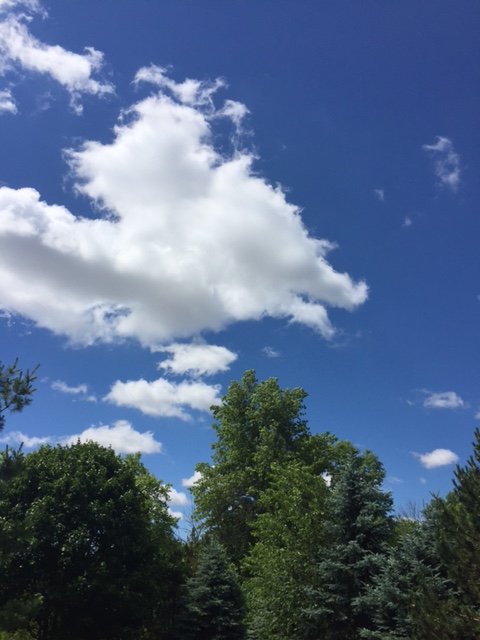
But the birds were in good humor that morning and serenaded me as I went forth to mow the lawn. And then I looked up at the blue sky dotted with huge languishing cotton ball clouds pictured above, a sight not seen nearly often enough in central Ohio, and my heart shifted gears from Psalm 130 to 19: “The heavens are telling the glory of God; and the firmament proclaims God’s handiwork. Day to day pours forth speech, and night to night declares knowledge. There is no speech, nor are there words; their voice is not heard; yet their voice goes out through all the earth, and their words to the end of the world.” (Psalm 19:1-4).

In basketball 19 doesn’t beat 130, but in the game of faithful living it does. God’s presence is all around us no matter how far down in the depths we are feeling. We just have to look for it with all our senses. No, the skies are not always breathtakingly beautiful, but the loving God of all creation is always surrounding us if we have eyes to see and ears to hear.

Even the author of De Profundis knew that while in the depths, and Psalm 130 ends with this statement of faith and hope: “I wait for the Lord, my soul waits, and in his word I hope; my soul waits for the Lord more than those who watch for the morning, more than those who watch for the morning. O Israel, hope in the Lord! For with the Lord there is steadfast love, and with him is great power to redeem. It is he who will redeem Israel from all its iniquities.”

It is necessary to cry out for help, to admit our helplessness to cope with the slings and arrows of life. It is also necessary to wait patiently and hopefully because the arc of moral justice bends ever so slowly. But we are also called to take action to collaborate in our own healing, and that’s exactly what Jairus and the woman with the 12-year flow of blood do in the Gospel lesson for this week.

Their story in Mark 5:21-43 describes two people in the depths of despair. Jairus, a powerful leader of the synagogue is helpless to save his gravely ill daughter and seeks Jesus out and humbles himself by kneeling at Jesus’ feet, begging for healing for his little girl. But as often happens in ministry, Jesus is interrupted right in the middle of this crisis by a person from the other end of the socio-economic spectrum.

A woman who is unclean because she has had a flow of blood for 12 years is also desperate. So much so that she risks coming out in public seeking healing because a multitude of doctors have only made her worse. She humbles herself in a different way, only wanting to touch the hem of Jesus’ garment; and immediately she feels her body healed.

Jesus, of course, feels power go out from him and seeks the woman out – not to scold or condemn her, but to praise her for her faith which has healed her.

But alas, news comes that Jairus’ daughter has died while Jesus was busy healing the woman. When Jesus assures Jairus that his daughter is not really dead the crowd laughs at him. That happens to people who dare to believe in God’s power in spite of evidence that evil and suffering have prevailed.

And Jesus goes to Jairus’ home, tells the little girl to get up, and when she does he instructs those there to give the girl something to eat. Just another day’s work for Jesus because he believes and heals those who dare to believe with him and through him.

Like Jairus and the woman we often have much suffering and fear we need to be healed of. These texts make it clear the formula for healing is to admit the mess we’re in, cry out for help, wait patiently for deliverance, and when Jesus’ is in the neighborhood (which is always) take action to find him so faith can make us whole too.

Advent 4, 2023: Love

We have made our way this Advent from prophesy and promise to stand now on the cusp of fulfillment.  This very night we will celebrate again the birth of love incarnate in the form of a helpless infant.  Like that baby, love is vulnerable.  Both require careful nurture and handling.  Love is a gift entrusted to common people like Mary and Joseph, like you and me.  Of all the gifts we may give or receive this week, none is more precious than the simple gift of love.  That is what inspired St. Paul to write: “And now these three remain: faith, hope and love. But the greatest of these is love.”

God’s love is a spirit that requires embodiment to become real.  God’s love must become flesh to dwell among us.  At Bethlehem that love came to life in the infant Jesus.  Today, if we are open to the mystery, it can come to life in you and me as the church, the body of Christ.  We can be the light of the world because of Christmas. So today we live between the warm feeling of God’s love and the choice to put that sentiment into concrete action.   We humbly receive God’s most precious gift as we light the 4th candle of Advent, the Candle of Love. 

[Light the 4th Candle]

Please pray with me as I share this Advent prayer from Kate Bowler and Jessica Richie from their book, “The Lives We Actually Have:”

God, we are waiting for love,

not the simple kind or the sweep-you-off-your-feet kind,

but the absurd kind.

The kind wrapped in rags, resting in a bucket of animal feed.

Love enough to save us all.

Blessed are we who look for Love,

deeper, fuller, truer—than we have ever known,

than we could have ever hoped for.

Blessed are we who seek you,

the light that dawned so long ago in that dark stable.

Love given.                                                    

Love received.

Dear God, Hold us in that love these last few hours of Advent till that love is born again in our hearts this very night. Amen

Northwest UMC, Columbus, OH; December 24, 2023

Feeding the Wolves

A familiar Native American legend has been on my mind a lot recently. It’s the one about two wolves that reside in each human. One wolf is fear and the other is love. The two wolves are in constant struggle with each other to see which will control our lives. When the elders are asked which wolf wins the inner battle the answer is “The one you feed.”

I am very concerned that the steady diet of fear being fed to us by political candidates from both parties is so pervasive that the wolf of love in all of us is being starved to death. With all the dark money stoking the flames of fear on every form of media it is very tempting to just throw our hands in the air and surrender.

Dr. Brene Brown describes our situation this way: “In times of uncertainty, it is common for leaders to leverage fear and weaponize it to their advantage…If you can keep people afraid and give them an enemy who is responsible for their fear, you can get people to do just about anything.…when we are managing during times of scarcity or deep uncertainty, it is imperative that we embrace the uncertainty…We need to be available to fact-check the stories that team members may be making up, because in scarcity we invent worse-case scenarios.” 

That reminds me of a definition of fear I learned many years ago — FEAR = False Evidence Appearing Real. We all need to use our best critical thinking to not feed the fear wolf any false information. There are plenty of factual things to fear without adding bogus dishes to our diet.

The Christian church in many ways has been complicit in spreading the bad news of a fear-based theology. The misunderstanding and mistranslation of the Hebrew word “yirah” as “fear” has been used for centuries to try and literally scare the “hell” out of people, or perhaps scare people out of hell would be a better way to put it.

Fear is not a good long-term motivator of desired behavior. It only works when an external authority figure is present to enforce the threat. But fear is a fairly effective way to produce guilt in people, and that guilt technique has been used to control church members, i.e. keep them coming back to church and paying their dues. I have often said that if people really understood the Good News of grace and God’s unconditional love the church would be out of business.

The word yirah in reference to God is better understood as “awe.” We overuse he word “awesome” these days to describe anything from a sunset to a new dress, and it has lost the power of truly standing in awe of the ultimate mystery of the creative force we call God.

If we can get back to praising that Holy Mystery and the unconditional love fed to us every moment of eternity then the wolf of fear doesn’t stand a chance. That’s the life force described in I John: “There is no fear in love, but perfect love casts out fear. For fear has to do with punishment, and whoever fears has not been perfected in love.” (I John 4:18)

Being nurtured by that kind of love makes it possible for humans to obey the great commandments to love God and to love our neighbors. Without that love, we are vulnerable to unscrupulous salespeople, propagandists, and politicians who use fear-inducing rhetoric and imagery to manipulate others into buying or believing what they are promoting.

Our United Methodist District Superintendent, Rev. Tim Bias, recently wrote about the power of words in his monthly newsletter. In there he shared a wonderful story about what feeding the wolf of love looks like at the micro level of interpersonal relationships. I’ve heard the story several times before, but the end of the story still brought tears of joy to my eyes. I share it here in the hope that it will feed your love wolf with the abundance that begs to be shared with others. If we keep the faith and treat everyone we meet, (yes, even our political foes) the way we want to be treated we will make more difference in the world than we will ever know.

“There was a first-year teacher at Saint Mary’s School in Morris, Minnesota. She said she had 34 students who were all dear to her. But one student stood out. His name was Mark. She said he was one in a million. He was very neat in appearance with a happy-to-be-alive attitude that made even his occasional mischievousness delightful. There was just one thing about Mark: he talked incessantly.

She had to remind him again and again that talking without permission was not acceptable. Every time she corrected him, he responded, “Thank you for correcting me, Teacher.”

She said, “I didn’t know what to make of it at first. But before long, I became accustomed to hearing it many times a day.”

One morning her patience was growing thin when Mark talked once too often. She said, “I made a first-year teacher mistake. I looked at Mark and said, ‘If you say one more word, I am going to tape your mouth shut!’”

It wasn’t ten seconds later when one of the students blurted out, “Mark is talking again, Teacher.”  I hadn’t asked any of the students to help me watch Mark, but since I had stated the punishment in front of the class, I had to act on it.

I remember the scene as if it had occurred this morning. I walked to my desk, very deliberately opened my drawer and took out a roll of masking tape. Without saying a word, I proceeded to Mark’s desk, tore off two pieces of tape, and made a big X with them over his mouth. I then returned to the front of the room. As I glanced at Mark to see how he was doing, he winked at me. That did it! I started laughing. The class cheered as I walked back to Mark’s desk, removed the tape, and shrugged my shoulders.

His first words were, “Thank you for correcting me, Teacher.”

At the end of the year, Mark went on to fourth grade. The teacher eventually moved on to teach junior-high math. Several years passed. As Mark entered the ninth grade, Mark and the teacher met again.

She said Mark was more handsome than ever and just as polite. Since he had to listen carefully to the instruction on the “new math,” he did not talk as much. One Friday, things just didn’t feel right. The class had worked hard on a new concept all week, and the teacher sensed that the students were frowning, frustrated with themselves, and edgy with one another.

To stop the crankiness, she asked the students to put their books away and to take out two sheets of notebook paper. She then asked them to list the names of the other students in the room on their paper, leaving a space between each name. Then she asked them to think of the nicest thing they could say about each of their classmates and write it down.

It took the remainder of the class period to finish their assignment. As the students left the room, each one handed her their papers. Mark said, “Thank you for teaching me today, Teacher. Have a good weekend.”   That Saturday, she wrote down the name of each student on a separate sheet of paper and she listed what everyone else had said about that individual.

On Monday, at the beginning of the class, she gave each student his or her list. Before long, the entire class was smiling. She listened as the students said things like, “Really? I never knew that meant anything to anyone!”  “I didn’t know others liked me so much.” After a few minutes, the class went back to studying math. No one mentioned those papers in class again.

It was several years later that the teacher learned that Mark had been killed in Vietnam. She had gotten word that Mark’s family wanted her to attend his funeral. At the funeral she watched and listened. One of the soldiers who acted as pallbearer came up to her and asked, “Were you Mark’s math teacher?” She nodded. He said, “Mark talked a lot about you.”

After the funeral, most of Mark’s former classmates headed to Chuck’s farmhouse for lunch. The teacher was invited to come by. Mark’s mother and father wanted to speak with her. When she arrived, they met her at her car.

“We want to show you something,” his father said, taking a wallet out of his pocket. “They found this on Mark when he was killed. We thought you might recognize it.” Opening the billfold, he carefully removed two worn pieces of notebook paper that had obviously been taped, folded and refolded many times. She knew what it was without looking at the paper.

Mark’s mother said, “Thank you so much for doing that. As you can see, Mark treasured it.”

Mark’s classmates started to gather around. Charlie smiled rather sheepishly and said, “I still have my list. I keep it in the top drawer of my desk at home.”

Chuck’s wife said, “Chuck asked me to put his in our wedding album. I have mine too,”

Marilyn said.  “It’s in my diary.” Then Vicki reached into her pocketbook, took out her wallet and showed her worn and frazzled list to the group. “I carry this with me at all times. I take it out and look at it every time I need encouragement. We all saved our lists.””

[Story adapted an article in The Reader’s Digest written by Sister Helen Mrosla, a Franciscan nun and the teacher in the story. The story first appeared in the Topeka Capitol-Journal in 1998.]


From Worst to Best: Kindness of Strangers

We always share a good news story as part of our prayer time at Northwest UMC to remind us that amidst all the bad news in our broken world there are many acts of kindness being done every day that don’t make headlines. My wife and I recently returned from a two-week trip to Italy and Greece, and as soon as we returned I sent a message to our pastors that I had a personal good news story from our trip that I wanted to share with the congregation. This is that story.

Our trip was wonderful. Everything worked like clockwork. No delays. We were never terribly lost anywhere, and the weather was wonderful. We were in Athens, Greece the day before our return flight to the States. We spent the morning sightseeing and ate lunch at a quaint hole-in-the-wall seafood restaurant; and THEN came the low point of our whole trip – I realized when getting ready to pay for lunch that I had lost my wallet somewhere that morning. We thought it might have been on one of the hop-on-hop-off buses we rode that morning; so we called that company, and they said no one had turned it in, but we could call back later and check.

It took us 20 minutes or more of panic to figure out what to do next and find a place quiet enough that we could hear. I have trouble hearing so Diana did most of the phone talking. Before we started calling credit card companies I got a call from our hotel answered by Diana. I didn’t realize who had called and was confused about how our hotel got involved, but they said someone had found my wallet and called them. They gave us number for a man named Mario.

I was overwhelmed with relief. But we were not home free quite yet. When Diana called Mario she quickly found out he spoke not a word of English; so we could not communicate. Diana asked several people passing by on the street if they spoke Greek and none did – but one young man suggested going into a local market to see if some one there could help us. The first young woman we asked could not speak English, but she got her manager who took my phone and spoke with Mario. She said he would take the wallet to our hotel in about 20 minutes.

It was then I realized I had the hotel room key card in my billfold and that is how he knew to call them. We got a taxi to take us to our hotel, but it was now rush hour on Friday afternoon and traffic was terrible. It seemed to take us forever and when we did arrive, Mario had not arrived and my heart sank again. The report at the hotel was that Mario found the wallet in the national park near our hotel. I had sat on a low bench there and even though my pocket has a Velcro cover on it, the wallet must have fallen out.

Mario called my phone again just then, and someone at the hotel desk served as our interpreter this time, talked to him and said he was on his way. He showed up very soon with his whole family with him. He told a doorman at the hotel that the same thing had happened to them before. That was why they went out of their way to make sure we got my wallet back.

When he handed me the wallet my heart sank again. All of my cash was gone. Someone had gotten to the wallet before Mario, but the good news is all of my credit cards, insurance cards, driver’s license, etc. were all there. I lost about $80 in cash but was so relieved to have every thing else back I didn’t really care. I was going to offer Mario a reward but had no cash to do so. He didn’t seem to expect one. I was very very lucky these total strangers took all that time and trouble to find me and so grateful to all the people who helped us overcome the language barrier and connect us. What could have ruined our trip turned into a celebration of basic human kindness and goodness.

Diana and I did our best without being able to speak Greek to tell Mario, his wife and two daughters how grateful we were. In all the emotion of the moment I forgot to take a picture of Mario and his family, something I would love to have; but trust me, we will never forget those kind new friends we made in Greece.