Oligarchy Inaugurated

January 20, 2025 was a day of extreme highs and lows for me and for many of my friends. It is a day that may go down in history as the day the American experiment in democracy died. As of yesterday we are living in an oligarchy, and whether we the people can survive it hangs very much in the balance. It will depend on how much courage enough people can muster to fight for their freedom before it is too late. Our democracy is on life support, and only the citizens of this country can determine if it will live or die.

For millions of Americans January 20 was also a unique and special day in the world of sports. The first ever 12-team College Football Playoffs culminated that evening with a championship game between two historic football power house teams, Notre Dame and Ohio State. Being a life-long Ohio State fan it was a special treat for our local team to play in that game, and for 3.5 hours it was a riveting and welcome distraction from the threat unfolding in Washington D.C.

After enjoying the post-game victory celebration for Ohio State for about an hour I made the foolish mistake of checking my phone for the news before going to bed. Needless to say reading about the plethora of executive orders signed yesterday by our new Supreme Leader quickly put a damper on my spirit. It wasn’t unexpected, and I should have known better; but it was a reminder that a much more important contest is being waged than a football game. It was time to come back to reality.

Ironically yesterday was also Martin Luther King Jr. Day, and the contrast between his dream for America and the Trump oligarchy could not be starker. One is a dream of justice for all described in the amazing founding documents of our nation 248 years ago. King’s dream is also grounded in the Hebrew and Christian Scriptures which describe all people as being created in the image of God. King gave his life as Jesus did proclaiming a Gospel of love and non-violence.

 But the Trump oligarchy is one founded on capitalistic selfishness and greed. It is based on the exclusive doctrine of racism and white supremacy where strangers and neighbors in our midst live in fear of imprisonment and deportation. It is a message of imperialism and American exceptionalism where might makes right. President Trump’s promise of a new Golden Age is a barely disguised reference to the Gilded Age of robber barons which will take us back 100 years,  undoing the hard won progress on women’s rights, unionization, minimum wages, civil rights, global cooperation, the climate crisis, and humane working conditions. We have to look no further than Putin’s Russia to see what the nightmare of oligarchy brings.

Jesus directly warned us in the Sermon on the Mount that we cannot serve God and money (Matthew 6:24), and the proof that we worship the latter in this country was blatantly obvious as the richest men in the world were given the seats of highest honor at Trump’s inauguration. Today I am overwhelmed with feelings of anger, fear, and depression. I feel helpless to know how to combat the evil on full display in the White House. But tomorrow or one day in the future I will find a way to join the 50% of my fellow Americans who did not vote for oligarchy and together with God’s help we will find a way to turn this nightmare into a brighter, stronger, and more just democracy than ever before. I may not live to see that day, but in God’s due time I do believe that “justice will roll down like waters, and righteousness like an ever-flowing stream.” (Amos 5:24)

Post Election Grief and Hope

I had a hard time dragging myself out of bed today as my attempts to deny what happened on Election Day increasingly fail. An old Peter and Gorden song written by John Lennon and Paul McCartney has been playing in my head since Wednesday morning:

“Please lock me away
And don’t allow the day
Here inside where I hide
With my loneliness

I don’t care what they say
I won’t stay in a world without love

Birds sing out of tune
And rain clouds hide the moon
I’m okay, here I’ll stay
With my loneliness

I don’t care what they say
I won’t stay in a world without love.”

That’s how much of me feels today, and I appreciate all the posts from friends that have affirmed the need to take time for self-care and grief. I’m still functioning, even though I feel like a zombie much of the time, going through the motions of life without much energy.

I don’t know how long this grief will last. It is what it is, and it is important to both embrace it and share it with others who need to know we are not in this mess alone.

In due time the sun will shine again. The birds will sing in tune once more, and together we will create communities of hope and love that can sustain resistance and defiance of a world without love.

Who Do You Say You Are? Reflections on Identity and Life’s Challenges

“I hope for nothing. I fear nothing. I am free.” Nikos Kazantzakis’ epitaph.

Those words from the Greek Author and philosopher, Nikos Kazantzakis, have both inspired and haunted me since I was first introduced to them as a twenty-something seminary student 53 years ago. Kazantzakis, most famous for his novel, “Zorba the Greek,” wrote many volumes full of such deep and baffling sayings. Many of them have stuck with me my entire adult life, and I was reminded of again of them when my wife and I had a chance to visit Crete on a cruise to several Greek Islands last spring. Crete is both the birthplace of Kazantzakis and where he is buried.

 The epitaph in particular has been on my mind recently as my awful, terrible, no good, horrible summer of 2024 has continued right into the fall. [Please read my posts from August 4th and 12th if you want all the details.]. Quite frankly I do know that my little problems the last 4 months can’t hold a candle to hurricane destruction, people living in war zones, people starving from famine and climate change, people suffering from chronic pain, grief, persecution, broken relationships, addiction, homelessness, and so many more. Is it possible for any of us to truly hope for nothing and fear nothing?

My most recent personal challenge is undergoing chemotherapy for a rare form of lymphoma in my blood. I’ve known this day was coming sooner or later since my oncologist has been tracking the slow increase of a monoclonal glutamate in my blood for over a decade. I was personally hoping for later, like much later. But of course this was the great summer of my discontent, and what better time for my IgM antibodies to set off a siren alerting my doctor that something was wrong. This alarm was as loud as our home security system when I accidentally set if off. When the IgM jumped from around 2000 in January to 6500 in July it was such a loud warning that even my denial mechanisms were overpowered.

Technically I have been a “cancer patient” for about 13 years now because I was diagnosed with a mild prostate cancer in 2011. But that cancer has never needed any kind of treatment. Being told I needed to start getting chemotherapy ASAP for this lymphoma was a whole different ball game. One of my first challenges after this diagnosis was a debate within about how I wanted to think about myself going forward. Naming something helps give us some agency over it.

I knew I didn’t want to think of myself as a “cancer patient” because I am so much more than any diagnosis or label or title can convey. We are complex and complicated beings who defy narrow definitions of ourselves. In other words, I have cancer; it doesn’t have me. But knowing what I didn’t want to identify as didn’t answer the harder question of finding a name for this new, added dimension of my being. I toyed with “victor” (maybe too ambiguous depending on how one defines what victory even looks like. Jesus certainly didn’t look like a victor on the cross, but how our ideas of victory change on Easter morning! Don’t like “survivor” either. I want more from life than just surviving. As an aside, it has taken me 6 weeks or so to reach sporadic bouts of peace where I can live into the words above. In fact I hadn’t been able to express those thoughts and feelings like this until I started writing them. One of the many reasons writing is so therapeutic for me.

At those many other times when I don’t feel good at all about my new blood brother, I have caught myself recalling the title of a 1995 movie, “Dead Man Walking.” As time goes on I have had fewer of those DMW moments and more of the positive ones. After writing this, I’m pretty sure that ratio will continue to improve. Because as I wrote this post I realized that I have a simple and maybe fun way to embrace and integrate my cancer into my “Stevenness.” You see, my cancer has a pretty cool name. It’s Waldenstrom, named after a 20th Swedish Doctor who first described it. But Waldenstrom is a very heavy handle for my little cancer. It sounds like a cousin to Frankenstein. So I have decided to christen my cancer with the nickname, “Waldy,” and that seems like a name I get arms around.

One final thought (or two): Throughout this naming/identity dialogue with myself there was a biblical scene that kept coming to my mind. All three synoptic Gospels (Matt. 16:15, Mark 8:29, Luke 9:20) recount the time Jesus gave his disciples a pop quiz. Like all good teachers Jesus starts with a safe, impersonal question. He asks, “Who do people say that I am?” After the disciples respond with several Hebrew heroes from the past, Jesus stops them and asks the zinger: “and who do you say that I am?’ Jesus went from preaching to meddling in a hurry.

Simon Peter as usual jumps in with the answer: “You are the Christ, the Messiah.” Peter knows the right words, he just doesn’t yet understand what those words really mean or will mean to him. Far too many of us today know “who” Jesus is, but that’s only half the equation. It’s one thing to answer the catechism, or recite the Apostles’ Creed, but quite another to know what those words require of us who claim the identity of Jesus’ followers.

It occurs to me that the unspoken question that Jesus leaves hanging in the air for his disciples to discover for themselves is this: “Who do You say that you are?” Have you wrestled with that question recently? Who do you identify with/as? What name do you give to the totality of the amazing God-created being you are? We humans are more than the sum of our parts. Be gentle with your being. But remember to ask yourself occasionally: “Who do You say that you are?”

The answer to that question is never final; it is dynamic and ever-changing. But the closer we get to an answer we can live with, the closer we are to fearing nothing—not even my new friend Waldy or whatever other demons with which we have wrestle.

Political Violence Must Stop

My high School 60th Class Reunion

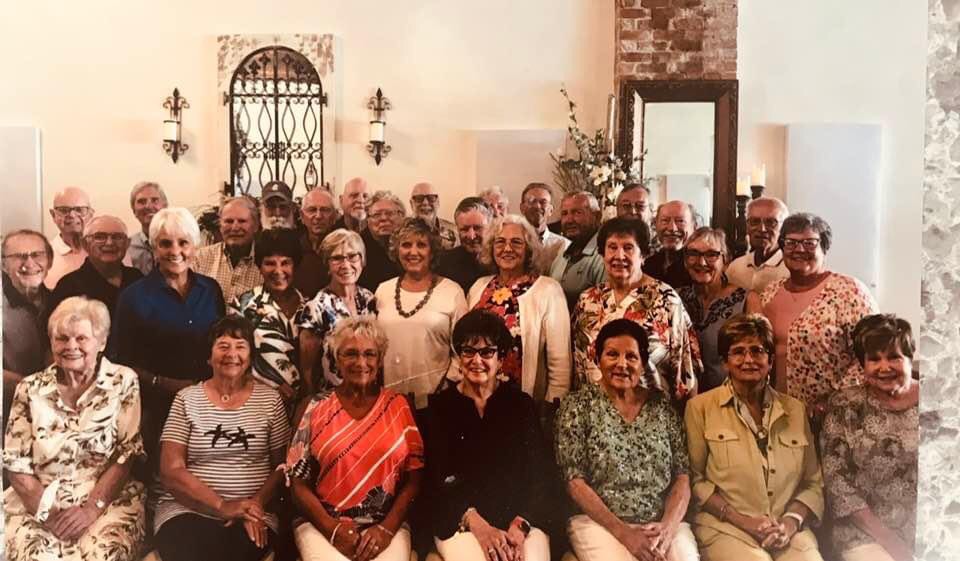
Last Saturday was one of those good days, until it wasn’t. My 1964 graduating class (pictured above) held its 60th reunion at lunch time in Wapakoneta, OH, my hometown, which is about an hour away from my house under normal conditions.

I had my usual problems with inertia when I woke up, you know “a body at rest tends to stay at rest.” That combined with a home maintenance issue I needed to tend to and road construction delay made me about 30 minutes late arriving at the reunion.

As the only clergy person in our class I normally get asked to deliver a prayer to begin the program at our reunions. And I had prepared a prayer (which I have posted separately). I didn’t get to offer my prayer since I was late and learned that someone else had prayed so lunch could begin on time – which is a good thing, to remind everyone that lay people can pray just fine.

I enjoyed visiting with my classmates, learned that many more had died or were in failing health than when we met five years ago. Maybe that reminder of our mortality made us more willing to talk. At least it seemed our conversations were more open.

From the reunion I drove a few miles further to visit an aunt and a cousin who live now in an assisted living/nursing facility. I had good visits with both of them and a good trip home listening to an audio book as I drove.

Because I was listening to a book I did not hear the news of what had happened to former President Trump in Pennsylvania until I turned the TV on later that evening.

If you know me at all you know that I am no fan of Donald Trump. But the news that we had another act of political violence sent me into a deep depression. I was and am glad that President Trump was not hurt any worse, but this recurring nightmare is getting really old.

I’ve lived through at least nine political assassinations or attempted ones. (JFK, MLK, RFK, George Wallace, Ronald Reagan, Paul Pelosi, Gabbie Gifford, Steve Scalise, and Donald Trump). That’s in a 61 year span or on average one every seven years! Our insane love affair with guns is literally killing our dream of democracy.

My funk lasted all day Sunday as I watched all the news I could stand about the assassination attempt. And then the sun did come up again, and I felt better this morning (Monday). Life moved on, and I decided to watch less news and refuse to let my emotions be controlled by all those things I cannot control or impact.

My resolve was sorely tested. Another of Trump’s hand-picked judges dismissed the classified document case in the morning and by afternoon we learned that Trump’s Vice President pick is a senator from my own state. J.D. Vance, in my opinion, was the worst of the three final apprentice candidates on Trump’s list.

Vance has out hypocrited all the other hypocrites by moving from one of Trump’s most vocal critics in 2016 to sucking up so much that he is now Trump’s chosen running mate. Moreover Vance was one of the very first to fan the flames of violence on Saturday by saying that Biden’s rhetoric was directly responsible for the attempt on Donald Trump’s life.

At a time when calling for peaceful and respectful conduct is so badly needed Vance’s comments were like throwing gas on a fire already on the verge of uncontrollable. Vance is more radical than Trump on reproductive freedom; he is opposed to helping Ukraine in her life and death fight against Putin.

Vance is a terrible choice, and I must stop now before I drag myself down again into the pit of despair.

If you are one who prays, please do so for our broken country.

Baring All Before God

Kate Bowler’s Lenten meditation for today triggered a memory for me from nearly 70 years ago.  In her book, “Have a Beautiful Terrible Day,” Kate’s meditation for Monday of Lent Week Four is titled “letting yourself be known.”  She paints a wonderful contrast between fearing a God who judges our faults and one who knows all about us and loves us as we are.

She closes with this reflection prompt:  “We can have a very Elf on the Shelf view of God at times.  THERE IS GOD WATCHING YOU. Shudder.  What image of God seeing you and caring about you could you find comforting?”

A long-forgotten memory immediately popped into my head as soon as I read those words.  When I was young my maternal grandparents lived on a farm that had no indoor plumbing.  When I visited them I thought nothing of using their two-holer outhouse.  It was just the way they lived.  

I especially enjoyed visiting there because the 7th of my grandparents’ children, Gary, aka Butch, was only 4 years older than I. He was more like a cousin than an uncle to me and just enough older that I admired his greater knowledge of worldly things. Farm kids have a much earlier and healthier grasp of how life and death work than we city slickers did.

So here’s my memory.  One day uncle Butch and I were using the outhouse.  I’m guessing I was 9 or 10 and he was 13 or 14 at the time.  We were at that curious age where sex was often a topic of conversation.  I don’t remember any details of our conversation, much of which I later learned was misinformed.  But I have a vivid memory that for some reason we decided to take off all our clothes and run around the back yard naked.

Had we done that at my house I think my parents would have had a heart attack.  But my dear grandmother who had raised five boys and two girls simply watched us from the kitchen window and laughed.  

Isn’t that a great image of a God from whom nothing is hidden, who sees us in all our human frailty and fallibility and laughs

Darkness Will Not Prevail

Black History Month and Lent

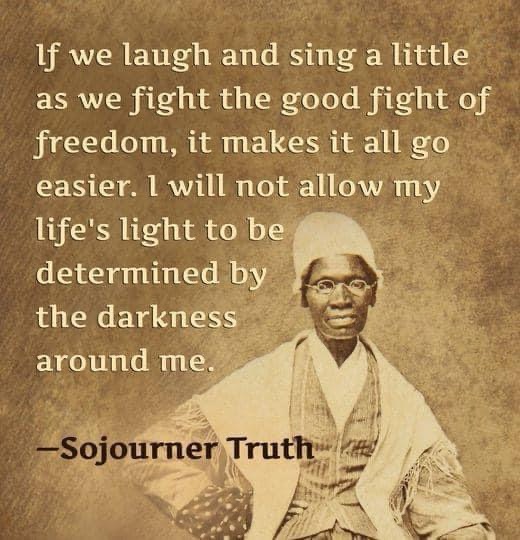
Black History month and Lent go well together. Jesus’ 40 days in the wilderness and our 40 days of Lent pale in comparison to 400 years of slavery and systemic racism, but the determination to not let the darkness prevail requires the same kind of faith.

Darkness and Balance

Darkness has taken on a new significance for me personally in recent years. I was diagnosed ten years ago with peripheral neuropathy which causes numbness in my feet and legs, meaning my sense of balance leaves a lot to be desired.

My physical therapist has taught me some things that help in coping with my impaired balance. There are basically two senses that send information to our brains that help us feel steady on our feet. One is the feel of our feet on what ever surface we are standing or walking upon. Neuropathy plays havoc with that input.

Secondly we get signals from our eyes about our surroundings that help orient us in space. For that sensory data to compute obviously requires our being able to see where we are and where we’re going, and that vision requires enough natural or artificial light to illuminate our path. Simply put it is much harder to maintain a sense of balance in the dark.

That explains why you will find nightlights in every room in our house and why I use a cane to steady myself when walking on uneven surfaces or in the dark. And yes, getting up to make my way to the bathroom in the middle of the night is still sometimes an adventure, even with motion sensor night lights and my cane. It is also why I am very grateful for the flashlight app on both my iPhone and my Apple Watch. I am almost never without at least a small source of light.

Cultural and Political Darkness

On a more macro level Lent 2024 feels really dark to me, even with the blessing of sunshine and above average temperatures here in Ohio. Technology has not invented an app that can brighten the dark night of the soul I feel when witnessing the suffering in Gaza and Ukraine. Natural disasters are still heartbreaking to watch, but I understand the science of how climate change is causing the devastation on the California coast. I cannot however wrap my mind around the evil of modern warfare or the hatred that inspires it.

I despair at the insecurity and depravity that justifies a Putin killing his political enemies or invading a neighboring country just because he can. And I weep over the ignorance about our history that blinds people to the threat of authoritarian leaders and the cult-like devotion to those who blatantly practice it.

Being the Light

When the darkness of sin and evil threatens to drown out the light, God has always called on those like Sojourner Truth to step up and refuse to let the darkness determine our life’s light. That quote reminded me that I am always inspired by the words of another black woman, Amanda Gorman, whose marvelous poem, “The Hill We Climb,” ends with these powerful words:

“When day comes, we step out of the shade aflame and unafraid. The new dawn blooms as we free it. For there is always light. If only we’re brave enough to see it. If only we’re brave enough to be it.”

Action Steps

A Lenten challenge might be to find what God wants each of us to actually do to be the light. It may be relating to family members or co-workers in a more caring way, or volunteering for some group that you’ve always meant to get involved in, getting involved in local politics, advocating for justice by writing letters to representatives, or supporting marginalized groups. There’s plenty of darkness to go around and every ray of light does make a difference.

Prayer

O God of eternal light, the darkness scares me. I know in my head the words from the Gospel of John that assure us the darkness will not overcome the Light of the World. But my heart is not so sure! Rather than just spout pious platitudes that fall flat on their face, please give me the courage to really feel your light in my soul and the guts to go out into the darkness and be it. Amen

Dust to Dust

The fact that Ash Wednesday fell on Valentine’s Day this year has made for some clever jokes and memes.  My favorite is a driver asking his backseat passenger what she’s doing on Valentine’s Day.  She replies, “Rubbing dirt on peoples’ faces and telling them they are going to die.”  (If you are not familiar with the Scripture used when imposing ashes on another’s forehead on Ash Wednesday that joke won’t make any sense.  The words from Genesis 3:19 say, “Remember you are dust, and to dust you shall return.”)

Ash Wednesday seems a bit more real at age 77 than it did at 37 or even 57.  I told a clergy friend that we were asked to ponder how much time we might have left during our worship service tonight, and he said, “That just went from preaching to meddling!”

I am also more aware of my clock ticking this year because I had what felt like a big brush with my own mortality last week. It started when a grape-sized lump mysteriously appeared on top of my shoulder.  Since I’ve been having trouble with that shoulder I made an appointment to get it checked out with my orthopedic shoulder doc.  But I also made the mistake of getting on the internet where I convinced myself it was a swollen lymph node.  I even called my oncologist and talked to his nurse who asked several good questions.  When I told her I was seeing my shoulder guy that afternoon about it she asked me to call her back after that appointment and let her know what he said before she talked to her doctor. 

I was feeling some real fear of dying and wondering how I would handle a serious cancer diagnosis because I do have a so far dormant lymphoma and feared it was finally becoming symptomatic.  When I got to the orthopedic office I first saw a resident, and he immediately said “I know what that is,” which seemed comforting even before he explained.  His tone of voice was not ominous at all and I began to relax.  He called it a “geyser something” which didn’t ring any bells, but he explained it was an eruption of fluid caused by my weakened rotator cuff.  He went out to confer with the doctor who immediately came in and said it was nothing to worry about.  He called it a cyst, which was a term I understand and said there was nothing we needed to do about it

I was very relieved and felt a little foolish that I had catastrophized the situation, but I’m also glad that for those few hours I had an Ash Wednesday experience of at least for a little while feeling quite dusty.  What changes that semi-close encounter with mortality will make in my life remains to be seen.  I hope it will help me keep things in perspective; actually work on my end of life planning and simply put things in better order physically and spiritually.  Remembering February 6, 2024 will help me do that, and the harmless lump on my shoulder will be there as a visible reminder that I am indeed dust and to dust I will return.  

Faith Like the Birds

In this frigid cold snap we have had in Ohio recently I have been filling our bird feeders every day, and the cardinals, blue jays, woodpeckers, sparrows, and the whole wonderful diversity of our feathered friends have flocked to our yard as soon as I finish. How they communicate so quickly that it’s feeding time is a mystery to me, but they do; and I’ve decided we have very biblical birds in our neighborhood.

You see, the birds don’t ever leave food on the table or let the seeds that fall on the ground go to waste, and that has reminded me of the story in Exodus about God providing manna/bread from heaven each day to feed the Hebrews in the wilderness. As usual the Hebrew people are complaining to Moses that he has brought them out into the wilderness to starve. They say they were better off as slaves in Egypt. When Moses shares their concern with Yahweh this is the response he gets: ”Then the Lord said to Moses, “I am going to rain bread from heaven for you, and each day the people shall go out and gather enough for that day. In that way I will test them, whether they will follow my instruction or not.” (Exodus 16:4) 

And God delivers on that promise, but the test is that God through Moses instructs the people to only gather enough of the manna for that day’s needs and not to try and store some up for another day. God is testing their faith to see if they will trust that each day the promise will be fulfilled again. That’s why when Jesus teaches his disciples what we now know as “The Lord’s Prayer” we are instructed to pray only for “our daily bread,” and not for a whole week’s worth. To do so is the difference between a mindset of faith in God’s providence and a scarcity mentality where we hoard more than our share of life’s resources for fear that we will run out the next day.

And that’s the way the birds in our yard live. They don’t leave any bird seed in the feeder for tomorrow because they trust that I will be faithful to meet their needs each new day. As you will see if you read the rest of the story in Exodus 16 some of God’s human children aren’t quite as trusting. And since I don’t speak fluent bird it may be that my feathered friends do complain when I’m late filling their feeders. They are much earlier risers than I; so I don’t pretend to be as faithful as God, but I can tell by the way they flock to the feeders whenever I fill them they are very grateful. And I am grateful to them for reminding me to be satisfied with my daily bread. 

Where’s the Justice?

Election Day, praying for my tribe to win as much as possible even as I fear the dangerous person just elected Speaker of the House and the Trump circus in a New York court room. Trump has succeeded in taking the media spotlight off the mayhem in Gaza, but the slaughter continues there and elsewhere. A mass shooting in Cincinnati recently barely made the news.

We are having new skylights installed today while millions of people have no roof over their head at all. Where is the justice?

My privilege feels like a millstone tied around my neck, even while I resent working for hours on end the last two days to maintain our wonderful home.

I get wonderful medical care for my puny aches and pains while hospitals are bombed in Gaza. Where’s the justice?

I simply turn the tap and open the fridge whenever I thirst or hunger while millions of climate refugees and war victims around the world are starving and dying. Where’s the justice?

By accident of birth I am a privileged white male in a relatively safe and prosperous nation. My ease and comfort are as undeserved as the suffering of innocent Israelis and Palestinians and Ukrainians is unjustified. Where’s the justice?

If I thank God for providing so bountifully for me and my tribe anyone can see the irony that all these others of God’s children who pray to the same God still suffer so horribly. I am not some worthy saint being rewarded for my good behavior like a school boy getting gold stars for what we used to call “deportment.” If I am graded on keeping the 10 commandments or living by the Boy Scout Law I learned as a youth you better believe I hope God grades on the curve. Where’s the justice?

As we Christians paused ever so briefly this week to observe All Saints Day our grief and memories of those who have passed beyond this mortal coil are tied to the deaths of all those unknown to us but known to God souls lost in recent days to the madness of war. Nadia Bolz-Weber said it so well in her sermon for Sunday, “You’re going to die:”

“The untimely and unnecessary deaths of 10,000 children of God, many of whom are actual children, in just that one tiny area of our planet in one month’s time ripples out into an ocean of grief for the 100,000s of thousands who know their names…their babies, and brothers and wives and friends.

This is their day too.

So as we remember our own dead, may we feel connected to the sorrow of those who are also grieving today. And say as our lord did, Blessed are they who mourn. Blessed are they who have loved enough to know what loss feels like.”

I had never thought about grief as a blessing even though I have read those words from the Beatitudes dozens of times. “Blessed are those who mourn.” My thoughts always jump to the second half of that verse “for they shall be comforted.” Yes, we yearn for our own comfort and those of others. But there is no comfort without grief, just as there is no resurrection without death. So in one of those theological twists of fate there is gratitude even for pain. If we could not feel the pain of grief, even for people 10,000 miles away, we also could not feel love and appreciation for our privilege.

I do not deserve my comfortable life any more than the trapped citizens of Gaza deserve the horrors of modern warfare, any more than the 1400 Israelis deserved to die on October 7, or the 6,000,000 Jewish victims of the Holocaust, or the 3000 Americans deserved to die on 9/11. All of that reminds me that life itself is a privilege to be cherished and lived to its fullest no matter where we have landed by accident of birth on this fragile planet.

May our gratitude for what is take the wings of mercy to act as those who do justice here and now, who love mercy wherever we are planted, and through it all walk humbly and gratefully with the One who gives it all and who alone can fathom the mystery of life and death in our broken and unjust world.

A Prayer for Peace in a World Gone Mad

Dear Holy One, my soul is weary from the weight of suffering and war hanging over the world since October 7.  My mind cannot comprehend the depth of the hate that drives people to inflict such cruelty on other humans.  The centuries-old hatred between Palestinians and Jews is so horrific it defies human understanding.  I want to offer even a tiny bit of wisdom or hope, but the well of inspiration is dry.  There simply seem to be no good solutions.  When our own members of Congress cannot overcome their differences to elect a leader what hope is there for peace in the Middle East?  Anger and hate veto any desire to make peace or even to limit the wrath of retribution to just one eye for an eye or one life for a life.  To turn the other cheek to the evil represented by Hamas or Putin is almost laughable at worst or hopelessly naïve at best.  We all live in glass houses and none dare cast stones because we are none of us without sin.  My own nation’s history of genocide and racism is a log in our eyes that disqualify us from passing judgment on anyone else. 

Human history is one horror saga after another full of wars, bloodshed, and tears.  Out of the depths we cry peace, peace, but there is no peace.  Widows in Ramah are still weeping for their children while it takes excruciating days to even open a gate to deliver food and water to starving masses in Gaza.  I want to turn my mind and eyes away from the atrocities, but my heart yearns to know the awful news, even though I feel hopeless to respond.  The ties of sisterhood and brotherhood that bind me to my siblings in Ukraine, Gaza, and Israel are too strong for me to just escape into apathy or hopelessness.  My prayer is that when we hit the bottom of our grief we will surrender to the reality that peace is beyond our human reach.  For it is only in surrender to our weakness that you can fill us with courage and strength for the living of these days.  Fill my weary spirit with your eternal peace and love, O Ground of all Being, and let me be a flicker of light in the darkness.    Amen