Peace that Passes All Understanding

So many competing emotions in Advent 2015! Consumerism has almost ruined the holiday season for me in a “normal” year, but the epidemic of fear fed by the recent wave of terrorist attacks makes it especially challenging and necessary for me to dig deep and find the bedrock of faith and gratitude in 2015.

I struggled for days with what, if anything, to say about the attacks in Paris on November 13, partly because so much has already been said, both wise and foolish, but mostly because I have been very depressed about the state of the world and not sure what to say that can make any contribution. I finally gave up and said nothing.

That Friday the 13th for me was a metaphor for the tug of war between hope and fear. One of our beautiful grandchildren spent that day at our house. I’m very biased, of course, but little things she did that day made my papa pride swell for what a sweet, caring, smart little girl she is.

Shortly after I took her home I heard the first reports about the attacks in Paris on a TV in a fast food restaurant. Unlike 9/11 when the world stopped to watch the horror unfold, I seemed to be the only one in the McDonald’s paying any attention to the news. Everyone else was chatting and carrying on as usual because these kinds of events have become chillingly commonplace.

That evening I went to a meeting to watch a film entitled “Climate Refugees,” which in painful detail describes how millions of people have been driven from their homes by storms, floods and draughts related to climate change. The whole film, which was made long before the current refugee crisis in Europe, was alarming, but one segment especially so given the chaos in Paris that very evening. That segment talked about how desperate, frightened refugees are easy prey for sex traffickers and terrorist organizations looking for new recruits. I was so overwhelmed by the scope of the problem that I couldn’t bring myself to stay for the discussion after the film.

The level and frequency of violence in our world since then has shaken the foundations of my faith. I am questioning my long-held belief in humans being created in the image of God. I am afraid for my family and for the future of the planet. And my first reaction to that fear and anger was to join the chorus of politicians who want to bomb our way out of the ISIS problem and arm ourselves and close our borders. I know better, but it scares me even more that some of our “leaders” or wannabes don’t. Instead they see these tragedies as an opportunity to sell more guns and generate more fear and fan the flames of their own political fortunes with abhorrent ideas borrowed from Hitler’s playbook.

On the bright side there have been wonderful statements of faith and hope from those with a greater understanding of human history and a better vision of human potential. One of those reminded me that love is ultimately the victor over hate. I believe that’s true in the long run, but for now hate has a big lead and the clock is ticking.

The paragraphs above were written during Thanksgiving week, and wisely, I believe, I chose not to share them then because they felt too hopeless and negative. Then yesterday came news of the biggest U.S. mass shooting since Sandy Hook. I was still wrestling with depression and feared this latest killing spree would only deepen my despair. Much to my surprise I am not as pessimistic 24 hours after San Bernardino as I have been for 2.5 weeks. I am very sad and determined to do more to be the solution to the dis-ease strangling our nation and world. But I am not depressed, and that feels very strange.

On the one hand I feel a bit guilty for not being discouraged, and on the other I am afraid to analyze my hopeful feeling for fear I will awaken from a dream and it will be gone. But unlike Ebby Calvin “Nuke” LaLoosh in my favorite baseball movie “Bull Durham,” I am cursed with self-awareness. And most days that’s a good thing – and today is one of those.

I had noticed ironically yesterday that the last thing I posted in this blog was a piece about being “content in whatever state I am in” based on the words of St. Paul in Philippians 4. I posted that 4 days before the Paris terrorist attacks. How quickly I forgot those words to live by when the chips were down.

But tonight, several mass shootings later, some other words from that same 4th chapter popped into my awareness as I was pondering why I was not as depressed by these latest killings much closer to home. In particular verse 7 came to mind, and I had a warm feeling because what had been just words and ideas 3 weeks ago was actually a reality for me. I was experiencing the “peace that passes all understanding,” and it was very good.

So I revisited Philippians 4, and here’s the context for verse 7: “Rejoice in the Lord always; again I will say, Rejoice. 5Let your gentleness be known to everyone. The Lord is near. 6Do not worry about anything, but in everything by prayer and supplication with thanksgiving let your requests be made known to God. 7And the peace of God, which surpasses all understanding, will guard your hearts and your minds in Christ Jesus. 8 Finally, beloved, whatever is true, whatever is honorable, whatever is just, whatever is pure, whatever is pleasing, whatever is commendable, if there is any excellence and if there is anything worthy of praise, think about these things. 9Keep on doing the things that you have learned and received and heard and seen in me, and the God of peace will be with you.”

How relevant and practical those old words are for this particular Advent. Rejoice, in spite of our fear. Be gentle to everyone, including ourselves. Know that Emmanuel (“God with Us”) is near. Replace worry with prayer and supplication and thanksgiving. Prayer is not enough in our struggle with death and destruction and violence, but it is the foundation, the source of strength that sustains us when “our arms are too weary” to be carriers of hope to a frightened world.

And Paul gives attitude adjustment advice better than the best self-help guru. He says to focus on what is good and true and excellent and worthy of praise. Because even in the dark days of Advent 2015 there is much goodness in the world. We may just have to work a little harder to find it, but it is more necessary than ever to find it and share it.

One such image for me that is stronger than the non-stop horrific news coverage from California is that of a simple gesture by my granddaughter that Friday the 13th. She came down to my office that morning with two juice boxes in her hands that she had gotten from the lunch box she brought with her. When I asked her if she was going to drink them both she said, “No, this one’s for you.” A simple pure act of caring and sharing, unprompted and natural. It was the best juice box I’ve tasted in a long time!

She was doing in her six-year-old way what the final advice is in that passage from Paul. It says, “Keep on doing the things that you have learned and received and heard in me, and the peace of God will be with you.” Don’t abandon the ways of love and peace. Don’t fall into the temptation to fight fire with fire. Be forgiving and compassionate, even when those things make no sense and seem impossible. There is no peace in following the ways of King Herod, another mass murderer. The peace of God came “not with swords loud clashing, nor roll of stirring drum, but with deeds of love and mercy” in a helpless refugee child born in a barn.

No matter how loud our leaders and our hearts want to shout fear and hate, the still small voice of God says, “Fear not, I am still bringing you good news of great joy.” Don’t miss it!
Peace and Contentment No Matter What

Being content in whatever state I am in, and that’s not a geography question by the way, has been getting more challenging for me for the last 6 years. I have been a glass-half-full kind of guy for most of my life, but the natural aging process seemed to kick into high gear for me in the fall of 2009, just before my 63rd birthday. Since then I’ve had two major surgeries and a laundry list of old people medical issues that aren’t life-threatening and not worth itemizing. But they are a pain, literally and figuratively.

I know the uselessness of going into victim mode, and I cringe when I catch myself and my peers devoting the lion’s share of our conversations to medical reports. But self-pity is an occupational hazard for later life, and I do fall into the thrall of its siren song far too frequently.

All of that provided a helpful existential and personal backdrop for a Bible Study I just led for my church. We studied an excellent book by Adam Hamilton entitled The Call: The Life and Message of The Apostle Paul. My theological bias has led me to focus most of my attention on Jesus and the Synoptic Gospels for most of my career; so this study of Paul was an excellent refresher course for me that helped me take a serious look at Paul’s life and what shaped his theological perspective.

I have quoted Paul in sermons, at weddings and funerals, and frequently used his dramatic conversion as an example of the unlimited power of God to transform and redeem any life. But not since seminary 40 plus years ago have I done a systematic study of the context and circumstances that inspired Paul’s writing and teaching and his absolutely unstoppable devotion to his call to share the Christian Gospel with the world at any and all personal cost and sacrifice.

I have been as guilty as most preachers of cherry picking and proof texting verses of Scripture out of context, and two of those verses I refer to often from Paul have taken on a deeper level of meaning for me as a result of studying Paul’s life again. One is the aforementioned verse about being content in whatever state I am in (Phil. 4:11), and the other is from Romans 8 where Paul assures us that “nothing in all creation can separate us from the love of God in Christ Jesus.”

Those verses are powerful statements of faith even taken out of context, but when we realize that Paul wrote Philippians, a letter of joy and rejoicing, from one of the several prison cells where he spent 4-5 years of the last decade of his life they take on a deeper meaning. Earlier in Philippians 4 Paul says, “Rejoice in the Lord always; again I will say, Rejoice. 5Let your gentleness be known to everyone. The Lord is near. 6Do not worry about anything, but in everything by prayer and supplication with thanksgiving let your requests be made known to God. 7And the peace of God, which surpasses all understanding, will guard your hearts and your minds in Christ Jesus.”

Those are strong words from a man who describes the trials of his life this way in II Corinthians: “Five times I have received from the Jews the forty lashes minus one. 25 Three times I was beaten with rods. Once I received a stoning. Three times I was shipwrecked; for a night and a day I was adrift at sea; 26 on frequent journeys, in danger from rivers, danger from bandits, danger from my own people, danger from Gentiles, danger in the city, danger in the wilderness, danger at sea, danger from false brothers and sisters; 27 in toil and hardship, through many a sleepless night, hungry and thirsty, often without food, cold and naked. 28 And, besides other things, I am under daily pressure because of my anxiety for all the churches.” (11:24-28)

Paul was a man of passion and perseverance. Someone has defined “passion” as something one is willing to suffer for. Paul was willing and determined to share the Gospel, and he experienced great hardship and pain for his efforts. But did he suffer? If he learned to be content with whatever he had and therefore found the peace that passes all understanding, I would argue he did not suffer. There is a popular self-help statement that says, “Pain is inevitable but suffering is optional” which is often attributed to Buddha. It is consistent with the Buddhist philosophy but no one knows for sure where it originated. Regardless of the source, that advice applies to Paul and to anyone who achieves the attitude of acceptance toward circumstances, tragedies, pain, and other problems that one cannot control.

Paul is able to rise above the “slings and arrows of outrageous fortune” when Hamlet cannot because of his faith and absolute trust in the goodness and mercy of eternal God. Given the hardship he endured and triumphed over to almost single-handedly spread the Gospel of Christ across the Roman Empire, the words of Romans 8 echo like a climactic crescendo to the symphony of his life.

“Who will separate us from the love of Christ? Will hardship, or distress, or persecution, or famine, or nakedness, or peril, or sword? 36 As it is written,
“For your sake we are being killed all day long;
we are accounted as sheep to be slaughtered.”
37 No, in all these things we are more than conquerors through him who loved us. 38 For I am convinced that neither death, nor life, nor angels, nor rulers, nor things present, nor things to come, nor powers, 39 nor height, nor depth, nor anything else in all creation, will be able to separate us from the love of God in Christ Jesus our Lord.” (Romans 8:35-39)

Paul has been there, done that. He’s not a bystander to the forces of opposition. He doesn’t just believe in the love of God, he’s felt it and been sustained by it in the most difficult and hopeless situations imaginable. If he’s content and at peace, who am I to be discouraged or undone by the minor difficulties and challenges life puts in my way?

Will the Circle Be Unbroken?

I attended a Bluegrass Festival with some friends a few weeks ago and have been singing or humming “May the Circle Be Unbroken” ever since. Bluegrass is not my music of choice; so I’ve been pondering why that song has stuck in my head. There are good memories of singing that song around campfires when I was a youth minister many years ago. But it has taken on a deeper more pervasive meaning lately. Some of that became clearer to me this week after a depressing visit with my 94 year old father who has outlived his mental and physical faculties and is miserable. Is there a better day coming for him and his wife suffering from dementia?

I don’t think it’s in the sky but where? What? How? Those questions become more relevant as morality pounds harder on my door each day, in aches and pains, friends in surgery, cancer diagnoses and biopsies, longer list of things I can no longer do. I’ve toyed with the lyrics of that song by changing the “e” to an “i” in “better,” i.e., “There’s a bitter day a coming….” That’s what happens when we turn in on ourselves, we get bitter and go victim. “Why me?” “It’s not fair!” “Why didn’t I take better care of myself?” “Let’s try one more miracle supplement that flows out of the fountain of youth!” Fear springs from the unknown “in the sky” or in some place of darkness, from regrets over a lifetime of sin or just dumb mistakes we can never erase.

Fear is epidemic in our society. I was at a wedding reception recently where I was told one of the men at my table was carrying a concealed weapon “because you never know what might happen.” The next week my relatives at a family gathering were discussing preparedness drills for an active shooter at their little country church and in their schools where children are being taught to throw anything they can find at a shooter ala David versus Goliath–only Goliath didn’t have his NRA sanctioned AR 15.

A father was shot dead last Friday in front of his six kids and wife in a burglary in our affluent “safe” suburb. And today Ted Koppel was on the morning news talking about his new book Lights Out, about the coming cyber-attack that will paralyze our society. The temptation to buy some guns and a generator and become a survivalist is so strong even I feel it tugging at me. There is a little solace for me that I’m old enough I may not have to deal with the worst of the Hunger Games scenario, but I fear for my kids and grandkids and feel hopeless and helpless to do anything significant to help them.

Will the circle be unbroken? Or has human depravity and selfishness reached epic proportions that strain the bonds of civility beyond the breaking point? Is Jesus’ pacifist advice to turn the other cheek and put away our swords just naïve idealism? Those are not verses that fearful Christians cite when they turn to Scripture for comfort. I quoted Isaiah (2:4) and Micah (4:3) once to a life-long Christian, the verses about “beating our swords into plowshares and our spears into pruning hooks,” and she said that in 60 years of going to church she didn’t remember ever hearing those words! Unless prophetic voices stand up to the fear mongers and proclaim a message of hope and reason to a world gone mad, the circle may indeed be broken.

I remember being this depressed about the state of the world back in 1972 after Nixon’s landslide victory in spite of Watergate and the protests about the Vietnam War. I wrote a letter to the editor saying that all we could do now was “wait for the inevitable judgment of God.” 43 years later we are still here. We’ve survived that war in SE Asia, the resignation of Nixon and his Vice President, 9/11 and a host of other terrorist attacks, too many mass shootings to count, a huge economic recession, and at least so far several ill-advised wars in the Middle East that have only fanned the flame of hatred in that cauldron of religious and ideological conflict that is the eternal flame of human strife and animosity.

The circle is frayed and contorted out of shape, but it is still unbroken; and that last paragraph is a micro-second in the eternity of the cosmic circle viewed from God’s perspective. As we scroll backward in time through Holocaust, Civil War, Slavery, Genocide of native people, the Dark Ages, the Crusades, Roman, Greek, Syrian, Egyptian, Ottoman Empires, the rise and fall of numerous Dynasties in China and Japan, Exile and Exodus, Stone Age and Ice Ages, and all the other eras of our planet’s history that I missed in history class, our current fears and woes are put in better perspective.

In every generation there have been concerns about the elasticity and tenacity of the circle, and it is still unbroken. That is not an excuse to blithely bury our heads in the sand or in our parochial platitudes. We must counter the fear mongers with words and lives of hope and visions of peace in any way we can. And remembering the great circle maker and sustainer gives us the courage to witness to our faith even when fear and doubt threaten to overwhelm us.

Finding Our Way Back to God: The Search for Meaning, Micah 6:1-8

Many years ago I overheard a dinner table conversation between my in-laws that stuck with me. This was back in the days before bucket seats and consoles with gear shifts and cup holders began dividing the front seats of cars like the Berlin wall. For those who don’t remember those good old days, the front seat was a bench seat and dating couples could snuggle up close to each other while driving. We didn’t need cell phones to be guilty of distracted driving. My in-laws had been married for many years at this point, and my mother-in-law was reminiscing about their dating days and how she used to sit over in the middle right next to her beloved. And she asked, “Why don’t we do that anymore?” Her husband got a mischievous grin on his face and said, “Well, I’m not the one who moved.”

As we consider how we find our way back to God the first thing we need to remember is that God isn’t the one who moved either. And our text from Micah addresses the question of how we make that journey.

We sometimes move away from God because we are searching for purpose and meaning for life in a scary confusing world. What is our passion, our purpose for living? What gets us out of bed in the morning saying? And how we answer that question is one of the keys to finding our way back to God when we feel lost and like running away.

The most familiar verse in the book of Micah is one attempt to wrestle with the search for the meaning of life and our relationship with God. Micah 6:8 says, “God has told you, O mortal, what is good; and what does the LORD require of you but to do justice, and to love kindness, and to walk humbly with your God? That verse is Micah’s reply to the question raised two verses earlier – “With what shall I come before the LORD, and bow myself before God on high?” This is familiar format for an entrance litany as Jews prepare themselves for worship – asking what must we do to please God, to make ourselves worthy of God’s presence and blessing?

Part of our struggle when we feel removed from God is centered in that basic question – am I good enough? And when we feel like we are not, what does God do about that? When we mess up do we get what we deserve from God? I hope not. And if we feel like we don’t have a clear purpose for our lives or we are failing to achieve it, it’s hard to feel all warm and fuzzy about God.

What is your why for living? Unless we can answer that question we are just going through the motions in some kind of cosmic rat race, and that feeling of meaninglessness is not conducive to closeness with God.

Micah prophesied at the beginning of that time when Israel and Judah were in the deep trouble that eventually led to the Exile. The Assyrian empire was threatening their very existence; the rulers of Israel had put their trust in foreign alliances instead of in the ways of God, investing vast sums in armaments instead of taking care of their own citizens, going into crippling debt by borrowing from the Assyrians. Sound familiar?

Listen to how the NRSV introduces the book of Micah: “Micah offered a theological interpretation of the dizzying events near the end of the 8th century: the fall of Samaria, the expansion of Jerusalem fueled by emigrants from the north, and the international situation made unstable by an aggressive superpower, Assyria.” So this question about the meaning of life and what we must do to please God was not some idle Sunday School discussion topic for Micah – it was a matter of life and death, and it still is.

Micah begins chapter 6 with an Imperative – “Listen up people to what the Lord says.” He then portrays the situation of Israel being on trial for breaking her covenant relationship with God. Then follows a quick review of God’s salvation history with Israel. Micah begins with the seminal event in Israel’s history, how God chose Moses, Aaron and Miriam to lead the people out of slavery in Egypt. Secondly he highlights a much less familiar, at least to us, story of Balaam’s encounter with King Balak of Moab during the long wilderness journey of the Exodus, and wraps it up with a reference to two cities representing the crossing of the River Jordan, Shittim on the east side of the Jordan and Gilgal on the west in the Promised land.

If you’re like me, the exodus from Egypt and the crossing of the Jordan are familiar stories, but the Balaam and Balak reference, not so much. We’ll come back to it because it’s a really cool story, but for now let’s just say Micah uses it to remind the people of one of many times during the 40 years in the wilderness that God rescued the Israelites and helped them overcome obstacles and enemies that stood in their way to freedom and promise.
So with a God who has done all that for his people, people are asking why have things gone so sour? Their world is going to hell in a handbasket. They feel abandoned and alienated from this God who has been their deliverer and savior for centuries.

They need to remember, God isn’t the one who moved – God is faithful and just forever; so when we feel separated from God, the question is what do we need to do to get back next to God.

Micah responds by turning to the question of worthiness and atonement. Verse 6 says “With what shall I come before the Lord.” How can I find my way back to God? And then follows a litany of sacrifices that gets increasingly ridiculous – the best calves, 1000 rams, 10000 rivers of oil, and first born children. You see, the Jews are big on laws. We’re familiar with the top ten list from Mt. Sinai, but those tedious books of Leviticus and Numbers that we don’t often read spend a lot of time explaining the 10 commandments and trying to legislate specific rules and regulations for daily life in order to fulfill what God requires. There are 613 laws the Jews tried to live up to –- and they didn’t’ have any apps to keep track of those. So obviously, being the imperfect fallible human beings they were, they needed a way to make amends with God when they messed up, which was often.

And their system for getting back in God’s graces was offering sacrifices to God. These were ritualistic acts of worship, but as Micah and the other prophets point out, to attend church regularly and perform all the necessary rituals doesn’t mean squat if you go on living unjust, sinful lives the rest of the time.

So finally we get to verse 8 where Micah summarizes what the faithful life looks like in three short phrases – what does the Lord require? – do justice, love mercy or kindness, and walk humbly with God. That’s the way to a life of meaning and purpose, that’s the way back to God. It’s not just something we can do but encompasses who we are called to be. I heard a wonderful sermon once that took its theme from a Frank Sinatra song, “Strangers in the Night,” and in particular from the profound refrain to that song that just says, “do be do be do.” The preacher said if you change that phrase and take out the “be” all you have left is “do do.”

We are not human doings – we are human beings, and faithful living is a holistic process that encompasses all that we are, not just some segmented religious part of our life. Micah lists justice, mercy and humility, qualities that include active doing – working for justice, treating others with mercy and kindness as a way of being –not out of sense of duty or obligation, but simply because in a faithful, loyal relationship with God, we take on those qualities of being.

Pope Francis is a fascinating example of what Micah describes here. The Pope is beloved by so many people because of his humility. He has rejected the usual pomposity of his office, traveling in a little Fiat, taking time to listen to a little girl trying to keep her immigrant parents in this country, spending time with the homeless, washing stinky feet. He walks the walk and because he does so he can also advocate for justice in the halls of Congress and get a standing ovation for the golden rule from a badly broken and partisan legislature.
Francis has been criticized for being too political, but that’s where justice has to happen, in the political arena where too often the rules that perpetuate poverty are passed by the powerful for the benefit of the powerful.

We sometimes use separation of church and state as an excuse for not getting our hands dirty in the messy business of politics, but that’s a misunderstanding of the first amendment to our constitution. It says, “Congress shall make no law respecting an establishment of religion, or prohibiting the free exercise thereof.” It doesn’t say religion can’t influence the making and implementation of the laws and policies we live by. In fact Micah and the prophets and Jesus are all very clear that God wants laws that are just and that part of the free exercise of our faith is to help make that happen.

Speaking of church and state, let’s go back to King Balak and Balaam for a moment. The whole story is in Numbers 22-24, and I’d encourage you to read it. It is no accident that Micah uses this story in this section about justice and mercy and humility. The short version of the story is that the Israelites are on their way through the wilderness on their way to the Promised Land and one of the many hostile territories they have to pass through is Moab. King Balak sees the vast number of these illegal immigrants heading into his country and orders the prophet Balaam to curse them and drive them away. (Sort of like building a big fence?) But Balaam consults a higher authority, and God tells him, don’t curse these people for they are blessed. In a humorous scene, when Balaam’s faith wavers a bit his faithful donkey sees God’s angel blocking their path when Balaam can’t see the angel, and the donkey prevents Balaam from giving in to King Balak.

Three times Balak pleads and begs with Balaam to curse the Hebrew people, trying to bribe him with great wealth and power, but Balaam holds fast and tells this powerful ruler that he must do and say only what God has told him. Instead of cursing the Israelites he blesses them and they continue on their way toward the Promised Land.
What does the Lord require of us? Balaam and his donkey’s kind of courage and steadfast faithfulness – refusing to give into unjust, unethical demands of the world, even when it would seem to benefit us to do so. And how do we do that? By walking humbly with God as our constant companion and spiritual guide.
Finding God’s meaning and purpose for most of us is not about one burning bush moment. It’s a journey not a destination. It’s about a total body of work, a life of working for justice for the least and lost, of being kind and merciful to everyone, and doing it all not to earn brownie points with God but to simply share God’s love with the world.
John Wesley famously said when he was kicked out of the Church of England, “The World is My Parish.” And he took his ministry to the streets and to the open fields where people who did not feel welcome and worthy in the church were looking for their purpose and trying to find their way back to God.

On this World Communion Sunday, when our world seems to be on the way to the same destruction that befell Samaria and Jerusalem, the Word from God is this: Listen up People, I have not moved, trust my ways. Do not be overwhelmed or despair. I know your sins and they have not driven me away and never will. Don’t worry about paying for your sins, that has already been done by Jesus Christ, and your mission, should you choose to accept it, is to be Christ-like in humble, merciful service, to work for justice in whatever part of my world you are in – I’m right here with you always.

Benediction: May God grant us the vision of Balaam’s donkey to see that God is not the one who has moved. God is on this journey with us to empower and lead us. By our own strength we cannot live just and merciful lives all the time, but if we humbly walk with God, he will show us the way. That is our purpose. Let’s go.

Walls or Bridges?

“Something there is that doesn’t love a wall, that wants it down!” Robert Frost, “Mending Wall”

O God of unity, forgive our walls made of concertina wire. Forgive our walls of fear and hate, fortified with ideology and suspicion. Forgive our scarcity mentality that hoards life and refuses refuge to the homeless and hopeless. Remind us again that we are to treat the sojourner and alien in our midst as one of us because we are all one human family, that how we treat the least of our sisters and brothers is how we treat you.

The need is overwhelming, but your love oh God is boundless and unconditional. Renew our faith that all things are possible with you; swing wide the gates of our hearts and empower us with your Holy Spirit to build bridges of hope instead of ugly walls. Amen.

Prayer for the Discouraged and Fearful: 13th Sunday after Pentecost

O God, these are times that try our souls and our faith. Our world is full of assault weapons and political insults. So much violence on our streets, in the news, on our small screens and big screens makes us want to buy AK 47’s instead of putting on the “full armor of God.” Taking up a cross, turning the other cheek, forgiving mass murderers and terrorists – those things seem so hopelessly naive. No offense, Lord, but Kevlar vests seem like a better bet against an active shooter and the arrows of evil than the “breastplate of righteousness.” (Ephesians 6)

We’re afraid, Lord, afraid for our safety, our freedom, and our future as a nation and as a human race. We’re afraid for our children, for those who try to keep the peace, and for those trapped in an economic system where the deck is stacked against them. You’ve taught us that perfect love casts out fear, O God, but our love is imperfect and our fear threatens to cast out love, especially for those who need love the most.

We pray for victims of abuse and hate who become abusive and hateful. We pray for the victims of violence and other traumatic life events that drive them to flee from their homelands illegally or legally, for those who seek refuge in drugs or other forms of harmful self-medication, for those so desperate to escape the prison of poverty that they resort to crime. We pray for spirits and relationships and health broken by the burdens of unjust life circumstances, for the bullied who become bullies and their victims, for the homeless and the hopeless, for those trapped in ideologies that prevent compassion and understanding of other beliefs and believers. Lord, hear our prayers and our desperation in the face of so much fear and misery.

We see so many others lose faith and hope and turn away from you, Lord. When Jesus asks, “Do you also wish to go away?” (John 6:67) we are sorely tempted to say, “Yes, Lord, being a Christian disciple is too hard!” The strong and ruthless, not the meek or the peacemakers, seem likely to inherit the earth if there is anything left of it when the plundering and bloodshed are over.

Fear and faith wrestle for our souls, and even though it makes no sense to us or the world we hear ourselves saying with Peter, “We will follow you, Lord. You have the words of eternal life. We have come to believe and know that you are the holy one of God.”

Thanks for giving us moments of courage we did not know we had, for assuring us that our “Weeping may linger for the night, but joy comes with the morning.” (Ps. 30:5). Help us hang on through the night, O God of promise; hear our prayer. Amen.

Prayer for 11th Sunday after Pentecost

O Eternal One, the beauty of the summer season at my peaceful home battles in my mind with the harsh realities of life in our broken world. I feel like E.B. White when he said, “I arise in the morning torn between a desire to save the world and a desire to savor the world. This makes it hard to plan the day.”

The 24/7 news cycle bombards us with news of desperate migrants from Africa overwhelming a Greek and European economy teetering on the brink. The next news story describes nursing homes in Japan exclusively for survivors of atomic bombs dropped on them as children 70 years ago this week. Wildfires destroy homes and force evacuations in draught stricken California while typhoon Soudelor ravages Taiwan and China. I turn the page of my newspaper, hoping for some good news, and read that 2000 Iraqis have reportedly been executed by ISIS.

My God, have you forsaken us? The scope and number of world crises is overwhelming, and that doesn’t even begin to count our individual concerns about illness, grief, employment, relationships, and our failures to be the kinds of caring people we want to be. We know we are supposed to respond to the needs of others, God, but the needs are more than we can cope with; and sometimes it all seems so hopeless we don’t even know how to pray.

Help us not to despair and lose faith. We are not the first to feel overburdened and lost, nor will be the last. Even Jesus on the cross drew on the lament of Psalm 22 when he felt forsaken. St. Paul, who is always so strong and certain in his faith, acknowledges times of doubt in Romans 8 and assures us “the Spirit helps us in our weakness; for we do not know how to pray as we ought, but that very Spirit intercedes with sighs too deep for words.” Yes, God’s Holy Spirit intercedes for us. When we are at the end of our ropes, God prays for us!

But we have to be open to that intercession to receive it. Draw us close in our times of fear and uncertainty, God, like a loving mother comforting a child shivering in terror from a nightmare. Do not let doubt and fear drive us from you, Holy One, for it is exactly in such times that we need you more than ever.

We believe, Lord, help our unbelief. Let our weakness and helplessness in the face of everything happening in our lives and world be the motivation that brings us humbly back to you, admitting we can neither save nor savor the world without your divine guidance and eternal strength.

Pray with us and for us, O God, our hope and salvation. Amen.

Blowing in the Wind: Hiroshima and Our Addiction to Violence

hiroshima
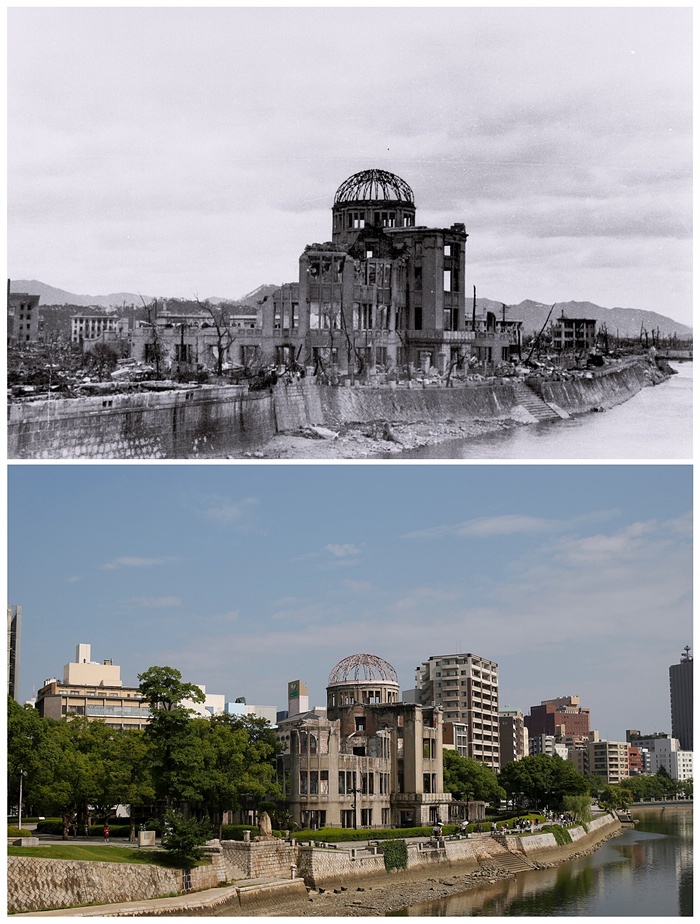
With so much political posturing dominating the news this week there seems to be little notice in the U.S. that today is the 70th anniversary of the first atomic bomb dropped on Japan. I’m sure the date is not forgotten in Hiroshima. August 6, 1945 has been a somber day for me ever since I learned about it in school. Even though I wasn’t born until 15 months after it occurred, what happened in that Japanese city at 8:15 that morning changed the world I was born into forever.

Diana and I visited Japan several years ago, and the horror of that event was made even more real. As we stood on the very spot where so much death and devastation took place, we saw pictures and read accounts of the unbelievable power unleashed on that city, of the 70,000 people who were annihilated by the blast and perhaps 200,000 more who died later after horrible suffering from radiation poisoning.

Many arguments about the pros and cons of the decision to drop that bomb and the one 3 days later on Nagasaki have been offered, and I appreciate that ethical and political debate. The truth is that whether dropping the bombs was justified or not, the atomic genie can’t be put back into the bottle. The question as always is what to do now with the reality we have.

I am haunted by Einstein’s assessment of the significance of this day. He said, “The splitting of the atom changed everything, save man’s mode of thinking. Thus we drift towards unparalleled catastrophe.” Yes, we have managed to avoid nuclear annihilation for 70 years, and that’s a good thing. Except for the people unfortunate enough to live near Chernobyl or Three Mile Island or Fukushima the human race has been smart enough or lucky enough to avoid nuclear disaster. We will probably never know how close we have come on many occasions, and the tensions with Russia and Iran and North Korea, not to mention the threat of nukes falling into the hands of terrorist groups, mean we still have not changed the mode of our thinking.

Why has humankind always used every new technology to develop more deadly ways to maim and kill each other? Every advance in science seems to carry with it a dark side of destruction. Chariots, horses, airplanes, ships and rockets become delivery systems for death. Chemical gases, Nobel’s invention of dynamite, even pressure cookers can and have been turned into weapons—just the opposite of the biblical vision of beating “swords into plowshares, and their spears into pruning hooks; nation shall not lift up sword against nation, neither shall they learn war anymore.” (Isaiah 2:4)

A friend emailed me a piece today about the positive uses of drones to deliver medicine with the comment that drones have been getting bad publicity lately. My response was, “No, some idiots flying drones have been getting bad publicity.” It isn’t the technology that is the problem; it is our failure to use it wisely. And that failure usually stems from fear.

Fear is the enemy of the moral courage to change the way we think and stop the madness of violence as the default solution to our conflicts and problems. Another wise friend sent me these statistics yesterday. “In the US we had about 34,000 gunshot deaths in 2013, two thirds of which are actually suicides. Germany had about 200, and Canada and Britain had even less. Somebody has to have the moral courage to say that this is crazy, to have 300 million firearms in one nation, and that all it does is to lead to thousands of deaths.”

There is an old folk song that asks a question that is as relevant today as it was in 1945 or when Bob Dylan asked it in 1963: “How many deaths will it take till we know that too many people have died?” Dylan’s answer was that “the answer my friend is blowing in the wind.” I don’t know if Dylan knew that the Hebrew word for wind, “ruach,” is also the word for “spirit” and “breath.” So that song for me says the answer is blowing in the life-breathing spirit of God, and only there.

The answer is not more and bigger bombs. The answer is not more guns. The answer is to examine our fears that drive us to build gated communities, to propose building walls on our borders to keep others out. Instead of repairing roads, educating our children, alleviating poverty, and addressing social injustice, we spend obscene amounts of money and resources on defense because we are afraid. The gun lobby sells more and more automatic weapons that have no purpose but to kill other people because we are afraid. Wealthy lobbies buy more and more congressional votes because our legislators are afraid to take courageous stands that will cost them their office and lifetime benefits. The church is silent about being peacemakers and turning the other cheek because we are afraid those unpopular views will cost us members and contributions.

I started a series a few months ago on Pentecost and the power of the Holy Spirit as described in Acts 2 (see posts from May 26 and June 14). I haven’t finished that series because other issues keep grabbing my attention. I didn’t realize when I started this post that I would come back around to Pentecost.

“When the day of Pentecost had come, they were all together in one place. And suddenly from heaven there came a sound like the rush of a violent wind, and it filled the entire house where they were sitting. Divided tongues, as of fire, appeared among them, and a tongue rested on each of them. All of them were filled with the Holy Spirit.” (Acts 2:1-4)

The forces of fear are powerful and real and require an even stronger power to overcome them. They cannot be conquered by any human technology or ideology. Fear paralyzes our ability to reason and recognize the futility and foolishness of our attempts to save our lives and our stuff through arms. We can learn a valuable lesson from Alcoholics Anonymous about our addiction to bigger and badder weaponry or security systems. AA knows we cannot conquer an addiction without surrendering to a higher power.

That higher power blew through Jerusalem on Pentecost and changed lives and the world forever. And the answer to stopping the violence in our theaters and schools and churches and to defusing the nuclear nightmare is still blowing in the ruach of God.

Blow, holy wind, blow away our fears.

Freeway Theology

IMG_0048 (2) I saw this graffiti spray-painted on a freeway overpass several years ago, and my immediate thought was “I guess forever was longer than John expected!” After wondering how and why people hang over the side of an overpass and paint upside down, my next thought was “that’ll preach.” I’ve used it often in preaching class as an example of the kinds of ordinary observations in daily life that can have theological significance.

Jesus did that, of course, using mustard seeds, lost sheep and coins, yeast, candles, a valuable pearl, and even a hated Samaritan to weave parables that reveal truth about the nature of God that declarative sentences can’t illuminate in the same holistic way. Stories and images reach beyond the intellect and move us at a deeper emotional level.

John obviously fell out of love with whoever’s name was beneath that paint. It happens all the time in human relationships, but we cannot convert that unfortunate reality that sometimes leaves deep scars on the human psyche into what God’s relationship to us looks like. How unfortunate if we let false teachings about a wrathful, judgmental God scare us away from the only source of truly unconditional love there is.

We often hear Paul’s marvelous words about love read at weddings: 4 “Love is patient; love is kind; love is not envious or boastful or arrogant 5 or rude. It does not insist on its own way; it is not irritable or resentful; 6 it does not rejoice in wrongdoing, but rejoices in the truth. 7 It bears all things, believes all things, hopes all things, endures all things. 8 Love never ends.” (I Corinthians 13). I try to warn starry-eyed couples that those words do not describe human love, no matter how strong that love is. Paul is writing about God’s love revealed to us in Christ, and it is the backup we can always turn to when we want to remove the tattoo of our beloved from our arm or spray paint over his or her name on the overpass.

God’s love is forever. It’s not a 5 year or 50000 or mile guarantee. It’s not even “till death do us part,” as great as that deep love is. There is no fine print in God’s covenant with us. We can break the contract or think we have by our own sinfulness or stupidity, but God won’t ever stop loving us, period. Like the prodigal son’s father, God waits patiently for us to come home, no matter how badly we’ve messed up our lives or how long we’ve been gone.

That message is repeated in a multitude of ways in the Hebrew Scriptures and the New Testament. Two of my favorites are: “Come now, let us argue it out, says the LORD: though your sins are like scarlet, they shall be like snow; though they are red like crimson, they shall become like wool.” (Isaiah 1:18). And “If we say that we have no sin, we deceive ourselves, and the truth is not in us. 9If we confess our sins, God is faithful and just will forgive us our sins and cleanse us from all unrighteousness.” (I John 1:8-9)

That’s pretty straight forward and clear. Don’t let disappointments with human love confuse you about God’s love. With God, forever really means forever.

Three Brothers and the Hidden Treasure

I first heard this story many years ago, probably around the campfire at church camp. I don’t know the source or author, but I have always remembered it as a great parable about the joys and frustrations of exploring the mysterious depths of faith questions. (If anyone knows the author or source, please let me know.)

Three brothers lived in a rustic cabin deep in the woods. They had no neighbors and rarely any visitors; so they were surprised by a knocking at their door one night during a nasty thunder storm. When Jacob went to the door he found a very wet old man who had lost his way in the storm. The old gent said he didn’t want to impose, but if he could get some shelter for the night in a shed or barn he would be most grateful.

Jacob scoffed and said they would never think of putting a needy traveler in the barn. He invited the old man into the cabin where the brothers fed him, loaned him dry clothes and provided a comfortable bed for the night. The next morning they fed him a hearty breakfast and gave him food and water to take with him as he prepared to continue his journey. The old man was so grateful for their hospitality he pulled a tattered piece of paper from his knapsack and said he wanted them to have it. When Walter, the youngest of the three tried to decline the offer their guest insisted. He said it was a treasure map. “I’m too old to continue the search,” he told them, “but I want you to have this as a token of my appreciation.”

Thomas, the middle brother, saw it would be ungracious to refuse the gesture; so he took the map and put it in a desk drawer after the man was gone. He had never said where he was going, and the brothers thought it was a little odd; but they were soon preoccupied with their daily chores and forgot about the map.
They speculated a bit that evening at dinner about their mysterious visitor, and Walter wondered out loud where the treasure map might lead them. Jacob and Thomas were both skeptical but decided to humor their younger brother. So they carefully unfolded the map after the dinner dishes were cleared from the table. There were some recognizable landmarks in the mountains to the west of their cabin and not that far away was the traditional “x” marking a spot where they assumed the alleged treasure should be.
Since it appeared to be only a half day’s hike and their chores were mostly done, they agreed to satisfy their curiosity. As Walter argued, “What have we got to lose? If it’s a hoax we’re only out a day’s journey. But if there really is a treasure there, we don’t want to miss it!”

So they set out the next morning at sunrise and followed the map through the woods, forded a stream and climbed into the foothills. By late morning they arrived at what seemed to be the location marked on the map. Nothing immediately appeared to be of any value, but upon a more careful search of the area Thomas found an entrance to an abandoned mine that had been hidden by the underbrush. They cleared some debris from the entrance and carefully crept into the mine shaft using the flashlights they had brought along just in case.

They had not gone 20 feet into the mine when the beam of Walter’s flashlight reflected off of something bright and shiny. They carefully moved some timbers that were in the way and could not believe their eyes. They were staring at a chest with brass hinges, and when they opened it they found it full of jewels and gold and silver.
When they recovered from their amazement they began to make a plan of what to do. The chest was much too heavy for them to carry back home; so they decided to take as much of the treasure as they could carry in their back packs and come back later for the rest when they could bring a cart. They hid the chest a little deeper in the mine under more timbers and dirt, camouflaged the mine entrance as best they could with tree branches, and hurried back home, so excited they forgot to eat the lunches they had packed.

Back in their cabin they spread their loot out on the table and began dreaming about what they could do with their new-found wealth. They were all too worked up to sleep much that night, but decided they would hike into town the following morning and have their treasure assayed so they would know just how filthy rich they really were.
There was a jeweler in the county seat, and he was the one who broke the bad news to the brothers. He examined most of their “treasure” very carefully shaking his head and muttering before he finally said, “Boys, I’m sorry, but what you’ve got here is just cheap costume jewelry. It’s not worth more than a few dollars.”

The brothers were devastated. Why would that nice old man play such a cruel joke on them? They made the long journey back home in silence, each lost in his own thoughts. They didn’t talk about what happened much, but in the days and years that followed the three brothers each reacted to this disappointment in very different ways.

Walter coped by simply refusing to accept the fact that his “treasure” was worthless. He wore different rings and watches and chains proudly everywhere he went. People laughed at him and some pitied him, but he refused to give up his belief that he was a rich man.

Thomas was simply angry. He felt cheated by the cruel hoax that had been perpetrated on them. He could not get past his hostility toward the old man who had given them the map, and he withdrew into his own world and died a lonely and bitter man.

Jacob shared his brothers’ frustration and confusion. He did not understand what had happened either, but he could not believe that the kindly old traveler had intentionally duped them. He pondered the situation for some time and kept wondering if there was something they had missed on the first trip. For some reason he didn’t fully understand he had kept the treasure map; so he packed camping gear and tools and returned to the site.
It was a hard dirty job on his own, but he worked his way carefully further into the mine, passing the place where they had found the chest. He had to shore up the shaft in several places where the timbers were rotten, and he made multiple trips to town for more supplies. Some days he was exhausted and wondered if he was the real fool; but he didn’t give up, he kept digging deeper.

One day his labor paid off. The light from his miner’s cap glinted off something. He dug a bit deeper in that spot and uncovered one of the richest veins of gold ore ever found in that area. He was truly a wealthy man.