Searching for Calm in Crisis

I’ve been struggling a lot since January 20 to keep my sanity, and I know I’m not alone. No matter how many times I tell myself that I need to not dwell on the political mayhem I don’t seem to be able to stop myself from checking my phone or turning on the tv or radio to see what the latest chaotic news out of Washington is.

When a friend asked me recently how I was, my reply was something like this: “I’m dismayed, disgusted, depressed, disillusioned, displeased, despondent, and distressed. (Full disclosure – this was at the beginning of a zoom call and knowing I would probably be asked some version of “how are you” I had rehearsed my answer knowing that this friend would immediately understand what I was saying.

While I certainly intend no implication that my situation resembles what Jesus was dealing with in the Gospels, the need for finding peace and relief from my anxiety brought to mind two passages in Mark’s Gospel.

“In the morning, while it was still very dark, he got up and went out to a deserted place, and there he prayed.And Simon and his companions hunted for him. When they found him, they said to him, “Everyone is searching for you.” (Mark 1:35-37)

“The apostles gathered around Jesus and told him all that they had done and taught. He said to them, “Come away to a deserted place all by yourselves and rest a while.” For many were coming and going, and they had no leisure even to eat. And they went away in the boat to a deserted place by themselves. Now many saw them going and recognized them, and they hurried there on foot from all the towns and arrived ahead of them. As he went ashore, he saw a great crowd, and he had compassion for them, because they were like sheep without a shepherd, and he began to teach them many things.” (Mark 6:30-34)

Jesus can’t escape the demands on his time and healing power no matter where he goes. I bet he was glad he didn’t have a cell phone so people could text or call him 24/7 with their requests for help!

But seriously, how do mere mortals like you and me cope with a world gone mad. When there seems to be no end to the pain and suffering the Trump/Musk duo and their minions are willing to inflict on the most vulnerable people in our country and around the world, and we feel powerless to stop them, what can we do?

A friend recently shared a breath prayer from author Sarah Bessey: “Inhale: Show me who to be. Exhale: And what is mine to do.” (From “Field Notes from the Wilderness”). I find the prayer relaxing, but I still am searching for a clear answer to those questions for living my life in 2025.

Paul tells us in Romans that when we don’t know how to pray the Spirit intervenes for us with “sighs too deep for words.” But right now those sighs are too deep for me to understand.

I keep coming back to one of my go to verses in Micah 6:8 where we are told what God requires of us and number one on the list is “to do justice.” But what does that look like in a world where injustice seems to have all the power? Nothing new, of course. That’s the story of human history, but it’s not something I ever expected to have to deal with in my democratic country.

I should have known better. History is full of examples of civilizations and empires that have ceased to exist in any recognizable form. And God knows the United States in spite of many admirable qualities and achievements has an ugly underbelly of racism, genocide, and imperialism that never seems to go away. And here we are in 2025 with a would be dictator using all of those ugly sins of our fathers to try and destroy the foundations of our democracy from the most powerful position in our government.

In the Judeo-Christian Scriptures when God’s people build golden calves or pursue earthly power by putting their faith in monarchs or foreign alliances things never end well. The nation of Israel is split into two opposing countries, carried into exile, and overrun in succession by Assyrians, Babylonians, Greeks and Romans.

But in all of those biblical disasters somehow there is always a faithful remnant that survives the injustice to renew the covenant with God. If we are living in such a time I am haunted by doubts that I am brave enough to be part of such a faithful remnant. What price am I willing to pay to stand up to the forces of evil?

The good news about being in a time like this is that it is a crucible where the rubber of faith meets the road. All questions are laid bare. Do I really believe in resurrection, or in that moving verse in Romans 8 that I have quoted so often that nothing, “not powers or principalities, or life or death, nothing in all creation can separate us from the love of God?”

One of my favorite images of faith is the story of Jesus and his disciples caught in a storm out on the Sea of Galilee and these brave fishermen who make their living on the sea are scared to death. When they look around for Jesus to save them they find him sound asleep in the back of the boat. He is literally sleeping through the storm.

As much as I’d like to be that calm in this or any crisis, I am much more ore like the father in Mark 9 who brought his son to Jesus to be healed. When Jesus tells him all things are possible to those who believe the father cries out, “I believe Lord, help my unbelief!”

Or there is this example from American history. “These are the times that try men’s souls” is a quote from Thomas Paine’s “The American Crisis.” Paine wrote this during the Revolutionary War to encourage the American colonists to persevere and fight for victory. Well, we are in another American crisis 250 years later, and the question is will we persevere and keep the faith in the aspirational dreams of equality for all people written by Thomas Jefferson and signed by all the founding fathers who pledged “their lives, their fortunes and their sacred honor.”

The answers to all those questions for me and for our nation are yet to be revealed, but I want to close with a powerful statement from James Weldon Johnson that I read recently in “Sojourners” magazine. His words inspire me.

“I will not let prejudice or any of its attendant humiliations and injustices bear me down to spiritual defeat. My inner life is mine, and I shall defend and maintain its integrity against all the powers of hell.”

May it be so for me and thee.

Advent 2024, Hope

In the busy Advent season it is easy to lose sight of the purpose of this part of the Christian year.  Our calendars and to do lists are crammed full of important traditions and celebrations, and we don’t think we have any time or energy left to create housing for the Holy! 

On this first Sunday of Advent we are focusing on making room for Hope in a world that often looks hopeless.  In the short run where we live that may seem to be the case.  But here’s the thing; God doesn’t live in the short run but in the cosmic expanse of time and space.  And that’s where our hope comes from.

Emmanuel, God with us, isn’t just a December thing.  The one we are preparing for, the helpless baby born in a barn is with us for eternity.  Our hope is not in things or people that are here today and gone tomorrow, but in the God of all creation.  As Diana Butler Bass reminds us reminds us with this quote from Revelation, our hope is anchored in one “who is and who was and who is to come”–a mysterious presence that warms our hearts on the coldest and darkest seasons of our lives.

And so today we light the Candle of Hope, a tiny flame that represents the reason a weary world can still rejoice.

Please pray with me:

O Holy creator and sustainer God, remind us as we begin this Advent season that you can bring forth hope anywhere and everywhere.  You reveal your glory in a gorgeous sunrise, in a loving smile, and even in a humble stable.  Your holiness is all around us, in a cloud of witnesses who have gone before us, in a warm embrace when there are no words required, and in random acts of kindness that are contagious.  Our prayer today is that you will help us take time from our busyness to clear out some anger or doubt in our hearts and make room for the Holy, for our hearts are truly the only space you need to give birth to the gift of Hope.  We offer our prayers and our hearts in the name of the babe of Bethlehem who still gives hope to our weary world. Amen

Northwest UMC, December 1, 2024

Post Election Grief and Hope

I had a hard time dragging myself out of bed today as my attempts to deny what happened on Election Day increasingly fail. An old Peter and Gorden song written by John Lennon and Paul McCartney has been playing in my head since Wednesday morning:

“Please lock me away
And don’t allow the day
Here inside where I hide
With my loneliness

I don’t care what they say
I won’t stay in a world without love

Birds sing out of tune
And rain clouds hide the moon
I’m okay, here I’ll stay
With my loneliness

I don’t care what they say
I won’t stay in a world without love.”

That’s how much of me feels today, and I appreciate all the posts from friends that have affirmed the need to take time for self-care and grief. I’m still functioning, even though I feel like a zombie much of the time, going through the motions of life without much energy.

I don’t know how long this grief will last. It is what it is, and it is important to both embrace it and share it with others who need to know we are not in this mess alone.

In due time the sun will shine again. The birds will sing in tune once more, and together we will create communities of hope and love that can sustain resistance and defiance of a world without love.

Who Do You Say You Are? Reflections on Identity and Life’s Challenges

“I hope for nothing. I fear nothing. I am free.” Nikos Kazantzakis’ epitaph.

Those words from the Greek Author and philosopher, Nikos Kazantzakis, have both inspired and haunted me since I was first introduced to them as a twenty-something seminary student 53 years ago. Kazantzakis, most famous for his novel, “Zorba the Greek,” wrote many volumes full of such deep and baffling sayings. Many of them have stuck with me my entire adult life, and I was reminded of again of them when my wife and I had a chance to visit Crete on a cruise to several Greek Islands last spring. Crete is both the birthplace of Kazantzakis and where he is buried.

 The epitaph in particular has been on my mind recently as my awful, terrible, no good, horrible summer of 2024 has continued right into the fall. [Please read my posts from August 4th and 12th if you want all the details.]. Quite frankly I do know that my little problems the last 4 months can’t hold a candle to hurricane destruction, people living in war zones, people starving from famine and climate change, people suffering from chronic pain, grief, persecution, broken relationships, addiction, homelessness, and so many more. Is it possible for any of us to truly hope for nothing and fear nothing?

My most recent personal challenge is undergoing chemotherapy for a rare form of lymphoma in my blood. I’ve known this day was coming sooner or later since my oncologist has been tracking the slow increase of a monoclonal glutamate in my blood for over a decade. I was personally hoping for later, like much later. But of course this was the great summer of my discontent, and what better time for my IgM antibodies to set off a siren alerting my doctor that something was wrong. This alarm was as loud as our home security system when I accidentally set if off. When the IgM jumped from around 2000 in January to 6500 in July it was such a loud warning that even my denial mechanisms were overpowered.

Technically I have been a “cancer patient” for about 13 years now because I was diagnosed with a mild prostate cancer in 2011. But that cancer has never needed any kind of treatment. Being told I needed to start getting chemotherapy ASAP for this lymphoma was a whole different ball game. One of my first challenges after this diagnosis was a debate within about how I wanted to think about myself going forward. Naming something helps give us some agency over it.

I knew I didn’t want to think of myself as a “cancer patient” because I am so much more than any diagnosis or label or title can convey. We are complex and complicated beings who defy narrow definitions of ourselves. In other words, I have cancer; it doesn’t have me. But knowing what I didn’t want to identify as didn’t answer the harder question of finding a name for this new, added dimension of my being. I toyed with “victor” (maybe too ambiguous depending on how one defines what victory even looks like. Jesus certainly didn’t look like a victor on the cross, but how our ideas of victory change on Easter morning! Don’t like “survivor” either. I want more from life than just surviving. As an aside, it has taken me 6 weeks or so to reach sporadic bouts of peace where I can live into the words above. In fact I hadn’t been able to express those thoughts and feelings like this until I started writing them. One of the many reasons writing is so therapeutic for me.

At those many other times when I don’t feel good at all about my new blood brother, I have caught myself recalling the title of a 1995 movie, “Dead Man Walking.” As time goes on I have had fewer of those DMW moments and more of the positive ones. After writing this, I’m pretty sure that ratio will continue to improve. Because as I wrote this post I realized that I have a simple and maybe fun way to embrace and integrate my cancer into my “Stevenness.” You see, my cancer has a pretty cool name. It’s Waldenstrom, named after a 20th Swedish Doctor who first described it. But Waldenstrom is a very heavy handle for my little cancer. It sounds like a cousin to Frankenstein. So I have decided to christen my cancer with the nickname, “Waldy,” and that seems like a name I get arms around.

One final thought (or two): Throughout this naming/identity dialogue with myself there was a biblical scene that kept coming to my mind. All three synoptic Gospels (Matt. 16:15, Mark 8:29, Luke 9:20) recount the time Jesus gave his disciples a pop quiz. Like all good teachers Jesus starts with a safe, impersonal question. He asks, “Who do people say that I am?” After the disciples respond with several Hebrew heroes from the past, Jesus stops them and asks the zinger: “and who do you say that I am?’ Jesus went from preaching to meddling in a hurry.

Simon Peter as usual jumps in with the answer: “You are the Christ, the Messiah.” Peter knows the right words, he just doesn’t yet understand what those words really mean or will mean to him. Far too many of us today know “who” Jesus is, but that’s only half the equation. It’s one thing to answer the catechism, or recite the Apostles’ Creed, but quite another to know what those words require of us who claim the identity of Jesus’ followers.

It occurs to me that the unspoken question that Jesus leaves hanging in the air for his disciples to discover for themselves is this: “Who do You say that you are?” Have you wrestled with that question recently? Who do you identify with/as? What name do you give to the totality of the amazing God-created being you are? We humans are more than the sum of our parts. Be gentle with your being. But remember to ask yourself occasionally: “Who do You say that you are?”

The answer to that question is never final; it is dynamic and ever-changing. But the closer we get to an answer we can live with, the closer we are to fearing nothing—not even my new friend Waldy or whatever other demons with which we have wrestle.

Now What? A Car Wreck?

Come on, God. I don’t believe you micromanage our lives, but it sure seems like you are testing my faith and patience this summer. The fun began in May with an ugly family feud that is still going on. June brought my hiatal hernia surgery and recovery from that through most of July.

August’s first surprise literally began just after midnight on August 1st when I got so dizzy I couldn’t walk, stand, or even sit without falling over. That episode is described in detail in my recent post, “ICU Life Lessons” from last week. The upshot of that experience was a 6-day hospital stay for low blood pressure and low hemoglobin, both caused by a bleeding ulcer.

Three pints of blood and two endoscopies resolved those issues, and I have been recovering at home for the last four days, feeling stronger each day. And then tonight the next challenge to my patience came in a flash when another driver sideswiped my car by cutting into our lane too soon, wiping out my side mirror and knocking my front bumper askew. Dealing with that at 70 mph was scary, but we’re grateful that my Toyota Venza is much heavier than her Chevy Spark; and neither one of us lost control.

No one was hurt and the other driver stopped to exchange information with us; so things could have been much worse. But I know all too well the hassles of what comes next as I have to deal with insurance companies again. I say again because the claim on my last accident when someone failed to yield right of way, pulling in front of me and totaling my previous car has still not been totally settled. That accident occurred almost 3 years ago and for reasons beyond my comprehension my lawyer has not managed to close the case.

Dealing with insurance company stress is not what the doctor ordered for my recovery. But I will continue praying for the patience to be content in whatever state I am in. I do believe, Lord. Please help my unbelief. Amen

Dueling Psalms, 130-19

Note: As I said in my “Breaking Silence” post yesterday I decided to go to the lectionary to look for some inspiration about the depressing state the world is in right now, and as usual the Word is there if we choose to look. One of the texts for this Sunday in the Revised Common Lectionary is Psalm 130, a never-failing, classic writing on coping with difficult situations. I found this post on that Psalm from 2017 which still seems quite relevant, and so I share it first before turning to another great text from Mark 5, the healing of Jairus’ daughter, which is the Gospel lesson in this Sunday’s lectionary.

No, that 130-19 is not a lopsided NBA finals basketball score! It’s the score of my attitude adjustment a few days ago when I awoke in one of those woe-is-me moods and thought of the lament known as De Profundis in Psalm 130. That’s Latin for “O crap I have to face another day of aches and pains and bad news!”

My arthritis was nagging at me, my chronic back trouble was moving up the pain scale, and the news was full of more terrorist attacks and hate crimes. Reading the newspaper over my morning coffee used to be one of my favorite times of the day. I still do it out of a sense of duty to be an informed citizen, but it has become an increasingly depressing task.

Psalm 130 begins “Out of the depths I cry to you, O Lord. Lord, hear my voice! Let your ears be attentive to the voice of my supplications!” As tensions between our nation and others mount, as our president foolishly believes his own nationalistic rhetoric that we can shrug off our responsibility for climate change and go it alone, as fears of terror attacks increase, and partisan politics paralyze any attempt to address critical domestic and international issues responsibly, I often wonder if God or anyone is listening to the voice of my supplications.

Later that same morning I went out to work in our lawn and gardens still down in the depths. We are blessed to live on a beautiful property decorated with my wife’s gardening handiwork, a pond, trees and flowers. But the beauty requires hard work, especially this time of year when the grass and the weeds are being very fruitful and multiplying. It’s the work that prompts me at times to say that “yard work” is made up of two four-letter words.

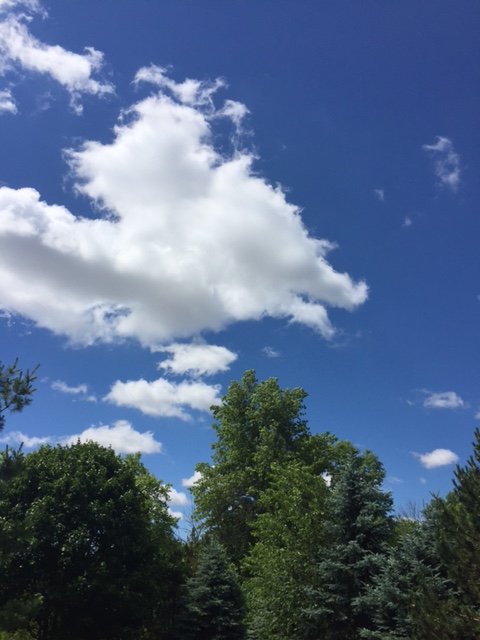
But the birds were in good humor that morning and serenaded me as I went forth to mow the lawn. And then I looked up at the blue sky dotted with huge languishing cotton ball clouds pictured above, a sight not seen nearly often enough in central Ohio, and my heart shifted gears from Psalm 130 to 19: “The heavens are telling the glory of God; and the firmament proclaims God’s handiwork. Day to day pours forth speech, and night to night declares knowledge. There is no speech, nor are there words; their voice is not heard; yet their voice goes out through all the earth, and their words to the end of the world.” (Psalm 19:1-4).

In basketball 19 doesn’t beat 130, but in the game of faithful living it does. God’s presence is all around us no matter how far down in the depths we are feeling. We just have to look for it with all our senses. No, the skies are not always breathtakingly beautiful, but the loving God of all creation is always surrounding us if we have eyes to see and ears to hear.

Even the author of De Profundis knew that while in the depths, and Psalm 130 ends with this statement of faith and hope: “I wait for the Lord, my soul waits, and in his word I hope; my soul waits for the Lord more than those who watch for the morning, more than those who watch for the morning. O Israel, hope in the Lord! For with the Lord there is steadfast love, and with him is great power to redeem. It is he who will redeem Israel from all its iniquities.”

It is necessary to cry out for help, to admit our helplessness to cope with the slings and arrows of life. It is also necessary to wait patiently and hopefully because the arc of moral justice bends ever so slowly. But we are also called to take action to collaborate in our own healing, and that’s exactly what Jairus and the woman with the 12-year flow of blood do in the Gospel lesson for this week.

Their story in Mark 5:21-43 describes two people in the depths of despair. Jairus, a powerful leader of the synagogue is helpless to save his gravely ill daughter and seeks Jesus out and humbles himself by kneeling at Jesus’ feet, begging for healing for his little girl. But as often happens in ministry, Jesus is interrupted right in the middle of this crisis by a person from the other end of the socio-economic spectrum.

A woman who is unclean because she has had a flow of blood for 12 years is also desperate. So much so that she risks coming out in public seeking healing because a multitude of doctors have only made her worse. She humbles herself in a different way, only wanting to touch the hem of Jesus’ garment; and immediately she feels her body healed.

Jesus, of course, feels power go out from him and seeks the woman out – not to scold or condemn her, but to praise her for her faith which has healed her.

But alas, news comes that Jairus’ daughter has died while Jesus was busy healing the woman. When Jesus assures Jairus that his daughter is not really dead the crowd laughs at him. That happens to people who dare to believe in God’s power in spite of evidence that evil and suffering have prevailed.

And Jesus goes to Jairus’ home, tells the little girl to get up, and when she does he instructs those there to give the girl something to eat. Just another day’s work for Jesus because he believes and heals those who dare to believe with him and through him.

Like Jairus and the woman we often have much suffering and fear we need to be healed of. These texts make it clear the formula for healing is to admit the mess we’re in, cry out for help, wait patiently for deliverance, and when Jesus’ is in the neighborhood (which is always) take action to find him so faith can make us whole too.

Pastoral Prayer, June 9, 2024

O Holy God, our Emmanuel.  Here we are in June, about as far from Christmas as we can get; so it seems a good time to remind ourselves that you sent Jesus to us, not just at Christmas, but forever as Emmanuel, which means “God with us.” Sometimes when we need you most, God, we forget you are with us always – on the mountaintops and in the valley of the shadow, when the pain is so bad we don’t think we can stand it anymore, there you are at our bedside.

When we are afraid the storms of life are going to drown us, there you are napping in the back of the boat waking to tell us “Peace, be still; I’ve got this.”  When our legs are so tired we can’t go another step, you carry us.  When it feels like the world is going to hell in a handbasket, you’re right there in the basket with us.

The Psalmist says there is no place in all creation we can flee from your presence.  You’re up there with the astronauts in the Space Station showing off your breathtaking creation.  And if we visit Mars or other planets, you’ll be waiting there for us, too. Even when things are going great and we’re tempted to think we don’t need you, you wait patiently in the wings like a mother hen ready to take care of her chicks.

Forgive us, Holy One, when we forget you are our constant companion and friend.  Life is hard at times.  That’s why we need times of worship and prayer to feel the peace that surpasses anything else life can offer.  How can we thank you, Lord?  We certainly don’t deserve your unconditional love and grace!  We just pray that you will speak to each one of us right now and assure us that whatever cares or concerns are on our hearts just now we do not have to deal with them alone. 

And so we praise you for your presence.  We ask that you show us how to be that same presence with others.    And we thank you most for sending the one called Emmanuel to show us how to live and how to conquer even death itself.  And so we pray together the prayer he taught us to pray. 

O Holy God, our Emmanuel.  Here we are in June, about as far from Christmas as we can get; so it seems a good time to remind ourselves that you sent Jesus to us, not just at Christmas, but forever as Emmanuel, which means “God with us.” Sometimes when we need you most, God, we forget you are with us always – on the mountaintops and in the valley of the shadow, when the pain is so bad we don’t think we can stand it anymore, there you are at our bedside.

When we are afraid the storms of life are going to drown us, there you are napping in the back of the boat waking to tell us “Peace, be still; I’ve got this.”  When our legs are so tired we can’t go another step, you carry us.  When it feels like the world is going to hell in a handbasket, you’re right there in the basket with us.

The Psalmist says there is no place in all creation we can flee from your presence.  You’re up there with the astronauts in the Space Station showing off your breathtaking creation.  And if we visit Mars or other planets, you’ll be waiting there for us, too. Even when things are going great and we’re tempted to think we don’t need you, you wait patiently in the wings like a mother hen ready to take care of her chicks.

Forgive us, Holy One, when we forget you are our constant companion and friend.  Life is hard at times.  That’s why we need times of worship and prayer to feel the peace that surpasses anything else life can offer.  How can we thank you, Lord?  We certainly don’t deserve your unconditional love and grace!  We just pray that you will speak to each one of us right now and assure us that whatever cares or concerns are on our hearts just now we do not have to deal with them alone. 

And so we praise you for your presence.  We ask that you show us how to be that same presence with others.    And we thank you most for sending the one called Emmanuel to show us how to live and how to conquer even death itself.  And so we pray together the prayer he taught us to pray. 

Northwest United Methodist Church, Columbus, Ohio

Jesus and Stages of Grief

As we made our way through the passion story of Holy Week this year it occurred to me that the Gospel accounts of Jesus’ last week are an interesting case study in the classic stages of grief proposed by Dr. Elizabeth Kubler-Ross in her 1969 book “On Death and Dying.”

The stages do not occur in a linear order but ebb and flow like the phases of the moon, and we always need to remind ourselves that the Gospels are theological works, not historical biography; but given that, it strikes me that we can learn about the universal human experience of grief by studying what the Gospel writers tell us about the final days of Jesus’ earthly life.

Kubler-Ross’ stages include anger and depression which are often two sides of the same emotion – one expressed outwardly and the other turned in upon oneself. Because of that anger is easier to identify and that is true with Jesus also. The cleansing of the temple which is described in all four Gospels is one of the few times we ever see Jesus angry. He sometimes is verbally angry with the Scribes and Pharisees, but when he overturns tables and drives the money changers out of the temple with a whip that is the rare incident where Jesus is obviously and physically very angry.

Another scene which could be motivated by either anger or depression would be one of the “last words” from the cross where Jesus cries out, “My God, My God, why have you forsaken me?” Hearing the tone of voice and seeing Jesus’ body language when he uttered these words might help us better understand his mental state at the time, but both Matthew 27 and Mark 15 describe his tone as “crying out with a loud voice,” and that is the best evidence we have.

Depression can certainly not be diagnosed from a few 3rd person accounts of Jesus’ actions, but the three incidents that come to mind when I think about that stage of grief are when Jesus weeps over the death of his friend Lazarus, when he weeps over Jerusalem and says, “Would that you, even you, had known on this day the things that make for peace! But now they are hidden from your eyes.  For the days will come upon you, when your enemies will set up a barricade around you and surround you and hem you in on every side and tear you down to the ground, you and your children within you. And they will not leave one stone upon another in you, because you did not know the time of your visitation.” (Luke 19:42-44). And perhaps in all four Gospels where Jesus refuses to answer any questions in his trials before Pilate, Herod, and the Chief Priests. Those incidents however I interpret more as a strong, silent resistance to the unjust power of oppression rather than depression or resignation.

The stage of grief that stymies me when it comes to Jesus is denial. If you readers have ideas about this one I would love to hear them, but for now I cannot think of examples of times where I see Jesus being in denial about his fate. He sets his face toward Jerusalem in spite of the protestations of his disciples. He stages a protest entrance into Jerusalem riding on a humble donkey, and he returns daily to teach and heal in Jerusalem that last week and to celebrate the Passover, all of which seem like acts of faithful determination and not ones of denial in any form.

The stage of bargaining seems to me to only appear in the Garden of Gethsemane when Jesus says, “If this cup can pass from me, please make it so,” but those words are immediately followed by “But not my will but yours be done,” which move us toward the final stage of acceptance.

It should come as no surprise that examples of acceptance are easier to find with Jesus. When Peter pulls out his sword to resist the soldiers in the garden Jesus sternly tells him to put it away. And then on the cross where it would require the greatest amount of acceptance and courage, at least 4 of the recorded “seven last words” reflect the confidence that only comes with acceptance of death as the final stage of human life.

Those four include Jesus commending his mother into the care of one of his disciples, assuring the repentant thief that he will be with Jesus in paradise that very day, commending his spirit into the hands of God, and finally saying “It is finished.” I suppose one could also make a case that forgiving his executioners is also an act of acceptance, but that amazing act of grace really defies categorization.

Grief is a very complicated emotional process, and the Kubler-Ross stages are one very helpful lens through which to understand it. I find it comforting to find connections between my own experiences of grief and those of the incarnate life of God in Jesus. For me sharing the human condition of these grief stages with Jesus affirms the reality of his humanity and also the hope for achieving some degree of acceptance of my own mortality that he exemplifies for us.

I welcome your comments and insights on any of the above.

Into Your Hands

I am one of the narrators for our church’s Good Friday cantata, “The Shadow of the Cross.” At the conclusion of the cantata each narrator will share one of Jesus’ last words from the cross. My line is “Father, into your hands I commend my spirit.” This opportunity has forced me to think about how to interpret those words.

Were they uttered in exasperation? “I give up God. You’ll have to take it from here!” Or maybe just a plea for help? Another way of expressing a feeling of abandonment or defeat, even anger? Luke 23:46, the only Gospel that contains this particular phrase, prefaces the words with “Jesus cried out with a loud voice,” which might support that kind of interpretation.

But Psalm 31:5, a source Jesus could have drawn upon, says, “Into your hand I commit my spirit; you have redeemed me, O Lord, faithful God.” That context seems to support what feels right to me. I believe this phrase expresses a surrendering and acceptance of death in all its forms to a mysterious power that makes all things new. They are uttered in the sure and certain belief in resurrection.

For Luke that is all there is to say, and he adds: “Having said this, he breathed his last.” For Luke this is the last of Jesus’ last words. That’s a great exit line, but how do average folks like us truly believe and trust that mystery? As one feeling much too close to the daunting age of 80 that question has taken on more and more significance for me.

Delivering these important words from the cross reminds me of the characters in Nikos Kazantzakis’ novel, “The Greek Passion,” where people in a Greek village take on the various roles in the story of Christ’s passion and so identify with their characters that they become them. The man portraying Judas is driven out of town for his betrayal of Jesus, and the man portraying Jesus, offers himself as a sacrificial lamb, confessing to a murder he didn’t commit to save others from being executed.

Obviously my one liner is not nearly as intense, but it feels like it can still be powerful and transforming for me and maybe others if the Holy Spirit works through me. It is always a heavy responsibility to speak hope into darkness, and God knows things are plenty dark just now, even days before the solar eclipse passes through our state. 

Help me Holy One.  I believe; help my unbelief.

Darkness Will Not Prevail

Black History Month and Lent

Black History month and Lent go well together. Jesus’ 40 days in the wilderness and our 40 days of Lent pale in comparison to 400 years of slavery and systemic racism, but the determination to not let the darkness prevail requires the same kind of faith.

Darkness and Balance

Darkness has taken on a new significance for me personally in recent years. I was diagnosed ten years ago with peripheral neuropathy which causes numbness in my feet and legs, meaning my sense of balance leaves a lot to be desired.

My physical therapist has taught me some things that help in coping with my impaired balance. There are basically two senses that send information to our brains that help us feel steady on our feet. One is the feel of our feet on what ever surface we are standing or walking upon. Neuropathy plays havoc with that input.

Secondly we get signals from our eyes about our surroundings that help orient us in space. For that sensory data to compute obviously requires our being able to see where we are and where we’re going, and that vision requires enough natural or artificial light to illuminate our path. Simply put it is much harder to maintain a sense of balance in the dark.

That explains why you will find nightlights in every room in our house and why I use a cane to steady myself when walking on uneven surfaces or in the dark. And yes, getting up to make my way to the bathroom in the middle of the night is still sometimes an adventure, even with motion sensor night lights and my cane. It is also why I am very grateful for the flashlight app on both my iPhone and my Apple Watch. I am almost never without at least a small source of light.

Cultural and Political Darkness

On a more macro level Lent 2024 feels really dark to me, even with the blessing of sunshine and above average temperatures here in Ohio. Technology has not invented an app that can brighten the dark night of the soul I feel when witnessing the suffering in Gaza and Ukraine. Natural disasters are still heartbreaking to watch, but I understand the science of how climate change is causing the devastation on the California coast. I cannot however wrap my mind around the evil of modern warfare or the hatred that inspires it.

I despair at the insecurity and depravity that justifies a Putin killing his political enemies or invading a neighboring country just because he can. And I weep over the ignorance about our history that blinds people to the threat of authoritarian leaders and the cult-like devotion to those who blatantly practice it.

Being the Light

When the darkness of sin and evil threatens to drown out the light, God has always called on those like Sojourner Truth to step up and refuse to let the darkness determine our life’s light. That quote reminded me that I am always inspired by the words of another black woman, Amanda Gorman, whose marvelous poem, “The Hill We Climb,” ends with these powerful words:

“When day comes, we step out of the shade aflame and unafraid. The new dawn blooms as we free it. For there is always light. If only we’re brave enough to see it. If only we’re brave enough to be it.”

Action Steps

A Lenten challenge might be to find what God wants each of us to actually do to be the light. It may be relating to family members or co-workers in a more caring way, or volunteering for some group that you’ve always meant to get involved in, getting involved in local politics, advocating for justice by writing letters to representatives, or supporting marginalized groups. There’s plenty of darkness to go around and every ray of light does make a difference.

Prayer

O God of eternal light, the darkness scares me. I know in my head the words from the Gospel of John that assure us the darkness will not overcome the Light of the World. But my heart is not so sure! Rather than just spout pious platitudes that fall flat on their face, please give me the courage to really feel your light in my soul and the guts to go out into the darkness and be it. Amen