Advent IV, Unextinguishable Love

advent-waiting-img_1492 The decorations are up, the stockings are hung with care, and children are bursting with anticipation. The nativity scene is set in its special place, but the manger is still empty. The nursery is stocked by Babies R Us, but the guest of honor has not yet arrived. Like expectant parents we can’t wait to cuddle the tiny new life in our arms. We are so close we can feel the baby kicking in the womb, and we are filled with a rich mixture of joy and anxiety. As we wait, let’s remember how different Jesus’ arrival was from birth today, and yet how similar. Parenting is a universal gift of love. In a birthing suite or a stable, to hear that first cry melts our hearts with instant love. Birth is worth every second of the long wait. And so today we light the 4th Advent candle, a light no darkness can extinguish, the candle of Love.

Prayer:
O God, our heavenly parent, we are so close we can see the lights of Bethlehem reflecting on icy roads. Forgive us when we get distracted from the destination of our Advent journey. With trees and houses and malls ablaze with Christmas decorations, it’s easy to get lost on our way to the manger. Disturbing news from inhumane places like Aleppo threaten to extinguish our hope for humankind. Winter storms cancel much needed Sabbath worship services. Remind us again O God that even in the shortest, darkest of days the light of the world awaits us in Bethlehem’s modest manger, and that light is constant and unfailing. It is the light of love; a love that makes room for a mother in labor in a strange place; a love that hears angels sing of peace on earth and joy to the world. As the lights from on the Advent wreath grow brighter, help us welcome the gift of love into our hearts; so we can be midwives in a dark and weary world, helping give birth to the miracle of love. In the name of the one who is Love in human form we pray. Amen.

Wait Training: Third Sunday in Advent

advent-waiting-img_1492[This was our Advent Candle lighting for today at Northwest UMC. The opening monologue was written by Rev. Mebane McMahon and performed beautifully by Heather Sherrill. I wrote the candle lighting liturgy and prayer.]

(Talking on a cell phone) I understand I just had the test yesterday. I know you said, “Make an appointment with your family doctor next week. She’ll have the results by then.” I heard you say that, but do you have any idea how hard it is for me to wait until NEXT week. You told me that my blood work came back with some elevated levels. What exactly does that mean?

As I said, “I have this pain in my side, but last night I could barely sleep. (gesturing) the pain moved to my back!! What could that mean? (A little hysterically) It’s spreading!? This infection, inflammation, this blockage, this rupture or CANCER. It’s spreading. I know it is.

Christmas is 2 weeks away. I have two small children. I DON’T HAVE TIME FOR PAIN. How long do I have to wait? (Apologetically) I’m sorry. It’s not your fault. (sighing) I guess I’ll just have to wait. (hangs up call)

(Pacing and thinking out loud) Stay positive Heather. It might NOT be a life-threatening disease. Wait, she says. WAIT. (Takes a deep breath, Silence. Reflection.) I’m not good at this. Is there anybody who will wait with me? And pray for me? And help me when I can’t help myself?….And….And (softening and calming down. Breathing deeply) huh. I wonder if there is someone I can help in the meantime. Is there anybody else I know who is having to wait like this?

(Praying) O God, how long? How long do I have to wait for a diagnosis, for treatment and recovery? How long do I have to wait for healing and what exactly will that look like? How long? How long O Lord? (exits)

Candle Liturgy:
We are on our way to Bethlehem and the Advent journey gives us time to prepare our hearts and make room for the gifts of compassion, patience and joy that God wants us to have. But time moves so slowly when we’re waiting—waiting for a text or phone call—for news that our kids are OK; for a doctor to give us good news or bad news. Either way, it’s better to know than to be left hanging in the unknown where our imaginations can drive us crazy. As people of faith we know where we are and whose we are. Scripture and carols and prayer are the signposts on our journey that give us hope and peace. And today we light the third candle, the candle of Joy. The light is growing and Joy shines from our hearts to those who need good news.

Prayer:
O Holy God, waiting is exhausting and every year we seem to need the good news of Christmas more than ever. Help us wait with patience for the promised Joy of the season, but remind us that our waiting is not passive. Forgive us when we get so concerned about ourselves that we fail to see the needs of those around us. When we are anxious give us again the assurance that “Weeping may linger for the night, but joy comes with the morning.” Remind us once more that “those who wait for the Lord shall renew their strength” so we can share your joyful good news for the world. Renew our hearts, O God, with your eternal love and help us be the joy we long for in the way we live and in how we relate to those who wait with us. In the name of the coming Christ we pray. Amen.

Advent II, Candle of Peace

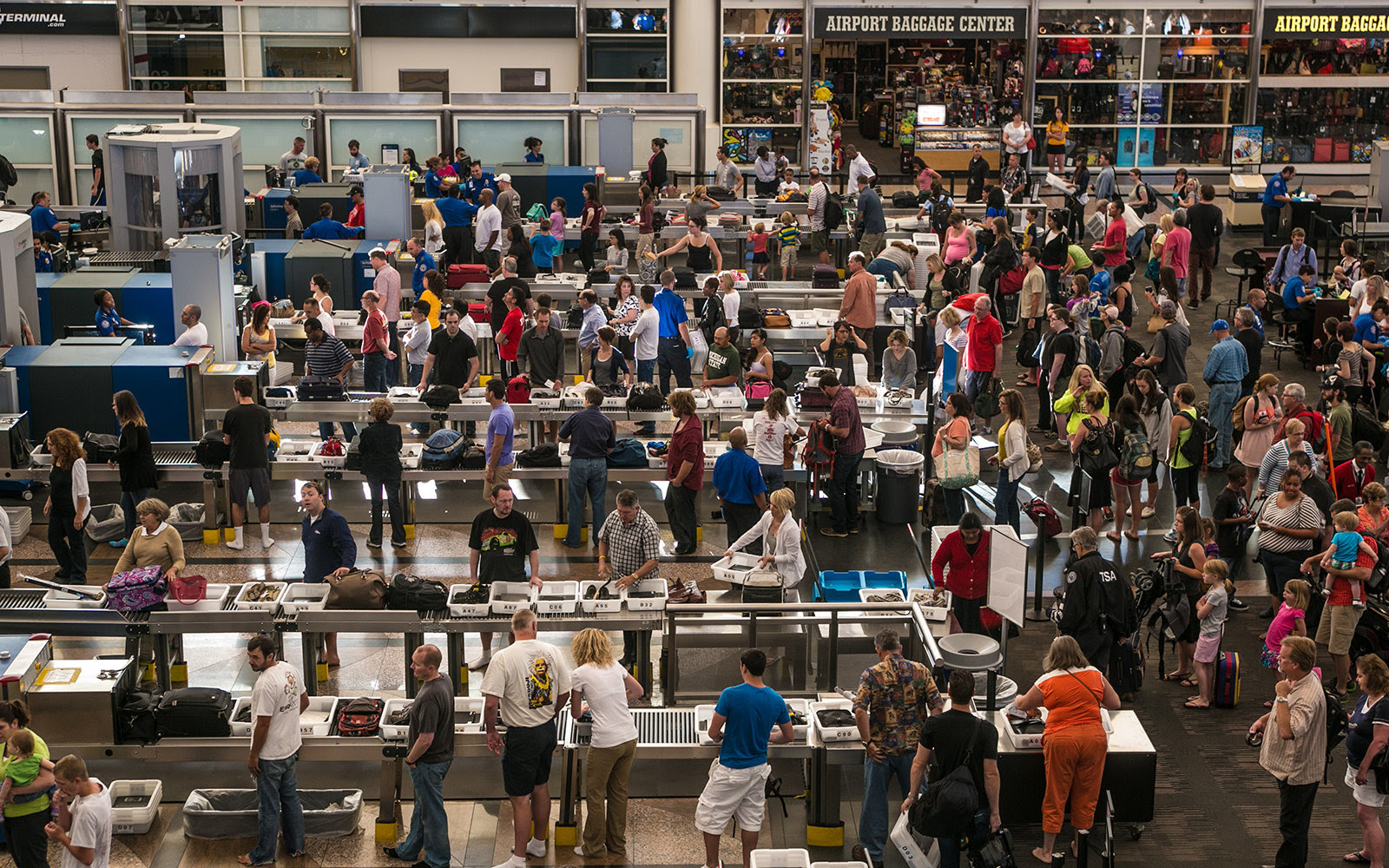
Denver International Airport (Photo by George Rose/Getty Images)

[Traveler enters with suitcase] Oh no! Look at those lines at security! Why is it every time I’m running late at the airport the security lines are out the door?? TSA must have been designed to prove Murphy was an optimist!!
Do you suppose these security people can move any slower? I’ll never make it to my gate on time.

Just look at all those people! All those families with kids! They’ll take forever to get through the line. And that couple over there with the deer in the headlights look. They don’t have a clue how to manage this system. You have to take off your jacket, your belt, your shoes, and get everything out of your pockets. Even a quarter may set off the metal detector! Put away my cell phone, no, can’t do that yet my boarding pass is on my phone. And if you’ve got an artificial joint you get a free pat down.

Stupid terrorists. We didn’t have to do all this stuff before 9/11. It wouldn’t be so bad to wait if it made me feel safe and secure, but it doesn’t. We’re vulnerable anywhere. Look at what happened just this week at Ohio State!

[Sits on suit case]

OK Steve, calm down. Breathe. I know it’s not all about me. All those other passengers—they’re all trying to get somewhere just like I am. They aren’t here just to aggravate me. And the TSA folks are doing their very difficult job the best they can. I’m sure they aren’t getting paid enough to put up with grumpy travelers like me. And I’ll even bet a little respect and being nice to them gets me through faster than complaining!

It helps if I don’t just see the crowd but see other people like me. Look at that poor mother traveling with two little kids. She’s probably trying to get home for Christmas or maybe to see a sick relative or bury a loved one. And those soldiers are likely being deployed to somewhere dangerous far away from their families for the holidays.

Sure, waiting a few minutes is inconvenient, but we’re all in the same boat. I’m old enough I remember a time when it wasn’t like this. We could walk leisurely to the gate and other people could go with you to say goodbye. How long do you suppose we will have to wait till the world is peaceful enough that we can do that again, till we just learn to get along as friends and neighbors? I wonder how long. [Exits]

Lighting the Advent Candle:

As usual, the second Sunday of Advent comes as we enter the final month of our calendar year, but 2016 has been far from ordinary. The long, long campaign season is finally over, but the political and social strife continues unabated. We are promised security and peace from all sides, but we are still waiting for those promises to be fulfilled. And so we wait for God’s light to break into the darkness just as it did so long ago in another time torn by strife and oppression. Today we light a second candle, the candle of peace, to witness to the world that the light is still growing in all of us who dare to wait and hope and believe. Together our lights can make a difference, and in due time our waiting will be rewarded with the peace that passes all understanding.

Prayer:
O God, waiting is so hard. We read the words of Scripture from centuries ago that promise peace, and we start celebrating Christmas earlier every year desperately hoping that this is finally the year. We long for true peace but often settle for false security that doesn’t satisfy the yearning in our hearts. We take our shoes off at airports and go through metal detectors; security cameras record our activities all over town, and we install security systems at home. Our military is the mightiest ever known in the world. And yet people carry guns and pepper spray, and we lock down our schools on a regular basis. Even police officers are not safe from senseless acts of violence. Enlighten us O God to the ways of the Prince of Peace. Teach us again that we will not find true peace until our hearts find rest in you. Remind us that your eternal peace does not come with “swords loud clashing or roll of stirring drums, but with deeds of love and mercy.” Remind us again in the small glimmer of these candles that the light still shines in the darkness, and the darkness will never overcome it. We wait and pray in the name of the Prince of Peace, Amen.

Advent I, Candle of Hope

advent-waiting-img_1492How long, O Lord, how long? Are we there yet? We know the journey to Bethlehem is long, but we need your presence in our broken world right now. We can’t wait any longer. Yes, we know your time is not ours. “1000 years in your sight are like yesterday when it’s gone.” We know, but we still wait like anxious children, full of hope and anticipation.

Advent rituals help us wait and prepare our hearts. So today even as the days grow shorter and shorter, we light the candle of hope to help us find our way to you.

Let us pray:
Gracious God, you know we aren’t very good at waiting. OK, we aren’t good at it at all. We live in a world of instant gratification. We spend money we don’t have in pursuit of stuff that promises satisfaction. We wait exasperated in long Black Friday lines. Forgive our foolish impatience, Lord. Remind us again that the one we are waiting for will come at just the right time because you always deliver on your promises in your time not ours. Our time is one of much anxiety and fear, but because we also live in your time, we live in hope as we wait. In the name of the Christ, hear us we pray. Amen

Patience and Perspective: Why Thanksgiving and Advent Matter More than Ever

“For a thousand years in thy sight are but as yesterday when it is past, and as a watch in the night.” Psalm 90:4

The joke says “Wisdom comes with age, but sometimes wisdom comes alone.” There’s some truth in that, but as one who is learning the hard way, I can attest that age does come with some perspective and experience. I am going to resist the temptation to do a general rant about the rush to Santa Claus that turns the time between Halloween and December 25 into a blur. But I do regret the de-emphasis of Thanksgiving and Advent. We need more than ever times of gratitude and patience in this anxious age of instant gratification that doesn’t satisfy. Gratitude and patience are what Thanksgiving and Advent are all about, or should be.

I heard from several disenchanted voters and analysts of all persuasions that the recent election was all about a desire for change because of voter frustration with the current political situation. While I understand that sentiment and agree that much of what goes on in government is corrupt and broken, I was struck by a phrase I heard several times from Millennials and Gen Xers who said “nothing has changed in 50 years.”

I can’t begin to address the solution to what’s ailing our democratic system, but since I’ve voted in the last 13 Presidential elections beginning in 1968 I do feel somewhat qualified to address what’s changed in the last 50 years. In the 90th Congress, elected in 1966, there were only 11 women in the House of Representatives and 1 in the Senate. In this year’s election those numbers are 83 in the House and 21 in the Senate. I have not found exact data on racial minorities for 90th Congress, but one source said there were fewer than 10 until 1969. By contrast the new Congress in 2017 will have the greatest racial diversity in the history of the republic – 102 members of color in the House and 10 in the Senate. Those numbers equal an 867% increase for women and 1120% for racial minorities in the last 50 years.

Does that mean we have achieved equality in D.C. or in our nation? Of course not; we all know we are a very long way from achieving the high ideals of “liberty and justice for all” that we all profess to believe in, but where we are today on the long journey to equality for all is a far cry from saying nothing’s changed in 50 years.
There are many examples of progress toward social justice if we take time to look for them, and gratitude requires an intentional commitment to focus our attention on what there is to be thankful for, especially in this 24/7 news cycle and social media world where we are bombarded with mostly bad news constantly and can overreact to something and make it viral before bothering to check it’s veracity. Isn’t it interesting that the word “viral” comes from a term that used to mean something contagious that makes us sick?

We can all do something about the virus of untrue and biased information besides just complaining. There have been times in the last 2 weeks that I have simply had to turn off the TV and all my devices (de-vices?) to keep from being overwhelmed and depressed about the “news” coming at me from all directions. A fast from consuming the viral spread of anger, hate and fear is good preventative health from time to time. Perhaps more importantly, we can all stop and verify information before we spread it around by reposting or retweeting. Social media makes it far too easy to just hit a button and spread a virus before we have time to evaluate the information and its source. In the heat of political conflict it is not always easy to remember that, but if we would all pause and reflect on what the consequences might be and how images and words might affect others who become our unintended audience when we hit that button we can all help in a small way to heal the growing divisions in our nation and world. If we aren’t part of the solution we are part of the problem, and if we aren’t helping create positive change in our nation we shouldn’t expect our elected leaders to do it for us.

Mr. Rogers’ has been quoted a lot lately about “looking for the helpers” in a bad situation. Please, in this week of overeating and overshopping and overfootballing, let’s all take time to look for the positive signs of change in our world and be thankful. To do that requires backing up to get a better perspective on the big picture instead of focusing entirely on our problems. Yes, health care costs and jobs and our own civil liberties are important, and we must keep working as fast and justly as possible to change those situations. But to do so requires patience and perseverance and an appreciation of how far we’ve already come. The big picture gives us a better perspective on progress while at the same time reminding us that there are millions of other people in the world who are homeless and refugees and orphans, addicted and incarcerated that we must not ever forget. From Cain’s question “Am I my brother’s keeper?” in Genesis 4 to the lawyer’s question “Who is my neighbor?” to Jesus in the Good Samaritan story (Luke 10), God’s answer is “What you do to the least of these you do to me.” (Matt. 25)

As we have seen this week in the Trump vs. Hamilton tweet storm, artists and artistic works have great power to give us a glimpse of the bigger picture. Good drama and fiction can transport us out of our own swamp of alligators for a time and move us emotionally in ways that pure “facts” or logical arguments never will. It is no coincidence that the musical “Hamilton” celebrating diversity has taken Broadway by storm in this season of division and bigotry. And it is likewise no coincidence that the movie “Loving” began showing in theaters 4 days before the 2016 election. I haven’t seen it yet, but “Loving” is based on a landmark Supreme Court case, yes 50 years ago, in 1967. It’s the story of Mildred and Richard Loving who were sentenced to prison for violating a Virginia law against interracial marriage. In a unanimous decision (imagine that?) the US Supreme Court ruled that “the freedom to marry, or not marry, a person of another race resides with the individual, and cannot be infringed by the State.”

Yes, a great deal has changed in the last 50 years, and much of it for the better. But here’s where patience and Advent come into play, and the turmoil and anxiety about what a Trump presidency may do to impede the cause of justice and equality only underscores this point. We’re not sure who actually coined the phrase “eternal vigilance is the price of liberty” but it is certainly true. A major reason for the necessity of patience and vigilance in our democratic system is that what is seen as progress by some is always seen as a threat to others. The balance between individual liberty and universal justice is in constant tension, and that tension is usually part of the creative process. When the tension becomes bitter and partisan, when one or both sides want to be right more than they want justice for all, when the tension becomes more like a competitive tug-of-war instead of a cooperative teeter totter the tension can become destructive. We have had cycles of both productive and destructive tension throughout our history, and keeping the total picture in mind helps us to be patient with the process and not resort to oppressive or violent means to demand change to get our way.

The truth of the matter is that some people, not all, who voted for Trump and Pence under the banner of change do not want change at all. That minority of white voters really want to undo the changes we’ve made in the last 50 or 100 years that don’t benefit their privileged status. The reality is that in addition to seasons of gratitude and patience the USA desperately needs a season of reflection and repentance to remember all of our history. Only when we admit that this nation was built on a foundation of racism and genocide can we appreciate how far we’ve come and why we’ve got so far to go before “liberty and justice” for all is more than a pious platitude.

The struggle we are now in for the heart and soul of our democracy is so difficult because it is so old and so deeply ingrained in our history and DNA that we don’t recognize it. We learn at an early age about the early European immigrants coming to America in search of liberty and freedom, but most of our schools, families, churches and other civic organizations fail to teach white Americans the rest of our history. We don’t learn about the evils of slavery or we naively think it is a nasty little problem that was resolved by President Lincoln. We don’t learn about the founding fathers being slave holders. We don’t learn about the rape and pillage of Native American lands from people who were here for centuries before the first Europeans “discovered” America.

Why? Because our parents and their parent before them didn’t learn those lessons either because to learn the whole truth about who we really are is too painful. But ignorance is more painful in the long run. Without knowing our past we are condemned to repeat it generation after generation. Our lack of knowledge and the successful use of fearmongering racist tactics to win an election are an indictment of our education system, but even more they are an indictment of the church of Jesus Christ for being co-opted into a conspiracy of silence instead of proclaiming a John the Baptist Gospel of repentance for our sins. John and Jesus told it like it really is. Contrary to Jack Nicholson’s famous line in “A Few Good Men,” not only can we handle the truth only truth and the whole truth can set us free. As Frederick Buechner said so well in “Telling the Truth: The Gospel as Tragedy, Comedy and Fairy Tale,” “The Gospel is bad news before it is good news.”

Ironically the bad news of the Gospel and of our current political state is something that we should be thankful for. I’m not one bit thankful for hatred and racism ever, but as one commentator pointed out nothing new happened on November 8. The anger and divisions have always been a part of our history, clear back at least to the Continental Congress. The silver lining in the Trump election is that the dark underbelly of hate and anger is out in the open where it can be dealt with.

The struggle for liberty and justice is never easy, but when we look at the big picture and understand why change is so hard and how long it has been going on, we can appreciate and be thankful for the progress we’ve made; and we can be confidently patient that from God’s perspective the outcome of the battle between justice and evil is not in doubt. The road to justice is not linear but full of curves and detours and switchbacks, but we have a roadmap from a God who is always on the side of the oppressed and downtrodden. Justice probably won’t happen in our time, but because we also live in God’s time where a thousand years are but as yesterday, we live in gratitude and hope even as we continue to wait and work for liberty and justice for all.

The Journey from Bah to Aha

I am not a fan of the way we Americans do Christmas. Most everything about this season bugs me, as in Bah Hum-bug! How do I hate it? Let me count the ways: Black Thanksgiving week consumer mania, Christmas lights that mysteriously become tangled and dysfunctional while tucked in their storage boxes, frozen fingers putting said lights up outdoors, and temporary outbursts of December charity to quiet guilty consciences for another year so we can ignore the injustices in our society that keep people trapped in poverty, just to name a few.

I used to think my negativity about the Holidays was because my employment for most of my adult life required a lot of extra effort in November and December. I worked my way through college working for a florist and put in many long hours from before Thanksgiving until Christmas Eve preparing, selling, and delivering floral finery for festive occasions. And then I jumped out of the frying pan into the fire of being a pastor – writing sermons, planning worship services, caroling parties, collecting donations for those in need, visiting the homebound. Non-stop activity for the entire Advent season leaves little time or energy for doing all the “normal” things people do at home and with family and friends. The last church I served we had Christmas Eve services at 4, 7, 9, and 11, and by the time I crawled into bed early Christmas morning any Christmas spirit I had was pretty well spent. In fact, just writing that paragraph makes me want to go take a long winter’s nap!

There are of course many rewards to the Christian observances of Christmas, and I don’t mean to belittle those. Seeing the joy in a mother’s eyes when we made it possible for her family to have food and gifts for Christmas, sharing carols or communion with a nursing home patient, or singing “Silent Night” with my church family all holding lighted candles at midnight on Christmas Eve are priceless experiences.

2014 is my first year of full retirement from pastoral ministry, and what I’ve discovered is that it wasn’t my various holiday-intensive jobs that made me Grinchy. I still don’t like the way we do Christmas, and that realization helped me come to an Aha moment as I sat in worship on the 2nd Sunday of Advent this year. The sermon by Rev. Tom Slack was based on Mark 1 and stressed the urgency of John the Baptist’s call for repentance in preparation for the imminent appearance of the Christ. To repent means to turn around, to change the way I’m going, and when I applied that to my Ebeneezer Scrooge approach to Christmas I realized, as anyone else could have told me, that my attitude is a choice. I can continue to be a moaning and groaning critic of all the things that are wrong with the way we do Christmas, or I can do as Gandhi suggests and “Be the change I want to see in the world.”

The serenity prayer came to mind and as usual is very good advice. It asks God for “the serenity to accept the things I cannot change.” I can’t change the way other people choose to spend their time or money at Christmas, and if I could, complaining and criticizing is never the most effective way to persuade anyone to change. Secondly, that prayer asks for “the courage to change the things I can.” The only thing I really can change directly is me and my attitude, and that is far more likely to affect others either positively or negatively than any words ever will. As someone once said, “What you do speaks so loudly I can’t hear what you say,” or as St. Francis put it, “Preach the Gospel at all times and when necessary use words.”

How I relate to others one-on-one, be in a homeless stranger or family and friends, those I love most, or how I treat harried sales clerks and UPS drivers and restaurant servers who are just trying to scratch out a living is a powerful example of either Christ-like compassion or Grinchy grouchiness – and both are contagious. God not only loves a cheerful giver, God knows any other giving is not generosity at all.

Is turning an attitude around easy to do? Not for me. I need a guiding star or Rudolph with his red nose to guide me through the fog of clever marketing and the frustrations of crowded calendars and freeways and malls. Rudolph goes down in history for rescuing Christmas. That’s not my goal. I simply want to do my small part to share the Good News of God’s unconditional love for us by the way I choose to live in spite of and because of the holy busyness of this season.

Everyone in the Christmas story makes individual choices that are critical to the outcome. Some of those choices are blatantly selfish and evil. Caesar Augustus decrees that a poor peasant girl in the final days of her pregnancy must make a dangerous journey to Bethlehem and deliver her precious infant in a barn. Herod’s insecurity drives him to order the murder of innocent children. But those choices from people in power aren’t the choices we celebrate. An overwhelmed innkeeper provides the best shelter he has when there is no room in the inn. A frightened Mary says “yes” to God’s plan for her when she could have ignored or laughed at the audacity of that angelic announcement. And her amazing fiancé loves her enough to trust her unbelievable explanation of how she came to be pregnant. These are all simple individual choices that changed the course of human history.

Mark’s Gospel doesn’t waste any time with genealogies and background stories. John the Baptist and a grown up Jesus both burst on the scene in chapter one demanding that we repent and believe the Gospel. They call me to follow Jesus no matter how busy or frustrated I am or what fantastic doorbuster bargains Walmart and Amazon are dangling in front of me. They remind me that my job is not to judge how others celebrate the birth of Christ. God or Santa can decide who’s naughty or nice. My job is to know what I can control (me) and be the best star-following disciple I can be.