“Be still and know that I am God.” Those words from Psalm 46 were given to the people of Jerusalem when their city was literally surrounded by the armies of Assyria. In a time when their lives were in pieces God offers the gift of inner peace. “Relax, breathe,” God says, “Trust me to handle this.”
This second Sunday in Advent is a time to find quiet stillness in our souls because we are in God’s hands. God is the source of inner calm which we must have for peaceful living with our neighbors. We cannot solve the problems of world peace. But each of us is called to be a peacemaker with that neighbor, who votes the wrong way, and with the weird cousin who disrupts family gatherings, and with the co-worker who drives us batty.
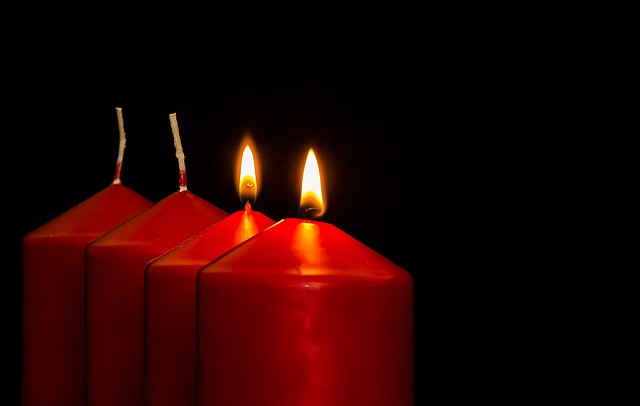
Today we relight the candle of hope from last Sunday, and we faithfully light the candle of peace that begins in each of our hearts.
[Light two candles]
Please join me in the prayer on the screen:
Dear God, you are our refuge and strength. Because of you we do not fear when our lives go to pieces. We know the peace that begins when we take time to be still and know you are always with us. You give us a peace that passes all human understanding. You promise us a Prince of Peace, and this Advent season we prepare ourselves again for his coming. Because of his birth in a humble stable we find a stable faith that shows up in peacemaking wherever we are. Amen
I had a hard time dragging myself out of bed today as my attempts to deny what happened on Election Day increasingly fail. An old Peter and Gorden song written by John Lennon and Paul McCartney has been playing in my head since Wednesday morning:
“Please lock me away And don’t allow the day Here inside where I hide With my loneliness
I don’t care what they say I won’t stay in a world without love
Birds sing out of tune And rain clouds hide the moon I’m okay, here I’ll stay With my loneliness
I don’t care what they say I won’t stay in a world without love.”
That’s how much of me feels today, and I appreciate all the posts from friends that have affirmed the need to take time for self-care and grief. I’m still functioning, even though I feel like a zombie much of the time, going through the motions of life without much energy.
I don’t know how long this grief will last. It is what it is, and it is important to both embrace it and share it with others who need to know we are not in this mess alone.
In due time the sun will shine again. The birds will sing in tune once more, and together we will create communities of hope and love that can sustain resistance and defiance of a world without love.
“I hope for nothing. I fear nothing. I am free.” Nikos Kazantzakis’ epitaph.
Those words from the Greek Author and philosopher, Nikos Kazantzakis, have both inspired and haunted me since I was first introduced to them as a twenty-something seminary student 53 years ago. Kazantzakis, most famous for his novel, “Zorba the Greek,” wrote many volumes full of such deep and baffling sayings. Many of them have stuck with me my entire adult life, and I was reminded of again of them when my wife and I had a chance to visit Crete on a cruise to several Greek Islands last spring. Crete is both the birthplace of Kazantzakis and where he is buried.
The epitaph in particular has been on my mind recently as my awful, terrible, no good, horrible summer of 2024 has continued right into the fall. [Please read my posts from August 4th and 12th if you want all the details.]. Quite frankly I do know that my little problems the last 4 months can’t hold a candle to hurricane destruction, people living in war zones, people starving from famine and climate change, people suffering from chronic pain, grief, persecution, broken relationships, addiction, homelessness, and so many more. Is it possible for any of us to truly hope for nothing and fear nothing?
My most recent personal challenge is undergoing chemotherapy for a rare form of lymphoma in my blood. I’ve known this day was coming sooner or later since my oncologist has been tracking the slow increase of a monoclonal glutamate in my blood for over a decade. I was personally hoping for later, like much later. But of course this was the great summer of my discontent, and what better time for my IgM antibodies to set off a siren alerting my doctor that something was wrong. This alarm was as loud as our home security system when I accidentally set if off. When the IgM jumped from around 2000 in January to 6500 in July it was such a loud warning that even my denial mechanisms were overpowered.
Technically I have been a “cancer patient” for about 13 years now because I was diagnosed with a mild prostate cancer in 2011. But that cancer has never needed any kind of treatment. Being told I needed to start getting chemotherapy ASAP for this lymphoma was a whole different ball game. One of my first challenges after this diagnosis was a debate within about how I wanted to think about myself going forward. Naming something helps give us some agency over it.
I knew I didn’t want to think of myself as a “cancer patient” because I am so much more than any diagnosis or label or title can convey. We are complex and complicated beings who defy narrow definitions of ourselves. In other words, I have cancer; it doesn’t have me. But knowing what I didn’t want to identify as didn’t answer the harder question of finding a name for this new, added dimension of my being. I toyed with “victor” (maybe too ambiguous depending on how one defines what victory even looks like. Jesus certainly didn’t look like a victor on the cross, but how our ideas of victory change on Easter morning! Don’t like “survivor” either. I want more from life than just surviving. As an aside, it has taken me 6 weeks or so to reach sporadic bouts of peace where I can live into the words above. In fact I hadn’t been able to express those thoughts and feelings like this until I started writing them. One of the many reasons writing is so therapeutic for me.
At those many other times when I don’t feel good at all about my new blood brother, I have caught myself recalling the title of a 1995 movie, “Dead Man Walking.” As time goes on I have had fewer of those DMW moments and more of the positive ones. After writing this, I’m pretty sure that ratio will continue to improve. Because as I wrote this post I realized that I have a simple and maybe fun way to embrace and integrate my cancer into my “Stevenness.” You see, my cancer has a pretty cool name. It’s Waldenstrom, named after a 20th Swedish Doctor who first described it. But Waldenstrom is a very heavy handle for my little cancer. It sounds like a cousin to Frankenstein. So I have decided to christen my cancer with the nickname, “Waldy,” and that seems like a name I get arms around.
One final thought (or two): Throughout this naming/identity dialogue with myself there was a biblical scene that kept coming to my mind. All three synoptic Gospels (Matt. 16:15, Mark 8:29, Luke 9:20) recount the time Jesus gave his disciples a pop quiz. Like all good teachers Jesus starts with a safe, impersonal question. He asks, “Who do people say that I am?” After the disciples respond with several Hebrew heroes from the past, Jesus stops them and asks the zinger: “and who do you say that I am?’ Jesus went from preaching to meddling in a hurry.
Simon Peter as usual jumps in with the answer: “You are the Christ, the Messiah.” Peter knows the right words, he just doesn’t yet understand what those words really mean or will mean to him. Far too many of us today know “who” Jesus is, but that’s only half the equation. It’s one thing to answer the catechism, or recite the Apostles’ Creed, but quite another to know what those words require of us who claim the identity of Jesus’ followers.
It occurs to me that the unspoken question that Jesus leaves hanging in the air for his disciples to discover for themselves is this: “Who do You say that you are?” Have you wrestled with that question recently? Who do you identify with/as? What name do you give to the totality of the amazing God-created being you are? We humans are more than the sum of our parts. Be gentle with your being. But remember to ask yourself occasionally: “Who do You say that you are?”
The answer to that question is never final; it is dynamic and ever-changing. But the closer we get to an answer we can live with, the closer we are to fearing nothing—not even my new friend Waldy or whatever other demons with which we have wrestle.
This is a quick follow up to my post from July 9 (“A Long Overdue Apology”) which is about one of my juvenile dating blunders 60 plus years ago. Especially for my high school classmates who inquired about that situation at our class reunion last Saturday – here’s the rest of the story.
I did decide while at the reunion to apologize to the woman I had disrespected on that long ago date. To my relief she remembered the date but did not remember my bad behavior and graciously assured me I need no longer worry about that incident.
The interesting thing that ensued during our conversation was that she shared her story about apologizing to her brother for a time when she had treated him badly. And then another classmate joined our conversation and told us of a situation similar to mine where he apologized to a woman he had treated poorly on a date many years before.
I left the reunion glad I had apologized and even happier that my doing so had opened the door for some mutual sharing of our common humanity.
“Then some people came, bringing to him a paralyzed man, carried by four of them. And when they could not bring him to Jesus because of the crowd, they removed the roof above him, and after having dug through it, they let down the mat on which the paralytic lay.” (Mark 2:3-4)
I had a very humbling experience last week that reminded me of the story from Mark’s Gospel about the paralyzed man brought to Jesus in a most unusual way. All three other Gospels contain a similar story where someone is carried to Jesus for healing, but only Mark has this most dramatic detail about the man’s friends being so committed and creative that they lowered him down to Jesus through a hole they dug in the roof.
Wouldn’t you love to hear the insurance adjuster’s response when the homeowner explains the hole in the roof with this story? My experience last week was far less dramatic but still very emotional for me.
The back story, no pun intended, is that because of chronic back pain and peripheral neuropathy I sometimes have a difficult time walking any distance. This is especially true after I’ve been sitting in a confined space, like an airplane seat, for any extended period of time. Last Wednesday my wife and I flew from Columbus, Ohio to Houston, Texas to visit family for the Thanksgiving holiday. The flight was delayed for 30-40 minutes while we sat on the tarmac in Columbus waiting for the pilots to arrive on another delayed flight from Houston. That made the total time on the plane around 3 hours.
Upon arriving at the Bush Intercontinental Airport in Houston we had a long walk (and a train ride) from Terminal E to baggage claim in Terminal C, and I was struggling to get there pulling a carry on and wearing a backpack. My dear wife offered to help with my luggage, but she already had plenty of her own; and I stubbornly kept pushing on.
By the time we got to Terminal C I was really tired and unsure how much further we had to go. We stopped to ask for directions from an airport employee who just happened to have an empty wheelchair, and he graciously offered me a ride. He was a life saver, and I was very grateful for his help. He not only pushed me to baggage claim, he took our claim tickets and got our luggage for us and then took us another good distance to where we could catch a shuttle to the car rental center. He even loaded our suitcases on the shuttle bus for us.
But here’s my problem. While I was very grateful for the assistance we received, I still felt helpless and frustrated that I needed that kind of help. I have not come close to mastering St. Paul’s advice in Philippians 4 to ”be content in whatever state I’m in.” I am reminded every time I look in the mirror that I am 77 years old, and if I forget, my aches and pains remind me of that fact; but I still try to deny it.
So I wonder how the paralytic man in the Gospel stories felt about his situation. We aren’t told why or how long he has been paralyzed. We don’t know if he asked these friends to take him to Jesus or if it was their idea. We don’t know how he felt about being carried up on the roof. That had to be little scary for him!
The truth is the story really isn’t about the paralytic, just as my wheelchair ride wasn’t really about me. The Gospel story is primarily about Jesus, and my story if I step back from my own pity party is really about the kind man who helped us. Yes, he was doing a job he is paid to do, but he did it with such kindness and grace that it was obviously more than just a job.
And Mark’s point in sharing this story in just the second chapter of his Gospel is not primarily about the paralytic but about the healing power of God and who Jesus is. We need to read the first chapter of Mark to realize how central that fact is. Mark wastes no time getting to the radical ministry of Jesus. In the very first chapter he includes four specific healing stories, including Simon’s mother-in-law, casting out many demons, a man with an unclean spirit, and a leper. He goes “throughout all Galilee,” and even though he tells them all not to tell about their healing by the time he returns to Capernaum even though there was no social media to promote his good works Mark tells us “the whole city” is crowding around to get to Jesus. He’s a bigger celeb than Taylor Swift.
But here’s the thing about the story in Mark 2; it’s not just another healing story. For the first time Mark tells us Jesus dares to forgive the paralytic’s sins, and that of course ticks off the Scribes who are nearby and take offense that Jesus dares to claim such divine authority. I love Jesus’ response to the Scribes. He basically says, “OK, to show you my power, how about I just say to the man ‘take up your bed and go home?’” Which of course the miraculously healed man does, and the crowd is amazed because “we have never seen anything like this.”
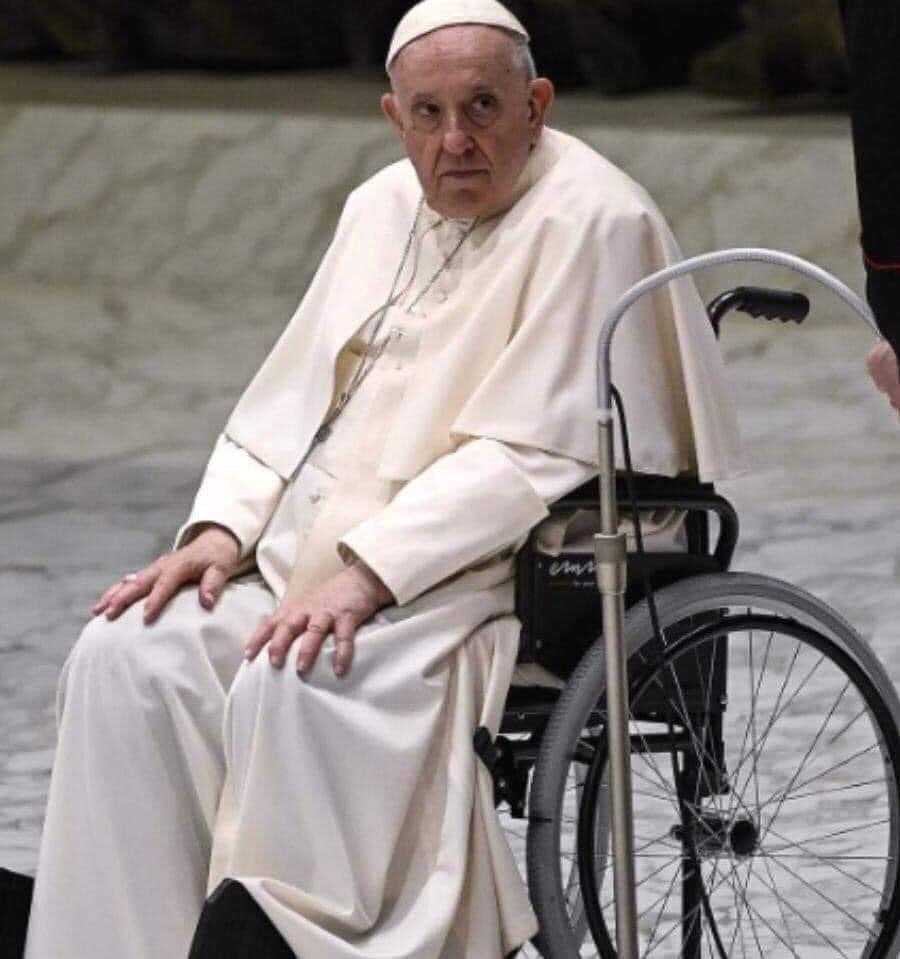
As I was thinking about all of this I came across this picture of Pope Francis, and it hit me again. My story like the paralytic’s story are not about the helpees but the Helper. If a great man like Pope Francis can accept the help of others who am I to think I am somehow better than that. The truth is we are all dependent on the help of others. It may be emotional support or sometimes physically taking us to the spiritual or physical help we need. It may be realizing we are dependent on the farmers, truckers, and grocers who get food on the shelf for us to purchase.
The secret to it all is being humble enough to recognize and ask for whatever help we happen to need at any given point in life. We all come into this life totally dependent on others to nurture, protect, and care for our needs for several years, and the cycle of life means that most of us will end up pretty much in the same need for caregivers at the end of this life. Our choice is how humbly and graciously we accept that care.
In the words of that great philosopher, Kenny Rogers, you gotta know when to hold ‘em, know when to fold ‘em and know when to walk away while you still can. I needed that wisdom this week.
I made a good but sad and hard decision to give up yet another activity I have enjoyed for about 70 years. I don’t remember exactly when I first experienced the joy of riding a two-wheel bike without training wheels, but I would guess I was 6 or 7. That had to be one of the first liberating rites of passage right up there with learning to walk and potty training.
My bike riding for the next 65 years was pretty routine. And then about four years ago I bought a step-through bike, aka a girl’s bike, because I was having trouble with my balance swinging my leg over the cross bar of my 30 plus year-old Schwinn that my father-in-law had willed to me when he could no longer ride. Almost immediately I discovered that my balance issues had more to do with my neuropathy than the kind of bike I was riding. I was still able to ride for awhile in spite of a few minor low-speed falls that happened while starting and stopping. No injuries ensued, but I gradually gave up trying to ride.
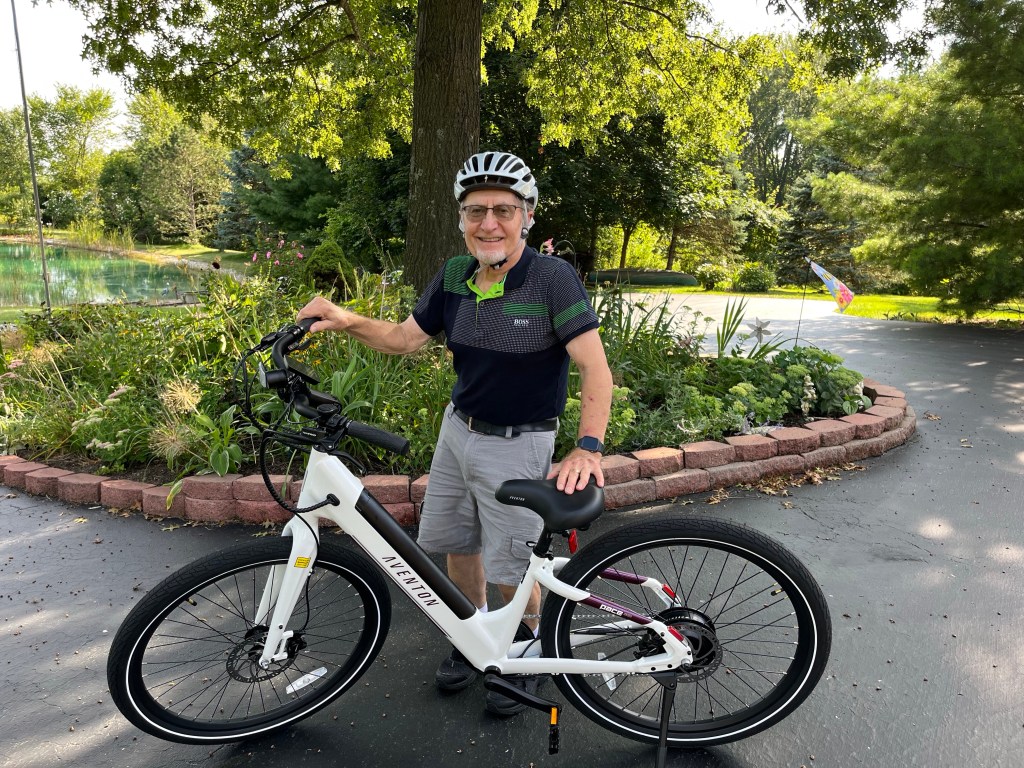
A few weeks ago I went into a bike shop in search of adult training wheels to see if I could still ride some with that kind of help. Talk about the circle of life!!! But a kind salesperson offered me an alternative that seemed to be a way out of that circle. He had me try an electric bike with a small motor which would give me a boost at start up where I had the most trouble getting up enough speed to establish my balance.
After test riding the e-bike (pictured above) in the store’s parking lot I was sold and brought it home on a trial basis. Unfortunately I discovered over the last two weeks that my balance and reflexes just aren’t up to learning the new skills required to master the e-bike. I had a couple minor falls on it, again miraculously without damaging myself or the bike. The last fall was on a short trip down our driveway to get our mail, and I sadly concluded it just isn’t worth the risk of a major injury to keep trying.
So with a heavy heart I asked my wife to help me load the bike in my SUV and returned it to the store. In addition to the sadness of adding bike riding to my growing list of things I used to be able to do, I’ve been processing how to gracefully surrender to the realities of aging without totally giving up on living.
That task is a work in progress, but I believe a piece of it is to be grateful for all the decades of good memories that bike riding has provided for me. Many of those memories are from the years before I could drive when my bike gave me the first taste of freedom to take myself to the neighborhood grocery store for a pop cycle or candy bar. It was only a block away, but the longest journey starts with a short one. That 1-speed (probably also a Schwinn) took me to Little League practice, the community swimming pool, and later every morning for a year to deliver newspapers clear on the other side of our small town. OK, it was only two miles, but on frigid January mornings at 6 a.m. in northwest Ohio if felt like 20!
The summer I was 15 my good buddy Denny Dafler and I road 200 miles on six 25-mile trips and a 50 to earn our cycling merit badges for Boy Scouts. That was also the summer of my first great love, and she lived 5 miles out in the country. My legs were never in better shape than the summer of 1962.
As an adult my biking has been more relaxed rides of 5-10 miles on bike trails near home—good exercise and sometimes a therapeutic way to burn off frustration or other unresolved emotions. My exercise bike is a poor substitute from feeling the wind of the road in my face, but it is safer and more age appropriate at this stage of my life, and no helmet hair results either.
Having just passed the mid-point of 2023 this seems like a good time to reflect back on goals and intentions I had for this year when it was in its infancy. Among the therapeutic values of blogging or journaling is the ability to look back at what I was thinking and writing about at some point in the past. When I did that recently I was reminded that a key goal I had for myself in January was to practice gratitude.
I must confess I have not done well with that goal and had mostly forgotten about it, as often happens with New Year’s resolutions. Rereading the two posts I wrote about practicing gratitude has been a wonderful reminder of several really good ideas from other people that I wrote about there, including my mentor Dr. Bill Brown, Robert Fulghum, dear friends Jean and Katy Wright, Dr. Brene Brown, Kate Bowler, and Kelly Corrigan. (I am quite proud of the two posts I wrote back in January and really grateful for all the wisdom I borrowed from those friends and scholars.)
So the question now is how do I stay focused on that wisdom and not let it slip again into that vast pool of great ideas I enjoy pondering but fail to integrate into my daily life? If I had a magic potion to make that happen I would gladly share it, but as I said in January gratitude like any skill requires the hard work of practice. Wishing doesn’t make it so or I would be the most grateful, joyful person around, and my dear wife can tell you that unfortunately is not the case.
Physical exercise is a good analogy for regular practice. During the pandemic I started an exercise program of swimming 2-3 times per week, and worked my way up to being able to swim a half mile. I kept that routine up until some health issues and travel caused me to get out of the habit earlier this year. I have just gotten back in the pool a few times in the last 3 weeks, including a 350 yard swim today. Swimming is great exercise because it works the whole body, is aerobic, and provides a quiet, meditative respite from other cares and concerns. But having said that, I must add that I am totally wiped out for the rest of the day after just 18 minutes in the pool. It would be easy to get discouraged about that, but I know from experience it takes time to rebuild my endurance.
Gratitude practice is a similar challenge. It requires the discipline and focus to consciously practice paying attention to all the blessings I am privileged to enjoy. I can choose to take time during the day, especially first thing in the morning and at bedtime, to call to mind what I am truly grateful for, even if I forget. I can give thanks for the beautiful home and yard I am privileged to occupy and not just complain about the work and expense it takes to do so. I can choose to be grateful for all the activities I can still do instead of regretting the ones I have had to give up. I can remind myself how fortunate I am to live in a peaceful place free from violence and war and so far immune from the worst ravages of extreme weather caused by climate change.
But this is not an either-or Pollyanna approach to life that ignores the injustices and suffering of others my community or world. I have used the word “privileged” several times above intentionally. I need to remind myself that I am truly privileged in so many ways largely to the accident of birth. And with that privilege comes the responsibility to use that privilege to do whatever I can to do what the prophet Micah tells us God requires of all of us, “To do justice, love mercy, and to walk humbly (gratefully) with God.”
Because of multiple life contingencies I have gotten out of the habit of swimming for exercise in recent months. After two years of very faithfully swimming 2 or 3 times per week travel, injury, spring yard work, and other forms of exercise have usurped the time previously devoted to time in the pool. I had forgotten that swimming is more than just physical exercise for me. It is also a form of meditation and solitude that other forms of exercise do not readily offer. So as I have begun to swim again in the last two weeks I have been reminded of those other benefits of time in the water. I had two radically different but essentially similar experiences in my swimming last week and this.
Thanks to Silver Sneakers (a wonderful insurance benefit for seniors) I have memberships at both our local YMCA’s and a private gym with a small pool. Last week I swam at the private gym and literally had the 4-lap pool entirely to myself for the 20 minutes I was there. It was as peaceful and quiet as any place I can imagine. By contrast this week I went to one of our Central Ohio YMCA’s and almost left without swimming. The cool weather we are having this week meant that the outdoor pool at the Y was closed and consequently the shallow end of the indoor pool was filled with a gaggle of elementary age kiddos making a joyful noise to the Lord or to someone!!
Being a devout introvert I was at first put off by all the noise. As I hesitantly walked into the pool area to see if there was even a lap lane available one of the life guards said to me, “Welcome to the party!” He also pointed me to an open lane which was of course right next to the semi-organized chaos in the shallows where brave high school-aged counselors were riding heard on the younger kids. The guard said I might get a stray beach ball in my lane but otherwise said it was all mine.
These two diametrically opposed scenarios turned out to be essentially the same however once I put on my snorkel and began swimming my laps. With my head submerged in the water I was totally alone in silence, repeating the mantras I use to turn my swimming time into one that is also meditation.
Finding time and space for solitude is increasingly difficult in our extroverted and fast-paced, multi-tasking culture. It requires a great deal of discipline to carve out such time and space in most of modern life, but nothing I have found works as well for me as donning a snorkel and submerging myself in the amniotic, baptismal water of a pool or pond. It doesn’t require deep sea diving experience or equipment. My head is never more than a few inches below the surface of the water, but those few inches filter out all the external distractions. And if I can also quiet the inner noise of my worrisome mind I am as close to a mystical peace as I have ever been.
It reminds me of Luke 5:4 where the disciples have been out fishing all night and have nothing to show for their labor. Jesus tells them to “put out into the deep and let down their nets.” Peter argues that they have been there and done that, but if you say so we’ll try again. It’s like Peter is humoring this carpenter. It makes no logical sense, just like swimming a few inches below the water should not silence all the noisy children just a few feet away. But it works. The disciples’ nets are filled to the breaking point because they obeyed, and my initial resistance to the chaos in the pool was transformed by the lifeguard’s positive attitude to reframe the child-like exuberance into an invitation to a party.
Your quiet place may be someplace entirely different than mine, but we all need one where we can “put out into the deep” of the mystery of existence.
[Note: This post was written on January 2 but not posted until January 4. It will make more sense with that timeline in mind.] My year of practicing gratitude literally began with a tough challenge. For almost all of my adult years the new year has begun with watching the iconic ball drop in Time Square. Thanks to my own and our cultural addiction with football, 2023 was different. Along with a group of friends I watched a different ball drop this year—a ball that will linger in Ohio State fans’ memories as “wide left.” 2023 was literally just a few seconds old when what would have been a game winning field goal over #1 Georgia sailed like a wounded duck far left of the goal post.
That was almost 36 hours ago, but today as I read several articles about the game in today’s Columbus Dispatch I relived that moment and the frustration of a controversial call that dramatically affected the outcome of the game. I should not have subjected myself to that memory, but I was unable to let it go.
For me, that is a prime example of my biggest obstacle to practicing gratitude. I mentioned one of my mentors, Dr. Bill Brown, and his rhetorical theory called attention shifting in my last post, and this is exhibit A for 2023. In the larger scheme of problems on the world stage or even in my personal life the outcome of a silly game should not be my prime focus. The Peach Bowl is over and done. My dwelling on a terrible call by the refs does not deserve the amount of my attention I am choosing to spend on it. And it is a choice. I can shift my attention to a whole host of things that deserve my attention so much more if I choose to do so. [Remember, I wrote this a few hours before the near fatal football injury to Damar Hamlin, but that tragedy underscores in spades that all football games and other athletics must be kept in proper perspective.]
Notice I did not say that this is a simple or easy shift to make. The local media, my friends, and my social media are full of conversations about the Ohio State game. It is not easy to shift my attention away from all that chatter, but it can be done. I can choose to not read about the game. I can literally switch the tv channel when discussion of that game comes on. Unfortunately I don’t have a remote that can switch the channels in my brain when I think about that loss or my own aches and pains, or other negative and depressing problems in our world. But attention switching is a skill that I can learn if I choose to do so. And making practicing gratitude my priority for 2023 is step 1 in that process
I had the privilege again this past Advent to create liturgies for the lighting of each advent candle for our church. When we got to the third Sunday and the candle of joy (12/11/22 post) I asked some of my fellow fans of Dr. Brené Brown to help me find what she has said about joy. My friend Jean Wright came through with this gem from Dr. Brown: “In our research we found that everyone who showed a deep capacity for joy had one thing in common: They practiced gratitude…A wild heart can beat with gratitude and lean in to pure joy without denying the struggle in the world. It’s not always easy or comfortable – but what makes joy possible is a front made of love and a back built of courage.”
There’s an old joke about someone asking how to get to Carnegie Hall. The answer is “practice, practice, practice.” Well, apparently the way to get to Joy is also, like any other life skill, to practice. Since I am by nature a skeptical, glass half empty kind of person, learning gratitude for me is something that requires lots and lots of practice. Practice is hard. Playing scales on the piano is work. Practicing on the putting green for hours is not nearly as much fun as hitting the crap out of a ball on the driving range. But no one will master the piano or lower their golf score without those basic practices.
It is no coincidence that my friend Jean Wright’s daughter, Katy, recently shared her wisdom about gratitude that she learned from podcasts with Kate Bowler and Kelly Corrigan who indirectly address the practice of gratitude by dividing life experiences into two categories, the “happies” and the “crappies.” The trick, of course, is paying at least an equal amount of attention to the former as we do the latter.
One of my mentors in grad school, Dr. Bill Brown, developed a rhetorical theory that helps with this task. He calls it “attention shifting,” which I will oversimplify here by saying it means intentionally shifting our focus or attention from one thing to another. I was reminded recently of another related skill for keeping things in perspective and practicing gratitude when my wife and I attended a high school production of “Everything I Needed to Know I Learned in Kindergarten” produced by the excellent Theater Arts Department at Thomas Worthington High School in Worthington, OH. Our great nephew Ryan Buckley has been part of that program for all four of his high school years, and we have enjoyed many plays there; but one scene in this production really resonated with me.
The Kindergarten play is based on the book by the same title by Robert Fulghum. I have read most of Fulghum’s stuff; so this story was familiar, but I must have been ready to hear it again. It’s a little long for a blog post, but I am going to include it here in full because it is so good.
Fulghum writes: “In the summer of 1959, at the Feather River Inn near the town of Blairsden in the Sierra Nevada Mountains of northern California. A resort environment. And I, just out of college, have a job that combines being the night desk clerk in the lodge and helping out with the horse-wrangling at the stables. The owner/manager is Italian-Swiss, with European notions about conditions of employment. He and I do not get along. I think he’s a fascist who wants pleasant employees who know their place, and he thinks I’m a good example of how democracy can be carried too far. I’m twenty-two and pretty free with my opinions, and he’s fifty-two and has a few opinions of his own.
One week the employees had been served the same thing for lunch every single day. Two wieners, a mound of sauerkraut, and stale rolls. To compound insult with injury, the cost of meals was deducted from our check. I was outraged.
On Friday night of that awful week, I was at my desk job around 11:00 P.M., and the night auditor had just come on duty. I went into the kitchen to get a bite to eat and saw notes to the chef to the effect that wieners and sauerkraut are on the employee menu for two more days.
That tears it. I quit! For lack of a better audience, I unloaded on the night auditor, Sigmund Wollman.
I declared that I have had it up to here; that I am going to get a plate of wieners and sauerkraut and go and wake up the owner and throw it on him.
I am sick and tired of this crap and insulted and nobody is going to make me eat wieners and sauerkraut for a whole week and make me pay for it and who does he think he is anyhow and how can life be sustained on wieners and sauerkraut and this is un-American and I don’t like wieners and sauerkraut enough to eat it one day for God’s sake and the whole hotel stinks anyhow and the horses are all nags and the guests are all idiots and I’m packing my bags and heading for Montana where they never even heard of wieners and sauerkraut and wouldn’t feed that stuff to the pigs. Something like that. I’m still mad about it.
I raved on this way for twenty minutes, and needn’t repeat it all here. You get the drift. My monologue was delivered at the top of my lungs, punctuated by blows on the front desk with a fly-swatter, the kicking of chairs, and much profanity. A call to arms, freedom, unions, uprisings, and the breaking of chains for the working masses.
As I pitched my fit, Sigmund Wollman, the night auditor, sat quietly on his stool, smoking a cigarette, watching me with sorrowful eyes. Put a bloodhound in a suit and tie and you have Sigmund Wollman. He’s got good reason to look sorrowful. Survivor of Auschwitz. Three years. German Jew. Thin, coughed a lot. He liked being alone at the night job–gave him intellectual space, gave him peace and quiet, and, even more, he could go into the kitchen and have a snack whenever he wanted to–all the wieners and sauerkraut he wanted. To him, a feast. More than that, there’s nobody around at night to tell him what to do. In Auschwitz he dreamed of such a time. The only person he sees at work is me, the nightly disturber of his dream. Our shifts overlap for an hour. And here I am again. A one-man war party at full cry.
“Fulchum, are you finished?”
“No. Why?”
Lissen, Fulchum. Lissen me, lissen me. You know what’s wrong with you? It’s not wieners and kraut and it’s not the boss and it’s not the chef and it’s not this job.”
“So what’s wrong with me?”
“Fulchum, you think you know everything, but you don’t know the difference between an inconvenience and a problem.
“If you break your neck, if you have nothing to eat, if your house is on fire–then you got a problem. Everything else is inconvenience. Life is inconvenient. Life is lumpy.
“Learn to separate the inconveniences from the real problems. You will live longer. And will not annoy people like me so much. Good night.”
In a gesture combining dismissal and blessing, he waved me off to bed.
* * *
Seldom in my life have I been hit between the eyes with a truth so hard. Years later I heard a Japanese Zen Buddhist priest describe what the moment of enlightenment was like and I knew exactly what he meant. There in that late-night darkness of the Feather River Inn, Sigmund Wollman simultaneously kicked my butt and opened a window in my mind.
For thirty years now, in times of stress and strain, when something has me backed against the wall and I’m ready to do something really stupid with my anger, a sorrowful face appears in my mind and asks: “Fulchum. Problem or inconvenience?”
I think of this as the Wollman Test of Reality. Life is lumpy. And a lump in the oatmeal, a lump in the throat, and a lump in the breast are not the same lump. One should learn the difference. Good night, Sig.
As I reflect on the year 2022 it is very easy for me to see the entire year through the lens of the last couple of months which have been rather crappy for me. Following my 76th birthday at the end of October my 77th trip around the sun began with an unexpected hospital stay because of a very serious urinary tract infection. That urinary infection has turned out to be one that is very hard to get rid of and has been bothering me off and on for about seven weeks now. Because of that it has been easy for me to throw a pity party for myself if I forget to keep my focus on the larger scheme of things. This illness is just an inconvenience. Other than the time I spent in the hospital and I a few days after that, I have been able to continue my normal daily activities. Those activities included the aforementioned opportunities to create Advent liturgies for worship in our church. And by sharing those liturgies in my blog, they have also been used by a number of other readers and worship leaders, for which I am grateful. I even got a bit of a chuckle each week during Advent when I noticed that the number of clicks on my Advent liturgies always seemed to go up about Thursday or Friday. I remember from my days of active pastoral ministry those were the days of the week when I suddenly realized I needed some help with worship resources for the coming Sunday.
I also realized this week that part of the attention shifting/gratitude practice is keeping my focus on the big picture and not just what is immediately in front or behind me. By paying too much attention to my recent illness I had completely forgotten about an amazing therapeutic golf program I became a part of this summer. That program is quite appropriately called “Fore Hope.“ In brief, this program pairs a wonderful volunteer “caddie” with each golfer. These caddies help the golfers with whatever that individual needs, from loading clubs on the golf cart, putting the ball on the tee, hunting for wayward balls, or literally holding the golfer up while he or she swings if there are balance issues. Having the opportunity to be a part of that program has given me a lot of hope and a new lease on life because I have been able to do something that I dearly love, which I thought was gone forever because of my health concerns. It has enabled me to play golf again with my son, and for the first time with two of my grandsons, and to my surprise as an introvert it also made me a part of a whole new community of friends.
I played my last golf with that group in mid-October and could not have written a more satisfying script for that evening. It was chilly, as October evenings are want to be in Ohio, and I almost wimped out and didn’t go; but I am so glad that I did. You see it turned out to be one of those magical times on the golf course when every putt found its way into or very close to the cup. And what is so special about the Fore Hope Golf community is that everybody is a cheerleader. We don’t keep score; so there is no insidious competition, and when any player makes a good shot everyone genuinely affirms that accomplishment.
But here’s the thing—about three weeks later I was flat on my back in the hospital and in the ensuing recovery from that experience, because I did not practice gratitude, I forgot all about the sheer joy I felt sharing those days on the golf course with my new friends. So for me, at least, an important part of the practice of gratitude is paying attention more often to the happies, and not letting the crappies which come along for all of us knock those moments of joy out of my awareness.