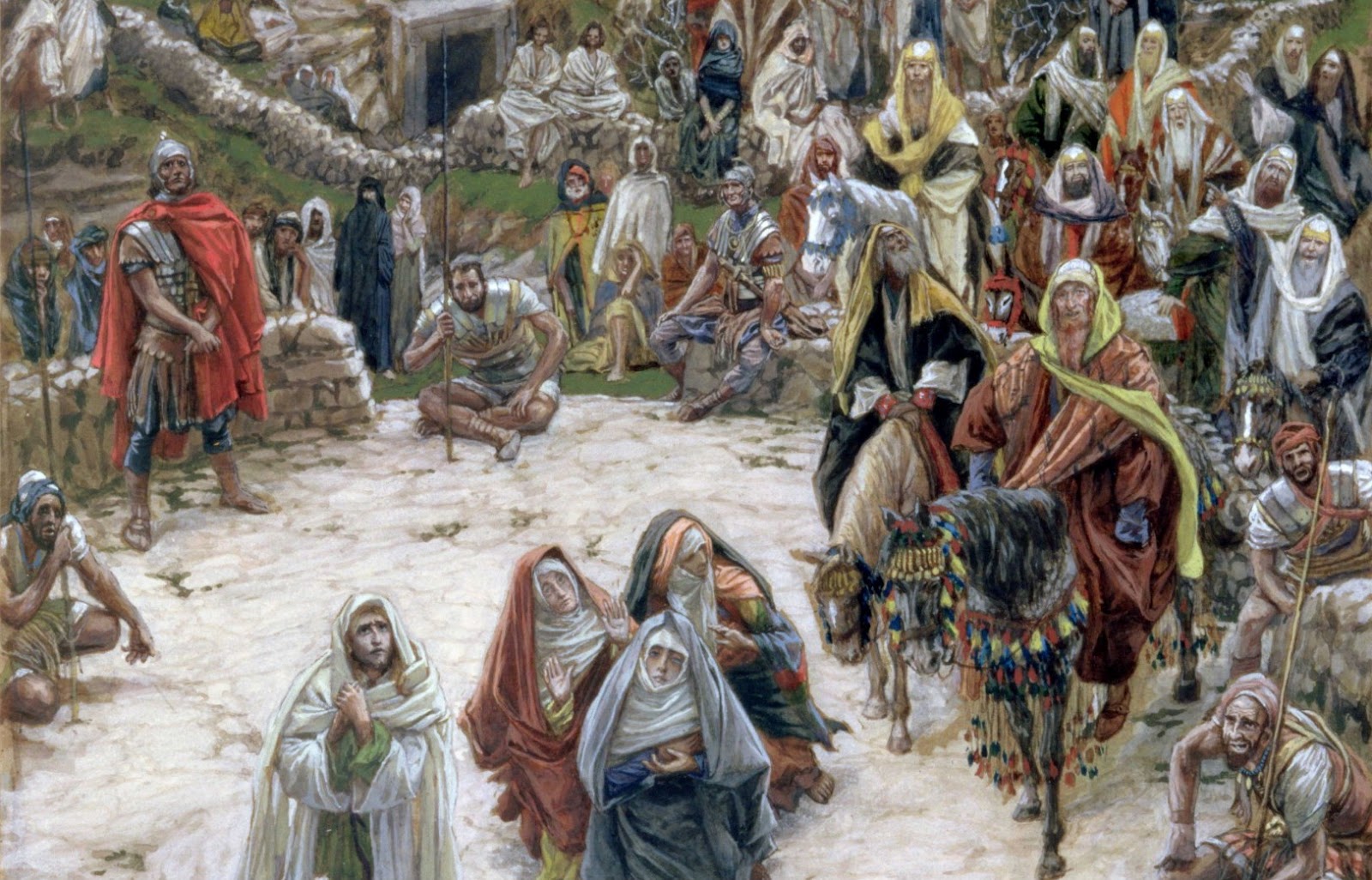
OMG: Good Friday Sermon, 2025

OMG – a common abbreviation used these days on social media and many users don’t know it, but it’s really a prayer, a lament.  It means “O My God,” and in our Good Friday context the emphasis is on the little word “My.”  Because even when we doubt and feel God is absent, we still own and affirm the relationship. My kids are still My kids even when they do stupid stuff I don’t agree with – same with friends, spouse, and colleagues.  Real relationships and friendships have no expiration date, and certainly there is none with the eternal God of all creation who has been with us since the day we were born and will be with us for all eternity after our short sojourn on this earth is over.  

Another common lament today is “Life sucks and then you die!”  That one is not in the Bible, but it could be in the book of Lamentations. When Jesus says from the cross, “My God My God why?”  Hear the My and not just the forsaken.  And of course the lament of Psalm 22 is followed immediately in our Bible by the most familiar Psalm of the whole 150.   Psalm 23 begins with “The Lord is MY shepherd.”

As we remember the brutal crucifixion of Jesus tonight I invite you to make that experience real.  Feel it in your gut.  Imagine or remember a time when you were in unbearable pain – either physical or emotional, and Jesus was certainly in both – a time when God feels as far away as the planet Pluto – at the death bed of someone you don’t think you can live without – when you hear a terminal diagnosis from a doctor – or your heartbreaks over a shattered relationship, or a job loss, or your financial security disappearing, or hearing on the news about unspeakable human cruelty.

Holocaust survivor Elie Wiesel in his book “Night” relates an incident when he was a prisoner in a Nazi concentration camp when a young man was hung and all the other prisoners forced to watch.  Someone asks Wiesel, “Where is your God?” and his answer is, “Right there on the gallows.” Whatever and whenever we suffer God suffers right along with us.

One of my favorite descriptions about human lament is the one Brian and Barbara just sang for us, “Day is Done,” by Peter, Paul, and Mary.  I asked for that song because of these lyrics which say, “Tell me why you’re crying my son; I know you’re frightened like everyone. Is it the thunder in the distance you fear? Will it help if I stay very near – I am here.” And if you take my hand my son, all will be well when the day is done.”

We really want to believe that “all will be well when the day is done,” but we don’t know how long that metaphorical day will last or if we can last that long. But what we do know is that it helps to have someone very near.  It helps to be able to share out loud what our pain is with someone we trust and know will listen and just be present as long as we need them. 

I just learned about a quote from Fred Rogers recently in our Books to Bridges book group.  Mr. Rogers said, “What is mentionable is manageable.” “What is mentionable is manageable.”

Pain that we try to carry alone can suck the very life out of us, but if we can talk about it the power it has over us is shared and diminished – it becomes manageable.

Another lament in Psalm 13 begins with these plaintive words: “How long, O Lord? Will you forget me forever?   How long will you hide your face from me? How long must I bear pain in my soul and have sorrow in my heart all day long?”   The point in sharing these cries for help is not to depress us but simply that it’s OK to lament, to doubt; those feelings are part of the human condition. No matter how strong your faith is it is hard when the foundations of your existence are shaken like an 8.0 earthquake.  Even Jesus who had more faith than all of us put together cries out “My God, My God, why have you forsaken me?” which is even more powerful in the Aramaic that Jesus would have spoken: “Eloi, Eloi, lema sabachthani?”    

And as you heard in our scripture from Psalm 22 tonight we know where Jesus got those words.  Jesus knew his Scriptures very well, and he knew his people for centuries had been no strangers to devastating loss.  They were experts at lament.  We even have a whole book called Lamentations in the Hebrew Scriptures, which is our Old Testament, devoted to nothing but laments.  And part of the prophet Isaiah’s description of God’s Messiah is that he is a suffering servant who “… was despised and rejected by others; a man of suffering and acquainted with grief.”

Ps 22 is typical of another source of laments the Hebrew people used in public worship. Do you know that there are more psalms of lament in the book of Psalms than any other type of Psalm? One of my favorites when I’m having a no good, terrible, awful day is Psalm 130.  It’s called “De Profundis” in Latin and says, “Out of the depths I cry to you, O Lord.  Lord, hear my voice! Let your ears be attentive to the voice of my supplications!”  Out of the depths loosely translated means “we are in deep do do.”

Psalm 63:1 echoes the same song: “O God, You are MY God; early will I seek you; my soul thirsts for You; my flesh longs for you in a dry and thirsty land where there is no water.” I’ll bet most of us have been in such a dry and thirsty land or may even be there right now.  That’s the message of Good Friday.  I still remember vividly one such time in my youth.  It was my Boy Scout Order of the Arrow initiation.  I was maybe 13. I was led out along with my fellow scouts in total silence and darkness until I was tapped on the shoulder and told to stop and sleep right there, left alone in a strange, dark woods overnight with only a sleeping bag. I had no idea if anyone else was close by or where I was. It was the most alone I had ever been at that stage of my life

Kate Bowler, one of my go to devotional sources, wrote this blessing two years ago in 2023, but it is even more relevant today and is part of her Lenten devotions for 2025. 

It’s called “A Blessing for when you need a little hope.”  “These days feel heavy and dark, like hope packed up and left, and forgot to send a postcard. We cry: Where are the good things? And honestly, where are the good people— the sensible ones fighting for what matters? Why does it feel like bad stuff always elbows its way to the front, pushing everything good to the sidelines? We’re tired. Exhausted, really. Desperation is knocking, and it’s tempting to surrender. Blessed are you, who see the world as it is: the sickness and loneliness, the injustice that never seems to end, the greed and misuse of power, the violence and intimidation, the mockery of truth, and disdain for weakness, and worse— the seeming powerlessness of anyone trying to stop it. Blessed are you, worn down by hard-earned cynicism, running on fumes, with no promise of a destination. Maybe hope isn’t so distant. Maybe it’s there—small, persistent, and stubborn. May you grasp something in the heaviness. A glimmer of what could be, and walk, step by step, toward the possibility that goodness exists. Hope is an anchor dropped into the future pulling you forward, toward something better— even if it doesn’t feel like it right now.”

Yes, my friends, there is always hope somewhere.  Even “O My God, My God” still claims God as ours.

 This Good Friday feels more real to me because we are living in a time of great uncertainty in our country and our world.  No matter what your politics you know these are unsettling times.  But we aren’t the first to feel this way.  The women at the foot of the cross and the other disciples hiding out somewhere had no idea what their future held – and neither do we.  I invite you to put yourself in the crucifixion story – pretend we don’t know what happens on Sunday morning, and enter fully into the forsakenness of that moment with Jesus and his followers and friends.   

What do we do when life seems hopeless, empty, dark, alien, and full of fear and uncertainty?  Like Jesus we can call out “O My God, help us!” and God will answer.  Maybe not immediately; we may have to go through a long Saturday of uncertainty, as long as that Saturday lasts, but there will be an answer because God does not forsake us, just as God did not forsake Jesus.

Even here in the darkness we remember that God so loved the world that God sent Jesus to love and save us. When all else fails it is that love that is eternal.  God so loved the world, and as author Sarah Bessey says, we are called to love that world too and everyone in it, even, Sarah says, knowing that it will break our hearts – knowing it will break our hearts.  To love means risking, being vulnerable, feeling pain — but a broken heart is so much better than not having a heart at all. 

Good Friday 2025, Northwest UMC, Columbus, OH

Squads of Love

The following words of wisdom hit me today right where I needed them. I had another morning when I struggled to get out of bed because I didn’t want to face another day of the awful mess our world is in. And this message by one of my favorite spiritual guides quoting another of my favorites helped me face the day.

Father Richard Rohr shared this insight in his daily meditation from the Center for Action and Contemplation:

Religion scholar Diana Butler Bass ponders the crowd’s outrage after Jesus’ first sermon in Nazareth (Luke 4:18–30)—and the courage required to resist it:  

A preacher gets up, quotes scripture, and reminds the gathered congregation that God loves the outcast—those in fear for their lives—the poor, prisoners, the disabled, and the oppressed. 

In response, an outraged mob tries to kill the preacher…. 

Jesus spoke directly to the congregation saying that God loved widows and those stricken with leprosy—implying that his neighbors had not treated widows and lepers justly. They praised God’s words about justice but were not acting on God’s command to enact mercy toward outcasts. 

That’s when they “all” got angry and turned into a mob. At least, the majority of them didn’t want to hear this. They flew into a rage. 

When they heard this, all in the synagogue were filled with rage. They got up, drove him out of the town, and led him to the brow of the hill on which their town was built, so that they might hurl him off the cliff. But he passed through the midst of them and went on his way. [Luke 4:28–30] 

… What do you do when the mob turns ugly? When widows and lepers, when LGBTQ people and immigrants, are afraid and treated cruelly—and when a brave prophet calls out the self-righteous? What do you do when there’s a lynch mob or a cross-burning? 

I suspect the unnamed heroes of this story stepped outside of the “all,” not willing to be part of the totality, and made a way for the intended victim to pass safely. Did they spot one another in the angry throng? A furtive glance, seeing another hesitant face across the room? Maybe they moved toward one another, hoping to keep each other safe. Did a few others notice the two and the small band then began to multiply? The “all” was furious; the few didn’t understand how it had come to this. 

It was frightening for them; it must have been hard to go against their family, friends, and neighbors. As they followed the mob to the bluff, they must have worried that if they spoke up they could be thrown off, too. But instead of submitting to the tyranny of the “all,” maybe they formed a little alternative community in solidarity with each other. When Jesus was herded to the cliff, perhaps it was they who saw an opening—made an opening—and helped him escape. He passed through the midst of them and went on his way. 

That is, indeed, a miracle. The bystanders find the courage to do something. 

If Jesus needed that, so do we…. We must form squads of love and make a path through together … no matter how fearsome the mob. 

And that’s the overlooked miracle of Luke 4: Only a community—even one that goes unnoticed in the crowd—the band that refuses to join the rabble—can keep us from going completely over the edge.

Lent: Fourth Sunday Prayer

O God of eternal love, we are here again needing your amazing grace.  We’re half way through our Lenten journey, and to be honest some of us have lost our way.  The distractions of life keep pulling us off track.  There are taxes to do, gardens to prepare, and our houses, offices, and even our lives need a good spring cleaning. 

Spring break isn’t long enough, and quite frankly we often come back from vacations more tired than when we left. Those school assignments or work deadlines are still lurking on our lap tops and in the back of our minds.  Instead of focusing on what you would have us do for others we get turned in on our own fears and doubts about the future—concerns about our own health or the well-being of our loved ones. 

Gracious Holy One, we know you have told us over and over again to put our trust in you and not in things that thieves or natural disasters can take from us.  But we still have to buy expensive food and watch our retirement accounts shrivel up.  Those fears are real, God.  And they make it hard to trust in the future. 

So we’re here seeking hope and assurance.  We need forgiveness for the times we have strayed from the narrow path that leads to salvation and for the times when we self-righteously look down our noses at others who are just as lost as we are.  Speak to us again your words of grace that tell us and show us that we can never wander so far that you can’t find us, for you are with us and your spirit is right within our hearts.

Remind us once more, O Holy One, that you are not the judgmental, angry God many of us grew up learning about, but you are the Good Shepherd, the mother hen, the eagle parents nurturing their young. You love us unconditionally forever.  There’s no fine print, no preexisting conditions in the new covenant we have with you that was signed and sealed in Jesus’ own blood on Calvary’s cross.

So with grateful hearts we the people of your kindom reaffirm our trust and offer again the prayer Christ taught us to pray …

Eternal Love: A Journey Through Lent

I was not in the mood for Lent this year. With everything going on in the world and my own ever-nearing 80th birthday in just 19 months the last thing I wanted to hear was “You are dust, and to dust you shall return.” I already felt lost in the wilderness and didn’t think I needed to add any more of lostness to my weary soul.

But even good habits die hard and this annual tradition kept nagging at me; so my wife and I decided to attend our church’s Ash Wednesday service on line, and I’m very glad we did. On-line worship is not usually the best way to worship for me, but I am grateful for that option when I need it. The service at Northwest UMC on Ash Wednesday was an exception to the rule for both Diana and me. It was a very well done service that was contemplative, and being at our kitchen table with only candle light to illumine the room was ideal for that particular kind of worship.

Our church had provided packets for the service that included ashes and a small piece of clay. At one point in the service, after hearing the traditional Scriptures for Ash Wednesday read, we were asked to take the clay and form it into something symbolic that would have meaning for us during the 40 day journey of Lent.

We were give time to pray about that assignment while soft guitar music played. Thanks to the wisdom of several authors I’ve been reading in the chaotic days since January 20 (Richard Rohr, Kate Bowler, Diana Butler Bass, Nadia Bolz-Weber, Brian McLaren, and Sarah Bessey) my mind was led to think about the one constant and trustworthy thing in any time of crisis, namely God’s eternal love.

So I formed my clay into the symbol for infinity which always looks like an 8 lying down to me. Then as I had time to ponder that a little longer it came to me that what I was thinking and feeling was not just a mysterious concept of never-ending infinity or even in Buzz Lightyear’s famous quote “To infinity and Beyond.”

What I was trying to capture in clay was something quite tangible and real – Love. I’ve felt that love more powerfully than ever before through my family and friends who rallied around me during my health crises in the last 8 months. I discovered that my village is a lot bigger and deeper than I realized before. The ministry of presence took on a more beautiful meaning for me in the physical and spiritual companionship that surrounded me and got me through a wilderness journey of my own.

So I decided to shape one end of my clay infinity symbol into a heart (pictured above), and it is still sitting on the kitchen table to remind me several times a day that St. Paul got it right in I Corinthians 13:7-10 when he wrote: ” Love bears all things, believes all things, hopes all things, endures all things. Love never ends. But as for prophecies, they will come to an end; as for tongues, they will cease; as for knowledge, it will come to an end. For we know only in part, and we prophesy only in part, but when the complete comes, the partial will come to an end.”

That worship experience was a much needed reminder for me of that eternal love which is the constant, solid ground under our feet even when the foundations of everything we thought we could trust are shaking like an earthquake, to borrow a phrase from the great theologian Paul Tillich. The Ash Wednesday service I didn’t think I wanted helped me to surrender a lot of the anger and frustration I’ve been dealing with about our current political crisis, and I am very grateful.

Today I put that picture of my clay symbol on my watch and phone as wallpaper to be an even more frequent reminder for me the power of eternal love.

A funny thing happened after that Ash Wednesday service. When my wife Diana looked at my art work she said, “I like your fish.” After I explained to her what I intended my symbol to be I realized that the fish is also a great symbol for eternal love. I was also reminded that art is also mysterious and can mean different things to different people at different times.

The fish symbol has been a Christian symbol for 2000 years because the early Christians used it as a secret code to identify themselves as Jesus followers to one another in a way that they hoped would not be recognized by their Roman persecutors. The origin of the symbol came from the Greek word for fish, Ichthus. It was and still is used because the letters of the word ichthus are the first letters of the Greek phrase “Iēsous Christos theou hy ios sōtēr”, which translates to “Jesus Christ Son of God Savior”. 

So whether I see a fish or an infinity symbol when I see this piece of clay doesn’t matter. They both speak to me of God’s eternal love that will sustain me through these 40 days of Lent and through whatever the future holds until I return to dust and beyond. I hope it might do the same for you.

Into Your Hands

I am one of the narrators for our church’s Good Friday cantata, “The Shadow of the Cross.” At the conclusion of the cantata each narrator will share one of Jesus’ last words from the cross. My line is “Father, into your hands I commend my spirit.” This opportunity has forced me to think about how to interpret those words.

Were they uttered in exasperation? “I give up God. You’ll have to take it from here!” Or maybe just a plea for help? Another way of expressing a feeling of abandonment or defeat, even anger? Luke 23:46, the only Gospel that contains this particular phrase, prefaces the words with “Jesus cried out with a loud voice,” which might support that kind of interpretation.

But Psalm 31:5, a source Jesus could have drawn upon, says, “Into your hand I commit my spirit; you have redeemed me, O Lord, faithful God.” That context seems to support what feels right to me. I believe this phrase expresses a surrendering and acceptance of death in all its forms to a mysterious power that makes all things new. They are uttered in the sure and certain belief in resurrection.

For Luke that is all there is to say, and he adds: “Having said this, he breathed his last.” For Luke this is the last of Jesus’ last words. That’s a great exit line, but how do average folks like us truly believe and trust that mystery? As one feeling much too close to the daunting age of 80 that question has taken on more and more significance for me.

Delivering these important words from the cross reminds me of the characters in Nikos Kazantzakis’ novel, “The Greek Passion,” where people in a Greek village take on the various roles in the story of Christ’s passion and so identify with their characters that they become them. The man portraying Judas is driven out of town for his betrayal of Jesus, and the man portraying Jesus, offers himself as a sacrificial lamb, confessing to a murder he didn’t commit to save others from being executed.

Obviously my one liner is not nearly as intense, but it feels like it can still be powerful and transforming for me and maybe others if the Holy Spirit works through me. It is always a heavy responsibility to speak hope into darkness, and God knows things are plenty dark just now, even days before the solar eclipse passes through our state. 

Help me Holy One.  I believe; help my unbelief.

Lent/Holy Week Video: Anointed

Our church, Northwest UMC in Columbus, Ohio, is doing a series of worship services and sermons on the events in Jesus’ last week in Jerusalem. For each Sunday in Lent our talented music director, Brian Luke, has recorded a short video of what each event might look like through the eyes of a contemporary character in the story.

For the fourth Sunday in Lent the text was the anointing of Jesus at Bethany in the Gospel according to Matthew. I was asked to portray a witness to the anointing who is being questioned by the authorities about what had transpired. A version of this event appears in all four Gospels, and here is Matthew’s account.

“Now while Jesus was at Bethany in the house of Simon the leper, a woman came to him with an alabaster jar of very costly ointment, and she poured it on his head as he sat at the table. But when the disciples saw it, they were angry and said, “Why this waste? For this ointment could have been sold for a large sum and the money given to the poor.” But Jesus, aware of this, said to them, “Why do you trouble the woman? She has performed a good service for me. For you always have the poor with you, but you will not always have me. By pouring this ointment on my body she has prepared me for burial. Truly I tell you, wherever this good news is proclaimed in the whole world, what she has done will be told in remembrance of her.” Matthew 26:6-13 (NRSV)

The link below will take you to the video:

drive.google.com/file/d/1ayIosZ7iMVaeXwPipeyKjrybF1e4aa87/view

Baring All Before God

Kate Bowler’s Lenten meditation for today triggered a memory for me from nearly 70 years ago.  In her book, “Have a Beautiful Terrible Day,” Kate’s meditation for Monday of Lent Week Four is titled “letting yourself be known.”  She paints a wonderful contrast between fearing a God who judges our faults and one who knows all about us and loves us as we are.

She closes with this reflection prompt:  “We can have a very Elf on the Shelf view of God at times.  THERE IS GOD WATCHING YOU. Shudder.  What image of God seeing you and caring about you could you find comforting?”

A long-forgotten memory immediately popped into my head as soon as I read those words.  When I was young my maternal grandparents lived on a farm that had no indoor plumbing.  When I visited them I thought nothing of using their two-holer outhouse.  It was just the way they lived.  

I especially enjoyed visiting there because the 7th of my grandparents’ children, Gary, aka Butch, was only 4 years older than I. He was more like a cousin than an uncle to me and just enough older that I admired his greater knowledge of worldly things. Farm kids have a much earlier and healthier grasp of how life and death work than we city slickers did.

So here’s my memory.  One day uncle Butch and I were using the outhouse.  I’m guessing I was 9 or 10 and he was 13 or 14 at the time.  We were at that curious age where sex was often a topic of conversation.  I don’t remember any details of our conversation, much of which I later learned was misinformed.  But I have a vivid memory that for some reason we decided to take off all our clothes and run around the back yard naked.

Had we done that at my house I think my parents would have had a heart attack.  But my dear grandmother who had raised five boys and two girls simply watched us from the kitchen window and laughed.  

Isn’t that a great image of a God from whom nothing is hidden, who sees us in all our human frailty and fallibility and laughs

Holy Saturday

My church has a wonderful Chapel in the Woods which has been the site of summer time worship every Sunday for over 30 years. It is one of my favorite places to pray and meditate whenever I am near the church campus during the week and on Sundays. It is extra special to me because we have a memory garden at the back of the chapel, and that is where I want my ashes to be scattered when I transition to the next stage of eternal life.

The chapel is also special to me because it was originally started as a fellow Eagle Scout’s project. My favorite feature of the chapel has always been the big cross at the front which was made from a dead tree stump.

But this spring the painful decision was made that the big cross had to come down. The old tree stump had become increasingly unstable due to age and insect damage. So for safety reasons our old rugged cross is no more. We are in the process of deciding what we will put in the old cross’ place. A committee is asking for suggestions for what should come next, but that cross was so perfect for that setting that I cannot yet imagine what could come close to being as meaningful.

The fallen cross seems a fitting metaphor for the grief and uncertainty of the day between Good Friday and Easter. I cannot really imagine the depth of the pain and fear those women and men who loved Jesus so dearly and witnessed his execution on that Friday when the sky turned black. I can’t feel what they felt because I know the rest of the story. We know that the cross is not the end. Thanks be to God

Holy Thursday Humility

I had a Martin Luther moment this morning.  No, I didn’t nail any theses to a church door.  It happened like this.  I had a busier than usual early morning for me, which means I was dressed and doing some slightly physical labor outside by 9 am.  Mornings are hard for me anytime.  My arthritic joints complain loudly when pressed into action too soon after I get up. 

All of that is to say that my outside chores required more exertion than they used to, and I managed to work up a sweat.  I hadn’t planned on showering this morning because I wanted to work out later in the day, but I had a PT appointment and wasn’t fit to go without a shower.  As I finished the shower I remembered the story that Martin Luther always reminded himself that he was baptized whenever he bathed.  At that moment I realized how fresh and renewed I felt.  It was like the warm water had had not only washed away the sweat and relaxed tight muscles, it wrapped me in the grace-filled water of baptism.

This being Holy/Maundy Thursday I had read two devotions earlier this morning about Jesus washing his disciples’ feet, including those of Judas.  The familiar story of Jesus overruling the objections of Peter who argued their roles should be reversed reminded me of Jesus’ own baptism where John makes a similar plea that Jesus should be the one doing the baptizing.

One of my favorite moments in the musical “Godspell” is the baptism scene.  When John asks Jesus what he’s doing there Jesus simply replies, “I came to get washed up.” And on this Holy Thursday I marvel anew at the integrity and consistency of Jesus’ ministry.  From baptism to foot washing he shows us the meaning and the power of humble servanthood.  He arrived in Jerusalem that Sunday not in a Lincoln limo, but in a beat up Volkswagen bug.  He came to show us in everything he did in the words of the great old hymn by Ernest W. Shurtleff (1887) that it is “not with swords loud clashing, or roll of stirring drums, but with deed of love and mercy the heavenly kingdom comes.” (From “Lead On, O God Eternal”)

Micah 6:8 is the verse I would pick from the whole Bible if I could only have one to describe the meaning of messianic living and what it means to take up a cross and follow Jesus.  Holy Week provides the whole story of Christian discipleship in a nutshell as Jesus shows us what God requires of those who would fulfill the human potential our creator has instilled from birth/baptism in all of us.  In those 6 days Jesus did justice, he lived mercifully, he did it all in humility, and like God the creator he rested on the Sabbath.  And then comes rebirth and a new creation early on Sunday morning. 

On Mortality and Life Expectancy

I am officially in the season of my life when my friends are reminding me of our shared mortality.  No matter how hard we try to not be like our elders have been at our age, whenever we folks now  in our 70’s get together in person or on zoom, sharing of health concerns tends to dominate or at least infect our conversations.  I have for years had a dread of the time when one of my close friends dies, wondering when that may happen; and being grateful that I have been fortunate to reach 76 years without that experience.  But now I know it is not a question of if that will occur, but when. 

A year ago we lost a good friend who my wife had known for 40 plus years.  I had only shared that friendship with her for 8 or 9 years.  This year a good friend we’ve both known for 20 years is dying of lung cancer, and also two very good friends of mine whom I have known for over 50 years are facing possible life-threatening issues.  Given all that the familiar warning of John Donne to not “ask for whom the bell tolls” takes on a whole new existential meaning.

I was researching another topic the other day and came across some curious biblical passages that address but add no clarity to the familiar quandary we all wrestle with—how long can I expect to live.  On that topic Genesis 6:3 has God saying, “My spirit shall not abide in mortals forever, for they are flesh; their days shall be one hundred twenty years.”  That could be both good news and bad.  But only a chapter later we are told “Noah was six hundred years old when the flood of waters came on the earth.” (Genesis 7:6)  And to further muddy the waters (no pun intended)  Psalm 90:10 says, “The years of our life are seventy, or even by reason of strength eighty; yet their span is but toil and trouble; they are soon gone, and we fly away.”

If we want certainty about how long we can expect to live those verses certainly don’t help.  They were written by different authors in very different contexts; but here’s what they are saying to me.  No one really knows how long they will walk on this earth.  We can let that uncertainty drive us crazy, or we can make peace with it and live in the only time we really ever have – Today.  Some days it is easier to do that than others of course, but finding that peace that passes all human understanding always depends on how well we can surrender our doubts and fears to the very source of our life. 

Surrender is hard for us competitive type humans.  It sounds like defeat or loss, and most of us really hate losing.  But this kind of surrender is just the opposite.  It is victory at the deepest level to find relief from things we cannot conquer on our own but need to offer up to a higher power.  Prayer can take a multitude of forms, but it is the best way we have to connect with that higher power and simply trust in the goodness and mercy only God can give. 

As I was writing this, the words to an old hymn I have not sung for many years, but the lyrics to “What a Friend We Have in Jesus” by Joseph Scriven are still in my memory bank, and they really sum up this whole matter and many other mysteries of life very well.  Those lyrics in part say,

“O what peace we often forfeit,
 O what needless pain we bear,

 All because we do not carry
 Everything to God in prayer!”