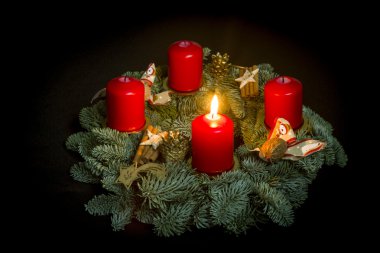
Advent 2024, Hope

In the busy Advent season it is easy to lose sight of the purpose of this part of the Christian year.  Our calendars and to do lists are crammed full of important traditions and celebrations, and we don’t think we have any time or energy left to create housing for the Holy! 

On this first Sunday of Advent we are focusing on making room for Hope in a world that often looks hopeless.  In the short run where we live that may seem to be the case.  But here’s the thing; God doesn’t live in the short run but in the cosmic expanse of time and space.  And that’s where our hope comes from.

Emmanuel, God with us, isn’t just a December thing.  The one we are preparing for, the helpless baby born in a barn is with us for eternity.  Our hope is not in things or people that are here today and gone tomorrow, but in the God of all creation.  As Diana Butler Bass reminds us reminds us with this quote from Revelation, our hope is anchored in one “who is and who was and who is to come”–a mysterious presence that warms our hearts on the coldest and darkest seasons of our lives.

And so today we light the Candle of Hope, a tiny flame that represents the reason a weary world can still rejoice.

Please pray with me:

O Holy creator and sustainer God, remind us as we begin this Advent season that you can bring forth hope anywhere and everywhere.  You reveal your glory in a gorgeous sunrise, in a loving smile, and even in a humble stable.  Your holiness is all around us, in a cloud of witnesses who have gone before us, in a warm embrace when there are no words required, and in random acts of kindness that are contagious.  Our prayer today is that you will help us take time from our busyness to clear out some anger or doubt in our hearts and make room for the Holy, for our hearts are truly the only space you need to give birth to the gift of Hope.  We offer our prayers and our hearts in the name of the babe of Bethlehem who still gives hope to our weary world. Amen

Northwest UMC, December 1, 2024

Who Do You Say You Are? Reflections on Identity and Life’s Challenges

“I hope for nothing. I fear nothing. I am free.” Nikos Kazantzakis’ epitaph.

Those words from the Greek Author and philosopher, Nikos Kazantzakis, have both inspired and haunted me since I was first introduced to them as a twenty-something seminary student 53 years ago. Kazantzakis, most famous for his novel, “Zorba the Greek,” wrote many volumes full of such deep and baffling sayings. Many of them have stuck with me my entire adult life, and I was reminded of again of them when my wife and I had a chance to visit Crete on a cruise to several Greek Islands last spring. Crete is both the birthplace of Kazantzakis and where he is buried.

 The epitaph in particular has been on my mind recently as my awful, terrible, no good, horrible summer of 2024 has continued right into the fall. [Please read my posts from August 4th and 12th if you want all the details.]. Quite frankly I do know that my little problems the last 4 months can’t hold a candle to hurricane destruction, people living in war zones, people starving from famine and climate change, people suffering from chronic pain, grief, persecution, broken relationships, addiction, homelessness, and so many more. Is it possible for any of us to truly hope for nothing and fear nothing?

My most recent personal challenge is undergoing chemotherapy for a rare form of lymphoma in my blood. I’ve known this day was coming sooner or later since my oncologist has been tracking the slow increase of a monoclonal glutamate in my blood for over a decade. I was personally hoping for later, like much later. But of course this was the great summer of my discontent, and what better time for my IgM antibodies to set off a siren alerting my doctor that something was wrong. This alarm was as loud as our home security system when I accidentally set if off. When the IgM jumped from around 2000 in January to 6500 in July it was such a loud warning that even my denial mechanisms were overpowered.

Technically I have been a “cancer patient” for about 13 years now because I was diagnosed with a mild prostate cancer in 2011. But that cancer has never needed any kind of treatment. Being told I needed to start getting chemotherapy ASAP for this lymphoma was a whole different ball game. One of my first challenges after this diagnosis was a debate within about how I wanted to think about myself going forward. Naming something helps give us some agency over it.

I knew I didn’t want to think of myself as a “cancer patient” because I am so much more than any diagnosis or label or title can convey. We are complex and complicated beings who defy narrow definitions of ourselves. In other words, I have cancer; it doesn’t have me. But knowing what I didn’t want to identify as didn’t answer the harder question of finding a name for this new, added dimension of my being. I toyed with “victor” (maybe too ambiguous depending on how one defines what victory even looks like. Jesus certainly didn’t look like a victor on the cross, but how our ideas of victory change on Easter morning! Don’t like “survivor” either. I want more from life than just surviving. As an aside, it has taken me 6 weeks or so to reach sporadic bouts of peace where I can live into the words above. In fact I hadn’t been able to express those thoughts and feelings like this until I started writing them. One of the many reasons writing is so therapeutic for me.

At those many other times when I don’t feel good at all about my new blood brother, I have caught myself recalling the title of a 1995 movie, “Dead Man Walking.” As time goes on I have had fewer of those DMW moments and more of the positive ones. After writing this, I’m pretty sure that ratio will continue to improve. Because as I wrote this post I realized that I have a simple and maybe fun way to embrace and integrate my cancer into my “Stevenness.” You see, my cancer has a pretty cool name. It’s Waldenstrom, named after a 20th Swedish Doctor who first described it. But Waldenstrom is a very heavy handle for my little cancer. It sounds like a cousin to Frankenstein. So I have decided to christen my cancer with the nickname, “Waldy,” and that seems like a name I get arms around.

One final thought (or two): Throughout this naming/identity dialogue with myself there was a biblical scene that kept coming to my mind. All three synoptic Gospels (Matt. 16:15, Mark 8:29, Luke 9:20) recount the time Jesus gave his disciples a pop quiz. Like all good teachers Jesus starts with a safe, impersonal question. He asks, “Who do people say that I am?” After the disciples respond with several Hebrew heroes from the past, Jesus stops them and asks the zinger: “and who do you say that I am?’ Jesus went from preaching to meddling in a hurry.

Simon Peter as usual jumps in with the answer: “You are the Christ, the Messiah.” Peter knows the right words, he just doesn’t yet understand what those words really mean or will mean to him. Far too many of us today know “who” Jesus is, but that’s only half the equation. It’s one thing to answer the catechism, or recite the Apostles’ Creed, but quite another to know what those words require of us who claim the identity of Jesus’ followers.

It occurs to me that the unspoken question that Jesus leaves hanging in the air for his disciples to discover for themselves is this: “Who do You say that you are?” Have you wrestled with that question recently? Who do you identify with/as? What name do you give to the totality of the amazing God-created being you are? We humans are more than the sum of our parts. Be gentle with your being. But remember to ask yourself occasionally: “Who do You say that you are?”

The answer to that question is never final; it is dynamic and ever-changing. But the closer we get to an answer we can live with, the closer we are to fearing nothing—not even my new friend Waldy or whatever other demons with which we have wrestle.

ICU LIFE LESSONS

Three days ago I quite unexpectedly began a crash course in life lessons I didn’t sign up for. Thanks to dangerously low blood pressure and low Hemoglobin I became so dizzy at home and unable to stand that I earned myself a first-ever ride in an ambulance. That bumpy ride landed me two other firsts —two nights in ICU and a first time blood transfusion.

Quite a day and night, and I’m happy to report that within 24 hours and after some bleeding ulcers were discovered and treated I made a remarkable recovery. I am writing this from a regular hospital room just under four days after it all began and am processing it all by trying to capture and share some of what I’ve learned.

First and foremost I have been amazed and humbled by the outpouring of love I’ve felt from family and friends. The hospital EMT’s and hospital staff have been fantastic. I expected that, but am still beyond grateful for how dedicated and wonderful they all have been, and some of what they had to do for me was quite frankly disgusting.

What blew me away however has been the constant stream of visits, texts, and phone calls from family and friends concerned about my welfare. My dear wife, Diana, has been a rock, and I can never repay her for the hours she has spent with me and so thoughtfully brought me things from home that I might need. I can’t imagine going through something like this without her. I hope I will never take her for granted, but I also know we have pledged to care for each other in sickness and in health. It’s a covenant we made with each other 22 years ago, and one we take very seriously.

But it takes a village to hold up the most loving care giver. And that’s where I am in awe at how large and strong my village is. I am not bragging. I am so humbled because I know I am not as supportive of my family and friends as mine have been for me in the last 96 hours. For example, it is about a 30 minute drive from my house to Riverside Methodist Hospital in Columbus, Ohio. I was not in crisis; so my ambulance ride did not feature high speeds or sirens.

I was however in bad enough shape that I was taken immediately into treatment once we arrived at the ER. That was a blessing, but even more so was that within the first 20 minutes I was in the ER in walked my beautiful 25 year old granddaughter. Her mother called her because she was the closest family member to my location, and she was able to leave work and come sit with me during that scariest part of my journey.

It was a powerful reminder to me of how important a ministry of presence is. Olivia was simply there for me, and her maturity and calm demeanor was contagious. She asked questions I didn’t think of and just was an extra pair of eyes and ears for me.

And much to my wondering eyes other family members just kept showing up. Within my first hour in the ER my village blossomed to include my daughter (who is herself recovering from painful foot surgery) and son-in-law, along with their two sons (my grandsons). And to round out my entourage a nephew by marriage who is a surgical nurse at Riverside dropped by to add his medical knowledge and expertise.

They all stayed around until I was admitted and situated in an ICU room and have all been back or called/texted me every day since. And so has my son who was not able to join the welcome party that morning but came to visit with his wife that first evening.

I knew I was loved by my family before Thursday, but quite frankly we don’t always show that love as much as we could. My family members are all very busy people, and it is easy to feel sometimes like we oldsters are not a priority for them; but they have showed me in no uncertain terms this week that when they are needed the most they are there.

Humility. I know everyone jokes about how you surrender your dignity when you become a hospital patient, and that’s true. The first thing the nurses did when I arrived in the ICU was remove every stitch of the clothing I came in with. They wiped me down with baby wipes, and I use that term because I felt like a helpless baby. And that feeling came through even more strongly that night when my bowels did their thing all over me and my bed before I had time to even realize what was happening.

The staff calmly cleaned me and my mess up as if they do it every day, and likely they do. And then it happened again a few hours later, and I was really embarrassed. When I apologized they simply said, “that’s what we’re here for.” What gracious and loving servants!

We are all just a minute away from such a reminder of how interdependent we are. Being helpless and needing assistance with even the most basic of bodily functions is nothing to be embarrassed about. It is part of the cycle of life and our human condition.

I know that my situation here has been nothing compared to people who are battling life-threatening diseases and injuries, but the lessons are similar. I also know I am very privileged to have access to excellent medical care which far too many of my fellow citizens do not have. Those are the sisters and brothers we all have who need us to be their advocates and village members who demand a just and universal health care system.

We are our sisters and brothers keepers, and I will emerge from my experience not just healed of my physical symptoms but with better empathy and awareness of how I can pay forward the wonderful care I have received.

Thank you my dear village.

A Prayer for Earth Day Resurrection

O Holy, Mysterious God, You are so much more than we can comprehend.  We are in awe of the power of resurrection around and within us.  As we celebrate Earth Day tomorrow the birds and buds and blooms are bursting forth with every color in the rainbow all around us.  Even in the midst of powerful storms that frighten us you manage to water the earth and bring forth new life.

We pray that your words of hope spoken and sung on this fourth Sunday of Easter will nourish new seeds of hope and faith in each of us as well.  We have marveled this month at the miracle of a total solar eclipse and the orderly progression of your cosmos that made it possible to predict that heavenly event years in advance down to the second in every exact location.  We are so humbled by the majesty and mystery of your creative power.

And yet we are called to repentance when we ponder the ways we have failed to be good stewards of this planet we call home.  We are reaping the whirlwinds of our sin against creation.  Extreme weather events and deadly wars cause so much suffering for your children.  Fear and hatred infect personal and international relationships, and we despair at the seeming hopelessness of the human condition.  Remind us again, O creator God, that what is impossible for us is possible for you if we trust in the power of your love and grace.

We pray for your resurrecting Holy Spirit to flow through the delegates at our United Methodist Conference meeting this week, and into the halls of Congress, and over the war torn landscapes of Ukraine and Gaza.  Blow your holy wind into the hearts of political enemies all over the world so that a new resurrection of peace and good will can blossom forth in the deserts and wilderness places in our world.

And we pray too for all those carrying a heavy burden of personal grief in our congregation and beyond.  May hope and peace be resurrected in those who have lost loved ones, homes, jobs, or purpose for their lives.  We dare to believe in resurrection because you have showed us, O Holy One, that you can bring life out of death in so many ways, and it is in the name of our risen, living Lord, Jesus Christ that we offer our lives and our prayers, saying together the prayer he taught us to pray. 

Northwest UMC, April 21, 2024

Epiphany – Herod Lives

“Then Herod secretly called for the magi and learned from them the exact time when the star had appeared. Then he sent them to Bethlehem, saying, “Go and search diligently for the child, and when you have found him, bring me word so that I may also go and pay him homage.” Matthew 2:7-8

I am embarrassed to admit this. It took me till the third anniversary of January 6 to realize that horrible event took place on Epiphany, the twelfth day of Christmas. So for the last 24 hours since that light went on in my head I’ve been trying to think of some way to make theological sense of that convergence of those two radically different events. I don’t believe in coincidences; so I knew there had to be a connection, but all I was coming up with was that the attack on the very core of our democracy was even worse because it happened on Epiphany.

There are just a handful of dates in my lifetime that burned such a mark on my psyche that I will always remember where I was when I first heard about them: the assassinations of JFK, MLK, and RFK; the explosion of the Challenger space shuttle; 9/11; the election of Donald Trump; and the insurrection against our government on January 6, 2021.

I was working my home office that day but had the TV on fearing there might be trouble around the certification of Joe Biden’s election as President. But even though I was worried there might be some kind of trouble at the Capitol that day I never in my wildest imagination expected what played out on my TV screen that awful afternoon. As I watched the badly outnumbered Capitol police be overrun by an angry mob that began scaling the walls of the Capitol building, smashing windows, and swarming into the halls of Congress I sat there in stunned silence. Feeling helpless I finally did the only thing I could think to do. I got on Facebook, and I still remember exactly what I said: “Whatever you are doing, stop and pray. Our democracy is under attack.”

During worship this morning at our church it finally dawned on me what the connection was between the insurrection and. Epiphany. After preaching about the light of the star that leads us to Jesus our pastor, Chris Rinker, went on to say that we also need to remember that there are always forces of darkness that try to snuff out the light. There are always Herods who are so insecure and so desperate to preserve their own power that they will do anything to put down any threat real or imagined to their fragile egos.

Of course there are. I remember as a young pastor many years ago preaching on Matthew’s story of the Magi and Herod, and the title of that sermon was “Be Sure You Follow the Right King.” There are always Herods and the person fulfilling that role on January 6, 2021 was none other than President Donald Trump. Just as Herod told the Magi to go find the Christ child so he could go worship him too, our 45th President urged his angry followers to march to the Capitol and stop his Vice President from fulfilling his Constitutional duty to certify the legitimate electoral colleges votes from the 2020 election.

Three long years later we are still dealing with the fallout from that awful day, and I must admit I am often very discouraged about that and what it means for the future of our nation. But here’s my takeaway from this Epiphany 2024 message from Matthew. I can’t say it any better than Maltbie Babcock said it in 1901 in his great hymn, “This is My Father’s World;” so I will just end here with the third verse of that hymn:

“This is my Father’s world:
O let me ne’er forget
That though the wrong seems oft so strong,
God is the Ruler yet.
This is my Father’s world:
Why should my heart be sad?
The Lord is King: let the heavens ring!
God reigns; let earth be glad!”

Renaming the YMCA?

One of the few benefits I’ve found of being old is a feature that comes with many Medicare Advantage plans. Silver Sneakers is a program that pays for access to many gyms and exercise facilities as part of one’s health insurance after the age of 65. Insurance companies benefit because people who exercise are healthier and have fewer claims for medical bills from their insurance. And, of course, having access to places to work out benefits senior citizens.

My wife and I have enjoyed Silver Sneakers since we went on Medicare 12 years ago. We are fortunate that with Silver Sneakers we can use 4 different YMCA’s and another gym that are all within 15 miles of our home, and we often decide which one to use depending on what errands or other trips we need to make on a given day. We’ve even been able to use our Silver Sneakers membership to workout when we are traveling.

Having said that I want to give a shout out to my favorite place to workout. My go to exercise since I had back surgery two years ago has been to swim, and my favorite pool is at one of our local Y’s in the nearby suburb of Hilliard, Ohio. It has become my favorite because of very friendly staff who call me by name and make me feel very welcome whenever I walk in. I also like the temperature of the water in their pool, about 82 degrees. But there’s something else I have come to appreciate very much about our Y, and that is the diversity of the staff and those who use that facility.

On any given day at the Y I see several people of different ethnicities. There are Asian Americans, African Americans, Muslim women in hijabs and some in berkas, either working at the front desk or often using the pool by themselves or with their children. The first time I saw two of these women get in the pool fully clothed in berkas and hijabs I must admit I was a bit taken aback. But it has become a common sight now. Recently a new sign was put up by the deep end of the pool warning of the danger for those who can’t yet swim. What struck me about that sign is that it is written in four different languages.

During the recent holiday season I was also pleased to notice that in addition to a Christmas tree in the lobby area there was a Menorah on the counter where members check in. I like the diversity and inclusive message all those things communicate. But here’s the irony in all that. YMCA originally stood for “Young Men’s Christian Association,” but it has obviously outgrown that name. Many of us who workout there are certainly not young, more than half I see are not men, and as I’ve demonstrated above the membership at our Y is certainly much broader than “Christian.”

I’m not proposing a name change. I happen to enjoy singing the YMCA song. I just find the diversity there a bit of good news in a world that needs all of the positivity we can get. So my hat is off to the Hilliard Y and all who help create the hospitality and inclusivity it represents.

It’s fun to play at the YMCA!

Advent I 2023: Hope

Today is the first Sunday in the season of Advent.  It is a time of preparing our hearts to receive once more God’s promise of healing for our broken world.  Advent is a season of waiting and hoping for what is already but not yet.  It is a time of living in between – between promise and fulfillment, between hope for and receiving.  

This Advent it is harder than usual to be people of hope. The skies over the Holy Land are full of rockets and bombs instead of an angel chorus. We live between Christmas carols on the airways and horrific images of war on our news feeds.

But here, even in this time between hope and despair, we gather to reaffirm our faith in the eternal light that cannot be extinguished by any amount of human sin and suffering. As people of faith have done for hundreds of years we claim the gift of hope once more by lighting the first candle of Advent.

[Light Candle]

Please pray with me as I share this Advent prayer from Kate Bowler and Jessica Ritchie, from their book, “The Lives We Actually Have:”

“God, these are darkening days, with little hope in sight.

Help us in our fear and exhaustion. Anchor us in hope.  Bless us who cry out: ‘Oh God, why does the bad always seem to win?

When will good prevail?

We know you are good, but we see so little goodness.’

God, show us your heart, how you seek out the broken.

Lift us on your shoulders and carry us home—no matter how strong we think we are.

God, seek us out, and find us, we your tired people, and lead us out to where hope lies. where your kingdom will come and your will be done, on earth as it is in heaven.

Fill us with your courage. Calm us with your love. Fortify us with your hope.”

We pray in the name of the One we Hope for who already walks with us every day. Amen

Northwest UMC, Columbus, Ohio, December 3, 2023

Where’s the Justice?

Election Day, praying for my tribe to win as much as possible even as I fear the dangerous person just elected Speaker of the House and the Trump circus in a New York court room. Trump has succeeded in taking the media spotlight off the mayhem in Gaza, but the slaughter continues there and elsewhere. A mass shooting in Cincinnati recently barely made the news.

We are having new skylights installed today while millions of people have no roof over their head at all. Where is the justice?

My privilege feels like a millstone tied around my neck, even while I resent working for hours on end the last two days to maintain our wonderful home.

I get wonderful medical care for my puny aches and pains while hospitals are bombed in Gaza. Where’s the justice?

I simply turn the tap and open the fridge whenever I thirst or hunger while millions of climate refugees and war victims around the world are starving and dying. Where’s the justice?

By accident of birth I am a privileged white male in a relatively safe and prosperous nation. My ease and comfort are as undeserved as the suffering of innocent Israelis and Palestinians and Ukrainians is unjustified. Where’s the justice?

If I thank God for providing so bountifully for me and my tribe anyone can see the irony that all these others of God’s children who pray to the same God still suffer so horribly. I am not some worthy saint being rewarded for my good behavior like a school boy getting gold stars for what we used to call “deportment.” If I am graded on keeping the 10 commandments or living by the Boy Scout Law I learned as a youth you better believe I hope God grades on the curve. Where’s the justice?

As we Christians paused ever so briefly this week to observe All Saints Day our grief and memories of those who have passed beyond this mortal coil are tied to the deaths of all those unknown to us but known to God souls lost in recent days to the madness of war. Nadia Bolz-Weber said it so well in her sermon for Sunday, “You’re going to die:”

“The untimely and unnecessary deaths of 10,000 children of God, many of whom are actual children, in just that one tiny area of our planet in one month’s time ripples out into an ocean of grief for the 100,000s of thousands who know their names…their babies, and brothers and wives and friends.

This is their day too.

So as we remember our own dead, may we feel connected to the sorrow of those who are also grieving today. And say as our lord did, Blessed are they who mourn. Blessed are they who have loved enough to know what loss feels like.”

I had never thought about grief as a blessing even though I have read those words from the Beatitudes dozens of times. “Blessed are those who mourn.” My thoughts always jump to the second half of that verse “for they shall be comforted.” Yes, we yearn for our own comfort and those of others. But there is no comfort without grief, just as there is no resurrection without death. So in one of those theological twists of fate there is gratitude even for pain. If we could not feel the pain of grief, even for people 10,000 miles away, we also could not feel love and appreciation for our privilege.

I do not deserve my comfortable life any more than the trapped citizens of Gaza deserve the horrors of modern warfare, any more than the 1400 Israelis deserved to die on October 7, or the 6,000,000 Jewish victims of the Holocaust, or the 3000 Americans deserved to die on 9/11. All of that reminds me that life itself is a privilege to be cherished and lived to its fullest no matter where we have landed by accident of birth on this fragile planet.

May our gratitude for what is take the wings of mercy to act as those who do justice here and now, who love mercy wherever we are planted, and through it all walk humbly and gratefully with the One who gives it all and who alone can fathom the mystery of life and death in our broken and unjust world.

Eucharistic Blackmail

“Then he took a loaf of bread, and when he had given thanks, he broke it and gave it to them, saying, “This is my body, which is given for you. Do this in remembrance of me.” And he did the same with the cup after supper, saying, “This cup that is poured out for you is the new covenant in my blood. But see, the one who betrays me is with me, and his hand is on the table.”  (Luke 22:19-21)

I heard something from a friend this week that has left me adrift in a sea of incredulity.  Given the bitter divisions in our nation and my denomination I should not have been shocked, but I was.  This friend is a former member of a United Methodist church I used to serve.  She is one of the casualties of the great United Methodist schism of 2022-23.  She told me that a relative who still attends the now Global Methodist Church reported the following from their worship service last Sunday:  prior to communion the pastor told the congregation that anyone planning to vote for Issue One in the upcoming Ohio general election should probably not take communion.

Issue One is a constitutional amendment that will protect reproductive rights and access to abortion.  This is a very controversial and emotionally charged issue, and while I respect the opinion of those who oppose Issue One I do not think access to the Sacrament of Holy Communion should be used to persuade or intimidate anyone to vote in any particular way. 

I don’t know what the position of the Global Methodist denomination is on who may or may not receive this sacrament, but in the United Methodist Church we practice an open table.  As a pastor I would never presume to judge who is worthy or unworthy to come to the Lord’s table because it is the Lord’s table, not mine or my church’s.  The exemplar for that inclusive table is the Upper Room itself on the night before Jesus is crucified.  The Gospels make it very clear that all 12 disciples are there to celebrate the Passover with Jesus.  You can count them all in Da Vinci’s painting.

But seriously, check the Gospel accounts in Matthew 26, Mark 14, and Luke 22. 

According to all of these retellings of what transpired in the Upper Room Jesus not only knew that Judas would betray him and Peter would deny him 3 times, but also that all the other disciples would run and hide in his hour of greatest need. “Then Jesus said to them, “You will all become deserters because of me this night; for it is written, “I will strike the shepherd, and the sheep of the flock will be scattered.'(Matthew 26:31). Does that disqualify any of the 12 from sitting at the table with Jesus? No, they all are there to receive this sacrament of remembrance.

Jesus is very clear about whose job it is and isn’t to judge others – and it isn’t mine or any clergy person’s.  “Do not judge, so that you may not be judged. For with the judgment you make you will be judged, (Matthew 7:1)   Or check the parable of the weeds in the wheat in Matthew 13 where Jesus says, “Let both of them grow together until the harvest; and at harvest time I will tell the reapers, ‘Collect the weeds first and bind them in bundles to be burned, but gather the wheat into my barn.’” Or my favorite, the billboard that says, “Just love them all.  I’ll sort them out later.” –  God. 

When Jesus says, “Come to me all who are weary and heavy laden, and I will give you rest,” (Matthew 11:28) all means all; and this sinner is darn glad we are all invited to the table.  When we all get on one side of the table for a remake of Da Vinci’s picture there will be Donald Trump next to Alexandria Ocasio-Cortez, Hamas Palestinians next to Netanyahu, Putin next to Zelenskyy, and in the middle Jesus asking, “What took you so long to get here?”

And in the background John Lennon is singing:

“You may say I’m a dreamer,

But I’m not the only one.

I hope someday you’ll join us

And the world will be as one.”

From Worst to Best: Kindness of Strangers

We always share a good news story as part of our prayer time at Northwest UMC to remind us that amidst all the bad news in our broken world there are many acts of kindness being done every day that don’t make headlines. My wife and I recently returned from a two-week trip to Italy and Greece, and as soon as we returned I sent a message to our pastors that I had a personal good news story from our trip that I wanted to share with the congregation. This is that story.

Our trip was wonderful. Everything worked like clockwork. No delays. We were never terribly lost anywhere, and the weather was wonderful. We were in Athens, Greece the day before our return flight to the States. We spent the morning sightseeing and ate lunch at a quaint hole-in-the-wall seafood restaurant; and THEN came the low point of our whole trip – I realized when getting ready to pay for lunch that I had lost my wallet somewhere that morning. We thought it might have been on one of the hop-on-hop-off buses we rode that morning; so we called that company, and they said no one had turned it in, but we could call back later and check.

It took us 20 minutes or more of panic to figure out what to do next and find a place quiet enough that we could hear. I have trouble hearing so Diana did most of the phone talking. Before we started calling credit card companies I got a call from our hotel answered by Diana. I didn’t realize who had called and was confused about how our hotel got involved, but they said someone had found my wallet and called them. They gave us number for a man named Mario.

I was overwhelmed with relief. But we were not home free quite yet. When Diana called Mario she quickly found out he spoke not a word of English; so we could not communicate. Diana asked several people passing by on the street if they spoke Greek and none did – but one young man suggested going into a local market to see if some one there could help us. The first young woman we asked could not speak English, but she got her manager who took my phone and spoke with Mario. She said he would take the wallet to our hotel in about 20 minutes.

It was then I realized I had the hotel room key card in my billfold and that is how he knew to call them. We got a taxi to take us to our hotel, but it was now rush hour on Friday afternoon and traffic was terrible. It seemed to take us forever and when we did arrive, Mario had not arrived and my heart sank again. The report at the hotel was that Mario found the wallet in the national park near our hotel. I had sat on a low bench there and even though my pocket has a Velcro cover on it, the wallet must have fallen out.

Mario called my phone again just then, and someone at the hotel desk served as our interpreter this time, talked to him and said he was on his way. He showed up very soon with his whole family with him. He told a doorman at the hotel that the same thing had happened to them before. That was why they went out of their way to make sure we got my wallet back.

When he handed me the wallet my heart sank again. All of my cash was gone. Someone had gotten to the wallet before Mario, but the good news is all of my credit cards, insurance cards, driver’s license, etc. were all there. I lost about $80 in cash but was so relieved to have every thing else back I didn’t really care. I was going to offer Mario a reward but had no cash to do so. He didn’t seem to expect one. I was very very lucky these total strangers took all that time and trouble to find me and so grateful to all the people who helped us overcome the language barrier and connect us. What could have ruined our trip turned into a celebration of basic human kindness and goodness.

Diana and I did our best without being able to speak Greek to tell Mario, his wife and two daughters how grateful we were. In all the emotion of the moment I forgot to take a picture of Mario and his family, something I would love to have; but trust me, we will never forget those kind new friends we made in Greece.