Where’s the Justice?

Election Day, praying for my tribe to win as much as possible even as I fear the dangerous person just elected Speaker of the House and the Trump circus in a New York court room. Trump has succeeded in taking the media spotlight off the mayhem in Gaza, but the slaughter continues there and elsewhere. A mass shooting in Cincinnati recently barely made the news.

We are having new skylights installed today while millions of people have no roof over their head at all. Where is the justice?

My privilege feels like a millstone tied around my neck, even while I resent working for hours on end the last two days to maintain our wonderful home.

I get wonderful medical care for my puny aches and pains while hospitals are bombed in Gaza. Where’s the justice?

I simply turn the tap and open the fridge whenever I thirst or hunger while millions of climate refugees and war victims around the world are starving and dying. Where’s the justice?

By accident of birth I am a privileged white male in a relatively safe and prosperous nation. My ease and comfort are as undeserved as the suffering of innocent Israelis and Palestinians and Ukrainians is unjustified. Where’s the justice?

If I thank God for providing so bountifully for me and my tribe anyone can see the irony that all these others of God’s children who pray to the same God still suffer so horribly. I am not some worthy saint being rewarded for my good behavior like a school boy getting gold stars for what we used to call “deportment.” If I am graded on keeping the 10 commandments or living by the Boy Scout Law I learned as a youth you better believe I hope God grades on the curve. Where’s the justice?

As we Christians paused ever so briefly this week to observe All Saints Day our grief and memories of those who have passed beyond this mortal coil are tied to the deaths of all those unknown to us but known to God souls lost in recent days to the madness of war. Nadia Bolz-Weber said it so well in her sermon for Sunday, “You’re going to die:”

“The untimely and unnecessary deaths of 10,000 children of God, many of whom are actual children, in just that one tiny area of our planet in one month’s time ripples out into an ocean of grief for the 100,000s of thousands who know their names…their babies, and brothers and wives and friends.

This is their day too.

So as we remember our own dead, may we feel connected to the sorrow of those who are also grieving today. And say as our lord did, Blessed are they who mourn. Blessed are they who have loved enough to know what loss feels like.”

I had never thought about grief as a blessing even though I have read those words from the Beatitudes dozens of times. “Blessed are those who mourn.” My thoughts always jump to the second half of that verse “for they shall be comforted.” Yes, we yearn for our own comfort and those of others. But there is no comfort without grief, just as there is no resurrection without death. So in one of those theological twists of fate there is gratitude even for pain. If we could not feel the pain of grief, even for people 10,000 miles away, we also could not feel love and appreciation for our privilege.

I do not deserve my comfortable life any more than the trapped citizens of Gaza deserve the horrors of modern warfare, any more than the 1400 Israelis deserved to die on October 7, or the 6,000,000 Jewish victims of the Holocaust, or the 3000 Americans deserved to die on 9/11. All of that reminds me that life itself is a privilege to be cherished and lived to its fullest no matter where we have landed by accident of birth on this fragile planet.

May our gratitude for what is take the wings of mercy to act as those who do justice here and now, who love mercy wherever we are planted, and through it all walk humbly and gratefully with the One who gives it all and who alone can fathom the mystery of life and death in our broken and unjust world.
Eucharistic Blackmail

“Then he took a loaf of bread, and when he had given thanks, he broke it and gave it to them, saying, “This is my body, which is given for you. Do this in remembrance of me.” And he did the same with the cup after supper, saying, “This cup that is poured out for you is the new covenant in my blood. But see, the one who betrays me is with me, and his hand is on the table.”  (Luke 22:19-21)

I heard something from a friend this week that has left me adrift in a sea of incredulity.  Given the bitter divisions in our nation and my denomination I should not have been shocked, but I was.  This friend is a former member of a United Methodist church I used to serve.  She is one of the casualties of the great United Methodist schism of 2022-23.  She told me that a relative who still attends the now Global Methodist Church reported the following from their worship service last Sunday:  prior to communion the pastor told the congregation that anyone planning to vote for Issue One in the upcoming Ohio general election should probably not take communion.

Issue One is a constitutional amendment that will protect reproductive rights and access to abortion.  This is a very controversial and emotionally charged issue, and while I respect the opinion of those who oppose Issue One I do not think access to the Sacrament of Holy Communion should be used to persuade or intimidate anyone to vote in any particular way. 

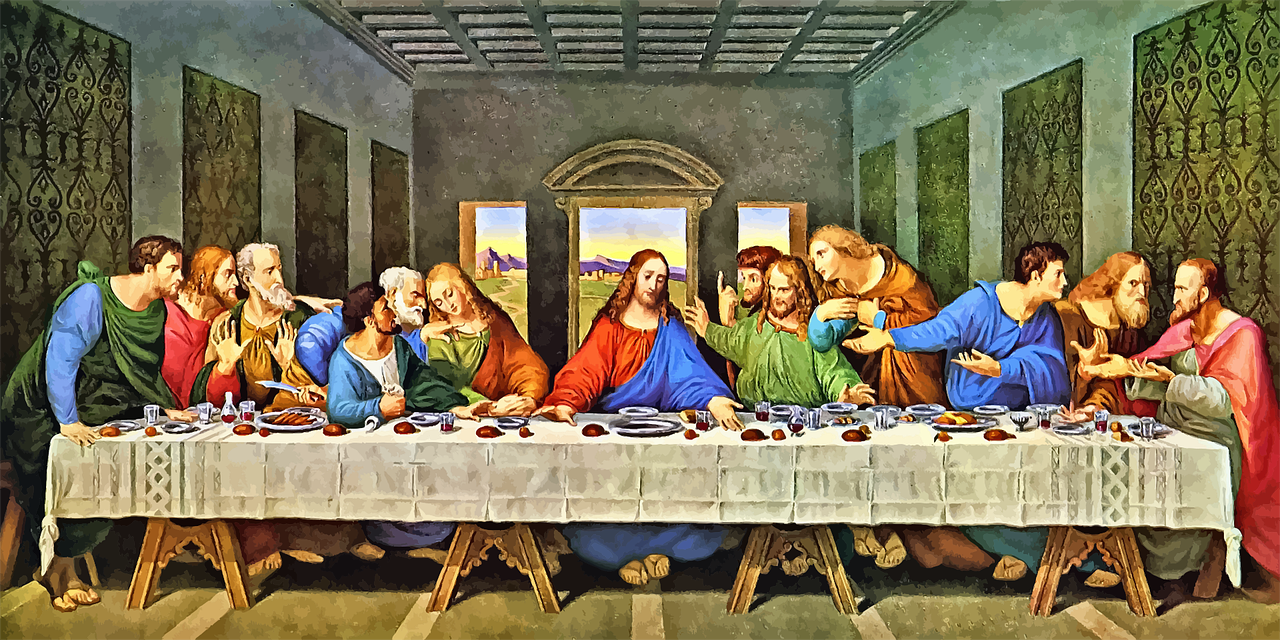
I don’t know what the position of the Global Methodist denomination is on who may or may not receive this sacrament, but in the United Methodist Church we practice an open table.  As a pastor I would never presume to judge who is worthy or unworthy to come to the Lord’s table because it is the Lord’s table, not mine or my church’s.  The exemplar for that inclusive table is the Upper Room itself on the night before Jesus is crucified.  The Gospels make it very clear that all 12 disciples are there to celebrate the Passover with Jesus.  You can count them all in Da Vinci’s painting.

But seriously, check the Gospel accounts in Matthew 26, Mark 14, and Luke 22. 

According to all of these retellings of what transpired in the Upper Room Jesus not only knew that Judas would betray him and Peter would deny him 3 times, but also that all the other disciples would run and hide in his hour of greatest need. “Then Jesus said to them, “You will all become deserters because of me this night; for it is written, “I will strike the shepherd, and the sheep of the flock will be scattered.'(Matthew 26:31). Does that disqualify any of the 12 from sitting at the table with Jesus? No, they all are there to receive this sacrament of remembrance.

Jesus is very clear about whose job it is and isn’t to judge others – and it isn’t mine or any clergy person’s.  “Do not judge, so that you may not be judged. For with the judgment you make you will be judged, (Matthew 7:1)   Or check the parable of the weeds in the wheat in Matthew 13 where Jesus says, “Let both of them grow together until the harvest; and at harvest time I will tell the reapers, ‘Collect the weeds first and bind them in bundles to be burned, but gather the wheat into my barn.’” Or my favorite, the billboard that says, “Just love them all.  I’ll sort them out later.” –  God. 

When Jesus says, “Come to me all who are weary and heavy laden, and I will give you rest,” (Matthew 11:28) all means all; and this sinner is darn glad we are all invited to the table.  When we all get on one side of the table for a remake of Da Vinci’s picture there will be Donald Trump next to Alexandria Ocasio-Cortez, Hamas Palestinians next to Netanyahu, Putin next to Zelenskyy, and in the middle Jesus asking, “What took you so long to get here?”

And in the background John Lennon is singing:

“You may say I’m a dreamer,

But I’m not the only one.

I hope someday you’ll join us

And the world will be as one.”

From Worst to Best: Kindness of Strangers

We always share a good news story as part of our prayer time at Northwest UMC to remind us that amidst all the bad news in our broken world there are many acts of kindness being done every day that don’t make headlines. My wife and I recently returned from a two-week trip to Italy and Greece, and as soon as we returned I sent a message to our pastors that I had a personal good news story from our trip that I wanted to share with the congregation. This is that story.

Our trip was wonderful. Everything worked like clockwork. No delays. We were never terribly lost anywhere, and the weather was wonderful. We were in Athens, Greece the day before our return flight to the States. We spent the morning sightseeing and ate lunch at a quaint hole-in-the-wall seafood restaurant; and THEN came the low point of our whole trip – I realized when getting ready to pay for lunch that I had lost my wallet somewhere that morning. We thought it might have been on one of the hop-on-hop-off buses we rode that morning; so we called that company, and they said no one had turned it in, but we could call back later and check.

It took us 20 minutes or more of panic to figure out what to do next and find a place quiet enough that we could hear. I have trouble hearing so Diana did most of the phone talking. Before we started calling credit card companies I got a call from our hotel answered by Diana. I didn’t realize who had called and was confused about how our hotel got involved, but they said someone had found my wallet and called them. They gave us number for a man named Mario.

I was overwhelmed with relief. But we were not home free quite yet. When Diana called Mario she quickly found out he spoke not a word of English; so we could not communicate. Diana asked several people passing by on the street if they spoke Greek and none did – but one young man suggested going into a local market to see if some one there could help us. The first young woman we asked could not speak English, but she got her manager who took my phone and spoke with Mario. She said he would take the wallet to our hotel in about 20 minutes.

It was then I realized I had the hotel room key card in my billfold and that is how he knew to call them. We got a taxi to take us to our hotel, but it was now rush hour on Friday afternoon and traffic was terrible. It seemed to take us forever and when we did arrive, Mario had not arrived and my heart sank again. The report at the hotel was that Mario found the wallet in the national park near our hotel. I had sat on a low bench there and even though my pocket has a Velcro cover on it, the wallet must have fallen out.

Mario called my phone again just then, and someone at the hotel desk served as our interpreter this time, talked to him and said he was on his way. He showed up very soon with his whole family with him. He told a doorman at the hotel that the same thing had happened to them before. That was why they went out of their way to make sure we got my wallet back.

When he handed me the wallet my heart sank again. All of my cash was gone. Someone had gotten to the wallet before Mario, but the good news is all of my credit cards, insurance cards, driver’s license, etc. were all there. I lost about $80 in cash but was so relieved to have every thing else back I didn’t really care. I was going to offer Mario a reward but had no cash to do so. He didn’t seem to expect one. I was very very lucky these total strangers took all that time and trouble to find me and so grateful to all the people who helped us overcome the language barrier and connect us. What could have ruined our trip turned into a celebration of basic human kindness and goodness.

Diana and I did our best without being able to speak Greek to tell Mario, his wife and two daughters how grateful we were. In all the emotion of the moment I forgot to take a picture of Mario and his family, something I would love to have; but trust me, we will never forget those kind new friends we made in Greece.

Holy Saturday

My church has a wonderful Chapel in the Woods which has been the site of summer time worship every Sunday for over 30 years. It is one of my favorite places to pray and meditate whenever I am near the church campus during the week and on Sundays. It is extra special to me because we have a memory garden at the back of the chapel, and that is where I want my ashes to be scattered when I transition to the next stage of eternal life.

The chapel is also special to me because it was originally started as a fellow Eagle Scout’s project. My favorite feature of the chapel has always been the big cross at the front which was made from a dead tree stump.

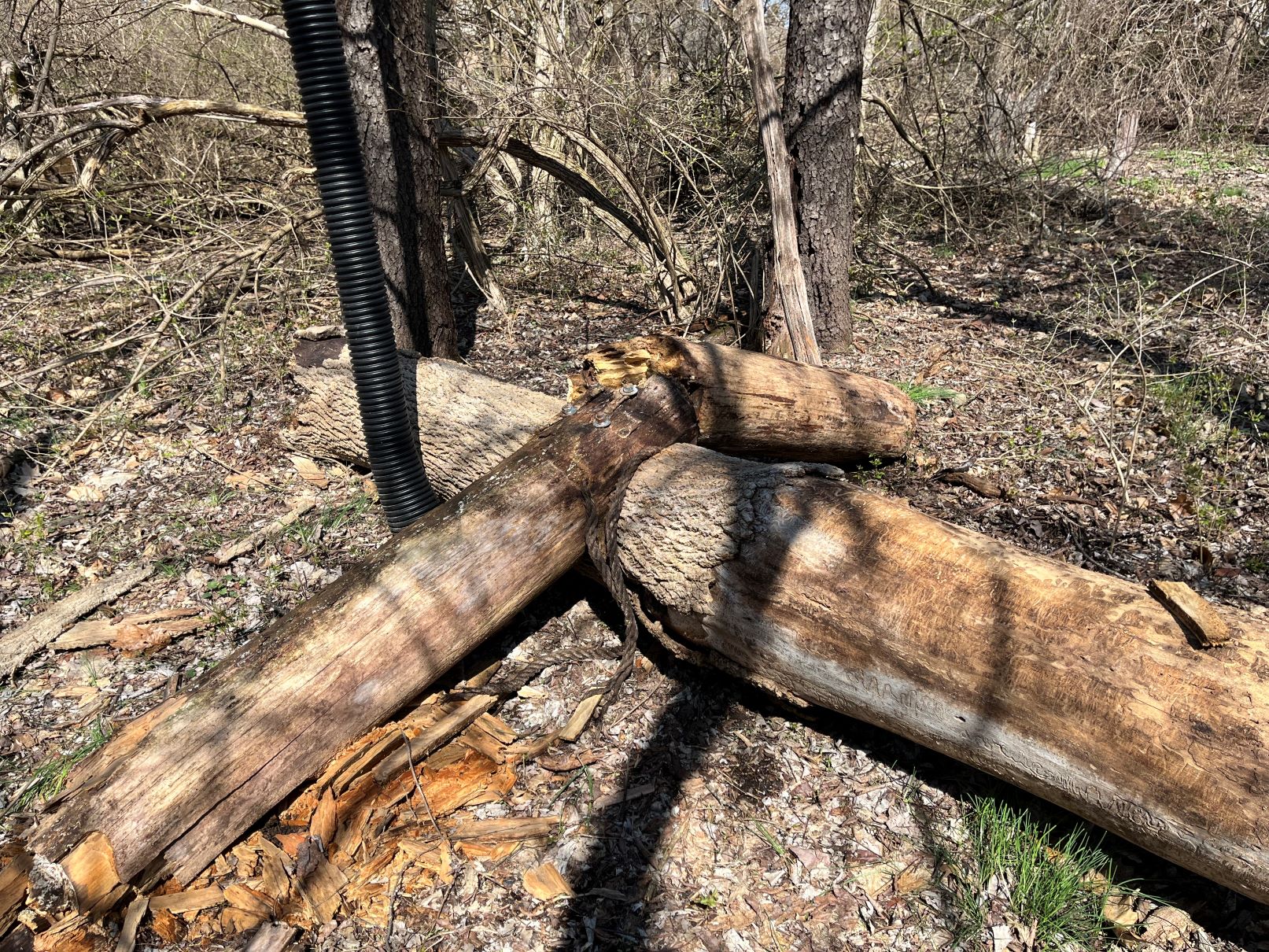
But this spring the painful decision was made that the big cross had to come down. The old tree stump had become increasingly unstable due to age and insect damage. So for safety reasons our old rugged cross is no more. We are in the process of deciding what we will put in the old cross’ place. A committee is asking for suggestions for what should come next, but that cross was so perfect for that setting that I cannot yet imagine what could come close to being as meaningful.

The fallen cross seems a fitting metaphor for the grief and uncertainty of the day between Good Friday and Easter. I cannot really imagine the depth of the pain and fear those women and men who loved Jesus so dearly and witnessed his execution on that Friday when the sky turned black. I can’t feel what they felt because I know the rest of the story. We know that the cross is not the end. Thanks be to God

Mighty Violent Winds

“When the day of Pentecost had come, they were all together in one place. And suddenly from heaven there came a sound like the rush of a violent wind”. (Acts 2:1-2 NRSV)

“Tornadoes killed at least 11 across Midwest, South. The sprawling storm system also brought wildfires to the southern plains and blizzard conditions to the upper Midwest.” WBNS TV headline, Columbus, OH, April 1, 2023

I attended the annual Schooler Institute on Preaching at the Methodist Theological in Ohio this past week.  The lectures and preaching by Dr. Luke Powery from Duke University were excellent, but one word I heard for the first time has stuck with me.  Dr. Powery’s theme for the two day conference was “Preaching and the Holy Spirit,” and one text he preached on was the familiar Pentecost story from Acts 2. 

The “new” word for me is in the second verse of that chapter where it says “the rush of a violent wind.”  I normally use the NRSV translation, and I didn’t remember that word “violent” being in that translation.  I have always heard and read that verse describing “a mighty wind.” The word “violent” just strikes me as a strange way to describe the Holy Spirit of a gracious and loving God.  (Sure enough when I went back to both copies of the NRSV Bible that I have, one that was copyrighted in 1993, both translate that word as “violent.”  It was not till I went back to the King James Version of my youth that I found the translation that has been residing in my memory for decades.  The KJV’s translation of that verse is “a rushing mighty wind.”)  Maybe I’m in denial about the power of Holy Spirit, but I am still more comfortable with a mighty wind than a violent one.

When I think of a violent wind I don’t have to look beyond daily news stories about deadly tornados and cyclones that are a weekly occurrence this year, and that’s no April Fool.  Here in central Ohio we are under a high wind advisory again today as I write this, exactly seven days after high winds here knocked out electricity for thousands of people.  And we’re the lucky ones.  Those were “mighty” winds in Ohio but not nearly as violent as other parts of the country and world have experienced.  

The winds last week were the strongest I have ever personally experienced in my 76 years of life.  They were officially recorded at 49 MPH at John Glenn International Airport in Columbus, Ohio.  And now this weekend in addition to more deadly storms that have killed at least 22 people in seven states, a tornado touched down near my hometown of Wapakoneta in northwest Ohio.  According to the National Weather Service we have had 130 tornados in the U.S. already this year which is a150% increase over last year.  That’s what I would call some pretty violent winds.  

In her book, “Saving Us: A Climate Scientist’s Case for Hope and Healing in a Divided World,” Katharine Hayhoe describes even more violent winds like Hurricane Maria that ravaged Puerto Rico in 2017.  “It’s estimated to have caused several thousand deaths, while also destroying more than 80% of the territory’s utility poles and transmission lines.  Storm damage caused the longest blackout in U.S. history—in some places, over eleven months without power.  For many hospitals and senior citizen residences, this was a key contributor to the mounting death toll. “ (p. 178). 

Sometimes mighty or even violent winds bring positive change as they did on the Day of Pentecost. Hayhoe reports that Puerto Rico is now building solar and battery capacity that will ultimately transition the island to 100% clean energy. Unfortunately in our time of extreme political partisanship such positive change only comes after terrible storm damage.   

It was not always so. Ronald Reagan, yes that Ronald Reagan, stated in 1984, “Preservation of our environment is not a partisan challenge; it’s common sense.”  Apparently many of our current Congress people didn’t get that memo.  

In the face of all the floods, blizzards, tornados, and nor’easters we’ve already had in 2023 I am amazed that there has been almost no public outcry or discussion about the impact climate change is having as it increases the frequency and destructive force of these weather events.  How can we explain this mass avoidance of the obvious and important threat to our way of life and perhaps the long term viability of life on Earth?  

Perhaps the lack of attention to climate change is because there are plenty of other crises bombarding us for our attention, many of which are more immediate, like surviving and rebuilding after multiple natural disasters.  Such existential crises make it very hard to think about solutions to a global problem that may not be fully realized in my lifetime.  But it is coming for my children and grandchildren, and we can’t wait any longer to pay attention and do long-range planning. 

One major reason for our willful avoidance of reality is what Alastair McIntosh describes as “denialism.”  Hayhoe (p. 134) quotes McIntosh as defining it this way: “Denialism…keeps at bay what might be—fears, guilt and a sense of shame, not to mention all that lurks behind a need for CO2-belching markers of identity such as wait out in the car park.”

Hayhoe says those of us who are concerned about what’s causing the rash of deadly storms marching across our country every week may suffer from “eco-anxiety,” which the Oxford Dictionary defines as “extreme worry about current and future harm to the environment caused by human activity and climate change.” Ironically the dictionary adds that eco-anxiety is not considered to be a mental disorder since it is a “rational response to current climate science reporting.”

We have plenty of reason to be anxious and even fearful about the climate crisis that has been building to a crescendo ever since the Industrial Revolution began in the late 19th century.  Fear is not a pleasant emotion, but it can be a positive force for good if we channel our eco-anxiety into creative ways to be better stewards of God’s creation.  I’m sure the disciples were frightened by the mighty/violent win on the Day of Pentecost, but they didn’t let that fear stop them from sharing the Gospel with a crowd of people from a multitude of countries. 

May these violent winds we are experiencing in 2023 transform us and propel us into action to speed up our responses to our climate crisis.  As Kathryn Hayhoe puts it, “I believe it’s what we do with that fear that makes all the difference.”

2023 Words: Practice Gratitude

 I had the privilege again this past Advent to create liturgies for the lighting of each advent candle for our church. When we got to the third Sunday and the candle of joy (12/11/22 post) I asked some of my fellow fans of Dr. Brené Brown to help me find what she has said about joy.  My friend Jean Wright came through with this gem from Dr. Brown: “In our research we found that everyone who showed a deep capacity for joy had one thing in common: They practiced gratitude…A wild heart can beat with gratitude and lean in to pure joy without denying the struggle in the world.  It’s not always easy or comfortable – but what makes joy possible is a front made of love and a back built of courage.” 

There’s an old joke about someone asking how to get to Carnegie Hall. The answer is “practice, practice, practice.”  Well, apparently the way to get to Joy is also, like any other life skill, to practice. Since I am by nature a skeptical, glass half empty kind of person, learning gratitude for me is something that requires lots and lots of practice. Practice is hard.  Playing scales on the piano is work. Practicing on the putting green for hours is not nearly as much fun as hitting the crap out of a ball on the driving range.  But no one will master the piano or lower their golf score without those basic practices.

It is no coincidence that my friend Jean Wright’s daughter, Katy, recently shared her wisdom about gratitude that she learned from podcasts with Kate Bowler and Kelly Corrigan who indirectly address the practice of gratitude by dividing life experiences into two categories, the “happies” and the “crappies.” The trick, of course, is paying at least an equal amount of attention to the former as we do the latter. 

One of my mentors in grad school, Dr. Bill Brown, developed a rhetorical theory that helps with this task. He calls it “attention shifting,” which I will oversimplify here by saying it means intentionally shifting our focus or attention from one thing to another. I was reminded recently of another related skill for keeping things in perspective and practicing gratitude when my wife and I attended a high school production of “Everything I Needed to Know I Learned in Kindergarten” produced by the excellent Theater Arts Department at Thomas Worthington High School in Worthington, OH. Our great nephew Ryan Buckley has been part of that program for all four of his high school years, and we have enjoyed many plays there; but one scene in this production really resonated with me.

The Kindergarten play is based on the book by the same title by Robert Fulghum. I have read most of Fulghum’s stuff; so this story was familiar, but I must have been ready to hear it again. It’s a little long for a blog post, but I am going to include it here in full because it is so good.

Fulghum writes: “In the summer of 1959, at the Feather River Inn near the town of Blairsden in the Sierra Nevada Mountains of northern California.  A resort environment.  And I, just out of college, have a job that combines being the night desk clerk in the lodge and helping out with the horse-wrangling at the stables.  The owner/manager is Italian-Swiss, with European notions about conditions of employment.  He and I do not get along.  I think he’s a fascist who wants pleasant employees who know their place, and he thinks I’m a good example of how democracy can be carried too far.  I’m twenty-two and pretty free with my opinions, and he’s fifty-two and has a few opinions of his own.

One week the employees had been served the same thing for lunch every single day.  Two wieners, a mound of sauerkraut, and stale rolls.  To compound insult with injury, the cost of meals was deducted from our check.  I was outraged.

On Friday night of that awful week, I was at my desk job around 11:00 P.M., and the night auditor had just come on duty.  I went into the kitchen to get a bite to eat and saw notes to the chef to the effect that wieners and sauerkraut are on the employee menu for two more days.

That tears it.  I quit!  For lack of a better audience, I unloaded on the night auditor, Sigmund Wollman.
I declared that I have had it up to here; that I am going to get a plate of wieners and sauerkraut and go and wake up the owner and throw it on him.

I am sick and tired of this crap and insulted and nobody is going to make me eat wieners and sauerkraut for a whole week and make me pay for it and who does he think he is anyhow and how can life be sustained on wieners and sauerkraut and this is un-American and I don’t like wieners and sauerkraut enough to eat it one day for God’s sake and the whole hotel stinks anyhow and the horses are all nags and the guests are all idiots and I’m packing my bags and heading for Montana where they never even heard of wieners and sauerkraut and wouldn’t feed that stuff to the pigs.  Something like that.  I’m still mad about it.

I raved on this way for twenty minutes, and needn’t repeat it all here.  You get the drift.  My monologue was delivered at the top of my lungs, punctuated by blows on the front desk with a fly-swatter, the kicking of chairs, and much profanity.  A call to arms, freedom, unions, uprisings, and the breaking of chains for the working masses.

As I pitched my fit, Sigmund Wollman, the night auditor, sat quietly on his stool, smoking a cigarette, watching me with sorrowful eyes.  Put a bloodhound in a suit and tie and you have Sigmund Wollman.  He’s got good reason to look sorrowful.  Survivor of Auschwitz.  Three years.  German Jew.  Thin, coughed a lot.  He liked being alone at the night job–gave him intellectual space, gave him peace and quiet, and, even more, he could go into the kitchen and have a snack whenever he wanted to–all the wieners and sauerkraut he wanted.  To him, a feast.  More than that, there’s nobody around at night to tell him what to do.  In Auschwitz he dreamed of such a time.  The only person he sees at work is me, the nightly disturber of his dream.  Our shifts overlap for an hour.  And here I am again.  A one-man war party at full cry.

“Fulchum, are you finished?”

“No.  Why?”

Lissen, Fulchum.  Lissen me, lissen me.  You know what’s wrong with you?  It’s not wieners and kraut and it’s not the boss and it’s not the chef and it’s not this job.”

“So what’s wrong with me?”

“Fulchum, you think you know everything, but you don’t know the difference between an inconvenience and a problem.

“If you break your neck, if you have nothing to eat, if your house is on fire–then you got a problem.  Everything else is inconvenience.  Life is inconvenient.  Life is lumpy.

“Learn to separate the inconveniences from the real problems.  You will live longer.  And will not annoy people like me so much.  Good night.”

In a gesture combining dismissal and blessing, he waved me off to bed.

* * *

Seldom in my life have I been hit between the eyes with a truth so hard.  Years later I heard a Japanese Zen Buddhist priest describe what the moment of enlightenment was like and I knew exactly what he meant.  There in that late-night darkness of the Feather River Inn, Sigmund Wollman simultaneously kicked my butt and opened a window in my mind.

For thirty years now, in times of stress and strain, when something has me backed against the wall and I’m ready to do something really stupid with my anger, a sorrowful face appears in my mind and asks:  “Fulchum.  Problem or inconvenience?”

I think of this as the Wollman Test of Reality.  Life is lumpy.  And a lump in the oatmeal, a lump in the throat, and a lump in the breast are not the same lump.  One should learn the difference.  Good night, Sig.

As I reflect on the year 2022 it is very easy for me to see the entire year through the lens of the last couple of months which have been rather crappy for me. Following my 76th birthday at the end of October my 77th trip around the sun began with an unexpected hospital stay because of a very serious urinary tract infection. That urinary infection has turned out to be one that is very hard to get rid of and has been bothering me off and on for about seven weeks now. Because of that it has been easy for me to throw a pity party for myself if I forget to keep my focus on the larger scheme of things. This illness is just an inconvenience. Other than the time I spent in the hospital and I a few days after that, I have been able to continue my normal daily activities. Those activities included the aforementioned opportunities to create Advent liturgies for worship in our church. And by sharing those liturgies in my blog, they have also been used by a number of other readers and worship leaders, for which I am grateful.  I even got a bit of a chuckle each week during Advent when I noticed that the number of clicks on my Advent liturgies always seemed to go up about Thursday or Friday. I remember from my days of active pastoral ministry those were the days of the week when I suddenly realized I needed some help with worship resources for the coming Sunday.

I also realized this week that part of the attention shifting/gratitude practice is keeping my focus on the big picture and not just what is immediately in front or behind me. By paying too much attention to my recent illness I had completely forgotten about an amazing therapeutic golf program I became a part of this summer. That program is quite appropriately called “Fore Hope.“ In brief, this program pairs a wonderful volunteer “caddie” with each golfer. These caddies help the golfers with whatever that individual needs, from loading clubs on the golf cart, putting the ball on the tee, hunting for wayward balls, or literally holding the golfer up while he or she swings if there are balance issues. Having the opportunity to be a part of that program has given me a lot of hope and a new lease on life because I have been able to do something that I dearly love, which I thought was gone forever because of my health concerns. It has enabled me to play golf again with my son, and for the first time with two of my grandsons, and to my surprise as an introvert it also made me a part of a whole new community of friends.

I played my last golf with that group in mid-October and could not have written a more satisfying script for that evening. It was chilly, as October evenings are want to be in Ohio, and I almost wimped out and didn’t go; but I am so glad that I did. You see it turned out to be one of those magical times on the golf course when every putt found its way into or very close to the cup. And what is so special about the Fore Hope Golf community is that everybody is a cheerleader. We don’t keep score; so there is no insidious competition, and when any player makes a good shot everyone genuinely affirms that accomplishment.

But here’s the thing—about three weeks later I was flat on my back in the hospital and in the ensuing recovery from that experience, because I did not practice gratitude, I forgot all about the sheer joy I felt sharing those days on the golf course with my new friends. So for me, at least, an important part of the practice of gratitude is paying attention more often to the happies, and not letting the crappies which come along for all of us knock those moments of joy out of my awareness.

Advent Candle Liturgy, Hope, 2022

As we begin this season of Advent with the candle of hope we affirm our trust in these Beatitudes for the hopeful:

Blessed are those who wait silently with the hopeless.

Blessed are the patient who model peace for all around them.

Blessed are those who are ridiculed for their unrealistic optimism.

Blessed are those who simply light up the space they inhabit.

Blessed are those surrounded by the deep darkness of grief.  They will be comforted.  

Blessed are those who shine through a faith undimmed by human tears.

Blessed are those who face the truth of human evil but will not give up the dream of God’s peaceable kingdom.

Blessed are those who can sit peacefully in the darkness and wait for the dawn.

Blessed are the wise ones who have walked in deep darkness but also know the joy of emerging into the light.  

Blessed are the hopeful, for they are brave enough to be light for a world drowning in darkness.

Please pray with me as we again light the candle of hope.

O Holy One, we pray today that we may not be distracted by the personal and cultural chaos around us.  Help us pay attention to what is true and just.  Even as one way of being in the world is ending, help us to cling to our hope, not for a return to the way things were pre-Covid or pre-Ukraine, but to a new world emerging from the ashes of the old.  Speak to us again the truth that endurance through dark times produces character and hope that allows us to never be weary in doing what is right.  Send your Holy Spirit upon us today that we can be a community of faith that disrupts the broken world with hopefulness.  Make us a community of  hope where we resuscitate each other when our faith is running low.  Remind us that we are called to be a movement of hope, even as institutions, denominations, and individual leaders come and go.  Give us hope to wait upon you when we are weary, to rest but not give up.  Please, Holy God, renew our strength and raise us up on eagles’ wings to be a resurrected and dynamic movement that draws us and others ever closer to the way, truth, and life as followers of Jesus.  Amen

Northwest UMC, Columbus, OH, November 27, 2022

Hallows Eve Prayer

O divine Creator, in our topsy-turvy world it is so important to spend time with you as the one true North Star that is our unwavering guide through all the joys and sorrows of this mortal life.  Your eternal and constant presence is so vitally important to us In a world where Prime Ministers rise and fall faster than the stock market; where prices keep rising, where election ads bombard our airwaves and inboxes, and political violence reigns from San Francisco to Ukraine.  The change of seasons is bittersweet as we relinquish the warmth of summer for the beauty of fall, but we draw comfort from the assurance than the seasons come and go on your dependable schedule no matter what craziness we humans inflict on your creation.  

We count on the steadfastness of your grace even as we are ashamed of how far we humans drift from your plan for us and your creation.  In this season of ghosts and goblins we are often so embarrassed that we want to hide from you in costumes that disguise us from our own sin and selfishness.  It is so easy to get swallowed up by our own privilege and comfort where the false idols of materialism and the prosperity gospel wait to ambush us on every billboard and in every commercial.  We know better, Lord.  We know we can’t serve you and money at the same time. But like St. Paul we often do the very things we know we should not do and vice versa.  

We admire the heroines and heroes of the faith who bravely stand up for your truth at great risk to themselves.  They trust that you have power over death itself, but so often our faith is weak in the face of the sacrifices it will take for us to truly follow you.  And so we come to worship putting on a smile even when we are dying inside.  We pretend we are fine when we feel lost and broken-hearted.  Or we are afraid to share our joys and successes because we know others are grieving and lonely.  

Open our ears this Sabbath day, O Holy One, to hear again the wonderful news of your amazing grace.  Pull away our masks and costumes and liberate us from the fear and doubt that keeps us hiding out light under a bushel.  Remind us again that Jesus didn’t just invite a select few to his table.  With open arms Jesus says, “Come to me ALL who are weary and heavy laden and I will give you rest.”  He broke bread with sinners and tax collectors because he knew they are your beloved children also.  

And so are we, not because we are better than anyone else, but simply because we are a part of your heavenly family.  We all matter just as all the parts of our anatomy matter to our bodies.  We are not made to be self-sufficient or alone, but to be members of the church, the body of Christ.  We give thanks for this community of believers called to put our faith into action and to transform our broken world into your beloved community.  Thank you, O God, for sending Jesus into the world to show us that we need not hide from you no matter what but can humbly come to you anytime and anywhere just as we are.  In that assurance we boldly offer our prayers and our lives to you in the name of Jesus our liberator, saying as one the prayer he taught us to say…

Pastoral Prayer, Sunday, October 30, Northwest UMC, Columbus, OH

When, Lord, when?

Oh Holy One , I am feeling like pharaoh must have felt during the plagues. Fire, floods, Covid, monkeypox, and the stupidity of gun violence and war bombard me constantly from my newsfeed.

As the anniversary of 9/11 approaches once more I remember those pesky words from Jesus that we are to love our enemies and pray for those who persecute us. That was hard then and still is, oh so very hard.

Never did I imagine back then that I would see the day when political foes in our own country would be the enemies that I struggle to love or even forgive!

I know it’s wrong but I find myself longing for the God of Exodus who drowned the Egyptian‘s in the Red Sea. Or even for the God of Mary who promised us that the rich and powerful will be sent empty away. When, oh Holy One? When will justice roll down like waters? When will we beat our swords into garden tools and never learn war anymore? When, Lord, when?

In the words of one who survived one of the darkest hours of human history, Corrie Ten Boom, “Lord if you want these people forgiven you are going to have to do it because I can’t.“

And yet I give you thanks, Lord, for modern day prophets like Diana Butler Bass, Brian McLaren, Nadia Bolz-Weber, and the dear departed Rachel Held Evans. They give me hope even in the depths of despair about the future of humanity.

And it’s not so much for myself that I pray, Holiest One. It is for those I love the most, my children and grandchildren, that I weep. They will inherit the mess my generation has made.

Please send your miracle-working spirit to renew a right spirit within us, to help us repent of the greed that is destroying our planet and the fabric of our society.

Oh how I hope that it is not too late. And I give thanks that in your eternal, cosmic power it is never too late. Amen

Wilson!!

“Then the Lord God said, “It is not good that the man should be alone; I will make him a helper as his partner.” (Genesis 2:18)

The recent pandemic has reinforced our knowledge that it is not good for humans to be alone. Our daughter-in-law is a very strong and self-aware introvert. Several months into the pandemic she joked that even a committed introvert like herself had to admit that she was missing human contact. Far more seriously we know that the hiatus from play dates and school has had serious mental health consequences on many children and youth who are behind in their social development and their ability to communicate in ways that are not mediated by technology.

Yes, it is true that technology has helped bridge the human contact gap in significant ways with virtual learning and digital meeting apps like zoom, but anyone who has spent much time using those tools will tell you that kind of meeting or teaching and learning is just not as good as face to face contact.

I was reminded of a wonderful movie that explored the theme of human loneliness when I found this golf ball in my bag last week. I led a men’s retreat several years ago where we watched the 2000 Tom Hanks film, “Cast Away” and then explored what the movie said about the human experience.

In that movie Hanks plays Chuck Noland, a harried FedEx executive, who is cast away as the lone survivor of a company cargo plane crash in the Pacific. The good news is he survived the crash. The bad news is he is washed ashore on a small deserted island where he is totally and completely alone. He manages to survive for years by creatively making use of a few items in packages that wash ashore from the plane crash.

One of the seemingly most useless items that floats into Noland’s island home is a brand new Wilson volleyball. No net, just the ball, and while beach volleyball is a real sport, it does require more than one person. That ball however soon becomes the most important factor in helping Noland maintain his sanity as multiple attempts to sail off the island in makeshift boats end in disaster and even a suicide attempt fails.

Noland discovers a way to meet the need for “human” contact without internet, cell phone, smoke signals, or even written communication. He turns the Wilson volleyball into Wilson, his friend and companion. He paints a face on the volleyball and regularly talks to Wilson about his plight. In the most poignant scene when Noland finally manages to push and paddle beyond the breakers and put out to sea on a makeshift sailboat, his buddy Wilson is washed overboard by a large wave and slowly drifts further and further away. Noland can only cry plaintively, “Wilson! Wilson!” as his faithful friend disappears from his sight.

Our men’s retreat was held at a church camp, and one of the men found a Wilson volleyball in a closet in the lodge where we were meeting. That ball, of course, became our mascot for the weekend, sitting with us as we discussed the film, coming to meals with us, and sleeping on one of the bunks in the dormitory-style room where we slept.

Now I have my own Wilson Jr. golf ball sitting on my desk to remind me again that it is not good to be alone. (And, it helps our bond that I played some very good golf with my Wilson, and he didn’t desert me like so many balls have by disappearing into the woods or splashing down into a water hazard.). Please understand, as an introvert I still regularly need and enjoy solitude. Zoom does make many things easier or even possible, like book clubs, meetings over distances without time-consuming and expensive travel, and especially regular contacts with distant friends.

But nothing, not even a lovable volleyball, can meet our basic need for human contact. My therapist says touch is the first and most basic form of human communication. Research has shown that infants who receive an adequate amount of loving touch not only thrive, but those who are not held and touched literally die.

We can see this phenomenon in other species, many of whom mate for life. Unfortunately many Americans have lost sight of the need for meaningful human contact. Our myth of rugged individualism has turned far too many of our human interactions into a transactional, self-centered dance of using people for our own profit and benefit.

Our consumer driven economy and our fear of an always uncertain future have convinced too many of us that we can never have enough material wealth to feel secure. Perhaps the silver lining in our current inflationary anxiety is that we will learn like Chuck Noland did to be satisfied and live with what we have. Powerful story telling like “Cast Away” is a way of teaching us those life lessons vicariously so we don’t have to actually be stranded on a desert island or isolated in a pandemic to learn them.