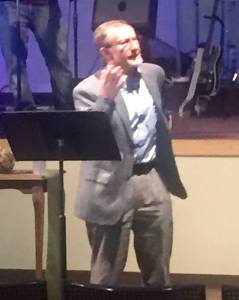
“Too Close to Home,” Luke 4:21-30

January 2016 at NWUMC
Note: This is part of a sermon series entitled “Skin in the Game” we’ve been doing at Northwest UMC since Epiphany to talk about the meaning of Incarnation.

Jesus said, “Today this Scripture has been fulfilled in your hearing.” (Luke 4:21) What Scripture? If you feel like you have come into the middle of a movie, you have. Pastor Tom Slack dealt with the first half of this text last Sunday. More about that shortly, but first I want us to think about how we react when things don’t go the way we want? Or we don’t get something we really are counting on, perhaps a Christmas gift that isn’t quite what you were expecting?

A little boy asked his grandparents for an iPad. Boy was he surprised when he opened his gift on Christmas morning and found a bandage for an injured eye. It was an “eye pad” all right, but not the kind that comes from Apple. When my son was driving his kids to school on the first Monday after the long holiday break he dropped first grader Audrey off at her school first and could immediately see in the rear view mirror that her 2-year old brother Brady was not happy when he realized he was next. It was like that moment when the family dog realizes you aren’t just going for a ride but are heading for the vet. Brady stuck out his lip, turned his head and wouldn’t look at his dad or talk to him all the way to pre-school. He was expecting Christmas vacation to be the new normal and made it quite clear he was not ready to have to go back to school.

I’m sure Brady was fine a few minutes after he bid a tearful goodbye to his guilt-ridden father, but some unwanted surprises are harder to take and last longer. A teen grounded for doing something that seemed like a good idea until it wasn’t, an elderly parent forced to have his or her driving privileges taken away or to move from an old familiar home. Broken marriage vows, political heroes who turn out to have feet of clay. Whatever the disappointment, it’s hard not to be upset, even angry, to blame everyone but ourselves, sometimes even God, and the bigger the disappointment, the harder it is to accept things we can’t change or have no control over.

In the Gospel lesson from Luke we have a complicated story where high expectations turn into disappointment. Pastor Tom did a great job last week of covering the first half of this story, but let me do very quick review for those who weren’t here. In part I of this story Jesus has returned to his hometown of Nazareth after his baptism, temptation in the wilderness, and some teaching and healing in other towns in the area. As was his custom, Luke tells us, he went to the synagogue in Nazareth on the Sabbath to teach. He was handed the scroll of the prophet Isaiah and read the passage that describes Jesus’ understanding of who he was and what his ministry was about. The passage talks about proclaiming good news to the poor, release of the captives, restoring sight to the blind, and proclaiming the acceptable year of the Lord because the Messiah is anointed by the Holy Spirit to do those things.

That part about the Holy Spirit is critical to understanding what it means for Jesus and for us to put our skin in the game to build God’s Kingdom. Luke links every important event in Jesus’ early life to the Holy Spirit. Jesus is conceived by the Holy Spirit, the Holy Spirit descends on him at his baptism, the Spirit drives him into the wilderness to be tested and prepared for his ministry, and it is the spirit that empowers him to proclaim after reading those words about the Messiah, “Today this Scripture is fulfilled in your hearing.”

It’s that last line that gets the hometown crowd excited. Nothing Jesus read up till that point was new to them. Isaiah’s words had been around 500 years or so and similar pleas for social justice for the poor and misfortunate run through many of the prophets. God had sent prophets for centuries to proclaim that message, but people didn’t listen. So God decided he has to do a new thing, he has to go all in and put skin in the game. “And the word became flesh and dwelt among us” is how the Gospel of John describes the incarnation. My favorite translation of that verse is the one that says, “God pitched his tent among us.” Not in luxury and ease but on the front lines of suffering, that’s where God decides he can’t just tell us anymore how to live together; he will come and show us in the form of Jesus.

Paul Harvey used to tell about a man who was angry at God and the church was home alone on Christmas Eve while the rest of his family went to church. Late that evening he looked out and saw a flock of birds struggling in his yard with snow that was falling so hard and was so wet and heavy that it coated their wings like a jet needing to be de-iced. They were flopping around trying to fly but couldn’t. The man went out and opened his garage doors hoping they would go in there out of the storm. When they didn’t he tried to herd them to safety, but that only made them more frightened and confused. He was thinking, “If I could just become a bird for a little while, one of them, they would trust me and I could save them.” Just then he heard the church bells ringing. It was midnight, the beginning of Christmas Day, and he suddenly understood why God chose to come to earth in human form.

Putting skin in the game means to be invested in something. If you’ve ever shopped at Aldi’s you know about their clever way of handling the problem of getting their grocery carts back where they belong. They don’t pay employees to round up carts left in their parking lot. They have their customers put a quarter in a gizmo on the cart that unchains it from the other carts, and when you return it you get your 25 cents back. Two bits is not a big investment, but it’s enough skin in the game that I’ve never seen anyone fail to return their cart. We all are more likely to show up for an event if it costs us something, even a token amount. I’m a big Ohio State fan, but on frigid January nights when the wind is blowing off the Olentangy River near the Schottenstein Center I might wimp out and choose to stay home in the comfort of my living room and watch the basketball game in HD on the flat screen. But since I have paid in advance for my tickets, I’m much more likely to show up. Because I have some skin in the game—even if it’s cold skin.

As Jesus’ conversation with the folks in Nazareth continues, we see just how much he’s risking by putting his skin in the game. His hometown folks are at first excited. “This is Joe’s kid. We remember him. He’s one of us, and if he’s the Messiah, wow, just think what he can do for us! We’ve heard all the amazing things he’s done in other places, it’s gotta be even more awesome here in his hometown. Jesus, do here what you did in Capernaum. You know us, Lord; you’re one of us. We changed your diapers, wiped your runny nose, put up with your childhood moods. You know how much we need your healing and miracles. You could get the lead out of our water; maybe turn some of it into a good Merlot? And while you’re at it, could you give us the power ball numbers for next week?

But their high expectations soon turn to disbelief and disappointment. Jesus responds by reminding them that prophets are not usually accepted in their own hometown. Jesus has a bigger agenda than making his neighbors happy. He has an urgency to share a much more important message with the whole world. His mission is to go global with the Gospel, and he knows he doesn’t have much time.

That explains his strange references to Sidon and Syria. He says Elijah and Elisha didn’t heal their hometown folks; they went to Sidon and Syria, to Gentiles, strangers, foreigners. Why would they do that? Because those great prophets understood that the God of Creation is also God of the whole Universe. Yahweh’s power to heal and save cannot be hoarded by any one nation or people. Isaiah said, “It is not enough for the Messiah to save Israel, I will make you a Light to the nations.” Jesus and the prophets understood that to be God’s chosen people is not to receive preferential treatment, but they and we are chosen to be God’s servants to the whole wide world—to people of all faiths or no faith at all.

None of that is new. It is all straight out of Hebrew Scriptures. But when Jesus reminds his Nazarene neighbors of the universal scope of God’s love, they think he has stopped preaching and gone to meddling, just like we all do when our taken-for-granted expectations are challenged!

When I teach preaching classes to seminary students one of the key principles I try to impart to them is the need to build a relationship of trust with their congregations. The preacher’s job is not just to get God’s word said, but to get it heard, and that’s more likely to happen in an atmosphere of mutual trust. Based on the response of Jesus’ congregation in Nazareth, he flunked that part of preaching 101. I’ve often wondered why Jesus would stir up so much trouble so early in his ministry. It’s like he’s waving a red flag in front of a bull. But I’ve decided it’s because urgent situations where so much is at stake don’t allow time for the luxury of community building. Life and death matters require immediate and complete truth.

The Scriptures tell us that we “shall know the truth and it will set us free,” but what John’s Gospel doesn’t say is that first the truth may make us mad. When an addict is confronted with his or her self-destructive behavior, the truth still hurts. When I really see myself in the mirror, really see, or when I hear honest criticism of mistakes I’ve made, or am told my bad health is because of my poor lifestyle choices, I probably will not welcome that truth with open arms.

That’s why the folks at Nazareth react so violently. Luke tells us, “When they heard this, all in the synagogue were filled with rage. They got up, drove him out of the town, and led him to the brow of the hill on which their town was built, so that they might hurl him off the cliff.” Jesus looks like he’s about to have the shortest ministry in history. Most pastors enjoy a little honeymoon with a new congregation, but not here.

That’s because Jesus’ words hit too close to home. The Nazarenes are expecting special treatment from their hometown hero, and instead they resent his including a bunch of foreigners in God’s mercy. They don’t want to share Jesus with the Syrians and Gentiles. They want to keep Jesus and God all for themselves. Of course they know better. They know their Bible. They know the truth – they just don’t really know it and embody it. Don’t we all have a tendency to read the Scriptures selectively? We choose to focus on Scriptures we like instead of the uncomfortable truth we need to hear.

To have skin in the game means we show up and speak the truth even when it’s risky. Jesus finds out early on in his home town that what he’s up to is dangerous to the max, but he is the young and fearless prophet who speaks the truth, not to make people mad, but to invite them to see the truth about themselves and the world God has created.

The question for us is do we have enough skin in God’s game to follow the example of Jesus? Do we care enough to risk rejection for the truth? To speak up for the downtrodden, to take the side of the underdog – to object to sexist or racist attitudes and comments? God does – no matter what it costs. God is all in – are we? That’s what it means when Jesus says, “take up your cross and follow me.” God doesn’t promise us a rose garden, but the way of the cross that leads to the Garden of Gethsemane.

But here’s the best news—whatever Gethsemane you find yourself in, whatever disappointment or pain you are dealing with right now—you don’t have to face it alone. God’s powerful spirit that anointed Jesus is also with us in every up and down phase of life – every one! No matter how terrible or hopeless things seem, God is right there with you – not to make everything the way we wish it was, but to go through it with us.

Jesus’ situation looks pretty desperate. The people of Nazareth are so mad they want to kill him. But this brief story foreshadows much bigger things to come. They take Jesus out to the edge of a cliff and are ready throw him to his death, but Luke ends the story with one simple sentence: “Jesus just passes among them and goes on to Galilee.” If that sounds familiar, it’s because after Jesus’ resurrection, Matthew says the angels told the disciples at the empty tomb,”He is going ahead of you to Galilee, there you will see him.”

The risen Christ is always going ahead of us to a Galilee far away – where no prophet has gone before. And he calls us to go with him. Notice, we are not asked to go alone – but with the same power of the Holy Spirit that enables Jesus to conquer his fear of death. We are all called to trust the God who loves us enough to suffer with us and for us, to show us the way and the truth and the life – because our God so loves the world that He puts his own skin in the game.

Some times are harder than others to put our skin in the game – to play the game of life full out. Often those times are when we are personally disappointed with our life situation or with ourselves. I was reminded this week of an experience that always speaks to me about that issue. This past Thursday was the 30th anniversary of the explosion of the Space Shuttle Challenger. Some of you are too young to remember that tragedy, but most of you have seen the pictures. For me the most memorable thing about that day was the final words spoken by Commander Dick Scobee just before the explosion took those seven lives. They were just a couple of minutes into the mission when the crew was given the go ahead to go to full power, and Commander Scobee’s last words were, “Roger, go with full throttle up.”

That’s how I want to live my life, whatever the circumstances, full throttle up! That’s what Jesus came to show us, that no matter what happens to us or around us, we have the power of the Holy Spirit to live life fully and abundantly. So wherever God calls us to go this week, my prayer is that we can respond with confidence and faith, and go with full throttle up!

The Unbroken Circle of Life II

IMG_1150 I have rarely reposted a previous blog here, but in searching for some inner wisdom to cope with life today I was drawn to one I wrote just 3 months ago in October of 2015. It still sounds good and maybe even more relevant now than it did then; so it is copied as written below. My only additional preface is a comment I made in my journal recently as 2016 has gotten off to a bumpy start for me, my family, and the world: “The cycle of life keeps turning and there are no stations to get off till you get to the terminal.”

Will the Circle Be Unbroken?
I attended a Bluegrass Festival with some friends a few weeks ago and have been singing or humming “May the Circle Be Unbroken” ever since. Bluegrass is not my music of choice; so I’ve been pondering why that song has stuck in my head. There are good memories of singing that song around campfires when I was a youth minister many years ago. But it has taken on a deeper more pervasive meaning lately. Some of that became clearer to me this week after a depressing visit with my 94 year old father who has outlived his mental and physical faculties and is miserable. Is there a better day coming for him and his wife suffering from dementia?

I don’t think it’s in the sky but where? What? How? Those questions become more relevant as morality pounds harder on my door each day, in aches and pains, friends in surgery, cancer diagnoses and biopsies, longer list of things I can no longer do. I’ve toyed with the lyrics of that song by changing the “e” to an “i” in “better,” i.e., “There’s a bitter day a coming….” That’s what happens when we turn in on ourselves, we get bitter and go victim. “Why me?” “It’s not fair!” “Why didn’t I take better care of myself?” “Let’s try one more miracle supplement that flows out of the fountain of youth!” Fear springs from the unknown “in the sky” or in some place of darkness, from regrets over a lifetime of sin or just dumb mistakes we can never erase.

Fear is epidemic in our society. I was at a wedding reception recently where I was told one of the men at my table was carrying a concealed weapon “because you never know what might happen.” The next week my relatives at a family gathering were discussing preparedness drills for an active shooter at their little country church and in their schools where children are being taught to throw anything they can find at a shooter ala David versus Goliath–only Goliath didn’t have his NRA sanctioned AR 15.

A father was shot dead last Friday in front of his six kids and wife in a burglary in our affluent “safe” suburb. And today Ted Koppel was on the morning news talking about his new book Lights Out, about the coming cyber-attack that will paralyze our society. The temptation to buy some guns and a generator and become a survivalist is so strong even I feel it tugging at me. There is a little solace for me that I’m old enough I may not have to deal with the worst of the Hunger Games scenario, but I fear for my kids and grandkids and feel hopeless and helpless to do anything significant to help them.

Will the circle be unbroken? Or has human depravity and selfishness reached epic proportions that strain the bonds of civility beyond the breaking point? Is Jesus’ pacifist advice to turn the other cheek and put away our swords just naïve idealism? Those are not verses that fearful Christians cite when they turn to Scripture for comfort. I quoted Isaiah (2:4) and Micah (4:3) once to a life-long Christian, the verses about “beating our swords into plowshares and our spears into pruning hooks,” and she said that in 60 years of going to church she didn’t remember ever hearing those words! Unless prophetic voices stand up to the fear mongers and proclaim a message of hope and reason to a world gone mad, the circle may indeed be broken.

I remember being this depressed about the state of the world back in 1972 after Nixon’s landslide victory in spite of Watergate and the protests about the Vietnam War. I wrote a letter to the editor saying that all we could do now was “wait for the inevitable judgment of God.” 43 years later we are still here. We’ve survived that war in SE Asia, the resignation of Nixon and his Vice President, 9/11 and a host of other terrorist attacks, too many mass shootings to count, a huge economic recession, and at least so far several ill-advised wars in the Middle East that have only fanned the flame of hatred in that cauldron of religious and ideological conflict that is the eternal flame of human strife and animosity.

The circle is frayed and contorted out of shape, but it is still unbroken; and that last paragraph is a micro-second in the eternity of the cosmic circle viewed from God’s perspective. As we scroll backward in time through Holocaust, Civil War, Slavery, Genocide of native people, the Dark Ages, the Crusades, Roman, Greek, Syrian, Egyptian, Ottoman Empires, the rise and fall of numerous Dynasties in China and Japan, Exile and Exodus, Stone Age and Ice Ages, and all the other eras of our planet’s history that I missed in history class, our current fears and woes are put in better perspective.

In every generation there have been concerns about the elasticity and tenacity of the circle, and it is still unbroken. That is not an excuse to blithely bury our heads in the sand or in our parochial platitudes. We must counter the fear mongers with words and lives of hope and visions of peace in any way we can. And remembering the great circle maker and sustainer gives us the courage to witness to our faith even when fear and doubt threaten to overwhelm us.

[originally written October 27, 2015]

Fear of Knowledge?

I usually enjoy seeing news about my home town, but not today. An article in the Columbus Dispatch via the Dayton Daily News caught my eye today when I saw “Wapakoneta” in the headline. Wapak, as the natives call it, is a small county-seat town in Northwest Ohio where I graduated from high school 50 years ago. The headline brought home to me literally how insidious Islamophobia is affecting not only our present world crisis but future generations as well.

The story reported that 21 7th-graders in Wapak are boycotting history lessons that include Islam. (Note: I have since learned from the editor of the Wapakoneta Daily News that the official number of students according to the School Superintendent is 10; so I want to share that bit of good news.) In particular they are opting out of one of 21 sections in their world history class that focuses on Islamic civilization from A.D. 500-1600. The good news is that world history is part of curriculum. It certainly wasn’t when I was a student there. For us history didn’t begin until Columbus “discovered” America in 1492.

According to the news article “Ohio’s state learning standards call for study of numerous civilizations and empires, and the impact of Christianity, Islam and other religions on history.” The section in question “focuses on the impact of Islamic civilization as it spread throughout most of the Mediterranean in the period following the fall of Rome and its later impact on the European Renaissance. Attention is paid to achievements in medicine, science, mathematics and geography.”

The bad news is that “the school policy that allows the Wapakoneta students to opt out is shared in some form by hundreds of other school districts statewide.” The policy does not allow students to opt out of entire classes, just certain sections if “after careful, personal review of the lesson and materials a parent determines that it conflicts with their religious beliefs or value system.” Maybe some of these 21 students have parents who know enough about Islam to make a careful review of this material, but I’m betting most of them only know what Donald Trump and Fox News have told them about these people who comprise 1 billion members of the human race.

I get the fear caused by recent world events, but even if we have reason to fear a designated “enemy,” doesn’t it make sense to know as much about them as we can. The impact of Islam on the European Renaissance has direct influence on our history in this country. Their story is part of our story, and if we fail to understand our history we are indeed condemned to repeat it. Like it or not we live in a multicultural international community. People who are different from us are literally our neighbors here and around the world.

The alma mater of Wapak High School has a phrase that sounds way off key to my ears today. It says, “Hail to thee dear Alma Mater, temple reared by God’s own hand.” I’m sure the author of those words many decades ago had only the Christian God in mind as the builder of said temple of learning. The God of the entire universe I know is weeping for those 21 students and everyone else who is being robbed of a chance to better understand the world we live in by fear and ignorance.

The final paragraph of the Columbus Dispatch article is especially poignant. It quotes the state’s seventh-grade history standard on civic skills which makes a case against opting out of lessons like this. It reads, “Skills in accessing and analyzing information are essential for citizens in a democracy. The ability to understand individual and group perspectives is essential to analyzing historic and contemporary issues.”

The American democratic experiment is founded on an informed citizenry, and ignoring important aspects of world and American history because we are afraid of what we might learn reminds me of the old adage, “Don’t confuse me with the facts. My mind is already made up.” Saddest of all is what these students are being taught, not by the schools, but by parents who are passing on their own fears and biases to their children.

This situation reminded me of a great song that I first heard at Wapak High over 50 years ago when our high school chorus performed Rodgers and Hammerstein’s great musical “South Pacific.” The song “Carefully Taught” in that show is about how people learn their prejudices. It’s long before we get to formal education. One line of that song says it so well, “You’ve got to be taught before it’s too late, before you are six or seven or eight, to hate all the people your relatives hate, You’ve got to be carefully taught!” (I wrote a full article on that topic last year entitled “Life Lessons I Didn’t Learn in Class,” posted February 24, 2014).

Fear of people and things outside our comfort zone is a learned behavior. Innocent children don’t come into the world with preconceived notions. We learn subtly or directly to label differences as “other” instead of understanding and appreciating the basic human needs and desires that make us part of one common species. I love it whenever I see the suggestion about how to answer the question we get on medical forms and other documents that asks for “race”? The answer that is never one of the choices is the one that really matters, and it is “human.”
All of us share the same basic needs for love and acceptance, for food and water and shelter, for clean air to breath, for a sense of security and safety. Maslow’s hierarchy of needs knows no ethnic or ideological distinctions. When we isolate ourselves from “others” geographically, socially, economically, and even by refusal to study our common history, those needs and commonalities are obscured by fear, ignorance and bigotry. Fear of violence is understandable. Fear of knowledge is tragic.

I became aware just recently of the peacemaking work of a fellow Ohio native, Marshall Rosenberg, a psychologist who died earlier this year. He was the creator of Nonviolent Communication, a communication process that helps people to exchange the information necessary to resolve conflicts and differences peacefully. One of the tenets of non-violent communication is that humans act out of unmet needs. So one of the first steps toward understanding our own behavior or that of others is to ask what unmet needs we may have. (I would add especially in this season of hectic holiday consumerism, these are real needs, not desires created by clever marketing or peer pressure.)

One of Rosenberg’s insights that speak so clearly to our current world situation is that “violence is the tragic expression of unmet needs.” That is not easy to remember when we are afraid for ourselves or others, but it is critical because it is hitting the pause button on our natural flight or fight emotions long enough to put ourselves in the place of another and ask what unmet needs that person has that might explain his or her actions. That understanding is what makes compassion possible in interpersonal and international relationships. And it is only possible when we take time to know about and understand others. That happens in multiple ways, from really listening to each other to cultural competence that comes from taking the time to learn about the history and customs and beliefs of our fellow travelers on spaceship earth.

That’s the way to unlearn those hurtful, dangerous things we were “carefully taught…. before we were six or seven or eight.” Those prejudices and fears passed on from one generation to the next by well-meaning but uninformed people. We can learn and change and grow, but not if we are afraid of knowledge and are AWOL from class.

Peace that Passes All Understanding

So many competing emotions in Advent 2015! Consumerism has almost ruined the holiday season for me in a “normal” year, but the epidemic of fear fed by the recent wave of terrorist attacks makes it especially challenging and necessary for me to dig deep and find the bedrock of faith and gratitude in 2015.

I struggled for days with what, if anything, to say about the attacks in Paris on November 13, partly because so much has already been said, both wise and foolish, but mostly because I have been very depressed about the state of the world and not sure what to say that can make any contribution. I finally gave up and said nothing.

That Friday the 13th for me was a metaphor for the tug of war between hope and fear. One of our beautiful grandchildren spent that day at our house. I’m very biased, of course, but little things she did that day made my papa pride swell for what a sweet, caring, smart little girl she is.

Shortly after I took her home I heard the first reports about the attacks in Paris on a TV in a fast food restaurant. Unlike 9/11 when the world stopped to watch the horror unfold, I seemed to be the only one in the McDonald’s paying any attention to the news. Everyone else was chatting and carrying on as usual because these kinds of events have become chillingly commonplace.

That evening I went to a meeting to watch a film entitled “Climate Refugees,” which in painful detail describes how millions of people have been driven from their homes by storms, floods and draughts related to climate change. The whole film, which was made long before the current refugee crisis in Europe, was alarming, but one segment especially so given the chaos in Paris that very evening. That segment talked about how desperate, frightened refugees are easy prey for sex traffickers and terrorist organizations looking for new recruits. I was so overwhelmed by the scope of the problem that I couldn’t bring myself to stay for the discussion after the film.

The level and frequency of violence in our world since then has shaken the foundations of my faith. I am questioning my long-held belief in humans being created in the image of God. I am afraid for my family and for the future of the planet. And my first reaction to that fear and anger was to join the chorus of politicians who want to bomb our way out of the ISIS problem and arm ourselves and close our borders. I know better, but it scares me even more that some of our “leaders” or wannabes don’t. Instead they see these tragedies as an opportunity to sell more guns and generate more fear and fan the flames of their own political fortunes with abhorrent ideas borrowed from Hitler’s playbook.

On the bright side there have been wonderful statements of faith and hope from those with a greater understanding of human history and a better vision of human potential. One of those reminded me that love is ultimately the victor over hate. I believe that’s true in the long run, but for now hate has a big lead and the clock is ticking.

The paragraphs above were written during Thanksgiving week, and wisely, I believe, I chose not to share them then because they felt too hopeless and negative. Then yesterday came news of the biggest U.S. mass shooting since Sandy Hook. I was still wrestling with depression and feared this latest killing spree would only deepen my despair. Much to my surprise I am not as pessimistic 24 hours after San Bernardino as I have been for 2.5 weeks. I am very sad and determined to do more to be the solution to the dis-ease strangling our nation and world. But I am not depressed, and that feels very strange.

On the one hand I feel a bit guilty for not being discouraged, and on the other I am afraid to analyze my hopeful feeling for fear I will awaken from a dream and it will be gone. But unlike Ebby Calvin “Nuke” LaLoosh in my favorite baseball movie “Bull Durham,” I am cursed with self-awareness. And most days that’s a good thing – and today is one of those.

I had noticed ironically yesterday that the last thing I posted in this blog was a piece about being “content in whatever state I am in” based on the words of St. Paul in Philippians 4. I posted that 4 days before the Paris terrorist attacks. How quickly I forgot those words to live by when the chips were down.

But tonight, several mass shootings later, some other words from that same 4th chapter popped into my awareness as I was pondering why I was not as depressed by these latest killings much closer to home. In particular verse 7 came to mind, and I had a warm feeling because what had been just words and ideas 3 weeks ago was actually a reality for me. I was experiencing the “peace that passes all understanding,” and it was very good.

So I revisited Philippians 4, and here’s the context for verse 7: “Rejoice in the Lord always; again I will say, Rejoice. 5Let your gentleness be known to everyone. The Lord is near. 6Do not worry about anything, but in everything by prayer and supplication with thanksgiving let your requests be made known to God. 7And the peace of God, which surpasses all understanding, will guard your hearts and your minds in Christ Jesus. 8 Finally, beloved, whatever is true, whatever is honorable, whatever is just, whatever is pure, whatever is pleasing, whatever is commendable, if there is any excellence and if there is anything worthy of praise, think about these things. 9Keep on doing the things that you have learned and received and heard and seen in me, and the God of peace will be with you.”

How relevant and practical those old words are for this particular Advent. Rejoice, in spite of our fear. Be gentle to everyone, including ourselves. Know that Emmanuel (“God with Us”) is near. Replace worry with prayer and supplication and thanksgiving. Prayer is not enough in our struggle with death and destruction and violence, but it is the foundation, the source of strength that sustains us when “our arms are too weary” to be carriers of hope to a frightened world.

And Paul gives attitude adjustment advice better than the best self-help guru. He says to focus on what is good and true and excellent and worthy of praise. Because even in the dark days of Advent 2015 there is much goodness in the world. We may just have to work a little harder to find it, but it is more necessary than ever to find it and share it.

One such image for me that is stronger than the non-stop horrific news coverage from California is that of a simple gesture by my granddaughter that Friday the 13th. She came down to my office that morning with two juice boxes in her hands that she had gotten from the lunch box she brought with her. When I asked her if she was going to drink them both she said, “No, this one’s for you.” A simple pure act of caring and sharing, unprompted and natural. It was the best juice box I’ve tasted in a long time!

She was doing in her six-year-old way what the final advice is in that passage from Paul. It says, “Keep on doing the things that you have learned and received and heard in me, and the peace of God will be with you.” Don’t abandon the ways of love and peace. Don’t fall into the temptation to fight fire with fire. Be forgiving and compassionate, even when those things make no sense and seem impossible. There is no peace in following the ways of King Herod, another mass murderer. The peace of God came “not with swords loud clashing, nor roll of stirring drum, but with deeds of love and mercy” in a helpless refugee child born in a barn.

No matter how loud our leaders and our hearts want to shout fear and hate, the still small voice of God says, “Fear not, I am still bringing you good news of great joy.” Don’t miss it!

Peace and Contentment No Matter What

Being content in whatever state I am in, and that’s not a geography question by the way, has been getting more challenging for me for the last 6 years. I have been a glass-half-full kind of guy for most of my life, but the natural aging process seemed to kick into high gear for me in the fall of 2009, just before my 63rd birthday. Since then I’ve had two major surgeries and a laundry list of old people medical issues that aren’t life-threatening and not worth itemizing. But they are a pain, literally and figuratively.

I know the uselessness of going into victim mode, and I cringe when I catch myself and my peers devoting the lion’s share of our conversations to medical reports. But self-pity is an occupational hazard for later life, and I do fall into the thrall of its siren song far too frequently.

All of that provided a helpful existential and personal backdrop for a Bible Study I just led for my church. We studied an excellent book by Adam Hamilton entitled The Call: The Life and Message of The Apostle Paul. My theological bias has led me to focus most of my attention on Jesus and the Synoptic Gospels for most of my career; so this study of Paul was an excellent refresher course for me that helped me take a serious look at Paul’s life and what shaped his theological perspective.

I have quoted Paul in sermons, at weddings and funerals, and frequently used his dramatic conversion as an example of the unlimited power of God to transform and redeem any life. But not since seminary 40 plus years ago have I done a systematic study of the context and circumstances that inspired Paul’s writing and teaching and his absolutely unstoppable devotion to his call to share the Christian Gospel with the world at any and all personal cost and sacrifice.

I have been as guilty as most preachers of cherry picking and proof texting verses of Scripture out of context, and two of those verses I refer to often from Paul have taken on a deeper level of meaning for me as a result of studying Paul’s life again. One is the aforementioned verse about being content in whatever state I am in (Phil. 4:11), and the other is from Romans 8 where Paul assures us that “nothing in all creation can separate us from the love of God in Christ Jesus.”

Those verses are powerful statements of faith even taken out of context, but when we realize that Paul wrote Philippians, a letter of joy and rejoicing, from one of the several prison cells where he spent 4-5 years of the last decade of his life they take on a deeper meaning. Earlier in Philippians 4 Paul says, “Rejoice in the Lord always; again I will say, Rejoice. 5Let your gentleness be known to everyone. The Lord is near. 6Do not worry about anything, but in everything by prayer and supplication with thanksgiving let your requests be made known to God. 7And the peace of God, which surpasses all understanding, will guard your hearts and your minds in Christ Jesus.”

Those are strong words from a man who describes the trials of his life this way in II Corinthians: “Five times I have received from the Jews the forty lashes minus one. 25 Three times I was beaten with rods. Once I received a stoning. Three times I was shipwrecked; for a night and a day I was adrift at sea; 26 on frequent journeys, in danger from rivers, danger from bandits, danger from my own people, danger from Gentiles, danger in the city, danger in the wilderness, danger at sea, danger from false brothers and sisters; 27 in toil and hardship, through many a sleepless night, hungry and thirsty, often without food, cold and naked. 28 And, besides other things, I am under daily pressure because of my anxiety for all the churches.” (11:24-28)

Paul was a man of passion and perseverance. Someone has defined “passion” as something one is willing to suffer for. Paul was willing and determined to share the Gospel, and he experienced great hardship and pain for his efforts. But did he suffer? If he learned to be content with whatever he had and therefore found the peace that passes all understanding, I would argue he did not suffer. There is a popular self-help statement that says, “Pain is inevitable but suffering is optional” which is often attributed to Buddha. It is consistent with the Buddhist philosophy but no one knows for sure where it originated. Regardless of the source, that advice applies to Paul and to anyone who achieves the attitude of acceptance toward circumstances, tragedies, pain, and other problems that one cannot control.

Paul is able to rise above the “slings and arrows of outrageous fortune” when Hamlet cannot because of his faith and absolute trust in the goodness and mercy of eternal God. Given the hardship he endured and triumphed over to almost single-handedly spread the Gospel of Christ across the Roman Empire, the words of Romans 8 echo like a climactic crescendo to the symphony of his life.

“Who will separate us from the love of Christ? Will hardship, or distress, or persecution, or famine, or nakedness, or peril, or sword? 36 As it is written,
“For your sake we are being killed all day long;
we are accounted as sheep to be slaughtered.”
37 No, in all these things we are more than conquerors through him who loved us. 38 For I am convinced that neither death, nor life, nor angels, nor rulers, nor things present, nor things to come, nor powers, 39 nor height, nor depth, nor anything else in all creation, will be able to separate us from the love of God in Christ Jesus our Lord.” (Romans 8:35-39)

Paul has been there, done that. He’s not a bystander to the forces of opposition. He doesn’t just believe in the love of God, he’s felt it and been sustained by it in the most difficult and hopeless situations imaginable. If he’s content and at peace, who am I to be discouraged or undone by the minor difficulties and challenges life puts in my way?

Stages of Faith

Another of my faith journey mentors has passed on to the next stage of faith.  The news came in an obituary shared by a colleague on Facebook: James W. Fowler III, Prominent Practical Theologian and Ethicist, Dies at 75.

I discovered the work of James Fowler through his 1981 book, Stages of Faith, when I was working on my doctorate in the late ‘80’s and early ‘90’s.  His research and writing on the stages of faith development resonated with my own faith journey from a very concrete-literal understanding of faith to a more universal and inclusive theology and became a central focus of my dissertation on a narrative of moral discourse.  That paradigm for how preaching and teaching can promote moral and faith development has been the foundation of my ministry and teaching for the past 35 years.  I invite you to read the brief descriptions of Fowler’s 6 stages of faith development at the link below.

http://www.psychologycharts.com/james-fowler-stages-of-faith.html

In the multi-cultural global village we live in today, the need for a more universal and inclusive faith has never been more needed.  I especially like this description of Stage 4, the Individuative-Reflexive stage:  “This is the tough stage, often begun in young adulthood, when people start seeing outside the box and realizing that there are other “boxes”. They begin to critically examine their beliefs on their own and often become disillusioned with their former faith. Ironically, the Stage 3 people usually think that Stage 4 people have become “backsliders” when in reality they have actually moved forward.”

And when we despair about those who seem de-churched or “post-Christian,” Fowler reminds us that a mature faith comes only with life experience.  This is what he says about stage 5, Conjunctive Faith:  “It is rare for people to reach this stage before mid-life. This is the point when people begin to realize the limits of logic and start to accept the paradoxes in life. They begin to see life as a mystery and often return to sacred stories and symbols but this time without being stuck in a theological box.”

Faith is a journey, not a destination.  It is not a straight line but a maze of twists and turns, highs and lows.  It is a dynamic adventure.  The faith stories we live by are never the same when we read or hear them again because we are not the same people we were yesterday or yesteryear.  I am so grateful for sages like Jim Fowler who teach us that we are shaped by our past but we are not defined or confined by it.

When I saw the news that he had died this week I was saddened.  Many of the mentors who shaped my understanding of myself and the divine are no longer present on this earth.  But their legacy lives on in me and countless others who have and will continue to benefit from their wisdom.  We are surrounded by a cloud of witnesses.  My cloud includes saints like Jim Fowler, Fred Craddock, Paul Tillich, Van Bogard Dunn, Bob Browning, Everett Tilson, Jeff Hopper, Bill Croy, Bob Chiles, my mother and grandparents, and far too many more to name.

When someone important in my life passes on, I try to take time to give thanks for his or her contribution to my life and the larger world.  And I also ask God to help me be worthy of that legacy and share it with those who are learning and growing and searching for meaning in their own faith journey at whatever stage or phase they are.  My job is not to preach or lecture or insist on my way or any particular way.  My job is to come along side others and share the journey with them.

Thanks be to God for people like Jim Fowler who have been my companion on the way.

James W. Fowler, distinguished Howard Candler Professor of Theology and Human Development at Candler School of Theology, Emory University, was Director of both the Center for Research on Faith and Moral Development and the Center for Ethics, and also served as an ordained elder in the Western North Carolina Conference of the United Methodist Church.