Life as Improv

drama masks
As a retired pastor I have often joked that I cannot find the concept of retirement anywhere in the Bible, but not being employed by a church during busy and important seasons like Holy Week reminds me of both the benefits and challenges of being “retired.” It is certainly nice to be more relaxed and not put in an extra-long work week with preparation for 3 or 4 worship services on top of dealing with routine responsibilities and any pastoral emergencies. It’s great to have more time for personal and family activities that pastors sacrifice even more than usual during the busiest times of the church year.

On the flip side retirement often lends itself to a feeling of being less relevant and important, maybe like being the maid of honor or mother of the bride, though I confess I’ve never been in either of those roles. And speaking of roles, I was reminded today of Shakespeare’s line from “As You Like It”: “All the world’s a stage, and all the men and women merely players; they have their exits and their entrances, And one man in his time plays many parts…” Some days retirement for me feels like I am still on stage but I no longer have a script. Some days I have trouble remembering which act or scene I’m in or even what play. I miss cues and interactions with other actresses and actors who are no longer in the cast.

When I was a child I had a blind trust in my parents and others in authority to direct my life and give me wise counsel. I made my way through much of my education playing the part quite well of one who learned my lines and fed them back to teachers on exams. With age comes an increasing realization that life is more improv than memorizing lines or taking direction. Many of my mentors have made their final exit from this stage of life, and the need to write my own script and take responsibility for the meaning and purpose of my life without a boss or other authority figure directing my play is both intimidating and liberating.

Sometimes we fall into the trap of thinking of God as the great director or playwright of our lives. It sounds comforting to think God has predetermined our fate and knows the outcome of our lives. But then we realize the terrible cost we pay for that escape from freedom and responsibility. If we surrender our free will to a notion of such a controlling God or any false gods we become more like puppets than actors and lose the very essence of our humanity.

Life as improv means cutting the puppeteer’s strings that bind and control us, being open to new challenges as adventures to be embraced instead of wasting our time looking for a script to tell us what we should be doing at any given stage of life. We humans don’t come with an owner’s manual. Lots of people try to usurp the role of producing and directing our lives for us, but ultimately the stage lights go up again every day and we get to improvise.

Unfortunately religion is often used as a tool to stifle creativity and freedom. Yes, we need guidance and direction from a higher power, but we do not need a micro-manager for a God. The Judeo-Christian Scriptures can be viewed as a guide book or a rule book, but in reality they are really a collection of scripts from the lives of those who have gone before us in the faith journey. We can learn from the lives of the heroines and heroes of faith in the Hebrew and Christian Scriptures (and also from the villains who show us what not to do). But their lives and contexts are not the same as ours. We have to write our own scripts that account for the unique circumstances of the scenes we are called to perform in the 21st century. That does not mean we start from scratch. The basic guidelines for living a faithful life of integrity don’t change. Very few of us can memorize a long script or recite multiple chapters and verses from the Bible. But the essence of God’s direction for our lives is neatly summarized in key verses. Among the favorites that I fall back on when I can’t remember my part or all my lines are these:

“He has told you, O mortal, what is good; and what does the Lord require of you but to do justice, and to love kindness, and to walk humbly with your God?” Micah 6:8

“In everything do to others as you would have them do to you; for this is the law and the prophets.” Matthew 7:12

“Which commandment is the first of all?” 29 Jesus answered, “The first is, ‘Hear, O Israel: the Lord our God, the Lord is one; 30 you shall love the Lord your God with all your heart, and with all your soul, and with all your mind, and with all your strength.’ 31 The second is this, ‘You shall love your neighbor as yourself.’ There is no other commandment greater than these.” Mark 12:28-31

Those words do not dictate stage directions for what I should do in a particular situation, but they describe the quality of the character we are all called upon to play no matter what our role is. The roles change from time to time as Shakespeare tells us, but how we are to play our parts is very clear. God as director says, “Love me and love your neighbor.” The details and nuances of how we do that is where we get to improvise.

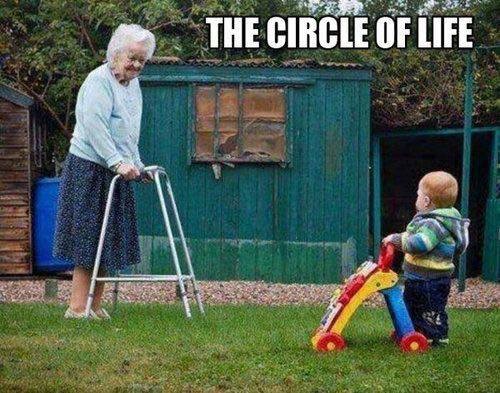
The Unbroken Circle of Life II

IMG_1150 I have rarely reposted a previous blog here, but in searching for some inner wisdom to cope with life today I was drawn to one I wrote just 3 months ago in October of 2015. It still sounds good and maybe even more relevant now than it did then; so it is copied as written below. My only additional preface is a comment I made in my journal recently as 2016 has gotten off to a bumpy start for me, my family, and the world: “The cycle of life keeps turning and there are no stations to get off till you get to the terminal.”

Will the Circle Be Unbroken?
I attended a Bluegrass Festival with some friends a few weeks ago and have been singing or humming “May the Circle Be Unbroken” ever since. Bluegrass is not my music of choice; so I’ve been pondering why that song has stuck in my head. There are good memories of singing that song around campfires when I was a youth minister many years ago. But it has taken on a deeper more pervasive meaning lately. Some of that became clearer to me this week after a depressing visit with my 94 year old father who has outlived his mental and physical faculties and is miserable. Is there a better day coming for him and his wife suffering from dementia?

I don’t think it’s in the sky but where? What? How? Those questions become more relevant as morality pounds harder on my door each day, in aches and pains, friends in surgery, cancer diagnoses and biopsies, longer list of things I can no longer do. I’ve toyed with the lyrics of that song by changing the “e” to an “i” in “better,” i.e., “There’s a bitter day a coming….” That’s what happens when we turn in on ourselves, we get bitter and go victim. “Why me?” “It’s not fair!” “Why didn’t I take better care of myself?” “Let’s try one more miracle supplement that flows out of the fountain of youth!” Fear springs from the unknown “in the sky” or in some place of darkness, from regrets over a lifetime of sin or just dumb mistakes we can never erase.

Fear is epidemic in our society. I was at a wedding reception recently where I was told one of the men at my table was carrying a concealed weapon “because you never know what might happen.” The next week my relatives at a family gathering were discussing preparedness drills for an active shooter at their little country church and in their schools where children are being taught to throw anything they can find at a shooter ala David versus Goliath–only Goliath didn’t have his NRA sanctioned AR 15.

A father was shot dead last Friday in front of his six kids and wife in a burglary in our affluent “safe” suburb. And today Ted Koppel was on the morning news talking about his new book Lights Out, about the coming cyber-attack that will paralyze our society. The temptation to buy some guns and a generator and become a survivalist is so strong even I feel it tugging at me. There is a little solace for me that I’m old enough I may not have to deal with the worst of the Hunger Games scenario, but I fear for my kids and grandkids and feel hopeless and helpless to do anything significant to help them.

Will the circle be unbroken? Or has human depravity and selfishness reached epic proportions that strain the bonds of civility beyond the breaking point? Is Jesus’ pacifist advice to turn the other cheek and put away our swords just naïve idealism? Those are not verses that fearful Christians cite when they turn to Scripture for comfort. I quoted Isaiah (2:4) and Micah (4:3) once to a life-long Christian, the verses about “beating our swords into plowshares and our spears into pruning hooks,” and she said that in 60 years of going to church she didn’t remember ever hearing those words! Unless prophetic voices stand up to the fear mongers and proclaim a message of hope and reason to a world gone mad, the circle may indeed be broken.

I remember being this depressed about the state of the world back in 1972 after Nixon’s landslide victory in spite of Watergate and the protests about the Vietnam War. I wrote a letter to the editor saying that all we could do now was “wait for the inevitable judgment of God.” 43 years later we are still here. We’ve survived that war in SE Asia, the resignation of Nixon and his Vice President, 9/11 and a host of other terrorist attacks, too many mass shootings to count, a huge economic recession, and at least so far several ill-advised wars in the Middle East that have only fanned the flame of hatred in that cauldron of religious and ideological conflict that is the eternal flame of human strife and animosity.

The circle is frayed and contorted out of shape, but it is still unbroken; and that last paragraph is a micro-second in the eternity of the cosmic circle viewed from God’s perspective. As we scroll backward in time through Holocaust, Civil War, Slavery, Genocide of native people, the Dark Ages, the Crusades, Roman, Greek, Syrian, Egyptian, Ottoman Empires, the rise and fall of numerous Dynasties in China and Japan, Exile and Exodus, Stone Age and Ice Ages, and all the other eras of our planet’s history that I missed in history class, our current fears and woes are put in better perspective.

In every generation there have been concerns about the elasticity and tenacity of the circle, and it is still unbroken. That is not an excuse to blithely bury our heads in the sand or in our parochial platitudes. We must counter the fear mongers with words and lives of hope and visions of peace in any way we can. And remembering the great circle maker and sustainer gives us the courage to witness to our faith even when fear and doubt threaten to overwhelm us.

[originally written October 27, 2015]

Peace and Contentment No Matter What

Being content in whatever state I am in, and that’s not a geography question by the way, has been getting more challenging for me for the last 6 years. I have been a glass-half-full kind of guy for most of my life, but the natural aging process seemed to kick into high gear for me in the fall of 2009, just before my 63rd birthday. Since then I’ve had two major surgeries and a laundry list of old people medical issues that aren’t life-threatening and not worth itemizing. But they are a pain, literally and figuratively.

I know the uselessness of going into victim mode, and I cringe when I catch myself and my peers devoting the lion’s share of our conversations to medical reports. But self-pity is an occupational hazard for later life, and I do fall into the thrall of its siren song far too frequently.

All of that provided a helpful existential and personal backdrop for a Bible Study I just led for my church. We studied an excellent book by Adam Hamilton entitled The Call: The Life and Message of The Apostle Paul. My theological bias has led me to focus most of my attention on Jesus and the Synoptic Gospels for most of my career; so this study of Paul was an excellent refresher course for me that helped me take a serious look at Paul’s life and what shaped his theological perspective.

I have quoted Paul in sermons, at weddings and funerals, and frequently used his dramatic conversion as an example of the unlimited power of God to transform and redeem any life. But not since seminary 40 plus years ago have I done a systematic study of the context and circumstances that inspired Paul’s writing and teaching and his absolutely unstoppable devotion to his call to share the Christian Gospel with the world at any and all personal cost and sacrifice.

I have been as guilty as most preachers of cherry picking and proof texting verses of Scripture out of context, and two of those verses I refer to often from Paul have taken on a deeper level of meaning for me as a result of studying Paul’s life again. One is the aforementioned verse about being content in whatever state I am in (Phil. 4:11), and the other is from Romans 8 where Paul assures us that “nothing in all creation can separate us from the love of God in Christ Jesus.”

Those verses are powerful statements of faith even taken out of context, but when we realize that Paul wrote Philippians, a letter of joy and rejoicing, from one of the several prison cells where he spent 4-5 years of the last decade of his life they take on a deeper meaning. Earlier in Philippians 4 Paul says, “Rejoice in the Lord always; again I will say, Rejoice. 5Let your gentleness be known to everyone. The Lord is near. 6Do not worry about anything, but in everything by prayer and supplication with thanksgiving let your requests be made known to God. 7And the peace of God, which surpasses all understanding, will guard your hearts and your minds in Christ Jesus.”

Those are strong words from a man who describes the trials of his life this way in II Corinthians: “Five times I have received from the Jews the forty lashes minus one. 25 Three times I was beaten with rods. Once I received a stoning. Three times I was shipwrecked; for a night and a day I was adrift at sea; 26 on frequent journeys, in danger from rivers, danger from bandits, danger from my own people, danger from Gentiles, danger in the city, danger in the wilderness, danger at sea, danger from false brothers and sisters; 27 in toil and hardship, through many a sleepless night, hungry and thirsty, often without food, cold and naked. 28 And, besides other things, I am under daily pressure because of my anxiety for all the churches.” (11:24-28)

Paul was a man of passion and perseverance. Someone has defined “passion” as something one is willing to suffer for. Paul was willing and determined to share the Gospel, and he experienced great hardship and pain for his efforts. But did he suffer? If he learned to be content with whatever he had and therefore found the peace that passes all understanding, I would argue he did not suffer. There is a popular self-help statement that says, “Pain is inevitable but suffering is optional” which is often attributed to Buddha. It is consistent with the Buddhist philosophy but no one knows for sure where it originated. Regardless of the source, that advice applies to Paul and to anyone who achieves the attitude of acceptance toward circumstances, tragedies, pain, and other problems that one cannot control.

Paul is able to rise above the “slings and arrows of outrageous fortune” when Hamlet cannot because of his faith and absolute trust in the goodness and mercy of eternal God. Given the hardship he endured and triumphed over to almost single-handedly spread the Gospel of Christ across the Roman Empire, the words of Romans 8 echo like a climactic crescendo to the symphony of his life.

“Who will separate us from the love of Christ? Will hardship, or distress, or persecution, or famine, or nakedness, or peril, or sword? 36 As it is written,
“For your sake we are being killed all day long;
we are accounted as sheep to be slaughtered.”
37 No, in all these things we are more than conquerors through him who loved us. 38 For I am convinced that neither death, nor life, nor angels, nor rulers, nor things present, nor things to come, nor powers, 39 nor height, nor depth, nor anything else in all creation, will be able to separate us from the love of God in Christ Jesus our Lord.” (Romans 8:35-39)

Paul has been there, done that. He’s not a bystander to the forces of opposition. He doesn’t just believe in the love of God, he’s felt it and been sustained by it in the most difficult and hopeless situations imaginable. If he’s content and at peace, who am I to be discouraged or undone by the minor difficulties and challenges life puts in my way?

Will the Circle Be Unbroken?

I attended a Bluegrass Festival with some friends a few weeks ago and have been singing or humming “May the Circle Be Unbroken” ever since. Bluegrass is not my music of choice; so I’ve been pondering why that song has stuck in my head. There are good memories of singing that song around campfires when I was a youth minister many years ago. But it has taken on a deeper more pervasive meaning lately. Some of that became clearer to me this week after a depressing visit with my 94 year old father who has outlived his mental and physical faculties and is miserable. Is there a better day coming for him and his wife suffering from dementia?

I don’t think it’s in the sky but where? What? How? Those questions become more relevant as morality pounds harder on my door each day, in aches and pains, friends in surgery, cancer diagnoses and biopsies, longer list of things I can no longer do. I’ve toyed with the lyrics of that song by changing the “e” to an “i” in “better,” i.e., “There’s a bitter day a coming….” That’s what happens when we turn in on ourselves, we get bitter and go victim. “Why me?” “It’s not fair!” “Why didn’t I take better care of myself?” “Let’s try one more miracle supplement that flows out of the fountain of youth!” Fear springs from the unknown “in the sky” or in some place of darkness, from regrets over a lifetime of sin or just dumb mistakes we can never erase.

Fear is epidemic in our society. I was at a wedding reception recently where I was told one of the men at my table was carrying a concealed weapon “because you never know what might happen.” The next week my relatives at a family gathering were discussing preparedness drills for an active shooter at their little country church and in their schools where children are being taught to throw anything they can find at a shooter ala David versus Goliath–only Goliath didn’t have his NRA sanctioned AR 15.

A father was shot dead last Friday in front of his six kids and wife in a burglary in our affluent “safe” suburb. And today Ted Koppel was on the morning news talking about his new book Lights Out, about the coming cyber-attack that will paralyze our society. The temptation to buy some guns and a generator and become a survivalist is so strong even I feel it tugging at me. There is a little solace for me that I’m old enough I may not have to deal with the worst of the Hunger Games scenario, but I fear for my kids and grandkids and feel hopeless and helpless to do anything significant to help them.

Will the circle be unbroken? Or has human depravity and selfishness reached epic proportions that strain the bonds of civility beyond the breaking point? Is Jesus’ pacifist advice to turn the other cheek and put away our swords just naïve idealism? Those are not verses that fearful Christians cite when they turn to Scripture for comfort. I quoted Isaiah (2:4) and Micah (4:3) once to a life-long Christian, the verses about “beating our swords into plowshares and our spears into pruning hooks,” and she said that in 60 years of going to church she didn’t remember ever hearing those words! Unless prophetic voices stand up to the fear mongers and proclaim a message of hope and reason to a world gone mad, the circle may indeed be broken.

I remember being this depressed about the state of the world back in 1972 after Nixon’s landslide victory in spite of Watergate and the protests about the Vietnam War. I wrote a letter to the editor saying that all we could do now was “wait for the inevitable judgment of God.” 43 years later we are still here. We’ve survived that war in SE Asia, the resignation of Nixon and his Vice President, 9/11 and a host of other terrorist attacks, too many mass shootings to count, a huge economic recession, and at least so far several ill-advised wars in the Middle East that have only fanned the flame of hatred in that cauldron of religious and ideological conflict that is the eternal flame of human strife and animosity.

The circle is frayed and contorted out of shape, but it is still unbroken; and that last paragraph is a micro-second in the eternity of the cosmic circle viewed from God’s perspective. As we scroll backward in time through Holocaust, Civil War, Slavery, Genocide of native people, the Dark Ages, the Crusades, Roman, Greek, Syrian, Egyptian, Ottoman Empires, the rise and fall of numerous Dynasties in China and Japan, Exile and Exodus, Stone Age and Ice Ages, and all the other eras of our planet’s history that I missed in history class, our current fears and woes are put in better perspective.

In every generation there have been concerns about the elasticity and tenacity of the circle, and it is still unbroken. That is not an excuse to blithely bury our heads in the sand or in our parochial platitudes. We must counter the fear mongers with words and lives of hope and visions of peace in any way we can. And remembering the great circle maker and sustainer gives us the courage to witness to our faith even when fear and doubt threaten to overwhelm us.

Stages of Faith

Another of my faith journey mentors has passed on to the next stage of faith.  The news came in an obituary shared by a colleague on Facebook: James W. Fowler III, Prominent Practical Theologian and Ethicist, Dies at 75.

I discovered the work of James Fowler through his 1981 book, Stages of Faith, when I was working on my doctorate in the late ‘80’s and early ‘90’s.  His research and writing on the stages of faith development resonated with my own faith journey from a very concrete-literal understanding of faith to a more universal and inclusive theology and became a central focus of my dissertation on a narrative of moral discourse.  That paradigm for how preaching and teaching can promote moral and faith development has been the foundation of my ministry and teaching for the past 35 years.  I invite you to read the brief descriptions of Fowler’s 6 stages of faith development at the link below.

http://www.psychologycharts.com/james-fowler-stages-of-faith.html

In the multi-cultural global village we live in today, the need for a more universal and inclusive faith has never been more needed.  I especially like this description of Stage 4, the Individuative-Reflexive stage:  “This is the tough stage, often begun in young adulthood, when people start seeing outside the box and realizing that there are other “boxes”. They begin to critically examine their beliefs on their own and often become disillusioned with their former faith. Ironically, the Stage 3 people usually think that Stage 4 people have become “backsliders” when in reality they have actually moved forward.”

And when we despair about those who seem de-churched or “post-Christian,” Fowler reminds us that a mature faith comes only with life experience.  This is what he says about stage 5, Conjunctive Faith:  “It is rare for people to reach this stage before mid-life. This is the point when people begin to realize the limits of logic and start to accept the paradoxes in life. They begin to see life as a mystery and often return to sacred stories and symbols but this time without being stuck in a theological box.”

Faith is a journey, not a destination.  It is not a straight line but a maze of twists and turns, highs and lows.  It is a dynamic adventure.  The faith stories we live by are never the same when we read or hear them again because we are not the same people we were yesterday or yesteryear.  I am so grateful for sages like Jim Fowler who teach us that we are shaped by our past but we are not defined or confined by it.

When I saw the news that he had died this week I was saddened.  Many of the mentors who shaped my understanding of myself and the divine are no longer present on this earth.  But their legacy lives on in me and countless others who have and will continue to benefit from their wisdom.  We are surrounded by a cloud of witnesses.  My cloud includes saints like Jim Fowler, Fred Craddock, Paul Tillich, Van Bogard Dunn, Bob Browning, Everett Tilson, Jeff Hopper, Bill Croy, Bob Chiles, my mother and grandparents, and far too many more to name.

When someone important in my life passes on, I try to take time to give thanks for his or her contribution to my life and the larger world.  And I also ask God to help me be worthy of that legacy and share it with those who are learning and growing and searching for meaning in their own faith journey at whatever stage or phase they are.  My job is not to preach or lecture or insist on my way or any particular way.  My job is to come along side others and share the journey with them.

Thanks be to God for people like Jim Fowler who have been my companion on the way.

James W. Fowler, distinguished Howard Candler Professor of Theology and Human Development at Candler School of Theology, Emory University, was Director of both the Center for Research on Faith and Moral Development and the Center for Ethics, and also served as an ordained elder in the Western North Carolina Conference of the United Methodist Church.

Welcome Fall with Fall Prevention

No, we can’t change the calendar, but on the first day of autumn (Wednesday, September 23) you can help raise fall prevention awareness. The Ohio Department of Aging is encouraging people to walk at least a mile tomorrow (or anytime in September) and post a selfie. Information about how to find groups walking and other details can be found at http://aging.ohio.gov/steadyu/.

There was also a good article about this in today’s Columbus Dispatch in the Metro Section, “Fall draws attention to risks of falling.” This paragraph got my attention: “An older Ohioan falls every two minutes, resulting in an injury every 5 minutes, 6 ER visits and one hospitalization an hour and 3 deaths every day.” What to do? First, don’t let fear of falling limit your activity. That actually leads to decreased mobility and increased likelihood of falling. 15-30 minutes of physical activity per day is the best to improve strength and balance and reduce the risk of falling.

Check with your local YMCA and other Silver Sneaker programs for balance and fitness classes. And check out the Steady U website listed above for more suggestions on how to prevent falls this fall.

I know this is a bit different topic than I usually write about, but I have a couple of personal interests in this. I am dealing with balance issues caused by peripheral neuropathy for one, and I have another birthday on the horizon which makes issues of aging more relevant every year. Also my wife, Diana, is a fitness coach and is encouraging her clients to walk tomorrow also. Just for fun, go to her Active Healthy Lifestyles page on Facebook and post a picture letting us know that you walked to help raise awareness. It’ll do us all good.