THE PERSISTENT PRINCESS OF PEACE

As the season of Christmas continues into a new year, my hope for the birth again of God’s messengers of peace in unexpected times and places, even here and now, lives on in spite of all the bad news 2015 has been able to muster. And to that end I share a short story I wrote years ago and included in my book, Building Peace from the Inside Out.

“Blessed are the Peacemakers, for they shall be called Children of God.” Matthew 5:9

Sally was sitting next to the window over the left wing of a 737. The lights of the city would have been pretty as they left O’Hare, but a snowstorm was brewing and the clouds quickly engulfed the plane. Sally was going to spend Christmas with her grandmother in Richmond, Virginia. She was a little scared. She was 14, and this was her first flight by herself. In her nervousness, she had neglected to use the restroom at the airport; so as soon as the seatbelt light went out, she was out of her seat.

In her haste Sally bumped against the brief case of the man in the aisle seat, knocking it off his lap. She reached down politely to pick it up for him, but he grabbed it quickly and gruffly warned her to be more careful. When Sally returned from the restroom she apologized again for the brief case incident. She tried to strike up a conversation with her seat mate. He was in no mood to talk. Sally put her IPod headphones on and turned to the window. There was nothing out there in the darkness but one blinking red light, way out on the end of the wing. Sally thought it was bouncing up and down way too much.

“What makes grownups so darn grumpy, especially at Christmas?” she wondered. But her thoughts were rudely interrupted by an explosion in the rear of the plane. They began to lose altitude rapidly. Everyone panicked and screamed. NO one heard the captain’s voice over the P.A. system urging everyone to “please remain calm.”
The next thing Sally remembered was coming to in a snow covered field. She was 300 yards from the flaming wreckage of the plane. She seemed to be OK except for some cuts and bruises. The man who had been sitting next to her was a few yards away. He was badly hurt and calling for help. Sally was tempted to ignore him but knew she couldn’t. He was barely able to talk, but Sally understood that he was still concerned about his brief case. Wondering what could possibly so important about that stupid brief case; she half-heartedly began to look for it as she searched the area for other survivors. The fire was too intense to get close to the plane. She saw no other signs of life.

Sally found a briefcase. She took it back to the man, but it was the wrong one. She was about to just leave and go for help, but the man pleaded with her. He was desperate. So she looked again. This time she found the briefcase under a piece of the fuselage. She took it to the man, and he motioned for her to bend down so she could hear him. He said he had a very important letter that had to get to Washington. He stressed how urgent it was, begging her to promise him she would see that was delivered. He fell back unconscious before she had time to respond. She took the letter and put it in her coat pocket, half wondering if he was on the level.

Ambulances came. Sally was taken to a hospital where she learned she was in Bellefontaine, Ohio. Her cuts were cleaned and bandaged. The doctors said she had suffered a mild concussion. The next morning she remembered the letter. It was still in her coat pocket. Sally decided she would try and find the man before she opened it. When she asked about him, the nurses told her there were only two other survivors. They were both women.

Back in her room, Sally opened the letter. It was a very official looking dispatch from the CIA in Los Angeles, warning the President about a plot to assassinate several foreign heads of state when they visited Camp David for a summit conference after Christmas. If the assassins were not stopped the possibilities for starting World War III were staggering. Sally was overwhelmed. She didn’t know what to do. She wasn’t sure who she could trust. If the letter fell into the wrong hands…. She wasn’t sure what might happen. But she did know that she had been charged with delivering it, and she would.

Sally asked the nurses when she could leave the hospital. She discovered that because she was a minor, they would not release her without parental consent. Sally tried in vain to convince the charge nurse that she had to leave. Seeing that was hopeless, she simply went back to her room, got dressed and left after the night shift came on duty.

Sally’s cell phone had a GPS on it that would have been really helpful had she not lost it in the crash. So resorting to older technology, she picked up a map at a convenience store. She discovered she was 60 miles from Columbus, the state capital. There must be an airport there, right? She had also lost her purse and had no money; so she decided to hitch a ride. Being young and attractive, she didn’t have to wait long for a ride. She was really glad to get out of the sub-freezing weather when a man in a Beamer stopped for her. She would have been more comfortable with a woman or a couple but was in no position to be picky.

The man seemed friendly enough. In fact he had ideas of being a lot friendlier than Sally wanted. A few miles down the highway, he turned off on a county road and tried to force himself on her. Sally resisted so fiercely that he finally just slapped her hard across the face, called her a bitch, and pushed her out into the cold. Sally didn’t mind at all. She was just glad to be rid of him.

Two hours later, nearly frozen from wandering in a blinding snow storm, she saw car lights coming toward her. She flagged the car down and discovered it was a sheriff’s deputy. The deputy, of course, wanted to know what Sally was doing there. She told him that she needed to get to Columbus. He insisted on taking her to the hospital to make sure she was OK. She protested but to no avail.

Sally didn’t realize she had gone far enough to be in different county. She was relieved to discover that she was not going back to Bellefontaine, but to another town called Marysville. The ER staff there treated her for frostbite and gave her a good meal. They could not understand why she was in such a hurry to be on her way. Sally tried making up a story about a sick uncle in Columbus who needed her. Didn’t fly. Finally, she decided she would just have to tell them the truth. She did. They laughed. So, reluctantly, she decided she had no choice but to show them the letter. That would convince them. But the letter was gone. It had fallen out of her pocket somewhere in the snow.

Sally began to feel trapped. The trauma of the crash, the cold, the exhaustion—all began to get to her. She had to get that message to Washington. The peace of the world depended on her, and these stupid people wouldn’t even listen to her. She began to scream at them hysterically.

The next morning, Sally woke up staring at the cold, barren walls of a Columbus psychiatric hospital. She was confused and scared. She tried the door to her room. It was locked. She pounded on the door. No one came. She was about to cry when she suddenly became aware of another person in the room. Sally had not noticed her roommate sleeping in the other bed—an African American girl, about Sally’s age. The sign on bed said “Paula.” As soon as she was fully awake, Paula gave Sally some very important advice: “Hey, girlfriend. You keep that up and they’ll put you on the back ward for keeps. You gotta play it cool if you ever want out of here.”

Sally was still frightened, but she recognized the truth in Paula’s words. Sally told her story to Paula. For the first time she found someone who believed her. Paula suggested that Sally try to call Washington; since there was no way of knowing how long they might keep her here. Paula told Sally she would show her where there was a pay phone when they went down to the dining room for breakfast.

Paula introduced Sally to some of her friends at breakfast, and Sally began to feel a little less scared and alone. But her frustration soon returned. When she tried to make her call, an attendant pulled rank on her—said she had an important call to make. And the attendant was still there talking when it was time for the patents to go back on the ward. Sally tried to convince the nurses to let her go back down that morning, or to let her use the phone in the nurse’s office. They refused. They laughed at her and said they were sure the president could wait until lunch time to talk to her.

Sally was about to lose her temper again, but Paula managed to calm her down. They spent the morning talking. Sally was surprised how quickly the time passed. After lunch she hurried back to the phone. She got as far as a White House operator who dismissed her as a crank call. She tried the local FBI office—same response.
Sally was ready to give up. She was beginning to question her own sanity. But Paula had been hard at work. She figured Sally would have a better chance if she could get to D.C. in person. Sally agreed but had no hope of making it in time. Paula did. She got the nurse to let Sally go with her to Occupational Therapy that afternoon. Paula told Sally what she had planned. They had to go outside to get to OT. Paula said she would distract the attendant so Sally could slip away. Sally begged Paula not to do anything foolish. Paula gave her the address of a friend who would help her get to the airport.

There was not time for further discussion. The only good-bye and thank you Sally could give Paula was a squeeze of her hand as they walked downstairs. As soon as they were outside, Paula screamed and took off running. The attendant went after her. Sally froze. She wanted to know what was going to happen to Paula. But one of the other patients knew what the plan was. She gave sally a friendly shove and told her to get going while she could.
Sally left reluctantly, trying to look as nonchalant as possible as she walked toward where Paula had told her the front gate was. She was still worried about Paula. She was also amazed at the lack of security. There were no guards, just as Paula had promised. Sally got on a city bus, trying hard to act calm. She knew for sure that everyone would recognize her as an escaped mental patient—even though she didn’t look a bit different than two days before—it seemed like two years—when she left Chicago.

The bus driver told her where to change buses to get to the address Paula had given her. It was in the University district, which was nearly deserted during Christmas break. Sally had forgotten all about Christmas. She found the apartment on 11th Avenue. It was in a run-down neighborhood, and Sally was uneasy. It seemed to be getting dark awfully early, but then she had lost all sense of what time it was. A huge African American man answered the door. He was about half drunk and Sally started to leave. But then a much friendlier face appeared.

As soon as Sally mentioned Paula’s name, Billy, the sober one, invited her in and asked what he could do to help. Sally told him her story. Billy agreed it did sound far-fetched. But like Paula, he sensed something in Sally’s eyes and her voice that made him trust her, in spite of his doubts. In a matter of minutes, Billy called the airport and Sally booked on a flight leaving for Reagan National in two hours. He said he knew someone who worked for United Airlines who pulled some strings for him. Otherwise things were all booked up with Christmas travelers.

After sharing some warmed-over pizza, Billy drove Sally to Port Columbus in his ’92 Cavalier. It was better than walking, but not much. Billy’s friend, Tracy, met them and produced a one-way ticket under an assumed name since Sally was not a fugitive in 3 counties. Tracy also used her airport ID to get Sally around the security check point. Billy slipped her a little cash to live on when she got there. Sally promised she would come back and repay him when she could. She was also hoping to see Paula again.

This flight was uneventful. Sally relived the nightmare of the last two days. For the first time since the crash she thought about her parents and her grandmother. They would be worried sick! But there was nothing she could do about that now. She would call them as soon as her unbelievable mission was over. And then she fell into a deep sleep of exhaustion.

Sally woke up as the plane was on its final descent over the Potomac. For a scary minute she thought they were going to land in the river and said a little prayer of appreciation when the wheels touched down safely on the other side. She was in Washington at last—exactly 48 hours later than her original flight should have been…. But that was all past now. She was here. Surely somebody here would listen to her. They just had to.
Fear of Knowledge?

I usually enjoy seeing news about my home town, but not today. An article in the Columbus Dispatch via the Dayton Daily News caught my eye today when I saw “Wapakoneta” in the headline. Wapak, as the natives call it, is a small county-seat town in Northwest Ohio where I graduated from high school 50 years ago. The headline brought home to me literally how insidious Islamophobia is affecting not only our present world crisis but future generations as well.

The story reported that 21 7th-graders in Wapak are boycotting history lessons that include Islam. (Note: I have since learned from the editor of the Wapakoneta Daily News that the official number of students according to the School Superintendent is 10; so I want to share that bit of good news.) In particular they are opting out of one of 21 sections in their world history class that focuses on Islamic civilization from A.D. 500-1600. The good news is that world history is part of curriculum. It certainly wasn’t when I was a student there. For us history didn’t begin until Columbus “discovered” America in 1492.

According to the news article “Ohio’s state learning standards call for study of numerous civilizations and empires, and the impact of Christianity, Islam and other religions on history.” The section in question “focuses on the impact of Islamic civilization as it spread throughout most of the Mediterranean in the period following the fall of Rome and its later impact on the European Renaissance. Attention is paid to achievements in medicine, science, mathematics and geography.”

The bad news is that “the school policy that allows the Wapakoneta students to opt out is shared in some form by hundreds of other school districts statewide.” The policy does not allow students to opt out of entire classes, just certain sections if “after careful, personal review of the lesson and materials a parent determines that it conflicts with their religious beliefs or value system.” Maybe some of these 21 students have parents who know enough about Islam to make a careful review of this material, but I’m betting most of them only know what Donald Trump and Fox News have told them about these people who comprise 1 billion members of the human race.

I get the fear caused by recent world events, but even if we have reason to fear a designated “enemy,” doesn’t it make sense to know as much about them as we can. The impact of Islam on the European Renaissance has direct influence on our history in this country. Their story is part of our story, and if we fail to understand our history we are indeed condemned to repeat it. Like it or not we live in a multicultural international community. People who are different from us are literally our neighbors here and around the world.

The alma mater of Wapak High School has a phrase that sounds way off key to my ears today. It says, “Hail to thee dear Alma Mater, temple reared by God’s own hand.” I’m sure the author of those words many decades ago had only the Christian God in mind as the builder of said temple of learning. The God of the entire universe I know is weeping for those 21 students and everyone else who is being robbed of a chance to better understand the world we live in by fear and ignorance.

The final paragraph of the Columbus Dispatch article is especially poignant. It quotes the state’s seventh-grade history standard on civic skills which makes a case against opting out of lessons like this. It reads, “Skills in accessing and analyzing information are essential for citizens in a democracy. The ability to understand individual and group perspectives is essential to analyzing historic and contemporary issues.”

The American democratic experiment is founded on an informed citizenry, and ignoring important aspects of world and American history because we are afraid of what we might learn reminds me of the old adage, “Don’t confuse me with the facts. My mind is already made up.” Saddest of all is what these students are being taught, not by the schools, but by parents who are passing on their own fears and biases to their children.

This situation reminded me of a great song that I first heard at Wapak High over 50 years ago when our high school chorus performed Rodgers and Hammerstein’s great musical “South Pacific.” The song “Carefully Taught” in that show is about how people learn their prejudices. It’s long before we get to formal education. One line of that song says it so well, “You’ve got to be taught before it’s too late, before you are six or seven or eight, to hate all the people your relatives hate, You’ve got to be carefully taught!” (I wrote a full article on that topic last year entitled “Life Lessons I Didn’t Learn in Class,” posted February 24, 2014).

Fear of people and things outside our comfort zone is a learned behavior. Innocent children don’t come into the world with preconceived notions. We learn subtly or directly to label differences as “other” instead of understanding and appreciating the basic human needs and desires that make us part of one common species. I love it whenever I see the suggestion about how to answer the question we get on medical forms and other documents that asks for “race”? The answer that is never one of the choices is the one that really matters, and it is “human.”
All of us share the same basic needs for love and acceptance, for food and water and shelter, for clean air to breath, for a sense of security and safety. Maslow’s hierarchy of needs knows no ethnic or ideological distinctions. When we isolate ourselves from “others” geographically, socially, economically, and even by refusal to study our common history, those needs and commonalities are obscured by fear, ignorance and bigotry. Fear of violence is understandable. Fear of knowledge is tragic.

I became aware just recently of the peacemaking work of a fellow Ohio native, Marshall Rosenberg, a psychologist who died earlier this year. He was the creator of Nonviolent Communication, a communication process that helps people to exchange the information necessary to resolve conflicts and differences peacefully. One of the tenets of non-violent communication is that humans act out of unmet needs. So one of the first steps toward understanding our own behavior or that of others is to ask what unmet needs we may have. (I would add especially in this season of hectic holiday consumerism, these are real needs, not desires created by clever marketing or peer pressure.)

One of Rosenberg’s insights that speak so clearly to our current world situation is that “violence is the tragic expression of unmet needs.” That is not easy to remember when we are afraid for ourselves or others, but it is critical because it is hitting the pause button on our natural flight or fight emotions long enough to put ourselves in the place of another and ask what unmet needs that person has that might explain his or her actions. That understanding is what makes compassion possible in interpersonal and international relationships. And it is only possible when we take time to know about and understand others. That happens in multiple ways, from really listening to each other to cultural competence that comes from taking the time to learn about the history and customs and beliefs of our fellow travelers on spaceship earth.

That’s the way to unlearn those hurtful, dangerous things we were “carefully taught…. before we were six or seven or eight.” Those prejudices and fears passed on from one generation to the next by well-meaning but uninformed people. We can learn and change and grow, but not if we are afraid of knowledge and are AWOL from class.

Peace that Passes All Understanding

So many competing emotions in Advent 2015! Consumerism has almost ruined the holiday season for me in a “normal” year, but the epidemic of fear fed by the recent wave of terrorist attacks makes it especially challenging and necessary for me to dig deep and find the bedrock of faith and gratitude in 2015.

I struggled for days with what, if anything, to say about the attacks in Paris on November 13, partly because so much has already been said, both wise and foolish, but mostly because I have been very depressed about the state of the world and not sure what to say that can make any contribution. I finally gave up and said nothing.

That Friday the 13th for me was a metaphor for the tug of war between hope and fear. One of our beautiful grandchildren spent that day at our house. I’m very biased, of course, but little things she did that day made my papa pride swell for what a sweet, caring, smart little girl she is.

Shortly after I took her home I heard the first reports about the attacks in Paris on a TV in a fast food restaurant. Unlike 9/11 when the world stopped to watch the horror unfold, I seemed to be the only one in the McDonald’s paying any attention to the news. Everyone else was chatting and carrying on as usual because these kinds of events have become chillingly commonplace.

That evening I went to a meeting to watch a film entitled “Climate Refugees,” which in painful detail describes how millions of people have been driven from their homes by storms, floods and draughts related to climate change. The whole film, which was made long before the current refugee crisis in Europe, was alarming, but one segment especially so given the chaos in Paris that very evening. That segment talked about how desperate, frightened refugees are easy prey for sex traffickers and terrorist organizations looking for new recruits. I was so overwhelmed by the scope of the problem that I couldn’t bring myself to stay for the discussion after the film.

The level and frequency of violence in our world since then has shaken the foundations of my faith. I am questioning my long-held belief in humans being created in the image of God. I am afraid for my family and for the future of the planet. And my first reaction to that fear and anger was to join the chorus of politicians who want to bomb our way out of the ISIS problem and arm ourselves and close our borders. I know better, but it scares me even more that some of our “leaders” or wannabes don’t. Instead they see these tragedies as an opportunity to sell more guns and generate more fear and fan the flames of their own political fortunes with abhorrent ideas borrowed from Hitler’s playbook.

On the bright side there have been wonderful statements of faith and hope from those with a greater understanding of human history and a better vision of human potential. One of those reminded me that love is ultimately the victor over hate. I believe that’s true in the long run, but for now hate has a big lead and the clock is ticking.

The paragraphs above were written during Thanksgiving week, and wisely, I believe, I chose not to share them then because they felt too hopeless and negative. Then yesterday came news of the biggest U.S. mass shooting since Sandy Hook. I was still wrestling with depression and feared this latest killing spree would only deepen my despair. Much to my surprise I am not as pessimistic 24 hours after San Bernardino as I have been for 2.5 weeks. I am very sad and determined to do more to be the solution to the dis-ease strangling our nation and world. But I am not depressed, and that feels very strange.

On the one hand I feel a bit guilty for not being discouraged, and on the other I am afraid to analyze my hopeful feeling for fear I will awaken from a dream and it will be gone. But unlike Ebby Calvin “Nuke” LaLoosh in my favorite baseball movie “Bull Durham,” I am cursed with self-awareness. And most days that’s a good thing – and today is one of those.

I had noticed ironically yesterday that the last thing I posted in this blog was a piece about being “content in whatever state I am in” based on the words of St. Paul in Philippians 4. I posted that 4 days before the Paris terrorist attacks. How quickly I forgot those words to live by when the chips were down.

But tonight, several mass shootings later, some other words from that same 4th chapter popped into my awareness as I was pondering why I was not as depressed by these latest killings much closer to home. In particular verse 7 came to mind, and I had a warm feeling because what had been just words and ideas 3 weeks ago was actually a reality for me. I was experiencing the “peace that passes all understanding,” and it was very good.

So I revisited Philippians 4, and here’s the context for verse 7: “Rejoice in the Lord always; again I will say, Rejoice. 5Let your gentleness be known to everyone. The Lord is near. 6Do not worry about anything, but in everything by prayer and supplication with thanksgiving let your requests be made known to God. 7And the peace of God, which surpasses all understanding, will guard your hearts and your minds in Christ Jesus. 8 Finally, beloved, whatever is true, whatever is honorable, whatever is just, whatever is pure, whatever is pleasing, whatever is commendable, if there is any excellence and if there is anything worthy of praise, think about these things. 9Keep on doing the things that you have learned and received and heard and seen in me, and the God of peace will be with you.”

How relevant and practical those old words are for this particular Advent. Rejoice, in spite of our fear. Be gentle to everyone, including ourselves. Know that Emmanuel (“God with Us”) is near. Replace worry with prayer and supplication and thanksgiving. Prayer is not enough in our struggle with death and destruction and violence, but it is the foundation, the source of strength that sustains us when “our arms are too weary” to be carriers of hope to a frightened world.

And Paul gives attitude adjustment advice better than the best self-help guru. He says to focus on what is good and true and excellent and worthy of praise. Because even in the dark days of Advent 2015 there is much goodness in the world. We may just have to work a little harder to find it, but it is more necessary than ever to find it and share it.

One such image for me that is stronger than the non-stop horrific news coverage from California is that of a simple gesture by my granddaughter that Friday the 13th. She came down to my office that morning with two juice boxes in her hands that she had gotten from the lunch box she brought with her. When I asked her if she was going to drink them both she said, “No, this one’s for you.” A simple pure act of caring and sharing, unprompted and natural. It was the best juice box I’ve tasted in a long time!

She was doing in her six-year-old way what the final advice is in that passage from Paul. It says, “Keep on doing the things that you have learned and received and heard in me, and the peace of God will be with you.” Don’t abandon the ways of love and peace. Don’t fall into the temptation to fight fire with fire. Be forgiving and compassionate, even when those things make no sense and seem impossible. There is no peace in following the ways of King Herod, another mass murderer. The peace of God came “not with swords loud clashing, nor roll of stirring drum, but with deeds of love and mercy” in a helpless refugee child born in a barn.

No matter how loud our leaders and our hearts want to shout fear and hate, the still small voice of God says, “Fear not, I am still bringing you good news of great joy.” Don’t miss it!

Will the Circle Be Unbroken?

I attended a Bluegrass Festival with some friends a few weeks ago and have been singing or humming “May the Circle Be Unbroken” ever since. Bluegrass is not my music of choice; so I’ve been pondering why that song has stuck in my head. There are good memories of singing that song around campfires when I was a youth minister many years ago. But it has taken on a deeper more pervasive meaning lately. Some of that became clearer to me this week after a depressing visit with my 94 year old father who has outlived his mental and physical faculties and is miserable. Is there a better day coming for him and his wife suffering from dementia?

I don’t think it’s in the sky but where? What? How? Those questions become more relevant as morality pounds harder on my door each day, in aches and pains, friends in surgery, cancer diagnoses and biopsies, longer list of things I can no longer do. I’ve toyed with the lyrics of that song by changing the “e” to an “i” in “better,” i.e., “There’s a bitter day a coming….” That’s what happens when we turn in on ourselves, we get bitter and go victim. “Why me?” “It’s not fair!” “Why didn’t I take better care of myself?” “Let’s try one more miracle supplement that flows out of the fountain of youth!” Fear springs from the unknown “in the sky” or in some place of darkness, from regrets over a lifetime of sin or just dumb mistakes we can never erase.

Fear is epidemic in our society. I was at a wedding reception recently where I was told one of the men at my table was carrying a concealed weapon “because you never know what might happen.” The next week my relatives at a family gathering were discussing preparedness drills for an active shooter at their little country church and in their schools where children are being taught to throw anything they can find at a shooter ala David versus Goliath–only Goliath didn’t have his NRA sanctioned AR 15.

A father was shot dead last Friday in front of his six kids and wife in a burglary in our affluent “safe” suburb. And today Ted Koppel was on the morning news talking about his new book Lights Out, about the coming cyber-attack that will paralyze our society. The temptation to buy some guns and a generator and become a survivalist is so strong even I feel it tugging at me. There is a little solace for me that I’m old enough I may not have to deal with the worst of the Hunger Games scenario, but I fear for my kids and grandkids and feel hopeless and helpless to do anything significant to help them.

Will the circle be unbroken? Or has human depravity and selfishness reached epic proportions that strain the bonds of civility beyond the breaking point? Is Jesus’ pacifist advice to turn the other cheek and put away our swords just naïve idealism? Those are not verses that fearful Christians cite when they turn to Scripture for comfort. I quoted Isaiah (2:4) and Micah (4:3) once to a life-long Christian, the verses about “beating our swords into plowshares and our spears into pruning hooks,” and she said that in 60 years of going to church she didn’t remember ever hearing those words! Unless prophetic voices stand up to the fear mongers and proclaim a message of hope and reason to a world gone mad, the circle may indeed be broken.

I remember being this depressed about the state of the world back in 1972 after Nixon’s landslide victory in spite of Watergate and the protests about the Vietnam War. I wrote a letter to the editor saying that all we could do now was “wait for the inevitable judgment of God.” 43 years later we are still here. We’ve survived that war in SE Asia, the resignation of Nixon and his Vice President, 9/11 and a host of other terrorist attacks, too many mass shootings to count, a huge economic recession, and at least so far several ill-advised wars in the Middle East that have only fanned the flame of hatred in that cauldron of religious and ideological conflict that is the eternal flame of human strife and animosity.

The circle is frayed and contorted out of shape, but it is still unbroken; and that last paragraph is a micro-second in the eternity of the cosmic circle viewed from God’s perspective. As we scroll backward in time through Holocaust, Civil War, Slavery, Genocide of native people, the Dark Ages, the Crusades, Roman, Greek, Syrian, Egyptian, Ottoman Empires, the rise and fall of numerous Dynasties in China and Japan, Exile and Exodus, Stone Age and Ice Ages, and all the other eras of our planet’s history that I missed in history class, our current fears and woes are put in better perspective.

In every generation there have been concerns about the elasticity and tenacity of the circle, and it is still unbroken. That is not an excuse to blithely bury our heads in the sand or in our parochial platitudes. We must counter the fear mongers with words and lives of hope and visions of peace in any way we can. And remembering the great circle maker and sustainer gives us the courage to witness to our faith even when fear and doubt threaten to overwhelm us.

Prayer for the Discouraged and Fearful: 13th Sunday after Pentecost

O God, these are times that try our souls and our faith. Our world is full of assault weapons and political insults. So much violence on our streets, in the news, on our small screens and big screens makes us want to buy AK 47’s instead of putting on the “full armor of God.” Taking up a cross, turning the other cheek, forgiving mass murderers and terrorists – those things seem so hopelessly naive. No offense, Lord, but Kevlar vests seem like a better bet against an active shooter and the arrows of evil than the “breastplate of righteousness.” (Ephesians 6)

We’re afraid, Lord, afraid for our safety, our freedom, and our future as a nation and as a human race. We’re afraid for our children, for those who try to keep the peace, and for those trapped in an economic system where the deck is stacked against them. You’ve taught us that perfect love casts out fear, O God, but our love is imperfect and our fear threatens to cast out love, especially for those who need love the most.

We pray for victims of abuse and hate who become abusive and hateful. We pray for the victims of violence and other traumatic life events that drive them to flee from their homelands illegally or legally, for those who seek refuge in drugs or other forms of harmful self-medication, for those so desperate to escape the prison of poverty that they resort to crime. We pray for spirits and relationships and health broken by the burdens of unjust life circumstances, for the bullied who become bullies and their victims, for the homeless and the hopeless, for those trapped in ideologies that prevent compassion and understanding of other beliefs and believers. Lord, hear our prayers and our desperation in the face of so much fear and misery.

We see so many others lose faith and hope and turn away from you, Lord. When Jesus asks, “Do you also wish to go away?” (John 6:67) we are sorely tempted to say, “Yes, Lord, being a Christian disciple is too hard!” The strong and ruthless, not the meek or the peacemakers, seem likely to inherit the earth if there is anything left of it when the plundering and bloodshed are over.

Fear and faith wrestle for our souls, and even though it makes no sense to us or the world we hear ourselves saying with Peter, “We will follow you, Lord. You have the words of eternal life. We have come to believe and know that you are the holy one of God.”

Thanks for giving us moments of courage we did not know we had, for assuring us that our “Weeping may linger for the night, but joy comes with the morning.” (Ps. 30:5). Help us hang on through the night, O God of promise; hear our prayer. Amen.

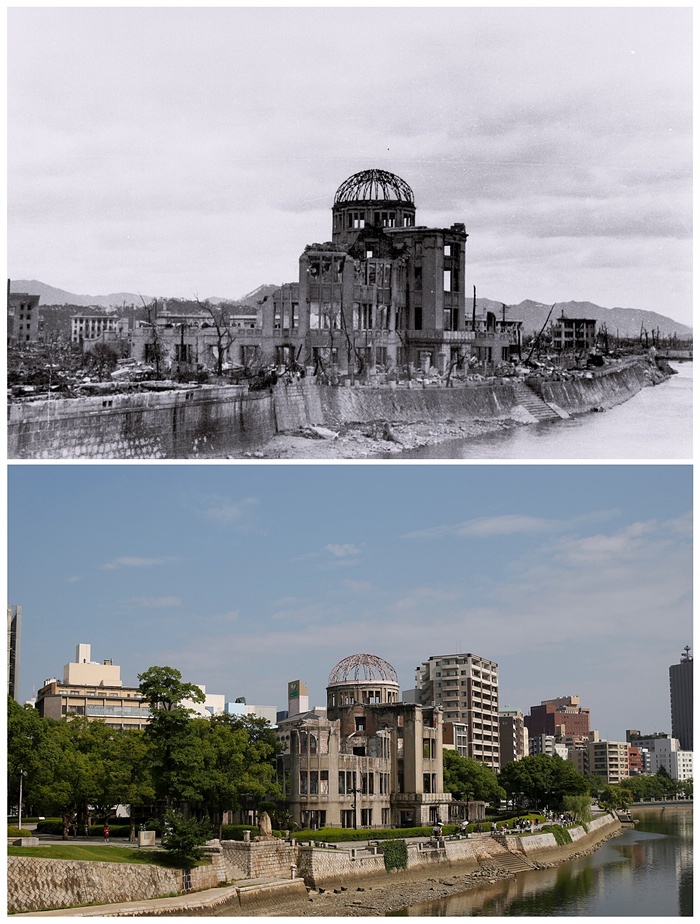
Blowing in the Wind: Hiroshima and Our Addiction to Violence

hiroshima
With so much political posturing dominating the news this week there seems to be little notice in the U.S. that today is the 70th anniversary of the first atomic bomb dropped on Japan. I’m sure the date is not forgotten in Hiroshima. August 6, 1945 has been a somber day for me ever since I learned about it in school. Even though I wasn’t born until 15 months after it occurred, what happened in that Japanese city at 8:15 that morning changed the world I was born into forever.

Diana and I visited Japan several years ago, and the horror of that event was made even more real. As we stood on the very spot where so much death and devastation took place, we saw pictures and read accounts of the unbelievable power unleashed on that city, of the 70,000 people who were annihilated by the blast and perhaps 200,000 more who died later after horrible suffering from radiation poisoning.

Many arguments about the pros and cons of the decision to drop that bomb and the one 3 days later on Nagasaki have been offered, and I appreciate that ethical and political debate. The truth is that whether dropping the bombs was justified or not, the atomic genie can’t be put back into the bottle. The question as always is what to do now with the reality we have.

I am haunted by Einstein’s assessment of the significance of this day. He said, “The splitting of the atom changed everything, save man’s mode of thinking. Thus we drift towards unparalleled catastrophe.” Yes, we have managed to avoid nuclear annihilation for 70 years, and that’s a good thing. Except for the people unfortunate enough to live near Chernobyl or Three Mile Island or Fukushima the human race has been smart enough or lucky enough to avoid nuclear disaster. We will probably never know how close we have come on many occasions, and the tensions with Russia and Iran and North Korea, not to mention the threat of nukes falling into the hands of terrorist groups, mean we still have not changed the mode of our thinking.

Why has humankind always used every new technology to develop more deadly ways to maim and kill each other? Every advance in science seems to carry with it a dark side of destruction. Chariots, horses, airplanes, ships and rockets become delivery systems for death. Chemical gases, Nobel’s invention of dynamite, even pressure cookers can and have been turned into weapons—just the opposite of the biblical vision of beating “swords into plowshares, and their spears into pruning hooks; nation shall not lift up sword against nation, neither shall they learn war anymore.” (Isaiah 2:4)

A friend emailed me a piece today about the positive uses of drones to deliver medicine with the comment that drones have been getting bad publicity lately. My response was, “No, some idiots flying drones have been getting bad publicity.” It isn’t the technology that is the problem; it is our failure to use it wisely. And that failure usually stems from fear.

Fear is the enemy of the moral courage to change the way we think and stop the madness of violence as the default solution to our conflicts and problems. Another wise friend sent me these statistics yesterday. “In the US we had about 34,000 gunshot deaths in 2013, two thirds of which are actually suicides. Germany had about 200, and Canada and Britain had even less. Somebody has to have the moral courage to say that this is crazy, to have 300 million firearms in one nation, and that all it does is to lead to thousands of deaths.”

There is an old folk song that asks a question that is as relevant today as it was in 1945 or when Bob Dylan asked it in 1963: “How many deaths will it take till we know that too many people have died?” Dylan’s answer was that “the answer my friend is blowing in the wind.” I don’t know if Dylan knew that the Hebrew word for wind, “ruach,” is also the word for “spirit” and “breath.” So that song for me says the answer is blowing in the life-breathing spirit of God, and only there.

The answer is not more and bigger bombs. The answer is not more guns. The answer is to examine our fears that drive us to build gated communities, to propose building walls on our borders to keep others out. Instead of repairing roads, educating our children, alleviating poverty, and addressing social injustice, we spend obscene amounts of money and resources on defense because we are afraid. The gun lobby sells more and more automatic weapons that have no purpose but to kill other people because we are afraid. Wealthy lobbies buy more and more congressional votes because our legislators are afraid to take courageous stands that will cost them their office and lifetime benefits. The church is silent about being peacemakers and turning the other cheek because we are afraid those unpopular views will cost us members and contributions.

I started a series a few months ago on Pentecost and the power of the Holy Spirit as described in Acts 2 (see posts from May 26 and June 14). I haven’t finished that series because other issues keep grabbing my attention. I didn’t realize when I started this post that I would come back around to Pentecost.

“When the day of Pentecost had come, they were all together in one place. And suddenly from heaven there came a sound like the rush of a violent wind, and it filled the entire house where they were sitting. Divided tongues, as of fire, appeared among them, and a tongue rested on each of them. All of them were filled with the Holy Spirit.” (Acts 2:1-4)

The forces of fear are powerful and real and require an even stronger power to overcome them. They cannot be conquered by any human technology or ideology. Fear paralyzes our ability to reason and recognize the futility and foolishness of our attempts to save our lives and our stuff through arms. We can learn a valuable lesson from Alcoholics Anonymous about our addiction to bigger and badder weaponry or security systems. AA knows we cannot conquer an addiction without surrendering to a higher power.

That higher power blew through Jerusalem on Pentecost and changed lives and the world forever. And the answer to stopping the violence in our theaters and schools and churches and to defusing the nuclear nightmare is still blowing in the ruach of God.

Blow, holy wind, blow away our fears.

Look, We CAN Communicate: Pentecost, Part 2, Acts 2:5-13

My Ph.D. in Communication is both a blessing and a curse. The curse is that when people know I studied communication at the graduate level they actually expect me to be able to communicate. My excuses that my research was theoretical and in rhetoric and public speaking, not in “normal” interpersonal discourse always fall on deaf ears. I sometimes feel like the undergrad who signed up for a course in interpersonal communication only to be very disappointed the first day of class when he discovered that the course catalogue description of a course about “human intercourse” was not exactly what he expected.

You don’t need a doctorate to know that communication is hard. Words are just symbols that represent objects or feelings or relationships. As symbols they can only point to the reality they represent. Communication goes through different filters of both the sender and receiver of the communication, and those filters are unique to each person. And of course communication occurs on multiple levels – verbal, non-verbal, emotional, rational, and all of those are culturally conditioned and affected by other environmental and genetic factors. This explains the popular success of John Gray’s book, Men are from Mars, Women are from Venus.

Sometimes the challenges of communication produce humorous and embarrassing results. For example, “The V-for-victory sign was immortalized by Winston Churchill in the early, dark days of World War II, and the proper form is with the palm facing outward. But, a simple twist of the wrist puts you in dangerous cultural waters. Throughout much of Her Majesty’s realm, the palm-in V sign is the equivalent of the more infamous middle-digit salute.” (See the article by William Ecenbarger of the Philadelphia Enquirer for many other valuable tips on cultural competence, http://articles.philly.com/2009-02-22/news/25280966_1_taxi-driver-mumbai-desk-clerk.)

The Hebrew Scriptures explain the origins of different languages in various parts of the world via the Tower of Babel story in Genesis 11. In that story it is human pride, a belief that humans could build a tower tall enough to reach to the heavens and establish their importance that leads to this judgment from God: 6 And the LORD said, “Look, they are one people, and they have all one language; and this is only the beginning of what they will do; nothing that they propose to do will now be impossible for them. 7 Come, let us go down, and confuse their language there, so that they will not understand one another’s speech.”

That story is a mythical way of explaining the reality that languages are unique to different cultures, countries and ethnicities. While I don’t believe God would throw that kind of monkey wrench into the communication machinery as a punishment for our pride, the language barrier is a major challenge to communication. There is a joke that defines “multi-lingual” as a person who speaks 3 or more, “bilingual” as a person who speaks two languages, and someone who speaks only one language as “an American.” That unfortunate state of affairs was demonstrated in a grocery checkout line when a woman finished a cell phone conversation in her native tongue. The man behind her in line said to her, “Excuse me, ma’am, but this is America and we speak English here. If you want to speak Spanish, go back to Mexico.” The woman calmly replied, “Sir, I was speaking Navajo. If you want to speak English, go back to England.”

The task of bridging cultural differences and communication challenges in our global village is very daunting. Technology offers help through on-line language lessons, apps and programs that automatically translate text from one language to another, and systems like the one at the United Nations where people from all over the world can hear a translation of a speaker’s words into their own language through a set of headphones. But those technologies do not solve the deeper spiritual divisions at the root of human suffering that manifests itself in prejudice, racism, economic injustice, terrorism and full scale war.

The on-going cultural and religious conflicts in our world are proof that we’ve a long way to go to overcome our failures to communicate. The Pentecost story in Acts 2 addresses those concerns, not from a technological or academic perspective, but from a spiritual point of view. Acts 2: 5-13 describes it this way: 5 Now there were devout Jews from every nation under heaven living in Jerusalem. 6 And at this sound the crowd gathered and was bewildered, because each one heard them speaking in the native language of each.7 Amazed and astonished, they asked, “Are not all these who are speaking Galileans? 8 And how is it that we hear, each of us, in our own native language?9 Parthians, Medes, Elamites, and residents of Mesopotamia, Judea and Cappadocia, Pontus and Asia, 10 Phrygia and Pamphylia, Egypt and the parts of Libya belonging to Cyrene, and visitors from Rome, both Jews and proselytes,11 Cretans and Arabs—in our own languages we hear them speaking about God’s deeds of power.” 12 All were amazed and perplexed, saying to one another, “What does this mean?” 13 But others sneered and said, “They are filled with new wine.”

Jews and non-Jews from all over the world hear the apostles sharing their faith story in their own language. This is not some ecstatic, unintelligible speaking in tongues, but genuine communication made possible by the power of the Holy Spirit. These apostles are not educated linguists. They are common fishermen and tax collectors. They have not suddenly been empowered by Rosetta Stone; they are filled with the only force capable of overcoming human fear and division. At Pentecost the confusion of tongues from the Tower of Babel story is reversed and the response of those who have ears to hear the Gospel is both amazing and confusing.

People from all over the world have come to Jerusalem for the Pentecost Festival and some are apparently there on other business – Romans, Cretans and Arabs. The story shows us that as insurmountable as our communication barriers are, be they religious, cultural or political, we cannot just throw up are hands and say “we can’t do that!” Whatever happened in Jerusalem that day, this story makes it very clear the “this is impossible, we give up” excuse simply will not fly. It is easy to despair and say the hatred and divisions in our world today between Islam and the West, for example, are not amenable to any simple communication skills. Anyone who thinks so must be filled with new wine or smoking those funny weeds.

But this story counters with evidence that the Acts 2 audience is exactly like our multi-cultural world. A cross section of the whole world, people from Asia Mesopotamia, Judea, Egypt and Libya are identified; and the message is clear. Because they have received the gift of God’s spirit, a spirit of unity and love that is universal and offered to all of God’s creation, these apostles are able to overcome all of the cultural and communication barriers and share their amazing transformation stories in ways that are heard and understood.

That is a word of hope that our war-weary world desperately needs to hear. We may see no hope for peace and justice because we rely too much on human ways of dealing with our problems. We still think we can build towers or systems or networks that will make us the heroes and heroines of our story. The problem is it’s not our story. And when our best efforts fail, in desperation and fear we think destroying our enemies will bring peace in spite of centuries of evidence that violence and death only beget more of the same.

God’s answer that is blowing in the wind of Pentecost is that the transforming power of the God of the whole universe is the only hope for overcoming human differences and conflicts. The God of Parthians, Medes, Elamites, and residents of Mesopotamia, Judea and Cappadocia, Pontus and Asia, Phrygia and Pamphylia is still the God of Americans and Syrians, of Islam and ISIS, of every soul that breathes; and those who dare to believe that are not crazy or filled with new wine. We are filled with the Holy Spirit of the Source of our being, and we speak a language of peace and grace that everyone can understand because it is the message that the world is longing to hear.

Peter’s summary of that message follows in Acts 2:14-36 and will be addressed in the next segment of this series on Pentecost.

(All Scriptures are quoted from the New Revised Standard Version)

A Prayer for Living the Dream

As we honor Dr. Martin Luther King Jr. it is a good time to renew our commitment to follow Jesus and all the prophets who call us to lives of peace and justice. Today we pray for all of our sisters and brothers who live in fear of violence and terror in Africa and Europe, or the Middle East and here at home.

O Creator and Sustainer of all, we ask you to speak words of comfort and hope to us today. With depressing news bombarding us about climate change, racial tensions, and violence in all parts of the world, we hunger and thirst for the strength and renewal of our spirits that you alone can provide. When so much of the terror and violence we see is fueled by misdirected religious fervor fed by insecurity and self-justification, it is easy to despair and wonder if Dr. King’s dream is still alive.

Remind us, O God, of how far we’ve come since Selma, even as we struggle with how far we have yet to go. And especially remind us again that the dream Dr. King articulated so beautifully with his words and his life was not just his dream. It was a dream of liberty and justice for all that echoes through the ages: from Deuteronomy’s hospitality for aliens and strangers, to Isaiah’s lions and lambs lying down together and Micah’s swords beaten into plowshares, to Jesus’ command to love one another, even those who persecute and revile us. It is a dream preserved by more recent prophets like Jefferson, Lincoln, Harriet Beecher Stowe and Sojourner Truth, by Gandhi, and Mother Theresa and Pope Francis and millions of unknown saints who witness to their faith by daily random acts of kindness.

Parents and teachers, mentors, coaches, nurses and caregivers, missionaries and friends—all doing a small but vital part to pass on the torch of freedom that violence and fear can never extinguish – because it is not our dream. It is ultimately an eternal dream for all of creation that springs from an infinite source of Hope and Trust in the author of that dream.

It is undying faith in you, eternal God, that enables us even in dark times to know with confidence deep in our hearts that with your help we shall indeed overcome – overcome the forces of hate and violence someday. And in that assurance we dare to pray and live in the name of Jesus Christ, who calls us all to keep his dream alive. Amen.

Northwest UMC, Columbus, OH, January 18, 2015

Freedom to Speak the Truth in Love

The killings and demonstrations in Copenhagen, cyber attacks and threats in response to Sony’s movie The Interview and the recent massacre at Charlie Hebdo’s offices in Paris have put the issue of freedom of expression on the front burner of media coverage and public discourse. Freedom of speech and freedom of the press are so critical to Western and American values that they are number one in the U.S. Bill of Rights. The international outpouring of protest and sympathy captured in the “Je Suis Charlie” movement is further evidence of how close to home this tragedy has struck.

Emotions run high when core values are threatened. As much as I believe in non-violence, even I am tempted to despair that we are on the brink of a horrible and perhaps inevitable violent confrontation between radical Islamists and the West.

In hopes of tempering emotional reaction with reason, I am reminded of two favorite quotes as I try to sort out my thinking on these complicated issues. I was introduced to the first many years ago in a book by Frederick Buechner entitled Telling the Truth: The Gospel as Tragedy, Comedy and Fairy Tale. Buechner likens the task of preaching to the final lines of Shakespeare’s King Lear where Edgar says, “The weight of this sad time we must obey; speak what we feel, not what we ought to say.”

As one who grew up in a family with the “unspoken” (of course) motto “If you can’t say something nice, don’t say anything at all,” saying what we feel is a radical notion and essential to freedom of expression. Saying only what one ought to say may be polite and tactful, but it is also a subtle form of censorship.

The question that must be addressed in this debate is where does one cross the line between freedom of expression and disregard for the feelings and values of other human beings. In the global information age where words and images circumnavigate the world in seconds what one says has far wider impact than ever before in human history.

The Sony and Charlie Hebdo cases provide excellent examples of that point. Unrestricted freedom of expression says we can make a movie about the assassination of a foreign leader or publish satirical ridicule of a figure considered to be a holy prophet by millions of people, but does the freedom to express those feelings justify the damage done to human relationships already stretched to the breaking point in our world?

Let me be perfectly clear that I am not saying that taking offense to any form of expression ever justifies violent reprisals. I am merely calling for more reflection on potential consequences of what we say and how we say it. Anger and conflict are natural human realities. (See my blog post “Prince of Peace,” April 1, 2014 for a more detailed discussion.) And because the Information Age makes interaction between different cultural values inevitable, it is imperative that we find non-violent ways to manage conflict while protecting basic human freedoms.

One way to do that is found in Ephesians 4:14-15, “We must no longer be children, tossed to and fro and blown about by every wind of doctrine, by people’s trickery, by their craftiness in deceitful scheming. But speaking the truth in love, we must grow up in every way into him who is the head, into Christ…” To “speak the truth in love” means a mature balance that is necessary between freedom of expression and consideration for other peoples’ feelings.

That does not mean failing to speak the truth, but it adds the critical dimension of thinking about how the truth is presented. Fred Craddock, another of my preaching mentors, says the preacher’s job is not to get things said, but to get them heard. That is true for all human communication and requires sensitivity and respect for one’s hearers to guide the choice of words and images we share with the world – and every tweet, whisper, Instagram, post and conversation has the potential for that kind of global sharing.

One of the lies many of us were told as children is that “sticks and stones may break my bones, but words will never hurt me.” Not true. Words and images have tremendous power to hurt and to heal; so use them wisely. Yes, the weight of these sad times demands that we say what we feel, but the peace and well-being of our world depends on our ability to learn to deliver that truth wrapped in love, even for those who call us enemy.

“How Can We Ever Do That?”

I have preached over 800 times in my ministerial career. Of all those sermons, none has stuck in my memory as much as the one I preached on September 23, 2001, 12 days after 9/11. As I was reflecting on that horrible event and the continuing scourge of violence in our world today I decided to revisit that sermon, and I found the words of Jesus that inspired that sermon as relevant and as troubling now as they were 13 years ago. So as I pray for peace for a world seemingly bent on destruction, I share these reflections again. The sermon was preached at Jerome United Methodist Church on the text from Matthew 5:38-48 on loving one’s enemies.

This week was harder for me than last week and not just because I was struggling with what to say here this morning. The suffering and agony of the whole terrorist ordeal became personalized and real for me this week. 3000 victims in the abstract last week were more than my mind could wrap itself around. But as individual stories emerged of real people with real names, victims and families and heroes and heroines, my already bruised and battered heart was broken over and over again.

But from the very first hours of the tragedy my greatest pain and fear was not for the damage and suffering that occurred on September 11, as unbelievably horrible as it was. My greatest pain and fear has been for the inevitable escalation and perpetuation of violence that I knew these horrible acts would generate in retaliation that will inflict more suffering on more innocent people.

A friend of mine told me just after the attacks that he had forgotten how easy it is to be a Christian in times of peace and prosperity. And he is very right. We turn to God and scripture for comfort and reassurance in times of distress, as well we must and should, but some of the most important words of scripture also challenge us and are hard to hear.

And that’s why I have been engaged in a lovers’ quarrel with Jesus for the last 12 days over what to say this morning. I have tried every trick I know to avoid the difficult words we just heard from the Sermon on the Mount–these words that are high on the list of those we wish Jesus hadn’t said, but they would not let me rest. They have forced themselves into my consciousness over and over again, pleading, demanding, and crying out to be proclaimed.

“You have heard it said…” O, have we ever – all the public opinion polls confirm in spades that those who want revenge are legion, and I include myself in those who are angry. Getting even is a natural human reaction, and we’ve all been there many times this month. “You have heard it said, an eye for and a tooth for a tooth.” Sounds like good advice. In fact, at the time those words were written, they were designed to limit revenge; so victims would not demand two eyes for an eye, or a whole mouthful of teeth for a tooth. But as someone has said, if we follow the eye for an eye and a tooth for a tooth philosophy to its logical conclusion, we end up with a world full of blind, toothless people, and the cycle of violence and pain continues forever.

“But I say to you…” Look out whenever Jesus starts out with that phrase and brace yourself for a zinger. “But I say to you, love your enemies. If anyone strikes, you on the north tower, turn the south tower as well.” O, Jesus, you’ve got to be kidding! We can’t do that! You can’t be serious. How can we possibly love those responsible for such horrific acts of death and destruction?

But Jesus isn’t alone on this one. I’m not sure to whom this letter was written, but a copy of it was circulating on the internet this week; and it contains a very similar thought from a leader of another of the world’s great religions, the Dalai Lama. He writes, “It may seem presumptuous on my part, but I personally believe we need to think seriously whether a violent action is the right thing to do and in the greater interest of the nation and people in the long run. I believe violence will only increase the cycle of violence. But how do we deal with hatred and anger, which are often the root causes of such senseless violence? This is a very difficult question, especially when it concerns a nation and we have certain fixed conceptions of how to deal with such attacks. I am sure that you will make the right decision. With my prayers and good wishes, the Dalai Lama.”

I couldn’t agree more with this analysis, and I have been pleased to hear more of these sentiments this week than I expected, but practically it’s not all that helpful. Of course violence begets more violence. Those who live by the sword die by the sword. We know that and want to believe peace is an achievable ideal. We’ve seen the failure of wars to end all wars and we want to be faithful Christians and follow the ways of the Prince of Peace. That’s all well and good in the abstract, but the question I want Jesus or the Dalai Lama or somebody smarter than I to answer is, HOW do we love our enemies? How do we love someone who can do to our nation what these terrorists have done?

Jesus says a bit earlier in the Sermon on the Mount, “Blessed are the peacemakers, for they shall be called children of God.” By whom? Not by their enemies or by most of their peers. Peacemakers, cheek turners, are more often called “yellow” and “coward” or “chicken,” but seldom even “children of God.” We would much rather go with Moses on this one wouldn’t we, but are we followers of Moses or Jesus?

It is hard to find silver linings in some clouds, but even in tragedy there are some benefits. We see it in extended families that rally around each other when there is a death of illness. And in a similar fashion, the outpouring of patriotic spirit and resolve in the last two weeks has been amazing. One could certainly argue that this tragedy has created a sense of community that has been sorely lacking in our nation for many years. But Jesus asks us to take that sense of community one giant step further–to include even our enemies in the circle of God’s family.

I had a flashback to Jr. Hi youth fellowship this morning. One of those awkward moments when we were circling up to say the benediction at the end of a meeting, and I found myself next to a girl and was afraid I’d get her cooties if I had to hold her hand. And some wonderful adult counselor saw the problem and stepped in between us to close the circle. That’s just what Jesus does when he asks us to love our enemies. When we can’t bring ourselves to take that hand, Jesus steps in and completes the circle.

This doesn’t mean that justice and order are not necessary for us to be able to live peaceful, secure lives once more. It simply means that our attitudes and methods of seeking justice and peace need to be just and peaceful and loving; so that we do not fall into the trap of perpetuating the very kind of behavior we deplore. The Christian way to the goal of peace and security must be prayer and dialogue, not bombs and bullets. We follow the way of compassion and love and forgiveness. It is not an easy way, but it is necessary. And the best news is that success is guaranteed–guaranteed by the one who walked the talk of that love all the way to the cross to show us once and for all that love is stronger than death, that nothing in all creation, not terrorism or fear or death itself, can separate us from the love of God in Christ Jesus our Lord.

Jesus did it. He practiced what he preached. But how can we love our enemies, even while we deplore their horrible deeds?

I certainly don’t have all the answers–not even all the questions; but it seems to me there are two or three things that are necessary for us to have any hope of following Jesus down this path of loving our enemies.

1) We need to understand who are enemies are and who they aren’t so we don’t over-react in fear against all Muslims or all Arabs, or against everyone who looks different and therefore suspicious.

2) We need to study and learn and discuss so we understand better the complicated political and religious realities we are caught up in. We don’t dare oversimplify or stereotype. Afghanistan is not our enemy – it is a nation in ruins from previous wars and conflicts. Neither Bin Laden and the terrorists nor the Taliban are representative of the Afghan people, and they cannot be equated.

Tamim Ansary, a writer and columnist in San Francisco, who is a native of Afghanistan, writes this interesting and chilling portrayal of his homeland:
“The Afghan people had nothing to do with this atrocity. They were the first victims of the perpetrators….Some say, why don’t the Afghans rise up and overthrow the Taliban? The answer is they’re starved, exhausted, hurt, incapacitated, suffering. A few years ago, the United Nations estimated that there are 500,000 disabled orphans in Afghanistan–a country with no economy, no food. There are millions of widows. And the Taliban has been burying these widows alive in mass graves. The soil is littered with land mines; the farms were all destroyed by the Soviets. These are a few of the reasons why the Afghan people have not overthrown the Taliban. We now come to the question of bombing Afghanistan back to the stone age. Trouble is, that’s been done. The Soviets took care of it already. New bombs would only stir the rubble of earlier bombs. Would they at least get the Taliban? Not likely. In today’s Afghanistan, only the Taliban eat, only they have the means to move around. They’d slip away and hide. Maybe the bombs would get some of those disabled orphans, they don’t move too fast; they don’t even have wheelchairs. Bombing Kabul would only make common cause with the Taliban –by raping once again the people they’ve already been raping all this time.”

3) Perhaps most important, we must practice forgiveness. Someone has written that forgiveness is the key to happiness. The pursuit of happiness is one of our most cherished American ideals, and forgiveness is what it takes to be free of the burdens of anger and hostility that make happiness very illusive.

One of the young widows of this tragedy was interviewed on ABC this week. Her husband was one of the passengers who apparently resisted the hijackers on the Pennsylvania flight and helped keep the tragedy from being even worse than it was. When Diane Sawyer asked this young widow with two small children and a third on the way if she wanted revenge, without batting an eye she said, “No, I don’t want any Arab women to have to go through what I’m going through.” And then to support her position she quoted the Sunday school song we sang this morning, “Jesus loves the little children, all the children of the world. Red and yellow, black and white, they are precious in his sight…” If she can forgive when her life has been altered forever, can we do any less?

I’ve always assumed that forgiveness was for those who have wronged me, but I realized in reflecting on this tragedy that forgiveness is a two-way street. Forgiveness needs to be given, but before it can be given it has to be received; and to receive it, we have to confess our own sin and examine our own contributions to misunderstanding, prejudice, and injustice. To assume we are good and they are bad is far too simple and counterproductive and leads us in the direction of a blind toothless world once more.

To understand why anyone has so much hatred toward our nation, we need to get to know these enemies–to understand what we may have done that we need to be forgiven for. And that dialogue can’t take place over the barrel of a gun or under the shadow of a cruise missile.

How can we love these enemies, or anyone who has done us great harm?

My favorite story about that kind of love comes from another period of unspeakable terror and suffering in human society, the Holocaust. After the war, a young Christian woman traveled around Europe proclaiming the good news of God’s grace and love for everyone who would repent and give their life to Christ. Corrie Ten Boom was a death camp survivor. Her entire family had died in the Nazi death gas chambers, and yet she was filled with God’s love and anxious to tell her story. Until one night when she was giving her testimony and looked out into the congregation where she saw a face that made her blood run cold. Sitting there staring at her from the pew was one of the former Nazi concentration camp guards who had helped to execute her family. She could barely finish her talk and hurried toward the side door of the church as soon as she was finished, hoping to avoid any further contact with this awful man.

But he was anxious to talk to her and met her at the door. He extended his hand as he told her that he had repented and become a Christian, but, he added, it was so good to hear someone like her proclaim the unbelievable good news that God’s love was available even to such a terrible sinner as he had been. His hand was there, waiting for Corrie to take it in Christian fellowship. But her hand was paralyzed, frozen at her side for what seemed like an eternity. The silence was awkward, and even though she knew she should shake his hand, she could not. Finally, she said a prayer. She said, “Lord, if you want me to forgive this man, you’re going to have to do it, because I can’t.”

And just then, Corrie said her hand moved of its own accord. She took the former Nazi’s hand and says she felt the most amazing surge of warmth and power pass between them that she had ever felt in her life.

How can we love our enemies? On our own, we can’t. But with God’s help as followers of Jesus Christ, relying on and empowered by God’s Holy Spirit, we can, we must, and we will.

Thanks be to God who gives us the victory!