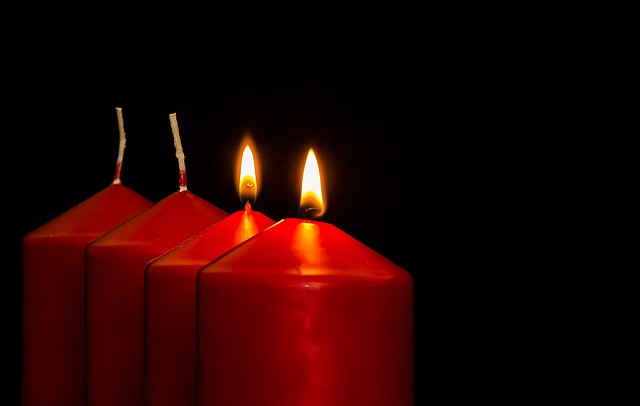
Advent 2: Candle of Peace 2025

“Be still and know that I am God.” Those words from Psalm 46 were given to the people of Jerusalem when their city was literally surrounded by the armies of Assyria. In a time when their lives were in pieces God offers the gift of inner peace. “Relax, breathe,” God says, “Trust me to handle this.”

This second Sunday in Advent is a time to find quiet stillness in our souls because we are in God’s hands. God is the source of inner calm which we must have for peaceful living with our neighbors. We cannot solve the problems of world peace. But each of us is called to be a peacemaker with that neighbor, who votes the wrong way, and with the weird cousin who disrupts family gatherings, and with the co-worker who drives us batty.

Today we relight the candle of hope from last Sunday, and we faithfully light the candle of peace that begins in each of our hearts.

[Light two candles]

Please join me in the prayer on the screen:

Dear God, you are our refuge and strength. Because of you we do not fear when our lives go to pieces. We know the peace that begins when we take time to be still and know you are always with us. You give us a peace that passes all human understanding. You promise us a Prince of Peace, and this Advent season we prepare ourselves again for his coming. Because of his birth in a humble stable we find a stable faith that shows up in peacemaking wherever we are. Amen

Northwest UMC, Columbus, Ohio

Be Still and Don’t Stop Believin’

A couple of Sundays ago when our Ohio October was still summerlike I spent some time in the Chapel in the Woods at our church after Sunday worship. Because of scheduling issues I attended our contemporary service that Sabbath which is not my preference. That Sunday was actually World Communion Sunday, a day that always has special meaning for me, especially in our fractured world today.

On that Sunday our church celebrated World Communion primarily at our traditional service because the contemporary service had been set aside for our annual Blessing of the Animals service. Communion was still celebrated at the contemporary service, along with treats for God’s four-footed critters that came to be blessed.

Needless to say it was a lively and noisy service, which is always fun, but it was not exactly what I needed that day. So, after worship I spent some time praying in our beautiful outdoor chapel and the words that came to me were “Be still and know that I am God.” I have meditated on those words frequently in the days since, seeking the balm they offer in the chaotic world we inhabit just now.

I am embarrassed to admit that I didn’t remember where those words come from in Scripture until I googled them. They are of course in verse 10 of a Psalm I have used dozens of times in funeral services, and the opening verses set the scene powerfully for having faith to be still when life is literally crumbling around us like the East Wing of the White House.

The psalm begins with these words:

“1 God is our refuge and strength,
    a very present help in trouble.
Therefore we will not fear, though the earth should change,
    though the mountains shake in the heart of the sea,
though its waters roar and foam,
    though the mountains tremble with its tumult.”

Those are the opening verses of Psalm 46 which some scholars believe was written as the armies of Assyria were besieging the city of Jerusalem in 701 BCE. Many of us can easily relate. It feels like all the values we thought our country was founded on are under siege.

I could recite a whole litany of things we’ve lost in the last 10 months, but I will focus instead on one of the most recent and egregious violations of Christian morality and Constitutional order. Because of the government shutdown SNAP benefits that help feed 42 million Americans have been cut off for the last 6 days.

There are contingency funds available to pay those food stamp benefits, and that has always been done in every other shutdown we’ve had. The only difference this time is the one who resides in what’s left of the White House.

Two federal judges have ordered the President to release those funds and provide food for hungry Americans, including the elderly and children. But Donald Trump has decided to ignore those court orders so he can use those 42 million people as political bargaining chips in the high stakes game of chicken he is playing with the democrats.

Meanwhile the President has given $40 million of our tax dollars to Argentina which hurts already desperate American farmers. He’s spent millions on unauthorized military action against Iran and Venezuela, and is threatening to do the same in Nigeria. But he refuses to even negotiate with democrats about skyrocketing health care premiums or to follow court orders and feed hungry people.

It seems useless to remind Washington about what Jesus said about feeding the least of these, although I have done so repeatedly with my three Republicans representatives in Congress. The tone deafness of this administration to calls for empathy and justice for our fellow human beings certainly feels like basic human decency is under siege.

How can we not wonder if God really is our help and refuge? Where is God’s help in this all too real time of trouble? As I typed those words, and I’m not making this up, a notification popped up on the top of my iPad screen that said “Don’t Stop Believein’!” That message came because the rock band Journey is coming to Columbus, OH next summer, but the timing of that message seemed way too relevant to be just a coincidence.

And that seems to be what the psalmist is saying to the besieged, hopeless folks in Jerusalem surrounded by the mighty armies of Sennacherib.

“God is in the midst of the city; it shall not be moved;
    God will help it when the morning dawns.
The nations are in an uproar; the kingdoms totter;
    he utters his voice; the earth melts.
The Lord of hosts is with us;
    the God of Jacob is our refuge.[c] Selah

Come, behold the works of the Lord;
    see what desolations he has brought on the earth.
He makes wars cease to the end of the earth;
    he breaks the bow and shatters the spear;
    he burns the shields with fire.”

And because of God’s ultimate rule of the whole universe, no matter how bad things seem at this or any moment, personal or in history, we can
10 “Be still, and know that I am God!
    I am exalted among the nations;
    I am exalted in the earth.”
11 The Lord of hosts is with us;
    the God of Jacob is our refuge.”

On Ash Wednesday last year we had an experiential worship service, and one of the things we were asked to do was create something from clay that was symbolic of the meaning of the season of Lent. I made this symbol which is still on my desk:

Some people thought it was a fish, which would be ok; but that is not what I was going for. I started out with an infinity symbol and then made one end into a heart. For me it symbolizes the only thing we can really count on and the only thing we need – God’s Infinite Love.

That ‘s what enables me at times to be still and know God’s in charge, even when the infidels are literally not only at the gates but in the seats of power.

Jerusalem was reborn from the ashes and somehow, someday the land of the free and the brave will be also. Be still and don’t stop believin’.

Contentment in Any Role

“All the world’s a stage,
And all the men and women merely players;
They have their exits and their entrances,
And one man in his time plays many parts…”

Those lines from Shakespeare’s “Mid Summer Night’s Dream” have been floating around in my head for quite some time. But I did not remember until I looked up the quote that it is the beginning of a monologue about the stages of life from infancy to death.

Being 78 and a cancer patient I have spent more time than I like thinking about my mortality, and that whole monologue that describes 7 stages of life fits right into that conversation in my head.

The questions I want to ask about that metaphor are two: What do you do or how do you cope when you don’t get the part you really want? And what about the times you get stuck with a part in the play of life that you really don’t want?

I’m guessing we’ve all been in both of those situations. When I was a sophomore in college a young woman I had been in a serious relationship for almost two years informed me I was no longer needed in the play of her life. She had a good reason, and I appreciated her sharing it with me. I was still devastated, but she helped me understand the break up wasn’t just about me personally; but about a career path I had chosen that she wanted no part of.

Earlier that year I had decided to switch majors from engineering to philosophy in preparation for going on to seminary after college. In other words I had opted for a very different part in a totally different play, and she did not want to play the role of a pastor’s wife. There are very good reasons to say no to what can be a very challenging unpaid, high expectations job, and I understand that better now than I did way back then. I also understand that I undoubtedly made the situation worse by making that important career decision without ever discussing it with her. Yes, I was still working from an old script where wives are subservient to their husbands.

The second half of the 20th century was a confusing time to be playing a romantic role. The old scripts of how men and women related were being thrown out, and new ones were still being written. Societal norms about sex, race, war, and peace were all in a state of flux. Life was like improv theater – we were all making it up on the fly.

That flux had major impact on the job market as well. We didn’t call it DEI back then, but in liberal circles where I played my roles as student and pastor and teacher the civil rights and women’s rights movements spurred efforts to increase diversity in the workplace and on faculties. As a white male that was a personal disadvantage to me. I had my heart set on a particular professorship when I finished my doctoral work and thought I had a good shot at it. I had been teaching at this school as an adjunct professor for two years, and my student evaluations were excellent.

Little did I know that the position had already been promised to a black woman who had taught there before me as an adjunct and left to do her PhD. I was disappointed, especially since I had turned down a role as a pastor at a church I had always admired earlier that year. Sometimes we don’t get to play the part we want or even be in that particular play, but in this case I did understand and agreed with the school’s priority on building a more diverse faculty. When I had been a student there 20 years earlier the entire faculty and administration was white and male, and the student body was 98% the same.

But to circle back to Shakespeare’s take on the stages of life as the roles we play from birth to death, I find his list rather limiting. He spends little time on the variety of parts we might play in adulthood, and I realize that life expectancy back then was much shorter than it is today. With advances in health care a productive adult life can last 50 or 60 years and may include several different careers, sometimes simultaneously.

I was a pastor, a teacher, and a university administrator in a period of 38 years of full time employment, and then spent 11 years in retirement doing all of those things on a part-time basis. But concurrent with those roles I was also a son, husband, father, brother, author, golfer, skier, softball player tennis player, runner, and friend.

But here’s my existential question for this stage I am acting on just now. In the last 8 months I have played parts I didn’t want, namely icu patient, cancer patient, and one dealing with a whole host of other old age maladies. What do we do when life throws us a curve and we find ourselves playing parts in our life drama that we never auditioned for? As I told my son a few months ago — I liked the roles I played in my 40’s and 50’s a whole lot better than this role as a senior citizen.

I can’t think about this dilemma without remembering St. Paul who had some affliction he calls “a thorn in the flesh.” We don’t know what the thorn was, but here is what Paul says about it: “Therefore, to keep me from being too elated, a thorn was given me in the flesh, a messenger of Satan to torment me, to keep me from being too elated. Three times I appealed to the Lord about this, that it would leave me, but he said to me, “My grace is sufficient for you, for power is made perfect in weakness.” (II Corinthians 12:7-9)

I don’t know about you, but if I were in Paul’s situation I wouldn’t be too thrilled with that answer. But God’s ways are not our ways, and being a man of great faith Paul was able to make peace with that thorn. He writes in Philippians 4:11, “I have learned in whatever state I am, to be content.” I’m not there yet with the parts I am playing in this stage of my life.

I am not content with my chronic pain. I am not content giving up most of the activities I used to enjoy. I am not content watching the country I love being destroyed by wanna be dictators and oligarchs. I am very uncontent to watch God’s beautiful creation on earth being destroyed by corporate greed that values short term profits over long term preservation of the planet.

Given all those things that disturb my contentment and peace which are important I have to realize that the stress they create in me are not healthy and in fact make me less able to respond to any of them. In spite of all the problems in our nation and the world there is still great beauty and kindness if I shift my attention to observe them and express gratitude for them. And that’s the point of Paul’s wise words just before the ones about being content. And therein lies the secret to his peace and contentment.

Here is what he says: “Finally, brothers and sisters, whatever is true, whatever is honorable, whatever is just, whatever is pure, whatever is pleasing, whatever is commendable, if there is any excellence and if there is anything worthy of praise, think about these things. As for the things that you have learned and received and heard and noticed in me, do them, and the God of peace will be with you.” (Philippians 4:8-9)

That’s a pretty good script to play from at any age and on any stage. Break a leg.

Now What? A Car Wreck?

Come on, God. I don’t believe you micromanage our lives, but it sure seems like you are testing my faith and patience this summer. The fun began in May with an ugly family feud that is still going on. June brought my hiatal hernia surgery and recovery from that through most of July.

August’s first surprise literally began just after midnight on August 1st when I got so dizzy I couldn’t walk, stand, or even sit without falling over. That episode is described in detail in my recent post, “ICU Life Lessons” from last week. The upshot of that experience was a 6-day hospital stay for low blood pressure and low hemoglobin, both caused by a bleeding ulcer.

Three pints of blood and two endoscopies resolved those issues, and I have been recovering at home for the last four days, feeling stronger each day. And then tonight the next challenge to my patience came in a flash when another driver sideswiped my car by cutting into our lane too soon, wiping out my side mirror and knocking my front bumper askew. Dealing with that at 70 mph was scary, but we’re grateful that my Toyota Venza is much heavier than her Chevy Spark; and neither one of us lost control.

No one was hurt and the other driver stopped to exchange information with us; so things could have been much worse. But I know all too well the hassles of what comes next as I have to deal with insurance companies again. I say again because the claim on my last accident when someone failed to yield right of way, pulling in front of me and totaling my previous car has still not been totally settled. That accident occurred almost 3 years ago and for reasons beyond my comprehension my lawyer has not managed to close the case.

Dealing with insurance company stress is not what the doctor ordered for my recovery. But I will continue praying for the patience to be content in whatever state I am in. I do believe, Lord. Please help my unbelief. Amen

Into Your Hands

I am one of the narrators for our church’s Good Friday cantata, “The Shadow of the Cross.” At the conclusion of the cantata each narrator will share one of Jesus’ last words from the cross. My line is “Father, into your hands I commend my spirit.” This opportunity has forced me to think about how to interpret those words.

Were they uttered in exasperation? “I give up God. You’ll have to take it from here!” Or maybe just a plea for help? Another way of expressing a feeling of abandonment or defeat, even anger? Luke 23:46, the only Gospel that contains this particular phrase, prefaces the words with “Jesus cried out with a loud voice,” which might support that kind of interpretation.

But Psalm 31:5, a source Jesus could have drawn upon, says, “Into your hand I commit my spirit; you have redeemed me, O Lord, faithful God.” That context seems to support what feels right to me. I believe this phrase expresses a surrendering and acceptance of death in all its forms to a mysterious power that makes all things new. They are uttered in the sure and certain belief in resurrection.

For Luke that is all there is to say, and he adds: “Having said this, he breathed his last.” For Luke this is the last of Jesus’ last words. That’s a great exit line, but how do average folks like us truly believe and trust that mystery? As one feeling much too close to the daunting age of 80 that question has taken on more and more significance for me.

Delivering these important words from the cross reminds me of the characters in Nikos Kazantzakis’ novel, “The Greek Passion,” where people in a Greek village take on the various roles in the story of Christ’s passion and so identify with their characters that they become them. The man portraying Judas is driven out of town for his betrayal of Jesus, and the man portraying Jesus, offers himself as a sacrificial lamb, confessing to a murder he didn’t commit to save others from being executed.

Obviously my one liner is not nearly as intense, but it feels like it can still be powerful and transforming for me and maybe others if the Holy Spirit works through me. It is always a heavy responsibility to speak hope into darkness, and God knows things are plenty dark just now, even days before the solar eclipse passes through our state. 

Help me Holy One.  I believe; help my unbelief.

Put Out Into the Deep – or Shallow

Because of multiple life contingencies I have gotten out of the habit of swimming for exercise in recent months. After two years of very faithfully swimming 2 or 3 times per week travel, injury, spring yard work, and other forms of exercise have usurped the time previously devoted to time in the pool. I had forgotten that swimming is more than just physical exercise for me. It is also a form of meditation and solitude that other forms of exercise do not readily offer. So as I have begun to swim again in the last two weeks I have been reminded of those other benefits of time in the water. I had two radically different but essentially similar experiences in my swimming last week and this.

Thanks to Silver Sneakers (a wonderful insurance benefit for seniors) I have memberships at both our local YMCA’s and a private gym with a small pool. Last week I swam at the private gym and literally had the 4-lap pool entirely to myself for the 20 minutes I was there. It was as peaceful and quiet as any place I can imagine. By contrast this week I went to one of our Central Ohio YMCA’s and almost left without swimming. The cool weather we are having this week meant that the outdoor pool at the Y was closed and consequently the shallow end of the indoor pool was filled with a gaggle of elementary age kiddos making a joyful noise to the Lord or to someone!!

Being a devout introvert I was at first put off by all the noise. As I hesitantly walked into the pool area to see if there was even a lap lane available one of the life guards said to me, “Welcome to the party!” He also pointed me to an open lane which was of course right next to the semi-organized chaos in the shallows where brave high school-aged counselors were riding heard on the younger kids. The guard said I might get a stray beach ball in my lane but otherwise said it was all mine.

These two diametrically opposed scenarios turned out to be essentially the same however once I put on my snorkel and began swimming my laps. With my head submerged in the water I was totally alone in silence, repeating the mantras I use to turn my swimming time into one that is also meditation.

Finding time and space for solitude is increasingly difficult in our extroverted and fast-paced, multi-tasking culture. It requires a great deal of discipline to carve out such time and space in most of modern life, but nothing I have found works as well for me as donning a snorkel and submerging myself in the amniotic, baptismal water of a pool or pond. It doesn’t require deep sea diving experience or equipment. My head is never more than a few inches below the surface of the water, but those few inches filter out all the external distractions. And if I can also quiet the inner noise of my worrisome mind I am as close to a mystical peace as I have ever been.

It reminds me of Luke 5:4 where the disciples have been out fishing all night and have nothing to show for their labor. Jesus tells them to “put out into the deep and let down their nets.” Peter argues that they have been there and done that, but if you say so we’ll try again. It’s like Peter is humoring this carpenter. It makes no logical sense, just like swimming a few inches below the water should not silence all the noisy children just a few feet away. But it works. The disciples’ nets are filled to the breaking point because they obeyed, and my initial resistance to the chaos in the pool was transformed by the lifeguard’s positive attitude to reframe the child-like exuberance into an invitation to a party.

Your quiet place may be someplace entirely different than mine, but we all need one where we can “put out into the deep” of the mystery of existence.

Unbound: Lazarus was, are we?

What do tennis, hiking, golf, biking, jogging, working on a ladder, and skiing all have in common? They are all things I have had to give up in the last 10 years due to the aging process. I was talking to a friend my age who has given up even more things than I, and when I described my emotional state as “feeling empty” and not having anything to fill the space left by all I’ve lost. The words were barely out of my mouth when my friend said, “That’s exactly how I feel!” Like all of my friends, we have often joked in years past about old people always complaining about their aches and pains all the time, but more and more as we navigate our 70’s we find ourselves doing exactly the same thing.

I remember about 12 years ago asking an “older” gentleman what he was doing in retirement. Without missing a beat he said, “Going to doctor appointments and funerals.” I thought that was funny back then, but I’m not laughing anymore. When I told my friend that I was seeing a counselor about my feelings of emptiness and depression his response surprised me. After asking if the therapy was helping he said, “Thanks for sharing that. I always thought you had it all together. But knowing you are feeling the same things that I am makes me feel not so alone.” That wasn’t a “misery loves company” response; that was the blessing of letting down our armor and being vulnerable.

I’m not patting myself on the back, mind you. I have been good friends with this man for over 50 years. We have gotten together for golf and/or lunch monthly for decades until old age took our clubs away. Now like many oldsters we just go to Bob Evans. We’ve developed a trust over the years, but the fact that he still thought I “had it all together” means I’m either a better actor than I thought or I’ve been much less honest with him than I wish I had. I’m hoping this recent conversation will help us stay on a more vulnerable level going forward.

Here’s the good news. In addition to my therapist I am also working with a spiritual adviser, and when I shared this story with him he reminded me that until we empty ourselves of all the busyness and activities that keep our minds off our pain God can’t fill us up with anything else. A light bulb went on for me when he said that because when you hear truth it illumines things around and within you. He helped me realize that instead of resenting the emptiness I am feeling I can choose to embrace it as a gift from God. That doesn’t mean the UPS is going to arrive at my doorstep with God’s gifts anytime soon, and no that’s not because of a supply chain issue. Spiritual growth takes time and a willingness to sit with pain or emptiness awhile.

The Hebrews were in the wilderness for 40 years, not because it takes that long to travel from Egypt to Israel or because Moses refused to ask for directions. Even Jesus spent 40 days in the wilderness wrestling with Satan because deep spiritual growth takes time to mature and ripen. The advice to “be still and know I am God” may sound really simple, but it’s not just a matter of shutting up for a few minutes so God can speak. It means prioritizing time for prayer and silence, and not the kind of prayer where we just tell God what we want or need.

Jacob wrestled with God all night long and was changed forever by that experience. Moses and Elijah both had to go up to Mt. Sinai/Horeb to hear God’s still small voice. I confess I am not good at silence. Even when writing these posts I frequently have a ball game on TV or music on some device. I know I write so much better when I am in a quiet place as I am while I write this, but like Paul I often fail to do the things I want to do and don’t practice what I preach.

The Gospel lesson for All Saints day this year is from John 11, the familiar story of Jesus raising Lazarus from the dead. There are many rich veins of truth to mine in that story, but two stand out for me just now. This chapter contains what every kid in Sunday School loves to memorize, namely the shortest verse in the Bible: “Jesus wept.” This is one of several times in the Gospel narratives that we see Jesus vulnerable and allowing his humanity to show through. Like us he grieves over a loss, even though we and he all know he’s going to restore Lazarus to life.

The second verse in that lesson that grabbed my attention this year was the last one where Lazarus emerges from the tomb all bound up like a mummy. He’s alive but not really. His movement and sight and vision are all hampered by his grave clothes???, and Jesus says, “Unbind him and let him go.”

What are the things that bind you and me and keep us from living abundantly in the reign of God? Are we so stuck in our old ways that as Martha so indelicately puts it in the King James Version, “He stinketh,”. My wife sells a very good air purifier that kills germs and removes odors, even in cars or houses that have been skunked. But even those machines will not remove the kind of stench that comes from us who are spiritually dead and don’t know it.

My prayer is for God to unbind me from the anger, fear and regret that I feel for all the things I’ve lost in this stage of my life. Unbind me, Holy one. Roll away the stone that keeps me trapped in a pity party for my past. Unbind me and let me embrace what is and what will be if I trust you to lead me.

What’s your prayer for new life?

Human Doings

I don’t remember where I first heard this piece of wisdom, but it surfaced from my memory bank today as I was mowing our lawn. The sage advice comes from that philosopher known to my generation as “Old Blue Eyes.” No, you don’t have to Google that, I’ll tell those of you too young to know, it’s Frank Sinatra. One of Sinatra’s many hit song was “Strangers in the Night,” and that song has a profound refrain that goes “do be do be do.”

That nonsense phrase truly became profound for me when someone pointed out to me that if you take the “be’s” out of that phrase all you have left is “do do.”

We all make “to do” lists, and there are even apps that will help you organize your to do list(s), and I’m guessing most of us have more than one. I’ve tried multiple ways to keep, organize, and prioritize my personal and professional tasks over the years, and if anyone tells you that retirement means you can throw your to do lists away, don’t believe them.

Most of you know I’m older than dirt; so I don’t have to worry about dating myself when I reminisce how years ago all the United Methodist pastors I knew organized their lives in a small pocket sized calendar. It came in the mail every year from our denominational publishing house, and it was free; so few of us ever questioned its efficacy. My only complaint about it was that since it also had pages in the black that served as an address book all of that information had to be updated and re-entered into the new little black book every January.

Somewhere along the line I let my human doings multiply, and I had to learn to write smaller to fit each day into a tiny space, and of course because life is full of surprises, to never write anything in ink. So when it was introduced I became an early adopter of the Palm Pilot, remember those? They were basically a digital calendar and address book that replaced paper calendars and Rolodexes in one handy gadget that didn’t have to be replaced or updated every year. And of course the Palm Pilot was soon replaced by iPhones and Androids that could do all those things and serve as a phone too, and eventually took over our lives by adding internet access.

Sorry to get distracted going down memory lane. My initial point was to reflect on being and doing. We all have to do lists regardless of how we record them, but who has a “to be” list? My reflections on that question emerged because I am home alone this week while my wife is visiting family in Texas. I had grandiose plans for the week: to organize my office that resembles the aftermath of a natural disaster, to clear out and donate clothes I no longer need, and even to sort through several drawers in my desk and bathroom which should say “Enter at Your Own Risk!”

Oh, and my to list for this week also included the simple task of assembling a new exercise bike that is still in a million pieces in my basement. I am now more than half way through the week, and not one of those major projects is even started and somehow my to do list is even longer than it was on Sunday. And I have been busy all week – going to doctor appointments, running errands, swimming at the Y to maintain what little physical fitness I have left, and oh yes, dealing with the aftermath of a car accident I had about a month ago.

I may deal with the latter issue in another blog, but suffice it to say for now that I have been somewhat overwhelmed with the complexities of filing insurance claims, arranging rental cars and other transportation, while still trying to keep up with my daily activities as much as possible.

Another big item on my “to do” list for this week was to do some writing. I’ve had multiple ideas for blog posts in the last three weeks but have not had or taken the time to pursue them. So today while mowing the lawn (which should not still be growing in October, right?) I made an executive decision to just stop, put the to do list on hold, and see what emerges if I start trying to capture a somewhat chaotic collection of thoughts and feelings in writing.

What I’ve been reminded of in doing that is how difficult, if not impossible, it is to flip a switch from being a human doing governed by the almighty to do list to reflecting on being itself. I believe the reason for that is that digging into our inner lives is 1) hard because we aren’t used to going there, and 2) scary because we may not like what we find. And once we look honestly at what meaning or purpose our lives really have we can’t unknow it. That toothpaste will not go back into the tube no matter how hard we try to put it there.

What I know for sure from trying to write this after a busy day of doing is that awareness of my being needs to inform all of my doing. If I try to separate the two I am too tired from doing to really give any meaningful attention to my inner/spiritual being.

Waiting and Renewing

Back in the 1980’s when I was going through one of several mid-life crises I found great stress relief in running. My routine often included running 3 or 4 miles a day, and I participated in road races several times a year. In those days 5 mile races were the most common, and I had run several of those in or just under an 8 minute per mile pace. That was usually around the 50th percentile for my age group, and I was pleased with that given my below average height. Guys with long legs took many fewer steps per mile than I did, at least that’s my story and I’m sticking to it.

But I remember very well the first 5K race I ran. It was a small, local race in my neighborhood; so I knew the race course well. It was “only” 3.1 miles after all, and with fewer participants I for some reason figured I could do better than my middle of the pack finishes in longer races. So I took off with the faster runners at a much faster pace than usual. The good new—I ran the first mile in 6 minutes, 30 seconds, the fastest mile I had ever run in my life. The bad news—I had burned up way too much energy and had to walk part of the next mile which was, of course, up hill. It was a classic tortoise and hare situation.

In the end my average time per mile for that 5K was about the same 8 minute pace I always ran. So what’s that ancient history got to do with anything? Well, this pandemic is not a sprint. We’re in this for the long haul like it or not. And that reality is setting in as it did for me when I realized I had shot my wad in the first mile of that 5K. We need to pace ourselves and practice good self-care during this enforced sabbatical from our normal lives.

For too many of us “normal” life is a rat race, and while this new reality is awkward and weird it can provide an opportunity to hit the pause button and reflect on other aspects of life that we too often run past or away from. It’s not easy, and I’m having a hard time not feeling trapped by this situation. We’re over a week into this marathon and the reality that we’ve got many miles to go is hitting some of us like marathon runners hitting “the wall.”

Isaiah 40 says, “Those who wait for the Lord will renew their strength.” But it doesn’t say how long we have to wait. Most of us are busy active people. Even my retired friends all comment about how busy they are and don’t know how they had time to work. We stay busy having lunch with friends, running errands, going to doctor appointments, socializing and enjoying recreational or volunteer activities. All of that has come to screeching halt, and we’re finding doing nothing is exhausting.

So we are learning how to wait, and it’s a choice how we wait. Are we just waiting for this pandemic to be over or are we waiting in a way that renews our strength? For me it’s all too easy to get frustrated with this waiting game. I’m in that older generation. I know I don’t have that many “good” years left in my life and I feel cheated that I’m being robbed of things I want to do. March Madness and the Masters golf tournament are my favorite time of the year. Gone. Lent and Easter as I’ve always known them, Caput! Trips we want to take, on hold. Spending time with my grandkids, Nada!

So what to do with those frustrations? I had a long talk with God this morning and got some of them off my chest. Don’t be afraid to let God have it when you get to the end of your rope. Much better than taking it out on your spouse or kids. God can handle it and understands. After all our Bible has an entire book devoted to complaints about terrible circumstances. It’s called “Lamentations.”

It’s ok to complain, but don’t stay there. Then we move on to figure out how to wait creatively. It’s true that necessity is the mother of invention. We’re learning how to live in a different reality in so many ways. We’re staying connected on line and practicing physical distancing. Teachers and parents are re-inventing how to do education. Churches are figuring out ways to be the church in new and marvelous ways.

We need time to rest and pace ourselves for the long haul, but waiting does not mean hibernating till this blows over. We are called as people of faith to keep caring for the most vulnerable among us; to stay in contact with those who are most isolated and with each other for moral support. Waiting means time to reflect on what we’ve lost in this situation, but also to be grateful for what we’ve gained and what we’re learning.

The “normal” rat race we were living a month ago wasn’t all perfect. What a tragedy it would be if we when this is all over we just go back to living the way we were. Take time to observe what’s better about our new normal. Journal and make notes about how you want to be on the other side of COVID-19. I know that’s not easy when you’re just trying to figure out how to survive this crisis. But remember, we have more time now – time we would have spent commuting to work, time we would have spent this weekend watching hours and hours of basketball and watching our brackets get busted.

How will you use this gift of waiting time? Use it wisely to take care of yourself physically, mentally and spiritually, and remember “those who wait for the Lord will renew their strength.” With God’s help we will get through this and come out better and stronger. Amen

Sabbatical

I just finished “Sabbath as Resistance,” an excellent book by Walter Brueggemann. It was written a few years ago but is as timely as today’s headlines in our consumer driven, workaholic world. Brueggemann closes the book with reflections on Psalm 73, and I want to quote what he has to say about verse 23 of that Psalm: “Nevertheless I am continually with you; you hold my right hand.”

Brueggemann’s commentary on that verse goes like this: “This is no casual hand-holding. This is a life-or-death grip that does not let go. ‘No-Sabbath’ existence imagines getting through on our own, surrounded by commodities to accumulate and before which to bow down. But a commodity cannot hold one’s hand. Only late does the psalmist come to know otherwise. Only late may we come to know, but likely not without Sabbath rest, rooted in God’s own restfulness and extended to our neighbors who also must rest. We, with our hurts, fears and exhaustion, are left restless until then.” (Emphasis added)

Hurt, fearful and exhausted – describes me to a tee as the bitter conflicts over church and national politics have me so tied up in knots I feel like a pressure cooker about to blow a gasket. Yes, I badly need a sabbatical. Not because I don’t care about the fate of the world, but because I care too much. Therefore at the suggestion of my dear wife who has to live with my depression and anger I am hereby vowing to do the following for at least a week and perhaps longer. This may be my jump starting Lent 17 days early–because when we find ourselves in the wilderness can’t always be neatly scheduled on the calendar.
For the next 7 days:

1) I will not begin my day by reading or listening to the morning news. (Doing so has been my morning ritual for all of my adult life. My dad was a newspaper man. I delivered a morning newspaper as a kid. Newspapers have been a part of my life forever; so this will not be easy.)

2) Instead I will begin my day with spiritual and physical exercise of some kind, after my first cup of coffee of course.

3) I will temporarily snooze my most ardent Facebook friends on either side of the great American political divide, refrain from posting or writing any political words, memes or blogs; and stop listening to political news and talk radio in my car.

I thank you in advance for your prayers as I begin this sabbatical. Pray that I can let go of trying to control my life so God can, and feel free to help hold me accountable in any way you like—even if I act like I don’t want you to.

In the name of the one who always has me by the hand, even when I squirm and try to pull away like an indignant two-year-old, Amen.