Prayer for a Dying 401-K

O God of the universe, my retirement funds are in the dumpster, they’re dropping faster than that first big stomach-churning drop on those big roller coasters. I’m so old I don’t know if those funds will have time to recover even if the market does, and I’m scared.

The other stuff I depend on for my well-being, e.g. Medicare and Social Security is also under attack from rogue billionaires in Washington who have no idea what life is like for us common folks. Without medicare I would not have been able to get the life-saving cancer treatment I just finished, and things are much worse for others who are uninsured or underinsured.

But you know all that already, O Holy One, and you know I’m better off than millions of others who are living in fear of real poverty or arrest and/or deportation to a hell hole in El Salvador just because they are the wrong color or dare to exercise their right to free expression.

My friends are losing their jobs as the economy craters. Public and higher education are under attack. I know you don’t intervene directly in human affairs. You have blessed (or cursed) us with free will; so I just pray for strength, courage, and faith for all of us to support and love one another no matter how deep this economic hole becomes.

No matter what happens to our standard of living our standard of loving can thrive and grow because it is not founded on the whims of human greed, but on the bedrock of your eternal love that nothing in all creation can ever take from us.

Clinging to that assurance our fears for the temporary stuff of this life fade as we affirm our real confidence in what it says on the money we used to have, “In God We Trust.” Amen

The Demise of Empathy

“Blessed are they who mourn, for they shall be comforted.” Jesus, The Beatitudes, Matthew 5:4

Of all the things I am sad about from the recent election, one of the most is my realization that a lack of empathy is largely responsible for the huge chasm dividing one half of this nation from the other.

That should have been obvious to me months, if not years, ago. A President-elect who mocks disabled Americans, who calls a decorated POW a loser, who denigrates gold star families and WWII dead, who calls insurrectionists “patriots,”and who threatens revenge on his political opponents and mass deportation to struggling immigrants is certainly no poster child for empathy.

Full disclosure, empathy or the lack thereof cuts both ways. I cannot bemoan the lack of empathy among others without confessing my own antipathy for those who voted for Trump and his fellow MAGAmaniacs.

That said, I have experienced the lack of empathy on a very personal level as I have tried to cope with my own anxiety and depression about the election outcomes. And by the way, the recent clown car arrivals at Mar-a-Lago containing new cabinet nominees has only deepened my concerns over the future of our nation and world.

To those who have mocked the grief and mourning of those like me who are genuinely fearful about the future, I would says this: Feelings are not debatable. They just are. So when I say I feel like I’m living thru a bad SNL, skit you can’t argue me out of that feeling. It is how I feel and no argument is going to change that.

Even if my Trumpian friends make some good points that we can agree on about the current state of our nation, we continue to disagree on who is to blame for the immigration, health care, economic, and a host of other problems.

While the MAGA crowd holds the government responsible for our societal problems, I argue that big business is to blame for most of our woes. not the government. And that unregulated capitalism will be a total disaster for the only planet we have.

Some justify Trump’s cabinet selection of “successful” business people makes sense because the government is one big business. I disagree strongly that our government is a business. The purpose of a business is to make profit for its owners and stakeholders. That is not the purpose of our democratic government, which is to defend and protect the rights and welfare of our citizens.

Those are two very different purposes. From our history we know that the business leaders/“robber barons” are the very folks who drove us into a worldwide depression in the 1920’s. Unregulated capitalism always favors profit over people. Those same geniuses of business also began the destruction of our planet with the greed fostered by the Industrial Revolution.

Most Titans of business lack empathy for the very people who earn their profits from them, and that same lack of empathy is on full display in the dystopian version of the GOP Trump has and is creating. We dems are so anxious and depressed because we’ve seen this movie before, and it didn’t end well.

And yes, anxiety and depression are also emotions which just are and cannot be argued away. They require empathy for as log as necessary and not argument. I’m sorry some people are frustrated with the prolonged mourning of those who lost the election by a slim popular vote margin, and I hope the MAGA crowd’s optimism about the future holds some truth.

Only time will tell, but my values in life require me to oppose and resist evil and injustice where I see it; and I see it in every policy, threat, and cabinet pick Trump has made so far.

Jesus and Stages of Grief

As we made our way through the passion story of Holy Week this year it occurred to me that the Gospel accounts of Jesus’ last week are an interesting case study in the classic stages of grief proposed by Dr. Elizabeth Kubler-Ross in her 1969 book “On Death and Dying.”

The stages do not occur in a linear order but ebb and flow like the phases of the moon, and we always need to remind ourselves that the Gospels are theological works, not historical biography; but given that, it strikes me that we can learn about the universal human experience of grief by studying what the Gospel writers tell us about the final days of Jesus’ earthly life.

Kubler-Ross’ stages include anger and depression which are often two sides of the same emotion – one expressed outwardly and the other turned in upon oneself. Because of that anger is easier to identify and that is true with Jesus also. The cleansing of the temple which is described in all four Gospels is one of the few times we ever see Jesus angry. He sometimes is verbally angry with the Scribes and Pharisees, but when he overturns tables and drives the money changers out of the temple with a whip that is the rare incident where Jesus is obviously and physically very angry.

Another scene which could be motivated by either anger or depression would be one of the “last words” from the cross where Jesus cries out, “My God, My God, why have you forsaken me?” Hearing the tone of voice and seeing Jesus’ body language when he uttered these words might help us better understand his mental state at the time, but both Matthew 27 and Mark 15 describe his tone as “crying out with a loud voice,” and that is the best evidence we have.

Depression can certainly not be diagnosed from a few 3rd person accounts of Jesus’ actions, but the three incidents that come to mind when I think about that stage of grief are when Jesus weeps over the death of his friend Lazarus, when he weeps over Jerusalem and says, “Would that you, even you, had known on this day the things that make for peace! But now they are hidden from your eyes.  For the days will come upon you, when your enemies will set up a barricade around you and surround you and hem you in on every side and tear you down to the ground, you and your children within you. And they will not leave one stone upon another in you, because you did not know the time of your visitation.” (Luke 19:42-44). And perhaps in all four Gospels where Jesus refuses to answer any questions in his trials before Pilate, Herod, and the Chief Priests. Those incidents however I interpret more as a strong, silent resistance to the unjust power of oppression rather than depression or resignation.

The stage of grief that stymies me when it comes to Jesus is denial. If you readers have ideas about this one I would love to hear them, but for now I cannot think of examples of times where I see Jesus being in denial about his fate. He sets his face toward Jerusalem in spite of the protestations of his disciples. He stages a protest entrance into Jerusalem riding on a humble donkey, and he returns daily to teach and heal in Jerusalem that last week and to celebrate the Passover, all of which seem like acts of faithful determination and not ones of denial in any form.

The stage of bargaining seems to me to only appear in the Garden of Gethsemane when Jesus says, “If this cup can pass from me, please make it so,” but those words are immediately followed by “But not my will but yours be done,” which move us toward the final stage of acceptance.

It should come as no surprise that examples of acceptance are easier to find with Jesus. When Peter pulls out his sword to resist the soldiers in the garden Jesus sternly tells him to put it away. And then on the cross where it would require the greatest amount of acceptance and courage, at least 4 of the recorded “seven last words” reflect the confidence that only comes with acceptance of death as the final stage of human life.

Those four include Jesus commending his mother into the care of one of his disciples, assuring the repentant thief that he will be with Jesus in paradise that very day, commending his spirit into the hands of God, and finally saying “It is finished.” I suppose one could also make a case that forgiving his executioners is also an act of acceptance, but that amazing act of grace really defies categorization.

Grief is a very complicated emotional process, and the Kubler-Ross stages are one very helpful lens through which to understand it. I find it comforting to find connections between my own experiences of grief and those of the incarnate life of God in Jesus. For me sharing the human condition of these grief stages with Jesus affirms the reality of his humanity and also the hope for achieving some degree of acceptance of my own mortality that he exemplifies for us.

I welcome your comments and insights on any of the above.

Uncle, Brother, and Friend

Even in the busy holiday season as Ecclesiastes tells us “There is a time to be born and a time to die.”  My uncle Gary was one of those whose time to die just happened.  He did not want a funeral service, but I felt a need to write a brief tribute here to mark his passing. 

Because my mother had five younger brothers I have always been blessed with lots of uncles.  As of this week only two of those five uncles are still living.  I have not been geographically or emotionally close to any of the five for many years, but the death of the youngest, my Uncle Gary, this week has touched me more than expected.  I have only spoken to Gary a few times in the last 50 plus years, but there was a time when he was more cousin/brother/friend than uncle to me.

You see Gary, who was “Butch,” as he grew up was only four years older than I.  When she heard about Gary’s death my sister Sue said, “Ouch, Gary was awfully close to being a part of our generation.”  Technically, she’s right.  My sisters and I are all baby boomers, and Gary was not, being born in 1942.  But personally Gary/Butch felt like he was part of my generation as we were growing up.  He was the only one of my mother’s siblings who was still at home as I grew up.  So when we visited my grandparents Butch and I would explore the barn or the woods on their farm together.  Because he was always there the nickname my sisters and I had for our grandmother was “Grandma Butchie.”  

My mom’s family was big on nicknames.  Her dad, Alma, was ”Hooker,” although he was just “Grandpa” to me.  In addition to “Butch;” my mom, Sarah, was “Sadie” or “Sal.”  Carl was “Bud;” John Franklin, “Hank;” and Forrest, “Frog;” Now, only. The latter two are alive, but this blog is about Butch.

It’s funny what memories survive over 70 years.  I’m sure there were many other things that Gary and I did, but here are the recollections that have stuck with me.  I had a great big problem with homesickness until I was at least 12.  In truth it was still hard when I went away to college when I was almost 20, but at least then I didn’t have to call my parents and ask them to come get me.  My earliest memory of time with Gary was probably when I was 8 or 9.  I was supposed to spend the night at Grandma’s farm.  When my mom delivered me to the farm one afternoon Gary and I ran off immediately to explore the woods that was maybe a quarter of a mile from their farmhouse.  My mom was talking with Grandma when we took off for the woods, and all was well until I saw her driving off from where we were in the woods.  I’m sure she was thinking it might be better to leave without a big good-bye scene, but I was devastated she had left without letting me know and started running toward the road in a futile attempt to catch up with her.  Later that night I was so homesick my grandma had to call my parents to come get me.

Another memory seems like a scene out of time so far removed as to be hard to believe.  My grandparents did not have indoor plumbing until I was in my teens.  Their water came from a pump outside and their bathroom was a two-holer outhouse.  You heard that right, and yes I remember sitting side by side in the outhouse with Gary doing what people do in a privy.  By this time I’m guessing he was about 14 and I 10.  It was in that outhouse that I got my first sex education from Gary.  Living on the farm, he had the advantage of first hand learning about sex from the animals they raised.  I doubt that the education I got from him was 100% accurate, but it was better than any I got anywhere else till I got to a college biology class.  I also remember running naked from the outhouse to the house, something my parents would have been horrified about.  But my grandma who had raised 7 kids, 5 of whom were boys, just smiled as she watched us from the kitchen window.  

Gary and I actually attended the same school for a couple of years.  When I was in Jr. High our Jr. and Sr. High Schools were housed in the same building, which as an aside was the same building my mother graduated from almost 20 years before.  Old Blume High School was showing its age, but our very far-sighted school board had planned very well for the baby boom that my class initiated; and they built a brand new high school that opened when I was in 8th grade and Gary was a senior.  By that time Gary was nearly an adult and I was still his much younger nephew.  At least that’s my speculation based on how he appeared to be too “cool” to acknowledge his scrawny and too smart for his own good little nephew when our paths crossed at school.  

After that Gary and I lost touch with each other.  I’m embarrassed to admit I don’t even know what he did after high school.  I was much too busy with my own life and plans to go on to college and beyond and unfortunately turned my back on that part of my life and family.  My parents moved 60 miles away from my home town while I was in college, and I am sorry to say I felt superior to my relatives because I had two degrees and most of them did not have even one.  I think Gary was also a victim of a family feud that occurred when my grandmother died.  I never knew what it was all about, but it left in its wake a never-healed division resulting in brothers not speaking to brothers.  

And now as my parents’ generation is almost all gone I realize the loss is mine for not staying more connected to those family members.  The education they could have given me about a blue collar life style would have been at least as valuable as any grad school class I took in helping me connect and communicate with a diverse and important part of the larger community we all belong to, even if we fail to realize it.  

So Rest In Peace, Uncle Gary.  Regrets for the connection we lost, but much gratitude for the good times we had as carefree youth.  

Prayer for a Broken Nation

O my God, are you as alarmed about the state of our nation as I am? I am in mourning today for civility, decency, and shattered dreams that our broken body politic can be healed. Yes, I know all things are possible with you. I know the stories of how you have delivered your people from Egyptian slavery, Babylonian exile, and German genocide, but our situation seems more desperate. We are not suffering at the hands of an external enemy but from a cancer within that is more insidious.

The high ideals espoused in our nation’s foundation documents lie trampled in the boot prints of greed, fear and falsehood. I’m grieving the death of discourse, reason and collaboration in a time when tribal loyalty has trumped even the desire to build bridges across the gaping chasms that divide us. This is one of those Romans 8 moments when we “don’t even know how to pray,” but you assure us that in such dark days the “Holy Spirit intercedes for us with sighs too deep for words.” (Romans 8:26).

Come, Lord Jesus! Walk across the waters of despair that threaten to consume us. Feed us as you have always done in wilderness times, be it manna for lost Hebrews, bread to nourish Elijah as he fled from Jezebel’s wrath, fish and loaves for the 5000 hungry for Jesus’ words of truth, or breakfast on the beach for frightened disciples with a resurrected savior. We are so weak from our 24/7 diet of partisan vitriol that it’s hard to even turn off our many devices and throw ourselves on your mercy.

And so my prayer is for comfort for those who are mourning, renewed faith in a time of doubt, peace that passes understanding, and strength to carry on when things seem hopeless. Remind us, God of all creation and Ground of our Being, that nothing can separate us from your love, no fear or failure, no panic or pain, no worldly power, no virus or vandalism, no injustice or inhumanity to others, not even death itself. For we follow a risen savior who is our guiding star no matter how stormy our skies may be. He is the way, truth and life, and in times such as these help us dig deeper to find the bedrock of faith when our foundations are shaken.

I ask these things in the name of the one who was so grounded that he slept as the storm at sea was raging. Give me that courage and faith I pray. Amen

Waves of Grief

Once upon many times I have heard/read that grief comes in waves, but I have not fully realized until recently how true that is. In the past I managed to keep myself so busy doing multiple jobs, going to school till I was 48, parenting et al, you get the workaholic picture, that I didn’t allow myself to grieve that much over the deaths of my parents. I buried myself in busyness much as I learned to dive under a wave so it would not hit me full force. Thus I was able to keep grief at arm’s length.

My mom died much too young 27 years ago this month and my dad just two years ago. But now I am a stage of life where lots of friends and colleagues are dying regularly, people much to close to my own age. Combine that with living in the suspended animation of 2020 while retired and I have more time to let those waves of grief come ashore.

I had two such experiences in the last two days. Yesterday I participated in a virtual gathering of clergy from our West Ohio Annual Conference. I confess I have not attended many of these annual clergy sessions since I retired, but since I could do so this year from the comfort of my home office I decided to “attend,” if only to see how the technology worked. And it did amazingly well, and attendance was at a record high; which may lead to a new way of conferencing post-pandemic.

This clergy session is where people are approved for ordination and at the other end of the spectrum for retirement. I had forgotten that the agenda also includes recognition of clergy members who have died in the past year. I didn’t know any of the new ordinands, but I certainly new a lot of the names on the list of those who had died, including my dear friend and mentor Russell Sawmiller who I wrote about when he died earlier this year. When those names were read and prayed for, a mini-wave of grief washed over me. It made the deaths more real to see them there in print. Obituaries do the same thing for me.

This evening I got a note on Facebook from a woman I didn’t remember, and when I asked how we knew each other she said she had worked as a secretary for a short time when Russ and I worked together at Indianola UMC in Columbus, Ohio almost 50 years ago. Darla and I chatted for a few minutes on Messenger, reminiscing about the good times we remember from that chapter in our lives, and when we finished I thought “I can’t wait to tell Russ about my conversation with Darla!” And a big old wave knocked me head over heels as I remembered I can’t go tell Russ anything.

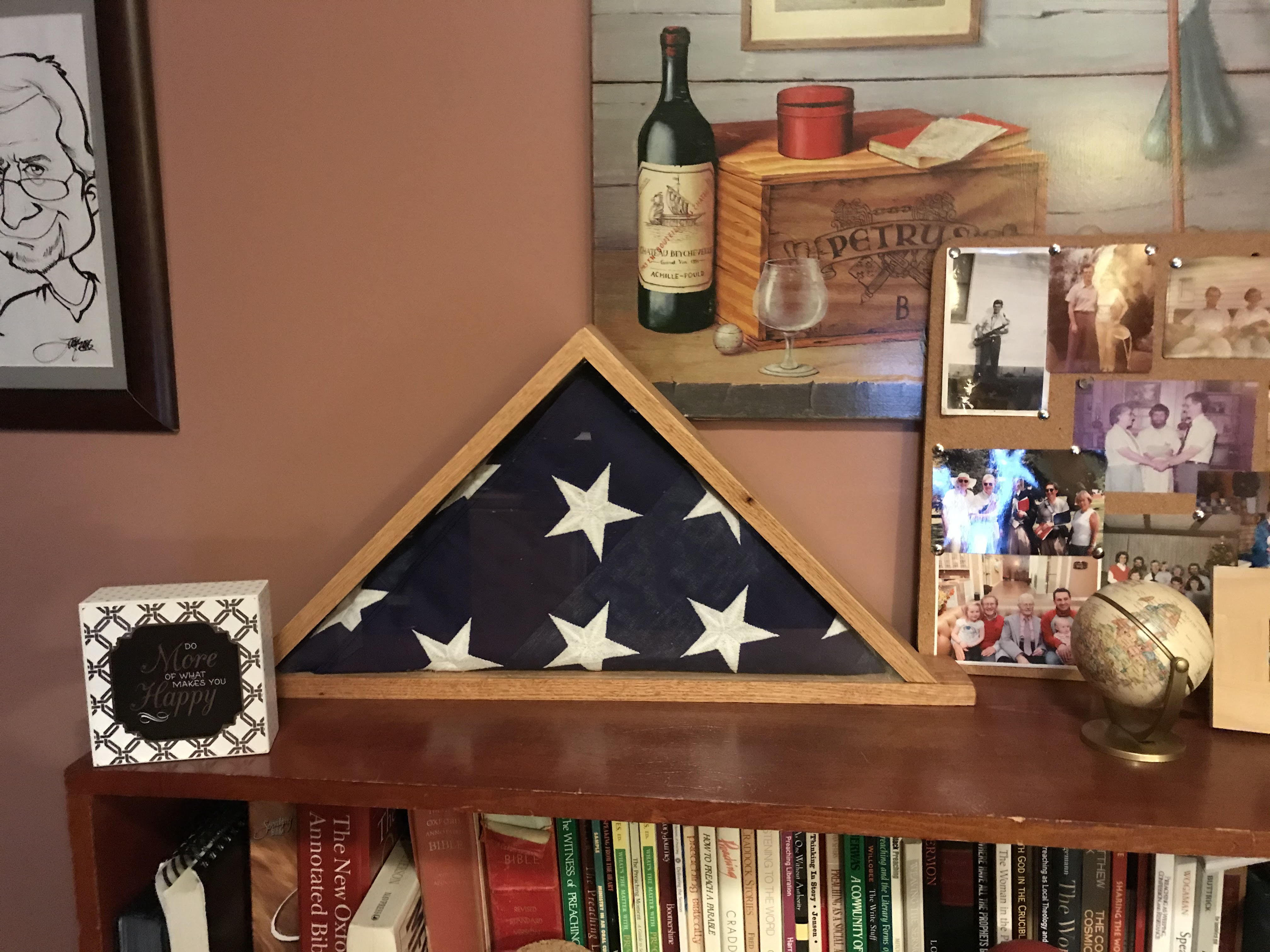
And while I’m on a roll I’ll add another mini-wave incident. I’ve had the flag from my father’s casket for over two years now and it has been in a plastic case provided by the funeral home all that time. A very good friend noticed the flag on a book case in my office recently when we were on a zoom call with a mutual friend. He said he had made wood and glass cases for flags for other people and would like to do one for me. It came via UPS yesterday, and putting the flag in the case and finding some of Dad’s WWII medals in the plastic case all brought up feelings of regret and appreciation for Dad again.

I have spent many vacations near different oceans and have experienced all kinds of waves—gentle ones that just lap at your ankles and angry ones that beat me up and tried to pull me out to sea with strong undertows. When I first thought about writing this post I was thinking more about ocean tides than waves, but I soon realized one major difference. The times for tide changes are so predictable and regular that they are published on charts that tell fisher people and beach goers, back when we could do that, exactly down to the minute when each high and low tide will be on any given day.

Waves are not predictable. They can lull one into a sense of false security, and then when least expected smack you upside the head with a big one. Grief is more like waves than tides. There are certainly times when feelings of grief can be predicted to arise—holidays, anniversaries of memorable events and of the day of death. But more often there are unpredictable waves of grief that just happen—driving by the place a loved one lived, attending the church where a service was held, hearing a particular song, looking at a picture, or just a memory that pops into one’s head uninvited. All of that is normal, and there is no right way to experience those waves or to predict how long they will last.

I knew a woman once who had been told that the normal period of grief for a spouse was two years, and she believed that as gospel. So she expected to grieve for two years, and that became a self-fulfilling prophecy for her. There is no right or wrong way to grieve. It’s great to have people come along side to share the experience when we want company, but each of us has to find our way through the grief journey in our own unique ways. As for me, I wish I had been more receptive and aware of my waves in the past, but I can’t go back and do remedial grief. I can only experience memories and emotions now in the present and welcome them with gratitude whenever they come along and actually choose to pay attention.

Stages of Grief in a Pandemic

I have been angry and depressed a lot lately, and I have been reflecting on how the stages of grief made famous by Elizabeth Kubler-Ross might help us figure out how to navigate a pandemic better. The five stages of grief Dr. Kubler Ross described are: denial, anger, depression, bargaining and acceptance. These stages are not linear or in any particular order and are most often thought of in terms of dealing with grieving the death of a loved one. But they can be helpful in understanding any kind of significant loss, including the loss of freedom, normal routines, contact with friends, family, etc. caused by Covid-19.

Denial: we have all been in this stage from time to time in the last few months, from the President on down. Denial is a normal reaction to bad news. None of us wants to believe a loved one is gone forever or that our health and ability to do normal activities has been drastically curtailed. I remember hearing the news that the Arnold Classic, a huge annual event with huge economic ramifications here in Columbus, Ohio had been cancelled. It was the first real evidence we had a serious problem, and I found it hard to believe when I heard that news. In retrospect it was a great decision made with courage and great insight by our government leaders. An event of that size that brought thousands of people to Columbus from all over the world would have been devastating to Ohio and made the death toll from the Coronavirus so much worse.

Denial is a normal reaction to bad news. It’s a defense mechanism that helps shut our bodies down the way novacaine numbs your gums to withstand the pain of a tooth filling or extraction. But denial is a stage, not a destination. We need to go there to survive a shock, but we can’t pitch a tent and stay there as a way to deny reality on a long term basis. Unfortunately the U.S. has failed in our response to the the pandemic because key leaders, including the President have hindered essential responses to the virus by denying the reality of the crisis. People who follow the lead of those who ignore the uncomfortable advice of experts from the medical and scientific communities are living in denial and get stuck in the grieving process, which in this case has deadly consequences not only for them but for our whole society.

Anger: Like spoiled children we all feel some level of anger when told we can’t do something we really want to do. I was really mad in the spring when my all time favorite sports events were killed off one after another in just a few days in March. College basketball tournaments died first and then in rapid order March Madness and the Masters golf tournament. In a blink of an eye my favorite few weeks of the year were felled like dominoes lined up back to back.

Students and families were robbed of graduations, final sports seasons for seniors dropped like flies, wedding plans trashed and countless other special occasions died painful deaths. And as the whole rest of the school year was cancelled and our economy shuttered the frustrations and anger increased exponentially as weeks dragged into months. Since it’s hard to be angry at an invisible enemy our anger got directed at public health officials who were just trying to do their jobs, at courageous governments leaders who made difficult and unpopular decisions to shut down any and everything we enjoy doing. Throw that kind of anger into an already politically divided society and you have armed protestors descending on state houses and the homes of public health officials, and that anger gets misdirected into rebellion against simple requests for the good of us all like wearing masks.

A friend of mine expressed that anger well when he said he rebelled at being told he had to wear a mask at a local retailer. His response, more fitting for a child than an adult, was to wear his mask on the back of his head. His argument, like those who decry the loss of their personal liberty, was that if asked to wear a mask he would have complied, but when he was told he had to that offended his personal freedom.

Depression: As our ability to deny a loss or lessen the pain with anger prove ineffective it is easy to fall into depression. When we feel powerless to change a situation and helpless to do anything about it depression is a natural and normal emotion to feel. And because we are still not good at talking about mental health issues it is easy for this one to be compounded by denying our depression. I was at the doctor this week and had to fill out a medical history and check any previous or current illnesses, and when I came to “depression” and “anxiety” I was reluctant to check those boxes even though I am currently in therapy and taking medications for both. When we are already feeling down or overwhelmed by other life issues or crises throwing a pandemic into the mix is like putting gas on a fire. Depression and its cousins, fear, worry, and despair in some degree are affecting us all just now, and as we are seeing a new surge of cases it is easy to play the blame game, go into victim mode and be overwhelmed.

Multiple grief over jobs, chronic illness, loss of contact with loved ones and friends, and support communities, loss of physical closeness and contact with others all compound the tendency to despair and surrender to our frustrations. Zoom contacts with friends, teachers, business colleagues, congregations and other significant contacts are a godsend, but they cannot replace real live human contact. Even those of us who are introverts are admitting we need people.

Bargaining: In the case of physical death and mortality this stage is characterized by promises to do x, y, or z if we or a loved one can just live a little longer or a miracle cure can be found to postpone the inevitable. In pandemic grief I’m not sure what this stage looks like. For some of us it may be if we are spared from this plague we will change our ways and correct some flaw in our lives. It may be a bargain for a loved one to be kept safe from the virus in spite of their risky behavior. This stage can take many forms; so it’s just good to be aware of when we find ourselves in that deal making mode with God or whomever we are negotiating with.

Acceptance: There’s no timeline or “normal” prognosis for how long it takes to get to the stage of accepting a loss we are grieving. Every person and every situation and relationship is different. Sometimes when we know a loved one or even oneself is dying there is time to do anticipatory grief, to be prepared, to say good bye, to make peace with the coming reality. Other times loss is sudden and unexpected and all the grieving must be done after the loss of a job or a relationship or a life. But regardless of the circumstances or timeline, good grief moves us toward a state of acceptance and peace with a new reality. This stage does not mean there will not be days when anger or denial come surging back like Covid-19, but those pangs of sadness become less frequent and less painful the more accepting we are of our new normal.

And so it is with this nasty virus. The more we can accept the reality of how pervasive and deadly this disease is, the better we can cope on a daily basis and the sooner we will be free of its hold on our lives. If we are impatient and fall back into denial and angry foolish behavior we jeopardize everyone’s life and prolong the hardship both personal and economic.

Acceptance does not mean being happy with the new reality. I am not happy that my parents are dead but I have learned to accept the reality that I am now an orphan and the oldest living member of my family. Am I sometimes angry or depressed about that, sure, but that doesn’t mean I refuse to believe all those things are true. Am I tired of wearing a mask and debating if it’s safe to go shopping or to see my kids, you bet. I’m exhausted by having my routines in life screwed up for over 3 months and for the foreseeable future.

I know that our collective denial in the early days of the pandemic cost us many lives. I know that on-going denial of the cold hard facts by the President and misinformation by his favorite news outlets is going to cost more lives and economic hardship. If wishing could make this virus go away it would have disappeared months ago. If firing the messengers who bring us inconvenient facts would change reality I’d be all for it. But that’s not how viruses work, and the sooner we as a total society accept the reality of our situation we will begin to win this fight. And if we don’t the awful history of how people rebelled against masks and restrictions during the Spanish Flu in 1918 and created a second and third wave much more deadly than the first will be repeated. So please friends, wear your mask. It won’t kill you, but denying the need to do so may kill us both.

Russell C. Sawmiller, Jr. 1927-2020

Last week I lost a mentor and dear friend who had been an important person in my life for almost as long as I can remember. He was 93 so his death was not a shock, but it hit me harder than I expected. Soon after I learned Russ had died I sat down to write this letter to express what he meant to me.

April 17, 2020

Dear God,
I’m writing this and asking that you forward it to my dear friend Russ who should have checked in with you early this morning. He never could figure out computers or cell phones; so I can’t send him an email or text, but I know somewhere out there in your marvelous universe he’s there and will be able to hear some things I should have said to him much sooner.

I first met Russ 49 years ago this summer when I had the good fortune to be appointed as his colleague and associate pastor in my first church after seminary. I’m sure there was divine intervention in that appointment because I had specifically told my bishop that I wanted my own church and did not want to be an associate pastor, and thanks to Russ I never really was, at least he never treated me like one.

Thanks, Russ for always treating me as a colleague. We were co-pastors in fact even though our titles never reflected that. Thanks for teaching me so much about being a pastor that I didn’t learn in seminary and didn’t even know what I didn’t know. You did that in a collegial way without ever making me feel like the greenhorn I was. You let me learn from my mistakes instead of warning or lecturing me, even when you had to clean up my messes. I think the only time you gave any disapproval was when I confided in you something I was too embarrassed to trust anyone else with. You just gave me one of those looks and a pointed rhetorical question: “Do you have a death wish?”

Since I heard about your passing this morning I have been flooded with memories of our times together, I didn’t appreciate those years at Indianola while we were up to our butts in alligators, but in retrospect they were some of the very best years of my life. I remember you giving advice like, “take a day off — and get out of town!” Sorry I didn’t do very well taking that advice to heart. You taught me from your own hard experience to be very careful about not becoming too beholden to parishioners who would expect preferential treatment or unacceptable power in church decisions. And, as you often said, “Sometimes it’s too hard to take it ‘one day at a time.’ Those days just settle for a half day at a time.”

I remember the day it dawned on me that we had to be related since my mother was a Sawmiller! I can’t believe it took me weeks to figure that out, and then not until you mentioned the little town of Kossuth where my mom was born. So we were distant cousins and maybe my job with you was some sort of nepotism, but I rather think it explains how well we worked together.

I am grateful for memories and pictures of you baptizing both of my kids. You broadened my perspectives on life, theology, sociology, politics and coping with personal tragedy in so many ways. Your wife had died of brain cancer just 3 years before we met, leaving you with two children to raise and a gaggle of women knocking on your door to take Marilyn’s place. You introduced me to a whole gang of your clergy friends who accepted me as a colleague and by example about how to do relevant and creative ministry in ways that I had never experienced in the very conservative church and community I grew up in.

In spite of living in the social unrest of the early ‘70’s, working in a rapidly changing neighborhood in a church in transition, i.e. dying, we had fun. I still chuckle about the time your friend Dick Teller asked us why we needed two curators for our “museum” where much of our large church building was described by phrases like “this is where the women’s society used to meet,” or this is “where the nursery used to be.” But then you taught me churches could repurpose spaces for community needs like the Neighborhood Services food pantry, Huckleberry House for runaway teens, and the first Ohio State University child care center. All of those programs moved on to bigger spaces as they grew, but you planted the seeds that are still serving that community 50 plus years later.

You taught me about collaboration with other churches in the University-Indianola Outreach program, and oh what stories Stan Sells had to tell us about funny experiences with those neighbors who lived in a totally different world than our church members. You taught me that church work and meetings could be fun, that good team building staff meetings and birthday lunches strengthened bonds that didn’t break in times of stress.

We played racquetball, not well, but it was great stress relief, and when I got depressed because a particular election outcome was not to either of our liking you gave me a nugget of wisdom I’ve never forgotten: “Steve, elections are like buses and pretty women. If you miss one there will be another one coming along soon.”

Our partnership included many Sunday mornings in the wonderful hideaway study up in the bell tower before worship when you’d tell me what the morning sermon was about and ask me to help you find a Scripture that fit. That last minute scrambling (aka proof texting?) was the exact opposite of how I had been taught to preach, and I must confess that many years later when I got the chance to teach preaching to seminary students I often used you as an example of how not to go about picking a preaching text!

By example you taught me and others to treat life as sacred without taking oneself too seriously. You shaped my ministerial career in so many ways, not the least of which was that my time with you was nothing like any horror stories I heard from other associate pastors. It was so obvious from the first time we met that you were different than many other stuffed-shirt pastors I had known who had made me reluctant to answer God’s persistent call to ministry. And it wasn’t just me that felt that immediate connection that made you such a good pastor and friend. When one of my good friends from seminary first met you shortly after we had both received our first appointments he told me how lucky I was and that he wished he had someone like Russ as his senior pastor.

I learned so much from you about ministry that I was ready to fly solo when you left Indianola for another challenge, just not as soon as I expected; but having a few months on my own at Indianola, a congregation where I already felt safe in an established community was the perfect basic training for the next step in my faith journey. I don’t think you planned it that way, but thanks anyway.
When four years later I was asked to take another appointment as an associate after having my own church my friends were aghast that I would do that. But because I had such a positive experience working with you it was something I could do. I’m glad to say my other staff experiences were mostly good — not as good as ours had been of course — but I do believe that was in part because I went into those situations with a positive attitude thanks to you.
I learned about generosity and hospitality as you offered your Vineyard cottage to my family when our children were too young to do our normal camping vacation. You couldn’t help that it rained that entire week, but being there stuck inside with two toddlers for a week may explain why I didn’t visit the Vineyard again for nearly 20 years. But when I did I was happy to return every year for the next four years, and those laid back weeks there with you were some of the best ever and something I looked forward to every year. The last year we vacationed together was 2001, and I’ll never forget that date because I flew home through New York that year on September 6th, just five days before the towers came crashing down.

I remember your loyalty to your mom and one of your many, many moves to be there for her in her last years. And speaking of moving! You moved so often I sometimes wondered if you were in witness protection! I hope your search for home is finally satisfied. I imagine Ralph has already given you a hard time about being late to join him on the other side, but I’m glad you two are together again with all your old Boston buddies sharing even more memorable years of memories than you and I have.

I’m so sorry your last years here were so hard, but I’m glad you really haven’t had to deal with the awful mess our world is in right now. If you can send us any divine intervention now we could sure use it.

I’m happy those years when you weren’t the old Russ are over and you are at peace. But I’m sad for the new memories we won’t get to make. I’m sorry I wasn’t as good a friend as you deserved these last few years but knowing the old Russ I loved wasn’t there made it hard. There would be no more boring retiree meetings together, no more cranberry pecan pancakes at First Watch, no more walks on the beach at Lucy Vincent or Gay Head.

I almost wrote “no more words of wisdom,” but I know that’s not true because after 50 years we share a bond that transcends death. What I’ve learned from you about life will always be a part of me. So, till we meet again at some First Watch or beach in the great beyond thanks for being a great friend, mentor, and the father figure I always wished I had.

So, thanks good friend for all the Russellisms, for the laughter and the tears of a life well lived and generously shared. As the finality of human life sinks in and the light of eternity shines a little brighter with you in it, I’m reminded of the words of Walter Brinkley, one of our elder members at Indianola. When Walter’s wife died he summed up the way I’m feeling in this world without you. He said, “I’m smiling through my tears.”

Peace and love,
Steve

Memories

dadonwayoutMy father died one year ago today.  On purpose or not I was too busy to think much about it today, but I do miss him.  I don’t miss the 2 hour drive to go visit him, but I miss knowing he was there even if he often drove me and my sisters crazy.  My dad and I were never very close, but in his later years I learned to accept him and forgive him for the things that bothered me about his attitude toward life.  He was too rigid and authoritarian – maybe things I haven’t accepted in myself?  We didn’t agree on theology or politics or child rearing philosophies, but in the end none of that stuff really mattered.  He was my father, and I literally owed my life to him.
He really did do the best he could to be the best person, father, husband, Christian he knew how to be. And like all of us he fell short of the mark regularly.  Like all of us he had to survive some difficult things in his life.  Unlike me and most of us he survived a near-death experience in a North Atlantic plane crash on his way home from World War II.  He didn’t talk about that experience and I regret that I never cared enough to ask him about what had to be a life-defining moment.  So I can only speculate on how the death of his crew mates in that crash or the 12 hours he spent in the water before being rescued affected him.  I know I have no right to judge him for his shortcomings and regret the distance I helped create between us by doing so.

All such life events have a ripple effect on everyone touched by them.  From that awful experience came my Dad’s conversion to Christianity, which led to my own growing up in the church and my career choices and how my faith and values have been shaped.  In many ways I am who I am now because of the engine that failed on that B-17 seventy-four years ago.

A friend told me after Dad died that someone had told him once we don’t really grow up until we become orphans.  I’m not sure I’ve made much headway in the last year, but I have a new appreciation for how fragile and temporary life is.  Things that once bothered me don’t seem so important anymore.  Maybe that’s a baby step toward maturity?

Thanks Dad.

Drum Beat of Life

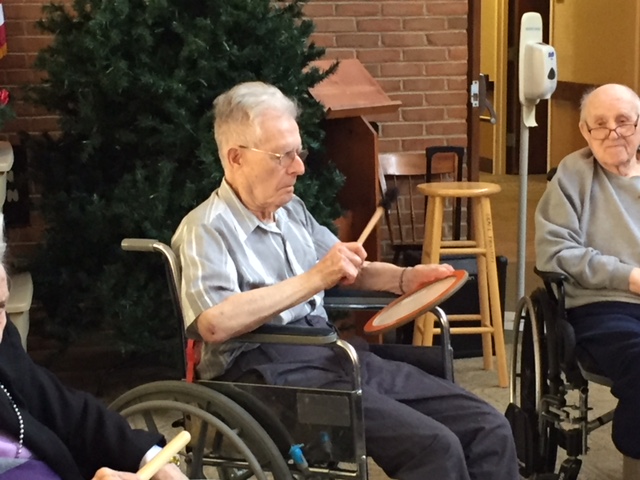
This picture has been special to me ever since I took it. My dad was very resistant to doing any of the activities organized for the patients in his nursing home. He never did care much for anyone telling him he needed to do something. So I was very surprised the day I took this picture. We had been sitting in the atrium visiting when the activity director he couldn’t stand began to gather some patients for a drumming circle. I could tell Dad was curious about what they were doing; so as I was getting ready to leave I asked him if he wanted me to take him back to his room or if he wanted to stay there. He surprised me by saying he wanted to stay and even more so when he agreed to join the group, took a tambourine and drumstick and began tapping out a rhythm.

I didn’t know then that it would be the last time I would see him alive. He died two weeks later on February 12 of this year, and that final photo became priceless. I came across it while scrolling through the photo roll on my phone today and realized with a start that it has been 6 months this week since he died. The months have flown by, but every once in a while I stop and think, “I need to go visit Dad.” Those difficult visits as he was failing physically and mentally were often very challenging, but even so there’s an empty place in my life that he filled for over 70 years.

That last photo seems so right in retrospect. Music was my dad’s life for 80 years. He played his tenor sax until he was 90 and sang in several choirs and ensembles at the retirement community he lived in. He had his own dance band when he was a young man playing all the Big Band standards of the ‘40’s and ‘50’s. He was in a church choir for as long as I can remember and had his own group called the Harsh Notes at the Otterbein retirement community. When he was no longer physically able to sing or play his sax a few years ago most of his reason for living was gone.

For my last image of him to be making music and to be doing so in a drumming circle is also special to me for one more reason. I know my dad was disappointed that none of his children inherited his passion for making music or his musical talent. Because I can’t carry a tune in a bucket when it came time for me to join our school band in junior high our band director suggested I could play the drums. My band career only lasted a year, but I enjoyed the drums and have a warm spot in my heart that my last earthly glimpse of my dad was of him drumming. Life changes and ends, but the beat goes on.