Prayer for Father’s Day 2025

O Heavenly Father, we use many metaphors to describe your holy mystery, terms like Father, Mother, Parent, Spirit, Friend, all pointing to your very essence which is Love. Today we honor those who can be one reflection of your love, the men who are or were fathers to us, biological or honorary. Many earthly fathers or father figures are great sources of wisdom, encouragement, and love, and for them on this day especially we offer thanks and praise.

But, unfortunately not all fathers are created equal. Some, because of their own trauma, are less than Hallmark papas, and because of that this day can be difficult for some of us. Where there is strife or pain associated with such relationships we pray for comfort, forgiveness, and reconciliation where those things are possible. For others we simply ask for the serenity to accept the things we cannot change.

Ideally, we pray for the closeness that you, God, had with Jesus. He referred to you with the term of endearment Abba, which is translated in English as “Daddy.” For fathers and those who fill that important role we pray for the wisdom, closeness, and love reflected in your holy relationship with Jesus. We know none of us mere humans can achieve that depth of agape love, and we do not want to create guilt for our mortal weaknesses and failures. But in you, God, we see a model for the kind of parent, grandparent, aunt, uncle, or friend we strive to be for those young in years or new in their faith journey.

Whether we realize it or not all of us are mentors and teachers for young people who observe and imitate our words and actions. Help us, Heavenly Father, to be worthy models of integrity, courage, faith, and love in all we do. May all of us so live that our fathers and children will be proud of us, but most importantly that you one day will say, “Well done, good and faithful servant.”

We pray as we try to live, in the name of Jesus, who taught us how to live, to love, and to pray using these words: Our Father, who art in heaven . . .

Northwest United Methodist Church, Columbus, Ohio

Happy Motherly God‘s Day

My home of origin in the 1950’s and 60’s was a very traditional patriarchal family. And the church family I grew up in was likewise dominated with patriarchal theology and structure. I can’t go back and change any of that, but I regret that my foundational values and theological constructs were void of any feminine images and qualities.

This reality for me was complicated by a strained relationship with my father. My dad survived a painful childhood with an abusive, alcoholic step-father and a near-death experience as a 24 year-old pilot in World War II. No one had discovered PTSD in those days, but I’m sure my dad was a classic case. He compensated by living by a very strict and literal adherence to conservative theological and cultural norms.

I never questioned my father’s love for me, but it always felt conditional on my living up to his high expectations and obedience to his rules. Theologically for me this meant the patriarchal image of God was filtered through my relationship to my earthly father. It never occurred to me or anyone in my circle of influence to question the God as Father theology I learned at church.

One of my regrets about this is that I felt much more comfortable with and closer to my mother but had no model for seeing her as the image of God. She was a good subservient wife as was expected in the culture we lived in, but there was also a quality of unconditional love and acceptance about her that was lacking in my dad. If I had a problem or screwed up, as I did often, I would always go to my mom and confess because she would calmly help me deal with the situation where my dad would either verbally or non verbally convey disapproval. That’s who my parents were. There’s no judgment in that now, although there was for many years as I tried to liberate myself from the conservative world my dad lived in.

My point here is that I wish someone had suggested to me that God is also an expression of the maternal, loving qualities we rightly or wrongly have attributed to the feminine. Because no one dared to think outside the patriarchal box I lived many years of my life with a fear of a judgmental God. And the larger church and even the liberal seminary I went to in my early 20’s was still a prisoner to the male-dominated images of God.

The entire faculty and 96% of my seminary class were white males. That began to change dramatically in the 1970’s after I graduated as women and people of color were added to the seminary community. That’s wonderful, but I missed it! I worked with several great senior pastors in my ministry, but again all white and male.

Finally in the early 2000’s when I was about 60 years old I joined a congregation with a wonderful, creative, vibrant female pastor. I went on to work part-time in retirement with her and other women, and it has opened a whole new world of theological depth and understanding to my image of the divine as full and inclusive of all of God’s creation. I still am blessed to hear the word proclaimed many Sundays and Holy Days from a unique female perspective. Most of the current devotional and theological blogs, podcasts, and books I have benefited most from in the last few years are created by female writers, pastors, and theologians.

And so this Mother’s Day I am giving thanks for all the women who have helped shape my life. Grandmothers, mother, aunts, colleagues, friends, wives, preachers, political leaders and more. Let’s celebrate that special capacity so many women have to nurture, soothe, love, and bless us with those God-given qualities the world so desperately needs right now.

Contentment in Any Role

“All the world’s a stage,
And all the men and women merely players;
They have their exits and their entrances,
And one man in his time plays many parts…”

Those lines from Shakespeare’s “Mid Summer Night’s Dream” have been floating around in my head for quite some time. But I did not remember until I looked up the quote that it is the beginning of a monologue about the stages of life from infancy to death.

Being 78 and a cancer patient I have spent more time than I like thinking about my mortality, and that whole monologue that describes 7 stages of life fits right into that conversation in my head.

The questions I want to ask about that metaphor are two: What do you do or how do you cope when you don’t get the part you really want? And what about the times you get stuck with a part in the play of life that you really don’t want?

I’m guessing we’ve all been in both of those situations. When I was a sophomore in college a young woman I had been in a serious relationship for almost two years informed me I was no longer needed in the play of her life. She had a good reason, and I appreciated her sharing it with me. I was still devastated, but she helped me understand the break up wasn’t just about me personally; but about a career path I had chosen that she wanted no part of.

Earlier that year I had decided to switch majors from engineering to philosophy in preparation for going on to seminary after college. In other words I had opted for a very different part in a totally different play, and she did not want to play the role of a pastor’s wife. There are very good reasons to say no to what can be a very challenging unpaid, high expectations job, and I understand that better now than I did way back then. I also understand that I undoubtedly made the situation worse by making that important career decision without ever discussing it with her. Yes, I was still working from an old script where wives are subservient to their husbands.

The second half of the 20th century was a confusing time to be playing a romantic role. The old scripts of how men and women related were being thrown out, and new ones were still being written. Societal norms about sex, race, war, and peace were all in a state of flux. Life was like improv theater – we were all making it up on the fly.

That flux had major impact on the job market as well. We didn’t call it DEI back then, but in liberal circles where I played my roles as student and pastor and teacher the civil rights and women’s rights movements spurred efforts to increase diversity in the workplace and on faculties. As a white male that was a personal disadvantage to me. I had my heart set on a particular professorship when I finished my doctoral work and thought I had a good shot at it. I had been teaching at this school as an adjunct professor for two years, and my student evaluations were excellent.

Little did I know that the position had already been promised to a black woman who had taught there before me as an adjunct and left to do her PhD. I was disappointed, especially since I had turned down a role as a pastor at a church I had always admired earlier that year. Sometimes we don’t get to play the part we want or even be in that particular play, but in this case I did understand and agreed with the school’s priority on building a more diverse faculty. When I had been a student there 20 years earlier the entire faculty and administration was white and male, and the student body was 98% the same.

But to circle back to Shakespeare’s take on the stages of life as the roles we play from birth to death, I find his list rather limiting. He spends little time on the variety of parts we might play in adulthood, and I realize that life expectancy back then was much shorter than it is today. With advances in health care a productive adult life can last 50 or 60 years and may include several different careers, sometimes simultaneously.

I was a pastor, a teacher, and a university administrator in a period of 38 years of full time employment, and then spent 11 years in retirement doing all of those things on a part-time basis. But concurrent with those roles I was also a son, husband, father, brother, author, golfer, skier, softball player tennis player, runner, and friend.

But here’s my existential question for this stage I am acting on just now. In the last 8 months I have played parts I didn’t want, namely icu patient, cancer patient, and one dealing with a whole host of other old age maladies. What do we do when life throws us a curve and we find ourselves playing parts in our life drama that we never auditioned for? As I told my son a few months ago — I liked the roles I played in my 40’s and 50’s a whole lot better than this role as a senior citizen.

I can’t think about this dilemma without remembering St. Paul who had some affliction he calls “a thorn in the flesh.” We don’t know what the thorn was, but here is what Paul says about it: “Therefore, to keep me from being too elated, a thorn was given me in the flesh, a messenger of Satan to torment me, to keep me from being too elated. Three times I appealed to the Lord about this, that it would leave me, but he said to me, “My grace is sufficient for you, for power is made perfect in weakness.” (II Corinthians 12:7-9)

I don’t know about you, but if I were in Paul’s situation I wouldn’t be too thrilled with that answer. But God’s ways are not our ways, and being a man of great faith Paul was able to make peace with that thorn. He writes in Philippians 4:11, “I have learned in whatever state I am, to be content.” I’m not there yet with the parts I am playing in this stage of my life.

I am not content with my chronic pain. I am not content giving up most of the activities I used to enjoy. I am not content watching the country I love being destroyed by wanna be dictators and oligarchs. I am very uncontent to watch God’s beautiful creation on earth being destroyed by corporate greed that values short term profits over long term preservation of the planet.

Given all those things that disturb my contentment and peace which are important I have to realize that the stress they create in me are not healthy and in fact make me less able to respond to any of them. In spite of all the problems in our nation and the world there is still great beauty and kindness if I shift my attention to observe them and express gratitude for them. And that’s the point of Paul’s wise words just before the ones about being content. And therein lies the secret to his peace and contentment.

Here is what he says: “Finally, brothers and sisters, whatever is true, whatever is honorable, whatever is just, whatever is pure, whatever is pleasing, whatever is commendable, if there is any excellence and if there is anything worthy of praise, think about these things. As for the things that you have learned and received and heard and noticed in me, do them, and the God of peace will be with you.” (Philippians 4:8-9)

That’s a pretty good script to play from at any age and on any stage. Break a leg.

ICU LIFE LESSONS

Three days ago I quite unexpectedly began a crash course in life lessons I didn’t sign up for. Thanks to dangerously low blood pressure and low Hemoglobin I became so dizzy at home and unable to stand that I earned myself a first-ever ride in an ambulance. That bumpy ride landed me two other firsts —two nights in ICU and a first time blood transfusion.

Quite a day and night, and I’m happy to report that within 24 hours and after some bleeding ulcers were discovered and treated I made a remarkable recovery. I am writing this from a regular hospital room just under four days after it all began and am processing it all by trying to capture and share some of what I’ve learned.

First and foremost I have been amazed and humbled by the outpouring of love I’ve felt from family and friends. The hospital EMT’s and hospital staff have been fantastic. I expected that, but am still beyond grateful for how dedicated and wonderful they all have been, and some of what they had to do for me was quite frankly disgusting.

What blew me away however has been the constant stream of visits, texts, and phone calls from family and friends concerned about my welfare. My dear wife, Diana, has been a rock, and I can never repay her for the hours she has spent with me and so thoughtfully brought me things from home that I might need. I can’t imagine going through something like this without her. I hope I will never take her for granted, but I also know we have pledged to care for each other in sickness and in health. It’s a covenant we made with each other 22 years ago, and one we take very seriously.

But it takes a village to hold up the most loving care giver. And that’s where I am in awe at how large and strong my village is. I am not bragging. I am so humbled because I know I am not as supportive of my family and friends as mine have been for me in the last 96 hours. For example, it is about a 30 minute drive from my house to Riverside Methodist Hospital in Columbus, Ohio. I was not in crisis; so my ambulance ride did not feature high speeds or sirens.

I was however in bad enough shape that I was taken immediately into treatment once we arrived at the ER. That was a blessing, but even more so was that within the first 20 minutes I was in the ER in walked my beautiful 25 year old granddaughter. Her mother called her because she was the closest family member to my location, and she was able to leave work and come sit with me during that scariest part of my journey.

It was a powerful reminder to me of how important a ministry of presence is. Olivia was simply there for me, and her maturity and calm demeanor was contagious. She asked questions I didn’t think of and just was an extra pair of eyes and ears for me.

And much to my wondering eyes other family members just kept showing up. Within my first hour in the ER my village blossomed to include my daughter (who is herself recovering from painful foot surgery) and son-in-law, along with their two sons (my grandsons). And to round out my entourage a nephew by marriage who is a surgical nurse at Riverside dropped by to add his medical knowledge and expertise.

They all stayed around until I was admitted and situated in an ICU room and have all been back or called/texted me every day since. And so has my son who was not able to join the welcome party that morning but came to visit with his wife that first evening.

I knew I was loved by my family before Thursday, but quite frankly we don’t always show that love as much as we could. My family members are all very busy people, and it is easy to feel sometimes like we oldsters are not a priority for them; but they have showed me in no uncertain terms this week that when they are needed the most they are there.

Humility. I know everyone jokes about how you surrender your dignity when you become a hospital patient, and that’s true. The first thing the nurses did when I arrived in the ICU was remove every stitch of the clothing I came in with. They wiped me down with baby wipes, and I use that term because I felt like a helpless baby. And that feeling came through even more strongly that night when my bowels did their thing all over me and my bed before I had time to even realize what was happening.

The staff calmly cleaned me and my mess up as if they do it every day, and likely they do. And then it happened again a few hours later, and I was really embarrassed. When I apologized they simply said, “that’s what we’re here for.” What gracious and loving servants!

We are all just a minute away from such a reminder of how interdependent we are. Being helpless and needing assistance with even the most basic of bodily functions is nothing to be embarrassed about. It is part of the cycle of life and our human condition.

I know that my situation here has been nothing compared to people who are battling life-threatening diseases and injuries, but the lessons are similar. I also know I am very privileged to have access to excellent medical care which far too many of my fellow citizens do not have. Those are the sisters and brothers we all have who need us to be their advocates and village members who demand a just and universal health care system.

We are our sisters and brothers keepers, and I will emerge from my experience not just healed of my physical symptoms but with better empathy and awareness of how I can pay forward the wonderful care I have received.

Thank you my dear village.

Where’s the Justice?

Election Day, praying for my tribe to win as much as possible even as I fear the dangerous person just elected Speaker of the House and the Trump circus in a New York court room. Trump has succeeded in taking the media spotlight off the mayhem in Gaza, but the slaughter continues there and elsewhere. A mass shooting in Cincinnati recently barely made the news.

We are having new skylights installed today while millions of people have no roof over their head at all. Where is the justice?

My privilege feels like a millstone tied around my neck, even while I resent working for hours on end the last two days to maintain our wonderful home.

I get wonderful medical care for my puny aches and pains while hospitals are bombed in Gaza. Where’s the justice?

I simply turn the tap and open the fridge whenever I thirst or hunger while millions of climate refugees and war victims around the world are starving and dying. Where’s the justice?

By accident of birth I am a privileged white male in a relatively safe and prosperous nation. My ease and comfort are as undeserved as the suffering of innocent Israelis and Palestinians and Ukrainians is unjustified. Where’s the justice?

If I thank God for providing so bountifully for me and my tribe anyone can see the irony that all these others of God’s children who pray to the same God still suffer so horribly. I am not some worthy saint being rewarded for my good behavior like a school boy getting gold stars for what we used to call “deportment.” If I am graded on keeping the 10 commandments or living by the Boy Scout Law I learned as a youth you better believe I hope God grades on the curve. Where’s the justice?

As we Christians paused ever so briefly this week to observe All Saints Day our grief and memories of those who have passed beyond this mortal coil are tied to the deaths of all those unknown to us but known to God souls lost in recent days to the madness of war. Nadia Bolz-Weber said it so well in her sermon for Sunday, “You’re going to die:”

“The untimely and unnecessary deaths of 10,000 children of God, many of whom are actual children, in just that one tiny area of our planet in one month’s time ripples out into an ocean of grief for the 100,000s of thousands who know their names…their babies, and brothers and wives and friends.

This is their day too.

So as we remember our own dead, may we feel connected to the sorrow of those who are also grieving today. And say as our lord did, Blessed are they who mourn. Blessed are they who have loved enough to know what loss feels like.”

I had never thought about grief as a blessing even though I have read those words from the Beatitudes dozens of times. “Blessed are those who mourn.” My thoughts always jump to the second half of that verse “for they shall be comforted.” Yes, we yearn for our own comfort and those of others. But there is no comfort without grief, just as there is no resurrection without death. So in one of those theological twists of fate there is gratitude even for pain. If we could not feel the pain of grief, even for people 10,000 miles away, we also could not feel love and appreciation for our privilege.

I do not deserve my comfortable life any more than the trapped citizens of Gaza deserve the horrors of modern warfare, any more than the 1400 Israelis deserved to die on October 7, or the 6,000,000 Jewish victims of the Holocaust, or the 3000 Americans deserved to die on 9/11. All of that reminds me that life itself is a privilege to be cherished and lived to its fullest no matter where we have landed by accident of birth on this fragile planet.

May our gratitude for what is take the wings of mercy to act as those who do justice here and now, who love mercy wherever we are planted, and through it all walk humbly and gratefully with the One who gives it all and who alone can fathom the mystery of life and death in our broken and unjust world.

Ode to My Beloved Bikes

In the words of that great philosopher, Kenny Rogers, you gotta know when to hold ‘em, know when to fold ‘em and know when to walk away while you still can. I needed that wisdom this week.

I made a good but sad and hard decision to give up yet another activity I have enjoyed for about 70 years. I don’t remember exactly when I first experienced the joy of riding a two-wheel bike without training wheels, but I would guess I was 6 or 7. That had to be one of the first liberating rites of passage right up there with learning to walk and potty training.

My bike riding for the next 65 years was pretty routine. And then about four years ago I bought a step-through bike, aka a girl’s bike, because I was having trouble with my balance swinging my leg over the cross bar of my 30 plus year-old Schwinn that my father-in-law had willed to me when he could no longer ride. Almost immediately I discovered that my balance issues had more to do with my neuropathy than the kind of bike I was riding. I was still able to ride for awhile in spite of a few minor low-speed falls that happened while starting and stopping. No injuries ensued, but I gradually gave up trying to ride.

A few weeks ago I went into a bike shop in search of adult training wheels to see if I could still ride some with that kind of help. Talk about the circle of life!!! But a kind salesperson offered me an alternative that seemed to be a way out of that circle. He had me try an electric bike with a small motor which would give me a boost at start up where I had the most trouble getting up enough speed to establish my balance.

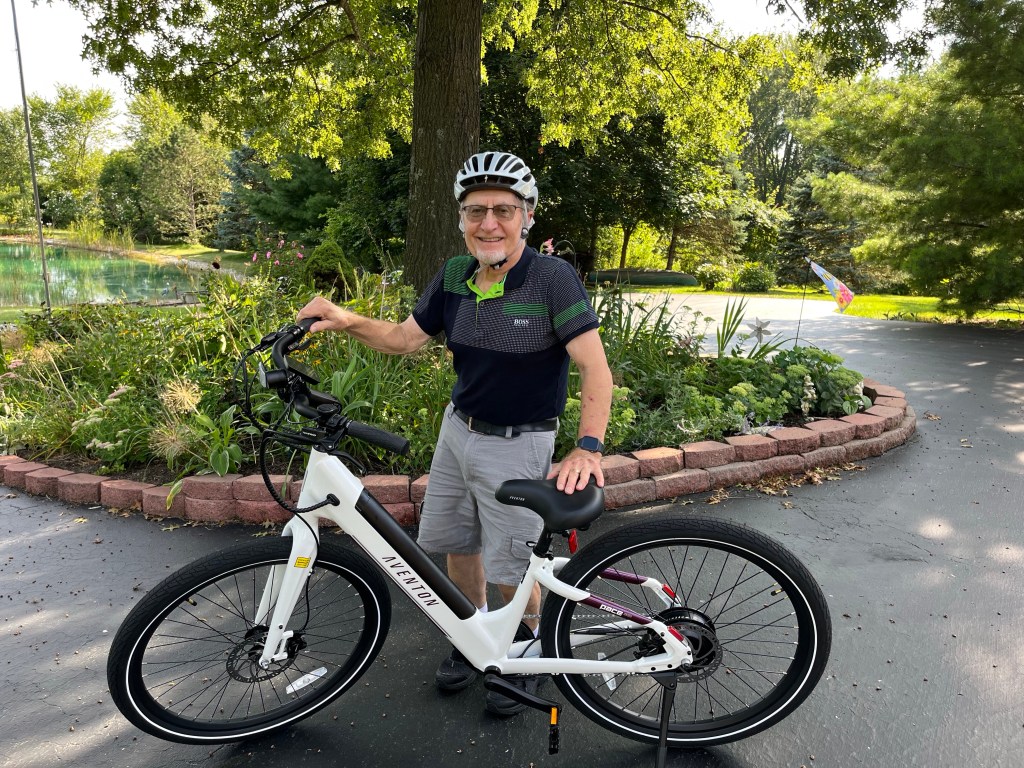
After test riding the e-bike (pictured above) in the store’s parking lot I was sold and brought it home on a trial basis. Unfortunately I discovered over the last two weeks that my balance and reflexes just aren’t up to learning the new skills required to master the e-bike. I had a couple minor falls on it, again miraculously without damaging myself or the bike. The last fall was on a short trip down our driveway to get our mail, and I sadly concluded it just isn’t worth the risk of a major injury to keep trying.

So with a heavy heart I asked my wife to help me load the bike in my SUV and returned it to the store. In addition to the sadness of adding bike riding to my growing list of things I used to be able to do, I’ve been processing how to gracefully surrender to the realities of aging without totally giving up on living.

That task is a work in progress, but I believe a piece of it is to be grateful for all the decades of good memories that bike riding has provided for me.   Many of those memories are from the years before I could drive when my bike gave me the first taste of freedom to take myself to the neighborhood grocery store for a pop cycle or candy bar.  It was only a block away, but the longest journey starts with a short one.  That 1-speed (probably also a Schwinn) took me to Little League practice, the community swimming pool, and later every morning for a year to deliver newspapers clear on the other side of our small town.  OK, it was only two miles, but on frigid January mornings at 6 a.m. in northwest Ohio if felt like 20!

The summer I was 15 my good buddy Denny Dafler and I road 200 miles on six 25-mile trips and a 50 to earn our cycling merit badges for Boy Scouts. That was also the summer of my first great love, and she lived 5 miles out in the country. My legs were never in better shape than the summer of 1962.

As an adult my biking has been more relaxed rides of 5-10 miles on bike trails near home—good exercise and sometimes a therapeutic way to burn off frustration or other unresolved emotions. My exercise bike is a poor substitute from feeling the wind of the road in my face, but it is safer and more age appropriate at this stage of my life, and no helmet hair results either.

Farewell my biking self.  Thanks for the memories.  

Thanksgiving/Advent Prayer

O merciful God, as we worship on this pivotal day between Thanksgiving and Advent give us faith to wrestle with the hard truth that so much of our American pursuit of happiness is based on one of the seven deadly sins, namely greed.  Nowhere is that tension between Jesus’ values and our culture’s more obvious than this time of year where we devote just one day to celebrating gratitude for what we have in the midst of the biggest season of consumerism that begins earlier every year. .

Jesus said it as plainly and clearly as possible in the Sermon on the Mount. “You can’t serve God and money.” It’s a simple either/or, and yet we are still trying our best to prove Jesus wrong.

Choices about our basic human and cultural values are hard because they are so important, and in this case Jesus is a prohibitive underdog. He is up against a multibillion dollar advertising industry telling us 24/7 that we are what we wear, drive, live in, and how we look. Our consumer goods are made to be obsolete sooner rather than later so we will fill the landfills with last year’s gadgets. 

The choice between your way, Holy God, and humanity’s foolish pursuits is what Joshua addressed the Hebrew people about centuries ago on their long journey to the Promised Land. When they were tempted to worship other gods Joshua said, “If  serving the Lord seems undesirable to you, then choose for yourselves this day whom you will serve. But as for me and my household, we will serve the Lord.” 

Gracious Lord, I confess, I love my Apple gadgets and the new car I bought a year ago as much as anyone else. And yes, I know my iPhone and Apple Watch were made by abused Chinese workers. And yes, I also know I am called to be the keeper of those very sisters and brothers who made these devices I take for granted every day. It pains me to be reminded of that injustice, but so far not enough to do anything about it.

Ever-loving One, we do know that greed has been the root cause of most of the injustices in human history. Every economic, government, or religious system that perpetuates the power of the haves over the have nots has greed for wealth, power, or control at its core.

O God, with heavy hearts we confess our own complicity in systemic greed because we know the first step to addressing any injustice is to admit we are part of the problem.

And so as we move from this Thanksgiving holiday into the season of Advent, our hope and prayer today is that the gratitude of Thanksgiving will inform everything we do this Advent season. And as we light each Advent candle may we remember to not let the true light of the world be hidden under a bushel. It’s time for love and hope to stand up to the forces of greed, to make this the year we don’t ask for everything we want, but give thanks for everything we have.  And so we humbly pray in Jesus’ name, saying together the words he taught us to pray…

Northwest UMC, Columbus, OH, November 27, 2022

Greed: The Deadliest Sin?

“No one can serve two masters; for a slave will either hate the one and love the other, or be devoted to the one and despise the other. You cannot serve God and wealth.” (Matthew 6:24)

I have long wrestled with the realization that our U.S. economic system is based on greed, one of the seven deadly sins. Nowhere is that tension between Jesus’ values and our culture’s more obvious than this time of year where we devote one day to celebrating gratitude in the midst of the biggest season of consumerism that begins earlier every year. The struggle is symbolically portrayed in the scene above re-created by our niece from a picture she saw somewhere.

Jesus’ words above from the Sermon on the Mount can’t say it any more clearly. “You can’t serve God and money.” It’s an either/or, and yet we are still trying our best to prove him wrong. We are far more likely to follow the polar opposite maxim of Gordon Gekko, portrayed by Michael Douglas in the 1987 movie “Wall Street.” Gekko actually said, “The point is, ladies and gentlemen, that greed, for lack of a better word, is good. Greed is right.” That line has been shortened in popular memory to it’s very essence, “Greed is Good.”

Choices about our basic human and cultural values are hard because they are so important, and in this case Jesus is a prohibitive underdog. He is up against a multibillion dollar advertising industry telling us 24/7 that we are what we wear, drive, live in, and how we look. Our consumer goods are made to be obsolete sooner rather than later so we will fill the landfills with last year’s gadgets. No one repairs things anymore; we just toss them in pursuit of the latest device, clothes, or vehicle.

Choice between God’s way and humanity’s foolish pursuits is what Joshua addresses the Hebrew people about on their long journey to the promised land: “ if serving the Lord seems undesirable to you, then choose for yourselves this day whom you will serve, whether the gods your ancestors served beyond the Euphrates, or the gods of the Amorites, in whose land you are living. But as for me and my household, we will serve the Lord.” (Joshua 24:15).

Please know I am preaching to myself as much as to anyone else. I love my Apple gadgets and the new car I bought a year ago. I know my iPhone and Apple Watch were made by abused Chinese workers. And yes, I also know I am the keeper of those very sisters and brothers who made these toys I take for granted every day. It pains me to be reminded of that injustice, but so far not enough to do anything about it.

I don’t know if greed is the deadliest sin, but I do know it has been the root cause of most of the injustices in human history. Slavery, colonialism, genocide, nationalism, wars of conquest, systemic racism, sexism, and every economic, government or religion system that perpetuates the power of the haves over the have nots have greed for wealth, power, or control at their core. I don’t have a solution to this basic human flaw that goes clear back to Adam and Eve and their sons, but I do know the first step to addressing any injustice is to admit we are part of the problem.

I don’t agree with a lot of what Marianne Williamson says, but I thought she hit a home run with this quote that popped up on my Facebook page today: “Hate has talked so loudly for so long. Greed has talked so loudly for so long. Love has got to stop whispering.”

Jesus said the same thing this way: “Therefore whatever you have said in the dark will be heard in the light, and what you have whispered behind closed doors will be proclaimed from the housetops.” (Luke 12:3).

This year may the gratitude of Thanksgiving inform the way we approach the Advent season. And as we light the Advent candles may we remember to not let the true light of the world to be hidden under a bushel. It’s time for love to stop whispering!

Pastoral Prayer July 10

O God, we’re here again seeking sanctuary from a broken world.  We need a place to rest and breathe, to reflect on the mysteries of life, and to turn our many cares and concerns over to you.  We confess our prayers too often sound like a shopping list, asking you to heal this family member, to protect loved ones who are traveling or going through a rough patch.  Forgive us when we forget that you already know the cares of our hearts.  Let us listen more than we talk in our prayers.

You have sent the Holy Spirit to comfort and guide us; you have provided us with the necessities of life, usually in great abundance.  You make it rain on the just and unjust alike, and we know it is not our job to tell you what to do.  But just so you know, we really wish you could send heavenly rain to our western states and other dry and arid places where your children are forced from their homes just as the Hebrew people were when they went to Egypt because of famine in Canaan.

Sometimes we get so focused on all the things that are wrong in our lives and in the world that we don’t see the good stuff.  We don’t stop to see the roses, let alone smell them.  We don’t listen to the bird songs, or marvel at a magnificent sunset; or rejoice over children and youth who have learned to share their abundance with their hungry neighbors.  You sent Jesus to give us abundant life, life that cannot be measured in earthly currency.  When we lose our way to embrace the abundance you provide, remind us that Jesus is the way and the truth and life we seek. 

We long for eternal life, but we don’t have to wait till we die to live that way.  Today is a part of eternity, but eternal life is not measured in years or decades or millennia.  It can begin right now on July 10th if we let go of the problems that weigh us down; so many things we can do nothing about.  Eternal life begins when we trust in you, O gracious God, when we surrender our lives and live for your glory; when we live in such a way that we make disciples for the transformation of the world. 

We can never do or say anything enough to express our gratitude for all you have done and are doing for us.  Sometimes the only prayer we need to say is a simple “thank you.”

Amen

Things I Never Asked My Father

My father, Herb Harsh, died four years ago at the age of 96. Part of my grieving for him and for myself has been thinking of many questions I wish I had asked him before he lost touch with reality. There are several reasons we never talked about a lot of things.

My father was a child of the depression born in 1921. He grew up with an abusive alcoholic step-father in rural northwestern Ohio. In spite of that he excelled in school and was valedictorian of the 1939 class at Buckland, Ohio high school. We used to tease him that it didn’t take much to be at the top of a class of 19, but the more I’ve come to appreciate the obstacles he overcame I regret that I didn’t give him more credit for his academic and survival skills in those depression years. His high school classmates were lifelong friends for him, bringing him back to high school reunions for nearly 70 years until he could physically no longer make the trip back home from his retirement community near Cincinnati.

My sister Sue and I inherited Dad’s ability to achieve in school. She was valedictorian of a class of 200, and I was second in a class of 120; and both of us went on to get graduate degrees. I think Dad would have been the first in his family to go to college had it not been for WWII. He enlisted in the Army Air Corps shortly after Pearl Harbor. One of the things I wish I asked him is what he did in years between high school and the service. My sister said she remembered he worked on the railroad at some point in his early life, and we think that may have been it.

I also wish I knew where he got his love for music. He played his tenor saxophone and sang in every musical group he could find until he was about 90. He had his own dance band in the 1950’s and bookended that with organizing “The Harsh Notes” quartet at his retirement community. In between he sang in the choir at every church he attended. When the aging process took those things away from him he lost most of his will to live. Because I was not gifted with any musical talent I never showed much interest in his love of music, and I regret that. I have always been a sports fan and listened to or watched every baseball, football and basketball game I could. My dad had zero interest in sports of any kind, and I wish I had explored that topic with him, just to understand him better.

I know my parents met at a dance, but I never cared enough to ask him for any details, and I’m sorry. All I do know is that my mother, a small town girl of maybe 19, followed her love to at least two air corps towns in Texas. Somewhere along the line they decided to marry before he was shipped overseas to fly B-17 bombers. I don’t know if they ever were formally engaged or where/when that might have happened. I do know they were married on June 5, 1943 in Tuscaloosa, Alabama where he was stationed for officer training. Sometime thereafter he shipped out to England. I wish I knew more about when that was and how he traveled there.

After he died we discovered that he had written about some of his war experience for the newsletter at the Otterbein Retirement community where he lived the final 38 years of his life. He apparently flew a few bombing runs over Germany near the end of the war, which he didn’t like doing, and again I wish I had asked him more about that. Like most survivors of war I don’t think he really wanted to talk about his war experience, but I wish I had shown more interest and wonder if it would have been good for him to talk about it.

The life-changing event in his service career happened after the war was over in Europe. He was co-pilot of a B-17 bringing 17 service members home after the war. For some strange reason I wish I understood they were flying across the Atlantic at night, leaving a refueling stop in the Azores Islands around midnight. Shortly after leaving there both of their engines failed, and they were forced to ditch (crash land) in the cold North Atlantic. Because it was foggy they came down too steep and too fast. My dad was knocked unconscious by the impact and remembers his pilot shaking him and urging him to get out before the plane sank.

The survivors of the crash impact spent the next 12 hours in the dark waters that they had been told might be shark infested. They were not able to retrieve any life rafts from the wreckage and had to rely entirely on their Mae West life jackets to keep them afloat. By the time they were finally rescued the next morning only four of the 17 men on the plane survived.

I cannot begin to imagine what those 12 hours were like. My dad didn’t write about any of that in his account. Watching his buddies die and fearing for his own life would surely have qualified him for a PTSD diagnosis if there had been such a thing in 1945. I will never know why I didn’t figure that out until very late in his life. It would have changed so much about our relationship and made me so much more patient and understanding about his approach to life, parenting, and his faith.

I wish I had asked him about how that horrific experience brought him from a churchless upbringing to a devout, dedicated Christian life for 70 years. I can only guess how his conversion experience happened, but what I know for sure is that my personal and professional life choices were totally affected by his come to Jesus moment or hours there in that water.

Why didn’t I explore all those important life events with my father? Let’s say I was a child of the ‘60’s and he came of age in the ‘30’s. Ironically it was his encouragement of me academically that created most of the divide between us. My life experience once I began college and seminary was totally foreign to the conservative, parochial life my father grew up in and chose to stay in after the war.

Pre-Viet Nam I was a typical patriotic American kid. I played war games with my friends, I wrote a piece in 4th grade that said I wanted to be a marine when I grew up. I was an Eagle Scout in 1960 at age 14, but all that began to change one day in my senior year of high school. A history teacher, Mrs. Miller, told our class one day that she thought Viet Nam was going to be the next trouble spot in the world. None of us had a clue where Viet Nam was, nor that Americans had been dying there already for 4 years. Suddenly my fantasies about attending one of the military academies came face to face on the nightly news with the realities of guerrilla warfare in the jungles of Southeast Asia,

That unjust and unnecessary war escalating was the backdrop to my entire college and seminary educational experience. My peers were dying in Vietnam and at Kent State University just 100 miles from my seminary campus. At the Methodist Theological School in Ohio we students didn’t have to protest. Our faculty and administration cancelled all classes to discuss how we could respond to the Kent State tragedy. That event led to my first political action. Some of us decided to go Washington DC and talk with our legislators about our concerns over the war and the unrest it was creating in our country. In one 24-hour whirlwind three of us drove all night to DC, talked with legislators the next day and turned around and drove straight home that night. The three of us probably made no difference in DC, but we bonded through that experience and are still good friends 52 years later.

Unfortunately my new liberal politics and theology were very troubling to my dad. I understand now that he needed the certainty of very concrete beliefs and values to manage his undiagnosed PTSD, and my divergence from those beliefs and values were a threat to his worldview. I wish I had been smart enough then to be patient and understanding about where he was coming from; but I guess I was not confident enough in my own burgeoning faith to reason with him. It was easier to rebel and withdraw from any controversial issues with him.

There is a running joke in my extended family about all of us who have received one or more of Dad’s infamous letters criticizing us for breaking one of his rules for living. My younger sister was always her Daddy’s girl and was his devoted caretaker in his last difficult years. She prided herself that she had never received one of his nasty letters, and she made it till he was getting very belligerent about his circumstances in his last two or three years. I’m hoping I don’t get that way, but I do know I learned or inherited my impatience and temper from him. He had every reason to be miserable those final months.

My mother died suddenly from brain cancer a few weeks after my parents celebrated their 50th anniversary. My dad was lost without her, and remarried a year later a recently widowed woman who also lived in their retirement community. Both families were aghast and thought they were making a huge mistake. But they had 20 good years together before dementia did it’s dastardly deed on her. Dad often lost patience with her, and I’m sure I would have too. Eventually she had to move into memory care, and Dad, bereft of his music, his wife, and his dignity became a handful. It was in that state he finally wrote a nasty note to my sister criticizing her for not being available to him 24/7. My sister Nancy is a candidate for sainthood, but her letter made one family member happy — my son, Matt, now gets to boast that he is the only member of the family who never got a Harshpa letter.

One of the things we can laugh about now but was very stressful in Dad’s later years was how much he absolutely hated wearing diapers. For many months he was determined he was going to invent an apparatus that would make diapers unnecessary. His idea was somehow to create a device out of plastic tubing which at one point he was going to super glue to his penis! When we all presented a united front and refused to buy him any more supplies for his hair-brained idea he was livid. I made one trip, two hours each way, to visit him after that, and when I told him no, I was not going to the hardware for him to buy supplies he told me I could go to hell, and my 4-hour trip resulted in one very ugly 5-minute visit.

I don’t share that to criticize my Dad. As I am aging now I fully understand the frustration of giving up so many things I used to be able to do. I wish I had more fully understood that for my dad, and I’m sure most families go through some similar tough times. We were never forgiven for taking away his car keys either, and I get it now.

The good news is that for some years before the diaper conflicts Dad and I reached a somewhat peaceful and comfortable relationship. He mellowed some, or gave up trying to change me, and I came to understand that he had done the best job as a father he could. That grace is what most dads want most for Father’s Day. We all have regrets about things we have done or failed to do as fathers, but the bottom line is we’ve all done the best we could, and that’s all anyone can ask.