OMG: Good Friday Sermon, 2025

OMG – a common abbreviation used these days on social media and many users don’t know it, but it’s really a prayer, a lament.  It means “O My God,” and in our Good Friday context the emphasis is on the little word “My.”  Because even when we doubt and feel God is absent, we still own and affirm the relationship. My kids are still My kids even when they do stupid stuff I don’t agree with – same with friends, spouse, and colleagues.  Real relationships and friendships have no expiration date, and certainly there is none with the eternal God of all creation who has been with us since the day we were born and will be with us for all eternity after our short sojourn on this earth is over.  

Another common lament today is “Life sucks and then you die!”  That one is not in the Bible, but it could be in the book of Lamentations. When Jesus says from the cross, “My God My God why?”  Hear the My and not just the forsaken.  And of course the lament of Psalm 22 is followed immediately in our Bible by the most familiar Psalm of the whole 150.   Psalm 23 begins with “The Lord is MY shepherd.”

As we remember the brutal crucifixion of Jesus tonight I invite you to make that experience real.  Feel it in your gut.  Imagine or remember a time when you were in unbearable pain – either physical or emotional, and Jesus was certainly in both – a time when God feels as far away as the planet Pluto – at the death bed of someone you don’t think you can live without – when you hear a terminal diagnosis from a doctor – or your heartbreaks over a shattered relationship, or a job loss, or your financial security disappearing, or hearing on the news about unspeakable human cruelty.

Holocaust survivor Elie Wiesel in his book “Night” relates an incident when he was a prisoner in a Nazi concentration camp when a young man was hung and all the other prisoners forced to watch.  Someone asks Wiesel, “Where is your God?” and his answer is, “Right there on the gallows.” Whatever and whenever we suffer God suffers right along with us.

One of my favorite descriptions about human lament is the one Brian and Barbara just sang for us, “Day is Done,” by Peter, Paul, and Mary.  I asked for that song because of these lyrics which say, “Tell me why you’re crying my son; I know you’re frightened like everyone. Is it the thunder in the distance you fear? Will it help if I stay very near – I am here.” And if you take my hand my son, all will be well when the day is done.”

We really want to believe that “all will be well when the day is done,” but we don’t know how long that metaphorical day will last or if we can last that long. But what we do know is that it helps to have someone very near.  It helps to be able to share out loud what our pain is with someone we trust and know will listen and just be present as long as we need them. 

I just learned about a quote from Fred Rogers recently in our Books to Bridges book group.  Mr. Rogers said, “What is mentionable is manageable.” “What is mentionable is manageable.”

Pain that we try to carry alone can suck the very life out of us, but if we can talk about it the power it has over us is shared and diminished – it becomes manageable.

Another lament in Psalm 13 begins with these plaintive words: “How long, O Lord? Will you forget me forever?   How long will you hide your face from me? How long must I bear pain in my soul and have sorrow in my heart all day long?”   The point in sharing these cries for help is not to depress us but simply that it’s OK to lament, to doubt; those feelings are part of the human condition. No matter how strong your faith is it is hard when the foundations of your existence are shaken like an 8.0 earthquake.  Even Jesus who had more faith than all of us put together cries out “My God, My God, why have you forsaken me?” which is even more powerful in the Aramaic that Jesus would have spoken: “Eloi, Eloi, lema sabachthani?”    

And as you heard in our scripture from Psalm 22 tonight we know where Jesus got those words.  Jesus knew his Scriptures very well, and he knew his people for centuries had been no strangers to devastating loss.  They were experts at lament.  We even have a whole book called Lamentations in the Hebrew Scriptures, which is our Old Testament, devoted to nothing but laments.  And part of the prophet Isaiah’s description of God’s Messiah is that he is a suffering servant who “… was despised and rejected by others; a man of suffering and acquainted with grief.”

Ps 22 is typical of another source of laments the Hebrew people used in public worship. Do you know that there are more psalms of lament in the book of Psalms than any other type of Psalm? One of my favorites when I’m having a no good, terrible, awful day is Psalm 130.  It’s called “De Profundis” in Latin and says, “Out of the depths I cry to you, O Lord.  Lord, hear my voice! Let your ears be attentive to the voice of my supplications!”  Out of the depths loosely translated means “we are in deep do do.”

Psalm 63:1 echoes the same song: “O God, You are MY God; early will I seek you; my soul thirsts for You; my flesh longs for you in a dry and thirsty land where there is no water.” I’ll bet most of us have been in such a dry and thirsty land or may even be there right now.  That’s the message of Good Friday.  I still remember vividly one such time in my youth.  It was my Boy Scout Order of the Arrow initiation.  I was maybe 13. I was led out along with my fellow scouts in total silence and darkness until I was tapped on the shoulder and told to stop and sleep right there, left alone in a strange, dark woods overnight with only a sleeping bag. I had no idea if anyone else was close by or where I was. It was the most alone I had ever been at that stage of my life

Kate Bowler, one of my go to devotional sources, wrote this blessing two years ago in 2023, but it is even more relevant today and is part of her Lenten devotions for 2025. 

It’s called “A Blessing for when you need a little hope.”  “These days feel heavy and dark, like hope packed up and left, and forgot to send a postcard. We cry: Where are the good things? And honestly, where are the good people— the sensible ones fighting for what matters? Why does it feel like bad stuff always elbows its way to the front, pushing everything good to the sidelines? We’re tired. Exhausted, really. Desperation is knocking, and it’s tempting to surrender. Blessed are you, who see the world as it is: the sickness and loneliness, the injustice that never seems to end, the greed and misuse of power, the violence and intimidation, the mockery of truth, and disdain for weakness, and worse— the seeming powerlessness of anyone trying to stop it. Blessed are you, worn down by hard-earned cynicism, running on fumes, with no promise of a destination. Maybe hope isn’t so distant. Maybe it’s there—small, persistent, and stubborn. May you grasp something in the heaviness. A glimmer of what could be, and walk, step by step, toward the possibility that goodness exists. Hope is an anchor dropped into the future pulling you forward, toward something better— even if it doesn’t feel like it right now.”

Yes, my friends, there is always hope somewhere.  Even “O My God, My God” still claims God as ours.

 This Good Friday feels more real to me because we are living in a time of great uncertainty in our country and our world.  No matter what your politics you know these are unsettling times.  But we aren’t the first to feel this way.  The women at the foot of the cross and the other disciples hiding out somewhere had no idea what their future held – and neither do we.  I invite you to put yourself in the crucifixion story – pretend we don’t know what happens on Sunday morning, and enter fully into the forsakenness of that moment with Jesus and his followers and friends.   

What do we do when life seems hopeless, empty, dark, alien, and full of fear and uncertainty?  Like Jesus we can call out “O My God, help us!” and God will answer.  Maybe not immediately; we may have to go through a long Saturday of uncertainty, as long as that Saturday lasts, but there will be an answer because God does not forsake us, just as God did not forsake Jesus.

Even here in the darkness we remember that God so loved the world that God sent Jesus to love and save us. When all else fails it is that love that is eternal.  God so loved the world, and as author Sarah Bessey says, we are called to love that world too and everyone in it, even, Sarah says, knowing that it will break our hearts – knowing it will break our hearts.  To love means risking, being vulnerable, feeling pain — but a broken heart is so much better than not having a heart at all. 

Good Friday 2025, Northwest UMC, Columbus, OH

Spiritual Jetlag

Subscribe to continue reading

Subscribe to get access to the rest of this post and other subscriber-only content.

Advent 4: Love

Just as expectant parents prepare for the miracle of birth, decorating the nursery and buying supplies for their newborn, so we prepare our hearts to receive this greatest gift of all, the miracle of God’s love.

God does not need a labor and delivery room because God is the one in whom we live, and move and have our being. But when we are wounded by others or weary from struggling against the forces of evil we sometimes forget God is close enough to taste the salt of our tears.

Today we are tired of the bad news that bombards us every day.  We are tired of senseless violence, tired of natural disasters, tired of fearing an invisible virus, and oh so tired of separation from loved ones and interruptions to our normal lives.  

[Light Candle] And yet we light this candle of love again on this short December day because we know God is always here and everywhere.  We rejoice and hope and love, not because all is well in our weary world, but because it is well with our souls.  We are warm even this close to the winter solstice because we are wrapped in God’s eternal love.

And so we pray: O Holy One, even as our days grow shorter the candles of hope, peace, joy and love burn brightly.  Even in the darkness we see the star of Bethlehem leading us to the greatest gift of Love the world has ever received.  We know you will be with us this week even if all the gifts have not arrived, even if the guest list is missing people we love, even if we are in quarantine; because nothing can separate us from your love.  We can’t begin to explain this holy miracle, but we light candles and sing praises anyway because we feel your love in the depths of our souls.  For that gift we give you thanks and praise.  Amen

OMG!

Oh My God, I am bone-tired weary. I am already physically and emotionally exhausted from personal challenges and the chaos in the world is more than I can even bear to hear about. 8000 plus new COVID cases in Ohio today, 240 COVID deaths Statewide just this week alone — all so unnecessary and down right stupid. Throw in a tsunami of gun violence and deaths, probably in part caused by the stresses of the pandemic that refuses to end. Are we stronger and smarter than this ever-changing corona virus? According to the overflowing ICU numbers and the number of foolish, misinformed people still refusing to get vaccinate it would seem the virus is definitely winning.

On a more cosmic scale I hear that the hole in ozone layer over the South Pole is now larger than the entire continent of Antarctica. Floods, fires, and hurricanes of epic proportions still cannot convince most of us to admit our addiction to fossil fuel that, like most addictions, is killing us in bigger numbers every year. Yes, I know you showed Elijah that you were not in the earthquake, wind, or fire* but in the still small voice. You tell us to be still and know you are God, but Lord, it is so hard to be still in the midst of chaos. Yes, I know Jesus slept through the storm in the boat, but I am like the disciples who were afraid and chastised Jesus for napping while they were in mortal danger.

There is no off switch on my worrisome brain. Yes, I can sometimes shut off all my devices and not listen to the 24/7 news, but it is so much harder to still my mind and soul. Speak to me, Lord of the universe. Reassure me you are walking through this difficult time with me, carrying me or (dragging me if necessary) when my legs are too weary to keep going. Speak to the storm and calm the turbulent sea within my heart. I believe O God, help my unbelief. Amen

PS: I’m grateful to report that as it often does when I “take it to the Lord in prayer” I feel much better. I can’t explain how that works. I just know it does.

*Bible references: I Kings 19:12, Psalms 46:10, Matthew 8:24, Mark 9:24

Spiritual Surrender: The Only Way Out

Hard to believe I’ve been blogging here for 10 years, and when I look back to my very first post I am a bit shocked to see it was about bringing our troops home from Afghanistan. I also originally did posts based on biblical texts from the Revised Common Lectionary; so today I decided to revisit that practice, and when I looked up the texts for August 22 I find God’s spirit moving again in mysterious ways. Several of these texts speak to the centuries old issues at work in the seemingly intractable conflicts in the Middle East.

The passage from Joshua 24 addresses Israel’s transactional “right” to occupy the land of their ancestors if they remain faithful to their covenant with Yahweh. Verses 15-18 say, “Now if you are unwilling to serve the LORD, choose this day whom you will serve, whether the gods your ancestors served in the region beyond the River or the gods of the Amorites in whose land you are living; but as for me and my household, we will serve the LORD. Then the people answered, “Far be it from us that we should forsake the LORD to serve other gods; for it is the LORD our God who brought us and our ancestors up from the land of Egypt, out of the house of slavery, and who did those great signs in our sight. He protected us along all the way that we went, and among all the peoples through whom we passed; and the LORD drove out before us all the peoples, the Amorites who lived in the land. Therefore we also will serve the LORD, for he is our God.”

Verses like that last verse one always trouble me—“…the Lord drove out before us all the peoples, the Amorites who lived in the land.” Would a just God of the whole universe choose sides and violently force the occupants of a piece of God’s creation out of the land they have called home for centuries? Would a just God rationalize such an eviction just because Joshua says God told us we can have this “Promised Land” even though we’ve been living in Egypt for 400 some years? That is not a rhetorical question because the fact that Israel and her neighbors are still killing each other over that piece of real estate makes this an urgent contemporary issue.

Preachers can challenge and deepen their own faith and that of their congregations by wrestling with such challenging issues. Some of us fear that exposing contradictions in the Bible will destroy faith, but that is not true. I love the quote in one of Frederick Beuchner’s books that says, “Doubt is the ants in the pants of faith.” We don’t usually come to Scripture or worship because our faith is totally secure. All of us, preachers perhaps most of all, come thirsting for authentic encounters with God, and if what preachers are serving fails to meet that need folks will stop at McD’s on the way home for junk food. I cast my lot with the theologians who realize that certainty is the enemy of faith, not doubt. To ignore contradictions within holy texts in hopes that no one will notice is a fool’s bargain. Because real faith at its core always contains some mystery and is therefore a holy riddle inviting us into dialogue with the text and with God.

For example, another of the lectionary texts for August 22 is from I Kings 8 which describes part of Solomon’s dedication of the first temple in Jerusalem many years after Joshua led the conquest of the Promised Land. Beginning at verse 24 we find these words: “Hear the plea of your servant and of your people Israel when they pray toward this place; O hear in heaven your dwelling place; heed and forgive. Likewise when a foreigner, who is not of your people Israel, comes from a distant land because of your name for they shall hear of your great name, your mighty hand, and your outstretched arm–when a foreigner comes and prays toward this house, then hear in heaven your dwelling place, and do according to all that the foreigner calls to you, so that all the peoples of the earth may know your name and fear you, as do your people Israel, and so that they may know that your name has been invoked on this house that I have built.”

“Do according to all that the foreigner calls to you; so that all peoples of the earth may know you name….” What an about face from thanking God for killing off the Amorites! And what a great way to examine the evolution of faith over time as God inspires women and men in all generations with the wisdom of Solomon. God’s concern for the foreigner/alien/sojourner is of course interspersed throughout the Hebrew texts along side more nationalistic sentiments because we know the path to faith is not the wide comfortable one but the narrow mountain road with numerous switchbacks and challenges that require our devotion and honest intellectual curiosity.

One of my biggest regrets about my preaching career is that I have not always been brave enough to wrestle in corporate worship with the challenges of biblical interpretation. It has been poor stewardship on my part to withhold from my parishioners and others the marvelous gifts of historical-criticism and narrative criticism I was given in my seminary education.

When I taught homiletics I encouraged my students to focus on just one text per sermon and refrain whenever possible from trying to preach on two or more selections from the lectionary. But there are exceptions to every rule, and this set of texts interact so well with each other that it is at least worth exploring how they inform or expand each other. For me the epistle text from Ephesians 6 also speaks to me as both a preacher and a citizen of our broken world.

The familiar passage about “putting on the whole armor of God” is an excellent metaphor for those preparing to speak for God in these difficult days of pandemic and domestic and international conflict. But “armor” can be a two-edged sword (to mix metaphors?). Remember how David refused to put armor on when he confronted Goliath because it hampered his ability to use the shepherd’s tools at his disposal? ( 1 Samuel 17). It is rather like Brene Brown’s analogy I heard recently in one of her podcasts where she characterized getting defensive when we feel vulnerable as “armoring up.”

Those “weapons” described in Ephesians are also metaphors and not meant to for us to go out as “Christian soldiers marching as to war…” as one of my my childhood (but no longer) favorite hymns puts it. I invite you to instead focus on the qualities of discipleship described in Ephesians instead of literalizing the military memes. As the author of Ephesians 6 says, “… in the strength of God’s power put on the whole armor of God, so that you may be able to stand against the wiles of the devil. For our struggle is not against enemies of blood and flesh, but against the rulers, against the authorities, against the cosmic powers of this present darkness, against the spiritual forces of evil in the heavenly places. Therefore take up the whole armor of God, so that you may be able to withstand on that evil day, and having done everything, to stand firm. Stand therefore, and fasten the belt of truth around your waist, and put on the breastplate of righteousness.”

In these days when lies, mis-information, and “alternative facts” bombard our ears and senses without ceasing I would argue that we need none of these parts of “armor” more urgently than “the belt of truth.” It is no accident that it is the first item listed for it is the truth that will set us free. But we know that truth can also make us feel very vulnerable and uncomfortable. We cannot question Joshua’s conquest of the Amorites, or the imposition of the nation of Israel on the Palestinians after World War II without also seeing in the mirror American genocide of indigenous people who lived on our “promised land” for centuries before Columbus sailed the oceans blue. No matter how much we divert our eyes we must eventually face the fact that our choices and actions as individuals and nation states have long-lasting consequences.

When I was in high school I excelled at history/social studies because I was blessed with a good memory that could regurgitate historical dates on demand. But it was not until I took a world history class in college that I had the first ah ha moment and began to connect the dots between one historical event and others that followed. For me my first revelation that the harsh treatment the allies imposed on the conquered Germans in the Treaty of Versailles that ended World War I was used by Hitler to inflame German nationalism and racism by blaming the dire economic plight of the Great Depression on their European enemies. A huge part of that Nazi response was to unify their base by scapegoating Jews and anyone else who was different from the pure Aryan race. Tragically that strategy resulted in the deaths of 6 million Jews and thousands of others in dozens of extermination centers. And the next link in the chain of events was an attempt at repentance by the allies who far too long pretended the Holocaust wasn’t happening. That act of penance was to create a new/old homeland for the Jews in Israel, which in turn displaced hundreds of thousands of Palestinians, and the viscous cycle rages on with 9/11, Desert Storm, killing of Osama Ben Laden, oil wars, Hezbola, the Taliban, etc. etc.

The gut wrenching headlines from Afghanistan right now defy any human resolution of the impact of brutal violence as city after city falls to the Taliban. It like all wars before it yet another gruesome illustration that peace can NEVER come through instruments of death. Violence ALWAYS escalates into more and more violence. The good news is that only when we reach the ultimate limit of our human wisdom can we surrender our fear, pride, ego and arrogance and call upon the cosmic power of the one we call God.

O Eternal Being, we have been told that your “Spirit helps us in our weakness; for we do not know how to pray as we ought, but that very Spirit intercedes with sighs too deep for words.” (Romans 8:26). This is one of those moments, O God. We confess our weakness. Intercede for us and bridge our foolish human divisions. Let all of us children of Abraham come together in weakness, trusting you as the only way, truth and life. Let believers, atheist, agnostics and all of your troubled children put down our weapons and raise our hands in unconditional surrender so your will and not ours will emerge from a world of chaos and death. Amen

Note: I would welcome comments and reactions. If you preach on one or more of these texts give me some feedback on how helpful or unhelpful this was. Thanks

Doubt and Faith

“Doubts are the ants in the pants of faith. They keep it awake and moving.”

The quote above has always been one of my favorites from Frederick Buechner. (It’s from his book, “Wishful Thinking.”) But of late I’m wondering if like most things one can have too much doubt. I know I’m way too old for a mid-life crisis, but the ants in my pants are feeling more like fire ants in recent days.

My preacher mentality means I usually feel that I need to offer a word of hope when I write about the stuff of life, but for today I just need to vent. I’m depressed about the whole state of the world. The fires in the Amazon, senseless gun violence, divisions in the fabric of society that are deeper and wider than the Grand Canyon—it all feels so hopeless to me. When we desperately need to come together to solve these huge problems we just choose up sides and fire salvos across a partisan chasm that is no more real than the imaginary lines we draw on our maps.

So maybe it’s an old age crisis? And I’m not talking about dying. I’m ok with whatever death means. But the crisis for me is about what kind of world are we leaving for our kids and grandkids? I’m not an end of the age, Second Coming guy. In fact I think Christians who are rooting for the Apocalypse and even encouraging it with conflict-producing radical pro-Israel Middle East policies are not only copping out of our stewardship of the earth responsibilities, they are making matters much worse.

When I reflect on my life and what I’ve done to leave the world a better place than I found it, I don’t like the picture I see. There was a time not too long ago when I felt differently. I thought we were making progress on huge social issues like racism, nuclear weapons, and climate change, but no more. Maybe this is just a pendulum swing and a temporary setback. I truly hope so. I know my time is not God’s time, and I do believe that the life force we call God is bigger than this little planet we occupy. On my worst days I wonder if given our human history of evil and destruction of each other and our world that maybe humankind has outlived its usefulness. What if the universe would be better off without us?

That’s not hopeful or “wishful thinking,” to use Buechner’s phrase. But maybe the key to his quote is the part that says doubt “keeps faith awake and moving.” It certainly does keep me awake at night, but does it keep me moving or does too much doubt paralyze me? Only if I surrender to it! Just moving for the sake of moving is exhausting and useless. But if doubt and big existential questions keep me moving deeper and force me to surrender to God instead of to my feeble human fears, then the ants are doing their job.

I feel like the father in Mark 9 who brought his son to Jesus for healing of a life-long affliction with seizures that threated to destroy him. So it is with the problems threatening to destroy our world. Like the father I lay our broken world at Jesus’ feet and say, “If you can do anything, have compassion on us and help us.” And Jesus said to him, “‘If you can’! All things are possible for one who believes.” And like the father. at least today, my best response is, “I believe; help my unbelief!”

A Doubting Faith: The Children, Mark 10:13-16

Little Johnny was asked to pray at a large family dinner. When he protested that he didn’t know how to pray his father said, “Just pray for your family, friends and neighbors, the poor, etc.” So Johnny prayed: “Dear Lord, thank you for our visitors and their children who finished off all my cookies and ice cream. Bless them so they won’t come again. And this coming Christmas, please send clothes to all those poor ladies on my Daddy’s phone who don’t have any clothes. Amen. Johnny was never asked to pray again, but don’t you just love the honesty of children?

That may not be what Jesus was thinking when he said “whoever does not receive the kingdom of God as a little child will never enter it.” You’ll notice in our text for today Jesus doesn’t ask the kids to speak! But when we think about the qualities children possess that we can learn from isn’t their refreshing honesty one of those? Kids tell it like it is. Today I want to focus on what being like children can teach us about having an honest faith that admits we all have doubts about life’s mysteries – and it’s OK.

Imagination is one of those qualities kids have that we sometimes lose as we grow up. Imagination is powerful – nothing can ever be created until someone imagines what it might look like. Heather Sherrill on our tech team is the theater director for Darby High School, and she shared with me recently some great stats on the value of the arts in education where creative imagination is nourished. Here are just a few of those benefits.
Students involved in music, theater and art are:
• Less likely to drop out of school
• 3 times more likely to earn a bachelor’s degree

• Have better listening and speaking skills
• Are more likely to engage in classroom discussion and public volunteerism
• And are less likely to engage in delinquent behavior

The bad news is that only 28% of public schools in high poverty areas offer theater instruction, and I would add, even in our best schools there is so much emphasis put on testing kids in math and science that important classes in the arts and physical education are cut or eliminated. Math and science are important of course in our high tech global economy, but there needs to be a balance in teaching skills and values that make for informed and competent citizens critical to a democracy. No calculus formula will provide those skills that only a solid education in the humanities offers.

Not all creative ideas that kids have, or adults for that matter, are necessarily good ideas. When my kids were 1 and 4 we moved into a parsonage that actually had two bathrooms – one up and one down. The kids were fascinated by how that plumbing worked; so Joy decided one day to flush her brother’s pacifier down the upstairs toilet and then ran downstairs to see if the binky would miraculously appear in the downstairs commode.

And that spark of imagination doesn’t die at puberty. We attended a performance of Peter Pan last weekend by Worthingway Middle School in Worthington. Our great nephew was in the cast. Do you remember that moment in the story where Tinkerbelle the fairy drinks the poison to keep Peter Pan from drinking it? And the spotlight that represents Tinkerbelle flickers out. But then Peter remembers that fairies live whenever kids believe in them and he asks all the kids in the audience to clap to show they believe. Guess what; even us old kids on Medicare were clapping until Tinkerbelle’s light flickered back to life.

Kids are also full of curiosity – that’s how they learn, and as Pastor Chris reminded us last week a childlike faith does not mean one that has no doubt. Children are full of questions. As we run some pictures of our Northwest Children’s ministries I want to share some insights and comments about childlike qualities from our Children’s ministry team.

When learning about the Creation Story a 5 year old asked “Okay, I get all this, so how did God really create the entire world? Did it just happen like a flash?” And I thought the hard questions from my kids were where babies come from!

During a discussion about being the hands and feet of Jesus Christ and feeding others in need an 8 year old asked, “When will there no longer be hungry people in this world?” Thank God for kids who can still imagine such a world and share their hope with us.

In all kinds of activities we see older kids helping the younger kids. It’s great to see such mentoring happening in our children’s ministry.

During our own version of the Winter Olympics some of the kids were so curious- they had to touch all the supplies beforehand and try it out first. A 5 and 8 year old didn’t want to play hockey or ski at first. Apparently they were not familiar with the sports and decided to complain about it. So the teachers provided coaching and encouragement and a nurturing environment for the kids to trust their team mates and themselves. The children tried and struggled, but they all got to the finish line and scored for their team. Building team work is key for a successful and fun experience- even if we lose the game- there is much appreciation for the game and for one another.

Kids like to be useful; to be significant and make a difference. The NW kids are learning from Bible stories and from the examples of this mission-minded church to be servants and good neighbors by doing things like decorating cards and tying fleece blankets for OSU Star House. The children are creative and love to share their quality artwork with others. Many are artists and they know it too. They have generous hearts and giving spirits. Always willing to share with their neighbors.

The Children’s Garden is such a great learning experience – lessons about patience and teamwork, stewardship for God’s creation, compassion for hungry people, and gratitude for harvest. While Preparing the Children’s Garden one 6 year old commented-“come on already, we need to get these seeds in the ground, time is running, people are hungry. We need more sun.” This was the weekend when we got snow in early April. Can you hear their eagerness!!!

Another example of that was one day while getting ready for Brown Bag Lunches a 9 year old commented, “Wow, we can do this; we need more friends to help. If we could all do our part, more people can eat.” One of the best things about the Brown Bag ministry is that our new friends from the neighborhood are helping and are also getting involved in other church activities,. They feel welcome here at Northwest, and our children are a big part of that hospitality.

Kids live in the moment—they see a problem and they want to address it right now, no appointing a committee to study hunger – just find ways to feed people now. I was much older than these kids when I was working as a youth pastor while in seminary, and one thing I remember from that experience was my Sr. Pastor telling me more than once, “Steve, don’t lose your idealism!” Children have natural idealism and hope – life hasn’t drained it out of them yet, and we all need all the hope we can get. Hope is the antidote for the negative kind of doubt that sometimes keeps us from moving forward, from daring to dream and try.

I was in Westerville on one of the few nice days we’ve had so far this month and had some time before my next appointment. I was near Sharon Woods Metro Park and decided to take a short hike. While there I remembered a scary moment at that park many years ago when my son Matt was maybe 4 or 5. We were riding bikes as a family and he was on his big wheel – remember those? Cool low to the ground kind of a drag racer tricycle. We came to a rather long steep hill on the bike trail and before we could yell for Matt to stop he was flying down that hill heading for a curve at the bottom where there was a wooden bridge across a small creek. If you know big wheels you know they had no brakes! We were sure he was going to crash into the bridge and die, but thank goodness he was a good driver or got lucky and zoomed thru the bridge and coasted to a stop on the other side.

I asked Matt, who now has his own 4 year old if he remembered that incident. He said no, only from hearing us talk about it. But then he went on to say something interesting. He said, “Watching Brady, his son, do things like that is a lot scarier than it was when he was the one doing them.” I forgot to remind Matt about the time he went sledding off the garage roof. Kids are risk takers. They haven’t learned about all the dangers of life yet. That gives parents gray hair, but it is also an important dynamic of faith. Courage comes from trusting your own ability and the basic goodness of life so we can do what’s right instead of just what’s safe.

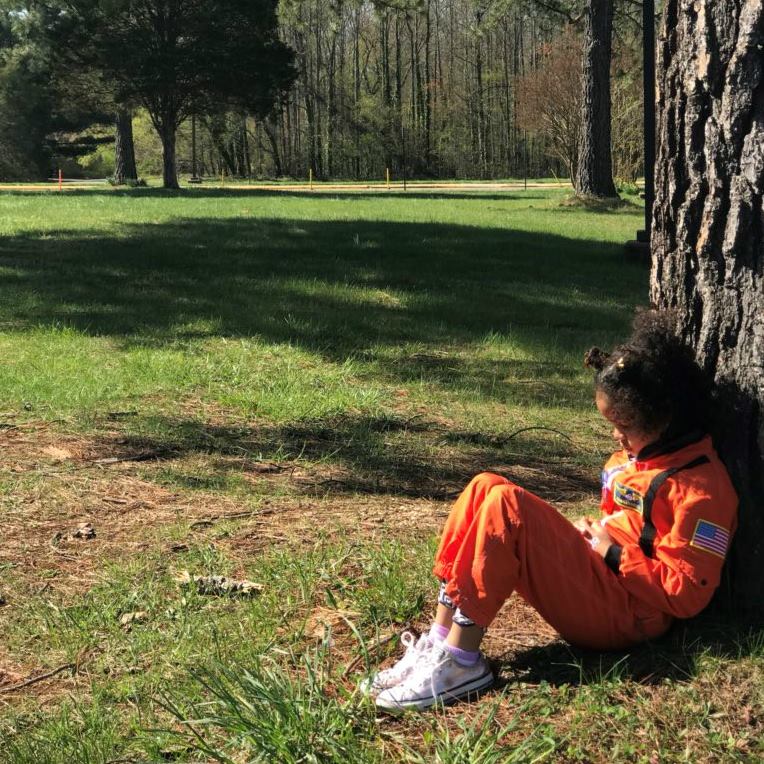
Speaking of risk takers, I came across this picture this week of Havana Chapman-Edwards, a first grader in Alexandria, Virginia who was the lone student at her school to join in the National School Walkout Day on April 20, the 19th anniversary of the shooting at Columbine High School.

Havana’s mom signed her daughter out of school because Havana said she wanted to participate. Her mom says she was crushed to see Havana sitting by herself, but then she became inspired by her daughter for standing up for what she believes in.

Havana told a news reporter that she was inspired by the Parkland High School students who have been pushing politicians to protect kids from school shootings.

For 13 seconds, Havana and her mom sat in silence to honor the 13 people who lost their lives at Columbine. Havana says that she wore her orange astronaut suit because she wants to show the world black girls are strong leaders.
Comedian Bill Murray in an interview with NBC news said this about student protests: “The thing that’s so powerful about students is that, when you haven’t had your idealism broken yet, you’re able to speak from a place that has no confusion [doubt?], where there is a clear set of values. Idealism is a voice that’s inside you, it’s your conscience. That can really deteriorate along the way… and it can become almost dysfunctional, but it’s there. Everyone has it.” I agree and would add that it’s the voice of idealism that children can help us all hear again.

Kids see the world with fresh eyes, unclouded by filters of status or rank. I saw a post recently from a childhood friend about his experience in the Vietnam War, and it reminded me of the great friendship we shared as children and youth. Blaine was one of my best friends. He was raised by his grandmother who I now realize was dirt poor. Their home was in a part of town that I’m ashamed to admit I would probably be uncomfortable to visit today. My family was lower middle class, but compared to the conditions my buddy lived in we were very wealthy. But I didn’t have those filters and lenses to see the world through then. Blaine was just my friend.

My point is that kids don’t come out of the womb with any kind of prejudices – those are acquired. When I was in high school we didn’t talk about racism or classism, even though they were very real in our little town. But we learned important life lessons in more subtle ways. We had an excellent choral music program that produced a popular musical every year. As you all know I can’t sing a lick now and I couldn’t then either, but I got to do the next best thing – I was on the crew that helped produce the shows. The one that I remember most is Rodgers and Hammerstein’s “South Pacific.” It’s set during WWII and centers around two love stories, one between an American nurse and a wealthy French property owner and the other between an America soldier and a Polynesian woman.

The romance and music are great but more important is the underlying story about prejudice and racism that threaten to keep these lovers apart. There is one memorable song called “Carefully Taught” that says “you have to be taught before it’s too late, before you are six, or seven or eight, to hate all the people your relatives hate. You have to be carefully taught.” Those important life lessons about human relationships could not be discussed openly in my school in the early ‘60’s, but by the magic of storytelling and imagination we could vicariously experience their power through those characters.

Finally there’s another really important reason Jesus welcomes and blesses the children that isn’t so obvious to us. We think of children much differently than people did in biblical times. Today we respect and encourage children, and because of that it is easy for us to romanticize this passage. We see cute pictures and all these positive attributes of childhood trust and enthusiasm, but the people of Jesus’ day saw children pretty much in the very opposite way. Children then were powerless, totally dependent liabilities. One commentator describes them as “non-persons.” They were on the very bottom rung of the cultural pecking order of the day.

So when the disciples saw people bringing their unruly, disruptive kids with them when Jesus was trying to teach important kingdom stuff the disciples tried to shoo the kids away. But Jesus says, “Wait a minute folks – don’t you dare chase those kids away. Everybody’s welcome in my kingdom – and that means everybody! The poor, the lepers, the sinners, the lame, and these precious little nobodies.” And you know what else, by welcoming the children Jesus also knew that he was making it possible for their mothers to also crash the old boys club and listen to the good news he came to share.

We’re really excited that we’ve had several new babies born into our church family recently. As I hear tales of sleepless nights and exhausted moms and dads I am reminded that to accept the blessed gift of a child means to becomes that child’s servant. Those helpless little bundles of humanity are totally dependent on someone to provide for their every need. Those who change diapers and wipe noses give up all claims to position or privilege – and that’s exactly how humble we must become to enter into God’s kingdom where all are equal.

Jesus and the disciples saw the same children, but Jesus saw them through the inclusive eyes of love; and that’s exactly how he sees you and me – runny noses, doubts and all, and he hangs out the welcome sign and blesses us and everyone who comes. Amen.


Monday morning, Holy Week

I just did the math and estimated that I have gotten out of bed approximately 3700 times on a Monday morning. Wish I hadn’t done that – the math that is, although if I hadn’t needed to go to the bathroom I might have pulled up the covers and stayed put. One of the hard things about retirement is the lack of a “normal” routine. The hardest days are often those that are also the best part of retirement—the ones where there’s nothing I “have” to do. Nothing on the calendar at all so the day is completely unstructured, a blank canvas staring back at me wondering what will be on it by the end of the day? Needless to say that’s an especially unusual kind of Monday for a retired pastor who remembers Holy Week as one of the busiest of the year.

I imagine Jesus didn’t want to get up and head back into Jerusalem that last Monday either. He had spent the night with friends in Bethany because of Mary and Martha’s hospitality, but also because it was safer there than in Jerusalem where powerful people wanted him dead. There the city sanitation workers were cleaning up the palm branches and leftover cloaks from the parade route Jesus had followed the day before. The crowds may have been hung over with joy and anticipation from the triumphal entry on Sunday, but Jesus knew what was coming or at least had a pretty good idea.

Imagine the internal debate! “My work here isn’t finished. The disciples aren’t nearly ready to take over! There’s so much more I need to do here. I won’t be able to heal anyone or teach anyone if I’m in jail or dead!”
Doing the right thing when the easy thing is so tempting; when all your friends are telling you to play it safe. To do requires the courage to be—to be true to oneself and to the one who gives us life. To do the peaceful thing in the face of fearful, hateful power requires first being at peace; being full of peace that is deeper than fear and stronger than doubt. That’s the energy that got Jesus out of bed that Monday and Tuesday and Wednesday and Thursday and on that Friday that seemed the worst of all Fridays ever.

His soul was full of an eternal peace that calms the storm at sea and the even bigger storms in our hearts that threaten to drive us into hiding when we most need to grab Monday morning by the neck and say “Bring it On!”

Dueling Psalms, 130 vs. 19


No, that 130-19 is not a lopsided NBA finals basketball score! It’s the score of my attitude adjustment a few days ago when I awoke in one of those woe-is-me moods and thought of the lament known as De Profundis in Psalm 130. That’s Latin for “O crap I have to face another day of aches and pains and bad news!” My arthritis was nagging at me, my chronic back trouble was moving up the pain scale, and the news was full of more terrorist attacks and hate crimes. Reading the newspaper over my morning coffee used to be one of my favorite times of the day. I still do it out of a sense of duty to be an informed citizen, but it has become an increasingly depressing task.

Psalm 130 begins “Out of the depths I cry to you, O Lord. Lord, hear my voice! Let your ears be attentive to the voice of my supplications!” As tensions between our nation and others mount, as our president foolishly believes his own nationalistic rhetoric that we can shrug off our responsibility for climate change and go it alone, as fears of terror attacks increase, and partisan politics paralyze any attempt to address critical domestic and international issues responsibly, I often wonder if God or anyone is listening to the voice of my supplications.
Later that same morning I went out to work in our lawn and gardens still down in the depths. We are blessed to live on a beautiful property decorated with my wife’s gardening handiwork, a pond, trees and flowers. But the beauty requires hard work, especially this time of year when the grass and the weeds are being very fruitful and multiplying. It’s the work that prompts me at times to say that “yard work” is made up of two four-letter words. But the birds were in good humor that morning and serenaded me as I went forth to mow the lawn. And then I looked up at the blue sky dotted with huge languishing cotton ball clouds pictured above, a sight not seen nearly often enough in central Ohio, and my heart shifted gears from Psalm 130 to 19:

“The heavens are telling the glory of God; and the firmament proclaims God’s handiwork. Day to day pours forth speech, and night to night declares knowledge. There is no speech, nor are there words; their voice is not heard; yet their voice goes out through all the earth, and their words to the end of the world.” (Psalm 19:1-4).

In basketball 19 doesn’t beat 130, but in the game of faithful living it does. God’s presence is all around us no matter how far down in the depths we are feeling. We just have to look for it with all our senses. No, the skies are not always breathtakingly beautiful, but the loving God of all creation is always surrounding us if we have eyes to see and ears to hear. Even the author of De Profundis knew that while in the depths, and Psalm 130 ends with this statement of faith and hope:

“I wait for the Lord, my soul waits,
and in his word I hope;
my soul waits for the Lord
more than those who watch for the morning,
more than those who watch for the morning.

O Israel, hope in the Lord!
For with the Lord there is steadfast love,
and with him is great power to redeem.
It is he who will redeem Israel
from all its iniquities.”

Be Still and Know

This is usually my favorite season of the year. New life breaking forth after a long winter’s nap, some days nice enough to get outside to work and play, and my favorite sports—golf and baseball—on the TV to distract me from all the bad news in the world. The latter isn’t working well this week as the news from Syria, N. Korea, and Washington DC just keeps going from bad to worse. As I pray hard for wisdom and reason to steer our nation and world through very troubled waters I am reminded by ancient Scripture that we are not the first to experience such times as these, and for just a moment my soul is still and knows the tumult of humankind will not have the final word.

“God is our refuge and strength, a very present help in trouble.
Therefore we will not fear, though the earth should change, though the mountains shake in the heart of the sea;
Though its waters roar and foam, though the mountains tremble with its tumult.
There is a river whose streams make glad the city of God, the holy habitation of the Most High.
God is in the midst of the city; it shall not be moved; God will help it when the morning dawns.
The nations are in an uproar, the kingdoms totter; God utters his voice, the earth melts.
The LORD of hosts is with us; the God of Jacob (and Rebekah) is our refuge.
Come, behold the works of the Lord; see what desolations God has brought on the earth.
God makes wars cease to the end of the earth; God breaks the bow, and shatters the spear; he burns the shields with fire.
“Be still, and know that I am God! I am exalted among the nations; I am exalted in the earth.”
The Lord of hosts is with us; the God of (Rebekah and) Jacob is our refuge.” (Psalm 46)