Faith Expeditions: Help!, Exodus 17:8-13

We began this sermon series four weeks ago with Pastor Chris showing off how he could still wear his Boy Scout uniform. It would take a faith expedition and a 30 lb. diet for me to get into my old uniform, if it still existed; but the scout motto to “Be Prepared” still fits perfectly.

To go on any expedition requires preparation and that preparation should include a support team. Those who know my wife Diana know that she is the energizer bunny in our house. And she doesn’t worry about anything because she knows I’ve got that covered for both of us. Case in point: about 15 years ago Diana and I drove over to Xenia to watch two of her nephews and a niece go sky diving. The 3 of them went up and as Pastor Chris reminded us two weeks ago, what goes up must come down. And they did. We got to watch the two boys land safely right on target, and they were so excited about the experience. We didn’t see where our niece Sarah landed and were a bit concerned. But a few minutes later she and her partner came walking up the road and she too was all smiles.

But here’s where things got very interesting. One of the instructors said to those of us who had stayed on terra firma, “We still have time for one more trip if anyone wants to go.” I’m thinking no way Jose, but Diana’s sister-in-law who had some sky diving experience looked at Diana and said, “You wanna go?”

Diana was so inspired by the joy she saw on her nephews’ and niece’s faces that she jumped at the chance. They got prepared with instructions and strapped on their parachutes and off they went into the wild blue yonder.
And there she is soaring like an eagle. Notice 2 things about this picture, that guy who was Diana’s tandem partner, that’s not me. I was still safely on the ground. And you can’t tell from the picture but Diana’s buddy had his AARP card. He was a veteran of many jumps and he literally had her back; so she entrusted him with her life.
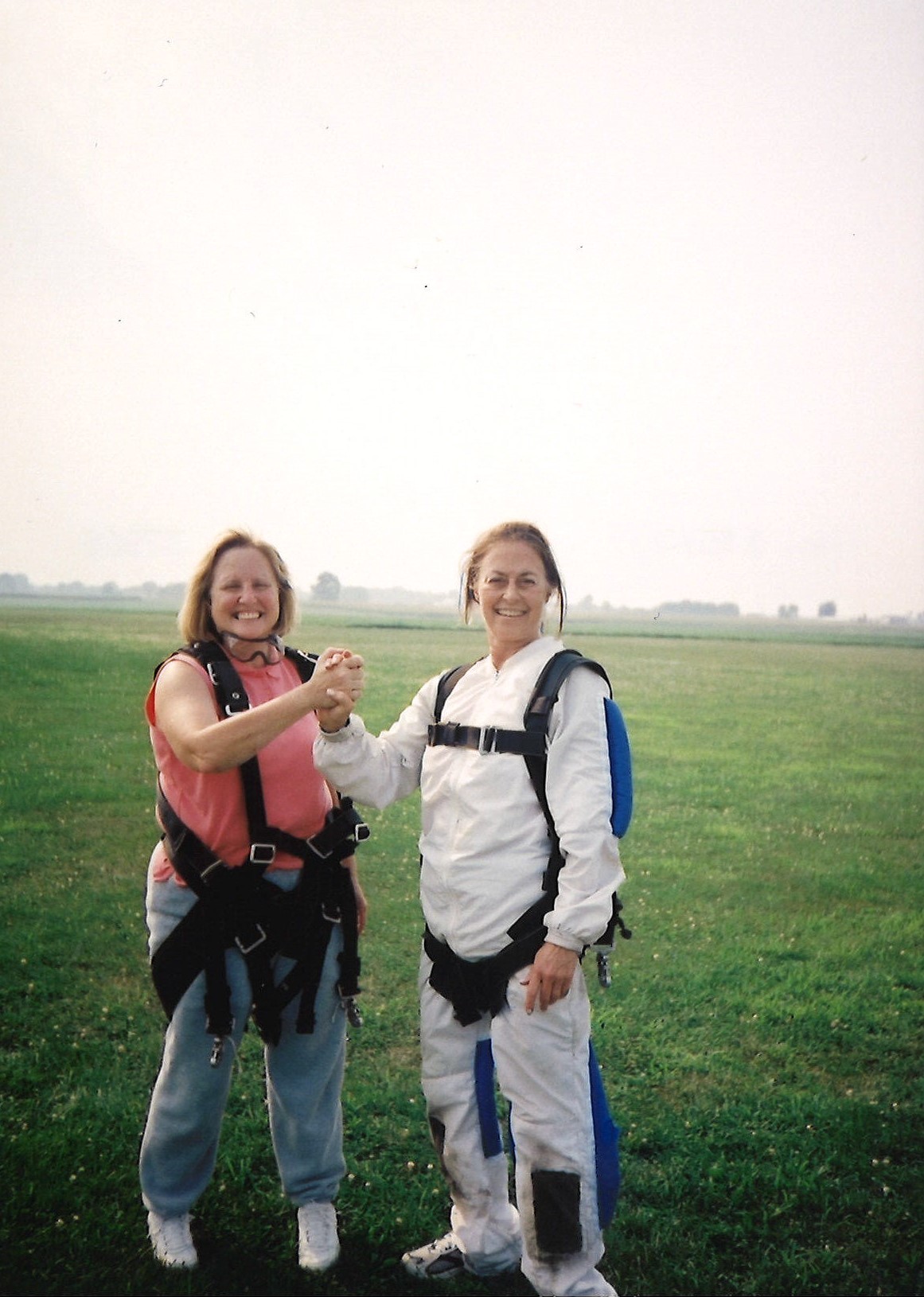
And here’s the “after” picture just so you know they landed safe and sound.

Moses at Rephidim was not jumping out of an airplane, but he too was in a life and death situation yet again on the long faith expedition known to us as the Exodus. Earlier in chapter 17, which is part of the “complaining” chapters in Exodus, the Israelites were ready to stone Moses for dragging them out into the God-forsaken wilderness. They again, like spoiled kids, want to go back to Egypt – this time because they have no water to drink. You may remember that this is where God tells Moses to strike a rock with his staff and water pours out and quenches the peoples’ thirst.

And then immediately Moses is confronted with another crisis—“Amalek came and fought with Israel.” Amalek was a descendant of Esau, and his people represent the bitter hatred between that branch of Abraham’s family and the Israelites. This battle is a reminder to us that there were already people living in the land the Israelites were claiming as theirs. The Amalekites saw the Israelites as illegal aliens in their land. And as we know there is still conflict over whose land has been promised to whom by which God. But that’s another sermon.

Today I want to focus on Moses’ unusual battle plan. He takes the same staff that he used to part the Red Sea, and the one he just used to get water out of the rock at Massah and Meribah. That staff is the visible symbol of God’s power and presence with the Israelites, and Moses says he’ll go up a hill and hold that staff aloft while Joshua goes into battle with Amalek.

Sure enough it works! As long as Moses holds up the staff Joshua’s men are winning the battle—but then Moses has a problem – his arms grow weary. Moses is human after all and like all of us he gets tired, but whenever he has to put his arms down to rest the tide of battle turns and Amalek’s army prevails.

What to do? Moses’ people are dying before his eyes, but he just can’t hold up the staff any longer. It’s just too heavy! Now we might expect Moses to cry out, “Houston, we have a problem!” But notice he doesn’t even have to do that. Moses isn’t up on that hilltop alone. His brother Aaron and another man named Hur go up there with him. And when they see the trouble Moses is having he doesn’t have to ask for their help. They don’t even have to call a committee meeting to decide what to do. They simply act, and the solution is simple.

They put a rock under Moses so he can sit down, and then Aaron and Hur get on either side of Moses and support his arms—not just for little while, but till the sun goes down. And because of their support and teamwork Joshua’s army wins the battle. Faith expeditions require a network of support. Taking a leap of faith is like trusting the person who packed your parachute and the pilot and your tandem partner—others who have experience, as well as those on the ground who pray.

One of my most memorable experiences in scouting was on a canoe trip on the Whitewater Canal in Indiana. I’m not sure where the name came from because there wasn’t any white water, but there was one narrow lock on the canal where the water was moving much faster. It was just around a bend in the river so we came upon it unexpectedly. Suddenly we saw a cable across the canal with a sign that warned us to stop and portage, i.e. get out and carry our canoes on the bank and put back in on the other side of the fast water.
Some of us were able to do that but because of inadequate warning some of our scouts got sucked into the faster current and made the mistake of grabbing on to the cable strung across the canal. You can imagine what happened; they stopped and their canoes went on without them.

The water wasn’t that deep so they were able to climb out and go retrieve their paddles and canoe downstream. The rest of the trip was uneventful for our group. However, because we had a large troop the canoe livery had to divide us into two groups. So when my group finished they hauled us and our canoes back to the starting point so the second group could have their turn.

Now the lock where some of our group got to remember their baptism wasn’t far from the beginning of the trip. It was easily within walking distance; so instead of warning our fellow scouts about that tricky spot as good scouts should some of us decided it would be fun to run ahead and see if anyone else got dumped in. And of course when they did, including our scoutmaster, we jumped out from where we were hiding and started laughing. But it didn’t take long before we realized the situation wasn’t funny anymore. Our scoutmaster was trapped beneath the canoe and wasn’t coming up. The scout with him was young and inexperienced and didn’t know what to do.

I was with some other boys on top of the lock about 10 feet above the water. I wish I could tell you this is where I sprang into action and saved the day, but I’m ashamed to admit I was flat out paralyzed with fear. My only contribution was to yell like an idiot for somebody to do something.

Fortunately for us all two of the scouts up there with me saw what needed to be done and literally jumped into action. They didn’t stop to worry about how deep the water was or what danger there was to themselves, they simply jumped from 10 feet up and were able to pull our sputtering scoutmaster to safety. Like Aaron and Hur, they saw a problem and acted to save the day.
None of us can get through life’s challenges alone. There are no self-made people.

My sister found this old photo recently that reminded me of my own ancestors who survived the great depression, two world wars, alcoholic husbands and all the challenges of parenthood. This is a 4 generation picture – I’m the cute kid in my grandmother’s arms. We’ve all got those folks who literally gave us life and kept us alive thru infancy; we’ve all got teachers and mentors; we’ve all got people who suffered in silence as we learned to drive or who ran behind us those first few times we rode a bike without training wheels.

It’s probably my age but I had one of those ah hah moments recently when talking to my youngest uncle Gary. He’s only 4 years older than I so was just ahead of me in school. He told me there were only 40 kids in his high school class. I was shocked because my class had a whopping 120, a 300% increase in just 4 years! And then I realized again that I am one of the original baby boomers – born in 1946. And that triggered one of those trips down memory lane when I realized why I was lucky enough to have brand new school buildings to attend throughout my public school career. Those old guys, and they were all men, who we made fun of – the school superintendent and the school board had the foresight to see the wave of us boomers coming in time to build a new elementary school and eight years later a new high school just as my class arrived on the scene; and they had the ability to pass school levies to make those things happen.
Who helped pave the way for your life? Who are the Aarons and Hurs who came along side you and supported you? It’s good to remember and be grateful even if we can’t thank those people. Keeps us humble too.

Think about Moses earlier in the biblical story. From day one of his call to serve God Moses knew he needed help and wasn’t afraid to ask for it. Well, he sort of asked. At the burning bush where God tells Moses he’s been chosen to go tell Pharaoh “Let my people go” Moses doesn’t exactly jump at the chance. He does what many of us do – he tries to weasel out of this scary faith expedition by making excuses. He says, “Not me Lord, I’m not a good public speaker. I’m not the one to go and convince Pharaoh to do this!” And God says, “OK, here comes your brother Aaron. He has the gift of gab. I’ll get him to be your helper.”

None of us have everything we need to tackle all the challenges life throws at us. But there are helpers around if we seek and trust God to provide them. We’ve been using different kinds of outdoor adventures to think about faith expeditions this month, but some of the most challenging expeditions in life have nothing to do with tents or canoes or parachutes. The inner journeys where we encounter painful memories, doubts, and fears are the toughest expeditions we ever have to take; but we all need to embark on those inner journeys over and over again to continue to grow in our faith.

We have a ministry here at Northwest that is specifically designed to match helpers up with those who need someone to just come alongside them, to listen to them, to pray for them. For the record these Stephen Ministers are not named for me, but for Stephen, one of the first deacons chosen by the early church to minister to the needs of the growing faith community. Stephen Ministers don’t do windows or home chores; their mission is to provide spiritual support for those going through difficult times on a faith expedition. And in the process, as is often the case, these Stephen Ministers discover that when we journey with someone else we also go deeper and stronger in our own faith. It’s a two-way street.

All it takes is a simple willingness to go the extra mile to help someone in need, even when it’s inconvenient–to take time to listen, really listen with our full attention to kids, seniors, colleagues and friends who are on an inner faith expedition. They may not know that’s what it is and there’s no need to label it as such. When we are on one of those journeys we just know we need someone there with us. We need someone to put a rock under us and hold us steady while we face whatever demons or challenges that lurk in the inner depths of our souls.

One of my favorite stories about a biblical helper is in the book of Ruth. Do you remember that story? Ruth’s mother-in-law Naomi is on a journey back to her home in Bethlehem after suffering terrible personal loses. Naomi and her family had been refugees in Moab because of a famine in Judah, and while there Naomi’s husband and both of her sons died. Both of Naomi’s sons had married Moabite women before their deaths, one named Ruth. So Ruth is not an Israelite, she is from Moab, one of those neighboring countries with no use for Israelites, and she’s dealing with her own grief.

When Naomi and her two widowed daughters-in-law come to a fork in the road where a critical life decision must be made, Naomi encourages both of them to go home to their people where they will be accepted and can find husbands there to provide for them. The other daughter-in-law returns to Moab, but Ruth’s response to Naomi is the famous line, “Where you go, I will go; where you lodge, I will lodge; your people shall be my people and your God my God.” Ruth saw Naomi needed a companion to walk with her through this tough time and she gave up the best path for herself to walk alongside Naomi.

And of course, the Scriptures tell us the rest of the story. In Bethlehem Ruth meets and falls in love with Boaz, and they become the great grandparents of King David. That’s important for Christians because when the Gospel of Matthew lists all those begats leading up to the birth of Jesus Ruth, the Moabitess is one of only five women listed in Jesus’ genealogy. She is the great, great, great …. Grandmother of Jesus 28 generations back.

When we see a need in others and respond to it, we never know what God has instore for us. So when you feel the need to journey into the deep spiritual mysteries – don’t be a worrier like me, say “Yes Lord,” and trust God to provide the support you need from people like Aaron or Hur or Ruth who will hold you steady till the sun goes down. Amen

Preached September 2, 2018, Northwest UMC, Columbus, OH

Reckless Love of Self, Ephesians 2:1-10

Before Lebron James announced his second departure from the Cleveland Cavalier one of the biggest sports stories in Cleveland was all about a basketball shot that was never taken. In game one of the NBA finals last month the Cavs lost a chance to win a critical game against the Golden State Warriors because J.R. Smith held the ball in the closing seconds of the game instead of shooting what could have been the game-winning shot. It appeared that Smith was confused, thinking the Cavs were ahead when in fact the score was tied, and he heard about it from irate sports fans.

Bob Oller, a sports writer for the Columbus Dispatch, took an interesting approach to that story. He went to one of the most admired sports heroes in Buckeye country, the only two-time Heisman Trophy winner and legendary Ohio State running back Archie Griffin. To quote Oller’s article, “Archie knows what it means to extend grace and receive mercy. Arch fumbled his first carry in his first game at Ohio State. It happens. Woody Hayes gave Griffin another chance and he made history with it. Archie also recalled another more glaring error he made when he fumbled a kick off on football’s biggest stage, the Super Bowl.” Archie’s take on JR Smith’s blunder: “It appears he lost track of the specifics of the situation….It’s a human mistake.”

Most of us don’t make our mistakes on national TV, but we all make them. What is something you regret that you wish you could undo? Words spoken in anger? Being self-absorbed with a problem and failing to notice the pain of a friend or loved one? Being distracted while driving and causing an accident or nearly doing so? As someone said recently, doing bad things doesn’t make us bad people, it makes us human.

In this sermon series we’re considering different aspects of love. Last week Pastor Chris talked about the first part of the great commandment – to love God with all one’s heart, soul, mind and strength. And most of us know the second part of that commandment which is to love your neighbor as yourself. We’re going to deal with the neighbor part of that verse in coming weeks, but today I want to focus on those final two words in the great commandment, “as yourself.” We often put so much attention on love of God and neighbor that we lose sight of those final two words that are a critical prerequisite to doing the other two.

To love anyone else as we love ourselves obviously means we have to first love ourselves, and that may be the hardest part of this whole deal. Loving yourself is hard for several reasons: 1) we are often taught directly or indirectly that it’s not cool to boast or brag about ourselves, that we should be humble; and often we get carried away with that because 2) we alone know the whole truth about all of our own dirty laundry. I believe it was Lincoln who said, “You can fool all the people some of the time, and some of the people all the time, but you cannot fool all the people all the time.”

That may be true, but even more true is the fact that you can’t fool God or yourself any of the time. No matter how good we are at hiding our faults from others, deep down our less desirable qualities are always with us like a perpetual bad hair day. Yes, we can rationalize or talk ourselves into doing something we know is not right, but deep down we still know it’s wrong and have to live with the guilt.

One of the biggest barriers to loving ourselves is perfectionism. Most of us don’t expect perfection from other people. We’re willing to cut them some slack, especially if we take time to consider that jerk who cuts us off on the freeway may be hurrying to get to a family emergency, or that rude clerk at the store is worried about her daughter who has run away from home. We know other people are just human, but why is it we often hold ourselves to a higher standard? I read a great line in a murder mystery the other day. The heroine of the story was beating herself up because she got taken in by a bad guy, and an old wise neighbor gave her this great advice. He said, “If I cried over every mistake I made I’d have drowned by now.”

Great advice, but part of the reason we have trouble loving ourselves is because we’ve got this accumulation of bad thoughts and behavior that seems to compound like credit card debt the longer we’re alive. And sometimes the church contributes to the guilt. I often joke that without guilt the church would be out of business. I may have borrowed that idea from the comedian, whose name I can’t remember, who joked about a church called “Our Lady of Perpetual Guilt.” But in all seriousness recklessly loving ourselves doesn’t mean excusing or sweeping our mistakes under the rug. Reckless love means embracing the good, bad and ugly, not just in others but first in ourselves, and that’s not easy to do.

The hard cold truth is that there is an evil streak in human nature. If we look honestly at the violence and suffering humans inflict on one another we have to admit it. Listen to what the writer of Ephesians says in the first part of chapter 2 that we read earlier: “You were dead through the trespasses and sins in which you once lived, following the course of this world, following the spirit that is now at work among those who are disobedient. All of us once lived among them in the passions of our flesh, and we were by nature children of wrath, like everyone else.”

“You were dead through the trespasses and sins in which you once lived… we were by nature children of wrath.” Those are harsh words to swallow and unfortunately they are the only words some people ever hear from the church. As Frederick Buechner puts it, “The Gospel is bad news before it’s good news.” And because some Christians who don’t love themselves get their jollies beating other people up with the bad news many folks don’t stick around long enough to hear the good news. And can you blame them?

A few weeks back Pastor Mebane preached a very good sermon on integrity and used the analogy from the game of golf about the honesty it takes to call a penalty on yourself. I was sitting up here that day and if you noticed I was squirming a little it was because she was getting too close to home. Anybody else feel that way, or was it just me that got my toes stepped on? Sometimes the truth hurts like when I look in the mirror expecting to see Brad Pitt and this old geezer keeps looking back at me.

I am old enough to remember a couple of previous versions of the United Methodist hymnal, and one thing I remember was that the old communion ritual had a prayer of confession that said, “We acknowledge and bewail our manifold sins and wickedness, which we, from time to time, most grievously have committed, by thought, word and deed, against thy Divine Majesty.” How’s that for a marketing strategy to attract folks to come to church? I can see the Facebook invitation now, “Come to Northwest this Sunday and bewail your manifold sins and wickedness!” I much prefer Jesus invitation, “Come to me you who are tired and carrying heavy burdens, and I will give you rest.”

Another thing I remember from the days when we used that old communion liturgy is that attendance on communion Sundays in many churches was always lower than average. I have no scientific evidence for why but I have a sneaking suspicion that people stayed away to avoid being saddled with a bigger load of guilt than they already had. Now it’s true that if you made it through the confession there was the Good News of salvation offered in the Sacrament itself, but I fear that once the guilt trip was triggered people didn’t hear the Good News of forgiveness. Out of curiosity I asked the office staff to give me the attendance numbers for the last 18 months here at Northwest. I was pleased to learn that over that period our average attendance on communion Sundays is almost identical to non-communion Sundays. I attribute that to the kinder, gentler language we use in celebrating communion that stresses how all are welcome at the Lord’s Table. And yes, ALL does mean ALL.

Please don’t misunderstand; I am not saying we don’t need confession as part of worship. We all have plenty to repent of as individuals and as a society, but we have to be very careful to be sure the Good News of the Gospel doesn’t get drowned out by the bad news. We get plenty of bad news all week and in order to recklessly and completely love ourselves we need to not only hear about the radical redeeming love of God, we need to feel it and experience it.

I John chapter 1 is a perfect example of the whole Gospel. Verse 8 says, “If we say that we have no sin, we deceive ourselves, and the truth is not in us.” If we stop there loving ourselves is pretty hard to do. But the very next verse says, “If we confess our sins, God who is faithful and just will forgive us our sins and cleanse us from all unrighteousness.” Today’s text from Ephesians says the same thing. Once it faces squarely the evil streak in all humans it shows us the way to self-love. Beginning at verse 4 it says, “But God, who is rich in mercy, out of the great love with which he loved us even when we were dead through our trespasses, made us alive together with Christ and raised us up with him, For by grace you have been saved through faith, and this is not your own doing; it is the gift of God— not the result of works, so that no one may boast.”

We can recklessly love ourselves, not in a boastful way, only because of the reckless love of God that saves us from our sin through freely given grace. It’s a love so reckless that Christ is willing to die a horrible death to show us the depth of God’s love; a reckless love that is like a sower who throws the seeds of grace everywhere, not just in “good” soil; a reckless love that runs down a dusty road to meet and embrace every prodigal child who repents and returns home.
In these days when the evil viruses of racism and nationalism and tribalism seem to be spreading like a plague it is easy to lose hope and to fear what the future holds. But fear is the lack of love, a lack of trust in God’s grace. If we trust God completely what have we to fear? As the great hymn “A Mighty Fortress is Our God” says, “The body they may kill, God’s truth abideth still,” and that truth is deep unconditional love.
Set free from fear by God’s grace we can stand up and speak up for truth and justice. We can worry less about what others think of us and do what’s right and instead of what’s popular. When we speak and live the truth we have nothing to fear because God has our back.

Think of the saints throughout our faith history who loved themselves enough to boldly love others. I love the women in the Moses story who defied Pharaoh’s authority and conspired to save Moses’ life – the midwives who refused to kill the Hebrew baby boys at birth, Moses’ mother and sister who put him in the bulrushes where Pharaoh’s own daughter would rescue and raise him. Without their courage Moses would never have grown up to lead his people out of slavery.

Where does love of self come from? Or if we’re born with it, what happens to it? One great answer to both those questions is captured in the words of a poem by Dorothy Law Nolte. It’s called “Children Learn What They Live.” Her words should be posted in every nursery and classroom. In part she says:
“If a child lives with criticism, she learns to condemn.
If a child lives with fear, he learns to be apprehensive.
If a child lives with shame, she learns to feel guilty. (That’s the bad news, but the poem goes on…)

If a child lives with encouragement, she learns to be confident.
If a child lives with acceptance, he learns to love.
If a child lives with approval, she learns to like herself.

Kids are so impressionable that the golden rule is doubly important for them and all of us whenever we interact with them. We can all help instill a healthy love of self by treating the little ones as we want to be treated, with patience, forgiveness and reckless love.

It occurred to me while working on this sermon that reckless love of ourselves boils down to applying the Golden Rule to how we treat ourselves. If I treat myself badly by living with self-criticism, fear and shame, then I’m going to treat others the same way. What if we simply begin by treating ourselves as we want others to treat us?

We can begin to do that by changing the way we do something that all of us do on a daily basis. Who do you see when you look in the mirror, when you really look? Do you see yourself flawed and imperfect physically or morally? Or do you see a child of God saved by grace, flaws and all, set free to serve God and others by the reckless love of God and self? When you look in the mirror from now on don’t compare yourself to people society tells us are beautiful or special, but see yourself through God’s eyes.

Treat yourself with kindness; treat yourself as you want others to treat you. Be like Martin Luther who it is said each day when he bathed rebatptised himself and reminded himself he was a beloved child of God, one who in the words of Ephesians is “created in Christ Jesus for good works, which God prepared beforehand to be our way of life.”

Reckless love is really quite simple: Love God and Love your neighbor as yourself.”

It all starts with loving that child of God we see in the mirror every day. Amen

PEACE-FULL

“In the beginner’s mind there are many possibilities, in the expert’s there are few.” – Shunryu Suzuki-roshi.

There are several versions of this parable, but here’s one I like because of its brevity: “Nan-in, a Japanese master during the Meiji era, received a university professor who came to inquire about Zen.
Nan-in served tea. He poured his visitor’s cup full, and then kept on pouring. The professor watched the overflow until he no longer could restrain himself. “It is overfull. No more will go in!”
Like this cup, Nan-in said, you are full of your own opinions and speculations. How can I show you Zen unless you first empty your cup?”

That story reminds me of a very helpful mantra for meditation I learned when I took an excellent on-line course called “Peace Ambassador Training” sponsored by the Shift Network. The simple three-part meditation is this: “Let me be peaceful; let me be kind; let me accept others as they are.” At first the part of that which gave me the most trouble was the third – accepting others as they are. To apply that to people I just flat out know are wrong is a total struggle for me. (This was especially true since I took the course in early 2016, just as the nasty Presidential election campaigns were turning up their volume.) Come to think of it the 2018 primary campaign is pretty ugly too!

I finally realized two things: that to accept others does not mean agreeing with everything they say or do, and that to accept others without judgment requires that I first need to work on accepting myself. So I modified the third phrase to read “let me accept myself and others as we are.” That’s better semantics, but even harder to do.
That led me to examine the first phrase. As Julie Andrews put it in “The Sound of Music,” “Let’s start at the beginning, a very good place to start.” “Let me be peaceful” seems to be very self-explanatory. It means to act in a peaceful manner, right? But then the meditation goes on to say “let me be kind,” and that seems a bit redundant to me. If I’m acting peacefully wouldn’t I automatically be kind or vice versa? That confused me for several months until I had an insight earlier this year that reminded me of the Zen parable above. To be peaceful means to be full of peace, and if I’m full of anything else, be it judgment, anger, anxiety, fear, lust or any of the other seven deadly sins there’s no room for peace. (See my February 2016 post “Giving up ALGAE for Lent” for a fuller discussion of this.)

The other thing I realized recently is that the key word in “let me be peaceful” is that little word ”be.” To be full of peace is a matter of “being” before it can be translated into “doing.” The doing is really part two of the mantra, “let me be kind.” Even though the verb is the same in both parts I believe kindness is more about actions and peacefulness is more about one’s state of being. That’s why Gandhi said, “There is no way to peace, peace is the way.”

It is only when we are full of peace in the very depths of our being that we can act kindly toward others and accept them regardless of their words or behavior. I also believe this is what Jesus was getting at in the farewell discourse to his disciples when he says, “Peace I leave with you; my peace I give to you. I do not give to you as the world gives. Do not let your hearts be troubled, and do not let them be afraid.” (John 14:27-29) How can Jesus expect his dear friends and closest confidants to not be troubled and afraid when he’s telling them he’s about to be brutally and very publicly executed? They are so afraid they all go into hiding, unable to bear the sight of their Lord and Savior suffering and dying on the cross.

The Judeo-Christian Scriptures are full of examples of both positive and negative examples of those who are full of peace and those who aren’t. Peter can walk on water when he’s full of peace, but when he realizes what he’s doing and let’s fear fill his heart he sinks like a rock. (Matthew 14:28-30) On the other hand, three brave men are able to defy the power of King Nebuchadnezzar when he orders them to bow down to his gods. “Shadrach, Meshach, and Abednego answered the king, “O Nebuchadnezzar, we have no need to present a defense to you in this matter. If our God whom we serve is able to deliver us from the furnace of blazing fire and out of your hand, O king, let him deliver us. But if not, be it known to you, O king, that we will not serve your gods and we will not worship the golden statue that you have set up.” (Daniel 3)

The same is true of post-canonical Christian Church history. Mother Theresa couldn’t have lived and worked in the wretched slums of Calcutta without being full of God’s peace. Joan of Arc could not have faithfully obeyed God even to burning at the stake if she was full of fear. One of the charges of heresy brought against Joan is one all Christians should desire for their epitaph: “It was said, “‘She does not submit herself to the judgment of the Church Militant, or to that of living men, but to God alone.”

That kind of peace does not come from human will alone. It comes only when we are humble enough to empty ourselves of pride and arrogance and allow God to fill us with peace. To that end I’ve found it very useful to employ a shortened version of this mantra whenever I remember to pause in a tough situation and ask God to fill me with peace.

These chaotic times we are living through today again cry out for women and men who are so full of God’s peace that we are able not only to act kindly but faithfully and courageously to defend truth and justice against any and all powers that threaten to fill us with fear. Pardon my irreverence, but I fully expect one of the first questions God will ask me on my judgment day is, “Steve, what are you full of?”

Good Friday Prayer

The adult choir at Northwest UMC is presenting a beautiful Tenebrae service for Good Friday. You are invited to join us this Friday evening, 7 pm. It’s called “The Shadow of the Cross” by Lloyd Larson. Here’s the prayer I’ve written to open the service:

It’s Friday Lord, and we’re here to remember – to remember a night long ago when you gathered with your friends to celebrate how you saved your people from slavery in Egypt. We remember that Passover because of all you shared in that Upper Room and invited us all to your table forever.

We remember that Passover meal because of what happened later in Gethsemane and the next day on a hill so ugly it was called the Place of the Skull. Words alone cannot convey the depth or the power of the mystery we come to relive this night. And so we turn to music, the language of the soul. Use the talents of these musicians to stir our imagination so we not only remember the pain and agony you suffered for us, but we actually feel the sting of the whip, the agony of betrayal, the bitterness of injustice, and the darkness of death and despair.

Help us tonight O God to actually be present in the shadow of the cross. Help us to stand with Jesus’ mother as she watched her beloved son bleed and die. Help us to be present weeping in the shadows with Judas and Peter; with Pilate and Herod hiding in their palaces. And let us stand bravely with the centurion and the thief who recognize who you really are.

Yes, we are in the shadow of the cross tonight, but we know that for there to be a shadow there has to be some light somewhere, even if we can’t see it. As the darkness closes in stand with us Lord. Help us feel the assurance of your grace that wipes away all our betrayal and denial with mercy and forgiveness.

As we feel the darkness descend till there are no shadows, there even in the mystery of death let us feel your love. We ask these things in the name of Jesus who was not in the shadow but on the cross. Amen

Monday morning, Holy Week

I just did the math and estimated that I have gotten out of bed approximately 3700 times on a Monday morning. Wish I hadn’t done that – the math that is, although if I hadn’t needed to go to the bathroom I might have pulled up the covers and stayed put. One of the hard things about retirement is the lack of a “normal” routine. The hardest days are often those that are also the best part of retirement—the ones where there’s nothing I “have” to do. Nothing on the calendar at all so the day is completely unstructured, a blank canvas staring back at me wondering what will be on it by the end of the day? Needless to say that’s an especially unusual kind of Monday for a retired pastor who remembers Holy Week as one of the busiest of the year.

I imagine Jesus didn’t want to get up and head back into Jerusalem that last Monday either. He had spent the night with friends in Bethany because of Mary and Martha’s hospitality, but also because it was safer there than in Jerusalem where powerful people wanted him dead. There the city sanitation workers were cleaning up the palm branches and leftover cloaks from the parade route Jesus had followed the day before. The crowds may have been hung over with joy and anticipation from the triumphal entry on Sunday, but Jesus knew what was coming or at least had a pretty good idea.

Imagine the internal debate! “My work here isn’t finished. The disciples aren’t nearly ready to take over! There’s so much more I need to do here. I won’t be able to heal anyone or teach anyone if I’m in jail or dead!”
Doing the right thing when the easy thing is so tempting; when all your friends are telling you to play it safe. To do requires the courage to be—to be true to oneself and to the one who gives us life. To do the peaceful thing in the face of fearful, hateful power requires first being at peace; being full of peace that is deeper than fear and stronger than doubt. That’s the energy that got Jesus out of bed that Monday and Tuesday and Wednesday and Thursday and on that Friday that seemed the worst of all Fridays ever.

His soul was full of an eternal peace that calms the storm at sea and the even bigger storms in our hearts that threaten to drive us into hiding when we most need to grab Monday morning by the neck and say “Bring it On!”

“Itchy Ears and the 99-yard Dash,” II Timothy 4:1-8

Today as we conclude this sermon series on being called I want to examine how Paul’s sense of calling was expressed even in his death. The problem is we don’t know how Paul died or when. Tradition has it he was beheaded in Rome as part of Nero’s persecution of Christians sometime around 63 AD/CE. But the New Testament, our main source of information about Paul’s life, is totally silent when it comes to the matter of Paul’s death.
Most of the book of Acts is a pretty detailed account of Paul’s ministry from his dramatic conversion on the road to Damascus to his missionary journeys all over Asia Minor and southern Europe, and finally to his arrival at last in Rome where he was a prisoner under house arrest awaiting trial. But after all the details of geography, arrests, shipwrecks and starting many new churches listen to how the book of Acts ends: “For two whole years Paul stayed there in his own rented house and welcomed all who came to see him. He proclaimed the kingdom of God and taught about the Lord Jesus Christ—with all boldness and without hindrance!” (Acts 28:30-31)

In other words as he faced Roman imprisonment and possible execution, Paul spends his time doing exactly what he did for all the years of his life after his call to follow Christ—he proclaimed the Gospel of Jesus Christ “with all boldness and without hindrance.”

Paul is one of the best examples of what I like to call the “Hokey Pokey” Gospel. You remember that fun little song which says in part “You put your whole self in, you take your whole self out, you put your whole self in and you shake it all about. You do the hokey pokey and you turn yourself around. That’s what it’s all about!” To be called means to put your whole self into whatever God is calling you to do. That doesn’t mean those who do full time Christian work are called any more than teachers, homemakers, bus drivers, garbage collectors or bee keepers. Any job can be a vocation if it is done fully as part of a life lived according to God’s will and values.

But just as the Hokey Pokey says, to fully respond to one’s call you have to “turn yourself around” or more accurately you have to let God turn you around. We often think the word “repentance” means to apologize, to say we’re sorry, and that’s partly correct – but it also means to turn around and go in a different direction. Paul did that when he was converted from being a hit man against the Christians to Christ’s boldest and most dedicated messenger. He had to give up his old life and do a complete 180. Most of us can’t do that on our own. To beat an addiction, to change careers, to turn our backs on the tempting idols of our materialistic world takes the help and support of others and the divine guidance of the Holy Spirit.

Most of us are more like Woody Allen than Paul when it comes to death and dying. Woody Allen says, “I don’t mind dying. I just don’t want to be there when it happens.” The best description I’ve ever found of what I’d call a good death is in a poem called “Thanatopsis” written 300 years ago by William Cullen Bryant. The word thanatopsis is derived from two Greek words and means “a consideration of death.” The poem is much more than the title word says; it is really a consideration of death and life because those are two sides of the same coin. One cannot die a good death without first living a good life.

The poem ends with these words:
“So live, that when thy summons comes to join
The innumerable caravan, which moves
To that mysterious realm, where each shall take
His chamber in the silent halls of death,
Thou go not, like the quarry-slave at night,
Scourged to his dungeon, but, sustained and soothed
By an unfaltering trust, approach thy grave,
Like one who wraps the drapery of his couch
About him, and lies down to pleasant dreams.”

So however or whenever St. Paul died I have the feeling he “approached his grave with an unfaltering trust like one who wraps the drapery of his couch about him and lies down to pleasant dreams.” But the question is how in the world do we achieve that kind of peace, a peace that enables us to be obedient to the end, to truly walk the walk of faith all the way to the finish line?

To find that kind of peace one must let go of regrets, and we all have them. Frank Sinatra sang “regrets, I’ve had a few, but then again too few to mention.” I wish I only had a few! And don’t think that just because Paul turned his life around on the road to Damascus that he lived 100% regret free from that moment on! In Romans 7 Paul says, “I do not understand my own actions. For I do not do what I want, but I do the very thing I hate…. For I do not do the good I want, but the evil I do not want is what I do. 20 Now if I do what I do not want, it is no longer I that do it, but sin that dwells within me.” Sin dwells in every human being. It comes as part and parcel of our free will; and that’s why repentance and conversion are not one and done events but on-going life-long journeys.

As Pastor Chris pointed out a few weeks ago Paul doesn’t always come across as a humble, repentant sinner. He frequently boasts about himself as a paragon of virtue and challenges people to live up to his example. And given all the hardship Paul lived through he truly is an excellent model to follow, not because he was perfect but because he was human like you and me, warts and all.

To run the risk of sounding too political one could say that Paul persisted. He refused to give up in spite of bitter conflict in the early church about the legitimacy of his evangelism among the gentiles. One of the most beautiful descriptions of the kind of determination it takes to live a faithful life is in the Scripture read for us today from II Timothy. As an aside, you may know that many biblical scholars are convinced that I and II Timothy were not actually written by Paul. The language in those epistles is a bit different from Paul’s other letters and the organization of the church described in these letters is far more advanced than would have been true in the first century.

But the testimony in these verses is so personal that if Paul didn’t say it he certainly could have. They describe his life and ministry to a “T” in beautiful poetic imagery that is especially vivid just now when we are watching the remarkable achievements of Olympic athletes who have trained all their lives for these games. II Timothy offers these words as Paul’s summary of his life’s work, and I don’t know about you but I’d love to be able to have these words as a eulogy for my life:

“As for me, I am already being poured out as a libation, and the time of my departure has come. I have fought the good fight, I have finished the race, I have kept the faith.”

When I was a Boy Scout 100 years ago one of the merit badges I needed to become an Eagle Scout was one for Athletics. This 98 lb. weakling had to accomplish a list of athletic tasks to the satisfaction of the supervisor for that merit badge. I don’t remember the other activities on the list but I still vividly remember the task that seemed insurmountable to me. I had to run ¾ of a mile in under 6 minutes. And yes I know that Olympic athletes today run twice that fast.

But I didn’t. Running was painful for me. I got cramps and pain in my side after about a half mile and that last lap around the track was sheer agony. But I did it because I had a goal I wanted to achieve and had further motivation from a friendly competition with one of my best friends to see which of us could make Eagle Scout first.

Do you ever quit on something before you reach your goal – weight loss, mastering a musical instrument, learning a new language, mending a relationship? I’ve got a terrible record as a quitter – stopped taking piano lessons, dropped out of band in middle school because staying there got complicated with my family’s priorities. I quit on my first marriage. I have not always fought the good fight and finished the race.
Did you ever hear of anyone getting a medal for running a 99-yard race? No – the race is 100 yards and no one wins by stopping short of the finish line. Jesus needs followers who are willing to give it all they have – whatever those talents may be that are uniquely yours. God can use all of us if we trust God enough to put our whole selves in. What that means will be different at each stage of life. As we age we have different amounts of time and life experience to draw upon, different talents and skills we’ve learned over the years.

For those who are called the real question is not “Is there life after death?” But “Is there life after birth?” Are we living life to the full or just going through the motions? Have we found a purpose and passion for our lives that keeps us going when the finish line seems totally out of reach? The power of focusing on that life purpose is what enables us to keep the faith and finish the race.

What keeps you from doing the things you know you should do? Timothy says it’s our “itchy ears.” Listen to these verses again: “I solemnly urge you: proclaim the message; be persistent whether the time is favorable or unfavorable…. For the time is coming when people will not put up with sound doctrine, but having itching ears, they will accumulate for themselves teachers to suit their own desires, and will turn away from listening to the truth and wander away to myths.” (Vs. 1b-4)

When our ears get itchy we look for teachers and leaders who say what we want to hear, and we turn away from the truth. Like allergies different things make different peoples’ ears itch. For some it is wealth or power. For some the temptation of living an easy life leads us away from God. Paul’s life teaches us that being called is not for sissies. Paul suffered greatly for his faith and has the right to tell us: “As for you, always be sober, endure suffering, do the work of an evangelist, carry out your ministry (life) fully.”

“Do the work of an evangelist!” What does that mean for all of you sitting out there? Is an evangelist only a pastor or a TV preacher? Is it someone who goes to the inner city or foreign lands to share the Gospel?

I have a friend who is spending a full month just now in Myanmar as a medical missionary. That’s her calling but it’s not mine and not most of yours. She has special skills as a nurse and great devotion to that type of ministry that enable her to go on such trips every year.

We don’t have to go anywhere special to be an evangelist because an evangelist is anyone who shares the good news of Christ with others. We can all witness to the world by living kind, loving Christ-like lives in whatever our work is or as students or in retirement wherever we are. St. Francis once said that all of us should “preach constantly and when necessary use words.” In other words how we treat others speaks louder than any eloquent preacher. Finding your calling where you can do that may mean turning yourself around. It may require making some tough sacrifices, but the Good news of Christ is that we are all loved and accepted by God and therefore do not need worldly comforts to live a meaningful life.

To be loved and cared for unconditionally is the salve that soothes itchy ears. Itchy ears can cause us to believe harmful myths – like our race is better than others, or that men deserve higher pay for doing the same job as women, or that children are to be seen and not heard! Paul fights the good fight until the day he dies to proclaim the truth that “there is neither slave nor free, Jew nor Greek, male nor female, but all are one in Christ Jesus.”

Age is one of those myths we need to examine carefully before we let them into our itchy ears. They, whoever they are, say “age is just a number.” That’s true but some of us have much bigger numbers than others!! And those bigger numbers can become excuses for not living life as fully and faithfully as we should. Aches and pains can make us give up certain activities. Exercise is too hard; everything takes more time and energy than it used to. We literally can’t do things we used to take for granted. We have to schedule time for simple things like tying shoes or cutting our own toenails because that requires extra effort. My days of giving grandkids piggy back rides are over, gone with the wind like my hopes of ever breaking 80 or even 90 on the golf course.

So it’s true, we old gray mares and stallions can’t horse around the way we used to, and that’s not all bad. I don’t want to go back and make the mistakes I made as a 20 something or 30 something! I’ve probably told you this before, but not today. There’s an organization called “Sageing International” that teaches people instead of saying how old they are to say “I have 71 years of life experience.” Instead of seeing age as a burden let’s value life experience more as an asset. And for you youngsters who don’t have your AARP cards yet, find some elders you can hang around with. We may not be able to figure out our smart phones, but like the Farmers Insurance commercials say, “We know a thing or two because we’ve seen a thing or two.”

Here are just a few examples of people who refused to let ageism stop them from finishing the race:
• Albert Schweitzer ministered to the sick in Africa until he was 89 – received the Nobel Peace Prize when he was 77.
• Anna Mary Robertson started painting when she was 76 saying “I am too young to sit on the porch and too old to work on the farm.” She worked until she was over 100. We know her better as Grandma Moses.
• Thurgood Marshall, the first African American Supreme Court justice served until he was 83
• Golda Meir became the 4th prime minister of Israel at age 72. She said “Old age isn’t a sin; it’s a call to service.”
• Artist Pablo Picasso did some of his best work in his later years and kept painting almost to his death. When asked what his greatest work was, he said, “The next one!”

Paul was not a spring chicken when he achieved his goal of getting to Rome. He didn’t get there the way he would have liked arriving as a Roman prisoner. But he didn’t let that stop him from doing what he was called to do.

So no matter how many candles were on your last birthday cake find God’s purpose for you at this stage of your life. Don’t let anyone with itchy ears convince you life is just a 99-yard dash.

Preached February 11, 2018, Northwest UMC, Columbus, OH

What’s Your Binky?

My colleague Chris Rinker told this story at our church recently, and I felt like it has such an important lesson for all of us that I asked Chris and the family in the story for permission to share it. They agreed; so here’s the story:

A few weeks ago at our church’s Breakfast with Santa event, one of the younger members of our congregation made a monumental, life-changing decision. He gave up his binky to Santa. Now, as most of you know, separating a toddler from his binky is no easy task. At some point, we all must grow up, and give up the things that bind us to the old way of living. But it is never easy. We asked the father of this brave boy about this decision and this is what he told us:

“Grant originally had two binkies. There was a particular one he put in his mouth, and another he always held in his hand. Last Christmas, we got him to give Santa (at the mall) the one he held in his hand. That spring, we tried to get him to give the one he kept in his mouth to the Easter Bunny. No dice. So, the Easter Bunny brought him a special little basket to put it in when we left the house. He took to that (reluctantly), and we seldom had to take it out of the house. During all this were countless frantic scrambling around the house (usually at bedtime) to try and find where he had left it.

Over the summer, we (mostly I) got frustrated with him trying to talk with it in his mouth. I was convinced it was affecting his normal speech. When I caught him trying to talk with it in, I would remove it and throw it across the room (playfully… mostly). He eventually took to the practice and would throw it across the room as well, which made finding it at bedtime even tougher. In June, he fell in love with a toy he saw in a catalog. His mother secretly bought it, and we promised him that Santa would make an early visit if he would leave it on the fireplace hearth. Again… no dice. He wanted to give it to Santa like he did last year. And not just any Santa, but the one at the mall.

It shocked us, then, as we were getting ready to leave for the church event, when he declared that he was bringing binky to give to the Santa at church.

Reality set in later that night when it was time for bed. There wasn’t a major meltdown, but Grant was a little sad when he realized the gravity of what he had done. The next morning, as promised, Santa left him the toy he wanted. This was followed by a few teary evenings at bedtime. On one particular occasion, through a veil of tears, he asked to stay a baby forever so he wouldn’t have to give up his binky. The next several nights were better, and now we’re back to normalcy. As for binky? It’s alive and well in our office drawer. The day he finds it will probably be the day he no longer believes in Santa.”

And so I wonder – what is your binky? What are you holding onto that is holding you back from moving on – physically, emotionally, or spiritually? What don’t you want to let go of that is necessary to leave behind? Whether it is guilt, or a memory, a grudge, a mistake, a habit, an idea, or a possession, let us take this time of offering to give it all to God.

Thanatopsis: A consideration of death (and life)

I can’t begin to estimate how many times I’ve quoted part of a poem called “Thanatopsis” at funerals. It was written by William Cullen Bryant in the early 19th century. I’m embarrassed to admit that I’ve never taken the time before to look up the meaning of thanatopsis. According to Wikipedia it is derived from the Greek ‘thanatos’ (death) and ‘opsis’ (view, sight) and means “a consideration of death. Bryant was still a young adult when he wrote the poem, and the depth of his understanding of human mortality for one at any age is remarkable. The poem is much more than the title word can define; it is really a consideration of death and life because they are two sides of the same inseparable coin. One cannot die a good death without first living a good life.

The poem came to mind today because my father, who is 96, is very ill and likely nearing his own demise. As I wrestle with my emotions and thoughts nothing quite expresses my feelings than these closing words of “Thanatopsis.” They are wise words that always remind me that the key to being at peace with one’s mortality is living every day with integrity and gratitude. Thank you Mr. Bryant for wisdom far beyond your years. His poem ends with these words:

“So live, that when thy summons comes to join
The innumerable caravan, which moves
To that mysterious realm, where each shall take
His chamber in the silent halls of death,
Thou go not, like the quarry-slave at night,
Scourged to his dungeon, but, sustained and soothed
By an unfaltering trust, approach thy grave,
Like one who wraps the drapery of his couch
About him, and lies down to pleasant dreams.”

Pastoral Prayer for 3rd Sunday in Advent

God of Mercy and Grace, again we pause to make ourselves aware of your presence. We know you are with us everywhere but in the rush and busyness of this season it’s easy to forget that and even to forget what Christmas is all about. Help us to center our hearts and souls just now that through Scripture and the blessed gift of music we will hear again and feel again the night and day of your eternal love. Bless these musicians as they proclaim the Good News, and give us open hearts to listen and believe.

Help us suspend our cynicism and doubt like Joseph did. Send your spirit to assure us that when life seems too much to bear, when we see no way out of impossible circumstances, if we seek your guidance you will show us the way, truth and life revealed so long ago in Christ Jesus. As we often sing, Love came down at Christmas, but that was just the ultimate expression of your presence that was with Sarah and Abraham, Ruth and Naomi, Jonah and Isaiah and all of your children in every generation since creation began.

And the sharing of your love didn’t stop at Bethlehem either – just as your spirit came to Mary and Joseph before the birth so it continued to protect the holy family from Herod’s evil way. The love that came down at Christmas was nurtured by Joseph and Mary; it was shared and proclaimed by Paul and the apostles and Christian martyrs and missionaries across the centuries in every corner of the world.

That Love still inspires kindness and mercy today, even in the midst of violence and unrest in the streets of Columbus or Jerusalem. It inspires sacrificial love as we share our blessings with those less fortunate and in those who will be traveling to Mexico 11 days from now to share the universal message of love that transcends all language and cultural barriers. We ask your blessing on those 12 messengers of Christ’s love that we have named today. Fill each of them to overflowing with the love of Christ and guide them safely on this mission of mercy.
In these final days of Advent, O Lord, we pray for the lonely, the sick, the discouraged and hopeless. We pray for generous hearts that our preparation for this holy birth will truly reflect the awe and mystery that is there every day for those who are humble enough to trust that with you all things are possible. We ask these things in Jesus’ name, as we pray the prayer he taught us to pray.

Pastoral Prayer October 22

O God, we humbly come to you with both joys and concerns. We pray for others that we have mentioned or written on prayer cards or in the secret places in our hearts. But we also stand in the need of prayer. Sometimes we feel like we’re drowning in a sea of trouble and we want to ask “why me?” Our 24/7 access to world news seems to feed us nothing but news of suffering, abuse, conflict, and grief. When the world feels like it is going mad, please reassure us that we are in your hands.

We pray for wisdom and compassion for ourselves and for our nation’s leaders. Give us all hearts open to your guiding spirit. We pray for victims of abuse. Let us share the good news with them that there is still love and goodness in our world. We pray for those in nursing homes and those in homes where grudges are nursed. We pray for those caught in cycles of poverty or violence, for those in such pain that they turn to harmful drugs for relief.

Remind us again of our connections to all of your children. No matter who we are, no matter where we come from, regardless of our financial status, race, ethnicity or sexual orientation – we are welcome in this community of Christ’s church. No matter our differences we are all restless until we find our rest in you, O God. We do not worship or serve an unknown God but one who is the ground of our being, the source of our hope, and the guiding light of our lives.

When we rejoice let us share the credit for our good fortune with all those who make us who we are, and when we are tempted to lose hope in any part of our life, give us again the assurance that you are a personal and loving God that never abandons us. We have a deep peace in our souls because we live and move and have our being in the eternal God, our creator and sustainer.

Hear our prayers O God which we offer in the name of Christ who taught us to pray this prayer ….