Now What? A Car Wreck?

Come on, God. I don’t believe you micromanage our lives, but it sure seems like you are testing my faith and patience this summer. The fun began in May with an ugly family feud that is still going on. June brought my hiatal hernia surgery and recovery from that through most of July.

August’s first surprise literally began just after midnight on August 1st when I got so dizzy I couldn’t walk, stand, or even sit without falling over. That episode is described in detail in my recent post, “ICU Life Lessons” from last week. The upshot of that experience was a 6-day hospital stay for low blood pressure and low hemoglobin, both caused by a bleeding ulcer.

Three pints of blood and two endoscopies resolved those issues, and I have been recovering at home for the last four days, feeling stronger each day. And then tonight the next challenge to my patience came in a flash when another driver sideswiped my car by cutting into our lane too soon, wiping out my side mirror and knocking my front bumper askew. Dealing with that at 70 mph was scary, but we’re grateful that my Toyota Venza is much heavier than her Chevy Spark; and neither one of us lost control.

No one was hurt and the other driver stopped to exchange information with us; so things could have been much worse. But I know all too well the hassles of what comes next as I have to deal with insurance companies again. I say again because the claim on my last accident when someone failed to yield right of way, pulling in front of me and totaling my previous car has still not been totally settled. That accident occurred almost 3 years ago and for reasons beyond my comprehension my lawyer has not managed to close the case.

Dealing with insurance company stress is not what the doctor ordered for my recovery. But I will continue praying for the patience to be content in whatever state I am in. I do believe, Lord. Please help my unbelief. Amen

Into Your Hands

I am one of the narrators for our church’s Good Friday cantata, “The Shadow of the Cross.” At the conclusion of the cantata each narrator will share one of Jesus’ last words from the cross. My line is “Father, into your hands I commend my spirit.” This opportunity has forced me to think about how to interpret those words.

Were they uttered in exasperation? “I give up God. You’ll have to take it from here!” Or maybe just a plea for help? Another way of expressing a feeling of abandonment or defeat, even anger? Luke 23:46, the only Gospel that contains this particular phrase, prefaces the words with “Jesus cried out with a loud voice,” which might support that kind of interpretation.

But Psalm 31:5, a source Jesus could have drawn upon, says, “Into your hand I commit my spirit; you have redeemed me, O Lord, faithful God.” That context seems to support what feels right to me. I believe this phrase expresses a surrendering and acceptance of death in all its forms to a mysterious power that makes all things new. They are uttered in the sure and certain belief in resurrection.

For Luke that is all there is to say, and he adds: “Having said this, he breathed his last.” For Luke this is the last of Jesus’ last words. That’s a great exit line, but how do average folks like us truly believe and trust that mystery? As one feeling much too close to the daunting age of 80 that question has taken on more and more significance for me.

Delivering these important words from the cross reminds me of the characters in Nikos Kazantzakis’ novel, “The Greek Passion,” where people in a Greek village take on the various roles in the story of Christ’s passion and so identify with their characters that they become them. The man portraying Judas is driven out of town for his betrayal of Jesus, and the man portraying Jesus, offers himself as a sacrificial lamb, confessing to a murder he didn’t commit to save others from being executed.

Obviously my one liner is not nearly as intense, but it feels like it can still be powerful and transforming for me and maybe others if the Holy Spirit works through me. It is always a heavy responsibility to speak hope into darkness, and God knows things are plenty dark just now, even days before the solar eclipse passes through our state. 

Help me Holy One.  I believe; help my unbelief.

Darkness Will Not Prevail

Black History Month and Lent

Black History month and Lent go well together. Jesus’ 40 days in the wilderness and our 40 days of Lent pale in comparison to 400 years of slavery and systemic racism, but the determination to not let the darkness prevail requires the same kind of faith.

Darkness and Balance

Darkness has taken on a new significance for me personally in recent years. I was diagnosed ten years ago with peripheral neuropathy which causes numbness in my feet and legs, meaning my sense of balance leaves a lot to be desired.

My physical therapist has taught me some things that help in coping with my impaired balance. There are basically two senses that send information to our brains that help us feel steady on our feet. One is the feel of our feet on what ever surface we are standing or walking upon. Neuropathy plays havoc with that input.

Secondly we get signals from our eyes about our surroundings that help orient us in space. For that sensory data to compute obviously requires our being able to see where we are and where we’re going, and that vision requires enough natural or artificial light to illuminate our path. Simply put it is much harder to maintain a sense of balance in the dark.

That explains why you will find nightlights in every room in our house and why I use a cane to steady myself when walking on uneven surfaces or in the dark. And yes, getting up to make my way to the bathroom in the middle of the night is still sometimes an adventure, even with motion sensor night lights and my cane. It is also why I am very grateful for the flashlight app on both my iPhone and my Apple Watch. I am almost never without at least a small source of light.

Cultural and Political Darkness

On a more macro level Lent 2024 feels really dark to me, even with the blessing of sunshine and above average temperatures here in Ohio. Technology has not invented an app that can brighten the dark night of the soul I feel when witnessing the suffering in Gaza and Ukraine. Natural disasters are still heartbreaking to watch, but I understand the science of how climate change is causing the devastation on the California coast. I cannot however wrap my mind around the evil of modern warfare or the hatred that inspires it.

I despair at the insecurity and depravity that justifies a Putin killing his political enemies or invading a neighboring country just because he can. And I weep over the ignorance about our history that blinds people to the threat of authoritarian leaders and the cult-like devotion to those who blatantly practice it.

Being the Light

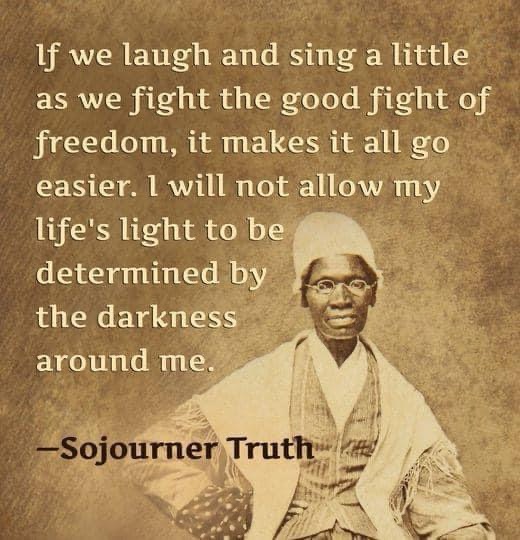
When the darkness of sin and evil threatens to drown out the light, God has always called on those like Sojourner Truth to step up and refuse to let the darkness determine our life’s light. That quote reminded me that I am always inspired by the words of another black woman, Amanda Gorman, whose marvelous poem, “The Hill We Climb,” ends with these powerful words:

“When day comes, we step out of the shade aflame and unafraid. The new dawn blooms as we free it. For there is always light. If only we’re brave enough to see it. If only we’re brave enough to be it.”

Action Steps

A Lenten challenge might be to find what God wants each of us to actually do to be the light. It may be relating to family members or co-workers in a more caring way, or volunteering for some group that you’ve always meant to get involved in, getting involved in local politics, advocating for justice by writing letters to representatives, or supporting marginalized groups. There’s plenty of darkness to go around and every ray of light does make a difference.

Prayer

O God of eternal light, the darkness scares me. I know in my head the words from the Gospel of John that assure us the darkness will not overcome the Light of the World. But my heart is not so sure! Rather than just spout pious platitudes that fall flat on their face, please give me the courage to really feel your light in my soul and the guts to go out into the darkness and be it. Amen

Dust to Dust

The fact that Ash Wednesday fell on Valentine’s Day this year has made for some clever jokes and memes.  My favorite is a driver asking his backseat passenger what she’s doing on Valentine’s Day.  She replies, “Rubbing dirt on peoples’ faces and telling them they are going to die.”  (If you are not familiar with the Scripture used when imposing ashes on another’s forehead on Ash Wednesday that joke won’t make any sense.  The words from Genesis 3:19 say, “Remember you are dust, and to dust you shall return.”)

Ash Wednesday seems a bit more real at age 77 than it did at 37 or even 57.  I told a clergy friend that we were asked to ponder how much time we might have left during our worship service tonight, and he said, “That just went from preaching to meddling!”

I am also more aware of my clock ticking this year because I had what felt like a big brush with my own mortality last week. It started when a grape-sized lump mysteriously appeared on top of my shoulder.  Since I’ve been having trouble with that shoulder I made an appointment to get it checked out with my orthopedic shoulder doc.  But I also made the mistake of getting on the internet where I convinced myself it was a swollen lymph node.  I even called my oncologist and talked to his nurse who asked several good questions.  When I told her I was seeing my shoulder guy that afternoon about it she asked me to call her back after that appointment and let her know what he said before she talked to her doctor. 

I was feeling some real fear of dying and wondering how I would handle a serious cancer diagnosis because I do have a so far dormant lymphoma and feared it was finally becoming symptomatic.  When I got to the orthopedic office I first saw a resident, and he immediately said “I know what that is,” which seemed comforting even before he explained.  His tone of voice was not ominous at all and I began to relax.  He called it a “geyser something” which didn’t ring any bells, but he explained it was an eruption of fluid caused by my weakened rotator cuff.  He went out to confer with the doctor who immediately came in and said it was nothing to worry about.  He called it a cyst, which was a term I understand and said there was nothing we needed to do about it

I was very relieved and felt a little foolish that I had catastrophized the situation, but I’m also glad that for those few hours I had an Ash Wednesday experience of at least for a little while feeling quite dusty.  What changes that semi-close encounter with mortality will make in my life remains to be seen.  I hope it will help me keep things in perspective; actually work on my end of life planning and simply put things in better order physically and spiritually.  Remembering February 6, 2024 will help me do that, and the harmless lump on my shoulder will be there as a visible reminder that I am indeed dust and to dust I will return.  

Faith Like the Birds

In this frigid cold snap we have had in Ohio recently I have been filling our bird feeders every day, and the cardinals, blue jays, woodpeckers, sparrows, and the whole wonderful diversity of our feathered friends have flocked to our yard as soon as I finish. How they communicate so quickly that it’s feeding time is a mystery to me, but they do; and I’ve decided we have very biblical birds in our neighborhood.

You see, the birds don’t ever leave food on the table or let the seeds that fall on the ground go to waste, and that has reminded me of the story in Exodus about God providing manna/bread from heaven each day to feed the Hebrews in the wilderness. As usual the Hebrew people are complaining to Moses that he has brought them out into the wilderness to starve. They say they were better off as slaves in Egypt. When Moses shares their concern with Yahweh this is the response he gets: ”Then the Lord said to Moses, “I am going to rain bread from heaven for you, and each day the people shall go out and gather enough for that day. In that way I will test them, whether they will follow my instruction or not.” (Exodus 16:4) 

And God delivers on that promise, but the test is that God through Moses instructs the people to only gather enough of the manna for that day’s needs and not to try and store some up for another day. God is testing their faith to see if they will trust that each day the promise will be fulfilled again. That’s why when Jesus teaches his disciples what we now know as “The Lord’s Prayer” we are instructed to pray only for “our daily bread,” and not for a whole week’s worth. To do so is the difference between a mindset of faith in God’s providence and a scarcity mentality where we hoard more than our share of life’s resources for fear that we will run out the next day.

And that’s the way the birds in our yard live. They don’t leave any bird seed in the feeder for tomorrow because they trust that I will be faithful to meet their needs each new day. As you will see if you read the rest of the story in Exodus 16 some of God’s human children aren’t quite as trusting. And since I don’t speak fluent bird it may be that my feathered friends do complain when I’m late filling their feeders. They are much earlier risers than I; so I don’t pretend to be as faithful as God, but I can tell by the way they flock to the feeders whenever I fill them they are very grateful. And I am grateful to them for reminding me to be satisfied with my daily bread. 

An Eye for An Eye?

Ever since October 7 I have been pondering the irony of the Israeli response to the horrific massacre of 1200 Israelis by Hamas.  One of the most familiar tenets of the Hebrew law found in Leviticus says, “Anyone who maims another shall suffer the same injury in return: fracture for fracture, eye for eye, tooth for tooth; the injury inflicted is the injury to be suffered.” (24:19-20). I learned two things about that Scripture in seminary: 1) It is very similar to another ancient law, The Code of Hammurabi, a Babylonian King in the 1700’s BCE, and 2) both the Code of Hammurabi and the Hebrew law were meant not to justify revenge but to limit the amount of revenge one could seek for an offense to an equitable amount.  So, for example, if someone poked out one of my eyes I could not in return poke out both of his or hers. 

Jesus came along 3000 years after Hammurabi and 1400 years after Moses and raised the bar to a whole new level in the Sermon on the Mount where he says, “You have heard that it was said, ‘An eye for an eye and a tooth for a tooth.’ But I say to you: Do not resist an evildoer. But if anyone strikes you on the right cheek, turn the other also,and if anyone wants to sue you and take your shirt, give your coat as well,and if anyone forces you to go one mile, go also the second mile.Give to the one who asks of you, and do not refuse anyone who wants to borrow from you.“You have heard that it was said, ‘You shall love your neighbor and hate your enemy.’  But I say to you: Love your enemies and pray for those who persecute you,” (Matthew 5:38-43).

Now, I’m not expecting the Israelis to live up to Jesus’ ethics.  I can’t, and I’m not sure anyone but Jesus could ever do that.  But it seems like not killing your enemy’s innocent women and children might be a start.  And it does seem fair to hold the Israelis to their own Scriptural standards.  At last count the Israelis have killed 16000 Palestinians in Gaza.   That’s more than 10 for every Israeli killed on 10/7.  That’s a lot more than “an eye for an eye.”

I understand the horror of that dark day.  No, I don’t.  Thank God, I have never experienced anything like it.  I was even far removed from any personal suffering on 9/11.  So, I know I have no right to judge.  I don’t know what I would do in the Israeli shoes.  Nor do I have any idea how I would survive the God awful inhumane conditions the people of Gaza have been living under for the last 60 days.  I just know the insane suffering I see on my TV screen has got to stop.  Not just because it is morally unjustifiable but mostly because it is just plain counterproductive.

War and killing have never solved anything.  If the Israelis could actually eliminate Hamas and terrorism by use of force there might be an argument for their military campaign.  But it won’t work.  The anger being fanned in the Muslim world by the war in Gaza will produce far more terrorists can ever kill.  If history has taught us anything it is that revenge only begets more violence in return.  That’s the point of Jesus’ teaching above about turning the other cheek.  To resist the natural human urge to strike back in anger, as impossible as that seems, is the only way the cycle of violence can ever be stopped in its tracks. 

As progressive as it was in the days of Hammurabi, as Gandhi once pointed out, “An eye for an eye and a tooth for a tooth just creates a world of blind, toothless people.”

I know that too criticize Israel opens me to charges of antisemitism, but I assure you I am not anti-Semitic.  I am a Christian nurtured in the Judeo-Christian tradition.  Jesus was a Jew.  I am constantly challenged and inspired by the Hebrew prophets.  I grieve for the hostages still in captivity, for the suffering of the Jewish people throughout history and on 10/7, but the killing needs to stop; the suffering of the people of Gaza must stop. 

December 5, 2023

Where’s the Justice?

Election Day, praying for my tribe to win as much as possible even as I fear the dangerous person just elected Speaker of the House and the Trump circus in a New York court room. Trump has succeeded in taking the media spotlight off the mayhem in Gaza, but the slaughter continues there and elsewhere. A mass shooting in Cincinnati recently barely made the news.

We are having new skylights installed today while millions of people have no roof over their head at all. Where is the justice?

My privilege feels like a millstone tied around my neck, even while I resent working for hours on end the last two days to maintain our wonderful home.

I get wonderful medical care for my puny aches and pains while hospitals are bombed in Gaza. Where’s the justice?

I simply turn the tap and open the fridge whenever I thirst or hunger while millions of climate refugees and war victims around the world are starving and dying. Where’s the justice?

By accident of birth I am a privileged white male in a relatively safe and prosperous nation. My ease and comfort are as undeserved as the suffering of innocent Israelis and Palestinians and Ukrainians is unjustified. Where’s the justice?

If I thank God for providing so bountifully for me and my tribe anyone can see the irony that all these others of God’s children who pray to the same God still suffer so horribly. I am not some worthy saint being rewarded for my good behavior like a school boy getting gold stars for what we used to call “deportment.” If I am graded on keeping the 10 commandments or living by the Boy Scout Law I learned as a youth you better believe I hope God grades on the curve. Where’s the justice?

As we Christians paused ever so briefly this week to observe All Saints Day our grief and memories of those who have passed beyond this mortal coil are tied to the deaths of all those unknown to us but known to God souls lost in recent days to the madness of war. Nadia Bolz-Weber said it so well in her sermon for Sunday, “You’re going to die:”

“The untimely and unnecessary deaths of 10,000 children of God, many of whom are actual children, in just that one tiny area of our planet in one month’s time ripples out into an ocean of grief for the 100,000s of thousands who know their names…their babies, and brothers and wives and friends.

This is their day too.

So as we remember our own dead, may we feel connected to the sorrow of those who are also grieving today. And say as our lord did, Blessed are they who mourn. Blessed are they who have loved enough to know what loss feels like.”

I had never thought about grief as a blessing even though I have read those words from the Beatitudes dozens of times. “Blessed are those who mourn.” My thoughts always jump to the second half of that verse “for they shall be comforted.” Yes, we yearn for our own comfort and those of others. But there is no comfort without grief, just as there is no resurrection without death. So in one of those theological twists of fate there is gratitude even for pain. If we could not feel the pain of grief, even for people 10,000 miles away, we also could not feel love and appreciation for our privilege.

I do not deserve my comfortable life any more than the trapped citizens of Gaza deserve the horrors of modern warfare, any more than the 1400 Israelis deserved to die on October 7, or the 6,000,000 Jewish victims of the Holocaust, or the 3000 Americans deserved to die on 9/11. All of that reminds me that life itself is a privilege to be cherished and lived to its fullest no matter where we have landed by accident of birth on this fragile planet.

May our gratitude for what is take the wings of mercy to act as those who do justice here and now, who love mercy wherever we are planted, and through it all walk humbly and gratefully with the One who gives it all and who alone can fathom the mystery of life and death in our broken and unjust world.

Mid-Year Reflections on Gratitude

Having just passed the mid-point of 2023 this seems like a good time to reflect back on goals and intentions I had for this year when it was in its infancy. Among the therapeutic values of blogging or journaling is the ability to look back at what I was thinking and writing about at some point in the past. When I did that recently I was reminded that a key goal I had for myself in January was to practice gratitude.

I must confess I have not done well with that goal and had mostly forgotten about it, as often happens with New Year’s resolutions. Rereading the two posts I wrote about practicing gratitude has been a wonderful reminder of several really good ideas from other people that I wrote about there, including my mentor Dr. Bill Brown, Robert Fulghum, dear friends Jean and Katy Wright, Dr. Brene Brown, Kate Bowler, and Kelly Corrigan. (I am quite proud of the two posts I wrote back in January and really grateful for all the wisdom I borrowed from those friends and scholars.)

So the question now is how do I stay focused on that wisdom and not let it slip again into that vast pool of great ideas I enjoy pondering but fail to integrate into my daily life? If I had a magic potion to make that happen I would gladly share it, but as I said in January gratitude like any skill requires the hard work of practice. Wishing doesn’t make it so or I would be the most grateful, joyful person around, and my dear wife can tell you that unfortunately is not the case.

Physical exercise is a good analogy for regular practice. During the pandemic I started an exercise program of swimming 2-3 times per week, and worked my way up to being able to swim a half mile. I kept that routine up until some health issues and travel caused me to get out of the habit earlier this year. I have just gotten back in the pool a few times in the last 3 weeks, including a 350 yard swim today. Swimming is great exercise because it works the whole body, is aerobic, and provides a quiet, meditative respite from other cares and concerns. But having said that, I must add that I am totally wiped out for the rest of the day after just 18 minutes in the pool. It would be easy to get discouraged about that, but I know from experience it takes time to rebuild my endurance.

Gratitude practice is a similar challenge. It requires the discipline and focus to consciously practice paying attention to all the blessings I am privileged to enjoy. I can choose to take time during the day, especially first thing in the morning and at bedtime, to call to mind what I am truly grateful for, even if I forget. I can give thanks for the beautiful home and yard I am privileged to occupy and not just complain about the work and expense it takes to do so. I can choose to be grateful for all the activities I can still do instead of regretting the ones I have had to give up. I can remind myself how fortunate I am to live in a peaceful place free from violence and war and so far immune from the worst ravages of extreme weather caused by climate change.

But this is not an either-or Pollyanna approach to life that ignores the injustices and suffering of others my community or world. I have used the word “privileged” several times above intentionally. I need to remind myself that I am truly privileged in so many ways largely to the accident of birth. And with that privilege comes the responsibility to use that privilege to do whatever I can to do what the prophet Micah tells us God requires of all of us, “To do justice, love mercy, and to walk humbly (gratefully) with God.”

On Kingdom Fishing

I discovered the work of Diana Butler Bass last year and continue to be challenged and inspired by her writing. Her training as both an historian and a theologian gives tremendous new insights into how to read Scripture. One of the most helpful of those commentaries on a familiar passage about Jesus’ call of his first disciples to follow him and “fish for people” broke open for me exciting and challenging new ways to read those texts in their historical context.

I urge you to read her short article at https://dianabutlerbass.substack.com/p/sunday-musings-f5c?token=eyJ1c2VyX2lkIjo0OTI5MDAwOSwicG9zdF9pZCI6OTgxODE1NjksImlhdCI6MTY3NDM3ODIwMiwiZXhwIjoxNjc2OTcwMjAyLCJpc3MiOiJwdWItNDc0MDAiLCJzdWIiOiJwb3N0LXJlYWN0aW9uIn0.MJ9jJmdaJPiOUGhPHuWGvwVoS3I21lN-cTvriOfXfKo&utm_source=substack&utm_medium=email. I hope you will, like me, be inspired to wrestle with this new way of experiencing the call of Christ to be about challenging the injustice of our worldly empires and joining Jesus in the work of building a just and loving kingdom.

Practice Gratitude, Part 2

[Note: This post was written on January 2 but not posted until January 4. It will make more sense with that timeline in mind.] My year of practicing gratitude literally began with a tough challenge. For almost all of my adult years the new year has begun with watching the iconic ball drop in Time Square. Thanks to my own and our cultural addiction with football, 2023 was different. Along with a group of friends I watched a different ball drop this year—a ball that will linger in Ohio State fans’ memories as “wide left.” 2023 was literally just a few seconds old when what would have been a game winning field goal over #1 Georgia sailed like a wounded duck far left of the goal post.

That was almost 36 hours ago, but today as I read several articles about the game in today’s Columbus Dispatch I relived that moment and the frustration of a controversial call that dramatically affected the outcome of the game. I should not have subjected myself to that memory, but I was unable to let it go.

For me, that is a prime example of my biggest obstacle to practicing gratitude. I mentioned one of my mentors, Dr. Bill Brown, and his rhetorical theory called attention shifting in my last post, and this is exhibit A for 2023. In the larger scheme of problems on the world stage or even in my personal life the outcome of a silly game should not be my prime focus. The Peach Bowl is over and done. My dwelling on a terrible call by the refs does not deserve the amount of my attention I am choosing to spend on it. And it is a choice. I can shift my attention to a whole host of things that deserve my attention so much more if I choose to do so. [Remember, I wrote this a few hours before the near fatal football injury to Damar Hamlin, but that tragedy underscores in spades that all football games and other athletics must be kept in proper perspective.]

Notice I did not say that this is a simple or easy shift to make. The local media, my friends, and my social media are full of conversations about the Ohio State game. It is not easy to shift my attention away from all that chatter, but it can be done. I can choose to not read about the game. I can literally switch the tv channel when discussion of that game comes on. Unfortunately I don’t have a remote that can switch the channels in my brain when I think about that loss or my own aches and pains, or other negative and depressing problems in our world. But attention switching is a skill that I can learn if I choose to do so. And making practicing gratitude my priority for 2023 is step 1 in that process