Even though I had 9 good hours of sleep last night I still woke up tired. So I’ve been thinking a lot all morning about how exhausting the two week holiday marathon at the end of December can be for introverts like me. When I was a full time pastor I blamed my tiredness on how busy the Advent/Christmas/New Year’s season is in the life of the church. Now that I am retired that explanation doesn’t work; especially this year when we celebrated Christmas Eve on line because of the nasty winter storm which canceled in person worship for many churches.
And then I read on Facebook that today, January 2, is actually World Introvert Day. Here’s what I found in a quick Google search: “Introverts worldwide will be able to celebrate World Introvert Day on January 2. This is the day following the dreadful celebrations of the previous year has ended. It allows them to enjoy solitude finally and recharge their social batteries. World Introvert Day started when psychologist and author Felicitas Heyne published this blog post calling for a day for us quiet ones.”
And so I wrote this prayer:
Holy One, I am grateful for the spiritual lessons of Advent and Christmas and for the changing of the calendar as a time for reflection and renewal, but I’m worn out. I enjoyed time with families and friends and lots of good food and fellowship. But I’m tired; I’m tired of people and parties. I’m tired of hearing the same holiday songs on a continuous loop. I need some peace and quiet, solitude and time to just breathe and be.
I need a sabbatical, and I know you get it, God, even if my extrovert friends never seem to run down. You took a day off after creation and rested. You included honoring Sabbath rest in your Top Ten rules for living. So thank you for that. Please help me to not feel guilty for putting my feet up and taking a nap today. Please help me set healthy boundaries on my energy levels; to remind myself and others that we introverts need downtime and solitude to recharge our batteries.
We can do the party circuit. We can prepare holiday meals and clean up. We can play games with the grandkids. But it drains our energy, and we need time to refresh, especially this time of year when the calendar is super full of events we want to attend. I even surprised myself this year that I was able be more present and active with family and friends, even when I didn’t feel like it beforehand. And then I crash when the party is over.
Please help me be gentle with myself; to not give up or get frustrated, but to rest when I’m tired. I think Isaiah must have been thinking of us introverts when he said, “God does not faint or grow weary; God’s understanding is unsearchable. He gives power to the faint and strengthens the powerless. Even youths will faint and be weary, and the young will fall exhausted, but those who wait for the Lord shall renew their strength; they shall mount up with wings like eagles; they shall run and not be weary; they shall walk and not faint.” (40:28-31)
Thank you, source of all energy, for Sabbath moments or days when we can simply wait on you. Amen
Hey God, do you ever have trouble sleeping? Oh, if you are omnipresent, I guess you can’t ever sleep can you? Or do you let the angels take over sometimes to give you a break? Yes, I know that anthropomorphic stuff isn’t real, but it’s 1:20 am; and I can’t sleep. I don’t know anyone else who’s awake at this hour that I can talk to; so you’re it. My sleeping pills have let me down. Reading and doing Wordle haven’t worked; and my blasted neuropathy has my feet feeling like they are on fire.
The more I think about my feet the more they hurt. The harder I try to shut my mind off, the louder the racket in my brain seems. At this hour all my aches and pains seem worse, and my list of things I need to get done in the next few days looms like some Sisyphusian boulder daring me to push it up that damn hill again.
I’m actually scared, God. The pain in my feet has never been this bad before. I’ve always been able to manage it with cream, drugs, and/or ice; but tonight/this morning nothing is working, and I don’t know what to do. I can’t handle sleepless nights like I used to when my youth groups did all night lock-ins at the church, or when I pulled all nighters to study for an exam or finish a term paper.
When you wrestled with Jacob all night long I guess he must have had a lot of adrenaline flowing to keep him going that long. That night near the Jabbock river Jacob had even more things on his mind. He was about to face the music of meeting his brother Esau years after he had swindled him out of his birthright and their father’s blessing. Jacob has sent huge amounts of cattle and other gifts across the river to assuage Esau’s anger, but restless Jacob is afraid it is not enough to buy his brother’s forgiveness. This one who has stolen his brother’s blessing is not satisfied with all his ill-gotten gain. What he asks of God to end their marathon wrestling match is a blessing. Will that salve his guilty conscience? Does a divine blessing imply grace and forgiveness?
In a way yes because the blessing God grants to Jacob is a whole new beginning – a new identity in the form of a new name. He is “born again” long before that New Testament term is coined. Jacob no longer is stuck with his birth name which means “heal grabber” because he tried to yank Esau back into their mother’s womb so Jacob could be the first born. His new name/identity is “Israel” which means “one who contends with God.”
I could use a new identity too, holy parent. My physical aches and pains try mightily to label me as a victim of old age, but when I am caught up in that identity I have little to offer you. I am like a fly trying to escape from a spider’s web, turned in on my chronic ailments instead of focusing my energy on all that is right for me and how blessed I already am.
I could do a lot worse for a new name than “one who contends with God,” even if that means walking with a limp. Please help me, eternal Being, to appreciate my gray beard and arthritis as reminders that I have been blessed with decades of life to wrestle with you and your call upon my life. Like Jacob let me know again that you are not far off at the top of some stairway to heaven, but right here in the sweaty ring of life with me even in the wee hours of the night.
“So teach us to count our days that we may gain a wise heart.” Psalms 90:12
(365 x 76) + 19 = x? One of the blessings/curses of autumn means that the anniversary of my birth is once again on the horizon. That means if I make it another six weeks I will have logged 27,259 days on planet earth!!!! Yes I know that isn’t what the Psalm means by “counting” my days, but it is a very daunting number that raises the question, “what difference have I made in the world in all those days?” And for me it means it recent years asking the other uncomfortable question – how many more days do I have left? Wouldn’t life be easier if we knew the answer to that, or would it? For the next logical question is what do I want to do with whatever that unknown number is?
I do most of my calendaring on my phone these days, but I still like a paper calendar on my desk to get a wider angle lens on my schedule. I also mark the days of the month off on a wall calendar above my desk, not so much to mark time as to make it easier to see at a glance what day it is.
That is kind of redundant since my watch also shows the day of the week and the date. But with all those reminders I still forgot a PT appointment this morning until it was almost too late to get there. A friend of mine who has a four year old said her daughter has underwear with the day of the week on them, and she uses those to keep track of which days she has pre-school. I think something like that might be useful for retirees!
I mentioned to my therapist recently that turning the page on the calendar gives me a sense of pause now that it didn’t do in my younger years. Having surpassed the 70 year life span mentioned in Psalms 90:10 several years ago the still small voice of mortality keeps reminding me with each passing month or season that numbering my remaining days now takes much smaller numbers than it used to.
When I told my counselor about those feelings he said, “So changing the calendar is existential for you?” I hadn’t thought about it in quite those terms, but I guess it is. And the arrival of fall is especially so when we drop 30 plus degrees in one Ohio day! The fall season is full of mortality reminders as plants wither and leaves fall with the temperature. And more so for me since I also have the aforementioned October birthday just waiting to add another notch to my solar orbits odometer.
They say age is just a number – an ever larger number! I have the feeling the Psalmist knew it takes more than just adding years and decades to get a wise heart. It takes wisdom not just to mark off 24-hour cycles each day but to live each day we are given to make those days count.
“Then the Lord God said, “It is not good that the man should be alone; I will make him a helper as his partner.” (Genesis 2:18)
The recent pandemic has reinforced our knowledge that it is not good for humans to be alone. Our daughter-in-law is a very strong and self-aware introvert. Several months into the pandemic she joked that even a committed introvert like herself had to admit that she was missing human contact. Far more seriously we know that the hiatus from play dates and school has had serious mental health consequences on many children and youth who are behind in their social development and their ability to communicate in ways that are not mediated by technology.
Yes, it is true that technology has helped bridge the human contact gap in significant ways with virtual learning and digital meeting apps like zoom, but anyone who has spent much time using those tools will tell you that kind of meeting or teaching and learning is just not as good as face to face contact.
I was reminded of a wonderful movie that explored the theme of human loneliness when I found this golf ball in my bag last week. I led a men’s retreat several years ago where we watched the 2000 Tom Hanks film, “Cast Away” and then explored what the movie said about the human experience.
In that movie Hanks plays Chuck Noland, a harried FedEx executive, who is cast away as the lone survivor of a company cargo plane crash in the Pacific. The good news is he survived the crash. The bad news is he is washed ashore on a small deserted island where he is totally and completely alone. He manages to survive for years by creatively making use of a few items in packages that wash ashore from the plane crash.
One of the seemingly most useless items that floats into Noland’s island home is a brand new Wilson volleyball. No net, just the ball, and while beach volleyball is a real sport, it does require more than one person. That ball however soon becomes the most important factor in helping Noland maintain his sanity as multiple attempts to sail off the island in makeshift boats end in disaster and even a suicide attempt fails.
Noland discovers a way to meet the need for “human” contact without internet, cell phone, smoke signals, or even written communication. He turns the Wilson volleyball into Wilson, his friend and companion. He paints a face on the volleyball and regularly talks to Wilson about his plight. In the most poignant scene when Noland finally manages to push and paddle beyond the breakers and put out to sea on a makeshift sailboat, his buddy Wilson is washed overboard by a large wave and slowly drifts further and further away. Noland can only cry plaintively, “Wilson! Wilson!” as his faithful friend disappears from his sight.
Our men’s retreat was held at a church camp, and one of the men found a Wilson volleyball in a closet in the lodge where we were meeting. That ball, of course, became our mascot for the weekend, sitting with us as we discussed the film, coming to meals with us, and sleeping on one of the bunks in the dormitory-style room where we slept.
Now I have my own Wilson Jr. golf ball sitting on my desk to remind me again that it is not good to be alone. (And, it helps our bond that I played some very good golf with my Wilson, and he didn’t desert me like so many balls have by disappearing into the woods or splashing down into a water hazard.). Please understand, as an introvert I still regularly need and enjoy solitude. Zoom does make many things easier or even possible, like book clubs, meetings over distances without time-consuming and expensive travel, and especially regular contacts with distant friends.
But nothing, not even a lovable volleyball, can meet our basic need for human contact. My therapist says touch is the first and most basic form of human communication. Research has shown that infants who receive an adequate amount of loving touch not only thrive, but those who are not held and touched literally die.
We can see this phenomenon in other species, many of whom mate for life. Unfortunately many Americans have lost sight of the need for meaningful human contact. Our myth of rugged individualism has turned far too many of our human interactions into a transactional, self-centered dance of using people for our own profit and benefit.
Our consumer driven economy and our fear of an always uncertain future have convinced too many of us that we can never have enough material wealth to feel secure. Perhaps the silver lining in our current inflationary anxiety is that we will learn like Chuck Noland did to be satisfied and live with what we have. Powerful story telling like “Cast Away” is a way of teaching us those life lessons vicariously so we don’t have to actually be stranded on a desert island or isolated in a pandemic to learn them.
“Swimming is the trifecta for me – exercise, meditation and alone time.” Brene Brown, “Atlas of the Heart,” p. 18
I had been thinking the same thing about swimming lately, and it was so good to have those feelings affirmed by someone whose work I admire so much. As some of you know I took up swimming as my primary form of exercise about a year ago. It happened almost accidently when I began doing some of my physical therapy for recovery from back surgery in the water. One of the blessings of the pandemic is that our YMCA’s began letting people reserve a lane in the pool to control numbers of swimmers and maintain social distance. The reservations are for 45 minutes; so the first time I went to the pool it only took me 15 minutes to do my PT exercises, and I still had 30 minutes left in my allotted time in the pool. So I decided I might as well see if I could swim a few laps – with the emphasis on “a few.”
That first time I managed 3 laps before I was exhausted. I have never been a strong swimmer. When I was in Boy Scouts many decades ago I needed to earn merit badges in both swimming and lifesaving in my pursuit of becoming an Eagle Scout. I passed both of those, but just barely. I was literally a 98 pound weakling in those days and also had a very hard time passing the requirement for running ¾ of a mile in under 6 minutes. My 13 year-old self would never believe that as a 40 something I could actually run 5 miles in 37.5 minutes; nor would he believe that I can now swim 900 yards in less than 45 minutes.
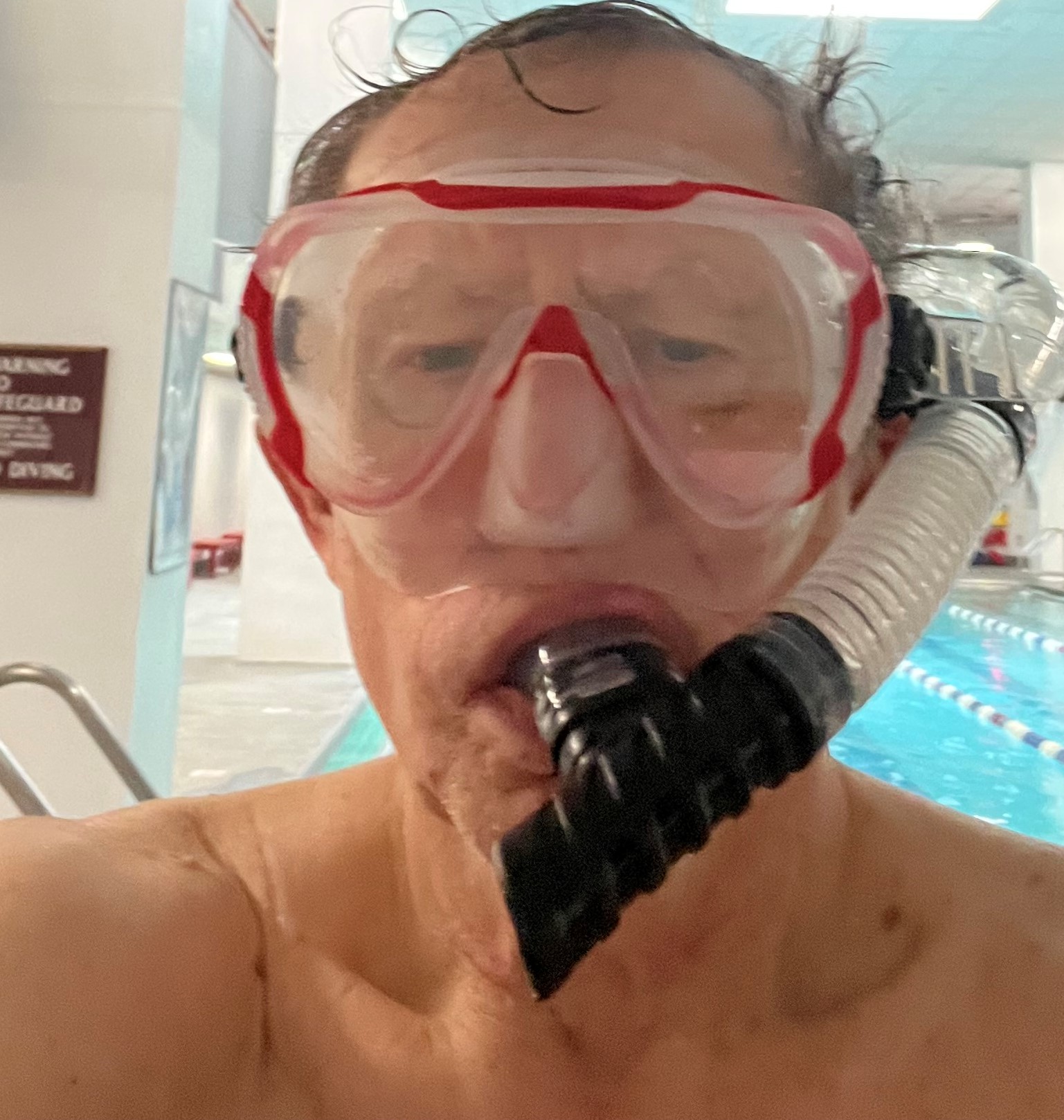
Because of several health concerns swimming is the ideal low-impact aerobic exercise for me. And over the last 12 months I have not only increased my endurance but have come to truly enjoy swimming. Dr. Brown captures some of the reason for that when she says, “When I’m swimming laps you can’t call me or talk to me, it’s just me and the black stripe.” As an introvert I need solitude, and especially since I got a new mask and snorkel and can actually do most of my laps under water where I can’t see or hear anything that solitude has been like icing on the cake.
Even though I was a fairly serious runner for 25 years I never experienced what others describe as the “runner’s high.” Running was always work for me, I think in part because I ran most when I was going through some particularly rough patches in my personal, professional, and married life. I wasn’t running for fun but literally running away from problems I didn’t know how to handle. But I realized today as I set a personal record of 900 yards that I am feeling a swimmer’s high. The water supports me, relieving pressure on my joints, and I truly felt like I could have gone much further today. Today I was in a pool that does not reserve lanes; so I had no time limit on how long I swam. I enjoy being in the pool so much now that I can even do it without resistance or hesitation even on very cold winter days.
The meditation aspect of swimming has taken the form for me of repeating a couple of mantras that resonate with where I am now in my faith journey. Those phrases include several Hebrew and Greek words for God (Yahweh, Elohim, and Abba), spirit (ruach), justice (mishpat), and love (agape). I hope my seminary professors will forgive me for my awkward combinations of several languages, but my current mantras are: Ruach Abba, Ruach Elohim, and Yahweh Mishpat. I especially like using “Abba or Daddy” for God as Jesus did because my other inspiration for swimming is remembering the 12 frightening hours my dad spent in the cold North Atlantic waiting to be rescued from the crash of his B-17 at the end of WWII.
Everyone needs to experiment and find what works for you, and that can change as we change. Today I added a new combination inspired by our congregation singing “We Are Called” in worship yesterday. That hymn is based on my very favorite summary of faithful living in Micah 6:8; so I swam several laps today repeating “Do Mishpat, love Agape, and swim humbly with Abba.” I have had trouble creating a regular meditation practice on land—too many distractions, but in water, which has so many theological conotations for me, I feel especially focused, close to, and sustained by the mystery we call God.
“Words alone are cheap. Breathing deeply is required also. Connecting to the heart, not just the eyes. Meditation, mindfulness, contemplation, art and creativity–accessing the right hemisphere of our brain, not just the verbal hemisphere, is needed.
Incorporating and honoring our bodies, breathing deeply, not just leading with our heads. The heart after all resides in the body and disperses its blood and values from that center. And breath is the same word as “spirit” in many languages (including Biblical ones).”
Yes, words are cheap, but they are all we have to express our thoughts and feelings. That quote is from Matthew Fox in his “Daily Meditations” for today, (January 29). The phrase that jumps off the page for me is “not just leading with our heads.” We know with our heads and hearts that we are holistic beings and certainly not the Cartesian model of rational-logical critters who only exist because we think. We also feel and act.
I first really understood that in graduate school working on my doctorate in rhetoric. It wasn’t until then that I learned that the traditional three-part sermons I grew up with were originally not just three sections of a sermon linked together more or less successfully. The three point idea originated clear back in the 4th century BCE with Aristotle. In his classic “Rhetoric” Aristotle describes a holistic approach to persuasive discourse that appeals to “logos, pathos, and ethos,” terms best translated into English as “reason, emotion, and ethics.” Effective persuasion needs all three elements because humans are rational, emotional and ethical beings. The latter term applies to our behavior that is shaped by our reason and emotion.
Western philosophy and education have majored ever since Descartes in developing and teaching that primarily addresses the mind to the detriment of emotional and ethical development. In other words as in the quote I began with we “lead with our heads.”
As I was writing this piece I saw a very timely post on Facebook that seems relevant. I can’t verify the source from a Facebook called “Compass,” but it certainly fits my life experience as one who led with my head through twelve plus years of higher education. Here are the key points of the post:
“According to Psychologists, there are four types of Intelligence:
1) Intelligence Quotient (IQ)
2) Emotional Quotient (EQ)
3) Social Quotient (SQ)
4) Adversity Quotient (AQ)
1. Intelligence Quotient (IQ): this is the measure of your level of comprehension. You need IQ to solve math, memorize things, and recall lessons.
2. Emotional Quotient (EQ): this is the measure of your ability to maintain peace with others, keep to time, be responsible, be honest, respect boundaries, be humble, genuine and considerate.
3. Social Quotient (SQ): this is the measure of your ability to build a network of friends and maintain it over a long period of time.
People that have higher EQ and SQ tend to go further in life than those with a high IQ but low EQ and SQ. Most schools capitalize on improving IQ levels while EQ and SQ are played down.
A man of high IQ can end up being employed by a man of high EQ and SQ even though he has an average IQ.
Your EQ represents your Character, while your SQ represents your Charisma. Give in to habits that will improve these three Qs, especially your EQ and SQ.
Now there is a 4th one, a new paradigm:
4. The Adversity Quotient (AQ): The measure of your ability to go through a rough patch in life, and come out of it without losing your mind.”
The phrase “leading with your head” reminded me of something I’ve been concerned about as I have watched way too much football in recent weeks. Last weekend was an especially exciting one for National Football League fans. There were four playoff games last weekend that were all as closely matched as mathematically possible. Three ended with winning field goals as time expired and the fourth game went to overtime.
First a confession and/or disclaimer: I know the game of American football has become dangerously violent. Players are bigger, faster and stronger than they used to be, and therefore bodies collide with much greater force. Padding and helmets are certainly much better than the days of leather helmets, but we still know many former players are suffering from traumatic brain injury, dementia, and Chronic traumatic encephalopathy (CTE) because of their years playing football. Knowing all that makes me uncomfortable watching, but it’s something I’ve been doing for nearly 70 years and is a very hard habit to break. I also think the way football has replaced our former much more civil national pastime (baseball) is another sign of the toxic masculinity that I wrote about plaguing the American psyche that I wrote about last week.
But I digress a bit. What I noticed watching so many games last weekend was a troubling difference between college and professional football. The college game has a rule against “targeting” which is aimed to limit hits to the head and neck area and crashing into an opposing player with the crown of the helmet. That rule is designed to protect both the player on the receiving end of the targeting and the cranium of the deliverer of the blow.
Yes, targeting is a judgment call that referees spend much time reviewing replays before enforcing. They take it very seriously because the penalty for targeting is ejection from the game, and that has and will cut down some on the most dangerous hits in an inherently violent game. I think the NFL needs to do something similar to prevent more life-threatening injuries from “leading with one’s head.”
I offer that football reflection as a metaphor for the rest of us in real life. When we lead with our heads, divorced from understanding the emotional, social, and I would add spiritual aspects that are co-partners with the head in human beings we are failing to maximize a healthy comprehension of human behavior. We are not just rational/thinking beings. The various components of our humanity need to work in partnership with each other or we are not living up to our potential. And the huge existential problems facing the human race will not be solved if we are not playing with a full deck.
I don’t remember where I first heard this piece of wisdom, but it surfaced from my memory bank today as I was mowing our lawn. The sage advice comes from that philosopher known to my generation as “Old Blue Eyes.” No, you don’t have to Google that, I’ll tell those of you too young to know, it’s Frank Sinatra. One of Sinatra’s many hit song was “Strangers in the Night,” and that song has a profound refrain that goes “do be do be do.”
That nonsense phrase truly became profound for me when someone pointed out to me that if you take the “be’s” out of that phrase all you have left is “do do.”
We all make “to do” lists, and there are even apps that will help you organize your to do list(s), and I’m guessing most of us have more than one. I’ve tried multiple ways to keep, organize, and prioritize my personal and professional tasks over the years, and if anyone tells you that retirement means you can throw your to do lists away, don’t believe them.
Most of you know I’m older than dirt; so I don’t have to worry about dating myself when I reminisce how years ago all the United Methodist pastors I knew organized their lives in a small pocket sized calendar. It came in the mail every year from our denominational publishing house, and it was free; so few of us ever questioned its efficacy. My only complaint about it was that since it also had pages in the black that served as an address book all of that information had to be updated and re-entered into the new little black book every January.
Somewhere along the line I let my human doings multiply, and I had to learn to write smaller to fit each day into a tiny space, and of course because life is full of surprises, to never write anything in ink. So when it was introduced I became an early adopter of the Palm Pilot, remember those? They were basically a digital calendar and address book that replaced paper calendars and Rolodexes in one handy gadget that didn’t have to be replaced or updated every year. And of course the Palm Pilot was soon replaced by iPhones and Androids that could do all those things and serve as a phone too, and eventually took over our lives by adding internet access.
Sorry to get distracted going down memory lane. My initial point was to reflect on being and doing. We all have to do lists regardless of how we record them, but who has a “to be” list? My reflections on that question emerged because I am home alone this week while my wife is visiting family in Texas. I had grandiose plans for the week: to organize my office that resembles the aftermath of a natural disaster, to clear out and donate clothes I no longer need, and even to sort through several drawers in my desk and bathroom which should say “Enter at Your Own Risk!”
Oh, and my to list for this week also included the simple task of assembling a new exercise bike that is still in a million pieces in my basement. I am now more than half way through the week, and not one of those major projects is even started and somehow my to do list is even longer than it was on Sunday. And I have been busy all week – going to doctor appointments, running errands, swimming at the Y to maintain what little physical fitness I have left, and oh yes, dealing with the aftermath of a car accident I had about a month ago.
I may deal with the latter issue in another blog, but suffice it to say for now that I have been somewhat overwhelmed with the complexities of filing insurance claims, arranging rental cars and other transportation, while still trying to keep up with my daily activities as much as possible.
Another big item on my “to do” list for this week was to do some writing. I’ve had multiple ideas for blog posts in the last three weeks but have not had or taken the time to pursue them. So today while mowing the lawn (which should not still be growing in October, right?) I made an executive decision to just stop, put the to do list on hold, and see what emerges if I start trying to capture a somewhat chaotic collection of thoughts and feelings in writing.
What I’ve been reminded of in doing that is how difficult, if not impossible, it is to flip a switch from being a human doing governed by the almighty to do list to reflecting on being itself. I believe the reason for that is that digging into our inner lives is 1) hard because we aren’t used to going there, and 2) scary because we may not like what we find. And once we look honestly at what meaning or purpose our lives really have we can’t unknow it. That toothpaste will not go back into the tube no matter how hard we try to put it there.
What I know for sure from trying to write this after a busy day of doing is that awareness of my being needs to inform all of my doing. If I try to separate the two I am too tired from doing to really give any meaningful attention to my inner/spiritual being.
“Or what woman having ten silver coins, if she loses one of them, does not light a lamp, sweep the house, and search carefully until she finds it? When she has found it, she calls together her friends and neighbors, saying, ‘Rejoice with me, for I have found the coin that I had lost.’ Just so, I tell you, there is joy in the presence of the angels of God over one sinner who repents.” Luke 15:8-10 (This is one of the three parables in Luke 15, the other two are about a lost sheep and a lost/prodigal son.)
Somehow yesterday I committed the unforgivable sin for those of us living in a 5G world. I lost my phone. It was not in any of the usual places I put it in the house, not in my office, bedroom, bathroom or kitchen. I wasn’t expecting any important calls or texts, but I was still feeling lost without that device which has become my constant companion and link to 24/7 news of the world.
After trying several times to call my phone with no luck I remembered that I had taken a walk earlier around our small pond and out to the mail box; so my wife and I made several trips retracing my steps. Since we looked everywhere inside we were sure the prodigal phone must be somewhere outside.
Finally I decided to try the “Find My Phone App” on my iPad to locate the wandering phone. That app gave me some confusing information that said the phone was anywhere from 40-800 feet away. Not helpful, iPad. As darkness began to descend on our outdoor search we retreated indoors. I switched the map on my iPad to a satellite view of our property, and on that map the location of the missing phone appeared to be in the house.
If you haven’t used this app you may not know that there is a button on it labeled “play sound.” I initially thought that meant it would like a gps verbally direct me to my phone, but each time I tapped that button I heard nothing. Then finally I learned by accident what “play sound” meant. I hit the “play sound” one last time and saw a promising sign when it said “connecting.” Not optimistically I went back down stairs to look one more time.
As I got half way down the basement stairs I began to heard a faint beeping sound, and it got louder with each step I took. It took a few minutes before I zeroed in on the exact spot which I had gone several times thinking I had not been in that room all day.
But then I looked down under the ping pong table, and there was my phone. And of course as soon as I saw where it was I remembered walking by there and hearing something drop to the floor, but I was in a hurry and after a quick glance back I didn’t take time to see what had fallen.
And then I remembered the parable of the lost coin, and I had a little better insight into what the joy of finding things and people who are lost feels like. Years ago I played Jesus in a children’s musical called “The Storytelling Man.” I still remember the song the kids sang after hearing the parables about the lost being found. The punch line of that song was, “Let’s have a party, let’s make a racket.”
That’s how I felt when I found something as ordinary as my phone. Can you imagine the joy God feels when a lost soul is found? Remember these parables are an attempt to give us a glimpse of what God’s reign is like. My favorite image from those parables is when the Father of the prodigal son goes running with arms wide open to meet his beloved son and welcome him home.
What or whom have you lost that is worth the effort to search diligently to find? It could be a friend or relative; it could be your passion or purpose in life. Whatever it is are you willing to put forth the effort and not stop searching until the lost is found. And if you are feeling lost yourself, drifting through life’s routines with no direction, please know that the source of all being that we call God is searching for you and will not give up until you are found.
I do not know what the average life expectancy is for snow persons, but we have one in our front yard, thanks to my wife Diana, who has lasted longer than any I can remember in our fickle Ohio weather.
It’s not been an easy two weeks for our Frosty. The constant cold temps have kept him from melting, but the sub-freezing has turned him into solid ice. That makes him very sturdy, but it has also meant that when his nose and hands fell off they could not be reimplanted.
Frosty’s noseless, handless condition and his loss of some of his buttons reminded me of one of my favorite children’s stories, “The Velveteen Rabbit,” by Marjorie Williams Bianco. For me the best part of the story is a discussion between two toys in a boy’s nursery, the skin horse and the velveteen rabbit, about what it means to be “real.” Here’s their dialogue:
“What is REAL?” asked the Rabbit one day, when they were lying side by side near the nursery fender, before Nana came to tidy the room. “Does it mean having things that buzz inside you and a stick-out handle?”
“Real isn’t how you are made,” said the Skin Horse. “It’s a thing that happens to you. When a child loves you for a long, long time, not just to play with, but REALLY loves you, then you become Real.”
Does it hurt?” asked the Rabbit.
“Sometimes,” said the Skin Horse, for he was always truthful. “When you are Real you don’t mind being hurt.”
Does it happen all at once, like being wound up,” he asked, “or bit by bit?”
“It doesn’t happen all at once,” said the Skin Horse. “You become. It takes a long time. That’s why it doesn’t happen often to people who break easily, or have sharp edges, or who have to be carefully kept.
Generally, by the time you are Real, most of your hair has been loved off, and your eyes drop out and you get loose in the joints and very shabby. But these things don’t matter at all, because once you are Real you can’t be ugly, except to people who don’t understand.”
One can learn a lot from stuffed toys and snow persons.
“Father, if the prophet had commanded you to do something difficult, would you not have done it? How much more, when all he said to you was, ‘Wash, and be clean’?” (2 Kings 5:13)
That verse is from the wonderful story of the healing of a Syrian military commander named Naaman. You can read the whole story in 2 Kings 5, but here’s the abridged version. Naaman comes down with a dreaded case of leprosy, the grossest curse of biblical times. But in Naaman’s household is a political prisoner captured in Israel. The slave girl is Naaman’s wife’s servant. This nameless girl overhears Naaman whining about his plight and tells him there is a prophet in Israel who can heal him of his leprosy. Even though this referral comes from an anonymous and powerless slave girl, i.e. someone on the very bottom rung of the cultural ladder, Naaman assumes such healing can only come from an important and powerful ruler. So he sends a letter to the King of Israel who freaks out assuming this is some kind of political trick to make him look bad.
And then the prophet Elisha hears about the King’s dilemma and says, “Send him to me.” Naaman shows up at Elisha’s house and gets all upset because Elisha doesn’t even come out to greet him. He just sends a messenger out who tells Naaman to go wash in the Jordan River 7 times. Naaman balks at this because he was expecting Elisha to come out and stage a spectacular miracle healing, and besides they have better rivers in Syria where he could have washed without making this long journey. He is ready to go off in a huff, unhealed, but his servants (note how the least powerful characters in this drama are again the wise ones) deliver the line at the beginning of this post. And reluctantly Naaman listens to reason, washes in the Jordan and is cured.
Naaman’s story came to my mind in the midst of this pandemic because like Naaman all of us are being asked to do very simple things that require no special skills or knowledge. We can all wear a mask and stay a distance from each other, and yet for different reasons masses of Americans refuse to do the only things we can do to combat this virus that has already killed over 225,000 Americans.
Will we listen to those wise enough now who are saying to us, “Hey, if you had to do some super heroic deed to stop the spread of this deadly disease, wouldn’t you do it? So how much more should we do the simple things.”
Naaman came to his senses and was humble enough that he listened to his servants and was healed, Give us ears, O God, to hear and heed the simple things we can do to be restored to health.