Respectful Disagreement

Like many wiser minds I have been very troubled about the state of our nation and the world in general. In particular I’m most concerned about the chasm of polarization that seems hopelessly wide and deep, making any productive discourse almost impossible. This impasse is a huge impediment to resolving everything from American culture wars to Vladimir Putin waiting to pounce on Ukraine.

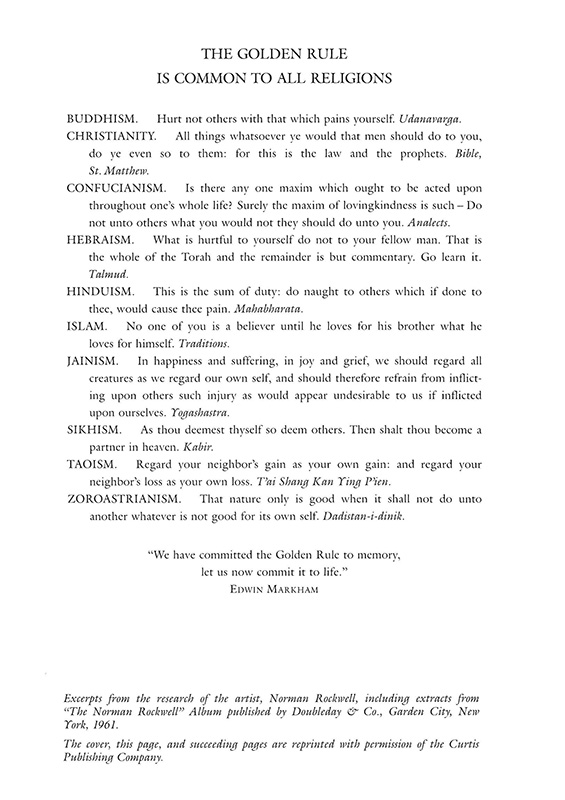
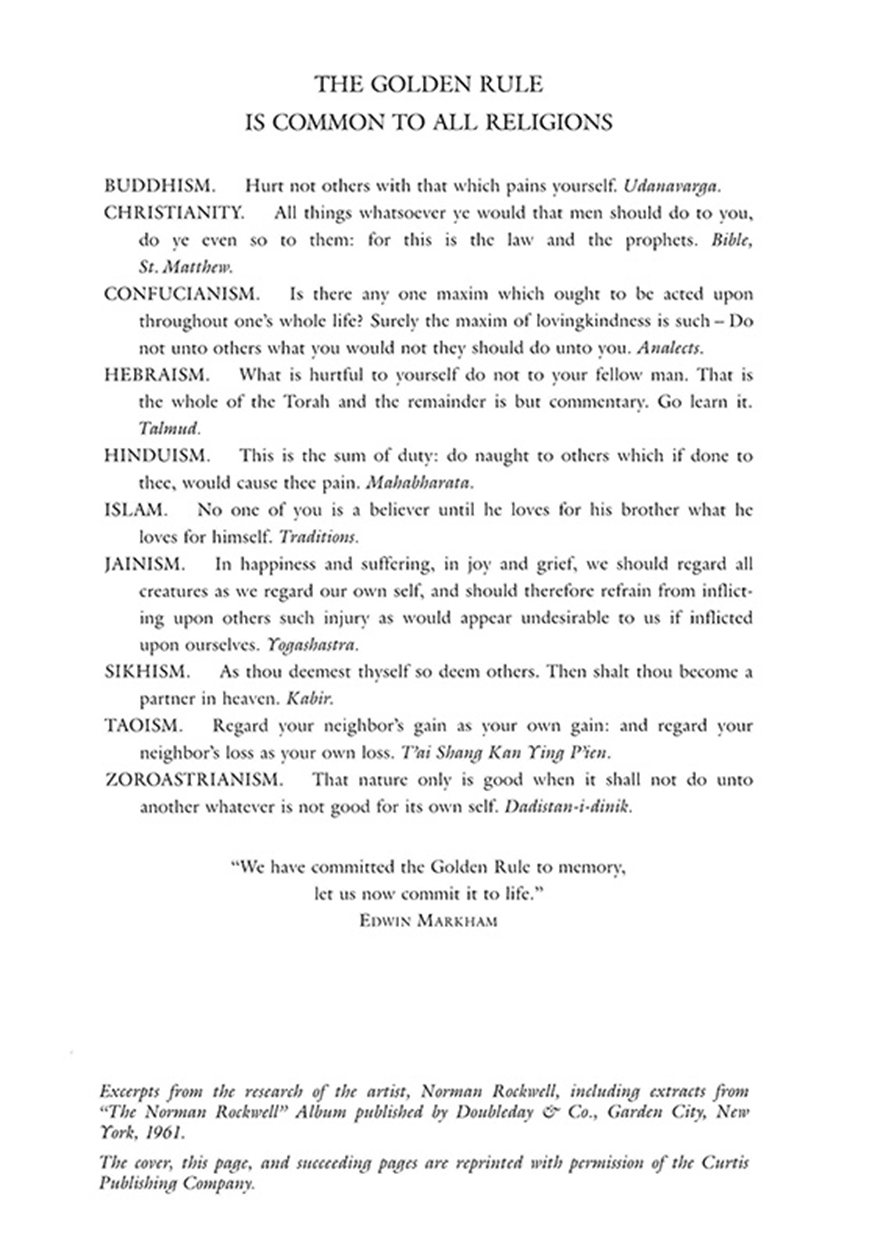
It may seem naive or trite, but what the Judeo-Christian world knows as “The Golden Rule,” “Do unto others as you would have them do unto you,” seems like such a simple solution to most of the world’s problems. Knowing that words similar to Matthew 7:12 or Leviticus 19:18 appear in other world religions I googled that phrase and, please excuse the pun, I struck gold on my first try. Here’s what I found:

The Saturday Evening Post: cover, April 1, 1961 was a Rockwell collage of a group of people of different religions, races and ethnicity as the backdrop for the inscription “Do Unto Other As You Would Have Them Do Unto You.” Rockwell was a compassionate man, and this simple phrase reflected his philosophy.
“I’d been reading up on comparative religion. The thing is that all major religions have the Golden Rule in Common. ‘Do unto others as you would have them do unto you.’ Not always the same words but the same meaning.” – Norman Rockwell

Here are Norman Rockwell’s notes on the way that the Golden Rule is expressed
in different religions…

Such a list is an example of what some contemporary theologians (e.g. Richard Rohr, Matthew Fox) would call cosmic or deep ecumenism.

All of that is wonderful wisdom, but I want to share with you a concrete example, a snapshot in time if you will, of what that kind of mutual respect looks like in action. In response to my blog entitled “Leading with Your Head,” (Jan. 30, 2022) I received this comment from a friend and colleague, Rev. Phyllis Fetzer. She wrote,

Hi, Steve, I enjoyed this blog post and thank you for the reminder re: being holistic and not just “leading with our head.” I mean no disrespect when I point out two things about your digression re: traumatic brain injury suffered by (football) players: (1) It’s not a “maybe;” it’s almost a certainty that players will experience damage to the brain. One recent (respected) study showed traumatic brain injury in 110 out of 111 players; that’s basically 100%. (2) May I gently point out to you (and hope that you would do the same to me) that having a lifelong habit of watching football doesn’t mean that that habit can’t change, right? Thinking of other ethical areas where people have said, “I just can’t change because it’s been this way my whole life.” E.g., men referring to women as “girls”. We *can* change in light of new learning, yes? I hope and think that you know that I respect you very much, and am also aware that I’m sure that I have (an) ethical blind spot(s) in some other area. Thanks for the good post.”

Wouldn’t the world be a much kinder and more productive and loving place if we could learn or relearn to disagree constructively and respectfully. I can tell you I certainly receive that kind of feedback with open arms and an open mind rather than putting up my defenses when I feel attacked. And I hope I have learned to live by that old golden rule just a little more thanks to Phyllis.

Leading with Your Head

“Words alone are cheap.  Breathing deeply is required also.  Connecting to the heart, not just the eyes. Meditation, mindfulness, contemplation, art and creativity–accessing the right hemisphere of our brain, not just the verbal hemisphere, is needed. 

Incorporating and honoring our bodies, breathing deeply, not just leading with our heads.  The heart after all resides in the body and disperses its blood and values from that center.  And breath is the same word as “spirit” in many languages (including Biblical ones).”

Yes, words are cheap, but they are all we have to express our thoughts and feelings.  That quote is from Matthew Fox in his “Daily Meditations” for today, (January 29).  The phrase that jumps off the page for me is “not just leading with our heads.”  We know with our heads and hearts that we are holistic beings and certainly not the Cartesian model of rational-logical critters who only exist because we think.  We also feel and act.

I first really understood that in graduate school working on my doctorate in rhetoric.  It wasn’t until then that I learned that the traditional three-part sermons I grew up with were originally not just three sections of a sermon linked together more or less successfully.  The three point idea originated clear back in the 4th century BCE with Aristotle.  In his classic “Rhetoric” Aristotle describes a holistic approach to persuasive discourse that appeals to “logos, pathos, and ethos,” terms best translated into English as “reason, emotion, and ethics.”  Effective persuasion needs all three elements because humans are rational, emotional and ethical beings.  The latter term applies to our behavior that is shaped by our reason and emotion.

Western philosophy and education have majored ever since Descartes in developing and teaching that primarily addresses the mind to the detriment of emotional and ethical development.  In other words as in the quote I began with we “lead with our heads.” 

As I was writing this piece I saw a very timely post on Facebook that seems relevant.  I can’t verify the source from a Facebook called “Compass,” but it certainly fits my life experience as one who led with my head through twelve plus years of higher education.  Here are the key points of the post:

“According to Psychologists, there are four types of Intelligence:

1) Intelligence Quotient (IQ)

2) Emotional Quotient (EQ)

3) Social Quotient (SQ)

4) Adversity Quotient (AQ)

1. Intelligence Quotient (IQ): this is the measure of your level of comprehension. You need IQ to solve math, memorize things, and recall lessons.

2. Emotional Quotient (EQ): this is the measure of your ability to maintain peace with others, keep to time, be responsible, be honest, respect boundaries, be humble, genuine and considerate.

3. Social Quotient (SQ): this is the measure of your ability to build a network of friends and maintain it over a long period of time.

People that have higher EQ and SQ tend to go further in life than those with a high IQ but low EQ and SQ. Most schools capitalize on improving IQ levels while EQ and SQ are played down.

A man of high IQ can end up being employed by a man of high EQ and SQ even though he has an average IQ.

Your EQ represents your Character, while your SQ represents your Charisma. Give in to habits that will improve these three Qs, especially your EQ and SQ.

Now there is a 4th one, a new paradigm:

4. The Adversity Quotient (AQ): The measure of your ability to go through a rough patch in life, and come out of it without losing your mind.”

The phrase “leading with your head” reminded me of something I’ve been concerned about as I have watched way too much football in recent weeks.  Last weekend was an especially exciting one for National Football League fans.  There were four playoff games last weekend that were all as closely matched as mathematically possible.  Three ended with winning field goals as time expired and the fourth game went to overtime.  

First a confession and/or disclaimer:  I know the game of American football has become dangerously violent.  Players are bigger, faster and stronger than they used to be, and therefore bodies collide with much greater force.  Padding and helmets are certainly much better than the days of leather helmets, but we still know many former players are suffering from traumatic brain injury, dementia, and Chronic traumatic encephalopathy (CTE) because of their years playing football.  Knowing all that makes me uncomfortable watching, but it’s something I’ve been doing for nearly 70 years and is a very hard habit to break.  I also think the way football has replaced our former much more civil national pastime (baseball) is another sign of the toxic masculinity that I wrote about plaguing the American psyche that I wrote about last week.

But I digress a bit.  What I noticed watching so many games last weekend was a troubling difference between college and professional football.  The college game has a rule against “targeting” which is aimed to limit hits to the head and neck area and crashing into an opposing player with the crown of the helmet.  That rule is designed to protect both the player on the receiving end of the targeting and the cranium of the deliverer of the blow.  

Yes, targeting is a judgment call that referees spend much time reviewing replays before enforcing.  They take it very seriously because the penalty for targeting is ejection from the game, and that has and will cut down some on the most dangerous hits in an inherently violent game.  I think the NFL needs to do something similar to prevent more life-threatening injuries from “leading with one’s head.”

I offer that football reflection as a metaphor for the rest of us in real life.  When we lead with our heads, divorced from understanding the emotional, social, and I would add spiritual aspects that are co-partners with the head in human beings we are failing to maximize a healthy comprehension of human behavior.  We are not just rational/thinking beings.  The various components of our humanity need to work in partnership with each other or we are not living up to our potential.  And the huge existential problems facing the human race will not be solved if we are not playing with a full deck. 

Rescue

Our church is doing a series of Advent devotions on words that reflect facets of the Advent and Christmas season. I wrote this one on the word “rescue.”

When I signed up for this word I was thinking about our granddaughter Olivia and the cat rescue organization she started last year. She named her rescue operation “Little Boo Rescue of Ohio” in honor of “Boo,” one of the first kittens she rescued who unfortunately was too sick to be saved.

The three cuties pictured here are Cherry, Mango and Honeydew. They along with their siblings, Apple and Bianca were near death when rescued, but thanks to a lot of TLC and excellent medical care all five are healthy again and looking for their forever homes. Olivia has always had a huge heart for our four-legged friends, and we are very proud of the work she and her colleagues are doing, all of which is over and above their full-time jobs.

Their rescue work often requires responding to calls from someone with a feral cat problem.  She and her friends respond by going out in the dark to capture cats so they can be neutered, vaccinated, and nursed back to health.  They are then either adopted or sent to foster homes.  It is a true labor of love.  

Such caring work reminds me of Jesus’ story of the shepherd who leaves the 99 sheep to go searching for the one lost stray.  We are all that lost one at some time in our lives, and we run and hide from God all too often.  But God never gives up and will be there to cuddle us back to health whenever we admit we need to be rescued.

We’ve all heard the joke about how hard it is to herd cats, and if she could I’m sure Olivia would transform herself into a cat so the lost ones would trust her and be easier to rescue. And that’s exactly what God did for us in the human baby born in Bethlehem so long ago. The incarnation means that God is with us no matter how many times we need to be rescued.

Unbound: Lazarus was, are we?

What do tennis, hiking, golf, biking, jogging, working on a ladder, and skiing all have in common? They are all things I have had to give up in the last 10 years due to the aging process. I was talking to a friend my age who has given up even more things than I, and when I described my emotional state as “feeling empty” and not having anything to fill the space left by all I’ve lost. The words were barely out of my mouth when my friend said, “That’s exactly how I feel!” Like all of my friends, we have often joked in years past about old people always complaining about their aches and pains all the time, but more and more as we navigate our 70’s we find ourselves doing exactly the same thing.

I remember about 12 years ago asking an “older” gentleman what he was doing in retirement. Without missing a beat he said, “Going to doctor appointments and funerals.” I thought that was funny back then, but I’m not laughing anymore. When I told my friend that I was seeing a counselor about my feelings of emptiness and depression his response surprised me. After asking if the therapy was helping he said, “Thanks for sharing that. I always thought you had it all together. But knowing you are feeling the same things that I am makes me feel not so alone.” That wasn’t a “misery loves company” response; that was the blessing of letting down our armor and being vulnerable.

I’m not patting myself on the back, mind you. I have been good friends with this man for over 50 years. We have gotten together for golf and/or lunch monthly for decades until old age took our clubs away. Now like many oldsters we just go to Bob Evans. We’ve developed a trust over the years, but the fact that he still thought I “had it all together” means I’m either a better actor than I thought or I’ve been much less honest with him than I wish I had. I’m hoping this recent conversation will help us stay on a more vulnerable level going forward.

Here’s the good news. In addition to my therapist I am also working with a spiritual adviser, and when I shared this story with him he reminded me that until we empty ourselves of all the busyness and activities that keep our minds off our pain God can’t fill us up with anything else. A light bulb went on for me when he said that because when you hear truth it illumines things around and within you. He helped me realize that instead of resenting the emptiness I am feeling I can choose to embrace it as a gift from God. That doesn’t mean the UPS is going to arrive at my doorstep with God’s gifts anytime soon, and no that’s not because of a supply chain issue. Spiritual growth takes time and a willingness to sit with pain or emptiness awhile.

The Hebrews were in the wilderness for 40 years, not because it takes that long to travel from Egypt to Israel or because Moses refused to ask for directions. Even Jesus spent 40 days in the wilderness wrestling with Satan because deep spiritual growth takes time to mature and ripen. The advice to “be still and know I am God” may sound really simple, but it’s not just a matter of shutting up for a few minutes so God can speak. It means prioritizing time for prayer and silence, and not the kind of prayer where we just tell God what we want or need.

Jacob wrestled with God all night long and was changed forever by that experience. Moses and Elijah both had to go up to Mt. Sinai/Horeb to hear God’s still small voice. I confess I am not good at silence. Even when writing these posts I frequently have a ball game on TV or music on some device. I know I write so much better when I am in a quiet place as I am while I write this, but like Paul I often fail to do the things I want to do and don’t practice what I preach.

The Gospel lesson for All Saints day this year is from John 11, the familiar story of Jesus raising Lazarus from the dead. There are many rich veins of truth to mine in that story, but two stand out for me just now. This chapter contains what every kid in Sunday School loves to memorize, namely the shortest verse in the Bible: “Jesus wept.” This is one of several times in the Gospel narratives that we see Jesus vulnerable and allowing his humanity to show through. Like us he grieves over a loss, even though we and he all know he’s going to restore Lazarus to life.

The second verse in that lesson that grabbed my attention this year was the last one where Lazarus emerges from the tomb all bound up like a mummy. He’s alive but not really. His movement and sight and vision are all hampered by his grave clothes???, and Jesus says, “Unbind him and let him go.”

What are the things that bind you and me and keep us from living abundantly in the reign of God? Are we so stuck in our old ways that as Martha so indelicately puts it in the King James Version, “He stinketh,”. My wife sells a very good air purifier that kills germs and removes odors, even in cars or houses that have been skunked. But even those machines will not remove the kind of stench that comes from us who are spiritually dead and don’t know it.

My prayer is for God to unbind me from the anger, fear and regret that I feel for all the things I’ve lost in this stage of my life. Unbind me, Holy one. Roll away the stone that keeps me trapped in a pity party for my past. Unbind me and let me embrace what is and what will be if I trust you to lead me.

What’s your prayer for new life?

Spiritual Surrender: The Only Way Out

Hard to believe I’ve been blogging here for 10 years, and when I look back to my very first post I am a bit shocked to see it was about bringing our troops home from Afghanistan. I also originally did posts based on biblical texts from the Revised Common Lectionary; so today I decided to revisit that practice, and when I looked up the texts for August 22 I find God’s spirit moving again in mysterious ways. Several of these texts speak to the centuries old issues at work in the seemingly intractable conflicts in the Middle East.

The passage from Joshua 24 addresses Israel’s transactional “right” to occupy the land of their ancestors if they remain faithful to their covenant with Yahweh. Verses 15-18 say, “Now if you are unwilling to serve the LORD, choose this day whom you will serve, whether the gods your ancestors served in the region beyond the River or the gods of the Amorites in whose land you are living; but as for me and my household, we will serve the LORD. Then the people answered, “Far be it from us that we should forsake the LORD to serve other gods; for it is the LORD our God who brought us and our ancestors up from the land of Egypt, out of the house of slavery, and who did those great signs in our sight. He protected us along all the way that we went, and among all the peoples through whom we passed; and the LORD drove out before us all the peoples, the Amorites who lived in the land. Therefore we also will serve the LORD, for he is our God.”

Verses like that last verse one always trouble me—“…the Lord drove out before us all the peoples, the Amorites who lived in the land.” Would a just God of the whole universe choose sides and violently force the occupants of a piece of God’s creation out of the land they have called home for centuries? Would a just God rationalize such an eviction just because Joshua says God told us we can have this “Promised Land” even though we’ve been living in Egypt for 400 some years? That is not a rhetorical question because the fact that Israel and her neighbors are still killing each other over that piece of real estate makes this an urgent contemporary issue.

Preachers can challenge and deepen their own faith and that of their congregations by wrestling with such challenging issues. Some of us fear that exposing contradictions in the Bible will destroy faith, but that is not true. I love the quote in one of Frederick Beuchner’s books that says, “Doubt is the ants in the pants of faith.” We don’t usually come to Scripture or worship because our faith is totally secure. All of us, preachers perhaps most of all, come thirsting for authentic encounters with God, and if what preachers are serving fails to meet that need folks will stop at McD’s on the way home for junk food. I cast my lot with the theologians who realize that certainty is the enemy of faith, not doubt. To ignore contradictions within holy texts in hopes that no one will notice is a fool’s bargain. Because real faith at its core always contains some mystery and is therefore a holy riddle inviting us into dialogue with the text and with God.

For example, another of the lectionary texts for August 22 is from I Kings 8 which describes part of Solomon’s dedication of the first temple in Jerusalem many years after Joshua led the conquest of the Promised Land. Beginning at verse 24 we find these words: “Hear the plea of your servant and of your people Israel when they pray toward this place; O hear in heaven your dwelling place; heed and forgive. Likewise when a foreigner, who is not of your people Israel, comes from a distant land because of your name for they shall hear of your great name, your mighty hand, and your outstretched arm–when a foreigner comes and prays toward this house, then hear in heaven your dwelling place, and do according to all that the foreigner calls to you, so that all the peoples of the earth may know your name and fear you, as do your people Israel, and so that they may know that your name has been invoked on this house that I have built.”

“Do according to all that the foreigner calls to you; so that all peoples of the earth may know you name….” What an about face from thanking God for killing off the Amorites! And what a great way to examine the evolution of faith over time as God inspires women and men in all generations with the wisdom of Solomon. God’s concern for the foreigner/alien/sojourner is of course interspersed throughout the Hebrew texts along side more nationalistic sentiments because we know the path to faith is not the wide comfortable one but the narrow mountain road with numerous switchbacks and challenges that require our devotion and honest intellectual curiosity.

One of my biggest regrets about my preaching career is that I have not always been brave enough to wrestle in corporate worship with the challenges of biblical interpretation. It has been poor stewardship on my part to withhold from my parishioners and others the marvelous gifts of historical-criticism and narrative criticism I was given in my seminary education.

When I taught homiletics I encouraged my students to focus on just one text per sermon and refrain whenever possible from trying to preach on two or more selections from the lectionary. But there are exceptions to every rule, and this set of texts interact so well with each other that it is at least worth exploring how they inform or expand each other. For me the epistle text from Ephesians 6 also speaks to me as both a preacher and a citizen of our broken world.

The familiar passage about “putting on the whole armor of God” is an excellent metaphor for those preparing to speak for God in these difficult days of pandemic and domestic and international conflict. But “armor” can be a two-edged sword (to mix metaphors?). Remember how David refused to put armor on when he confronted Goliath because it hampered his ability to use the shepherd’s tools at his disposal? ( 1 Samuel 17). It is rather like Brene Brown’s analogy I heard recently in one of her podcasts where she characterized getting defensive when we feel vulnerable as “armoring up.”

Those “weapons” described in Ephesians are also metaphors and not meant to for us to go out as “Christian soldiers marching as to war…” as one of my my childhood (but no longer) favorite hymns puts it. I invite you to instead focus on the qualities of discipleship described in Ephesians instead of literalizing the military memes. As the author of Ephesians 6 says, “… in the strength of God’s power put on the whole armor of God, so that you may be able to stand against the wiles of the devil. For our struggle is not against enemies of blood and flesh, but against the rulers, against the authorities, against the cosmic powers of this present darkness, against the spiritual forces of evil in the heavenly places. Therefore take up the whole armor of God, so that you may be able to withstand on that evil day, and having done everything, to stand firm. Stand therefore, and fasten the belt of truth around your waist, and put on the breastplate of righteousness.”

In these days when lies, mis-information, and “alternative facts” bombard our ears and senses without ceasing I would argue that we need none of these parts of “armor” more urgently than “the belt of truth.” It is no accident that it is the first item listed for it is the truth that will set us free. But we know that truth can also make us feel very vulnerable and uncomfortable. We cannot question Joshua’s conquest of the Amorites, or the imposition of the nation of Israel on the Palestinians after World War II without also seeing in the mirror American genocide of indigenous people who lived on our “promised land” for centuries before Columbus sailed the oceans blue. No matter how much we divert our eyes we must eventually face the fact that our choices and actions as individuals and nation states have long-lasting consequences.

When I was in high school I excelled at history/social studies because I was blessed with a good memory that could regurgitate historical dates on demand. But it was not until I took a world history class in college that I had the first ah ha moment and began to connect the dots between one historical event and others that followed. For me my first revelation that the harsh treatment the allies imposed on the conquered Germans in the Treaty of Versailles that ended World War I was used by Hitler to inflame German nationalism and racism by blaming the dire economic plight of the Great Depression on their European enemies. A huge part of that Nazi response was to unify their base by scapegoating Jews and anyone else who was different from the pure Aryan race. Tragically that strategy resulted in the deaths of 6 million Jews and thousands of others in dozens of extermination centers. And the next link in the chain of events was an attempt at repentance by the allies who far too long pretended the Holocaust wasn’t happening. That act of penance was to create a new/old homeland for the Jews in Israel, which in turn displaced hundreds of thousands of Palestinians, and the viscous cycle rages on with 9/11, Desert Storm, killing of Osama Ben Laden, oil wars, Hezbola, the Taliban, etc. etc.

The gut wrenching headlines from Afghanistan right now defy any human resolution of the impact of brutal violence as city after city falls to the Taliban. It like all wars before it yet another gruesome illustration that peace can NEVER come through instruments of death. Violence ALWAYS escalates into more and more violence. The good news is that only when we reach the ultimate limit of our human wisdom can we surrender our fear, pride, ego and arrogance and call upon the cosmic power of the one we call God.

O Eternal Being, we have been told that your “Spirit helps us in our weakness; for we do not know how to pray as we ought, but that very Spirit intercedes with sighs too deep for words.” (Romans 8:26). This is one of those moments, O God. We confess our weakness. Intercede for us and bridge our foolish human divisions. Let all of us children of Abraham come together in weakness, trusting you as the only way, truth and life. Let believers, atheist, agnostics and all of your troubled children put down our weapons and raise our hands in unconditional surrender so your will and not ours will emerge from a world of chaos and death. Amen

Note: I would welcome comments and reactions. If you preach on one or more of these texts give me some feedback on how helpful or unhelpful this was. Thanks

First Things First: Stillness

I was reflecting on the familiar words from Psalm 46 while meditating yesterday: “Be still and know that I am God” (Vs. 10) when it dawned on me that for most of my life I’ve been doing this backward.

Let me explain. For much of my life I was a professional student. Seriously, I finished my final formal education at age 47. Being a student came easy for me. It was comfortable because I knew how to play the education game. I like the pursuit of knowledge and hope I will always be a life-long learner.

But the psalmist put these words in the order they are in for a reason. “Be still” comes before “know that I am God.” In academic speak stillness is a prerequisite for knowing. Knowledge in the academic sense is mostly an intellectual exercise. But knowing God involves far more than our minds; it encompasses our whole being.

In Genesis 4:1 it says, “And the man knew his wife Eve and she conceived.” There “knowing” is a metaphor for total merging of one life with another. So it is with knowing God. To quote a contemporary theological statement called the “Hokey Pokey,” to really know God you have to put your “whole self in.”

And we cannot do that if our minds are racing hither and yon dealing with all the things modern life includes. How many times in the New Testament does Jesus go off to a quiet place by himself to pray, to commune with God? And that’s a problem for me. There are not many quiet places in my world. We live on two acres so there’s physical space for solitude, but even if I sit by our pond I can hear traffic from a freeway a half mile away; and urban sprawl is devouring most of the vacant land all around us.

So being still, really still in mind, body and spirit doesn’t come easily. It requires a conscious effort and discipline to find a place and dedicate time regularly to be still; so God can draw near and make herself known to us. That spiritual discipline requires us to put first things first. Be still, and then we can know God fully by surrendering our being into the mystery of Being Itself.

Like a Woman

[Note: I was going to write a note of appreciation for the many mother figures in my life, but I remembered I had written something similar a few years ago. I think it is still relevant and appropriate for a Mother’s Day post; so I’m republishing this post from January 2018.]

Bertha Hemmert was my surrogate grandma when I was growing up on Murray Street in Wapakoneta, Ohio. Not that I needed another grandma—I had two very loving ones already; but a little kid can never get too much of that special love that grandmas are so good at. And Mrs. Hemmert as I knew her then had one big advantage over my “real” grandmothers—she was just across the alley no more than 50 feet from our back door. She was probably younger than I am now, but to my 7 year-old self she seemed ancient. I don’t remember how she first befriended me. It was likely one of the many times I hit a stray baseball into her yard and had to go fetch it.

Two things I remember very well—I enjoyed hanging out at her house and “helping” her with chores like cleaning green beans from her garden. I’m sure I was often more trouble than help but I always felt welcome to drop in whenever I wanted. The other thing I remember – because my family has never let me forget it – is that one day while helping Mrs. Hemmert in the kitchen I announced to her that “I think I want to be a woman when I grow up.”

No, that was not some confusion over my sexual identity. As I reflect back on that memory and my childhood I have come to believe it meant I just felt loved being in her company and wanted to enjoy that feeling as much as I could. And it was not just Mrs. Hemmert who represented that unconditional love and acceptance for me. The most important people in my early life who gave me that kind of affirmation were all women—my grandmothers, my mom and my Aunt Ruth.

My reflection on those childhood relationships have been inspired by all of the events in our society in the past year that have raised awareness of female power and courage in spite of oppression and abuse–and by the guilt and remorse I feel that in spite of my life-long appreciation for women I have been part of the male dominated power structure that I could not be insulated from growing up in the 1950’s. Mrs. H. was typical of all of my female role models as I grew up. They were all stay-at-home mothers and homemakers, and they lived out that vocation proudly and well.

Proverbs 31 and has been used and misused to praise and eulogize many women like those. It says in part “A capable wife who can find? She is far more precious than jewels. The heart of her husband trusts in her, and he will have no lack of gain. She does him good, and not harm, all the days of her life. She seeks wool and flax, and works with willing hands. She is like the ships of the merchant, she brings her food from far away. She rises while it is still night and provides food for her household and tasks for her servant-girls. (Proverbs 31:10-15 NRSV) Of course the women in my life were the “servant-girls” for their families rather than having any, but that proverb is attributed to King Lemuel’s mother giving her son advice; and he could relate to that particular reference.

The misuse part of that Proverb has been on the hard-working from before dawn to after dark woman who is subservient to her husband. But listen to what other parts of that proverb say about women of strength as entrepreneurs and teachers of wisdom: “She considers a field and buys it; with the fruit of her hands she plants a vineyard. She girds herself with strength, and makes her arms strong. She perceives that her merchandise is profitable. Her lamp does not go out at night. She puts her hands to the distaff, and her hands hold the spindle. She makes linen garments and sells them; she supplies the merchant with sashes. Strength and dignity are her clothing, and she laughs at the time to come. She opens her mouth with wisdom, and the teaching of kindness is on her tongue. She looks well to the ways of her household, and does not eat the bread of idleness. Her children rise up and call her happy; her husband too, and he praises her: “Many women have done excellently, but you surpass them all.” (Vss.16-19, 24-29)

That part of this proverb reminds us that to limit women, or anyone, to a particular role or station in life is not only foolish but absolutely wrong. To respect or pay women less for the same work men do is unjust. To treat women as sex-objects in blatant, abusive or even subtle or unintended ways is wrong and must stop.
I was proud of Mrs. Hemmert and wanted to be like her – because “the teaching of kindness was on her tongue” and she treated me as someone of value and worth. Women today are demanding the same kind of respect and dignity and unconditional love that the wonderful women in my life gave me. Did they raise a perfect son or grandson or nephew? Of course not. There we too many sexist forces in my life in the way I was taught what it meant to be a man; in the ways all of the heroes of American history were portrayed as powerful white men; in the male-dominated leadership of the churches I was nurtured in; in the movies and television shows I watched; in the literature I read; and the list goes on and on.

But this I know, the seeds of love and compassion were sown in my heart and soul by people like Mrs. Hemmert. I have often been embarrassed when my family tells that story about my wanting to be a woman; but today I am proud to proclaim that I am still striving to be like her; to offer everyone the kind of affirmation and hospitality she gave to me. I want to be like the women who have had the courage to speak their truth to power in the past few months. I want to be like the men that Oprah included in her great speech at last night’s Golden Globes when she said:
“So I want all the girls watching here, now, to know that a new day is on the horizon! And when that new day finally dawns, it will be because of a lot of magnificent women, many of whom are right here in this room tonight, and some pretty phenomenal men, fighting hard to make sure that they become the leaders who take us to the time when nobody ever has to say ‘Me too’ again.”

Being Real

I do not know what the average life expectancy is for snow persons, but we have one in our front yard, thanks to my wife Diana, who has lasted longer than any I can remember in our fickle Ohio weather.

It’s not been an easy two weeks for our Frosty. The constant cold temps have kept him from melting, but the sub-freezing has turned him into solid ice. That makes him very sturdy, but it has also meant that when his nose and hands fell off they could not be reimplanted.

Frosty’s noseless, handless condition and his loss of some of his buttons reminded me of one of my favorite children’s stories, “The Velveteen Rabbit,” by Marjorie Williams Bianco. For me the best part of the story is a discussion between two toys in a boy’s nursery, the skin horse and the velveteen rabbit, about what it means to be “real.” Here’s their dialogue:

“What is REAL?” asked the Rabbit one day, when they were lying side by side near the nursery fender, before Nana came to tidy the room. “Does it mean having things that buzz inside you and a stick-out handle?”

“Real isn’t how you are made,” said the Skin Horse. “It’s a thing that happens to you. When a child loves you for a long, long time, not just to play with, but REALLY loves you, then you become Real.”

Does it hurt?” asked the Rabbit.

“Sometimes,” said the Skin Horse, for he was always truthful. “When you are Real you don’t mind being hurt.”

Does it happen all at once, like being wound up,” he asked, “or bit by bit?”

“It doesn’t happen all at once,” said the Skin Horse. “You become. It takes a long time. That’s why it doesn’t happen often to people who break easily, or have sharp edges, or who have to be carefully kept.

Generally, by the time you are Real, most of your hair has been loved off, and your eyes drop out and you get loose in the joints and very shabby. But these things don’t matter at all, because once you are Real you can’t be ugly, except to people who don’t understand.”

One can learn a lot from stuffed toys and snow persons.

L’chaim! To Life!

Yesterday morning I woke up in great anticipation. After being in a lot of pain in my back and hip for weeks I was scheduled to get an injection that might give me some relief. There were several inches of new snow on the ground, and most schools had cancelled classes for the day, but I figured that by afternoon when my appointment was the roads would be clear.

And then the phone rang. My doctor’s nurse was calling to tell me the doctor could not make it in, and my appointment would have to be rescheduled. Making matters worse the doctor only does these injections on Tuesdays; so I would have to wait an entire week.

To say I was very disappointed would be an understatement. My long-suffering wife would tell you that I am usually a glass half empty guy, and this unwelcome surprise did not help my general level of frustration with health concerns, COVID restrictions and all that entails.

But then a minor miracle happened, and I can’t explain it, which I guess is true of all miracles. I was looking at my sad sack face in the bathroom mirror, and suddenly out of nowhere I started singing some of the lyrics to “L’chaim” from “Fiddler on the Roof.” No one else was home fortunately, or my embarrassment over my poor singing voice would have probably stopped me from expressing an emotion of joy and optimism.

I haven’t seen or heard “Fiddler” for decades, and when I do think about that musical I usually think about the title song or “Tradition,” or “Do You Love Me?” But from somewhere hidden away in my memory came these words, and there I was singing as if no one was listening, “L’chaim, l’chaim, to life.”

I don’t know all the lyrics to that song so I ad libbed the words I remembered:

“May all your futures be pleasant ones, Not like our present ones; Drink, l’chaim, to life. To life, l’chaim, L’chaim, l’chaim, to life!”

“To us and our good fortune, Be happy, be healthy, long life! And if our good fortune never comes, Here’s to whatever comes; Drink, l’chaim, to life!”

I don’t know what to make of that except I know it lifted my spirits for the rest of that day. Thinking about the context of that musical set in the midst of oppression of the Jews by the Russian authorities put my minor problem of waiting a week for my injection in its proper perspective.

The characters in this wonderful musical are being forced to leave their beloved village of Anatevke for parts unknown. And the lovable protagonist of the drama, Tevye, is trying to cope with a shaking of the foundations of all his traditions as each of his daughters pushes the envelope further to claim her freedom.

And yet in the midst of all this disruption and change the men of Anatevke break into song to celebrate the arranged marriage of Tevye’s eldest daughter, Tzeitel, to the much older town butcher, Lazar Wolfe.

Spoiler alert: the arranged marriage doesn’t happen because Tzeitel protests and Tevye ends the agreement and lets her marry the man she loves, Motel Kamzoil the poor village tailor. Tevye’s daughters 1, traditions 0.

But regardless of what happens eventually the men in that bar spontaneously singing L’chaim are celebrating much more than one marriage. In the midst of all the unrest and uncertainty imposed on them by the hated Russians these men are still celebrating life.

The people of Anitevke have no idea what tomorrow will bring. Their traditions are being challenged by the younger generation as younger generations always do. And yet they celebrate love and hope in the future by marrying and bringing new life into a world of uncertainty and ambiguity.

We live in such a time right now in our pandemiced and polarized nation, and yet we dare to sing with Tevye and his friends:

“Be happy, be healthy, long life. And if our good fortune never comes’ Here’s to whatever comes. Drink, l’chaim, to life!” Amen

.

First Come, First Served

“Now there is in Jerusalem by the Sheep Gate a pool, in Aramaic called Bethesda, which has five roofed colonnades. In these lay a multitude of invalids—blind, lame, and paralyzed. One man was there who had been an invalid for thirty-eight years. When Jesus saw him lying there and knew that he had already been there a long time, he said to him, “Do you want to be healed?” The sick man answered him, “Sir, I have no one to put me into the pool when the water is stirred up, and while I am going another steps down before me.” Jesus said to him, “Get up, take up your bed, and walk.” And at once the man was healed, and he took up his bed and walked.” John 5:2-9

This poor invalid had been trying to get in that pool for 38 years. In today’s time frame that would mean he has been there since 1983! And no one has bothered to help him. Instead they push and shove to get in the healing water themselves. People with headaches, hangnails or allergies are still quite mobile and can get in first.

I was reminded of that story when I heard on the news recently an account of COVID vaccine distribution in a southern Florida County. In that county they announced a date for when those 65 and over could get the vaccine, first come, first served! And of course that resulted in chaos and confusion as those who were able-bodied camped outside the night before so they could be first in line. And as in John’s narrative about the pool by the sheep gate those who were sick or feeble and needed the vaccine more were left out in the cold because there was a limited number of vaccines available.

But along comes Jesus and upsets the apple cart as he usually does. Jesus doesn’t join the frenzy, jostling the crowd so he can carry the man into the pool. Jesus simply ignores the protocol altogether and heals the man himself.

The idea of first come, first served looks on first glance to be very fair. But when we look deeper into how it actually works in reality we realize how unfair it is to those most in need. Where does that show up in our society? Wealth and privilege buy the best school, healthcare, hotel accommodations and modes of transportation.

Some would argue that’s fair because we privileged ones have worked hard to earn enough to have all those benefits, Really? I have never been “wealthy” by worldly standards, but as a white male there were and still are more doors open to me and fewer arbitrary roadblocks or glass ceilings than women and people of color face.

My takeaway is that I want to pause and reflect on how a lucky break or good news for me may be just the opposite for the underprivileged. Recognizing the injustice is only step one, the hard part is figuring out how i can make the situation more just.

Those actions can be as personal as offering my place in line at grocery checkout to a frazzled father with two unhappy kids or to a woman with mobility issues. Or they run all the way to contacting government officials and helping them see the need for policy changes to level the playing field for the underprivileged. What is not an option for Christians is to ignore injustice hoping it will go away. It won’t. It just grows and embeds itself in the culture and becomes systemic.