Contentment in Any Role

“All the world’s a stage,
And all the men and women merely players;
They have their exits and their entrances,
And one man in his time plays many parts…”

Those lines from Shakespeare’s “Mid Summer Night’s Dream” have been floating around in my head for quite some time. But I did not remember until I looked up the quote that it is the beginning of a monologue about the stages of life from infancy to death.

Being 78 and a cancer patient I have spent more time than I like thinking about my mortality, and that whole monologue that describes 7 stages of life fits right into that conversation in my head.

The questions I want to ask about that metaphor are two: What do you do or how do you cope when you don’t get the part you really want? And what about the times you get stuck with a part in the play of life that you really don’t want?

I’m guessing we’ve all been in both of those situations. When I was a sophomore in college a young woman I had been in a serious relationship for almost two years informed me I was no longer needed in the play of her life. She had a good reason, and I appreciated her sharing it with me. I was still devastated, but she helped me understand the break up wasn’t just about me personally; but about a career path I had chosen that she wanted no part of.

Earlier that year I had decided to switch majors from engineering to philosophy in preparation for going on to seminary after college. In other words I had opted for a very different part in a totally different play, and she did not want to play the role of a pastor’s wife. There are very good reasons to say no to what can be a very challenging unpaid, high expectations job, and I understand that better now than I did way back then. I also understand that I undoubtedly made the situation worse by making that important career decision without ever discussing it with her. Yes, I was still working from an old script where wives are subservient to their husbands.

The second half of the 20th century was a confusing time to be playing a romantic role. The old scripts of how men and women related were being thrown out, and new ones were still being written. Societal norms about sex, race, war, and peace were all in a state of flux. Life was like improv theater – we were all making it up on the fly.

That flux had major impact on the job market as well. We didn’t call it DEI back then, but in liberal circles where I played my roles as student and pastor and teacher the civil rights and women’s rights movements spurred efforts to increase diversity in the workplace and on faculties. As a white male that was a personal disadvantage to me. I had my heart set on a particular professorship when I finished my doctoral work and thought I had a good shot at it. I had been teaching at this school as an adjunct professor for two years, and my student evaluations were excellent.

Little did I know that the position had already been promised to a black woman who had taught there before me as an adjunct and left to do her PhD. I was disappointed, especially since I had turned down a role as a pastor at a church I had always admired earlier that year. Sometimes we don’t get to play the part we want or even be in that particular play, but in this case I did understand and agreed with the school’s priority on building a more diverse faculty. When I had been a student there 20 years earlier the entire faculty and administration was white and male, and the student body was 98% the same.

But to circle back to Shakespeare’s take on the stages of life as the roles we play from birth to death, I find his list rather limiting. He spends little time on the variety of parts we might play in adulthood, and I realize that life expectancy back then was much shorter than it is today. With advances in health care a productive adult life can last 50 or 60 years and may include several different careers, sometimes simultaneously.

I was a pastor, a teacher, and a university administrator in a period of 38 years of full time employment, and then spent 11 years in retirement doing all of those things on a part-time basis. But concurrent with those roles I was also a son, husband, father, brother, author, golfer, skier, softball player tennis player, runner, and friend.

But here’s my existential question for this stage I am acting on just now. In the last 8 months I have played parts I didn’t want, namely icu patient, cancer patient, and one dealing with a whole host of other old age maladies. What do we do when life throws us a curve and we find ourselves playing parts in our life drama that we never auditioned for? As I told my son a few months ago — I liked the roles I played in my 40’s and 50’s a whole lot better than this role as a senior citizen.

I can’t think about this dilemma without remembering St. Paul who had some affliction he calls “a thorn in the flesh.” We don’t know what the thorn was, but here is what Paul says about it: “Therefore, to keep me from being too elated, a thorn was given me in the flesh, a messenger of Satan to torment me, to keep me from being too elated. Three times I appealed to the Lord about this, that it would leave me, but he said to me, “My grace is sufficient for you, for power is made perfect in weakness.” (II Corinthians 12:7-9)

I don’t know about you, but if I were in Paul’s situation I wouldn’t be too thrilled with that answer. But God’s ways are not our ways, and being a man of great faith Paul was able to make peace with that thorn. He writes in Philippians 4:11, “I have learned in whatever state I am, to be content.” I’m not there yet with the parts I am playing in this stage of my life.

I am not content with my chronic pain. I am not content giving up most of the activities I used to enjoy. I am not content watching the country I love being destroyed by wanna be dictators and oligarchs. I am very uncontent to watch God’s beautiful creation on earth being destroyed by corporate greed that values short term profits over long term preservation of the planet.

Given all those things that disturb my contentment and peace which are important I have to realize that the stress they create in me are not healthy and in fact make me less able to respond to any of them. In spite of all the problems in our nation and the world there is still great beauty and kindness if I shift my attention to observe them and express gratitude for them. And that’s the point of Paul’s wise words just before the ones about being content. And therein lies the secret to his peace and contentment.

Here is what he says: “Finally, brothers and sisters, whatever is true, whatever is honorable, whatever is just, whatever is pure, whatever is pleasing, whatever is commendable, if there is any excellence and if there is anything worthy of praise, think about these things. As for the things that you have learned and received and heard and noticed in me, do them, and the God of peace will be with you.” (Philippians 4:8-9)

That’s a pretty good script to play from at any age and on any stage. Break a leg.

Dueling Psalms, 130-19

Note: As I said in my “Breaking Silence” post yesterday I decided to go to the lectionary to look for some inspiration about the depressing state the world is in right now, and as usual the Word is there if we choose to look. One of the texts for this Sunday in the Revised Common Lectionary is Psalm 130, a never-failing, classic writing on coping with difficult situations. I found this post on that Psalm from 2017 which still seems quite relevant, and so I share it first before turning to another great text from Mark 5, the healing of Jairus’ daughter, which is the Gospel lesson in this Sunday’s lectionary.

No, that 130-19 is not a lopsided NBA finals basketball score! It’s the score of my attitude adjustment a few days ago when I awoke in one of those woe-is-me moods and thought of the lament known as De Profundis in Psalm 130. That’s Latin for “O crap I have to face another day of aches and pains and bad news!”

My arthritis was nagging at me, my chronic back trouble was moving up the pain scale, and the news was full of more terrorist attacks and hate crimes. Reading the newspaper over my morning coffee used to be one of my favorite times of the day. I still do it out of a sense of duty to be an informed citizen, but it has become an increasingly depressing task.

Psalm 130 begins “Out of the depths I cry to you, O Lord. Lord, hear my voice! Let your ears be attentive to the voice of my supplications!” As tensions between our nation and others mount, as our president foolishly believes his own nationalistic rhetoric that we can shrug off our responsibility for climate change and go it alone, as fears of terror attacks increase, and partisan politics paralyze any attempt to address critical domestic and international issues responsibly, I often wonder if God or anyone is listening to the voice of my supplications.

Later that same morning I went out to work in our lawn and gardens still down in the depths. We are blessed to live on a beautiful property decorated with my wife’s gardening handiwork, a pond, trees and flowers. But the beauty requires hard work, especially this time of year when the grass and the weeds are being very fruitful and multiplying. It’s the work that prompts me at times to say that “yard work” is made up of two four-letter words.

But the birds were in good humor that morning and serenaded me as I went forth to mow the lawn. And then I looked up at the blue sky dotted with huge languishing cotton ball clouds pictured above, a sight not seen nearly often enough in central Ohio, and my heart shifted gears from Psalm 130 to 19: “The heavens are telling the glory of God; and the firmament proclaims God’s handiwork. Day to day pours forth speech, and night to night declares knowledge. There is no speech, nor are there words; their voice is not heard; yet their voice goes out through all the earth, and their words to the end of the world.” (Psalm 19:1-4).

In basketball 19 doesn’t beat 130, but in the game of faithful living it does. God’s presence is all around us no matter how far down in the depths we are feeling. We just have to look for it with all our senses. No, the skies are not always breathtakingly beautiful, but the loving God of all creation is always surrounding us if we have eyes to see and ears to hear.

Even the author of De Profundis knew that while in the depths, and Psalm 130 ends with this statement of faith and hope: “I wait for the Lord, my soul waits, and in his word I hope; my soul waits for the Lord more than those who watch for the morning, more than those who watch for the morning. O Israel, hope in the Lord! For with the Lord there is steadfast love, and with him is great power to redeem. It is he who will redeem Israel from all its iniquities.”

It is necessary to cry out for help, to admit our helplessness to cope with the slings and arrows of life. It is also necessary to wait patiently and hopefully because the arc of moral justice bends ever so slowly. But we are also called to take action to collaborate in our own healing, and that’s exactly what Jairus and the woman with the 12-year flow of blood do in the Gospel lesson for this week.

Their story in Mark 5:21-43 describes two people in the depths of despair. Jairus, a powerful leader of the synagogue is helpless to save his gravely ill daughter and seeks Jesus out and humbles himself by kneeling at Jesus’ feet, begging for healing for his little girl. But as often happens in ministry, Jesus is interrupted right in the middle of this crisis by a person from the other end of the socio-economic spectrum.

A woman who is unclean because she has had a flow of blood for 12 years is also desperate. So much so that she risks coming out in public seeking healing because a multitude of doctors have only made her worse. She humbles herself in a different way, only wanting to touch the hem of Jesus’ garment; and immediately she feels her body healed.

Jesus, of course, feels power go out from him and seeks the woman out – not to scold or condemn her, but to praise her for her faith which has healed her.

But alas, news comes that Jairus’ daughter has died while Jesus was busy healing the woman. When Jesus assures Jairus that his daughter is not really dead the crowd laughs at him. That happens to people who dare to believe in God’s power in spite of evidence that evil and suffering have prevailed.

And Jesus goes to Jairus’ home, tells the little girl to get up, and when she does he instructs those there to give the girl something to eat. Just another day’s work for Jesus because he believes and heals those who dare to believe with him and through him.

Like Jairus and the woman we often have much suffering and fear we need to be healed of. These texts make it clear the formula for healing is to admit the mess we’re in, cry out for help, wait patiently for deliverance, and when Jesus’ is in the neighborhood (which is always) take action to find him so faith can make us whole too.

Breaking Silence

For multiple reasons I have been AWOL when it comes to new posts on here in the last few months. The reasons for that are complicated: multiple health issues which have caused a loss of energy to do anything that is not absolutely necessary to just maintain our home; normal slowing down of being 77.5 years old; a sense of hopelessness and depression over those personal losses; a painful family conflict that has been going on for months; and finally just being overwhelmed by the scope of the socio-political issues hanging over everything else.

As one who preached regularly from 1969-2018, a time which included some pretty trying days – civil rights, Aids and LGBT persecution, Viet Nam War protests, Watergate, and the arms race of the Reagan years, Iran Contra, 911, U. S. Attacks on Libya, Iraq, and Afghanistan, the Clinton impeachment trial, the epidemic of mass shootings in schools and other public places, and the divisiveness of the Trump brand of politics – I find myself reflecting on how I preached the Gospel in a relevant and authentic way that addressed current social realities that we all have to navigate.

That task was informed and made more urgent by my PhD research on narrative rhetoric and moral and faith development, as well as 20 years of teaching preaching classes to seminary students as a part-time Adjunct Professor. The basic ingredient of the way I was taught to preach and how I taught is grounding sermons on biblical texts, normally by choosing a text from the four texts for each Sunday listed in The Revised Common Lectionary. That lectionary is a three year cycle of texts chosen to correspond with the liturgical seasons of the church year. My reflection on my current silence also reminded me that I started this blog in 2011 to offer reflections on lectionary texts for the weeks coming up in the church calendar. So, as often happens, I am circling back to my roots and will see what wisdom for our current season of life might emerge from studying the lectionary texts for the next week or two.

The timing seems right to do this as I am recovering from some surgery and have extra time to write. Stay tuned.

I Don’t Care Who Started It…

“You have heard that it was said, ‘An eye for an eye and a tooth for a tooth.’ But I say to you: Do not resist an evildoer. But if anyone strikes you on the right cheek, turn the other also.” Jesus (Matthew 5:38-39)

I wish my mother were still alive, for a lot of reasons. Right now as I survey the current mess in the Middle East I wish she were here so she could sit down with Prime Minister Netanyahu and the Supreme Ruler of Iran and talk some sense into them.

My mom only had a high school education, but she had more practical wisdom than most of the “leaders” of the world when it came to resolving conflict. I think a lot of her wisdom came from growing up with 5 younger brothers.

I didn’t appreciate her wisdom as a kid; so I hope wherever she is she can hear my belated praise for the way she dealt with conflicts between me and my two younger sisters. Invariably when two or all three of us got into a squabble she would intervene and one or more of us would say, “She started it!” Or “he started it,” and Mom would just shake her head and say, “I don’t care who started it; I just want to know who’s going to end it.”

When it comes to the centuries-old animosity between Israel and her neighbors there is no way to determine who really started it because it’s been going on forever with first one side and then the other retaliating for some offense by the other.

And that’s where those troublesome verses from the Sermon on the Mount about turning the other cheek come into play. No one can take that advice literally and give it any practical consideration, but that isn’t the point of what Jesus was saying. He was saying “I don’t care who started this, but what matters is who has the courage to stop it?”

Violence begets more and often worse violence. It is a vicious cycle that only stops when someone says “enough” and refuses to retaliate.

In the current crisis the stakes could hardly be higher. I am not justifying the strike Israel made on the Iranian embassy in Syria nor the massive attack Iran launched in response on Saturday night. If allowed to continue to escalate this affair could engulf all of us in World War III, and no one wants that. Or do they?

The scariest part of this scenario is that there are millions of misguided and biblically illiterate “Christians” who are indeed rooting for this mess to turn into Armageddon. They falsely believe such a cosmic battle between good and evil will usher in the second coming of Christ and solve all the problems we humans are unwilling to solve for ourselves.

President Biden has come under criticism for urging Israel to exercise restraint, i.e. to stop or slow down the cycle of violence and destruction by refusing to retaliate. I believe Biden’s calming influence, while it likely will go unheeded, is exactly what this delicate situation calls for.

I shudder to think where the world would be this very day if someone with a purely transactional mentality like Donald Trump were sitting in the Oval Office just now. Trump is on record as saying during the 2016 campaign that his favorite Bible verse is “And eye for an eye, and a tooth for a tooth.” Unfortunately his biblical education must have stopped in Leviticus which Jesus clearly turns upside down in the Sermon on the Mount.

Is turning the other cheek or stopping the cycle of retaliation hopelessly naive? Maybe, but it sure beats the heck out of the endless, vicious cycle of violence.

SB LVIII: Service vs. Materialism

The “He Gets Us” television ad that aired during Super Bowl LVIII has prompted a lot of criticism from many of my liberal/progressive friends because of the huge cost of the ads. Those critics argue that all those millions of dollars could have been put to much better use feeding and housing people experiencing homelessness for example.

I understand those concerns, and upon learning that the ads are funded by theologically and politically conservative donors I get it even more. I must admit however that when I first watched the ad of people of different races and ethnicities washing each others feet I was favorably moved by that message, and I am sorry to have that positive narrative spoiled by knowing the back story.

The commercials that bothered me much more on the other hand were the hyper-materialistic message of the “shop like a billionaire” spots offered from the Chinese company Temu. That self-centered prosperity gospel message is a full 180 degrees opposite to the foot washing images of the “He Gets Us” commercials, and yet I have seen no objections being raised at all about that troubling message.

Not only is materialism a huge threat to basic Christian values, these commercials come from a company notorious for undercutting prices of American manufacturers by using what amounts to slave labor.

So the question for me is one of ethics. Is it better to promote a good message for the wrong reasons or to spout a false message blatantly? The “shop like a billionaire” ads seem totally wrong-headed. God knows we already have too many billionaires (Taylor Swift being one of a few notable exceptions) using their ill-gotten wealth for nefarious purposes. Promoting the prosperity gospel to the masses of gullible people only spreads that total distortion of Jesus’ message. I don’t know if the “He gets us” sponsors get Jesus or not, and I am reluctant to sit in judgment of them. What is obvious to me is that the Temu folks most certainly don’t get Jesus, and it bothers me that no one seems to be pointing that out.

And of course the bottom line, the hard question we all need to ask is “Do I get Jesus?” Lent is a good time to ask oneself, “How much time do I spend washing feet and how much chasing after the idols of materialism?”

Help from Our Friends

“Then some people came, bringing to him a paralyzed man, carried by four of them. And when they could not bring him to Jesus because of the crowd, they removed the roof above him, and after having dug through it, they let down the mat on which the paralytic lay.” (Mark 2:3-4)

I had a very humbling experience last week that reminded me of the story from Mark’s Gospel about the paralyzed man brought to Jesus in a most unusual way. All three other Gospels contain a similar story where someone is carried to Jesus for healing, but only Mark has this most dramatic detail about the man’s friends being so committed and creative that they lowered him down to Jesus through a hole they dug in the roof.

Wouldn’t you love to hear the insurance adjuster’s response when the homeowner explains the hole in the roof with this story? My experience last week was far less dramatic but still very emotional for me.

The back story, no pun intended, is that because of chronic back pain and peripheral neuropathy I sometimes have a difficult time walking any distance. This is especially true after I’ve been sitting in a confined space, like an airplane seat, for any extended period of time. Last Wednesday my wife and I flew from Columbus, Ohio to Houston, Texas to visit family for the Thanksgiving holiday. The flight was delayed for 30-40 minutes while we sat on the tarmac in Columbus waiting for the pilots to arrive on another delayed flight from Houston. That made the total time on the plane around 3 hours.

Upon arriving at the Bush Intercontinental Airport in Houston we had a long walk (and a train ride) from Terminal E to baggage claim in Terminal C, and I was struggling to get there pulling a carry on and wearing a backpack. My dear wife offered to help with my luggage, but she already had plenty of her own; and I stubbornly kept pushing on.

By the time we got to Terminal C I was really tired and unsure how much further we had to go. We stopped to ask for directions from an airport employee who just happened to have an empty wheelchair, and he graciously offered me a ride. He was a life saver, and I was very grateful for his help. He not only pushed me to baggage claim, he took our claim tickets and got our luggage for us and then took us another good distance to where we could catch a shuttle to the car rental center. He even loaded our suitcases on the shuttle bus for us.

But here’s my problem. While I was very grateful for the assistance we received, I still felt helpless and frustrated that I needed that kind of help. I have not come close to mastering St. Paul’s advice in Philippians 4 to ”be content in whatever state I’m in.” I am reminded every time I look in the mirror that I am 77 years old, and if I forget, my aches and pains remind me of that fact; but I still try to deny it.

So I wonder how the paralytic man in the Gospel stories felt about his situation. We aren’t told why or how long he has been paralyzed. We don’t know if he asked these friends to take him to Jesus or if it was their idea. We don’t know how he felt about being carried up on the roof. That had to be little scary for him!

The truth is the story really isn’t about the paralytic, just as my wheelchair ride wasn’t really about me. The Gospel story is primarily about Jesus, and my story if I step back from my own pity party is really about the kind man who helped us. Yes, he was doing a job he is paid to do, but he did it with such kindness and grace that it was obviously more than just a job.

And Mark’s point in sharing this story in just the second chapter of his Gospel is not primarily about the paralytic but about the healing power of God and who Jesus is. We need to read the first chapter of Mark to realize how central that fact is. Mark wastes no time getting to the radical ministry of Jesus. In the very first chapter he includes four specific healing stories, including Simon’s mother-in-law, casting out many demons, a man with an unclean spirit, and a leper. He goes “throughout all Galilee,” and even though he tells them all not to tell about their healing by the time he returns to Capernaum even though there was no social media to promote his good works Mark tells us “the whole city” is crowding around to get to Jesus. He’s a bigger celeb than Taylor Swift.

But here’s the thing about the story in Mark 2; it’s not just another healing story. For the first time Mark tells us Jesus dares to forgive the paralytic’s sins, and that of course ticks off the Scribes who are nearby and take offense that Jesus dares to claim such divine authority. I love Jesus’ response to the Scribes. He basically says, “OK, to show you my power, how about I just say to the man ‘take up your bed and go home?’” Which of course the miraculously healed man does, and the crowd is amazed because “we have never seen anything like this.”

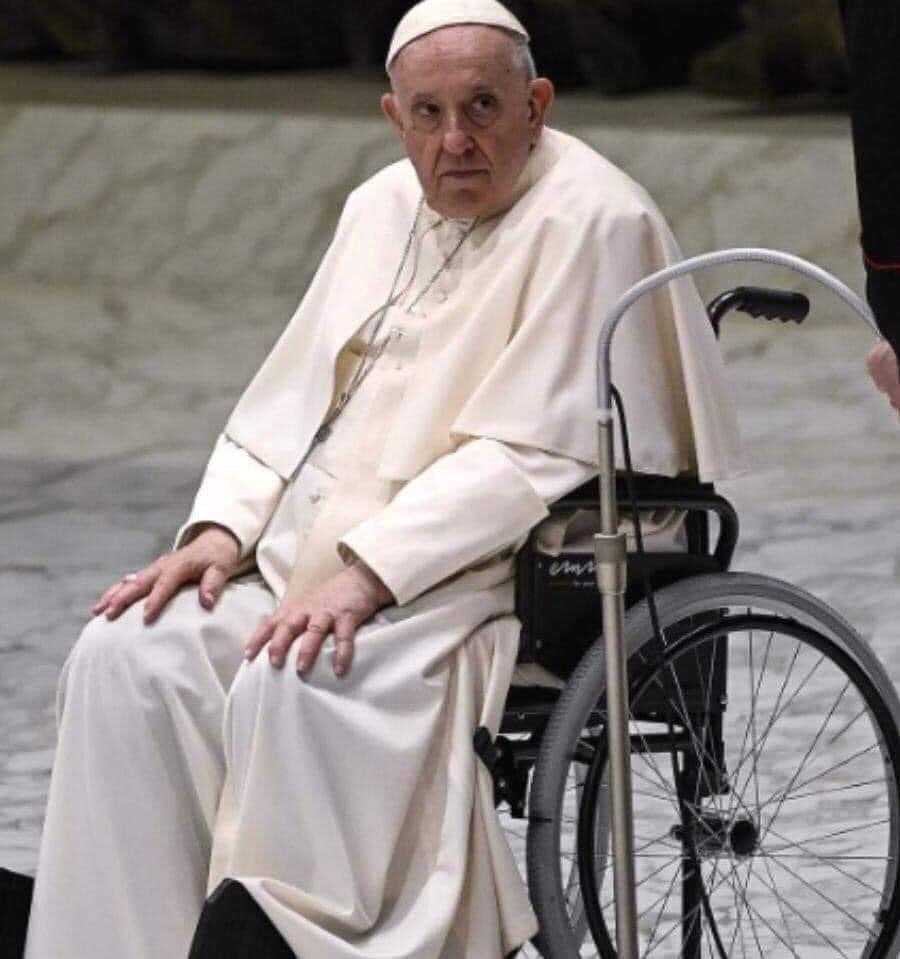
As I was thinking about all of this I came across this picture of Pope Francis, and it hit me again. My story like the paralytic’s story are not about the helpees but the Helper. If a great man like Pope Francis can accept the help of others who am I to think I am somehow better than that. The truth is we are all dependent on the help of others. It may be emotional support or sometimes physically taking us to the spiritual or physical help we need. It may be realizing we are dependent on the farmers, truckers, and grocers who get food on the shelf for us to purchase.

The secret to it all is being humble enough to recognize and ask for whatever help we happen to need at any given point in life. We all come into this life totally dependent on others to nurture, protect, and care for our needs for several years, and the cycle of life means that most of us will end up pretty much in the same need for caregivers at the end of this life. Our choice is how humbly and graciously we accept that care.

Feeding the Wolves

A familiar Native American legend has been on my mind a lot recently. It’s the one about two wolves that reside in each human. One wolf is fear and the other is love. The two wolves are in constant struggle with each other to see which will control our lives. When the elders are asked which wolf wins the inner battle the answer is “The one you feed.”

I am very concerned that the steady diet of fear being fed to us by political candidates from both parties is so pervasive that the wolf of love in all of us is being starved to death. With all the dark money stoking the flames of fear on every form of media it is very tempting to just throw our hands in the air and surrender.

Dr. Brene Brown describes our situation this way: “In times of uncertainty, it is common for leaders to leverage fear and weaponize it to their advantage…If you can keep people afraid and give them an enemy who is responsible for their fear, you can get people to do just about anything.…when we are managing during times of scarcity or deep uncertainty, it is imperative that we embrace the uncertainty…We need to be available to fact-check the stories that team members may be making up, because in scarcity we invent worse-case scenarios.” 

That reminds me of a definition of fear I learned many years ago — FEAR = False Evidence Appearing Real. We all need to use our best critical thinking to not feed the fear wolf any false information. There are plenty of factual things to fear without adding bogus dishes to our diet.

The Christian church in many ways has been complicit in spreading the bad news of a fear-based theology. The misunderstanding and mistranslation of the Hebrew word “yirah” as “fear” has been used for centuries to try and literally scare the “hell” out of people, or perhaps scare people out of hell would be a better way to put it.

Fear is not a good long-term motivator of desired behavior. It only works when an external authority figure is present to enforce the threat. But fear is a fairly effective way to produce guilt in people, and that guilt technique has been used to control church members, i.e. keep them coming back to church and paying their dues. I have often said that if people really understood the Good News of grace and God’s unconditional love the church would be out of business.

The word yirah in reference to God is better understood as “awe.” We overuse he word “awesome” these days to describe anything from a sunset to a new dress, and it has lost the power of truly standing in awe of the ultimate mystery of the creative force we call God.

If we can get back to praising that Holy Mystery and the unconditional love fed to us every moment of eternity then the wolf of fear doesn’t stand a chance. That’s the life force described in I John: “There is no fear in love, but perfect love casts out fear. For fear has to do with punishment, and whoever fears has not been perfected in love.” (I John 4:18)

Being nurtured by that kind of love makes it possible for humans to obey the great commandments to love God and to love our neighbors. Without that love, we are vulnerable to unscrupulous salespeople, propagandists, and politicians who use fear-inducing rhetoric and imagery to manipulate others into buying or believing what they are promoting.

Our United Methodist District Superintendent, Rev. Tim Bias, recently wrote about the power of words in his monthly newsletter. In there he shared a wonderful story about what feeding the wolf of love looks like at the micro level of interpersonal relationships. I’ve heard the story several times before, but the end of the story still brought tears of joy to my eyes. I share it here in the hope that it will feed your love wolf with the abundance that begs to be shared with others. If we keep the faith and treat everyone we meet, (yes, even our political foes) the way we want to be treated we will make more difference in the world than we will ever know.

“There was a first-year teacher at Saint Mary’s School in Morris, Minnesota. She said she had 34 students who were all dear to her. But one student stood out. His name was Mark. She said he was one in a million. He was very neat in appearance with a happy-to-be-alive attitude that made even his occasional mischievousness delightful. There was just one thing about Mark: he talked incessantly.

She had to remind him again and again that talking without permission was not acceptable. Every time she corrected him, he responded, “Thank you for correcting me, Teacher.”

She said, “I didn’t know what to make of it at first. But before long, I became accustomed to hearing it many times a day.”

One morning her patience was growing thin when Mark talked once too often. She said, “I made a first-year teacher mistake. I looked at Mark and said, ‘If you say one more word, I am going to tape your mouth shut!’”

It wasn’t ten seconds later when one of the students blurted out, “Mark is talking again, Teacher.”  I hadn’t asked any of the students to help me watch Mark, but since I had stated the punishment in front of the class, I had to act on it.

I remember the scene as if it had occurred this morning. I walked to my desk, very deliberately opened my drawer and took out a roll of masking tape. Without saying a word, I proceeded to Mark’s desk, tore off two pieces of tape, and made a big X with them over his mouth. I then returned to the front of the room. As I glanced at Mark to see how he was doing, he winked at me. That did it! I started laughing. The class cheered as I walked back to Mark’s desk, removed the tape, and shrugged my shoulders.

His first words were, “Thank you for correcting me, Teacher.”

At the end of the year, Mark went on to fourth grade. The teacher eventually moved on to teach junior-high math. Several years passed. As Mark entered the ninth grade, Mark and the teacher met again.

She said Mark was more handsome than ever and just as polite. Since he had to listen carefully to the instruction on the “new math,” he did not talk as much. One Friday, things just didn’t feel right. The class had worked hard on a new concept all week, and the teacher sensed that the students were frowning, frustrated with themselves, and edgy with one another.

To stop the crankiness, she asked the students to put their books away and to take out two sheets of notebook paper. She then asked them to list the names of the other students in the room on their paper, leaving a space between each name. Then she asked them to think of the nicest thing they could say about each of their classmates and write it down.

It took the remainder of the class period to finish their assignment. As the students left the room, each one handed her their papers. Mark said, “Thank you for teaching me today, Teacher. Have a good weekend.”   That Saturday, she wrote down the name of each student on a separate sheet of paper and she listed what everyone else had said about that individual.

On Monday, at the beginning of the class, she gave each student his or her list. Before long, the entire class was smiling. She listened as the students said things like, “Really? I never knew that meant anything to anyone!”  “I didn’t know others liked me so much.” After a few minutes, the class went back to studying math. No one mentioned those papers in class again.

It was several years later that the teacher learned that Mark had been killed in Vietnam. She had gotten word that Mark’s family wanted her to attend his funeral. At the funeral she watched and listened. One of the soldiers who acted as pallbearer came up to her and asked, “Were you Mark’s math teacher?” She nodded. He said, “Mark talked a lot about you.”

After the funeral, most of Mark’s former classmates headed to Chuck’s farmhouse for lunch. The teacher was invited to come by. Mark’s mother and father wanted to speak with her. When she arrived, they met her at her car.

“We want to show you something,” his father said, taking a wallet out of his pocket. “They found this on Mark when he was killed. We thought you might recognize it.” Opening the billfold, he carefully removed two worn pieces of notebook paper that had obviously been taped, folded and refolded many times. She knew what it was without looking at the paper.

Mark’s mother said, “Thank you so much for doing that. As you can see, Mark treasured it.”

Mark’s classmates started to gather around. Charlie smiled rather sheepishly and said, “I still have my list. I keep it in the top drawer of my desk at home.”

Chuck’s wife said, “Chuck asked me to put his in our wedding album. I have mine too,”

Marilyn said.  “It’s in my diary.” Then Vicki reached into her pocketbook, took out her wallet and showed her worn and frazzled list to the group. “I carry this with me at all times. I take it out and look at it every time I need encouragement. We all saved our lists.””

[Story adapted an article in The Reader’s Digest written by Sister Helen Mrosla, a Franciscan nun and the teacher in the story. The story first appeared in the Topeka Capitol-Journal in 1998.]

Mid-Year Reflections on Gratitude

Having just passed the mid-point of 2023 this seems like a good time to reflect back on goals and intentions I had for this year when it was in its infancy. Among the therapeutic values of blogging or journaling is the ability to look back at what I was thinking and writing about at some point in the past. When I did that recently I was reminded that a key goal I had for myself in January was to practice gratitude.

I must confess I have not done well with that goal and had mostly forgotten about it, as often happens with New Year’s resolutions. Rereading the two posts I wrote about practicing gratitude has been a wonderful reminder of several really good ideas from other people that I wrote about there, including my mentor Dr. Bill Brown, Robert Fulghum, dear friends Jean and Katy Wright, Dr. Brene Brown, Kate Bowler, and Kelly Corrigan. (I am quite proud of the two posts I wrote back in January and really grateful for all the wisdom I borrowed from those friends and scholars.)

So the question now is how do I stay focused on that wisdom and not let it slip again into that vast pool of great ideas I enjoy pondering but fail to integrate into my daily life? If I had a magic potion to make that happen I would gladly share it, but as I said in January gratitude like any skill requires the hard work of practice. Wishing doesn’t make it so or I would be the most grateful, joyful person around, and my dear wife can tell you that unfortunately is not the case.

Physical exercise is a good analogy for regular practice. During the pandemic I started an exercise program of swimming 2-3 times per week, and worked my way up to being able to swim a half mile. I kept that routine up until some health issues and travel caused me to get out of the habit earlier this year. I have just gotten back in the pool a few times in the last 3 weeks, including a 350 yard swim today. Swimming is great exercise because it works the whole body, is aerobic, and provides a quiet, meditative respite from other cares and concerns. But having said that, I must add that I am totally wiped out for the rest of the day after just 18 minutes in the pool. It would be easy to get discouraged about that, but I know from experience it takes time to rebuild my endurance.

Gratitude practice is a similar challenge. It requires the discipline and focus to consciously practice paying attention to all the blessings I am privileged to enjoy. I can choose to take time during the day, especially first thing in the morning and at bedtime, to call to mind what I am truly grateful for, even if I forget. I can give thanks for the beautiful home and yard I am privileged to occupy and not just complain about the work and expense it takes to do so. I can choose to be grateful for all the activities I can still do instead of regretting the ones I have had to give up. I can remind myself how fortunate I am to live in a peaceful place free from violence and war and so far immune from the worst ravages of extreme weather caused by climate change.

But this is not an either-or Pollyanna approach to life that ignores the injustices and suffering of others my community or world. I have used the word “privileged” several times above intentionally. I need to remind myself that I am truly privileged in so many ways largely to the accident of birth. And with that privilege comes the responsibility to use that privilege to do whatever I can to do what the prophet Micah tells us God requires of all of us, “To do justice, love mercy, and to walk humbly (gratefully) with God.”

From Worst to Best: Kindness of Strangers

We always share a good news story as part of our prayer time at Northwest UMC to remind us that amidst all the bad news in our broken world there are many acts of kindness being done every day that don’t make headlines. My wife and I recently returned from a two-week trip to Italy and Greece, and as soon as we returned I sent a message to our pastors that I had a personal good news story from our trip that I wanted to share with the congregation. This is that story.

Our trip was wonderful. Everything worked like clockwork. No delays. We were never terribly lost anywhere, and the weather was wonderful. We were in Athens, Greece the day before our return flight to the States. We spent the morning sightseeing and ate lunch at a quaint hole-in-the-wall seafood restaurant; and THEN came the low point of our whole trip – I realized when getting ready to pay for lunch that I had lost my wallet somewhere that morning. We thought it might have been on one of the hop-on-hop-off buses we rode that morning; so we called that company, and they said no one had turned it in, but we could call back later and check.

It took us 20 minutes or more of panic to figure out what to do next and find a place quiet enough that we could hear. I have trouble hearing so Diana did most of the phone talking. Before we started calling credit card companies I got a call from our hotel answered by Diana. I didn’t realize who had called and was confused about how our hotel got involved, but they said someone had found my wallet and called them. They gave us number for a man named Mario.

I was overwhelmed with relief. But we were not home free quite yet. When Diana called Mario she quickly found out he spoke not a word of English; so we could not communicate. Diana asked several people passing by on the street if they spoke Greek and none did – but one young man suggested going into a local market to see if some one there could help us. The first young woman we asked could not speak English, but she got her manager who took my phone and spoke with Mario. She said he would take the wallet to our hotel in about 20 minutes.

It was then I realized I had the hotel room key card in my billfold and that is how he knew to call them. We got a taxi to take us to our hotel, but it was now rush hour on Friday afternoon and traffic was terrible. It seemed to take us forever and when we did arrive, Mario had not arrived and my heart sank again. The report at the hotel was that Mario found the wallet in the national park near our hotel. I had sat on a low bench there and even though my pocket has a Velcro cover on it, the wallet must have fallen out.

Mario called my phone again just then, and someone at the hotel desk served as our interpreter this time, talked to him and said he was on his way. He showed up very soon with his whole family with him. He told a doorman at the hotel that the same thing had happened to them before. That was why they went out of their way to make sure we got my wallet back.

When he handed me the wallet my heart sank again. All of my cash was gone. Someone had gotten to the wallet before Mario, but the good news is all of my credit cards, insurance cards, driver’s license, etc. were all there. I lost about $80 in cash but was so relieved to have every thing else back I didn’t really care. I was going to offer Mario a reward but had no cash to do so. He didn’t seem to expect one. I was very very lucky these total strangers took all that time and trouble to find me and so grateful to all the people who helped us overcome the language barrier and connect us. What could have ruined our trip turned into a celebration of basic human kindness and goodness.

Diana and I did our best without being able to speak Greek to tell Mario, his wife and two daughters how grateful we were. In all the emotion of the moment I forgot to take a picture of Mario and his family, something I would love to have; but trust me, we will never forget those kind new friends we made in Greece.

Pentecost/Memorial Day Prayer

O Holy Spirit of wind and flame, here we are to worship on this intersection of Pentecost and Memorial Day weekend.  As always our prayer is for your Holy Spirit to breathe life into all we do. As we set aside time this weekend to honor the memories of fallen heroines and heroes we give thanks for our inalienable freedoms, even as we also engage in the continuous work of preserving and extending basic human rights to all of your children.  On this holiday when we ponder the awful cost of wars past and present, we pray for your vision of peace and justice to become at last a reality in this broken world.

For many of us this weekend is also a time to remember loved ones who are in the great cloud of witnesses that surround us.  Memories are like the wind that blows where it will, sometimes when least expected a word or song triggers a recollection that tugs at our hearts or brings a warm glow to our souls or a tear to our eye.  Other times we get smacked by regrets of things undone or questions we failed to ask of those who can no longer share their experience and wisdom.

We give thanks for time this weekend with family and friends, for cookouts and re-creation, for new memories made and traditions passed from one generation to the next.  We are grateful for technology that can bridge miles of separation and for those moments of quiet reflection that span the divide between this life and the next.  

For many this is a time of transition as a school year ends and the more relaxed season of summer begins.  We give you heartfelt thanks for those who educate our children.  May this summer season be for all of us a time of renewal and refreshment, a time for the inner child in all of us to play, to star gaze and enjoy the beauty of nature, a time for more being and less doing; a time of Sabbath rest and meditation upon those people and values too precious for any price.  

And God, some of us are anxious about the possibility of economic trouble looming in our nation’s capital.  Please guide the leaders of both parties that they may reach an agreement that is fair and just for all, especially for those who can least afford a financial crisis.  

Bless our time of worship, O Gracious One. May it be a time of sharing in your Kingdom where we recognize that we dwell in you and you in us; that the circle of life is unbroken when we surrender all we have and all we are in service to our Lord and Savior, your beloved Son who taught us the prayer we share with one voice…..

Northwest UMC, Columbus, OH, May 28, 2023