Reckless Love of Self, Ephesians 2:1-10

Before Lebron James announced his second departure from the Cleveland Cavalier one of the biggest sports stories in Cleveland was all about a basketball shot that was never taken. In game one of the NBA finals last month the Cavs lost a chance to win a critical game against the Golden State Warriors because J.R. Smith held the ball in the closing seconds of the game instead of shooting what could have been the game-winning shot. It appeared that Smith was confused, thinking the Cavs were ahead when in fact the score was tied, and he heard about it from irate sports fans.

Bob Oller, a sports writer for the Columbus Dispatch, took an interesting approach to that story. He went to one of the most admired sports heroes in Buckeye country, the only two-time Heisman Trophy winner and legendary Ohio State running back Archie Griffin. To quote Oller’s article, “Archie knows what it means to extend grace and receive mercy. Arch fumbled his first carry in his first game at Ohio State. It happens. Woody Hayes gave Griffin another chance and he made history with it. Archie also recalled another more glaring error he made when he fumbled a kick off on football’s biggest stage, the Super Bowl.” Archie’s take on JR Smith’s blunder: “It appears he lost track of the specifics of the situation….It’s a human mistake.”

Most of us don’t make our mistakes on national TV, but we all make them. What is something you regret that you wish you could undo? Words spoken in anger? Being self-absorbed with a problem and failing to notice the pain of a friend or loved one? Being distracted while driving and causing an accident or nearly doing so? As someone said recently, doing bad things doesn’t make us bad people, it makes us human.

In this sermon series we’re considering different aspects of love. Last week Pastor Chris talked about the first part of the great commandment – to love God with all one’s heart, soul, mind and strength. And most of us know the second part of that commandment which is to love your neighbor as yourself. We’re going to deal with the neighbor part of that verse in coming weeks, but today I want to focus on those final two words in the great commandment, “as yourself.” We often put so much attention on love of God and neighbor that we lose sight of those final two words that are a critical prerequisite to doing the other two.

To love anyone else as we love ourselves obviously means we have to first love ourselves, and that may be the hardest part of this whole deal. Loving yourself is hard for several reasons: 1) we are often taught directly or indirectly that it’s not cool to boast or brag about ourselves, that we should be humble; and often we get carried away with that because 2) we alone know the whole truth about all of our own dirty laundry. I believe it was Lincoln who said, “You can fool all the people some of the time, and some of the people all the time, but you cannot fool all the people all the time.”

That may be true, but even more true is the fact that you can’t fool God or yourself any of the time. No matter how good we are at hiding our faults from others, deep down our less desirable qualities are always with us like a perpetual bad hair day. Yes, we can rationalize or talk ourselves into doing something we know is not right, but deep down we still know it’s wrong and have to live with the guilt.

One of the biggest barriers to loving ourselves is perfectionism. Most of us don’t expect perfection from other people. We’re willing to cut them some slack, especially if we take time to consider that jerk who cuts us off on the freeway may be hurrying to get to a family emergency, or that rude clerk at the store is worried about her daughter who has run away from home. We know other people are just human, but why is it we often hold ourselves to a higher standard? I read a great line in a murder mystery the other day. The heroine of the story was beating herself up because she got taken in by a bad guy, and an old wise neighbor gave her this great advice. He said, “If I cried over every mistake I made I’d have drowned by now.”

Great advice, but part of the reason we have trouble loving ourselves is because we’ve got this accumulation of bad thoughts and behavior that seems to compound like credit card debt the longer we’re alive. And sometimes the church contributes to the guilt. I often joke that without guilt the church would be out of business. I may have borrowed that idea from the comedian, whose name I can’t remember, who joked about a church called “Our Lady of Perpetual Guilt.” But in all seriousness recklessly loving ourselves doesn’t mean excusing or sweeping our mistakes under the rug. Reckless love means embracing the good, bad and ugly, not just in others but first in ourselves, and that’s not easy to do.

The hard cold truth is that there is an evil streak in human nature. If we look honestly at the violence and suffering humans inflict on one another we have to admit it. Listen to what the writer of Ephesians says in the first part of chapter 2 that we read earlier: “You were dead through the trespasses and sins in which you once lived, following the course of this world, following the spirit that is now at work among those who are disobedient. All of us once lived among them in the passions of our flesh, and we were by nature children of wrath, like everyone else.”

“You were dead through the trespasses and sins in which you once lived… we were by nature children of wrath.” Those are harsh words to swallow and unfortunately they are the only words some people ever hear from the church. As Frederick Buechner puts it, “The Gospel is bad news before it’s good news.” And because some Christians who don’t love themselves get their jollies beating other people up with the bad news many folks don’t stick around long enough to hear the good news. And can you blame them?

A few weeks back Pastor Mebane preached a very good sermon on integrity and used the analogy from the game of golf about the honesty it takes to call a penalty on yourself. I was sitting up here that day and if you noticed I was squirming a little it was because she was getting too close to home. Anybody else feel that way, or was it just me that got my toes stepped on? Sometimes the truth hurts like when I look in the mirror expecting to see Brad Pitt and this old geezer keeps looking back at me.

I am old enough to remember a couple of previous versions of the United Methodist hymnal, and one thing I remember was that the old communion ritual had a prayer of confession that said, “We acknowledge and bewail our manifold sins and wickedness, which we, from time to time, most grievously have committed, by thought, word and deed, against thy Divine Majesty.” How’s that for a marketing strategy to attract folks to come to church? I can see the Facebook invitation now, “Come to Northwest this Sunday and bewail your manifold sins and wickedness!” I much prefer Jesus invitation, “Come to me you who are tired and carrying heavy burdens, and I will give you rest.”

Another thing I remember from the days when we used that old communion liturgy is that attendance on communion Sundays in many churches was always lower than average. I have no scientific evidence for why but I have a sneaking suspicion that people stayed away to avoid being saddled with a bigger load of guilt than they already had. Now it’s true that if you made it through the confession there was the Good News of salvation offered in the Sacrament itself, but I fear that once the guilt trip was triggered people didn’t hear the Good News of forgiveness. Out of curiosity I asked the office staff to give me the attendance numbers for the last 18 months here at Northwest. I was pleased to learn that over that period our average attendance on communion Sundays is almost identical to non-communion Sundays. I attribute that to the kinder, gentler language we use in celebrating communion that stresses how all are welcome at the Lord’s Table. And yes, ALL does mean ALL.

Please don’t misunderstand; I am not saying we don’t need confession as part of worship. We all have plenty to repent of as individuals and as a society, but we have to be very careful to be sure the Good News of the Gospel doesn’t get drowned out by the bad news. We get plenty of bad news all week and in order to recklessly and completely love ourselves we need to not only hear about the radical redeeming love of God, we need to feel it and experience it.

I John chapter 1 is a perfect example of the whole Gospel. Verse 8 says, “If we say that we have no sin, we deceive ourselves, and the truth is not in us.” If we stop there loving ourselves is pretty hard to do. But the very next verse says, “If we confess our sins, God who is faithful and just will forgive us our sins and cleanse us from all unrighteousness.” Today’s text from Ephesians says the same thing. Once it faces squarely the evil streak in all humans it shows us the way to self-love. Beginning at verse 4 it says, “But God, who is rich in mercy, out of the great love with which he loved us even when we were dead through our trespasses, made us alive together with Christ and raised us up with him, For by grace you have been saved through faith, and this is not your own doing; it is the gift of God— not the result of works, so that no one may boast.”

We can recklessly love ourselves, not in a boastful way, only because of the reckless love of God that saves us from our sin through freely given grace. It’s a love so reckless that Christ is willing to die a horrible death to show us the depth of God’s love; a reckless love that is like a sower who throws the seeds of grace everywhere, not just in “good” soil; a reckless love that runs down a dusty road to meet and embrace every prodigal child who repents and returns home.
In these days when the evil viruses of racism and nationalism and tribalism seem to be spreading like a plague it is easy to lose hope and to fear what the future holds. But fear is the lack of love, a lack of trust in God’s grace. If we trust God completely what have we to fear? As the great hymn “A Mighty Fortress is Our God” says, “The body they may kill, God’s truth abideth still,” and that truth is deep unconditional love.
Set free from fear by God’s grace we can stand up and speak up for truth and justice. We can worry less about what others think of us and do what’s right and instead of what’s popular. When we speak and live the truth we have nothing to fear because God has our back.

Think of the saints throughout our faith history who loved themselves enough to boldly love others. I love the women in the Moses story who defied Pharaoh’s authority and conspired to save Moses’ life – the midwives who refused to kill the Hebrew baby boys at birth, Moses’ mother and sister who put him in the bulrushes where Pharaoh’s own daughter would rescue and raise him. Without their courage Moses would never have grown up to lead his people out of slavery.

Where does love of self come from? Or if we’re born with it, what happens to it? One great answer to both those questions is captured in the words of a poem by Dorothy Law Nolte. It’s called “Children Learn What They Live.” Her words should be posted in every nursery and classroom. In part she says:
“If a child lives with criticism, she learns to condemn.
If a child lives with fear, he learns to be apprehensive.
If a child lives with shame, she learns to feel guilty. (That’s the bad news, but the poem goes on…)

If a child lives with encouragement, she learns to be confident.
If a child lives with acceptance, he learns to love.
If a child lives with approval, she learns to like herself.

Kids are so impressionable that the golden rule is doubly important for them and all of us whenever we interact with them. We can all help instill a healthy love of self by treating the little ones as we want to be treated, with patience, forgiveness and reckless love.

It occurred to me while working on this sermon that reckless love of ourselves boils down to applying the Golden Rule to how we treat ourselves. If I treat myself badly by living with self-criticism, fear and shame, then I’m going to treat others the same way. What if we simply begin by treating ourselves as we want others to treat us?

We can begin to do that by changing the way we do something that all of us do on a daily basis. Who do you see when you look in the mirror, when you really look? Do you see yourself flawed and imperfect physically or morally? Or do you see a child of God saved by grace, flaws and all, set free to serve God and others by the reckless love of God and self? When you look in the mirror from now on don’t compare yourself to people society tells us are beautiful or special, but see yourself through God’s eyes.

Treat yourself with kindness; treat yourself as you want others to treat you. Be like Martin Luther who it is said each day when he bathed rebatptised himself and reminded himself he was a beloved child of God, one who in the words of Ephesians is “created in Christ Jesus for good works, which God prepared beforehand to be our way of life.”

Reckless love is really quite simple: Love God and Love your neighbor as yourself.”

It all starts with loving that child of God we see in the mirror every day. Amen

Pastoral Prayer July 1

O God of reckless love, we your children come again to drink of your life-giving spirit. We are worn down by the heat and the steady drumbeat of conflict and division in our world. Speak words of life to us in your still small voice. Renew in us the vision you have given us of a world where liberty and justice for all are realities and not just ideals. As you inspired our ancestors to risk their very lives for that dream of freedom, let our celebration of independence be a time of renewal for all who follow him who is the truth that sets us free.

Let the spectacle of fireworks not only fill us with oohs and ahs in their moment of brilliance, but let them reverberate in our hearts to energize us to be the change we want to see; to be agents of compassion and civility in our daily relationships; to build bridges over partisan divides; to brighten our little corner of the world with random acts of kindness.

As we ring the bells of freedom let us also hammer out justice all over our land. We pray for families that are divided by strife, by politics, by geographic or emotional distance. We pray for military families separated by service to our country; for health care workers, first responders, and others for whom July 4th is just another work day. We pray for the families shattered by the shooting in Annapolis and for those broken by terminal illness, dementia, addiction or grief.

Yes, we’re here, loving God, hungry for love, for good news, for community; for all those things Jesus represents for us; for the things we find in bread and cup; in every child touched by Vacation Bible School; in every brown bag lunch packed and delivered with loving hands; in every smile and hug we share with those here today. We praise and thank you for the many signs of love you give us and pray for ears and eyes to recognize those signs even in a broken world. We dare to live as Easter people with resurrection in our hearts because of the one who taught us to pray……

Like a Fatherless Child

To paraphrase an old spiritual, “Sometimes I feel like a fatherless child.” Today is my first father’s day as an orphan. My dad died 4 months ago, and I didn’t expect to feel the loss today as much as I do. My dad and I were not very close, and his last few years were not conducive to meaningful conversation. Fortunately I made a concerted effort in recent years to forgive him for the things I resented about his parenting; and we were on good terms before he died. But there is still emptiness in my heart today. He’s not where I can visit with him or call him and that hurts.

If I feel that loneliness as a 71 year-old reasonably stable adult, I can’t imagine what the immigrant kids being held by our government away from their parents in a strange country and place they’ve never seen before are feeling. It breaks my heart, and so does the legalistic mindset that says, “You do the crime, you do the time.” Yes, at times that strategy is necessary, but these kids are innocent. They didn’t come here on their own. Many are here because their parents in desperation risked arrest to flee for their lives from danger in their home countries. They threw themselves on the mercy of our country much as immigrants have done for centuries, only this time the quality of mercy has been strained to the breaking point.

The legalistic response from the current administration and especially from (I hate to admit) my fellow United Methodist Jeff Sessions reminds me of the Scribes and Pharisees who wanted to throw the book at Jesus for healing someone on the Sabbath. Yes, Jesus broke the law because he knew compassion and human decency trump the law at times. You don’t tell a person begging for healing, “Sorry, not on the Sabbath.” As Jesus said, “The Sabbath was made for people, not people for the Sabbath.”

So what do we do now? Christians across the country and world have raised a hue and cry of righteous indignation, but so far the Republican President and Congress have been unmoved. Such desperate times call for desperate action. The damage being done to these children cannot go on. So here’s my suggestion to the Democratic leadership in Congress. Pay the ransom. Give the president what he wants. Pay for the stupid wall. The billions of dollars are a huge price to pay, but how do you put a price on the well-being of all the Dreamers and other children being held hostage? Pay the ransom for the sake of the fatherless and motherless kids. And then take the reins of government back in November or in 2020 and pull the funding for the worthless wall. It’s getting perilously late to save our democracy, but if a new birth of compassion is restored by the plight of these children it may be worth it.

Father’s Day Pastoral Prayer

Heavenly Father, we your prodigal children humbly come to you in prayer seeking forgiveness and guidance for all the need in our world. We lift up our joys and concerns written on these prayer cards as well as those we hold close to our hearts. We praise you for giving us a high standard of what fatherhood can be – a generous heart that allows children freedom to learn without sheltering us from the consequences of bad decisions. And you know we have made many. But we also know that the welcome mat is always out and your door is never locked to any who repent and return to you. We are here because we have felt your grace and radical hospitality and strive to offer the same to any and all who need love and compassion.

We pray for all fathers today here and in heaven with you. We give thanks where the bonds of love are strong in families, even as we pray for those where relationships are broken or strained. We know life is not always kind or fair. Help us celebrate the memories of good times between dads and kids, but also help us to let go of pain, forgive generously, knowing that we only have today – we cannot change the past. But with your help we can write a future worthy of Jesus who was so close he called you Abba which means “Daddy.”

In your family O God we are all brothers and sisters, no matter our race, gender, orientation or nationality. Help us all strive to emulate your unconditional love for everyone as if they are our own children, our own fathers and mothers.

And on this Father’s Day we pray for these members of our mission team who are leaving fathers and children behind to go and be the hands and feet of Christ to our sisters and brothers in Clendenin, West Virginia. We send this team as ambassadors from the Northwest branch of your family. We ask your blessing on them as they travel and work with those recovering from the terrible flood of 2016. They will offer their labor and their love, and we pray that hearts on both sides of the partnership will blossom with new relationships and a closer bond of love with Jesus Christ, the one who calls you Daddy, and the one who taught us to pray.

Flags, Idols and Outrage Burnout

Because life has been busier than usual for me the last few weeks I have not posted anything here. I know, you conservative friends have been relieved, but it doesn’t mean I haven’t been reflecting on the myriad of news events in our broken world. I’ve been busy in part because my dear wife had rotator cuff surgery four weeks ago and has been unable to use her right/dominant hand and arm. I’m glad to be her “right hand man,” and I have a whole new appreciation for all she does and for the loving ministry of caregivers everywhere. She’s still got a few more weeks in her sling, but we are grateful that she’s recovering very well.

The other reason I’ve not written was something I couldn’t identify until recently. You know the feeling you get when you’ve got something wrong but you’re not sure what, and how it helps to get it diagnosed and have a name for it? Well I heard someone on NPR last week who gave a name to what I’ve been feeling about the current political malaise in our country and world. She called it “outrage burnout.” There is such a string of astonishing unjust and stupid actions taken by the President, his Attorney General, his cadre of crazy lawyers, ICE, etc. that before you can respond to one outrage there’s two or three more. I’m convinced it’s a very clever political strategy to simply wear down the opposition before the midterm elections. So with that caveat, here’s a post I started a week or so ago while waiting for my wife at a Doctor’s appointment. You will notice it is a bit dated but I believe it is still relevant enough to be worth your time.

When I was ordained a United Methodist pastor 49 years ago this month one of the traditional questions the bishop asked me and my fellow ordinands was “Are you going on to perfection?” We dutifully, if suppressing a chuckle, gave the acceptable answer which is “yes.” If asked that now in this penultimate stage of my life I’d have to say “Probably not!” The point of that question is that like any milestone event in life, e.g. graduation, marriage, bat mitzvah, ordination is just that, a milestone on a long journey and not a destination. It is also there as a not-so-subtle reminder that all of us, clergy alike and maybe especially clergy are FHB’s – fallible human beings standing in the need of God’s grace.

Since that day in 1969 I have learned many things about my own fallibility and the dark side of human nature that have convinced me beyond a shadow of a doubt that “perfection” is not achievable in this life—not even close.
In fact, one of the biggest issues I’m dealing with in my 72nd year of life is dismay that humankind seems to be moving further from perfection at an alarming rate. For most of my adult life I have been comforted and inspired by Dr. Martin Luther King Jr’s statement that “The moral arc of the universe is long, but it bends toward justice.” Lately however I find myself questioning which way that arc is bending. My biggest regret about my ministry is that both my church and the world seem even more divided and imperfect now than they did 50 years ago.

I will spare all of us the litany of evil and depressing events that bombard us daily like a biblical plague of locusts. It is hard to decide which of the seven deadly sins is most prevalent on any given day. But for the sake of argument let’s just tackle the first two the Ten Commandments. The top two of the Decalogue can be summarized: 1) Have no other gods but Yahweh, and 2) Worship no idols. I am thinking of those two just now because of the “to kneel or not to kneel” debate going on between NFL football players, NFL owners, and President Trump.
The NFL recently, in my opinion, violated the first amendment rights of their predominantly black players by threatening to fine anyone for not standing during the national anthem. President Trump raised the ante by harkening back to the good old “America love it or leave it” days of the 1960’s anti-war protests to question if anyone defying the NFL rule even belongs in this country! Do you suppose he will also deport all the Amish, Mennonite and Jehovah Witnesses who also refuse to bow down to any empire’s graven image? Those groups have been exercising their right to freedom of expression for decades, but then again they’re white so that must make a difference.

The Supreme Court ruled in the middle of World War II no less that Americans have the right not to stand for the national anthem. Why does it matter? Because God and God’s values of justice and equality for all of humankind trump, pun intended, any human law or allegiance. That’s what the “under” means in “One nation under God.” And by the way all national laws of any nation are human laws. For a more detailed discussion of what Professor Robert Jewett calls “zealous nationalism” vs. “prophetic realism” see my post on “Biblical Politics,” Nov. 5, 2012.
The flag controversy began as a protest against police using excessive and too often fatal force, against black people, especially those who are unarmed. That’s a legitimate justice issue and needs to be addressed in any and all peaceful means; and kneeling players succeeded in bringing attention to that cause. But President Trump and the NFL have misconstrued their protest by trying to make it about patriotism and respect for the military. Intentionally or not that is a diversionary tactic to avoid the important issue of racial justice, the central moral issue of all of American history.

When a flag or any symbol becomes more important than the divine issues of truth and justice it has become an idol. Whenever loyalty to country or party supersedes loyalty to truth we are worshipping a false god. When I was a Boy Scout many decades ago there was a badge called “God and Country.” I don’t know if there is such an award in scouting now, but I hope not. That title equates God and Country as if the two are synonymous. They are not. Every nation, tribe, race, organization or group of FHB’s is by definition imperfect–in other words needs to always be “going on to perfection.” We the people of the USA have not and will never “arrive,” and therefore always are in need of positive and constructive criticism. That is what the first amendment so wisely is intended to protect and why it’s number one.

As for the NFL, let’s just say I’ll have more free time this fall on Sundays and Monday nights as I exercise my freedom to boycott their ill-advised rule.

P.S. As I was writing this my wife asked me a very good question about freedom of expression. This was during Rosanne Barr’s fifteen minutes of fame where her show was cancelled by ABC because she tweeted some racist comments about Valerie Jarett who was a member of the Obama administration. The difference is that Rosanne’s comments were degrading and libelous, defaming the very being of an African American woman. The NFL protest call attention to a social justice issue in order for it to be addressed. Rosanne slandered another human being in the cruelest of racial stereotypes that have no redeeming or critical value (and was a repeat offender of such behavior). Yes, she later apologized, but hateful speech is like the proverbial toothpaste that cannot be put back in the tube once it is expelled. On the other side of the political aisle a few days later Samantha Bee was guilty of using very crude speech about Ivanka Trump, and she was just as wrong and perhaps more so because her comments were not a late night tweet but a scripted pre-taped commentary on her TV show. So far as I know Bee has gotten off with much less punishment than Rosanne, and that is yet another example of how justice and human decency are being eroded by the partisan vitriol polluting the environment we all live in today.

Bottom line is that freedom of e xpre4ssion has never been an absolute right. The over –used example is that no one is allowed to induce panic in a crowded theater by yelling “fire” when there is none. Freedom must be tempered by the higher values of truth and respect for the greater good of others and the community.

The flag debate is not new but an on-going dialogue that will always be going on to perfection, even when it moves one step forward and two back. Never has the need for the balance between individual freedom and communal responsibility been more needed than it is today. The secret is in the first commandment. If we truly put the higher power of being itself that we call God first and foremost in our loyalties and obedience then other issues fall into place and greed, materialism, nationalism, sexism, and racism will not rule our thoughts and actions. Of course humankind has been trying to live up to that high ideal for 4000 years or so. We’re not close to arriving, and that is discouraging; but by the grace of God we continue on the way, even when the goal seems hopeless. For to continue seeking God’s way when all seems hopeless is the very meaning of faith.

May the Fourth

There were lots of Star Wars jokes this week about “May the fourth be with us,” but in a time that seems like a galaxy far far away the fourth of May has a more somber meaning. Forty-eight years ago four students at Kent State University were shot and killed by National Guardsmen sent there to control anti-war protests.
I was a student in 1970 at a liberal seminary 120 miles from Kent. Most of us at the Methodist Theological School in Ohio were opposed to the Viet Nam War; so we felt the pain of that tragedy from a particular point of view. Like many campuses our school was shut down after the shootings. The difference at Methesco, as we called it then, was that classes weren’t cancelled because of student protests. The Administration and faculty did it and called us all together to pray and discuss what we might do to respond to this tragedy and the animosity and anger dividing our nation.

It was a time not much different than our own where America was divided over a war that had dragged on far longer and cost more lives than was acceptable. Two presidents had promised to end the war and failed, and two prominent peace advocates had been assassinated just two years before. The move that set that fatal May day into action was President Nixon’s decision to secretly expand the war by invading Cambodia. Campuses all over the country erupted in violent protests and civic and college leaders at all levels struggled with how to restore order. Tragically people died at Kent State and 10 days later at Jackson State in Mississippi where two were killed and 12 wounded. The latter never received enough publicity. Some say it was racism because those students were black, but whatever the reason the loss of life added to the whole tragedy of that decade.

I want to emphasize that no one I knew blamed the guardsmen for the Kent State deaths. Those young men were about the same age as the protesters, which means they were my age; and I know I would have been scared to death in their shoes. If there’s blame to be had it belongs to President Nixon and Governor Rhoades and the Ohio state leaders who put the guard in that untenable position. But the blame game was of no use, and I’m grateful to my mentors at Methesco who helped us learn that lesson but instead helped us brainstorm more constructive responses.
It’s hard to find silver linings to some clouds, but if there were any benefits from the blood shed on those two campuses one would certainly be that those deaths forced the nation to a deeper examination of why we were in Southeast Asia. I believe May 4, 1970 was a turning point in the court of public opinion that brought our involvement in that war to an end sooner than it would have happened otherwise.

On a personal level that week had a profound impact on me and my ministry. The way our seminary community came together and how we responded put practical flesh and bones on the lessons we had learned academically about the imperative of the church to be engaged in social justice ministry. It was thing to study commandment to “do justice” (Micah 6:8); pleas for “justice (to) roll down like waters, and righteousness like an ever-flowing stream (Amos 5:24); visions of “beating swords into plowshares and spears into pruning hooks…and not learning war anymore” (Isaiah 2:4); or Jesus saying peacemakers are blessed (Matthew 5:9) and warning that “those who live by the sword will die by the sword” (Matthew 26:52) but quite another to apply those idealistic teachings to the nitty gritty of life and death issues.

After a good deal of discussion our seminary community decided on a two-prong approach to that May 4th. Knowing that there was deep division both within the church and the political community about the war we decided to try and address both. The decision was made that a delegation from Methesco would contact a nearby seminary with a much more conservative approach to theological and social issues to see if a dialogue between the two schools could help us both understand the other’s point of view. I was not part of that group so I don’t remember any particulars of what came from that discussion.

The other approach was for a group of us to travel to Washington DC and see if we could meet with Congressional representatives to express our concern and desire for peaceful resolutions of differences both within our nation and in the international community. We were young and poor then and full of energy; so three of us decided to save time and money we would drive straight through that night to DC, meet with whomever we could during the next day and then turn around and drive home the next night. I can’t even imagine doing that today, but it turned out to be one of the best bonding moments of my seminary career. The two guys I shared that 24-hour adventure with are still two of my best friends 48 years later.

We did meet with some representatives but came away feeling those men were much more concerned about protecting campus property and establishing law and order than they were about the human costs of the war or the issues the protesters were trying to raise. That too was a good lesson in patience and practical theology. Change and solutions to complex social issues do not happen overnight. Prophetic social justice ministry requires persistence. The issues change in each generation, but the need for people of faith to engage in relevant, messy, controversial issues never changes. There is always a need for the church to speak truth to power because the haves very rarely are willing to share their power with the have nots.

The three of us who were punchy and sleep-deprived when we completed our 24-hour marathon those many years ago are still active in retirement trying to discern God’s word for our day and trying as best we can to address social justice issues. May the force of truth and justice always be with us.

PEACE-FULL

“In the beginner’s mind there are many possibilities, in the expert’s there are few.” – Shunryu Suzuki-roshi.

There are several versions of this parable, but here’s one I like because of its brevity: “Nan-in, a Japanese master during the Meiji era, received a university professor who came to inquire about Zen.
Nan-in served tea. He poured his visitor’s cup full, and then kept on pouring. The professor watched the overflow until he no longer could restrain himself. “It is overfull. No more will go in!”
Like this cup, Nan-in said, you are full of your own opinions and speculations. How can I show you Zen unless you first empty your cup?”

That story reminds me of a very helpful mantra for meditation I learned when I took an excellent on-line course called “Peace Ambassador Training” sponsored by the Shift Network. The simple three-part meditation is this: “Let me be peaceful; let me be kind; let me accept others as they are.” At first the part of that which gave me the most trouble was the third – accepting others as they are. To apply that to people I just flat out know are wrong is a total struggle for me. (This was especially true since I took the course in early 2016, just as the nasty Presidential election campaigns were turning up their volume.) Come to think of it the 2018 primary campaign is pretty ugly too!

I finally realized two things: that to accept others does not mean agreeing with everything they say or do, and that to accept others without judgment requires that I first need to work on accepting myself. So I modified the third phrase to read “let me accept myself and others as we are.” That’s better semantics, but even harder to do.
That led me to examine the first phrase. As Julie Andrews put it in “The Sound of Music,” “Let’s start at the beginning, a very good place to start.” “Let me be peaceful” seems to be very self-explanatory. It means to act in a peaceful manner, right? But then the meditation goes on to say “let me be kind,” and that seems a bit redundant to me. If I’m acting peacefully wouldn’t I automatically be kind or vice versa? That confused me for several months until I had an insight earlier this year that reminded me of the Zen parable above. To be peaceful means to be full of peace, and if I’m full of anything else, be it judgment, anger, anxiety, fear, lust or any of the other seven deadly sins there’s no room for peace. (See my February 2016 post “Giving up ALGAE for Lent” for a fuller discussion of this.)

The other thing I realized recently is that the key word in “let me be peaceful” is that little word ”be.” To be full of peace is a matter of “being” before it can be translated into “doing.” The doing is really part two of the mantra, “let me be kind.” Even though the verb is the same in both parts I believe kindness is more about actions and peacefulness is more about one’s state of being. That’s why Gandhi said, “There is no way to peace, peace is the way.”

It is only when we are full of peace in the very depths of our being that we can act kindly toward others and accept them regardless of their words or behavior. I also believe this is what Jesus was getting at in the farewell discourse to his disciples when he says, “Peace I leave with you; my peace I give to you. I do not give to you as the world gives. Do not let your hearts be troubled, and do not let them be afraid.” (John 14:27-29) How can Jesus expect his dear friends and closest confidants to not be troubled and afraid when he’s telling them he’s about to be brutally and very publicly executed? They are so afraid they all go into hiding, unable to bear the sight of their Lord and Savior suffering and dying on the cross.

The Judeo-Christian Scriptures are full of examples of both positive and negative examples of those who are full of peace and those who aren’t. Peter can walk on water when he’s full of peace, but when he realizes what he’s doing and let’s fear fill his heart he sinks like a rock. (Matthew 14:28-30) On the other hand, three brave men are able to defy the power of King Nebuchadnezzar when he orders them to bow down to his gods. “Shadrach, Meshach, and Abednego answered the king, “O Nebuchadnezzar, we have no need to present a defense to you in this matter. If our God whom we serve is able to deliver us from the furnace of blazing fire and out of your hand, O king, let him deliver us. But if not, be it known to you, O king, that we will not serve your gods and we will not worship the golden statue that you have set up.” (Daniel 3)

The same is true of post-canonical Christian Church history. Mother Theresa couldn’t have lived and worked in the wretched slums of Calcutta without being full of God’s peace. Joan of Arc could not have faithfully obeyed God even to burning at the stake if she was full of fear. One of the charges of heresy brought against Joan is one all Christians should desire for their epitaph: “It was said, “‘She does not submit herself to the judgment of the Church Militant, or to that of living men, but to God alone.”

That kind of peace does not come from human will alone. It comes only when we are humble enough to empty ourselves of pride and arrogance and allow God to fill us with peace. To that end I’ve found it very useful to employ a shortened version of this mantra whenever I remember to pause in a tough situation and ask God to fill me with peace.

These chaotic times we are living through today again cry out for women and men who are so full of God’s peace that we are able not only to act kindly but faithfully and courageously to defend truth and justice against any and all powers that threaten to fill us with fear. Pardon my irreverence, but I fully expect one of the first questions God will ask me on my judgment day is, “Steve, what are you full of?”

A Doubting Faith: The Children, Mark 10:13-16

Little Johnny was asked to pray at a large family dinner. When he protested that he didn’t know how to pray his father said, “Just pray for your family, friends and neighbors, the poor, etc.” So Johnny prayed: “Dear Lord, thank you for our visitors and their children who finished off all my cookies and ice cream. Bless them so they won’t come again. And this coming Christmas, please send clothes to all those poor ladies on my Daddy’s phone who don’t have any clothes. Amen. Johnny was never asked to pray again, but don’t you just love the honesty of children?

That may not be what Jesus was thinking when he said “whoever does not receive the kingdom of God as a little child will never enter it.” You’ll notice in our text for today Jesus doesn’t ask the kids to speak! But when we think about the qualities children possess that we can learn from isn’t their refreshing honesty one of those? Kids tell it like it is. Today I want to focus on what being like children can teach us about having an honest faith that admits we all have doubts about life’s mysteries – and it’s OK.

Imagination is one of those qualities kids have that we sometimes lose as we grow up. Imagination is powerful – nothing can ever be created until someone imagines what it might look like. Heather Sherrill on our tech team is the theater director for Darby High School, and she shared with me recently some great stats on the value of the arts in education where creative imagination is nourished. Here are just a few of those benefits.
Students involved in music, theater and art are:
• Less likely to drop out of school
• 3 times more likely to earn a bachelor’s degree

• Have better listening and speaking skills
• Are more likely to engage in classroom discussion and public volunteerism
• And are less likely to engage in delinquent behavior

The bad news is that only 28% of public schools in high poverty areas offer theater instruction, and I would add, even in our best schools there is so much emphasis put on testing kids in math and science that important classes in the arts and physical education are cut or eliminated. Math and science are important of course in our high tech global economy, but there needs to be a balance in teaching skills and values that make for informed and competent citizens critical to a democracy. No calculus formula will provide those skills that only a solid education in the humanities offers.

Not all creative ideas that kids have, or adults for that matter, are necessarily good ideas. When my kids were 1 and 4 we moved into a parsonage that actually had two bathrooms – one up and one down. The kids were fascinated by how that plumbing worked; so Joy decided one day to flush her brother’s pacifier down the upstairs toilet and then ran downstairs to see if the binky would miraculously appear in the downstairs commode.

And that spark of imagination doesn’t die at puberty. We attended a performance of Peter Pan last weekend by Worthingway Middle School in Worthington. Our great nephew was in the cast. Do you remember that moment in the story where Tinkerbelle the fairy drinks the poison to keep Peter Pan from drinking it? And the spotlight that represents Tinkerbelle flickers out. But then Peter remembers that fairies live whenever kids believe in them and he asks all the kids in the audience to clap to show they believe. Guess what; even us old kids on Medicare were clapping until Tinkerbelle’s light flickered back to life.

Kids are also full of curiosity – that’s how they learn, and as Pastor Chris reminded us last week a childlike faith does not mean one that has no doubt. Children are full of questions. As we run some pictures of our Northwest Children’s ministries I want to share some insights and comments about childlike qualities from our Children’s ministry team.

When learning about the Creation Story a 5 year old asked “Okay, I get all this, so how did God really create the entire world? Did it just happen like a flash?” And I thought the hard questions from my kids were where babies come from!

During a discussion about being the hands and feet of Jesus Christ and feeding others in need an 8 year old asked, “When will there no longer be hungry people in this world?” Thank God for kids who can still imagine such a world and share their hope with us.

In all kinds of activities we see older kids helping the younger kids. It’s great to see such mentoring happening in our children’s ministry.

During our own version of the Winter Olympics some of the kids were so curious- they had to touch all the supplies beforehand and try it out first. A 5 and 8 year old didn’t want to play hockey or ski at first. Apparently they were not familiar with the sports and decided to complain about it. So the teachers provided coaching and encouragement and a nurturing environment for the kids to trust their team mates and themselves. The children tried and struggled, but they all got to the finish line and scored for their team. Building team work is key for a successful and fun experience- even if we lose the game- there is much appreciation for the game and for one another.

Kids like to be useful; to be significant and make a difference. The NW kids are learning from Bible stories and from the examples of this mission-minded church to be servants and good neighbors by doing things like decorating cards and tying fleece blankets for OSU Star House. The children are creative and love to share their quality artwork with others. Many are artists and they know it too. They have generous hearts and giving spirits. Always willing to share with their neighbors.

The Children’s Garden is such a great learning experience – lessons about patience and teamwork, stewardship for God’s creation, compassion for hungry people, and gratitude for harvest. While Preparing the Children’s Garden one 6 year old commented-“come on already, we need to get these seeds in the ground, time is running, people are hungry. We need more sun.” This was the weekend when we got snow in early April. Can you hear their eagerness!!!

Another example of that was one day while getting ready for Brown Bag Lunches a 9 year old commented, “Wow, we can do this; we need more friends to help. If we could all do our part, more people can eat.” One of the best things about the Brown Bag ministry is that our new friends from the neighborhood are helping and are also getting involved in other church activities,. They feel welcome here at Northwest, and our children are a big part of that hospitality.

Kids live in the moment—they see a problem and they want to address it right now, no appointing a committee to study hunger – just find ways to feed people now. I was much older than these kids when I was working as a youth pastor while in seminary, and one thing I remember from that experience was my Sr. Pastor telling me more than once, “Steve, don’t lose your idealism!” Children have natural idealism and hope – life hasn’t drained it out of them yet, and we all need all the hope we can get. Hope is the antidote for the negative kind of doubt that sometimes keeps us from moving forward, from daring to dream and try.

I was in Westerville on one of the few nice days we’ve had so far this month and had some time before my next appointment. I was near Sharon Woods Metro Park and decided to take a short hike. While there I remembered a scary moment at that park many years ago when my son Matt was maybe 4 or 5. We were riding bikes as a family and he was on his big wheel – remember those? Cool low to the ground kind of a drag racer tricycle. We came to a rather long steep hill on the bike trail and before we could yell for Matt to stop he was flying down that hill heading for a curve at the bottom where there was a wooden bridge across a small creek. If you know big wheels you know they had no brakes! We were sure he was going to crash into the bridge and die, but thank goodness he was a good driver or got lucky and zoomed thru the bridge and coasted to a stop on the other side.

I asked Matt, who now has his own 4 year old if he remembered that incident. He said no, only from hearing us talk about it. But then he went on to say something interesting. He said, “Watching Brady, his son, do things like that is a lot scarier than it was when he was the one doing them.” I forgot to remind Matt about the time he went sledding off the garage roof. Kids are risk takers. They haven’t learned about all the dangers of life yet. That gives parents gray hair, but it is also an important dynamic of faith. Courage comes from trusting your own ability and the basic goodness of life so we can do what’s right instead of just what’s safe.


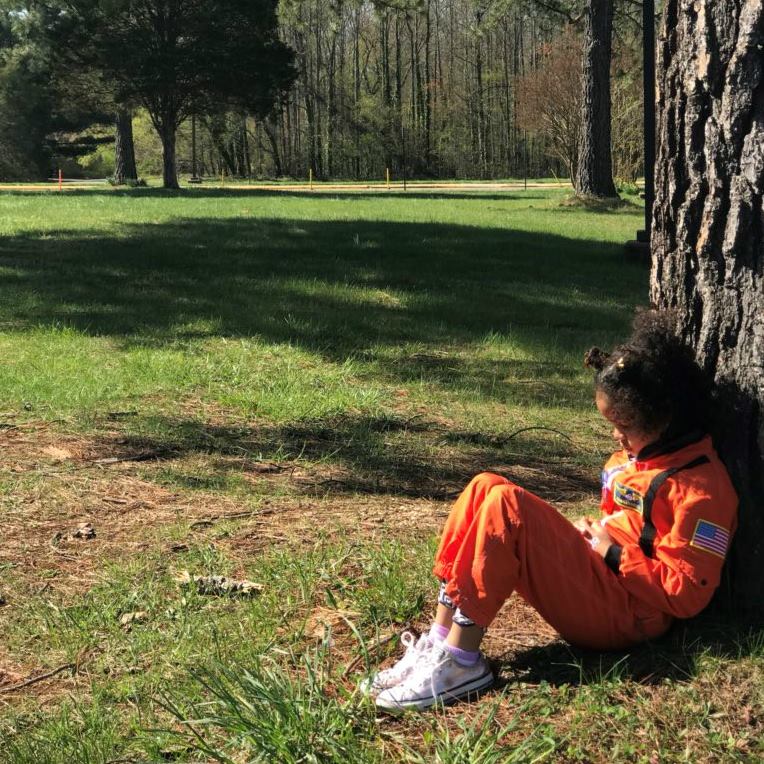
Speaking of risk takers, I came across this picture this week of Havana Chapman-Edwards, a first grader in Alexandria, Virginia who was the lone student at her school to join in the National School Walkout Day on April 20, the 19th anniversary of the shooting at Columbine High School.

Havana’s mom signed her daughter out of school because Havana said she wanted to participate. Her mom says she was crushed to see Havana sitting by herself, but then she became inspired by her daughter for standing up for what she believes in.

Havana told a news reporter that she was inspired by the Parkland High School students who have been pushing politicians to protect kids from school shootings.

For 13 seconds, Havana and her mom sat in silence to honor the 13 people who lost their lives at Columbine. Havana says that she wore her orange astronaut suit because she wants to show the world black girls are strong leaders.
Comedian Bill Murray in an interview with NBC news said this about student protests: “The thing that’s so powerful about students is that, when you haven’t had your idealism broken yet, you’re able to speak from a place that has no confusion [doubt?], where there is a clear set of values. Idealism is a voice that’s inside you, it’s your conscience. That can really deteriorate along the way… and it can become almost dysfunctional, but it’s there. Everyone has it.” I agree and would add that it’s the voice of idealism that children can help us all hear again.

Kids see the world with fresh eyes, unclouded by filters of status or rank. I saw a post recently from a childhood friend about his experience in the Vietnam War, and it reminded me of the great friendship we shared as children and youth. Blaine was one of my best friends. He was raised by his grandmother who I now realize was dirt poor. Their home was in a part of town that I’m ashamed to admit I would probably be uncomfortable to visit today. My family was lower middle class, but compared to the conditions my buddy lived in we were very wealthy. But I didn’t have those filters and lenses to see the world through then. Blaine was just my friend.

My point is that kids don’t come out of the womb with any kind of prejudices – those are acquired. When I was in high school we didn’t talk about racism or classism, even though they were very real in our little town. But we learned important life lessons in more subtle ways. We had an excellent choral music program that produced a popular musical every year. As you all know I can’t sing a lick now and I couldn’t then either, but I got to do the next best thing – I was on the crew that helped produce the shows. The one that I remember most is Rodgers and Hammerstein’s “South Pacific.” It’s set during WWII and centers around two love stories, one between an American nurse and a wealthy French property owner and the other between an America soldier and a Polynesian woman.

The romance and music are great but more important is the underlying story about prejudice and racism that threaten to keep these lovers apart. There is one memorable song called “Carefully Taught” that says “you have to be taught before it’s too late, before you are six, or seven or eight, to hate all the people your relatives hate. You have to be carefully taught.” Those important life lessons about human relationships could not be discussed openly in my school in the early ‘60’s, but by the magic of storytelling and imagination we could vicariously experience their power through those characters.

Finally there’s another really important reason Jesus welcomes and blesses the children that isn’t so obvious to us. We think of children much differently than people did in biblical times. Today we respect and encourage children, and because of that it is easy for us to romanticize this passage. We see cute pictures and all these positive attributes of childhood trust and enthusiasm, but the people of Jesus’ day saw children pretty much in the very opposite way. Children then were powerless, totally dependent liabilities. One commentator describes them as “non-persons.” They were on the very bottom rung of the cultural pecking order of the day.

So when the disciples saw people bringing their unruly, disruptive kids with them when Jesus was trying to teach important kingdom stuff the disciples tried to shoo the kids away. But Jesus says, “Wait a minute folks – don’t you dare chase those kids away. Everybody’s welcome in my kingdom – and that means everybody! The poor, the lepers, the sinners, the lame, and these precious little nobodies.” And you know what else, by welcoming the children Jesus also knew that he was making it possible for their mothers to also crash the old boys club and listen to the good news he came to share.

We’re really excited that we’ve had several new babies born into our church family recently. As I hear tales of sleepless nights and exhausted moms and dads I am reminded that to accept the blessed gift of a child means to becomes that child’s servant. Those helpless little bundles of humanity are totally dependent on someone to provide for their every need. Those who change diapers and wipe noses give up all claims to position or privilege – and that’s exactly how humble we must become to enter into God’s kingdom where all are equal.

Jesus and the disciples saw the same children, but Jesus saw them through the inclusive eyes of love; and that’s exactly how he sees you and me – runny noses, doubts and all, and he hangs out the welcome sign and blesses us and everyone who comes. Amen.

Faith, Doubt and Playing Possum

My brain feels like a whirling dervish this week with all the scandal, intrigue and assorted craziness in the news. I feel like I’m living in a bad soap opera with FBI raids on the President’s lawyer, Speakers of both the US House and the Ohio House stepping down unexpectedly and military strikes on Syria that put us closer to a nuclear showdown with Russia than any time since the Cuban Missile Crisis in 1962.

Maybe I’m a glutton for punishment but I can’t seem to stop watching and reading the news like the proverbial train wreck. I have managed to get engrossed in a couple of good novels as a respite from the 24-hour bad news cycle. One is a book on tape I listen to while driving, James Patterson’s “Woman of God,” and the other on my Nook, Dan Brown’s “Origin.” But of course both of those are full of conflict and profound theological questions about human suffering and human nature itself. And in my spare time I’m wading through a weighty and rather depressing tome entitled “What Are We Doing Here?” by Marilynne Robinson for a book club I’m in.

Mingled in with all that drama has been a personal struggle with guilt. On Wednesday of this week I had the painful task of dispatching a possum whose only offense was making his domicile under our deck. I’ve been trying to trap him or her for a few weeks and until this week had only managed to feed chipmunks who are too small to trip the trap and catch a stray cat. Every morning that the trap was by our deck I was relieved to find it empty, but Wednesday it was fully occupied by a sleeping possum who seemed quite content. It had finished off the apple that I used as bait and unlike the cat seemed quite content and even trusting when I carried him/her to a watery grave in our pond. It would have been much easier on me if she/he had hissed and growled at me, but that is not the way of the possum.

The possum’s capital offense was invading turf that belongs to us – we have a deed–but then I guess possums can’t read; so posting a no trespassing sign would probably not have done any good. Fearing he/she would attract or produce more furry friends that could do damage to the foundation of our house my wife and I felt justified in this dirty deed. I used to take such critters a few miles away and release them, but that is actually against the law of the land and increasingly impossible as urban sprawl takes over more and more habitat for our four-footed friends.

On this second week of Eastertide I couldn’t help theologizing a bit about this experience, and it occurred to me that there is a parallel here between my possum and what we did to Jesus a couple millennia ago. Their offenses were much the same– invading someone else’s space and making them/us uncomfortable. Just as the possum created conflict for me about his/her right and mine to occupy this space on Brock Road, so Jesus created such a degree of discomfort and cognitive dissonance by proclaiming a higher ethical standard of God’s reign that threatened the Jewish and Roman homeowners in Jerusalem that they set a trap for him and executed him on trumped up charges of blasphemy.

The big difference of course where these two tales of death diverge is in their outcome. And no I’m not suggesting Jesus was just playing possum in that tomb for 3 days. He was just as dead as my possum – ask his mother who watched him be nailed to that cross. Ask the centurion who ran a spear into his side to make sure he was dead. Jesus was dead!

But Eastertide is the season of resurrection – even in chilly Ohio where spring has been delayed. I saw a meme on Facebook that said “Mother Nature was late delivering spring because Father Time was driving and refused to stop and ask for directions.” But better late than never we had at least a teaser of spring this week. The daffodils, hyacinths and forsythia are blooming, the crocuses are croaking, and the robins are digging up earthworms in my yard.

I had an hour between two appointments on Thursday, our first warm day; so I went for a walk in one of Columbus’ lovely metro parks. I took exception to a sign that told me the trail I took was 1.1 miles. I know it had to be longer than that because it took me much longer to hike it that it used to. I was also struck for the first half mile or so by how dead everything looked. Dead trees and limbs were all over the woods, everything was the barren brown of winter. And then I looked a little closer and saw that there amongst the detritus of winter’s death there were tiny green leaves quietly emerging from some of the branches. When I walked by the lake there was a young couple facing each other on a picnic bench and staring into each other’s eyes as only new lovers can do.

Signs of new life are there even if they aren’t obvious to a casual observer. Even my poor departed possum will provide nutrients to the soil and food for some birds of prey. Even in the news there are signs of hope, but we may have to work to find them. Today’s headlines were all about the bombing of Syria and the most recent scandals in Washington. But back in the metro section was an editorial that gave me hope. One of my heroes in days gone by is a local preacher here in Columbus, Ohio who is often called the father of the Social Gospel.

Rev. Washington Gladden died 100 years ago this year after a long and illustrious career of championing social justice causes as the pastor of First Congregation Church on East Broad St. just a few blocks from the state capitol. Today’s editorial was about a memorial garden that the church is building on property next to the church to honor Gladden. The park, to open in August, will include “exhibitions on social justice issues, an artist-in-residence program to teach children about social justice, along with art, lectures and forums, community dialogues and performances.” Current Sr. Pastor Tim Aherns says plans call for “a refuge of waterfalls, public art, green space, trees and a pathway of quotes about the pursuit of justice.”

Gladden himself was an early advocate for ecumenism and church engagement in political reform. He was friends with Theodore Roosevelt, Booker T. Washington, and every prominent public figure in Columbus. “At the time of Gladden’s death,” the editorial concludes, “The Ohio State Journal—which regularly had published his social justice sermons on Page One—called him the ‘First Citizen’ of Columbus.” The full editorial is at http://www.dispatch.com/opinion/20180414/editorial-new-park-to-honor-columbus-social-justice-champion

My take away from all of this disjointed rambling is that there is always a spark of new life hidden in the darkest days. That’s what resurrection is all about. God is not playing possum. Spring may not arrive when the calendar says so, but it will arrive. Justice will roll down like waters, maybe not today but someday. Easter didn’t end two weeks ago, it just began, and that liturgical season lasts until Pentecost when God saw that even showing the disciples Jesus’ hands and side wasn’t proof enough and sent the mighty wind of the Holy Spirit to light a fire in those believers that no one, no thing, no how has or ever will extinguish. We believe Lord, help our unbelief.

Good Friday Prayer

The adult choir at Northwest UMC is presenting a beautiful Tenebrae service for Good Friday. You are invited to join us this Friday evening, 7 pm. It’s called “The Shadow of the Cross” by Lloyd Larson. Here’s the prayer I’ve written to open the service:

It’s Friday Lord, and we’re here to remember – to remember a night long ago when you gathered with your friends to celebrate how you saved your people from slavery in Egypt. We remember that Passover because of all you shared in that Upper Room and invited us all to your table forever.

We remember that Passover meal because of what happened later in Gethsemane and the next day on a hill so ugly it was called the Place of the Skull. Words alone cannot convey the depth or the power of the mystery we come to relive this night. And so we turn to music, the language of the soul. Use the talents of these musicians to stir our imagination so we not only remember the pain and agony you suffered for us, but we actually feel the sting of the whip, the agony of betrayal, the bitterness of injustice, and the darkness of death and despair.

Help us tonight O God to actually be present in the shadow of the cross. Help us to stand with Jesus’ mother as she watched her beloved son bleed and die. Help us to be present weeping in the shadows with Judas and Peter; with Pilate and Herod hiding in their palaces. And let us stand bravely with the centurion and the thief who recognize who you really are.

Yes, we are in the shadow of the cross tonight, but we know that for there to be a shadow there has to be some light somewhere, even if we can’t see it. As the darkness closes in stand with us Lord. Help us feel the assurance of your grace that wipes away all our betrayal and denial with mercy and forgiveness.

As we feel the darkness descend till there are no shadows, there even in the mystery of death let us feel your love. We ask these things in the name of Jesus who was not in the shadow but on the cross. Amen