Be Their Voice

Just wrote this to my congressional rep and senators: “The humanitarian crisis at the border with Mexico breaks my heart, embarrasses me and makes me furious. Innocent children are living in deplorable conditions for no reason other than the president needs to score political points with his base. I appeal to your basic human decency to address this travesty immediately. Work with the Democrats to adopt humane immigration reform with bipartisan, veto-proof support. America is better than the image we are projecting to the world because of this president’s racist policies and it must stop. I believe what we do to the least of these defenseless children is how we treat Christ himself. (Matthew 25:31-46) Please let me know what you are doing to stop this tragic misuse of political power. Thank you.”

Many of us feel helpless to do anything, and that’s just how oppressors want us to feel. I don’t expect my words to break through the political gridlock, but as discouraged as I am with our political leaders I still do believe there is a basic human sense of compassion (which means “to suffer with”) in most of our elected officials. Most of them went into public service with a real desire to actually serve the public good, but the forces of evil that corrupt even good women and men are very strong. The question is which is stronger?

Yes, the perks that go with elected office can warp the best of human motives. Once these people taste the benefits of insurance and pensions better than the rest of us, not to mention the heady aroma of power, it’s natural that their decisions are affected by the desire to keep their jobs. I’m not sure I could resist those temptations either.

So we are fighting strong, deep-seated powers, and I’m guessing that some of our senators and representatives feel pretty helpless too. But feeling helpless is no excuse to be complicit in causing human suffering by staying silence. Every elected official’s website says he/she wants to hear what’s on our minds. It may not change a thing, but it certainly can’t hurt. The good thing about political influence is that we the people do actually hold the ultimate power. The lobbyists and corporations may have the money, but if we who vote speak long and loud enough and in enough numbers, trust me, the folks in Washington will eventually remember who they work for.

If enough of us care enough to make our voices heard they will listen. Those kids living in squalor at the border, those broken-hearted parents who have had their children ripped from their arms, they can’t wait until 2020. They need those of us who can to speak up for them because they can’t.

Transforming Grace, Galatians 1:11-16a, 21-24

As many of you know the United Methodist Church as a denomination is in a season of division that came to a head at a special session of General Conference in February. Following that conference our West Ohio Bishop Gregory Palmer invited all the churches in West Ohio to spend time studying Paul’s letter to the Galatians. This sermon is the first of six in a series in response to the Bishop’s request.

Grace is such a central part of our faith but ironically is very hard to explain. Grace is like good art; we recognize it when we see it, and especially when we experience it. But let’s start with a definition so we’re all on same page. The United Methodist Book of Discipline says grace is the “undeserved, unmerited loving action of God in human existence through the ever-present Holy Spirit.”

It may also help to clarify the difference between mercy and grace which are often confused. While the terms have similar meanings, grace and mercy are not the same. As one author says, “mercy is God not punishing us as our sins deserve, and grace is God blessing us despite the fact that we do not deserve it.” In other words, mercy is deliverance from judgment. Grace goes one step further and extends kindness to the unworthy.

Those are good words but it may be better to illustrate what grace is and how it has the power to change lives.
When I was in high school our family car was a Rambler station wagon. It was about the uncoolest car a teenager could be caught driving. I was spared the shame of driving that car most of the time because somehow my parents who were far from wealthy found the money to provide me with a wonderful red and white six-year-old ‘56 Chevy. That was an act of Grace.

But there were times when I still had to drive the Rambler. I don’t remember why I drove it to work on one particular day, but I parked it in my usual spot by a brick building across the street from the flower shop where I worked. One unique feature of that Rambler was that it had a push-button transmission. Don’t ask me why, but for some reason instead of having a gear shift it had a pad of buttons to the left of the steering wheel, one for drive, reverse, neutral, etc. What it didn’t have was a button for “park.” That was normally no problem; you just needed to remember to set the brake. But on the day in question, perhaps subconsciously because of my dislike for that car, I failed to put the parking brake on, and as I was walking across the street to the flower shop I heard a crash and turned to see that the car had rolled down the hill into the brick building. Making matters worse I knew my dad had already traded that car in and was waiting for the new one to arrive.

Needless to say all that day I dreaded facing my dad when I got home. He was not the most gracious person in the world, and I expected him to be very upset. Dad didn’t have to yell or punish me; I just always felt like I didn’t quite measure up to his expectations. But on this day he surprised me by being very understanding and forgiving. That’s grace. I was clearly in the wrong, but instead of a lecture or silent disapproval I got undeserved, unmerited love.

Paul’s letter to the churches in Galatia is all about grace. Galatia was an area in what is now modern day Turkey. It was one of the first places Paul went on his initial missionary journey, and he started churches there in Antioch of Pisidia, Iconium, Lystra, and Derbe. Paul cared so much about these churches that he wrote this epistle to the Galatians because he heard they were straying from the Gospel of Grace he had preached to them, and he returned to Galatia on both of his other missionary journeys. That was an act of grace itself because on their first trip Paul and Barnabas had been stoned, beaten and jailed because they preached salvation came through Christ’s sacrificial love instead of by the traditional Jewish laws Paul had been so zealous for in his previous life.

But I’m getting a little ahead of the story. A few weeks back Pastor Chris preached about Paul’s dramatic conversion to Christ on the road to Damascus; so I won’t spend much time on it today. There are many examples of God’s transformative power in the Bible, but none more dramatic that Paul’s. That story is told in Acts 9 if you want the unabridged version. Paul refers to it in the verses we read this morning when he describes himself as one “proclaiming the faith he once tried to destroy.” He says he persecuted the Christians so viciously because he was “far more zealous for the traditions of his ancestors” than his peers.

Saul, which was Paul’s name before his conversion, was a hard line law and order guy. He believed that rigid compliance to the Jewish laws was the only way to win God’s favor. Period. That Saul would not have been caught dead preaching to the Gentiles in Galatia and would have in fact persecuted anyone who did. But listen to what the transformed Paul says in this letter to the Galatians: “God, who had set me apart before I was born, called me through his grace so that I might proclaim him among the Gentiles.” Paul did a complete 180 about face in his theology. He knew first-hand that he was not saved by his zealous devotion to the law but was set free by Grace; and that grace was so liberating that he literally and repeatedly risked his life to share it with others.

One of my most precious memories as a father is when my son Matt expressed his love for me by saying he was willing to run through a wall for me. Believe me, that’s undeserved grace, and it is just how strong Paul’s devotion to God was because of the power of God’s grace to turn his life around.

I ran across this example of grace in a news story the other day. It was about a young autistic boy who was at an amusement park with his family. The boy’s greatest desire that day was to ride the Spider Man ride. The line for that ride was very long when the family arrived that morning; so they decided to wait for a shorter line later in the day. As luck would have it, when they returned to Spider Man late in the day the ride had broken down and was closed for repairs. The young boy was beside himself and went into a world class melt down, throwing himself on the ground. He was inconsolable, and nothing his parents tried would calm him down. A young woman working in the park witnessed the boy’s meltdown, assessed the situation and simply went over and lay down beside him on the ground and lying there on his level began to talk to him until he was able to calm down. That was an act of grace. The boy’s parents thanked her for her compassion and promised they would return to the park soon, and when they do they will ride Spider Man early in the day. Our God of grace is one who lies down beside us in our worst moments. Author Anne Lamott captures the essence of that story. She says, “I do not understand the mystery of grace-only that it meets us where we are but does not leave us where it found us.”

Methodist founder John Wesley helped clarify how grace works by describing three different expressions of Grace. The first expression of grace is illustrated in Galatians 1:15 where Paul says God “set me apart before I was born.” That’s prevenient grace or the grace that precedes any human action. Prevenient Grace means God pursues us, that God is the initiator of all relationships with her.

The second expression of grace is justifying grace, the grace that pardons and forgives. Paul describes it in the salutation to Galatians where he says, “Grace and peace from God our Father and the Lord Jesus Christ who gave himself for our sins to set us free from the present evil age.” Justifying grace is what reconciles and realigns us with God no matter what we’ve done or who we have been. And it’s free – you can’t earn it and can’t buy it. Christ already paid the bill.

And that leads directly to the third expression of grace, called sanctifying grace. In Galatians we see evidence in Paul’s life of God’s transforming grace. Saul the persecutor has become Paul the proclaimer and witness for Christ. Or as John Wesley puts it, “God’s grace seeks nothing less than a new creation in the likeness of Jesus Christ. Sanctifying grace is God’s freely given presence and power to restore the fullness of God’s image in which we are created.”

Father’s Day is bittersweet for me because I have many regrets about the lack of closeness with my father. I was very late in learning to give him grace for doing the best he could with the life circumstances he had to overcome, and because of that we often did battle over our different world views.

But I want to add that my dad was actually a good example of God’s transforming power, and his conversion was no less dramatic than Paul’s. He was not a person of faith before going off to WW II, but after the war he was co-pilot of a B-17 that was flying 16 other soldiers home from Europe. Shortly after taking off from a refueling stop in the Azore Islands their plane developed engine trouble and they had to ditch, which means crash land, in the dark and fog somewhere in the North Atlantic. Only 4 of the 17 men aboard that plane were still alive when they were rescued after 12 hours in the water. That experience transformed my father into a very devout Christian for the remaining 70 years of his life.

But my dad’s faith was primarily one of laws and rules, and that was at the heart of the tension in our relationship. I wish I had understood earlier that my dad needed the certainty of his legalistic religion because of his childhood growing up with an abusive step-father. He needed the comfort he found in strict rules and structure to compensate for the lack of security he felt in his childhood home where grace was absent.

My father passed his need to strive for perfection on to his children, except for my younger sister – she was his favorite and could get away with murder. But as his eldest child and only son I tried to live up to his expectations. I excelled in school, in scouts, and church but it was never quite enough. I realized recently that I have no pictures of myself as child where I’m smiling. I always look too serious, too afraid to screw up. And so when I left home I rebelled – made stupid mistakes as a young adult I should have made in adolescence and hurt several people in the process.

The good news is that it’s never too late for God’s grace to work its magic. My dad and I didn’t ever agree on politics or theology, but through God’s grace we learned to accept our differences in his later years. We were able to extend grace to each other and stop pushing each other’s buttons.

Can I change this guy into a car? No, Transformers came along well after my childhood, and unlike the movie transformers this one can’t transform itself, and that’s a perfect example of Grace. We can’t transform ourselves either, no matter how many diets or exercise programs, or New Year’s resolutions we try. Grace is the opposite of “self-help.” We don’t want to admit we need help to change ourselves, but when we come to that place when we surrender our inflated notions of our own powers, then and only then – God’s undeserved, unmerited action of the Holy Spirit can transform us.

Have you had the experience of returning a rental car to one of those places where you have to drive over spikes that keep people from stealing cars? The spikes fold down so you can drive forward over them, but if you try to back up the spikes stay upright and, as the sign says, can cause “severe tire damage.”

I’ve never done that with a car, but I know in real life I do often go backward in my faith, as we all do. That’s so common that in the old days the church had a term for it, they called it “back sliding.” And when that happens and we ruin a set of Michelins, God says, “It’s OK, tires can be replaced, or even a whole Rambler.” God made us fallible human beings with free will. That means we all screw up regularly, but grace means that it doesn’t matter how often or how badly we mess up, God our Heavenly Father is still there waiting with open arms for us prodigals to come home.

Northwest UMC, Columbus, OH
June 16, 2019

As Tempus Fugits

I started writing this piece on May 29, and the fact that it took me a week to get back to it is exactly what it’s about. Each month when the calendar says we are near the end of another month my sense of urgency/panic about where time goes and how fast the circle of life is spinning comes around again like Haley’s Comet, only much more frequently. Aging certainly changes one’s perspective on time. I remember clearly being impatient with the plodding of the clock when I couldn’t wait to be 16 and able to drive. The summer I was 15 I was only a few months away from that magical age of freedom and responsibility that comes with a driver’s license.

That summer of 1962 was worse because I was one of the youngest in my class at school. My birthday is in October, but way back then one could start kindergarten at age 4 if your 5th birthday came by the end of the calendar year. That age difference didn’t matter for me at age 4 or even 14, but when all my classmates and friends were driving months before I could the age discrepancy seemed like an unbridgeable chasm.

I also had my first serious romance that summer. That was exciting. But the fact that Marcia lived 5 miles out in the country not so much. I was in great physical shape that summer because I rode my one-speed Schwinn out to see her about once a week; but that was the extent of the advantage of my long-distance romance. While my friends were dating and cruising through town on a Friday night I was dependent on my dad to drive me and Marcia to and from the local movie theater.

I do remember one of my very best one-liners from that summer. One night after I had walked her to the door I returned to the car and on the way home my father asked if I had kissed her. When I proudly said “yes” he, perhaps reliving his youth vicariously through me, asked “where.” And without missing a beat I replied, “On the front porch.” I don’t think he ever pried into my love life again!

I took two years of Latin in high school, and one of the few things I remember from that dead language is “Tempus Fugit” which means “time flies.” I know the earth has been rotating at the same speed for millions of years, and each day contains the same 24 hours give or take a few milliseconds. In more poetic form that means “525,600 minutes, how do you measure a year in a life?” according to the lyrics of “Seasons of Love” from the musical “Rent.”

But no matter what kind of arbitrary numbers we create to mark the passing of time we all know that sometimes tempus does fugit at supersonic speeds and other times it flat out crawls. When a four year-old is waiting out the last few days before Christmas it is not the same time for the child or parents as it is for two lovers away from all other responsibilities luxuriating in the mystery of real intimacy, even though by clock time they are the same.

I used to love amusement park rides that spin at high g-force speeds. There was one called the “Tilt-a-Whirl” and another where the floor dropped away when the ride got up enough speed that centrifugal force plastered the riders to the wall. I don’t remember the name but it was essentially a human centrifuge. I don’t do thrill rides anymore, partly because real life is scary enough, but also because I am feeling like my life is spinning too fast already for me to keep up with it.

Just for fun I took the number above from “Rent” and multiplied it by my age. I didn’t add in extra minutes for leap years, but the number is plenty big enough already. I have lived or at least existed in this life for something over 1,314,000 minutes! I’m sorry I did that calculation. (Note: a friend just checked my math and corrected this number. It’s really 38,106,000!). No wonder my body feels like its warranty has long since expired! But that important question from “Rent” seems more important each day. How do you measure a year in a life or 40 years or 72.5? We humans seem to have a propensity for wanting numerical values on such things.

In Academia there’s a constant tension between quantitative and qualitative research. That distinction shows up currently in the overemphasis on test scores in primary and secondary education and in the priority given to STEM schools (Science, Technology, Engineering, and Math). Those skills are obviously important in our postmodern world where employment and most of life depends on technology. Case in point: the friend who corrected my math above is an engineer. But if the STEM curriculum is overemphasized at the expense of education in the humanities where critical life skills are learned about social sciences, human history, interpersonal skills, the arts, and cross-cultural competencies just to name a few, we do so at our own peril.

Human beings are more than human doings. We are more than complex human computers that can be upgraded solely through a mechanistic and quantitative approach to the relationships between minds, bodies, individuals, societies and eco-systems. We are spiritual beings made for each other, to be in community, and there are no mathematical formulas for how to do that.

The answer “Rent” gives to how to measure a life may be simplistic but is nevertheless true on a fully human and spiritual level. The “Seasons of Love” song concludes as the title suggests by asking “how about love?” and concludes with the refrain “Remember the love, give love, spray love, measure your life in love.”

At 38,000,000 plus minutes and counting I am still trying to more fully and abundantly learn how to “give love, spray love. Measure your life in love.” Sounds a lot like Jesus doesn’t it? The only quantitative thing about Jesus’ teaching is that he summed up the whole Judeo-Christian philosophy in three short phrases: “Love God, love your neighbor and love yourself.”

When Oceans Rise

Earlier this year my wife and I joined another couple on an amazing five-week trip to New Zealand and Australia. We even had a bonus stop of 4 days in Tahiti on the way over. So many wonderful experiences it’s hard to even remember them all. We visited the bustling cities of Auckland, Brisbane and Sydney, took a tour of the fantastic Sydney Opera House, spent part of Ash Wednesday in awe as dolphins swam around the sail boat we were on in the harbor of Akoroa, NZ, sailed through Fiordland National Park on our cruise ship, petted some kangaroos and wallabies, saw glow worms in the Blue Mountains of Australia, toured the largest sand island in the world (Fraser Island), and spent time on the beautiful beach called the Gold Coast.

After all that I was pretty weary and getting tired of living out of a suitcase. Our trip involved 10 flights, staying in 12 hotels and a cruise ship cabin, more time zone changes than I can remember (not to mention crossing the International Date Line coming and going). We traveled over 22000 miles, had glorious weather everywhere, and thanks to our friends Barbara and Dave who did almost all of the planning and all of the driving on the left side of the road we were never lost, never had a delayed flight nor any lost luggage!! That in itself is a miracle!

But the best and most memorable part of the trip was saved till the end. All the tiredness was replaced by awe and wonder as we spent three days and two nights on Lady Elliot Island at the southern tip of The Great Barrier Reef. Yes we actually lived in this amazing eco resort on the reef! It’s an eco-resort because the owners are committed to stewardship of this natural wonder. They generate 80% of their electricity from solar power and will soon increase that figure to 100%. They desalinate sea water for their guests and staff. The island itself is tiny, just long enough for a bumpy air strip, and only 80 guests are on the island at any one time.

The picture here is a sunset on the west side of the island, one of two places where we could snorkel every day. The south end of the reef is in good shape still, unlike the north where rising ocean temperatures are threatening to kill it. So we rejoiced to see spectacular coral and more sea life than words can begin to do justice. We did not have an underwater camera, and on one level I regret that. But on another I am glad my encounters with huge sea turtles, hundreds of fish of every color in the rainbow and gorgeous, graceful and gigantic manta rays were unmediated by a camera lens. Those experiences are so vividly burned into my memory that I will never forget them.

The rich diversity of God’s creation, the peacefulness and majesty that appeared every time I moved from seeing nothing but water on the surface to simply putting my face in the water was transformative! God’s glory is right around us or below us in this case. All we have to do is pay attention. One day a huge sea turtle swam right under me so close I could have reached out and touched it. These big lumbering creatures on land move as gracefully as a ballerina in the primordial waters from which all life emerged

I have that sunset picture as wallpaper on my iPhone for several reasons: just for its beauty and as a reminder of the inspiring snorkeling we did there in that very water. But there’s another memory associated with that place that I have not really written or talked about much. We’ve been home over a month now, and we’ve told some family and friends about our last day snorkeling. It was memorable for a very different but equally moving reason.

We had snorkeled the day before out by the sailboat in that picture and had a marvelous time. It was the first time we saw manta rays, a real highlight of our time on the reef. The wing span of those rays is 8-10 feet, and even in a depth of 50 feet or more they dwarf everything else in the water. So of course on our final day there we wanted to relive that experience. We were in the same place that day, but what we didn’t realize while we were out in the water was that the current changed. It became so strong that we were unable to swim back into the one narrow opening in the coral where we could return to the beach.

Fortunately we were wearing life jackets so we were in no immediate danger of drowning, but no matter how hard we tried to swim toward shore we were gradually drifting further south, parallel to the coast but unable to get there. I am not usually one who prays for divine intervention in such situations, but I was just beginning to converse with Jesus about what in the world we were going to do when I saw a beautiful sight. One of the glass bottom boats from the resort had taken other snorkelers out nearby, and the captain saw we were in trouble and came over to rescue us.

He picked Diana up first and then came over toward me. When I swam over to the boat and grabbed onto its ladder nothing ever felt any better. The captain asked me if I was ok, and my reply was; “Now I am!” He probably had seen us and headed our way before I prayed, and I’m sure God had. They say God watches over animals and foolish people, right?

And now back to reality; another school shooting, number 35 of this school year. 49 years ago this week 4 students were killed at Kent Stated and this country came to a screeching halt. Now we barely notice. Our Secretary of State makes a fool of himself again by saying (to an Arctic conservation conference no less) that the arctic ice melt is “good for commerce” because it will open up new shipping lanes! I kid you not. Who does he think is going to engage in commerce with when our seaports are under water and climate refugees are overrunning the parts of the world that are left inhabitable? That kind of selfish short-sighted thinking will literally be the death of this planet, and it is of little comfort to me that I will die before the worst consequences of our stupidity are realized.

This week my grandchildren in Houston are reliving the nightmare of hurricane Harvey as their neighborhood streets and schools are once again flooded by torrential rains predicted to last the rest of the week! Does anyone in our so-called government care about these obvious impacts of climate change? No, they are all too busy trying to stay out of jail for their own lawless power grabbing behavior.

I realized this week why it has taken me so long to process our scary experience in the Great Barrier Reef waters. That experience ended well. We were rescued before our plight got really serious, but on a deeper (pun intended) level, who is going to rescue our nation and world from the morass of overwhelming problems we have created for ourselves? When nearly 50% of our population (according to latest polls 46%) supports our lying, power-grabbing president what hope is there for democracy? Many self-avowed Christians support Trump enthusiastically, even though he is on record as saying his favorite Bible verse is “An eye for and eye and a tooth for a tooth,” a verse directly vetoed by Jesus in the Sermon on the. Mount. Yes, the Jesus who says “the greatest of all is servant of all.” Can you imagine Trump trying to wrap his mind around that one?

The Sunday after our trip to Australia our church’s praise team did a contemporary song called “Oceans” that touched my jet-lagged soul. In part those lyrics say:

“You call me out upon the waters
The great unknown where feet may fail
And there I find You in the mystery
In oceans deep
My faith will stand

And I will call upon Your name
And keep my eyes above the waves
When oceans rise, my soul will rest in Your embrace
For I am Yours and You are mine

Spirit lead me where my trust is without borders
Let me walk upon the waters
Wherever You would call me”

It is so hard to have water-walking faith when the storms of life are raging all around us. I had a massage this morning, which is usually a very relaxing experience. It still felt good on my body, but my mind would not relax. The hate-filled rhetoric going on in DC and in my own United Methodist denomination, fears about the physical and emotional health of my kids and grandkids in Houston battled for attention in my mind with how to pay my bills and how to keep up with my yard work and getting my taxes done (we took an extension).

And yet in spite of it all the words of “Oceans” still float in the depths of my soul:

“Your grace abounds in deepest waters
Your sovereign hand
Will be my guide
Where feet may fail and fear surrounds me
You’ve never failed and You won’t start now

So I will call upon Your name
And keep my eyes above the waves
When oceans rise, my soul will rest in Your embrace
For I am Yours and You are mine

Spirit lead me where my trust is without borders
Let me walk upon the waters
Wherever You would call me
Take me deeper than my feet could ever wander
And my faith will be made stronger
In the presence of my Savior.”

It is Well with My Body, Sermon on II Corinthians 12:7b-10

Those who know me might think the title of this sermon is a belated April fool’s joke. But it’s not. Our Lenten sermon series has been about spiritual wellness that comes not because of but in spite of the brokenness around us – broken systems, broken hearts, or broken bodies. And for some reason when we got to the theme of broken bodies everybody turned to look at me.

I am at the age where it seems the favorite pastime among my peers is to report on our aches and pains – even though we have all sworn we wouldn’t be like that when we got old. But if you are younger or fortunate to have fewer physical ailments than I do this sermon is still for you. When Paul says he asked God to remove the thorn in his flesh we think it must be some physical problem he had—arthritis, glaucoma, neuropathy? No wait that’s my medical chart. Seriously, biblical scholars have tried to figure out what Paul’s thorn was for 2000 years, and we still don’t know.

But it doesn’t matter because this text is not medical, it’s theological. It invites us to wrestle with the question of how we as Christians cope with the pains of life – physical, emotional, or relational, and we all have one or more of those. We even describe other frustrations as physical. We say “she/he’s a real pain in the neck” (or some other body part). A cartoonist depicts one such idea about Paul’s thorn like this.
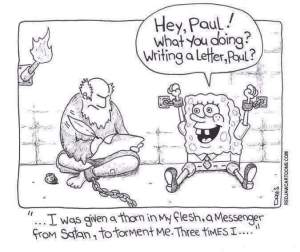
One of my new year’s resolutions back in January was to be able to cope better with my chronic pain. Instead I learned again that it pays to be careful what one asks for. Less than a week into 2019 I was diagnosed with a torn rotator cuff. That wasn’t exactly what I had in mind, God! Now I’m sure I’ve asked God way more than three times to take away my aches and pains, but the answer I keep getting is the same one Paul got — which is “no.” Paul says God told him “my grace is sufficient for you.”

Today’s text also says, “Therefore, to keep me from being too elated, a thorn was given me in the flesh.” Other translations say “to keep me humble.” I don’t know how long it took but Paul came to understand that his problem served to keep him humble. I do know that when I stop focusing on my own problems and pay attention to people with more severe physical pain than I have that works for me too. I am in awe of those of you who come faithfully to church using a walker or a wheelchair, or wearing a knee brace, or in between chemo treatments–who keep a positive attitude in spite of the slings and arrows life has thrown at you.

What Paul learned from his thorn in the flesh is that we have to learn to deal with the hand we are dealt. It doesn’t have to be fair or even understandable – it just is what it is. God is not some supernatural magician who can pronounce a holy abracadabra and take away our pain. Our God is one who suffers with us and gives us the strength to carry on no matter what.

You’ve probably heard it said that we can’t control things that happen to us; all we can control is how we respond to the challenges of life. If that sounds like a cliché it’s because it is. But it’s also true. I had the privilege to witness that in action over the last few years as my father and mother-in-law both dealt with very similar end of life issues. Diana’s mother, Mary, was confined to a wheelchair and lived in assisted living for 9 years. She didn’t just have a thorn, she had a whole rosebush! She had plenty to be unhappy about, but she was always cheerful, content and pleasant in spite of all that. My dad was in similar physical condition in his final years, but his attitude was entirely different. He was angry and never satisfied with anything. He resented his circumstances and made life difficult for those caring for him and also for himself.

I don’t say that to be judgmental because I’m much more like my father than my mother-in-law. All too often I throw myself a pity party and catastrophize my problems even though I know better. I know that words matter especially how our self-talk shapes our attitude toward the challenges we face in life.

For example, I went to the thesaurus to find another word for “pain” while writing this sermon so I didn’t keep repeating myself. The first three choices my thesaurus gave me were: “discomfort, agony and aching.” What a difference a simple word choice makes in describing the same sensation. To be in “agony” is certainly a whole different ball game than having “discomfort” or “aching.” The good news is we get to choose how we want to label what we’re feeling.

Another way of saying that is that “pain is inevitable, but suffering is optional.” Pain is part of the human condition. No matter how much we wish it wasn’t, it comes with the territory. I find the Buddhist explanation for suffering very helpful. Buddhism says that we suffer because we are too attached to the things of this world which are all temporary, including these mortal bodies we are privileged to inhabit for a while.

My physical limitations remind me constantly that aging is about learning to let go — letting go of stuff I don’t need, letting go of things I can no longer do while humbly asking for help when I need it. Letting go frees up energy to celebrate the things I can do, and to give thanks for more wisdom gained through life experience.

If a picture is worth a thousand words (or has that number gone up with inflation?) then this one is definitely worth that much.

Letting go is important practice for the ultimate letting go that comes with mortality. But I would hasten to add that letting go doesn’t mean surrender. It doesn’t mean quitting all the things that give life meaning. It means finding ways to still do what we enjoy. Remember, nowhere in the Bible is there any talk of letting go of serving God and our neighbors. In fact one sure way to not be turned in on myself and my problems is to find ways to help others.

Humility means letting go of our need to control things. God’s answer to Paul is that our weakness allows God to be our strength. It boils down to God saying, “I’m God and you’re not – so trust me.” Those are great words to remember if you’re heading into surgery or awaiting a birth of a baby. Letting go of our need to control, of having things our way can also free us of anxiety, worry and fear which are all stressors that only make our physical pains hurt more. As the 12 step programs put it, “Let go and let God.”

I realized this week that humility is so central to our faith that it serves as bookends to the season of Lent. Every year we begin the season of Lent on Ash Wednesday. We put the mark of the cross on our foreheads with ashes, and the traditional words that are said are from Genesis 3:19: “Remember you are dust and to dust you shall return.” We don’t say that to be morbid, but to remind us all of our place in creation. Yes, we will all die someday, and making our peace with mortality makes every day of life all that more precious.

And at the end of Lent we have the ultimate example of what humility looks like in Jesus. The night before he was crucified Jesus prays for his thorn to be taken from him. In the Garden of Gethsemane Jesus says, “Father, if it’s possible take this cup from me.” We’ve all prayed that prayer. I know I have many times. But what makes Jesus’ example so important are the words that a come next: “Not my will but yours be done.”

I don’t pretend to have that kind of faith. Paul says he’s achieved contentment with “weakness, insults, hardships, persecutions, and calamities,” and no, Lord, I’m not asking for those so I can learn to deal better with them. But I do believe the secret to abundant life is what Paul describes elsewhere in Philippians 4:11 where he says he has learned to “be content with whatever I have” or as some translations put it “to be content in whatever state I’m in.”

A couple of years ago I chose Psalm 90 as the Scripture I read and meditated on during Lent. Mornings are the worst time for my discomfort; so I really identify with this part of that Psalm: “Turn, O Lord! How long? Have compassion on your servants! Satisfy us in the morning with your steadfast love, so that we may rejoice and be glad all our days.” (vs. 13-14).

Pity-party Steve gravitates to the first phrase “How long, O Lord? Have compassion on your servants. Satisfy us in the morning…” Yes, Lord, especially in the morning. But the compassion I’m asking for isn’t what I really need. I want to feel like a 30 year-old again. I want the pain, ache, discomfort, agony to all go away.

But the Psalmist has a much deeper request that works for every age and stage of life. “Satisfy us in the morning with your steadfast love, so that we may rejoice and be glad all our days.” The pain meds modern science offers are never more than a temporary fix, and because of our overreliance on quick, easy remedies we have an opioid epidemic that can lead to horrific addiction and death. There’s a reason we don’t say “In Big Pharma We Trust.” God’s solution to pain is simply unconditional steadfast love, and it doesn’t just last for a morning. It enables us to rejoice all our days because unconditional love doesn’t say “I love you if you are faithful and brave or if you don’t complain.” Steadfast love says, “I love you, period.”

And that is exactly what Paul means when he says God’s grace is sufficient – it’s all we need, no matter what kind of pain we are dealing with.
I want to leave you with a story from Robert Fulghum about how we deal with pain and suffering. Fulghum is best known for writing “Everything I Needed to Know I Learned in Kindergarten.” In one of his other books he tells about an experience in his early twenties when he worked for a country resort. He had to do the night shift as a receptionist and mind the stables during the day. The owner was not the most likable or the kindest person on the planet and Robert was getting weary of eating the same lunch every day. In addition, the cost of the lunch would get deducted from his paycheck. It got on his nerves.

One night, he could hold it no longer, especially when he found out that the same lunch was going to be served for another couple of days. One of his colleagues, working as a night auditor, was Sigmund Wollman, a German Jew and a survivor of Auschwitz; Sigmund had spent three years at the concentration camp. He was happy and contented in the same hotel where Robert was mad and upset. Finding no one else around to share his frustration, Robert spoke to Sigmund and expressed his anger against the hotel owner.

Sigmund listened patiently before saying: “Lissen, Fulchum, Lissen me. You know what’s wrong with you? It’s not the food and it’s not the boss and it’s not this job.”

“So what’s wrong with me?”

“Fulchum, you think you know everything but you don’t know the difference between an inconvenience and a problem. If you break your neck, if you have nothing to eat, if your house is on fire — then you’ve got a problem. Everything else is an inconvenience. Life is inconvenient. Life is lumpy.”

Fulghum says, “I think of this as the Wollman Test of Reality. Life is lumpy. And a lump in the porridge, a lump in the throat and a lump in the breast are not the same lump. One should learn the difference.”

When we are tempted to turn inconveniences into problems, God says, “Let go. I’ve got this.” And our best response is, “OK, not my will but yours be done.”

Preached on April 7, 2019, Northwest UMC, Columbus, Ohio

Know When to Walk Away and When to Run

“If that house will not welcome you shake the dust from your feet and walk away.” Those words from the Gospel of Matthew kept running through my mind as I followed the struggles of the United Methodist General conference last week. Leaving a significant relationship is never easy, but sometimes it is the best choice to make. I have been an ordained United Methodist pastor for almost 50 years. For all but 3 years of my entire ministry my denomination has been arguing over LGBTQ acceptance.

Like Charlie Brown I dared to hope that just maybe this time the General Conference wouldn’t pull the ball away before Jesus could kick a field goal. It pains me greatly that once again my denomination has failed to be the church. Isn’t 47 years long enough to wait for the UMC to produce good fruit? Far too many good people have been damaged by the judgmental policies of our church. Far too much time and precious resources have been wasted fiddling with this unwinable debate while the world burns from hunger, poverty, climate change, racism and rising nationalism.

The world is in desperate need of authentic ministry to the marginalized, the immigrants and oppressed, and a church that cannot even accept its own LGBTQ children so we can all join hands to care for God’s children is not a a church worthy of Christ’s name.

I will of course pray long and hard for everyone wounded again by this rejection and for the rejectors. But I will also be praying about my future relationship to the UMC. My decision may be easier because I am retired. It will be a much harder choice for others in active ministry. I will wait to see what last week’s vote for an even harder line rejection of my beloved sisters and brothers actually means. Like Congress church politics are messy and convoluted. Even those who were in Indianapolis at General Conference are not sure what the so-called “Traditional” plan means. Parts of it were apparently declared unconstitutional by the Judicial Council before the vote which probably means the battle will continue, and even more LGBTQ people and their progressive supporters will be alienated from Christ and his redeeming, inclusive love.

Even though we don’t know what the future holds, these things I do know for sure. God isn’t finished with us yet. For people of faith resurrection always follows death. It may feel like Friday, but Sunday’s coming! The Christ I have come to know and love says, “Come to me ALL (not just those we deem worthy) who labor and are heavy laden.” And in that verse from Matthew where it says to shake the dust from your feet, listen to Jesus’ final warning to those who refuse to welcome God’s blessed ones: “Truly I tell you, it will be more tolerable for the land of Sodom and Gomorrah on the day of judgement than for that town.” (Matthew 10:15)

Whatever emerges from the coming schism I for one am ready to shake the dust of judgement and rejection from my feet and align myself with those who are welcoming and inclusive. I don’t know yet what that looks like organizationally, but Jesus knows it’s not the name on the church door that matters. It’s the hospitality inside the fellowship of believers that makes us a church.

Memories

dadonwayoutMy father died one year ago today.  On purpose or not I was too busy to think much about it today, but I do miss him.  I don’t miss the 2 hour drive to go visit him, but I miss knowing he was there even if he often drove me and my sisters crazy.  My dad and I were never very close, but in his later years I learned to accept him and forgive him for the things that bothered me about his attitude toward life.  He was too rigid and authoritarian – maybe things I haven’t accepted in myself?  We didn’t agree on theology or politics or child rearing philosophies, but in the end none of that stuff really mattered.  He was my father, and I literally owed my life to him.

He really did do the best he could to be the best person, father, husband, Christian he knew how to be. And like all of us he fell short of the mark regularly.  Like all of us he had to survive some difficult things in his life.  Unlike me and most of us he survived a near-death experience in a North Atlantic plane crash on his way home from World War II.  He didn’t talk about that experience and I regret that I never cared enough to ask him about what had to be a life-defining moment.  So I can only speculate on how the death of his crew mates in that crash or the 12 hours he spent in the water before being rescued affected him.  I know I have no right to judge him for his shortcomings and regret the distance I helped create between us by doing so.

All such life events have a ripple effect on everyone touched by them.  From that awful experience came my Dad’s conversion to Christianity, which led to my own growing up in the church and my career choices and how my faith and values have been shaped.  In many ways I am who I am now because of the engine that failed on that B-17 seventy-four years ago.

A friend told me after Dad died that someone had told him once we don’t really grow up until we become orphans.  I’m not sure I’ve made much headway in the last year, but I have a new appreciation for how fragile and temporary life is.  Things that once bothered me don’t seem so important anymore.  Maybe that’s a baby step toward maturity?

Thanks Dad.

CALLED NOW! Luke 5:1-11, Scout Sunday

All of my best friends when I was a kid were my fellow Boy Scouts. Much to my chagrin one of them posted this picture on Facebook a few weeks ago – yes, I’m the short one. This picture is from the day Blaine and I got our Eagle Scout awards. My point is not to brag but to show the Scouts here today that if this 90 pound weakling could make it to Eagle anybody can!

I see a lot of parallels between what I learned in scouting and our Gospel lesson for today, and I want to focus on just two – trust and obedience. A Scout is trustworthy is the first Scout Law. But when I try to remember all 12 points of the scout Law the one I often omit is obedient. There’s probably some deep psychological reason for that, but we aren’t going there today.

When Jesus, a carpenter and itinerant preacher gives Simon the fisherman advice on how to fish Simon’s first response is to say, “Master, we have worked all night and caught nothing.” Simon’s tired, smelly and in bad need of his morning coffee and a shower. But the story doesn’t stop there. Simon goes on to say, “Yet if you say so I will put down the nets.” Why would he do that? Jesus doesn’t know anything about fishing, and yet when he says, “Put out into the deep” Simon obeys. Why?

Luke gives us a clue. Simon begins his response to Jesus by calling him “Master.” He wouldn’t do that if he didn’t already know something about Jesus that makes him respect and Trust him. But before they can catch a boat load of fish they have to translate trust into obedient action and actually “put out into the deep.”

What might putting out into the deep mean for you right now today?? What is God calling you to do that is risky, outside your comfort zone? To fish for people means we all need to spread Christ’s love and mercy to a friend, fellow student, family member, neighbor or co-worker – especially those who are very hard to love.

Another important part of Scouting is the Scout oath which begins, “On my honor I will do my duty to God and my country.” When I was a scout I equated those two things. But with more life experience and deeper study of the Scriptures I have learned God and Country are not one and the same. God is listed first in that oath on purpose. Duty to God is bigger than duty to anything else because God is bigger than anything we can imagine or comprehend. So when our personal desires or interests come into conflict with what God would have us do, our duty is to follow the example of Christ.

That’s what it means to be called to follow Jesus, to be his disciple here and now. The call to discipleship is not just something that happened way back then to Simon and the other fishermen. It is the urging of God’s Holy Spirit calling all of us every day to do our duty to God.

The fishermen were not expecting a call from Jesus. They were just doing their jobs to try and make a living – and out of nowhere Jesus calls them instead to make a life and a life changing decision.

What might that kind of call look like today if it happened to you at work or school? Maybe like this skit:

Cast: Andrea, CEO of a seafood company.
John Thunderson, a friend and client of Andrea’s company
Jamie, John’s sister and business partner

[The scene is a contemporary office – Andrea is the only actor who appears on stage. The others are heard from offstage via microphones. Andrea is at a desk with lap top, papers piled up, disheveled, coffee cups on table, looking very frustrated and harried, coat on back of chair.]

Phone rings – Andrea ignores it for a couple of rings, then answers it, cradles it on shoulder while still working at computer

Hello, yes, this is Andrea.
[Pause]
Hi Bro. Yes, as always, but I’m never too busy for a good idea, what’s up?
[Pause]
Wait a second, Simon; is this another one of your hair-brained pyramid schemes? If I had half the money back I’ve lost on your too-good-to-be-true investment tips I could retire today.
[Pause]
Just give me the bottom line – how much do you need?
[Pause]
No money? OK, I’ll bite, what’s the punch line?

[Cell phone rings] Hang on Simon; I’ve got another call coming in.

[Answers cell phone] Hey John. Can I buzz you back in a sec – I’m on my other phone?
[Pause]
OK, yes, I understand it’s urgent. I’ll get right back to you, I promise. My brother’s on the other line–needs some money or something. I’ll just be a minute. Thanks.

[Disconnects cell phone and goes back to desk phone}

Simon, you still there? Sorry about that. What?
[Pause]
Oh, it was John Thunderson. Probably needs a new jingle for his latest Thunderson Tuna TV campaign. Anyway, what’s the deal here?
[Pause]
You don’t need money, so what do you need? [Pause] My time? That’s even worse. How much time and for what?
[Pause]
Whoa, slow down. I’ve not heard you so excited since you won the singles championship at the club. Let me see if I’ve got this anyways close to straight. You heard this motivational speaker who’s recruiting volunteers, and you want me to go with you to a training session for two weeks — in Buffalo???
[Pause]
Simon, I can’t do that. I’m swamped here. We just opened that new processing plant in Savannah. The shrimpers union is holding me up for a huge increase in benefits. [Looks at calendar] And I promised Mike I’d take care of the kids this weekend so he can visit his mother. I just can’t.
[Pause]
Yes, I’m really glad that he’s attracting big crowds. And I know we can use all the networking and publicity we can get for the business. You go and let me know how it looks when you get back. What kind of time commitment are you looking at after the training session?
[Pause]
Well, you better find out. I need to get someone to cover your territory if you’re going to be a groupie for this guy and save the world.

[Looks at phone] Now what? Text just came in. Gotta go, bye.

[Dials desk phone]

Jamie, it’s Andrea. Got your text. What’s going on?
[Pause]
Yeah, John called awhile ago, but I was on the other phone; so I haven’t really talked to him. You sound excited about something. Is everything OK?

[Cell phone rings] [Pauses and looks at phone] – Yeah, it’s John again, hang on Jamie.

[Answers cell phone]

John, sorry, I haven’t had a second to call you back yet. [Pause] Yeah, matter of fact; she’s on the other phone right now. Listen, let me call you back and we can do a conference call, OK?

[Hangs up cell and picks up desk phone] Jamie, you still there? Good. Listen, that’s John on the other phone. Let me put you on hold a minute while I call him back and we can all talk together on a three-way, OK?

[Punches buttons on phone] OK, you both there now?

John and Jamie: [together, from off stage over mic] Yes, I’m here.

Andrea: Good. What’s going on, you both sound frantic about something? Your folks OK I hope?

John: [excitedly] Yes, they’re fine, thanks, but I called because I’ve got this great idea I need to talk to you about!

Jamie: [interrupting] And I called to warn you about this crazy idea that has relieved John of his senses!

Andrea: Whoa, one at a time, please. Jamie, you go first.
Jamie: Andrea, please talk some sense into my brother will you? He’s gone batty over this guy and wants to run off tilting at windmills!

John: Jamie’s just too conservative, Andrea, not willing to take any chances. This is really big and we need to get in on the ground floor. I mean you have to hear this guy in person to understand. He’s just amazing, the way he can motivate people and inspire loyalty and creativity.

Jamie: But what does he know about the fish business? He’s a building contractor, for god’s sake!

John: For God’s sake–that’s it! I couldn’t put my finger on it, but that’s it! He’s got some kind of extraordinary power. Why take chances with something that awesome? If he’s a phony, he’ll fade away faster than Frosty in the noon day sun. But if he’s the real deal, I don’t want to be on the outside looking in. And I don’t want my friends and family there either.

Andrea: Slow down, you two. Who in the world are you talking about?

John: Didn’t Simon tell you? He said he was going to Buffalo for the training.

Andrea: Oh, that. I didn’t realize you were talking about the same thing. I didn’t listen to him all that carefully I’m afraid, just too much other stuff going on.

Jamie: Good for you, Andrea. I’m glad someone still has at least one foot planted in reality. This guy is a contractor who has had some kind of religious experience and thinks he’s God’s gift to humanity. He’s peddling peace and love and a bunch of feel good stuff that just won’t play in the real world. I hope you didn’t let Simon sell you a bill of goods.

John: I can’t explain it, Andrea. But, trust me, you owe it to yourself to meet this guy and decide for yourself. There’s something about him that I’ve never seen or felt before. He simply exudes this amazing sense of peace. He looks at you, and it’s like he sees right thru to your soul.

Andrea: Sounds like x-ray vision to me. I don’t want anybody getting that close to me, thanks.

John: I know, I didn’t think I did either. But this is different. There’s no sense of threat, no judgment–just affirmation and love. He takes you where you are and draws out the very best in you. I’m going to Buffalo this afternoon, Andrea, and I think you should come along, really.

Jamie: Great and you’re leaving me to take care of Mom and Dad AGAIN?

John: Yes, Jamie. They’ll be OK for a few days. This is more important. I’ve never felt so sure of anything in my life. Please come too, Jamie; give it a chance. The rat race we’re in isn’t making you happy. There has to be more to life than selling fish. This is more important, I just know it is.

[Pause–while Andrea weighs her options, then starts putting her coat on to leave]

Andrea: Sorry Jamie, I’ve known John since high school, I’ve never heard him so psyched before. I’ve got to see what this is about. It’s up to you, but I wish you’d come with us and give it a try.

[Andrea hangs up phone and exits, leaving everything as is on the desk]

I wrote that skit 15 years ago for a clergy gathering that was held here at Northwest over in the ministry center. It was the first time I was ever in this building, and I had no idea that part of my call would bring me here to be part of this great congregation many years later. I want to thank the talented people who made that video possible – you probably recognized Heather Sherrill as Andrea, but off camera were two other wonderful people – Barbara Luke as Jamie and our AV coordinator Eric Gauder who recorded and produced the video. These are very busy people. It took about a week of texts and emails just to find an hour when we were all available. Yet they took time to do this because they know that part of their call is to share their talents with and for God’s church.

God is still calling you and me every day, but like Andrea and John in the skit we stall and procrastinate and rationalize. So why do we resist God’s call upon our lives? When the first disciples haul in that amazing boat load of fish Luke says the crowds were amazed. But notice Simon’s immediate reaction when he suddenly realized who Jesus is. He falls on his knees and says, “Go away from me Lord, for I am a sinful man!”

It’s that feeling you get when going a little over the speed limit and suddenly realize there’s a state trooper with a radar gun aimed right at you. To follow God can be scary because of guilt, sin, insecurity, or the big unknown of just what doing our duty to God might involve. Jesus is calling these fishermen to leave everything they have done, everything they do — their comfort zone, their livelihood. And he offers no detailed job description. He just says, “Follow Me.” That’s scary- like being a federal employee trusting the government won’t be shut down again in five days.

When I first felt my own call to become a pastor I was 15 and at a senior high church camp worship service. We were asked to sign a 3 x 5 card if we felt called to some kind of Christian service. I signed the card, but I didn’t tell a soul – not even my family. In fact it took me 4 years before I was ready to reveal that call publicly. Why? Fear – I was afraid of being ridiculed or shunned by friends who would be afraid to be themselves around me. As you saw in that first picture I was already a little nerd. I didn’t need any other uncool qualities for my peers to judge.

So I said “Sorry God, I’m going to be an aeronautical engineer.” I lived in Neil Armstrong’s hometown so that was a very respectable calling. And it promised a lot more financial security than being a pastor. But God doesn’t play fair. She persisted and even used my first college calculus course to finally convince me to switch majors and plan on going to seminary.

But answering God’s call does not mean you all need to enroll in seminary tomorrow. God’s call is as unique for each one of us as we are all different in many ways. God’s call is very simple- just love each other – and that requires no graduate degree. It can be a ministry of your presence at a funeral, a phone call or a card to lonely friend, taking a meal to a grieving family, donating to charity, praying for someone in need, visiting a nursing home, writing a letter to a legislator about a social justice issue. Opportunities to answer God’s call are all around us, here and now every day. Our call is to pray for wisdom to discern what it is God wants each of us to do right now and then trust that call enough to go into action.

All the church growth experts agree that people are most likely to visit a new church if someone invites them personally. Notice that in the Scripture for today Jesus gives a personal invitation to the fishermen, and for them to respond so quickly he must have done it with urgency. We can’t tell from the written narrative – we don’t have snapchat photos or video so we miss the inflection in Jesus’ voice or how it felt to have Jesus look you in the eye and say “Follow Me.” And he spoke their language. They knew how to catch fish; so he says, “Come with me and I’ll put the talents you’ve already got to work catching people for my Kingdom.”

We have to be smart about discerning when God is calling us and when it’s a wrong number. The best way to be smart is to enlist help. Scouts are organized in troops – there no such thing as a solo scout, and there’s no such thing as a solo disciple.

Obedience to God doesn’t mean taking every problem on personally. Even Jesus needed help and called disciplines to join him. Well, guess what – Jesus needs reinforcements even more today. He’s no longer walking this earth and relies entirely on people like us to Trust and Obey him. If we do God empowers us with the Holy Spirit and will guide us to discern exactly what it is we are each called to do. And when we say yes, God provides the courage for us to do our duty.

God often speaks to us through music, and this week for me the message has been coming through a loveable green frog. Kermit puts it this way: “Have you been fast asleep, and have you heard voices? I’ve heard them calling my name. Is this the sweet sound that calls the young sailors, the voice might be one and the same. I’ve heard it too many times to ignore it. It’s something that I’m supposed to be. Someday we’ll find it, the rainbow connection, the lovers, the dreamers and me.”

May today be that day. Amen

Benediction: What is God calling you to do? God is pretty persistent – so you might as well answer the call, nudge, text, email or personal invitation. You won’t regret it. Go in Peace.

THE CLOCK IS TICKING

Nothing confronts us humans more with the deep mystery of life than our own awareness of our mortality. Woody Allen once said, “I don’t mind dying. I just don’t want to be there when it happens.” By contrast one of my favorite and most challenging Scripture texts is this one in Luke 2 when Jesus is 8 days old:

“Now there was a man in Jerusalem whose name was Simeon; this man was righteous and devout, looking forward to the consolation of Israel, and the Holy Spirit rested on him. 26 It had been revealed to him by the Holy Spirit that he would not see death before he had seen the Lord’s Messiah. 27 Guided by the Spirit, Simeon came into the temple; and when the parents brought in the child Jesus, to do for him what was customary under the law, 28 Simeon took him in his arms and praised God, saying,

29 “Master, now you are dismissing your servant in peace,
according to your word;
30 for my eyes have seen your salvation,
31 which you have prepared in the presence of all peoples,
32 a light for revelation to the Gentiles
and for glory to your people Israel.”

I confess I am more like Woody than Simeon, and life and death are full of countless examples of those opposing approaches to the grave. Dylan Thomas famously said,
“Do not go gentle into that good night,
Old age should burn and rave at close of day;
Rage, rage against the dying of the light.”

Contrast that with Elijah passing his mantel on to Elisha and ascending into the clouds. In my own family we witnessed the stark difference between my mother-in-law who was content and peaceful as her last days approached and my father who fought against the inevitable as long as he could.

I’m not sure what to make of this, but I think the clue to contentment is found in Simeon’s surrender when he says, 29 “Master, now you are dismissing your servant in peace,according to your word; 30 for my eyes have seen your salvation…” Simeon had accomplished his life’s purpose. He was looking forward to Israel’s consolation and believed God’s promise that he would not taste death until that purpose had been fulfilled.

What is the purpose of how we spend the dash between our date of birth and date of death? That’s a question all of us must wrestle with ourselves. We can ask God’s guidance and seek the counsel of wise mentors, but ultimately the choice is ours. What shall we live for? Are we human beings or human doings? Do we spend our lives in pursuit of things that do not satisfy our souls? Are we so caught up if making a living that we fail to make a significant life?

Since this is Super Bowl weekend let me share this analogy. Even casual football fans know that football time is not real clock time. The final minutes and seconds of a game can fly by or they can drag on forever depending on which team is ahead and who has the ball. If my team is behind they will do everything they can to stop the clock after every play – run out of bounds, spike the ball, call a time out, fake an injury, challenge a call, etc. Many a football widow knows how long it can be from the 2 minute warning till the final gun.

But if the team with the ball is ahead the exact opposite strategy is employed. They will run the ball so the clock keeps ticking after the play. They will stay inbounds; they will run the play clock almost down to zero on each play to use up as many seconds as possible before snapping the ball.

What’s the difference in these two scenarios? Team A is desperate to score again because they have not achieved their purpose which is to win the game. Team B is content to let the end come ASAP because they are ahead – they have fulfilled their purpose and accomplished their mission.

What does the scoreboard of your life say? Are you ahead or behind? Are you accomplishing your purpose or still striving to get to the goal line? I’ll be going to two funerals this week- one of the deceased was in her 80’s, the other just 50. Both dedicated their lives to helping others in personal and professional ways. Both were people of vision and compassion. One slipped gradually toward death over several months, but the other died suddenly leaving many of us again to wonder why.

I simply do not know. Maybe someday I will see clearly what is now only a dim reflection in a foggy mirror. But this much I do know, both Judy and Joe have left a hole in the human fabric; and it is part of my purpose and yours to pick up their mantle. The world will little note nor long remember who wins Super Bowl LIII, but if we want to win the game of life and be content to depart in peace whenever our time comes, we must all trust in God’s promise and make our game plan congruent with God’s will.

Walls?

“There where it is we do not need the wall:
He is all pine and I am apple orchard.
My apple trees will never get across
And eat the cones under his pines, I tell him.
He only says, “Good fences make good neighbours.”
Spring is the mischief in me, and I wonder
If I could put a notion in his head:
“Why do they make good neighbours? Isn’t it
Where there are cows? But here there are no cows.
Before I built a wall I’d ask to know
What I was walling in or walling out,
And to whom I was like to give offence.
Something there is that doesn’t love a wall,
That wants it down.” – Robert Frost

When I was a young child some people in our neighborhood built a fence on the property line between their house and their next door neighbors. That was unusual in those days before subdivisions where almost every yard is fenced. This fence was also unusual for several other reasons. It was 8 feet high but only about 16 feet long, leaving easy access around either end between the neighbors’ yards. You see it wasn’t a practical fence at all since it could not keep anyone or any animal from easily just going around it.

I overheard my parents discussing this fence one day and thought they were calling it a “spike” fence which made no sense because it was completely flat on top. There was nothing spikey about it! When I inquired about the fence my parents told me it was not “spike” but a “spite” fence because the neighbors who built the fence were angry with the folks next door. I don’t know if we ever knew what they were angry about, but I realize now the fence was a symbol of their animosity about something. It wasn’t really made of plywood but of anger.

Symbolic walls are much harder to tear down than physical ones, and I believe that is the reason for the stalemate and government shut down just now. President Trump has correctly pointed out that in the past Democrats have voted in favor of parts of a wall on our southern border; so the problem is not about a physical wall or about needing better border security, it is about what this wall has come to symbolize.

From the day he launched his campaign for president with remarks about Mexicans being “murderers and rapists” to racist comments about “s***hole” countries, to his refusal to condemn white supremacists in Charlottesville this President has demonstrated over and over that he is a racist. His father was a racist landlord in New York, and son Donald has not evolved from those roots.

Racism is an expression of fear, in this case fear of losing power and privilege that wealthy white males have controlled in this country since the first illegal immigrants landed at Jamestown and Plymouth Rock. And the wall stalemate/debate is grounded in that fear, and that is why it is so hard to resolve.

I have reread several artistic reflections on walls as I enjoy my own privileged status to sit in comfort with a cup of coffee and ruminate about what are life and death issues for unpaid government workers and desperate refugees. My thoughts have ranged from the account of the walls of Jericho in Joshua 6, to a play about an imaginary wall (“Aria da Capo” by Edna St. Vincent Millay), to Robert Frost’s poem “The Mending Wall,” to my own climbing up on a part of the Great Wall of China a few years ago.

All of those walls are the result of fear and somewhat based on reality. The citizens of Jericho were wiped out by Joshua and his men when “the walls came tumbling down.” The two shepherds in “Aria da Capo” kill each other because each of them has what the other wants on his side of the wall, but as they die and collapse on where the wall “is” they discover it does not exist except in their own imaginations.

I don’t know my Chinese history well enough to know how well the Great Wall worked at keeping their enemies out, but the sheer magnitude and effort and cost it took to build that wall speaks volumes about how great their fear was.

Frost’s poem cuts to the chase by asking hard questions about the need for walls. Do fences make good neighbors? Are walls needed if we follow the advice of the Great Commandment in both Hebrew Scriptures and the Gospels to “love our neighbors as ourselves?” Maybe that’s naïve, but on the other hand maybe it’s the only way, truth and life?