Gracious and Eternal God, Our time is not your time. We measure our time on this planet in months and years, but we know our 60 years are but a blink of an eye to you.
Help us keep things in perspective as we gather here to reminisce and share updates on our families and lives since we last gathered.
We know there are classmates and significant others who have graduated from this life to the next in the last five years, and we honor them in our hearts.
We give thanks for those who have planned this reunion and those who have prepared food for us and are here to serve us. We ask your blessing on us gathered here and on classmates who cannot be here for whatever reason.
Most of all we ask that you help us have grateful hearts as we think about our high school days and all the years since. It is way too easy to focus on the things our age has taken from us, the many things we wish we could do now, but our bodies refuse to cooperate.
We didn’t get a course in high school on aging, and we wouldn’t have believed what the future could have told us anyway. Who could have imagined the Dick Tracy future we live in now with smart watches and cars and gps’s that are both blessing and curse? We’re just glad there were no iPhones in 1964 to record all of the dumb stuff we did back then.
So help us live in the present, as challenging as it can be. Help us see ourselves not as old geezers but as elders with wisdom and experience to share, even as we keep open minds for learning all that life still has to teach us.
As we made our way through the passion story of Holy Week this year it occurred to me that the Gospel accounts of Jesus’ last week are an interesting case study in the classic stages of grief proposed by Dr. Elizabeth Kubler-Ross in her 1969 book “On Death and Dying.”
The stages do not occur in a linear order but ebb and flow like the phases of the moon, and we always need to remind ourselves that the Gospels are theological works, not historical biography; but given that, it strikes me that we can learn about the universal human experience of grief by studying what the Gospel writers tell us about the final days of Jesus’ earthly life.
Kubler-Ross’ stages include anger and depression which are often two sides of the same emotion – one expressed outwardly and the other turned in upon oneself. Because of that anger is easier to identify and that is true with Jesus also. The cleansing of the temple which is described in all four Gospels is one of the few times we ever see Jesus angry. He sometimes is verbally angry with the Scribes and Pharisees, but when he overturns tables and drives the money changers out of the temple with a whip that is the rare incident where Jesus is obviously and physically very angry.
Another scene which could be motivated by either anger or depression would be one of the “last words” from the cross where Jesus cries out, “My God, My God, why have you forsaken me?” Hearing the tone of voice and seeing Jesus’ body language when he uttered these words might help us better understand his mental state at the time, but both Matthew 27 and Mark 15 describe his tone as “crying out with a loud voice,” and that is the best evidence we have.
Depression can certainly not be diagnosed from a few 3rd person accounts of Jesus’ actions, but the three incidents that come to mind when I think about that stage of grief are when Jesus weeps over the death of his friend Lazarus, when he weeps over Jerusalem and says, “Would that you, even you, had known on this day the things that make for peace! But now they are hidden from your eyes. For the days will come upon you, when your enemies will set up a barricade around you and surround you and hem you in on every side and tear you down to the ground, you and your children within you. And they will not leave one stone upon another in you, because you did not know the time of your visitation.” (Luke 19:42-44). And perhaps in all four Gospels where Jesus refuses to answer any questions in his trials before Pilate, Herod, and the Chief Priests. Those incidents however I interpret more as a strong, silent resistance to the unjust power of oppression rather than depression or resignation.
The stage of grief that stymies me when it comes to Jesus is denial. If you readers have ideas about this one I would love to hear them, but for now I cannot think of examples of times where I see Jesus being in denial about his fate. He sets his face toward Jerusalem in spite of the protestations of his disciples. He stages a protest entrance into Jerusalem riding on a humble donkey, and he returns daily to teach and heal in Jerusalem that last week and to celebrate the Passover, all of which seem like acts of faithful determination and not ones of denial in any form.
The stage of bargaining seems to me to only appear in the Garden of Gethsemane when Jesus says, “If this cup can pass from me, please make it so,” but those words are immediately followed by “But not my will but yours be done,” which move us toward the final stage of acceptance.
It should come as no surprise that examples of acceptance are easier to find with Jesus. When Peter pulls out his sword to resist the soldiers in the garden Jesus sternly tells him to put it away. And then on the cross where it would require the greatest amount of acceptance and courage, at least 4 of the recorded “seven last words” reflect the confidence that only comes with acceptance of death as the final stage of human life.
Those four include Jesus commending his mother into the care of one of his disciples, assuring the repentant thief that he will be with Jesus in paradise that very day, commending his spirit into the hands of God, and finally saying “It is finished.” I suppose one could also make a case that forgiving his executioners is also an act of acceptance, but that amazing act of grace really defies categorization.
Grief is a very complicated emotional process, and the Kubler-Ross stages are one very helpful lens through which to understand it. I find it comforting to find connections between my own experiences of grief and those of the incarnate life of God in Jesus. For me sharing the human condition of these grief stages with Jesus affirms the reality of his humanity and also the hope for achieving some degree of acceptance of my own mortality that he exemplifies for us.
I welcome your comments and insights on any of the above.
The fact that Ash Wednesday fell on Valentine’s Day this year has made for some clever jokes and memes. My favorite is a driver asking his backseat passenger what she’s doing on Valentine’s Day. She replies, “Rubbing dirt on peoples’ faces and telling them they are going to die.” (If you are not familiar with the Scripture used when imposing ashes on another’s forehead on Ash Wednesday that joke won’t make any sense. The words from Genesis 3:19 say, “Remember you are dust, and to dust you shall return.”)
Ash Wednesday seems a bit more real at age 77 than it did at 37 or even 57. I told a clergy friend that we were asked to ponder how much time we might have left during our worship service tonight, and he said, “That just went from preaching to meddling!”
I am also more aware of my clock ticking this year because I had what felt like a big brush with my own mortality last week. It started when a grape-sized lump mysteriously appeared on top of my shoulder. Since I’ve been having trouble with that shoulder I made an appointment to get it checked out with my orthopedic shoulder doc. But I also made the mistake of getting on the internet where I convinced myself it was a swollen lymph node. I even called my oncologist and talked to his nurse who asked several good questions. When I told her I was seeing my shoulder guy that afternoon about it she asked me to call her back after that appointment and let her know what he said before she talked to her doctor.
I was feeling some real fear of dying and wondering how I would handle a serious cancer diagnosis because I do have a so far dormant lymphoma and feared it was finally becoming symptomatic. When I got to the orthopedic office I first saw a resident, and he immediately said “I know what that is,” which seemed comforting even before he explained. His tone of voice was not ominous at all and I began to relax. He called it a “geyser something” which didn’t ring any bells, but he explained it was an eruption of fluid caused by my weakened rotator cuff. He went out to confer with the doctor who immediately came in and said it was nothing to worry about. He called it a cyst, which was a term I understand and said there was nothing we needed to do about it
I was very relieved and felt a little foolish that I had catastrophized the situation, but I’m also glad that for those few hours I had an Ash Wednesday experience of at least for a little while feeling quite dusty. What changes that semi-close encounter with mortality will make in my life remains to be seen. I hope it will help me keep things in perspective; actually work on my end of life planning and simply put things in better order physically and spiritually. Remembering February 6, 2024 will help me do that, and the harmless lump on my shoulder will be there as a visible reminder that I am indeed dust and to dust I will return.
“Then some people came, bringing to him a paralyzed man, carried by four of them. And when they could not bring him to Jesus because of the crowd, they removed the roof above him, and after having dug through it, they let down the mat on which the paralytic lay.” (Mark 2:3-4)
I had a very humbling experience last week that reminded me of the story from Mark’s Gospel about the paralyzed man brought to Jesus in a most unusual way. All three other Gospels contain a similar story where someone is carried to Jesus for healing, but only Mark has this most dramatic detail about the man’s friends being so committed and creative that they lowered him down to Jesus through a hole they dug in the roof.
Wouldn’t you love to hear the insurance adjuster’s response when the homeowner explains the hole in the roof with this story? My experience last week was far less dramatic but still very emotional for me.
The back story, no pun intended, is that because of chronic back pain and peripheral neuropathy I sometimes have a difficult time walking any distance. This is especially true after I’ve been sitting in a confined space, like an airplane seat, for any extended period of time. Last Wednesday my wife and I flew from Columbus, Ohio to Houston, Texas to visit family for the Thanksgiving holiday. The flight was delayed for 30-40 minutes while we sat on the tarmac in Columbus waiting for the pilots to arrive on another delayed flight from Houston. That made the total time on the plane around 3 hours.
Upon arriving at the Bush Intercontinental Airport in Houston we had a long walk (and a train ride) from Terminal E to baggage claim in Terminal C, and I was struggling to get there pulling a carry on and wearing a backpack. My dear wife offered to help with my luggage, but she already had plenty of her own; and I stubbornly kept pushing on.
By the time we got to Terminal C I was really tired and unsure how much further we had to go. We stopped to ask for directions from an airport employee who just happened to have an empty wheelchair, and he graciously offered me a ride. He was a life saver, and I was very grateful for his help. He not only pushed me to baggage claim, he took our claim tickets and got our luggage for us and then took us another good distance to where we could catch a shuttle to the car rental center. He even loaded our suitcases on the shuttle bus for us.
But here’s my problem. While I was very grateful for the assistance we received, I still felt helpless and frustrated that I needed that kind of help. I have not come close to mastering St. Paul’s advice in Philippians 4 to ”be content in whatever state I’m in.” I am reminded every time I look in the mirror that I am 77 years old, and if I forget, my aches and pains remind me of that fact; but I still try to deny it.
So I wonder how the paralytic man in the Gospel stories felt about his situation. We aren’t told why or how long he has been paralyzed. We don’t know if he asked these friends to take him to Jesus or if it was their idea. We don’t know how he felt about being carried up on the roof. That had to be little scary for him!
The truth is the story really isn’t about the paralytic, just as my wheelchair ride wasn’t really about me. The Gospel story is primarily about Jesus, and my story if I step back from my own pity party is really about the kind man who helped us. Yes, he was doing a job he is paid to do, but he did it with such kindness and grace that it was obviously more than just a job.
And Mark’s point in sharing this story in just the second chapter of his Gospel is not primarily about the paralytic but about the healing power of God and who Jesus is. We need to read the first chapter of Mark to realize how central that fact is. Mark wastes no time getting to the radical ministry of Jesus. In the very first chapter he includes four specific healing stories, including Simon’s mother-in-law, casting out many demons, a man with an unclean spirit, and a leper. He goes “throughout all Galilee,” and even though he tells them all not to tell about their healing by the time he returns to Capernaum even though there was no social media to promote his good works Mark tells us “the whole city” is crowding around to get to Jesus. He’s a bigger celeb than Taylor Swift.
But here’s the thing about the story in Mark 2; it’s not just another healing story. For the first time Mark tells us Jesus dares to forgive the paralytic’s sins, and that of course ticks off the Scribes who are nearby and take offense that Jesus dares to claim such divine authority. I love Jesus’ response to the Scribes. He basically says, “OK, to show you my power, how about I just say to the man ‘take up your bed and go home?’” Which of course the miraculously healed man does, and the crowd is amazed because “we have never seen anything like this.”
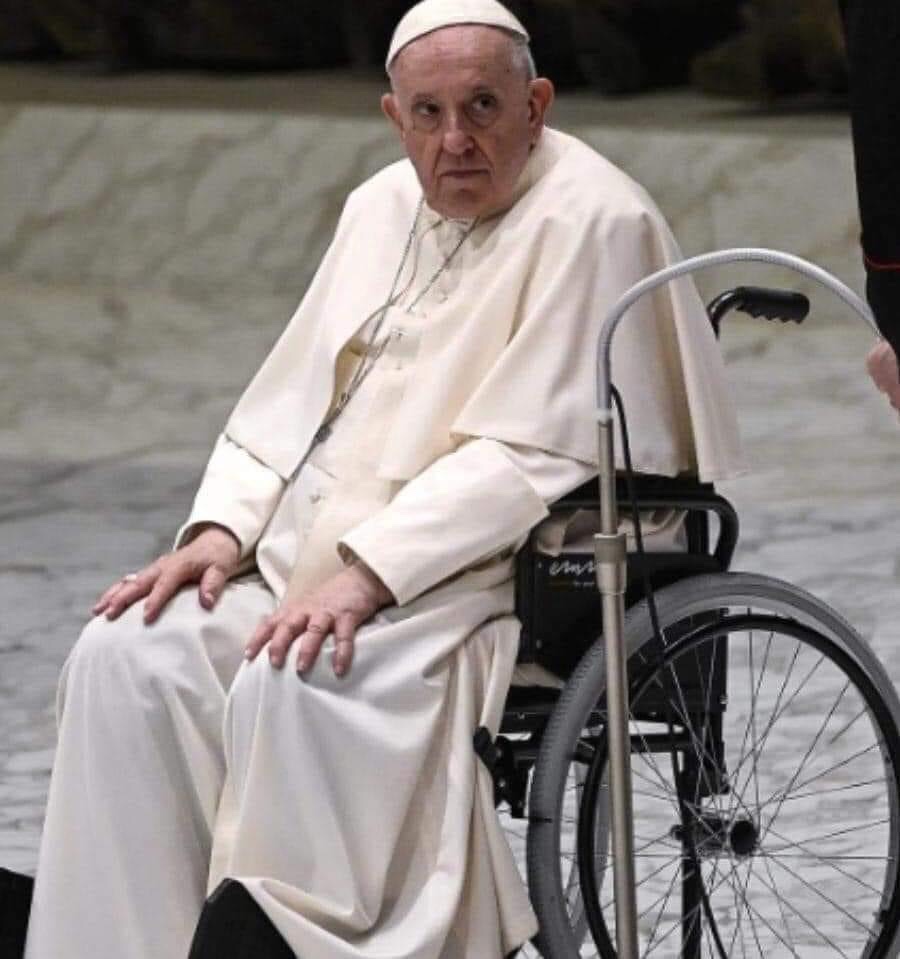
As I was thinking about all of this I came across this picture of Pope Francis, and it hit me again. My story like the paralytic’s story are not about the helpees but the Helper. If a great man like Pope Francis can accept the help of others who am I to think I am somehow better than that. The truth is we are all dependent on the help of others. It may be emotional support or sometimes physically taking us to the spiritual or physical help we need. It may be realizing we are dependent on the farmers, truckers, and grocers who get food on the shelf for us to purchase.
The secret to it all is being humble enough to recognize and ask for whatever help we happen to need at any given point in life. We all come into this life totally dependent on others to nurture, protect, and care for our needs for several years, and the cycle of life means that most of us will end up pretty much in the same need for caregivers at the end of this life. Our choice is how humbly and graciously we accept that care.
In the words of that great philosopher, Kenny Rogers, you gotta know when to hold ‘em, know when to fold ‘em and know when to walk away while you still can. I needed that wisdom this week.
I made a good but sad and hard decision to give up yet another activity I have enjoyed for about 70 years. I don’t remember exactly when I first experienced the joy of riding a two-wheel bike without training wheels, but I would guess I was 6 or 7. That had to be one of the first liberating rites of passage right up there with learning to walk and potty training.
My bike riding for the next 65 years was pretty routine. And then about four years ago I bought a step-through bike, aka a girl’s bike, because I was having trouble with my balance swinging my leg over the cross bar of my 30 plus year-old Schwinn that my father-in-law had willed to me when he could no longer ride. Almost immediately I discovered that my balance issues had more to do with my neuropathy than the kind of bike I was riding. I was still able to ride for awhile in spite of a few minor low-speed falls that happened while starting and stopping. No injuries ensued, but I gradually gave up trying to ride.
A few weeks ago I went into a bike shop in search of adult training wheels to see if I could still ride some with that kind of help. Talk about the circle of life!!! But a kind salesperson offered me an alternative that seemed to be a way out of that circle. He had me try an electric bike with a small motor which would give me a boost at start up where I had the most trouble getting up enough speed to establish my balance.
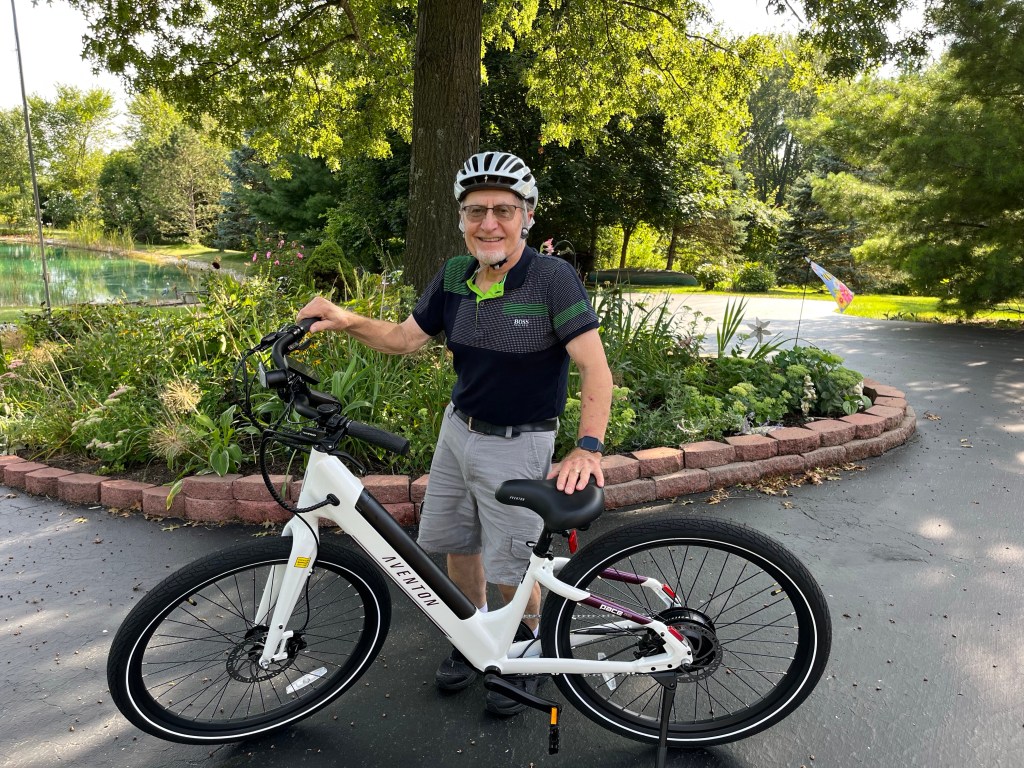
After test riding the e-bike (pictured above) in the store’s parking lot I was sold and brought it home on a trial basis. Unfortunately I discovered over the last two weeks that my balance and reflexes just aren’t up to learning the new skills required to master the e-bike. I had a couple minor falls on it, again miraculously without damaging myself or the bike. The last fall was on a short trip down our driveway to get our mail, and I sadly concluded it just isn’t worth the risk of a major injury to keep trying.
So with a heavy heart I asked my wife to help me load the bike in my SUV and returned it to the store. In addition to the sadness of adding bike riding to my growing list of things I used to be able to do, I’ve been processing how to gracefully surrender to the realities of aging without totally giving up on living.
That task is a work in progress, but I believe a piece of it is to be grateful for all the decades of good memories that bike riding has provided for me. Many of those memories are from the years before I could drive when my bike gave me the first taste of freedom to take myself to the neighborhood grocery store for a pop cycle or candy bar. It was only a block away, but the longest journey starts with a short one. That 1-speed (probably also a Schwinn) took me to Little League practice, the community swimming pool, and later every morning for a year to deliver newspapers clear on the other side of our small town. OK, it was only two miles, but on frigid January mornings at 6 a.m. in northwest Ohio if felt like 20!
The summer I was 15 my good buddy Denny Dafler and I road 200 miles on six 25-mile trips and a 50 to earn our cycling merit badges for Boy Scouts. That was also the summer of my first great love, and she lived 5 miles out in the country. My legs were never in better shape than the summer of 1962.
As an adult my biking has been more relaxed rides of 5-10 miles on bike trails near home—good exercise and sometimes a therapeutic way to burn off frustration or other unresolved emotions. My exercise bike is a poor substitute from feeling the wind of the road in my face, but it is safer and more age appropriate at this stage of my life, and no helmet hair results either.
When I was in Little League a hundred years ago, like every kid, I fancied myself a star shortstop, the most glamorous position on the diamond other than the pitcher. A couple of things doomed that dream. In addition to my diminutive size no one ever suggested I could improve my athletic chances by pumping some iron. So I was the perfect poster boy for a 98-pound weakling. My coaches very quickly determined I did not have the arm strength to play shortstop; so they moved me to second base where the throw to first base is much shorter.
I was reminded of that experience this week and also learned what a “wild goose chase” is all about. I came home from running errands one afternoon to find two Canadian geese floating on our quarter-acre pond as if they owned it. I like birds, just not messy, nasty ones; so as I have done in the past I set about inviting said geese to move on to other water. There are several other ponds in our neighborhood; so this seemed like a simple request. All they had to do was fly across the road and they would have several other lovely ponds to choose from.
When the geese ignored my suggestion that they move on I escalated my efforts, clapping my hands and raising my voice as I walked toward the pond. They literally turned their backs on me and calmly paddled toward the other side of the pond. To understand distances involved you need to know that it is about 40 yards or 120 feet across our pond. By comparison the distance from deep short stop to first base on a Little League field is maybe 80 feet. I point that out because last year when unwanted geese on our pond ignored my most persuasive rhetoric I found that throwing a small rock in their general direction was enough to get them to fly away. I didn’t try to hit them, just scare them, and it worked. That was last year. This week when I tried that tactic the first stone I threw didn’t travel 40 feet before falling weakly into the drink.
So I began circling the pond trying to scare the birds away and/or to get closer so I could frighten them with a rock splashing in their vicinity. As I circled the pond the geese just kept calmly paddling around the pond away from me, and every effort I made at throwing a rock was feebler than the last. After completely circumnavigating the pond, I was no closer to the dirty birds that when I started, and I swear I heard them laughing at me.
And that got me wondering about where else that shows up in my life? What other frustrating pursuits do I waste my time on? How about you? Are there wild goose chases you need to give up?
[Note: This post was written on January 2 but not posted until January 4. It will make more sense with that timeline in mind.] My year of practicing gratitude literally began with a tough challenge. For almost all of my adult years the new year has begun with watching the iconic ball drop in Time Square. Thanks to my own and our cultural addiction with football, 2023 was different. Along with a group of friends I watched a different ball drop this year—a ball that will linger in Ohio State fans’ memories as “wide left.” 2023 was literally just a few seconds old when what would have been a game winning field goal over #1 Georgia sailed like a wounded duck far left of the goal post.
That was almost 36 hours ago, but today as I read several articles about the game in today’s Columbus Dispatch I relived that moment and the frustration of a controversial call that dramatically affected the outcome of the game. I should not have subjected myself to that memory, but I was unable to let it go.
For me, that is a prime example of my biggest obstacle to practicing gratitude. I mentioned one of my mentors, Dr. Bill Brown, and his rhetorical theory called attention shifting in my last post, and this is exhibit A for 2023. In the larger scheme of problems on the world stage or even in my personal life the outcome of a silly game should not be my prime focus. The Peach Bowl is over and done. My dwelling on a terrible call by the refs does not deserve the amount of my attention I am choosing to spend on it. And it is a choice. I can shift my attention to a whole host of things that deserve my attention so much more if I choose to do so. [Remember, I wrote this a few hours before the near fatal football injury to Damar Hamlin, but that tragedy underscores in spades that all football games and other athletics must be kept in proper perspective.]
Notice I did not say that this is a simple or easy shift to make. The local media, my friends, and my social media are full of conversations about the Ohio State game. It is not easy to shift my attention away from all that chatter, but it can be done. I can choose to not read about the game. I can literally switch the tv channel when discussion of that game comes on. Unfortunately I don’t have a remote that can switch the channels in my brain when I think about that loss or my own aches and pains, or other negative and depressing problems in our world. But attention switching is a skill that I can learn if I choose to do so. And making practicing gratitude my priority for 2023 is step 1 in that process
Even though I had 9 good hours of sleep last night I still woke up tired. So I’ve been thinking a lot all morning about how exhausting the two week holiday marathon at the end of December can be for introverts like me. When I was a full time pastor I blamed my tiredness on how busy the Advent/Christmas/New Year’s season is in the life of the church. Now that I am retired that explanation doesn’t work; especially this year when we celebrated Christmas Eve on line because of the nasty winter storm which canceled in person worship for many churches.
And then I read on Facebook that today, January 2, is actually World Introvert Day. Here’s what I found in a quick Google search: “Introverts worldwide will be able to celebrate World Introvert Day on January 2. This is the day following the dreadful celebrations of the previous year has ended. It allows them to enjoy solitude finally and recharge their social batteries. World Introvert Day started when psychologist and author Felicitas Heyne published this blog post calling for a day for us quiet ones.”
And so I wrote this prayer:
Holy One, I am grateful for the spiritual lessons of Advent and Christmas and for the changing of the calendar as a time for reflection and renewal, but I’m worn out. I enjoyed time with families and friends and lots of good food and fellowship. But I’m tired; I’m tired of people and parties. I’m tired of hearing the same holiday songs on a continuous loop. I need some peace and quiet, solitude and time to just breathe and be.
I need a sabbatical, and I know you get it, God, even if my extrovert friends never seem to run down. You took a day off after creation and rested. You included honoring Sabbath rest in your Top Ten rules for living. So thank you for that. Please help me to not feel guilty for putting my feet up and taking a nap today. Please help me set healthy boundaries on my energy levels; to remind myself and others that we introverts need downtime and solitude to recharge our batteries.
We can do the party circuit. We can prepare holiday meals and clean up. We can play games with the grandkids. But it drains our energy, and we need time to refresh, especially this time of year when the calendar is super full of events we want to attend. I even surprised myself this year that I was able be more present and active with family and friends, even when I didn’t feel like it beforehand. And then I crash when the party is over.
Please help me be gentle with myself; to not give up or get frustrated, but to rest when I’m tired. I think Isaiah must have been thinking of us introverts when he said, “God does not faint or grow weary; God’s understanding is unsearchable. He gives power to the faint and strengthens the powerless. Even youths will faint and be weary, and the young will fall exhausted, but those who wait for the Lord shall renew their strength; they shall mount up with wings like eagles; they shall run and not be weary; they shall walk and not faint.” (40:28-31)
Thank you, source of all energy, for Sabbath moments or days when we can simply wait on you. Amen
[Note: So far the month of November has been a blur. I spent all of last week, including two days in the hospital, dealing with a bad UTI. So this post I wrote earlier in the month is a little dated, but like the non-linear game of baseball itself, still relevant to the human endeavor to orient ourselves in time and space.]
In the days of the Big Red Machine back in the 1970’s there was no bigger baseball fan than yours truly. The Cincinnati Reds’ games that weren’t on TV I followed closely as Marty Brenneman and Joe Nuxhall broadcast all 162 regular season games and many post season ones on the radio. In my car, doing dishes, or “working” on a sermon the radio was always on. I can still name most of the players from that team that won back to back World Series in ‘75 and ‘76. I can even remember most of the players from the 1961 Cincinnati Reds who were the first Cincinnati team in my lifetime to make it to the Fall Classic. In those days the games were played in the daytime, and our school always had the game on TV somewhere. We could sign out of study hall to go watch. One of my favorite memories of my freshman fall was Pittsburgh’s Bill Mazeroski’s walk-off homer to beat the Yankees in game 7 of the 1960 series.
As baseball has become more driven by money and free agency has players moving from team to team more often than the UK changes Prime Ministers I have lost interest in the game. The 162 game season now seems much too long with all of the post season games pushing the World Series into November. But, I still am drawn to watching the World Series every year, no matter which teams are in it. Maybe it’s because I have an October birthday and consider myself a Fall Classic too.
Tonight I watched the first game of this year’s Series between the Philadelphia Phillies and the Houston Astros. When I heard the announcer say that this is the 118th World Series my ears perked up, and I started wondering how many of those Series I had watched or listened to? The very first World Series I remember paying attention to was the 1954 Giants-Indians Series. It wasn’t my Reds, but it was an Ohio team; so I listened faithfully on the radio because I don’t think my family yet owned a television. I was of course disappointed as the Giants, led by a young Willie Mays, swept the Indians in 4 straight games.
But for historical purposes with that being my first World Series it means I have watched or listened to 68 Fall Classics, which also means that there were only 50 Series before I became a baseball fan. Therefore, I have witnessed 57.6% of every World Series ever played, and that makes me feel very old and I hope wiser.
“So teach us to count our days that we may gain a wise heart.” Psalms 90:12
(365 x 76) + 19 = x? One of the blessings/curses of autumn means that the anniversary of my birth is once again on the horizon. That means if I make it another six weeks I will have logged 27,259 days on planet earth!!!! Yes I know that isn’t what the Psalm means by “counting” my days, but it is a very daunting number that raises the question, “what difference have I made in the world in all those days?” And for me it means it recent years asking the other uncomfortable question – how many more days do I have left? Wouldn’t life be easier if we knew the answer to that, or would it? For the next logical question is what do I want to do with whatever that unknown number is?
I do most of my calendaring on my phone these days, but I still like a paper calendar on my desk to get a wider angle lens on my schedule. I also mark the days of the month off on a wall calendar above my desk, not so much to mark time as to make it easier to see at a glance what day it is.
That is kind of redundant since my watch also shows the day of the week and the date. But with all those reminders I still forgot a PT appointment this morning until it was almost too late to get there. A friend of mine who has a four year old said her daughter has underwear with the day of the week on them, and she uses those to keep track of which days she has pre-school. I think something like that might be useful for retirees!
I mentioned to my therapist recently that turning the page on the calendar gives me a sense of pause now that it didn’t do in my younger years. Having surpassed the 70 year life span mentioned in Psalms 90:10 several years ago the still small voice of mortality keeps reminding me with each passing month or season that numbering my remaining days now takes much smaller numbers than it used to.
When I told my counselor about those feelings he said, “So changing the calendar is existential for you?” I hadn’t thought about it in quite those terms, but I guess it is. And the arrival of fall is especially so when we drop 30 plus degrees in one Ohio day! The fall season is full of mortality reminders as plants wither and leaves fall with the temperature. And more so for me since I also have the aforementioned October birthday just waiting to add another notch to my solar orbits odometer.
They say age is just a number – an ever larger number! I have the feeling the Psalmist knew it takes more than just adding years and decades to get a wise heart. It takes wisdom not just to mark off 24-hour cycles each day but to live each day we are given to make those days count.