Steve Harsh, Ph.D., M.Div., is a pastor, teacher, and writer who uses the creative power of narrative to promote moral and faith development as the foundation of his preaching and teaching. Steve has been a pastor to six United Methodist congregations, been the Director of The Interprofessional Commission of Ohio, and taught preaching for twenty years as an Adjunct Professor at the Methodist Theological School in Ohio. He currently serves as a part-time preaching pastor at Northwest UMC in Columbus, Ohio. Steve lives with his wife Diana near Columbus, Ohio. Steve published his first book in 2011, Building Peace from the Inside Out: Stories for Peace Seekers and Peace Makers." It is available from lulu.com
“They sow the wind and reap the whirlwind.” (Hosea 8:7)
So far in 2024 my home state of Ohio has the distinction of being number 1 in a very undesirable category. We have had more tornados here in 2024 than any other state in the union, some of which have been deadly.
As we were sitting through another round of severe weather and tornado alerts today the verse from Hosea above came to mind. Hosea was talking about the consequences of breaking a covenant relationship with God, and in a way our human betrayal of our relationship with God’s creation is a similar situation.
For 150 years at least, since the beginning of the Industrial Revolution, Western civilization has sown the winds of pollution by prioritizing profits over people. The fossil fuel industry has known for decades that we have been poisoning Mother Earth with our addiction to fossil fuel, but they hid that scientific knowledge just as the tobacco industry suppressed their awareness of the lethal dangers of smoking to protect their bottom line.
And now we are reaping the whirlwind (sometimes literally) of our denial of humanity’s contribution to climate change. More frequent and stronger severe weather, flooding, wildfires, glaciers melting and causing ocean levels to rise, all are consequences of our irresponsible treatment of God’s creation.
And that’s the simple lesson Hosea is teaching us: our actions have consequences in all areas of our lives. It is such a basic rule of life that Paul elaborates on it in Galatians: “Do not be deceived, God is not mocked; for whatever you sow, that you will also reap. If you sow to your own flesh, you will reap corruption from the flesh; but if you sow to the Spirit, you will reap eternal life from the Spirit.” (6:7-8)
And as I read recently somewhere, if you sow bullets, you will never read peace.
“You have heard that it was said, ‘An eye for an eye and a tooth for a tooth.’ But I say to you: Do not resist an evildoer. But if anyone strikes you on the right cheek, turn the other also.” Jesus (Matthew 5:38-39)
I wish my mother were still alive, for a lot of reasons. Right now as I survey the current mess in the Middle East I wish she were here so she could sit down with Prime Minister Netanyahu and the Supreme Ruler of Iran and talk some sense into them.
My mom only had a high school education, but she had more practical wisdom than most of the “leaders” of the world when it came to resolving conflict. I think a lot of her wisdom came from growing up with 5 younger brothers.
I didn’t appreciate her wisdom as a kid; so I hope wherever she is she can hear my belated praise for the way she dealt with conflicts between me and my two younger sisters. Invariably when two or all three of us got into a squabble she would intervene and one or more of us would say, “She started it!” Or “he started it,” and Mom would just shake her head and say, “I don’t care who started it; I just want to know who’s going to end it.”
When it comes to the centuries-old animosity between Israel and her neighbors there is no way to determine who really started it because it’s been going on forever with first one side and then the other retaliating for some offense by the other.
And that’s where those troublesome verses from the Sermon on the Mount about turning the other cheek come into play. No one can take that advice literally and give it any practical consideration, but that isn’t the point of what Jesus was saying. He was saying “I don’t care who started this, but what matters is who has the courage to stop it?”
Violence begets more and often worse violence. It is a vicious cycle that only stops when someone says “enough” and refuses to retaliate.
In the current crisis the stakes could hardly be higher. I am not justifying the strike Israel made on the Iranian embassy in Syria nor the massive attack Iran launched in response on Saturday night. If allowed to continue to escalate this affair could engulf all of us in World War III, and no one wants that. Or do they?
The scariest part of this scenario is that there are millions of misguided and biblically illiterate “Christians” who are indeed rooting for this mess to turn into Armageddon. They falsely believe such a cosmic battle between good and evil will usher in the second coming of Christ and solve all the problems we humans are unwilling to solve for ourselves.
President Biden has come under criticism for urging Israel to exercise restraint, i.e. to stop or slow down the cycle of violence and destruction by refusing to retaliate. I believe Biden’s calming influence, while it likely will go unheeded, is exactly what this delicate situation calls for.
I shudder to think where the world would be this very day if someone with a purely transactional mentality like Donald Trump were sitting in the Oval Office just now. Trump is on record as saying during the 2016 campaign that his favorite Bible verse is “And eye for an eye, and a tooth for a tooth.” Unfortunately his biblical education must have stopped in Leviticus which Jesus clearly turns upside down in the Sermon on the Mount.
Is turning the other cheek or stopping the cycle of retaliation hopelessly naive? Maybe, but it sure beats the heck out of the endless, vicious cycle of violence.
I am one of the narrators for our church’s Good Friday cantata, “The Shadow of the Cross.” At the conclusion of the cantata each narrator will share one of Jesus’ last words from the cross. My line is “Father, into your hands I commend my spirit.” This opportunity has forced me to think about how to interpret those words.
Were they uttered in exasperation? “I give up God. You’ll have to take it from here!” Or maybe just a plea for help? Another way of expressing a feeling of abandonment or defeat, even anger? Luke 23:46, the only Gospel that contains this particular phrase, prefaces the words with “Jesus cried out with a loud voice,” which might support that kind of interpretation.
But Psalm 31:5, a source Jesus could have drawn upon, says, “Into your hand I commit my spirit; you have redeemed me, O Lord, faithful God.” That context seems to support what feels right to me. I believe this phrase expresses a surrendering and acceptance of death in all its forms to a mysterious power that makes all things new. They are uttered in the sure and certain belief in resurrection.
For Luke that is all there is to say, and he adds: “Having said this, he breathed his last.” For Luke this is the last of Jesus’ last words. That’s a great exit line, but how do average folks like us truly believe and trust that mystery? As one feeling much too close to the daunting age of 80 that question has taken on more and more significance for me.
Delivering these important words from the cross reminds me of the characters in Nikos Kazantzakis’ novel, “The Greek Passion,” where people in a Greek village take on the various roles in the story of Christ’s passion and so identify with their characters that they become them. The man portraying Judas is driven out of town for his betrayal of Jesus, and the man portraying Jesus, offers himself as a sacrificial lamb, confessing to a murder he didn’t commit to save others from being executed.
Obviously my one liner is not nearly as intense, but it feels like it can still be powerful and transforming for me and maybe others if the Holy Spirit works through me. It is always a heavy responsibility to speak hope into darkness, and God knows things are plenty dark just now, even days before the solar eclipse passes through our state.
Our church, Northwest UMC in Columbus, Ohio, is doing a series of worship services and sermons on the events in Jesus’ last week in Jerusalem. For each Sunday in Lent our talented music director, Brian Luke, has recorded a short video of what each event might look like through the eyes of a contemporary character in the story.
For the fourth Sunday in Lent the text was the anointing of Jesus at Bethany in the Gospel according to Matthew. I was asked to portray a witness to the anointing who is being questioned by the authorities about what had transpired. A version of this event appears in all four Gospels, and here is Matthew’s account.
“Now while Jesus was at Bethany in the house of Simon the leper, a woman came to him with an alabaster jar of very costly ointment, and she poured it on his head as he sat at the table.But when the disciples saw it, they were angry and said, “Why this waste?For this ointment could have been sold for a large sum and the money given to the poor.”But Jesus, aware of this, said to them, “Why do you trouble the woman? She has performed a good service for me.For you always have the poor with you, but you will not always have me.By pouring this ointment on my body she has prepared me for burial.Truly I tell you, wherever this good news is proclaimed in the whole world, what she has done will be told in remembrance of her.” Matthew 26:6-13 (NRSV)
Kate Bowler’s Lenten meditation for today triggered a memory for me from nearly 70 years ago. In her book, “Have a Beautiful Terrible Day,” Kate’s meditation for Monday of Lent Week Four is titled “letting yourself be known.” She paints a wonderful contrast between fearing a God who judges our faults and one who knows all about us and loves us as we are.
She closes with this reflection prompt: “We can have a very Elf on the Shelf view of God at times. THERE IS GOD WATCHING YOU. Shudder. What image of God seeing you and caring about you could you find comforting?”
A long-forgotten memory immediately popped into my head as soon as I read those words. When I was young my maternal grandparents lived on a farm that had no indoor plumbing. When I visited them I thought nothing of using their two-holer outhouse. It was just the way they lived.
I especially enjoyed visiting there because the 7th of my grandparents’ children, Gary, aka Butch, was only 4 years older than I. He was more like a cousin than an uncle to me and just enough older that I admired his greater knowledge of worldly things. Farm kids have a much earlier and healthier grasp of how life and death work than we city slickers did.
So here’s my memory. One day uncle Butch and I were using the outhouse. I’m guessing I was 9 or 10 and he was 13 or 14 at the time. We were at that curious age where sex was often a topic of conversation. I don’t remember any details of our conversation, much of which I later learned was misinformed. But I have a vivid memory that for some reason we decided to take off all our clothes and run around the back yard naked.
Had we done that at my house I think my parents would have had a heart attack. But my dear grandmother who had raised five boys and two girls simply watched us from the kitchen window and laughed.
Isn’t that a great image of a God from whom nothing is hidden, who sees us in all our human frailty and fallibility and laughs
Black History month and Lent go well together. Jesus’ 40 days in the wilderness and our 40 days of Lent pale in comparison to 400 years of slavery and systemic racism, but the determination to not let the darkness prevail requires the same kind of faith.
Darkness and Balance
Darkness has taken on a new significance for me personally in recent years. I was diagnosed ten years ago with peripheral neuropathy which causes numbness in my feet and legs, meaning my sense of balance leaves a lot to be desired.
My physical therapist has taught me some things that help in coping with my impaired balance. There are basically two senses that send information to our brains that help us feel steady on our feet. One is the feel of our feet on what ever surface we are standing or walking upon. Neuropathy plays havoc with that input.
Secondly we get signals from our eyes about our surroundings that help orient us in space. For that sensory data to compute obviously requires our being able to see where we are and where we’re going, and that vision requires enough natural or artificial light to illuminate our path. Simply put it is much harder to maintain a sense of balance in the dark.
That explains why you will find nightlights in every room in our house and why I use a cane to steady myself when walking on uneven surfaces or in the dark. And yes, getting up to make my way to the bathroom in the middle of the night is still sometimes an adventure, even with motion sensor night lights and my cane. It is also why I am very grateful for the flashlight app on both my iPhone and my Apple Watch. I am almost never without at least a small source of light.
Cultural and Political Darkness
On a more macro level Lent 2024 feels really dark to me, even with the blessing of sunshine and above average temperatures here in Ohio. Technology has not invented an app that can brighten the dark night of the soul I feel when witnessing the suffering in Gaza and Ukraine. Natural disasters are still heartbreaking to watch, but I understand the science of how climate change is causing the devastation on the California coast. I cannot however wrap my mind around the evil of modern warfare or the hatred that inspires it.
I despair at the insecurity and depravity that justifies a Putin killing his political enemies or invading a neighboring country just because he can. And I weep over the ignorance about our history that blinds people to the threat of authoritarian leaders and the cult-like devotion to those who blatantly practice it.
Being the Light
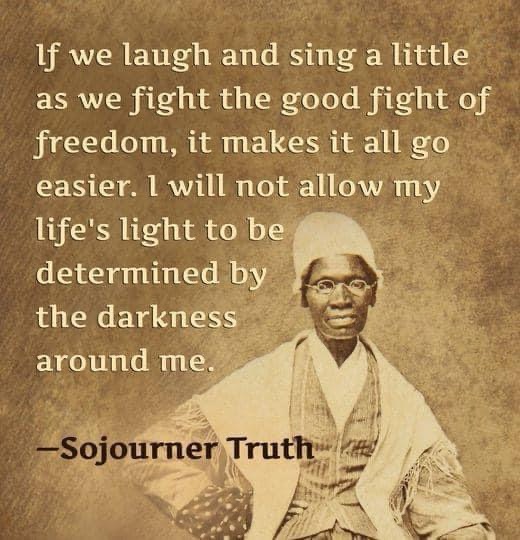
When the darkness of sin and evil threatens to drown out the light, God has always called on those like Sojourner Truth to step up and refuse to let the darkness determine our life’s light. That quote reminded me that I am always inspired by the words of another black woman, Amanda Gorman, whose marvelous poem, “The Hill We Climb,” ends with these powerful words:
“When day comes, we step out of the shade aflame and unafraid. The new dawn blooms as we free it. For there is always light. If only we’re brave enough to see it. If only we’re brave enough to be it.”
Action Steps
A Lenten challenge might be to find what God wants each of us to actually do to be the light. It may be relating to family members or co-workers in a more caring way, or volunteering for some group that you’ve always meant to get involved in, getting involved in local politics, advocating for justice by writing letters to representatives, or supporting marginalized groups. There’s plenty of darkness to go around and every ray of light does make a difference.
Prayer
O God of eternal light, the darkness scares me. I know in my head the words from the Gospel of John that assure us the darkness will not overcome the Light of the World. But my heart is not so sure! Rather than just spout pious platitudes that fall flat on their face, please give me the courage to really feel your light in my soul and the guts to go out into the darkness and be it. Amen
The fact that Ash Wednesday fell on Valentine’s Day this year has made for some clever jokes and memes. My favorite is a driver asking his backseat passenger what she’s doing on Valentine’s Day. She replies, “Rubbing dirt on peoples’ faces and telling them they are going to die.” (If you are not familiar with the Scripture used when imposing ashes on another’s forehead on Ash Wednesday that joke won’t make any sense. The words from Genesis 3:19 say, “Remember you are dust, and to dust you shall return.”)
Ash Wednesday seems a bit more real at age 77 than it did at 37 or even 57. I told a clergy friend that we were asked to ponder how much time we might have left during our worship service tonight, and he said, “That just went from preaching to meddling!”
I am also more aware of my clock ticking this year because I had what felt like a big brush with my own mortality last week. It started when a grape-sized lump mysteriously appeared on top of my shoulder. Since I’ve been having trouble with that shoulder I made an appointment to get it checked out with my orthopedic shoulder doc. But I also made the mistake of getting on the internet where I convinced myself it was a swollen lymph node. I even called my oncologist and talked to his nurse who asked several good questions. When I told her I was seeing my shoulder guy that afternoon about it she asked me to call her back after that appointment and let her know what he said before she talked to her doctor.
I was feeling some real fear of dying and wondering how I would handle a serious cancer diagnosis because I do have a so far dormant lymphoma and feared it was finally becoming symptomatic. When I got to the orthopedic office I first saw a resident, and he immediately said “I know what that is,” which seemed comforting even before he explained. His tone of voice was not ominous at all and I began to relax. He called it a “geyser something” which didn’t ring any bells, but he explained it was an eruption of fluid caused by my weakened rotator cuff. He went out to confer with the doctor who immediately came in and said it was nothing to worry about. He called it a cyst, which was a term I understand and said there was nothing we needed to do about it
I was very relieved and felt a little foolish that I had catastrophized the situation, but I’m also glad that for those few hours I had an Ash Wednesday experience of at least for a little while feeling quite dusty. What changes that semi-close encounter with mortality will make in my life remains to be seen. I hope it will help me keep things in perspective; actually work on my end of life planning and simply put things in better order physically and spiritually. Remembering February 6, 2024 will help me do that, and the harmless lump on my shoulder will be there as a visible reminder that I am indeed dust and to dust I will return.
The “He Gets Us” television ad that aired during Super Bowl LVIII has prompted a lot of criticism from many of my liberal/progressive friends because of the huge cost of the ads. Those critics argue that all those millions of dollars could have been put to much better use feeding and housing people experiencing homelessness for example.
I understand those concerns, and upon learning that the ads are funded by theologically and politically conservative donors I get it even more. I must admit however that when I first watched the ad of people of different races and ethnicities washing each others feet I was favorably moved by that message, and I am sorry to have that positive narrative spoiled by knowing the back story.
The commercials that bothered me much more on the other hand were the hyper-materialistic message of the “shop like a billionaire” spots offered from the Chinese company Temu. That self-centered prosperity gospel message is a full 180 degrees opposite to the foot washing images of the “He Gets Us” commercials, and yet I have seen no objections being raised at all about that troubling message.
Not only is materialism a huge threat to basic Christian values, these commercials come from a company notorious for undercutting prices of American manufacturers by using what amounts to slave labor.
So the question for me is one of ethics. Is it better to promote a good message for the wrong reasons or to spout a false message blatantly? The “shop like a billionaire” ads seem totally wrong-headed. God knows we already have too many billionaires (Taylor Swift being one of a few notable exceptions) using their ill-gotten wealth for nefarious purposes. Promoting the prosperity gospel to the masses of gullible people only spreads that total distortion of Jesus’ message. I don’t know if the “He gets us” sponsors get Jesus or not, and I am reluctant to sit in judgment of them. What is obvious to me is that the Temu folks most certainly don’t get Jesus, and it bothers me that no one seems to be pointing that out.
And of course the bottom line, the hard question we all need to ask is “Do I get Jesus?” Lent is a good time to ask oneself, “How much time do I spend washing feet and how much chasing after the idols of materialism?”
December 31, 1998 was one of those magical nights that fairy tales could be made of. It was exactly 25 years ago this past New Year’s Eve. The city of Columbus, Ohio held it’s very first “First Night” that year to mark the beginning of the New Year 1999. I have kept the little souvenir of that night on my desk for a quarter of a century because that event was like no other of the 78 first nights of a new year of my life.
I was single then, having ended a 30 year marriage 18 months earlier. I was also a new grandfather following the joyous birth of Olivia to my daughter and her husband in July of that year. Olivia’s dad, Drew Thomas, was and is a very good magician, and that played an important role in the real magic that occurred that First Night for me. Drew had been hired to perform one of his illusions at the stroke of midnight at the First Night celebration in downtown Columbus. The illusion was to make Columbus Mayor Greg Lashutka magically appear in an empty room. My son and I had been enlisted to help prepare the stage for that illusion in the days leading up to New Year’s Eve. Since the Mayor was not available to rehearse the illusion the day before the event I was actually his stand-in for rehearsal.
To my surprise, she not only had no plans, but was interested in joining me. It was an unusual first date in several ways. Because of my connection with Drew, we were invited to come back stage in the Ohio State house where food was available for the cast and crew. Because this was a family affair, both of my children and my young granddaughter, who was then six months old, were there. I don’t believe I have ever had a first date that involved all of my family.
At that point I had no plans to actually attend the celebration since to do so as a single didn’t sound very exciting. But as the big night drew closer my curiosity grew, and I decided I did want to see the fruits of our labor preparing for the illusion. In 1998 the phenomenon of on-line dating was in its infancy. Match.com was one of the pioneers in that industry, and I had dabbled with it a few times that year. So I decided to get back on that website and see if by chance I might find a last-minute date for New Year’s Eve. I noticed right away that one woman I had talked with the previous summer was still listed. Doubting that she would be available at the last minute I gave her a call anyway.
So after meeting the whole clan and enjoying some dinner, Diana and I spent several hours, taking in the various sites and entertainment around downtown Columbus. It was a very cold New Year’s Eve with temperatures well below freezing. So I didn’t know at the time if my date was holding my arm and snuggling close to me as we walked around because of attraction or just a desire to keep warm. In either case it felt really good. About 11:30 that evening we made our way back to the State House so we could take in Drew‘s performance.
As it turned out, we didn’t actually see what happened on stage. My daughter asked me if I would be willing to keep Olivia inside where it was warm so she could go outside and see the show. As midnight approached I was holding my precious granddaughter and standing next to my date, and it suddenly occurred to me that I had never been on a first date on New Year’s before. My dilemma was wondering if the tradition of kissing one’s date at the stroke of midnight was appropriate on a first date. Because the evening had gone so well, I decided it was worth the chance, and as it turned out, it was the first kiss of many more to come.
You see that date on our special first night was the woman who has become my best friend, companion, lover, and fellow adventurer for the past quarter century. Together Diana and I have celebrated the birth of six more grandchildren. We have each buried a parent. We have been there for each other in sickness and health. It has not been all happily ever after, of course, but the highs have far outnumbered the lows. Before I met Diana I had never been more than 1200 miles from Ohio, but thanks to here adventurous spirit together we have traveled all over North America. We have skied breathtaking mountains in 4 Western states and British Columbia. We have cruised the Caribbean and Mediterranean multiple times, climbed the Great Wall of China, toured the Colosseum in Rome, snorkeled with Sea Turtles and Manta Rays on the Great Barrier Reef, and created several lifetimes of memories all over the world that I could never have dreamed of on that First Night.
And we’re not done yet. Who knows what the future holds, but whatever it is I’m so glad I made that last-minute phone call 25 years ago that was the beginning of it all.
In this frigid cold snap we have had in Ohio recently I have been filling our bird feeders every day, and the cardinals, blue jays, woodpeckers, sparrows, and the whole wonderful diversity of our feathered friends have flocked to our yard as soon as I finish. How they communicate so quickly that it’s feeding time is a mystery to me, but they do; and I’ve decided we have very biblical birds in our neighborhood.
You see, the birds don’t ever leave food on the table or let the seeds that fall on the ground go to waste, and that has reminded me of the story in Exodus about God providing manna/bread from heaven each day to feed the Hebrews in the wilderness. As usual the Hebrew people are complaining to Moses that he has brought them out into the wilderness to starve. They say they were better off as slaves in Egypt. When Moses shares their concern with Yahweh this is the response he gets: ”Then the Lord said to Moses, “I am going to rain bread from heaven for you, and each day the people shall go out and gather enough for that day. In that way I will test them, whether they will follow my instruction or not.” (Exodus 16:4)
And God delivers on that promise, but the test is that God through Moses instructs the people to only gather enough of the manna for that day’s needs and not to try and store some up for another day. God is testing their faith to see if they will trust that each day the promise will be fulfilled again. That’s why when Jesus teaches his disciples what we now know as “The Lord’s Prayer” we are instructed to pray only for “our daily bread,” and not for a whole week’s worth. To do so is the difference between a mindset of faith in God’s providence and a scarcity mentality where we hoard more than our share of life’s resources for fear that we will run out the next day.
And that’s the way the birds in our yard live. They don’t leave any bird seed in the feeder for tomorrow because they trust that I will be faithful to meet their needs each new day. As you will see if you read the rest of the story in Exodus 16 some of God’s human children aren’t quite as trusting. And since I don’t speak fluent bird it may be that my feathered friends do complain when I’m late filling their feeders. They are much earlier risers than I; so I don’t pretend to be as faithful as God, but I can tell by the way they flock to the feeders whenever I fill them they are very grateful. And I am grateful to them for reminding me to be satisfied with my daily bread.



 Peacefully Harsh