PREQUEL TO LAZARUS UNBOUND

This post is something different than I’ve done before.  What follows are the notes I took as I dialogued with the John 11 text about the raising of Lazarus from the dead.  Although I am not preaching on this text right now, it’s an example of how I would begin to study a text for preaching.  It is the prequel to the post I wrote earlier this week entitled “Lazarus was unbound, are we?

John 11:32 When Mary came where Jesus was and saw him, she knelt at his feet and said to him, “Lord, if you had been here, my brother would not have died.”
11:33 When Jesus saw her weeping, and the Jews who came with her also weeping, he was greatly disturbed in spirit and deeply moved.
11:34 He said, “Where have you laid him?” They said to him, “Lord, come and see.”
11:35 Jesus began to weep
11:36 So the Jews said, “See how he loved him!”
11:37 But some of them said, “Could not he who opened the eyes of the blind man have kept this man from dying?”
11:38 Then Jesus, again greatly disturbed, came to the tomb. It was a cave, and a stone was lying against it.
11:39 Jesus said, “Take away the stone.” Martha, the sister of the dead man, said to him, “Lord, already there is a stench because he has been dead four days.”
11:40 Jesus said to her, “Did I not tell you that if you believed, you would see the glory of God?”
11:41 So they took away the stone. And Jesus looked upward and said, “Father, I thank you for having heard me.
11:42 I knew that you always hear me, but I have said this for the sake of the crowd standing here, so that they may believe that you sent me.”
11:43 When he had said this, he cried with a loud voice, “Lazarus come out!”
11:44 The dead man came out, his hands and feet bound with strips of cloth, and his face wrapped in a cloth. Jesus said to them, “Unbind him and let him go.”

John 11 includes the familiar story of the raising of Lazarus from the dead. There is no suspense or surprise about the outcome of this story.  Most of us know how the story ends, but the various theological assumptions revealed by how people respond to Lazarus’ death are worth careful examination.  (NRSV) 

The passage opens with Mary scolding Jesus for not being there sooner to keep her brother from dying, just as her sister Martha had done in verse 21.  We are not ever told Lazarus’ cause of death, but Martha and Mary apparently believes in a God who won’t let bad things happen to good people.  Earlier in the chapter John makes a point of telling us what a faithful disciple she was by reminding us that Mary has been in charge of the church kitchen for as long as anyone can remember. (Actually it says “Mary was the one who anointed the Lord with perfume and wiped his feet with her hair.” 11:2).  Mary’s complaint is more confusing because we know from the early part of this chapter that Jesus has said Lazarus will not die, but his illness is “for God’s glory, so that the Son of God may be glorified through it.” (Vs. 4). 

Does that sound a bit self-centered for Jesus?  It does to me.  John tells us repeatedly how much Jesus loved Martha, Mary and Lazarus, and yet he uses their suffering for his own glorification?  In fact John tells us in verse 6 that “after having heard that Lazarus was ill, he stayed two days longer in the place where he was.”  And it gets worse.  It isn’t that Jesus doesn’t understand the severity of Lazarus’ condition.  After using the euphemism of sleep to describe Lazarus’ conditions, he learns that, as usual, the disciples don’t get it, “then Jesus told them plainly, ‘Lazarus is dead.’”  (Vs. 14).  

All of that is back story and laden with John’s own theological perspective on the divinity of Jesus.  Ironically this passage also is most famous for the shortest verse in the Bible, in some translations, that shows Jesus in one of the most human moments in the Gospels.  Jesus weeps over the death of his dear friend and John tells us twice to be sure we get it that Jesus was “greatly disturbed.”  Even that quite natural emotion in the presence of death gets interpreted differently through two theological lenses.   Some of the spectators see Jesus’ tears as a sign of how much he loved Lazarus while the critics murmur that Jesus who has a great track record of miracles really could have saved Lazarus if he chose to.  

Speaking of theological lenses, John makes sure to let us insider readers of his Gospel know what the real subtext of this whole scene is.  There is a large stone in front of the tomb where Lazarus has been for four days.  Wouldn’t 3 days have been a better analogy to Jesus time in the tomb?  And yes, Martha reminds that the body is going to stink because he is really dead.  And then after John inserts an aside between Jesus and God to be sure we all understand this is all done for the glory of God, Jesus shifts to the imperative tone.  He says in a voice so loud the dead can hear it, “Lazarus, come out!”  

And then he does the second imperative: “Unbind him and let him go!”

What do we need to be unbound from to really come alive?  That question can take those who hear it in many different directions— materialism, nationalism, self-centered ness….

Emptiness – letting go, being unbound from striving for meaning –unbound from fear, doubt, anger, things that don’t satisfy the soul.  For those of us forced to let go of so many things in old age it can be anger, frustration, hopelessness, resentment, or mistrust. 

Lazarus’ resurrection led some to believe and some to go to Caiaphas and start plotting the crucifixion of Jesus as a sacrificial lamb to save the nation.  What rationalization do I use to justify my own selfish desires?  

Unbound: Lazarus was, are we?

What do tennis, hiking, golf, biking, jogging, working on a ladder, and skiing all have in common? They are all things I have had to give up in the last 10 years due to the aging process. I was talking to a friend my age who has given up even more things than I, and when I described my emotional state as “feeling empty” and not having anything to fill the space left by all I’ve lost. The words were barely out of my mouth when my friend said, “That’s exactly how I feel!” Like all of my friends, we have often joked in years past about old people always complaining about their aches and pains all the time, but more and more as we navigate our 70’s we find ourselves doing exactly the same thing.

I remember about 12 years ago asking an “older” gentleman what he was doing in retirement. Without missing a beat he said, “Going to doctor appointments and funerals.” I thought that was funny back then, but I’m not laughing anymore. When I told my friend that I was seeing a counselor about my feelings of emptiness and depression his response surprised me. After asking if the therapy was helping he said, “Thanks for sharing that. I always thought you had it all together. But knowing you are feeling the same things that I am makes me feel not so alone.” That wasn’t a “misery loves company” response; that was the blessing of letting down our armor and being vulnerable.

I’m not patting myself on the back, mind you. I have been good friends with this man for over 50 years. We have gotten together for golf and/or lunch monthly for decades until old age took our clubs away. Now like many oldsters we just go to Bob Evans. We’ve developed a trust over the years, but the fact that he still thought I “had it all together” means I’m either a better actor than I thought or I’ve been much less honest with him than I wish I had. I’m hoping this recent conversation will help us stay on a more vulnerable level going forward.

Here’s the good news. In addition to my therapist I am also working with a spiritual adviser, and when I shared this story with him he reminded me that until we empty ourselves of all the busyness and activities that keep our minds off our pain God can’t fill us up with anything else. A light bulb went on for me when he said that because when you hear truth it illumines things around and within you. He helped me realize that instead of resenting the emptiness I am feeling I can choose to embrace it as a gift from God. That doesn’t mean the UPS is going to arrive at my doorstep with God’s gifts anytime soon, and no that’s not because of a supply chain issue. Spiritual growth takes time and a willingness to sit with pain or emptiness awhile.

The Hebrews were in the wilderness for 40 years, not because it takes that long to travel from Egypt to Israel or because Moses refused to ask for directions. Even Jesus spent 40 days in the wilderness wrestling with Satan because deep spiritual growth takes time to mature and ripen. The advice to “be still and know I am God” may sound really simple, but it’s not just a matter of shutting up for a few minutes so God can speak. It means prioritizing time for prayer and silence, and not the kind of prayer where we just tell God what we want or need.

Jacob wrestled with God all night long and was changed forever by that experience. Moses and Elijah both had to go up to Mt. Sinai/Horeb to hear God’s still small voice. I confess I am not good at silence. Even when writing these posts I frequently have a ball game on TV or music on some device. I know I write so much better when I am in a quiet place as I am while I write this, but like Paul I often fail to do the things I want to do and don’t practice what I preach.

The Gospel lesson for All Saints day this year is from John 11, the familiar story of Jesus raising Lazarus from the dead. There are many rich veins of truth to mine in that story, but two stand out for me just now. This chapter contains what every kid in Sunday School loves to memorize, namely the shortest verse in the Bible: “Jesus wept.” This is one of several times in the Gospel narratives that we see Jesus vulnerable and allowing his humanity to show through. Like us he grieves over a loss, even though we and he all know he’s going to restore Lazarus to life.

The second verse in that lesson that grabbed my attention this year was the last one where Lazarus emerges from the tomb all bound up like a mummy. He’s alive but not really. His movement and sight and vision are all hampered by his grave clothes???, and Jesus says, “Unbind him and let him go.”

What are the things that bind you and me and keep us from living abundantly in the reign of God? Are we so stuck in our old ways that as Martha so indelicately puts it in the King James Version, “He stinketh,”. My wife sells a very good air purifier that kills germs and removes odors, even in cars or houses that have been skunked. But even those machines will not remove the kind of stench that comes from us who are spiritually dead and don’t know it.

My prayer is for God to unbind me from the anger, fear and regret that I feel for all the things I’ve lost in this stage of my life. Unbind me, Holy one. Roll away the stone that keeps me trapped in a pity party for my past. Unbind me and let me embrace what is and what will be if I trust you to lead me.

What’s your prayer for new life?

Election Blues and Faithful remnants

“The lame I will make the remnant, and those who were cast off a strong nation.”  Micah 4:7

Is it possible to be very pessimistic about the future of American democracy and simultaneously confident in the future of its ideals drawn from the best of Judeo-Christian values?  It is on the horns of that dilemma I find myself as I near the end of my 75th orbit around the sun.  The euphoria I felt a year ago when Donald Trump was soundly defeated in his bid to be re-elected dictator of the U.S. has given way to despair as I watch the democratic party described by Will Rogers when he said, “I don’t belong to any organized political party; I’m a democrat.”  Now that inter-party warfare threatens to doom the Biden presidency and in the process throw open the doors of the US Capitol so the failed coup attempt of January 6 can be successfully completed at the polls in 2022 and 2024.

I have voted faithfully in every election since 1968, but this year I am so discouraged by the way the bitter politicization in our country has infected even local elections for school boards, city councils, and township trustees that I am tempted to throw up my hands and not even vote. Politicians have always exaggerated and lied about reality to get votes, but this year 90,000 Americans have died unnecessarily because political lies have become more deadly than the Delta variant of COVID-19.

As the news plays on my radio or TV I hear Amos warning against the sins of Israel. I see Jesus weeping over Jerusalem because she would not listen to his words of salvation and peace. I see shock on the faces of those who have bought the lie of American exceptionalism as they try to wipe the mark of the beast off their faces on the day of Armageddon.

But deeper than my despair I also know that the reign of God is not dependent on sinful mortals. I feel in my dry bones the salvation history revealed throughout the Scriptures that there has always been a faithful remnant preserved from any tragedy that rises from the ashes of earthly kingdoms to carry on the eternal torch of God’s holy shalom.

There are 82 references to “remnant” in the Hebrew Scriptures.  These references are not about left-over pieces of fabric, but about those who are left out and powerless according to worldly ways.  Through flood, slavery, exile and even execution of the Messiah the solid rock of truth has survived as the foundation of life itself. The earthly power of Pharaohs, Jezebel, Nebuchadnezzar, Herod, Pilate, Hitler, Stalin, Pol Pot, and all the others named and unnamed in our history books is as flimsy as the fakery of the Wizard of Oz.

The creator of our universe will still prevail with or without us, even if we succeed in our blind foolishness and destroy the earth itself. Dr. King was right that the arc of the moral universe is long, so long that we cannot see the end. It is as unattainable for mere humans as the pot of gold at the end of a rainbow. So just now we despair because that arc of morality seems twisted and malformed in our finite ability to envision the mystery of the future. But I still dare to believe that it bends toward justice, maybe not in the dwindling short term of my lifetime, but in God’s eternal kairos.

From the perspective of 3/4 of a century of life on this planet this much I know, maybe not in my feeble brain but “deep in my heart,” the great old protest song “We Shall Overcome” is true. That “someday” of justice may not be on any human calendar, but it will come in God’s good time; and on that hope I must hang my hat, especially in such trying days as these.

Human Doings

I don’t remember where I first heard this piece of wisdom, but it surfaced from my memory bank today as I was mowing our lawn. The sage advice comes from that philosopher known to my generation as “Old Blue Eyes.” No, you don’t have to Google that, I’ll tell those of you too young to know, it’s Frank Sinatra. One of Sinatra’s many hit song was “Strangers in the Night,” and that song has a profound refrain that goes “do be do be do.”

That nonsense phrase truly became profound for me when someone pointed out to me that if you take the “be’s” out of that phrase all you have left is “do do.”

We all make “to do” lists, and there are even apps that will help you organize your to do list(s), and I’m guessing most of us have more than one. I’ve tried multiple ways to keep, organize, and prioritize my personal and professional tasks over the years, and if anyone tells you that retirement means you can throw your to do lists away, don’t believe them.

Most of you know I’m older than dirt; so I don’t have to worry about dating myself when I reminisce how years ago all the United Methodist pastors I knew organized their lives in a small pocket sized calendar. It came in the mail every year from our denominational publishing house, and it was free; so few of us ever questioned its efficacy. My only complaint about it was that since it also had pages in the black that served as an address book all of that information had to be updated and re-entered into the new little black book every January.

Somewhere along the line I let my human doings multiply, and I had to learn to write smaller to fit each day into a tiny space, and of course because life is full of surprises, to never write anything in ink. So when it was introduced I became an early adopter of the Palm Pilot, remember those? They were basically a digital calendar and address book that replaced paper calendars and Rolodexes in one handy gadget that didn’t have to be replaced or updated every year. And of course the Palm Pilot was soon replaced by iPhones and Androids that could do all those things and serve as a phone too, and eventually took over our lives by adding internet access.

Sorry to get distracted going down memory lane. My initial point was to reflect on being and doing. We all have to do lists regardless of how we record them, but who has a “to be” list? My reflections on that question emerged because I am home alone this week while my wife is visiting family in Texas. I had grandiose plans for the week: to organize my office that resembles the aftermath of a natural disaster, to clear out and donate clothes I no longer need, and even to sort through several drawers in my desk and bathroom which should say “Enter at Your Own Risk!”

Oh, and my to list for this week also included the simple task of assembling a new exercise bike that is still in a million pieces in my basement. I am now more than half way through the week, and not one of those major projects is even started and somehow my to do list is even longer than it was on Sunday. And I have been busy all week – going to doctor appointments, running errands, swimming at the Y to maintain what little physical fitness I have left, and oh yes, dealing with the aftermath of a car accident I had about a month ago.

I may deal with the latter issue in another blog, but suffice it to say for now that I have been somewhat overwhelmed with the complexities of filing insurance claims, arranging rental cars and other transportation, while still trying to keep up with my daily activities as much as possible.

Another big item on my “to do” list for this week was to do some writing. I’ve had multiple ideas for blog posts in the last three weeks but have not had or taken the time to pursue them. So today while mowing the lawn (which should not still be growing in October, right?) I made an executive decision to just stop, put the to do list on hold, and see what emerges if I start trying to capture a somewhat chaotic collection of thoughts and feelings in writing.

What I’ve been reminded of in doing that is how difficult, if not impossible, it is to flip a switch from being a human doing governed by the almighty to do list to reflecting on being itself. I believe the reason for that is that digging into our inner lives is 1) hard because we aren’t used to going there, and 2) scary because we may not like what we find. And once we look honestly at what meaning or purpose our lives really have we can’t unknow it. That toothpaste will not go back into the tube no matter how hard we try to put it there.

What I know for sure from trying to write this after a busy day of doing is that awareness of my being needs to inform all of my doing. If I try to separate the two I am too tired from doing to really give any meaningful attention to my inner/spiritual being.

OMG!

Oh My God, I am bone-tired weary. I am already physically and emotionally exhausted from personal challenges and the chaos in the world is more than I can even bear to hear about. 8000 plus new COVID cases in Ohio today, 240 COVID deaths Statewide just this week alone — all so unnecessary and down right stupid. Throw in a tsunami of gun violence and deaths, probably in part caused by the stresses of the pandemic that refuses to end. Are we stronger and smarter than this ever-changing corona virus? According to the overflowing ICU numbers and the number of foolish, misinformed people still refusing to get vaccinate it would seem the virus is definitely winning.

On a more cosmic scale I hear that the hole in ozone layer over the South Pole is now larger than the entire continent of Antarctica. Floods, fires, and hurricanes of epic proportions still cannot convince most of us to admit our addiction to fossil fuel that, like most addictions, is killing us in bigger numbers every year. Yes, I know you showed Elijah that you were not in the earthquake, wind, or fire* but in the still small voice. You tell us to be still and know you are God, but Lord, it is so hard to be still in the midst of chaos. Yes, I know Jesus slept through the storm in the boat, but I am like the disciples who were afraid and chastised Jesus for napping while they were in mortal danger.

There is no off switch on my worrisome brain. Yes, I can sometimes shut off all my devices and not listen to the 24/7 news, but it is so much harder to still my mind and soul. Speak to me, Lord of the universe. Reassure me you are walking through this difficult time with me, carrying me or (dragging me if necessary) when my legs are too weary to keep going. Speak to the storm and calm the turbulent sea within my heart. I believe O God, help my unbelief. Amen

PS: I’m grateful to report that as it often does when I “take it to the Lord in prayer” I feel much better. I can’t explain how that works. I just know it does.

*Bible references: I Kings 19:12, Psalms 46:10, Matthew 8:24, Mark 9:24

9/11 Memories and Dreams

I am listening to 9/11 memorial services, reading of all the names of those who died that day, except of course the terrorists. Who mourns for those enemies Jesus tells us to love?  What families did they leave behind?  What legacy of anger and malice drove them, and how contagious was/is that vengeance in our response.  No turning the other cheek here, just promises as recently as last week from President Biden to “hunt you down.”  What if we could sit down and break bread instead of breaking heads?  Is that a pipe dream, a hopelessly naive fantasy?  If it is what hope is there for a world that will ever at peace?  And I’m not talking about peace through mutual assured destruction but true peace through unity, through the ties that bind us all together as passengers on spaceship earth. 

Has there ever been a time in human history free from conflict and war?  Ever since Adam and Eve were evicted from the garden and the following fratricide between their sons the human family has been hell bent on creating more deadly and efficient ways to assert power over one another.  What if all that “creative” energy to invent smart bombs, split atoms and destroy one another could be channeled into learning ways to save our planet and all the creatures God has entrusted us with?  Even on this day when we relive the horror of 9/11 I still dare to hope for a time when God will “pour out my Spirit upon all flesh, and your sons and your daughters shall prophesy, and your young men shall see visions, and your old men shall dream dreams.”  (Joel 2:28, Acts 2:17)

Because like the cockeyed optimist nurse Nellie Forbush sings in the great musical by Rodgers and Hammerstein,  “South Pacific,” “I’m stuck like a dope with a thing called hope, and I can’t get it out of my heart – not this heart.”

No Short Cuts

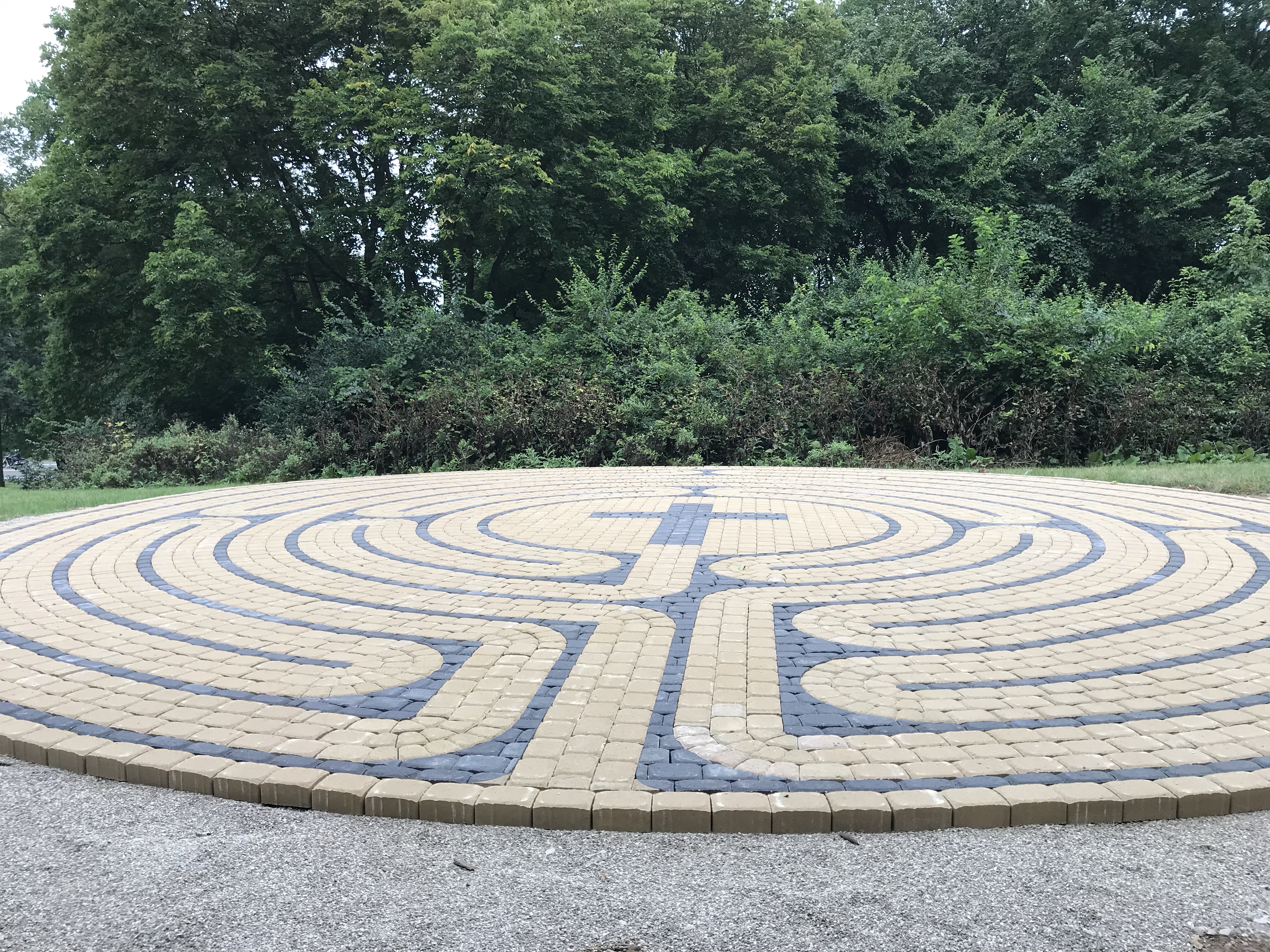
I walked our church’s new labyrinth this morning after church. I think it is the most beautiful one I’ve ever seen and am so grateful to those who worked to build it. I know it’s true of all labyrinths, but I was struck again today by how close one gets to the cross in the center on numerous occasions only to turn away and double back in the other direction. Isn’t that true of our faith journey? We feel especially close to God one minute, and the very next life hits us with a body blow we didn’t see coming; and all of a sudden God seems so distant that we feel lost and confused. That’s when spiritual discipline is needed to stay the course and trust that road less travelled will eventually lead us back to the cross.

There are no short cuts in our faith journey, only perseverance and trusting the Holy Spirit to lead us home. If you notice in the picture the entry path very quickly takes you within a few feet of the cross before it takes a sharp left turn that leads to the far side of the labyrinth. It would be so easy to step right over that blue line and in two steps be right at the foot of the cross. No one else was there to see if I cheated when I took my walk, but I knew that those who promise a short easy way to salvation are false prophets. To take a short cut would have robbed me of precious time for communion with God and defeated the whole purpose of being there.

Dog Food: Mark 7:24-37

“Now the woman was a Gentile, of Syrophoenician origin. She begged him to cast the demon out of her daughter. He said to her, “Let the children be fed first, for it is not fair to take the children’s food and throw it to the dogs.” (Mark 7:26-27)

That interchange has to be one of the most unChrist like things attributed to Jesus in any of the Gospels. The only similar verse which is even worse is in the Sermon on the Mount and lacks the context of Mark’s narrative. There Jesus just states “Do not give what is holy to dogs; and do not throw your pearls before swine, or they will trample them under foot and turn and maul you.” (Matthew 7:6)

In Mark’s narrative the dialogue is with a Gentile. And it would seem the distinction Jesus is making is that the Jews are God’s children and others are not. In all honesty I have not researched what biblical scholars have to say about how to interpret this text. One possibility that comes to my mind is that maybe Jesus was just having a bad day and didn’t want to be bothered by this woman’s request. If Jesus is fully human he certainly must have had times where just needed a break.

In fact Mark tells us in verse 24: “From there he set out and went away to the region of Tyre. He entered a house and did not want anyone to know he was there.” Any pastor can identify with the need to go off the grid once in awhile to recharge. One of the best pieces of advice I got early in my ministry from one of my mentors was to always take a day off each week and get out of town so people won’t bother you. That was way before cell phones or even pagers made it harder to get away, and it is even more difficult and tempting to check for texts and emails 24/7 today.

We didn’t call it self-care back then, but that’s what it is. Jesus is usually pretty good at going off by himself to pray when he needs to, or at least he tries. Mark is the most intriguing of the Gospels in that regard with all the references to the Messianic secret. The verses for September 5th’s lesson are bookended by two such references with the second coming in verse 36: “Then Jesus ordered them to tell no one; but the more he ordered them, the more zealously they proclaimed it.”

Jesus’ desire for some solitude is denied him twice in this short passage. The conclusion to verse 24’s statement that Jesus didn’t want anyone to know he was there says, “Yet he could not escape notice.” So maybe he was just frustrated. He figured that getting out of the country would offer a respite from the clamoring masses, but even in Tyre he couldn’t catch a break.

Throughout all the preceding chapters of Mark crowds are continually flooding Jesus with their needs to be healed. And in chapter 6 the feeding of the multitude story begins with Jesus expressing concern for his disciple’s self-care. They were so busy they didn’t have time to eat! I don’t know about you, but if I’m too busy to eat I get hangry pretty quick. So Jesus suggests they go off “to a quiet place” for some R & R. But the crowds got there first, and Jesus “had compassion on them because they were like sheep without a shepherd.”

That sounds more like the Jesus we want when we call him for help. So how do we reconcile that compassionate Jesus with the one one who calls Gentiles dogs in chapter 7? Other than my speculation above I am not sure, but I am intrigued with how quickly Jesus changes his tune when the woman responds to him, “Sir, even the dogs under the table eat the children’s crumbs.”

I think it’s an interesting coincidence that this narrative pivots on this comment about dogs when national dog day was this week. I enjoyed seeing everyone’s pictures of their fur babies on Facebook, but more than that I see a connection between this story from Mark with reading I’ve been doing recently about mysticism and the cosmic Christ.

In verses 29 and 30 we find Jesus’ response to the woman’s argument that even the dogs eat the children’s crumbs. “Then he said to her, “For saying that, you may go–the demon has left your daughter.” So she went home, found the child lying on the bed, and the demon gone.” What is there about the woman’s comment that made Jesus completely reverse himself? Could it be Jesus recognized the truth in her statement that all of creation is intrinsically connected as part of God’s creation?

Father Richard Rohr’s daily devotion for Aug. 27 contains this quote from the Celtic theologian Pelagius: “Look at the animals roaming the forest: God’s spirit dwells within them. Look at the birds flying across the sky: God’s spirit dwells within them. Look at the tiny insects crawling in the grass: God’s spirit dwells within them. . . . Look too at the great trees of the forest; look at the wild flowers and the grass in the fields; look even at your crops. God’s spirit is present within all plants as well. The presence of God’s spirit in all living things is what makes them beautiful; and if we look with God’s eyes, nothing on the earth is ugly.” (The Letters of Pelagius: Celtic Soul Friend, ed. Robert Van de Weyer, p. 71)

Rohr comments: “Because Pelagius saw God as present within all that has life, he understood Jesus’ command to love our neighbor as ourself to mean loving not only our human neighbor but all the life forms that surround us. ‘So when our love is directed towards an animal or even a tree,’ he wrote, ‘we are participating in the fullness of God’s love.’”

And Rohr concludes that devotion with these words from Thomas Berry, a modern mystic: “In reality there is a single integral community of the Earth that includes all its component members whether human or other than human. In this community every being has its own role to fulfill, its own dignity, its inner spontaneity. Every being has its own voice. Every being declares itself to the entire universe. Every being enters into communion with other beings. This capacity for relatedness, for presence to other beings, for spontaneity in action, is a capacity possessed by every mode of being throughout the entire universe.” (Thomas Berry, The Great Work: Our Way into the Future (Bell Tower: 1999), 3.)

Maybe Jesus recognized that cosmic spirit in the Syrophoenician woman’s compassion for the canine part of creation and that universal nature of her faith inspired him to extend his own cosmic healing power to her daughter.

Power Washing and Baptism

What do mustard seeds, rainbows, lost sheep, an expensive pearl, yeast, and wine have in common? They and many other common everyday things are used in the Judeo-Christian Scriptures to describe the kin-dom of God, and still today every once in awhile God sneaks a little theology lesson into the most ordinary moments to remind us that the line we draw between “sacred” and “secular” is an imaginary line. Those ah hah moments are all around us, and I would “see” many more of them if I wasn’t distracted with other things.

I had one of those serendipities yesterday while doing a most mundane chore. The picture here is of the deck at the back of our house. This deck has to be cleaned at least annually, but because of my back trouble it didn’t get done last year. Hence it was dirtier than usual this year, which is illustrated in the picture. The section of the deck on the right here has been cleaned, while the part on the left is what the condition was before cleaning.

This is no job for ordinary cleaning. Mold and grime congregate on this deck because it is shaded most of the day and doesn’t get the sun’s solar cleaning rays. So this task calls for a power washer and the patience to clean one small section of each board at a time. The deck is not very large, about 12′ x 20′ or 240 square feet, which doesn’t sound too daunting. But remember I’m cleaning with a stream of water that covers an inch or so at a time. I’m sorry I did the math that way because when multiplying 240 square feet times 144 square inches per square foot I get a total area of 34,560 square inches.

God speaks to us in mysterious ways if we’re listening, and I’m glad I decided to just do it yesterday because as I started the power washing process the Holy Spirit whispered in my ear one of my favorite lines from the musical “Godspell.” Near the beginning of that wonderful play Jesus comes to the Jordan River to meet John the Baptist. When John inquires of Jesus why he is there Jesus says, “I came to get washed up.”

That image helped me see my deck-cleaning job through a theological metaphor for baptism. But this is not the sanitized, watered-down version of baptism we practice today which usually leaves no signs of dramatic change from a few drops of water sprinkled on the head of one who often is so young as to have no idea what’s going on.

True baptism or baptism by the Holy Spirit is a life-changing transformation, and for most of us it requires more of a power washer blast than a sprinkle. My deck looks radically different when it’s clean, and yet the power washer can’t hold a candle to the power of the Holy Spirit. We celebrate the Damascus Road conversion kind of change God can bring into a life, but most of us don’t want to be knocked off our comfortable horses and be made blind for three days that may come with that in-dwelling of the Holy Spirit. (See Acts 9:1-19)

Procrastination is one form our resistance to change can take. I can find a million excuses for not cleaning my deck. It takes a couple of hours and is pretty boring most of the time, especially if my self-talk stays focused on how boring it is. I’m grateful God got through to me yesterday so I could not only clean the deck but could ponder again the mystery of God who is everywhere, even in scuzzy, moldy deck boards and power washers.

Our current existential crises calls for a power washer baptismal experience. We need to bring out the heavy artillery because those who dare to follow Jesus’ vision of a new way of living are automatically in conflict with the powers and principalities of the world. We cannot just call on Mr. Clean who claims to “get rid of grease and grime in just a minute.” Jesus’ followers are in this for the long haul and need daily and maybe hourly reminders of who we are, whose we are, and who we are becoming. Legend has it that Martin Luther reminded himself of his baptism every time he bathed.

What are you doing today that might be a vehicle for God’s transforming power? Put your theological Ray Bans on and tune your self-talk to the Holy Spirit network, and you may be pleasantly surprised.

Stop, Hear, Do!

“Religion that is pure and undefiled before God, the Father, is this: to care for orphans and widows in their distress, and to keep oneself unstained by the world.” (James 1:27, Lectionary text for 8/29/21)

There are 29 references to “widows” and 16 to “orphans” in the NRSV of the Bible. They are mentioned so consistently throughout Scripture of course because without a male protector they are the most vulnerable people in patriarchal biblical society; and that means they need the most help. I get that, but sometimes I just need a rest from the Social Gospel.

This is one of those weeks. Call it compassion fatigue, burn out, or just too pooped to participate. This week’s 24/7 news cycle has gone over the top with natural and human catastrophes. I’m sorry, Lord, but I’ve just had to turn the news off. One more report of a hurricane on top of an earthquake, wind and wild fire, one more gut-wrenching video of Afghan refugees climbing on to a moving aircraft to flee their homeland, one more story about school-age kids and teachers being caught in the political theater of the absurd about masks and vaccines for COVID may just be the final straw that pushes me over the edge.

It’s the blame game that is wearing on me the most right now. In the midst of all this chaos instead of joining forces to solve any one of these crises our state and federal leaders are redoubling their tug of culture war to find some political advantage in the worst situations. They seem oblivious to the reality that we are entering COVID 4.0 because the whole pandemic was politicized from Day 1.

Maybe the first step for people of faith or political leaders should be “First, Do No Harm” from the Hippocratic Oath. Not only are we failing miserably in taking care of widows and orphans, self-serving decisions have produced more poor, more widows and orphans left behind by the 623,000 plus Americans who have died from COVID so far. One headline today said, “Couple from LaMarque, Texas Who Didn’t Trust the Vaccine Have Died Leaving Four Orphans Behind.”

With all the resources the United States has, leading the world in the number of COVID deaths is beyond inexcusable. Scoring political points has trumped the use of time-tested public health tools like masks and vaccines to protect the most vulnerable.

Sure some of the finger pointing and political posturing goes with the territory because we are all caught in the matrix of a never-ending campaign cycle. I remember thinking last November after the election that I would get a breather from requests for campaign donations bombarding my inbox! How naive I was! And the requests just keep growing, coming from all over the country, not just from my own state. Perpetual campaigning leaves no time for actual governing! It is madness, not to mention an obscene waste of time and money. And the constant struggle for power and influence by the wealthy class is threatening to erode the very foundations of our democracy. How absurd is it that we may still be litigating the election results of 2020 when it’s time to cast votes in 2022.

Back in 2005, a time that seems so quaintly simple compared to the 2020’s, my wife and I participated in an intensive personal development program offered by Klemmer and Associates in California. There were many great life lessons we learned experientially in those workshops, but there is one gem that stands out for me, especially in a time like the one we are in now.

The focus of that program was learning how to set SMART goals for oneself and learning skills to overcome the internal and external obstacles that stand in the way of achieving them. The blame game is one major hurdle most of us have to overcome to change a habit and get unstuck. To lose weight, to risk pursuing a new career, to be vulnerable enough to take a significant relationship to a new level of intimacy, whatever the goal may be one commonality is that blaming others for why we cannot achieve a dream or a goal is totally counterproductive.

The most helpful advice I learned from Klemmer is that instead of blaming others or circumstances for whatever we want it is much more productive to ask three simple questions: “What worked? What didn’t work? What next?” How different might the current catastrophe in Afghanistan look if we asked those pragmatic questions instead of just trying to pin the blame on somebody else. There is more than enough blame to go around for 20 years of killing and mayhem in Afghanistan, and that doesn’t even count the equally bad track record the Russians and the British had there before us.

Just like COVID war produces widows and orphans. For what? Victory? How does one keep score in the game of war? The long bloody trail of human history should have taught us long ago that there are no winners in war. Each war begets the next ad infinitum. What might it mean for Americans to ponder what it means that World War II was the last war where we can count any kind of victory? Could it be that war has finally outlived its usefulness 2500 years after Isaiah and Micah both dreamed of the day when we would “beat our swords in to plowshares and our spears into pruning hooks?” (Isaiah 2:4, Micah 4:3)

Isn’t that the word that James wants Christians to be doers of? Talk is cheap. We pay lip service to pious platitudes about loving our neighbors and even our enemies, but who among us is really brave enough to walk that walk?

What have we got to lose? The way we have been trying to use “power over” others, especially in a toxic version of masculinity, simply isn’t working. Gun violence, raping the very planet we depend on for life itself, bitter partisanship instead of collaboration to solve problems that threaten the existence of the human race itself are all symptoms of humanity’s terminal illness.

Is it to late to be doers of the word instead of just hearers? Maybe a better question is are we even listening to the Word any longer? Do we have ears to hear? Are the noisy gongs and clanging cymbals of greed, consumerism, zealous nationalism, and rugged individualism so loud they drown out the “still small voice of God?” (I Kings 19:12).

Matthew Fox describes our plight quite well in his Daily Devotion from August 9: “A prime idea of the Bible, from Genesis to Revelation, is its very straightforward critique of misuses of power. From the very beginning, the Bible undercuts the power of domination and teaches us another kind of power: powerlessness itself. God is able to use unlikely figures who in one way or another are always inept, unprepared, and incapable—powerless in some way. In the Bible, the bottom, the edge, or the outside is the privileged spiritual position. This is why biblical revelation is revolutionary and even subversive. The so-called “little ones” (Matthew 18:6) or the “poor in spirit” (Matthew 5:3), as Jesus calls them, are the only teachable and “growable” ones according to him. Powerlessness seems to be God’s starting place, as in Twelve-Step programs. Until we admit that “we are powerless,” Real Power will not be recognized, accepted, or even sought.”

I love the quote attributed to Winston Churchill that says, “You can always count on Americans to do the right thing – after they’ve tried everything else.” It seems to me we’ve about exhausted “everything else.” Maybe we’re about ready to be doers of God’s way – collaborating, sharing, caring more about all of humankind and creation than our own bottom line? That’s what James calls “pure religion.” Others call it the peaceable kin-dom that God has put within each of us. That beloved community can only emerge like a butterfly from its chrysalis if we can learn to be unstained by the deadly values of the world.

The other very familiar verse from James is 2:26 which says “Faith without works is dead.” Without a major shift in our values, so are we.