Holy Roller Coaster Whiplash

Diana and I went with some family members recently to an amusement park-first time in years, and I had no intention of riding anything wilder than a Ferris Wheel. But you know how peer pressure is even at my advanced age. So I rode a couple of the “milder” coasters, and I use that term loosely. I opted out of things that went upside down but discovered that the old wooden coasters bang you around even more than some of the newer ones. One called the Blue Streak finished me off, and I was glad to find my head still attached to my body when it was done slamming me first one way and then the other.

That’s how I feel about consuming news in any form these days. We all know the stock market has had more dips and plunges in the last two weeks than most coasters, but trying to keep up with the shifting sands and contradictions coming from the White House has been equally disorienting.

In just two weeks we’ve had 3 mass shootings, on-again off-again Chinese tariffs, strange talk about buying Greenland and a cancelled state visit to Denmark. More EPA regulations have been shredded; background checks have been on the table again and off once more. The Emma Lazarus poem on Lady Liberty has been rewritten, as have rules now allowing the indefinite incarceration of migrant children, and the aforementioned stock market highs and lows.

With that entire dizzying blur of reality coming at me I need to pray. Yes, I know “thoughts and prayers” have become a pious platitude that sometimes excuses inaction, but like that seat belt holding me into the roller coaster I need a solid grounding in something bigger and stronger than my puny self before I can even begin to know how to put thoughts and prayers into action. So, let us pray:

O God, I feel you calling me to a higher place where things will make more sense than the crazy world I’m living in. I love that feeling of being embraced in your presence. I feel you near me in summer nights when even the crickets are chirping your glory. I sleep securely in the faith that you never rest from watching over your children. A new day dawns in all its splendor, but then we crest that first big hill and the bottom drops out. The news is about bullet proof backpacks for innocent children and others who are frightened, alone, bereft of parents and life necessities because they come from the wrong side of an imaginary line we humans have drawn to divide some of your children from others.

The roller coaster of life careens around corners where we look for active shooters, past free-falling retirement accounts, endangered species, and climate refugees. We grasp at anything to hang on to as we fly up another hill only to plunge again into the abyss of loneliness and insecurity. We dare to open our eyes long enough to catch a glimpse of sisters and brothers hungering for food and others fighting the demons of addiction. We want to reach out to them, but we’re too afraid for our own safety to let go and extend a hand.

Values like compassion and kindness that we have relied on forever seem to be no more. Everyone is too busy hanging on for dear life to pay attention to fellow passengers on the coaster. We are connected and share a common fate, and yet we feel isolated and alone, helpless and at the mercy of those who build and operate the ride. We are only passengers, out of control.

Some people seem to like the chaos, the adrenaline rush, but it is too much, too fast for me. My mind can’t make sense of the 24/7 news cycle that bombards me with yet more natural and unnatural disasters. When will it stop? I don’t know if I can take it much longer, Lord! Are you on the coaster with us? Does it look less frightening from your perspective, wherever you are?

And then this part of the ride is over. We jerk to a stop and emerge on wobbly legs back into the broken world we call home; and soon we are searching for another escape from whatever new catastrophe awaits if we dare turn on the news again.

I need a sabbatical, a place of respite from the daily drama of Breaking News. But the world is too much like the amusement park, all noise and lights. I can’t see the Milky Way because light pollution robs me of the awesomeness of the universe. Traffic noise, cell phone notifications, construction crews bulldozing yet more trees and paving over more of Mother Earth. Make it stop, Lord! I can’t hear your still small voice above the din, and I have never needed to hear it more.

Oh, let me find that inner stillness, that holiness of true communion with you that transcends my fear, that smooths out the highs and lows of life, and calms my troubled soul so I can let go of my security blankets and extend an open hand to my sisters and brothers.

I am still, and you are God; and that’s all I need to know. Amen

Hide and Seek, Sermon on John 20:19-31

A young boy was out walking with his mother and out of the blue asked, “Mom, how big is God?” The mother thought a moment and noticed a plane flying overhead high in the sky. She pointed to it and asked her son, “How big does that plane look, Ryan?” He said, “It looks really small.” “Remember that when we go out to the store later today,” was the mother’s reply.

I’ve been thinking this week about a question Pastor Mebane asked in her Easter sermon last week. The text for last week’s sermon told how two of the disciples run to the empty tomb and find only Jesus’ grave clothes there. John tells us, “Then the other disciple, who reached the tomb first, also went in, and he saw and believed.” Mebane’s question was about how long it took between when the disciple “saw” and when he “believed.”

It wasn’t a total transformation at the grave because just a few verses later we are told “When it was evening on that day, the first day of the week … the doors of the house where the disciples had met were locked for fear of the Jews.” They are playing hide and seek with the wrong guy. Even locked doors can’t stop Jesus from finding them.

And Jesus’ command to the disciples and to us is that it’s our turn. Believing in the resurrected Christ is just step one. We need to be sent, to shed our grave clothes and go be the church in the world that is dying for Good News.
That does not diminish the fact that our fears are real. Doubting Thomas usually gets most of the attention in this story. I like Thomas. I identify with his honest doubt. Frederick Beuchner says, “Doubt is the ants in pants of faith.” Honest doubt keeps us alive and growing.

There is no faith without doubt; they are two sides of same coin. Beucnher goes on to say that is not the presence of God that keeps us coming back to church – but the absence, the seeking of true peace in the midst of our broken world.

We don’t know where Thomas was. John just tells us he wasn’t there the first time Jesus appears to the other 10 disciples. Maybe Thomas was the most scared. The disciples are hiding – but Thomas is even afraid to hide in the same place with them. That’s ironic because Thomas earlier in the story where Jesus raises Lazarus from the dead is the disciple who says, “Let’s go to Jerusalem and die with Jesus!” What happened? Maybe Thomas realized it’s easier to die with Jesus than to live with or for him? After all, the Jews or other oppressors can only kill the body. Jesus wants our souls too.

But see what happens when we give into fear and hide from God? God breaks down the barriers anyway – even thru locked doors. And when Thomas is not there Jesus doesn’t give up on him; he comes back a week later specifically to address Thomas’ doubt and fear. Faith is not a one-time deal like a polio vaccine. It’s a lifelong journey. One of my favorite biblical characters is the man in Mark’s Gospel who asks Jesus to heal his son of an evil spirit. When Jesus inquires of the man’s faith his honest response is, “Lord I believe, help my unbelief.” Both Thomas and this father remind us that faith and doubt dwell in creative tension in all of us.

But I don’t want to focus on Thomas today. Instead I want us to look carefully at what Jesus says and does in these first post-resurrection encounters with his disciples.

John says the doors are locked in that upper room and Jesus comes right into the room anyway. How he did that is an interesting question we could explore, but that’s not really the point. Jesus coming into that locked room means that God breaks through whatever barriers we try to put up – whatever excuses we offer: I’m too old, too young, too poor, too busy, not good enough, too scared. “Sorry,” Jesus says, “it’s your turn now.”

One of the best Easter sermons I ever heard was by Bishop Dwight Loder, and the phrase I remember from that sermon is this. Bishop Loder said, “Jesus was not resurrected by the church. He was not resurrected for the church. He was resurrected AS the church.” We are the body of Christ, and as such God sends us in mission and service to the least and the lost. We are transformed by the salvation of Christ, but the story doesn’t end there. We are transformed so we can go out and change the world into the Kingdom of God.

How in God’s name can we do that? Exactly – we can only do it if we do it in God’s name and with God’s power. And here’s the good news – that power is ready and available for anyone who is willing to accept it and surrender to it.
Do you want peace in your life? Don’t we all? We long for real peace that only God can give, the peace that passes all human understanding. And the secret to finding that peace is right here in John 20. The first thing Jesus says to the disciples is “Peace be with you.” He doesn’t send them out looking for peace on E-bay or Craig’s list; he imparts it into their hearts and then sends them out. We don’t find or create that kind of peace; it finds us, in the midst of our doubts, not after all our doubts are resolved.

How does that work? Notice what happens right after Jesus says “As God has sent me, so I send you.” “When he had said this, he breathed on them and said to them ‘receive the Holy Spirit.’” He breathed life into them just as God breathed life into humankind in the creation story. God’s Holy Spirit empowers before it sends us out to serve.

But here’s the catch – that powerful spirit only comes in surrender. True peace only happens when we are vulnerable enough to get up close and personal with God. You have to get very close to let someone breathe on you. The question is do we want Jesus getting that close? Invading our personal space, meddling with our priorities? That’s scary. But, if we let down our barriers and allow Christ into our hearts we are empowered by the Holy Spirit to humbly and obediently do justice and act mercifully – outside our comfort zones in the world God sends us into. To say with all the saints that have gone before us, “Here I am, Lord, send me!”

Now I want to circle back to young Ryan’s question about how big God is. That afternoon Ryan’s mom took him with her to go grocery shopping, but on the way she took a slight detour to drive by the city’s airport. She parked near a fence where the planes on the tarmac were visible and said to Ryan, “Do you remember how small that plane looked when we saw it today way up in the sky? Ryan nodded. “And how big do these planes on the ground look?” “They’re really big!” her son replied. And Ryan’s mom said, “That’s how God is. The closer we are to God, the bigger God is.”

Peace comes only when we get close enough to Jesus that he can breathe on us. I’m not sure I want Jesus or anyone to get that close. We have to really trust someone to let them invade our personal space. If we let Jesus get that close we might have a have heartwarming experience like John Wesley. We might get called out of our comfort zone to put our faith into action!

I don’t know what Jesus is calling you to do. That’s between you and God, but I do know that we will only find the peace and power to fulfill our calling if we let the risen Christ get close enough to breathe the power of the Holy Spirit into us.

Benediction – God is big enough to help our unbelief if we allow God to get close enough. Jesus finds us when we foolishly try to play hide and seek, and he says, “You’re it. I send you out, but only after I breathe the power of the Holy Spirit into your hearts.” Go in Peace. Amen

Lighting the Christ Candle

In the darkest of days we gather once more on this special night to celebrate the holiest of births. We come searching for God in a world that has lost its way. But lest we despair at the state of our world the familiar Christmas stories remind us that things were not all calm and bright that night in Bethlehem.

Jesus was born in a barn because Roman oppression forced his parents to make that painful journey. But there into that terrible situation came an incredible gift, not delivered by FedEx, but by a frightened peasant girl, wrapped in swaddling clothes, announced by a heavenly host, and sent by almighty God who still loves our troubled world.

Tonight that gift comes again silently and calmly to those who have ears to hear the angels and eyes to see the star. It comes to those who take time to pause from the hectic activities of the season, [pause] to be still and at rest in the presence of a baby who sleeps in heavenly peace.

During the Advent season we have lit candles of hope, peace, joy and love. Tonight our waiting is over; our expectations are filled to overflowing as we again dare to light the Christ Candle, the light of the world.

Unison Prayer
O God of Grace and Glory, tonight our hearts are calm and bright, not because of our cares and concerns, but in spite of the things that keep us awake at night. As your Holy Spirit came upon Mary so long ago please send it again to us this very night. Conceive in us a new birth of joy and hope. Fill us to overflowing with your peace and love. Light in us again the eternal flame of your holy presence that we will go forth bravely into the darkness to do the work of Christmas, to feed the hungry, to comfort the sick, to share with all our neighbors the light of the world that no darkness will ever overcome. Amen

Incomprehensible Incarnation

Amid the cacophony of the mad world, in the darkest days of the year, in times of personal stress or sorrow, when we most need the peace that passes all human understanding, that’s exactly where God chooses to break into our world. Praying that you will feel that holy presence wherever you need it most this Christmas.

History Lessons

I’ve been pondering the current re-emergence of racism in America while reading a history of the contentious and violent 1968 presidential election. This takeover of the party of Lincoln and Eisenhower has its roots in the Southern Strategy of Nixon and the blatant racism of George Wallace and Strom Thurmond. Donald Trump is simply the latest horrible outbreak of the evil virus that has been in this country from its very beginning.

There has been attention drawn to the 14th Amendment recently by Trump’s unconstitutional assertion that he can abolish birthright citizenship with a stroke of his pen. The scary thing is that if he retains control of all three branches of government next year he probably can and will. That’s what dictators do.

But here’s the history lesson we need to remember. The 14th Amendment, along with 13 and 15, that abolished slavery and granted citizenship and voting rights to African American men (women had to wait another 60 years to vote along with their white sisters), all three of those amendments were adopted during Reconstruction. That means the southern states never did and never have adopted those basic human values because their economy and heritage was founded on enslaving and abusing other human beings.

On my most depressed days I wonder if Lincoln was wrong to try and preserve this deeply divided union. Maybe we would have been better off as two separate but unequal nations?

But then the Holy Spirit taps me on the shoulder yet again and whispers in my ear, “There is no longer Jew or Greek, there is no longer slave or free, there is no longer male and female; for all of you are one in Christ Jesus.” (Galatians 3:28)

And my hero Nikos Kazantzakis shouts in the other ear, ““My prayer is not the whimpering of a beggar nor a confession of love. Nor is it the trivial reckoning of a small tradesman: Give me and I shall give you. My prayer is the report of a soldier to his general: This is what I did today, this is how I fought to save the entire battle in my own sector, these are the obstacles I found, this is how I plan to fight tomorrow.” (Nikos Kazantzakis, “Saviors of God: Spiritual Exercises”)

Where does that faith and courage to fight the good fight come from? The clue is this other quote from Kazantzakis that is his epitaph: “I hope for nothing. I fear nothing. I am free.”

A Doubting Faith: The Children, Mark 10:13-16

Little Johnny was asked to pray at a large family dinner. When he protested that he didn’t know how to pray his father said, “Just pray for your family, friends and neighbors, the poor, etc.” So Johnny prayed: “Dear Lord, thank you for our visitors and their children who finished off all my cookies and ice cream. Bless them so they won’t come again. And this coming Christmas, please send clothes to all those poor ladies on my Daddy’s phone who don’t have any clothes. Amen. Johnny was never asked to pray again, but don’t you just love the honesty of children?

That may not be what Jesus was thinking when he said “whoever does not receive the kingdom of God as a little child will never enter it.” You’ll notice in our text for today Jesus doesn’t ask the kids to speak! But when we think about the qualities children possess that we can learn from isn’t their refreshing honesty one of those? Kids tell it like it is. Today I want to focus on what being like children can teach us about having an honest faith that admits we all have doubts about life’s mysteries – and it’s OK.

Imagination is one of those qualities kids have that we sometimes lose as we grow up. Imagination is powerful – nothing can ever be created until someone imagines what it might look like. Heather Sherrill on our tech team is the theater director for Darby High School, and she shared with me recently some great stats on the value of the arts in education where creative imagination is nourished. Here are just a few of those benefits.
Students involved in music, theater and art are:
• Less likely to drop out of school
• 3 times more likely to earn a bachelor’s degree

• Have better listening and speaking skills
• Are more likely to engage in classroom discussion and public volunteerism
• And are less likely to engage in delinquent behavior

The bad news is that only 28% of public schools in high poverty areas offer theater instruction, and I would add, even in our best schools there is so much emphasis put on testing kids in math and science that important classes in the arts and physical education are cut or eliminated. Math and science are important of course in our high tech global economy, but there needs to be a balance in teaching skills and values that make for informed and competent citizens critical to a democracy. No calculus formula will provide those skills that only a solid education in the humanities offers.

Not all creative ideas that kids have, or adults for that matter, are necessarily good ideas. When my kids were 1 and 4 we moved into a parsonage that actually had two bathrooms – one up and one down. The kids were fascinated by how that plumbing worked; so Joy decided one day to flush her brother’s pacifier down the upstairs toilet and then ran downstairs to see if the binky would miraculously appear in the downstairs commode.

And that spark of imagination doesn’t die at puberty. We attended a performance of Peter Pan last weekend by Worthingway Middle School in Worthington. Our great nephew was in the cast. Do you remember that moment in the story where Tinkerbelle the fairy drinks the poison to keep Peter Pan from drinking it? And the spotlight that represents Tinkerbelle flickers out. But then Peter remembers that fairies live whenever kids believe in them and he asks all the kids in the audience to clap to show they believe. Guess what; even us old kids on Medicare were clapping until Tinkerbelle’s light flickered back to life.

Kids are also full of curiosity – that’s how they learn, and as Pastor Chris reminded us last week a childlike faith does not mean one that has no doubt. Children are full of questions. As we run some pictures of our Northwest Children’s ministries I want to share some insights and comments about childlike qualities from our Children’s ministry team.

When learning about the Creation Story a 5 year old asked “Okay, I get all this, so how did God really create the entire world? Did it just happen like a flash?” And I thought the hard questions from my kids were where babies come from!

During a discussion about being the hands and feet of Jesus Christ and feeding others in need an 8 year old asked, “When will there no longer be hungry people in this world?” Thank God for kids who can still imagine such a world and share their hope with us.

In all kinds of activities we see older kids helping the younger kids. It’s great to see such mentoring happening in our children’s ministry.

During our own version of the Winter Olympics some of the kids were so curious- they had to touch all the supplies beforehand and try it out first. A 5 and 8 year old didn’t want to play hockey or ski at first. Apparently they were not familiar with the sports and decided to complain about it. So the teachers provided coaching and encouragement and a nurturing environment for the kids to trust their team mates and themselves. The children tried and struggled, but they all got to the finish line and scored for their team. Building team work is key for a successful and fun experience- even if we lose the game- there is much appreciation for the game and for one another.

Kids like to be useful; to be significant and make a difference. The NW kids are learning from Bible stories and from the examples of this mission-minded church to be servants and good neighbors by doing things like decorating cards and tying fleece blankets for OSU Star House. The children are creative and love to share their quality artwork with others. Many are artists and they know it too. They have generous hearts and giving spirits. Always willing to share with their neighbors.

The Children’s Garden is such a great learning experience – lessons about patience and teamwork, stewardship for God’s creation, compassion for hungry people, and gratitude for harvest. While Preparing the Children’s Garden one 6 year old commented-“come on already, we need to get these seeds in the ground, time is running, people are hungry. We need more sun.” This was the weekend when we got snow in early April. Can you hear their eagerness!!!

Another example of that was one day while getting ready for Brown Bag Lunches a 9 year old commented, “Wow, we can do this; we need more friends to help. If we could all do our part, more people can eat.” One of the best things about the Brown Bag ministry is that our new friends from the neighborhood are helping and are also getting involved in other church activities,. They feel welcome here at Northwest, and our children are a big part of that hospitality.

Kids live in the moment—they see a problem and they want to address it right now, no appointing a committee to study hunger – just find ways to feed people now. I was much older than these kids when I was working as a youth pastor while in seminary, and one thing I remember from that experience was my Sr. Pastor telling me more than once, “Steve, don’t lose your idealism!” Children have natural idealism and hope – life hasn’t drained it out of them yet, and we all need all the hope we can get. Hope is the antidote for the negative kind of doubt that sometimes keeps us from moving forward, from daring to dream and try.

I was in Westerville on one of the few nice days we’ve had so far this month and had some time before my next appointment. I was near Sharon Woods Metro Park and decided to take a short hike. While there I remembered a scary moment at that park many years ago when my son Matt was maybe 4 or 5. We were riding bikes as a family and he was on his big wheel – remember those? Cool low to the ground kind of a drag racer tricycle. We came to a rather long steep hill on the bike trail and before we could yell for Matt to stop he was flying down that hill heading for a curve at the bottom where there was a wooden bridge across a small creek. If you know big wheels you know they had no brakes! We were sure he was going to crash into the bridge and die, but thank goodness he was a good driver or got lucky and zoomed thru the bridge and coasted to a stop on the other side.

I asked Matt, who now has his own 4 year old if he remembered that incident. He said no, only from hearing us talk about it. But then he went on to say something interesting. He said, “Watching Brady, his son, do things like that is a lot scarier than it was when he was the one doing them.” I forgot to remind Matt about the time he went sledding off the garage roof. Kids are risk takers. They haven’t learned about all the dangers of life yet. That gives parents gray hair, but it is also an important dynamic of faith. Courage comes from trusting your own ability and the basic goodness of life so we can do what’s right instead of just what’s safe.


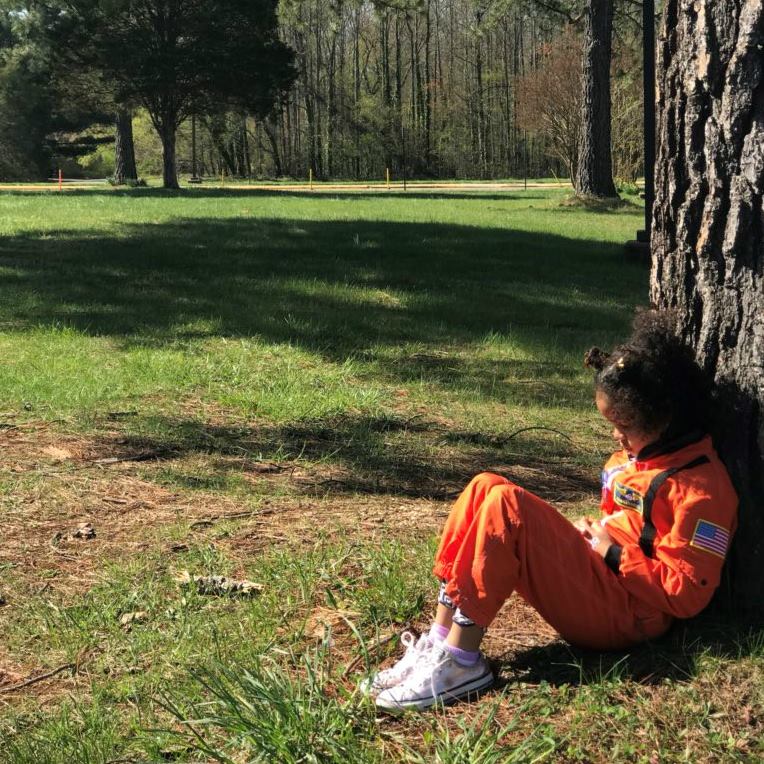
Speaking of risk takers, I came across this picture this week of Havana Chapman-Edwards, a first grader in Alexandria, Virginia who was the lone student at her school to join in the National School Walkout Day on April 20, the 19th anniversary of the shooting at Columbine High School.

Havana’s mom signed her daughter out of school because Havana said she wanted to participate. Her mom says she was crushed to see Havana sitting by herself, but then she became inspired by her daughter for standing up for what she believes in.

Havana told a news reporter that she was inspired by the Parkland High School students who have been pushing politicians to protect kids from school shootings.

For 13 seconds, Havana and her mom sat in silence to honor the 13 people who lost their lives at Columbine. Havana says that she wore her orange astronaut suit because she wants to show the world black girls are strong leaders.
Comedian Bill Murray in an interview with NBC news said this about student protests: “The thing that’s so powerful about students is that, when you haven’t had your idealism broken yet, you’re able to speak from a place that has no confusion [doubt?], where there is a clear set of values. Idealism is a voice that’s inside you, it’s your conscience. That can really deteriorate along the way… and it can become almost dysfunctional, but it’s there. Everyone has it.” I agree and would add that it’s the voice of idealism that children can help us all hear again.

Kids see the world with fresh eyes, unclouded by filters of status or rank. I saw a post recently from a childhood friend about his experience in the Vietnam War, and it reminded me of the great friendship we shared as children and youth. Blaine was one of my best friends. He was raised by his grandmother who I now realize was dirt poor. Their home was in a part of town that I’m ashamed to admit I would probably be uncomfortable to visit today. My family was lower middle class, but compared to the conditions my buddy lived in we were very wealthy. But I didn’t have those filters and lenses to see the world through then. Blaine was just my friend.

My point is that kids don’t come out of the womb with any kind of prejudices – those are acquired. When I was in high school we didn’t talk about racism or classism, even though they were very real in our little town. But we learned important life lessons in more subtle ways. We had an excellent choral music program that produced a popular musical every year. As you all know I can’t sing a lick now and I couldn’t then either, but I got to do the next best thing – I was on the crew that helped produce the shows. The one that I remember most is Rodgers and Hammerstein’s “South Pacific.” It’s set during WWII and centers around two love stories, one between an American nurse and a wealthy French property owner and the other between an America soldier and a Polynesian woman.

The romance and music are great but more important is the underlying story about prejudice and racism that threaten to keep these lovers apart. There is one memorable song called “Carefully Taught” that says “you have to be taught before it’s too late, before you are six, or seven or eight, to hate all the people your relatives hate. You have to be carefully taught.” Those important life lessons about human relationships could not be discussed openly in my school in the early ‘60’s, but by the magic of storytelling and imagination we could vicariously experience their power through those characters.

Finally there’s another really important reason Jesus welcomes and blesses the children that isn’t so obvious to us. We think of children much differently than people did in biblical times. Today we respect and encourage children, and because of that it is easy for us to romanticize this passage. We see cute pictures and all these positive attributes of childhood trust and enthusiasm, but the people of Jesus’ day saw children pretty much in the very opposite way. Children then were powerless, totally dependent liabilities. One commentator describes them as “non-persons.” They were on the very bottom rung of the cultural pecking order of the day.

So when the disciples saw people bringing their unruly, disruptive kids with them when Jesus was trying to teach important kingdom stuff the disciples tried to shoo the kids away. But Jesus says, “Wait a minute folks – don’t you dare chase those kids away. Everybody’s welcome in my kingdom – and that means everybody! The poor, the lepers, the sinners, the lame, and these precious little nobodies.” And you know what else, by welcoming the children Jesus also knew that he was making it possible for their mothers to also crash the old boys club and listen to the good news he came to share.

We’re really excited that we’ve had several new babies born into our church family recently. As I hear tales of sleepless nights and exhausted moms and dads I am reminded that to accept the blessed gift of a child means to becomes that child’s servant. Those helpless little bundles of humanity are totally dependent on someone to provide for their every need. Those who change diapers and wipe noses give up all claims to position or privilege – and that’s exactly how humble we must become to enter into God’s kingdom where all are equal.

Jesus and the disciples saw the same children, but Jesus saw them through the inclusive eyes of love; and that’s exactly how he sees you and me – runny noses, doubts and all, and he hangs out the welcome sign and blesses us and everyone who comes. Amen.


Faith, Doubt and Playing Possum

My brain feels like a whirling dervish this week with all the scandal, intrigue and assorted craziness in the news. I feel like I’m living in a bad soap opera with FBI raids on the President’s lawyer, Speakers of both the US House and the Ohio House stepping down unexpectedly and military strikes on Syria that put us closer to a nuclear showdown with Russia than any time since the Cuban Missile Crisis in 1962.

Maybe I’m a glutton for punishment but I can’t seem to stop watching and reading the news like the proverbial train wreck. I have managed to get engrossed in a couple of good novels as a respite from the 24-hour bad news cycle. One is a book on tape I listen to while driving, James Patterson’s “Woman of God,” and the other on my Nook, Dan Brown’s “Origin.” But of course both of those are full of conflict and profound theological questions about human suffering and human nature itself. And in my spare time I’m wading through a weighty and rather depressing tome entitled “What Are We Doing Here?” by Marilynne Robinson for a book club I’m in.

Mingled in with all that drama has been a personal struggle with guilt. On Wednesday of this week I had the painful task of dispatching a possum whose only offense was making his domicile under our deck. I’ve been trying to trap him or her for a few weeks and until this week had only managed to feed chipmunks who are too small to trip the trap and catch a stray cat. Every morning that the trap was by our deck I was relieved to find it empty, but Wednesday it was fully occupied by a sleeping possum who seemed quite content. It had finished off the apple that I used as bait and unlike the cat seemed quite content and even trusting when I carried him/her to a watery grave in our pond. It would have been much easier on me if she/he had hissed and growled at me, but that is not the way of the possum.

The possum’s capital offense was invading turf that belongs to us – we have a deed–but then I guess possums can’t read; so posting a no trespassing sign would probably not have done any good. Fearing he/she would attract or produce more furry friends that could do damage to the foundation of our house my wife and I felt justified in this dirty deed. I used to take such critters a few miles away and release them, but that is actually against the law of the land and increasingly impossible as urban sprawl takes over more and more habitat for our four-footed friends.

On this second week of Eastertide I couldn’t help theologizing a bit about this experience, and it occurred to me that there is a parallel here between my possum and what we did to Jesus a couple millennia ago. Their offenses were much the same– invading someone else’s space and making them/us uncomfortable. Just as the possum created conflict for me about his/her right and mine to occupy this space on Brock Road, so Jesus created such a degree of discomfort and cognitive dissonance by proclaiming a higher ethical standard of God’s reign that threatened the Jewish and Roman homeowners in Jerusalem that they set a trap for him and executed him on trumped up charges of blasphemy.

The big difference of course where these two tales of death diverge is in their outcome. And no I’m not suggesting Jesus was just playing possum in that tomb for 3 days. He was just as dead as my possum – ask his mother who watched him be nailed to that cross. Ask the centurion who ran a spear into his side to make sure he was dead. Jesus was dead!

But Eastertide is the season of resurrection – even in chilly Ohio where spring has been delayed. I saw a meme on Facebook that said “Mother Nature was late delivering spring because Father Time was driving and refused to stop and ask for directions.” But better late than never we had at least a teaser of spring this week. The daffodils, hyacinths and forsythia are blooming, the crocuses are croaking, and the robins are digging up earthworms in my yard.

I had an hour between two appointments on Thursday, our first warm day; so I went for a walk in one of Columbus’ lovely metro parks. I took exception to a sign that told me the trail I took was 1.1 miles. I know it had to be longer than that because it took me much longer to hike it that it used to. I was also struck for the first half mile or so by how dead everything looked. Dead trees and limbs were all over the woods, everything was the barren brown of winter. And then I looked a little closer and saw that there amongst the detritus of winter’s death there were tiny green leaves quietly emerging from some of the branches. When I walked by the lake there was a young couple facing each other on a picnic bench and staring into each other’s eyes as only new lovers can do.

Signs of new life are there even if they aren’t obvious to a casual observer. Even my poor departed possum will provide nutrients to the soil and food for some birds of prey. Even in the news there are signs of hope, but we may have to work to find them. Today’s headlines were all about the bombing of Syria and the most recent scandals in Washington. But back in the metro section was an editorial that gave me hope. One of my heroes in days gone by is a local preacher here in Columbus, Ohio who is often called the father of the Social Gospel.

Rev. Washington Gladden died 100 years ago this year after a long and illustrious career of championing social justice causes as the pastor of First Congregation Church on East Broad St. just a few blocks from the state capitol. Today’s editorial was about a memorial garden that the church is building on property next to the church to honor Gladden. The park, to open in August, will include “exhibitions on social justice issues, an artist-in-residence program to teach children about social justice, along with art, lectures and forums, community dialogues and performances.” Current Sr. Pastor Tim Aherns says plans call for “a refuge of waterfalls, public art, green space, trees and a pathway of quotes about the pursuit of justice.”

Gladden himself was an early advocate for ecumenism and church engagement in political reform. He was friends with Theodore Roosevelt, Booker T. Washington, and every prominent public figure in Columbus. “At the time of Gladden’s death,” the editorial concludes, “The Ohio State Journal—which regularly had published his social justice sermons on Page One—called him the ‘First Citizen’ of Columbus.” The full editorial is at http://www.dispatch.com/opinion/20180414/editorial-new-park-to-honor-columbus-social-justice-champion

My take away from all of this disjointed rambling is that there is always a spark of new life hidden in the darkest days. That’s what resurrection is all about. God is not playing possum. Spring may not arrive when the calendar says so, but it will arrive. Justice will roll down like waters, maybe not today but someday. Easter didn’t end two weeks ago, it just began, and that liturgical season lasts until Pentecost when God saw that even showing the disciples Jesus’ hands and side wasn’t proof enough and sent the mighty wind of the Holy Spirit to light a fire in those believers that no one, no thing, no how has or ever will extinguish. We believe Lord, help our unbelief.

O Lord, How Long?

I helped conduct a funeral for a woman the other day who had written an interesting inscription in her Bible. She wrote, “Please have someone read Isaiah 40:31 at my funeral.” That verse reads, “But those who wait for the Lord shall renew their strength, they shall mount up with wings like eagles, they shall run and not be weary, they shall walk and not faint.” That’s normally one of my favorite Scriptures, but what I noticed about it this time through the lens of my own personal grief for my father and mother-in-law (both died in the last 5 weeks) was that Isaiah doesn’t address an important question raised by that assurance.

That unanswered question is like a commercial that seems to run non-stop on our local TV stations and annoys me greatly. The ad is for a company that does home insulation and keeps saying that they can make your house warmer in winter and cooler in summer for “only $99 a month.” I keep asking the television what seems like an obvious omission of facts, “for how many months?” but so far I’ve gotten no reply. In a similar vein I find myself wanting to ask Isaiah to be more specific about these comforting words, “Those who wait for the Lord shall renew their strength.” That’s great but how long do we have to wait to renew our strength?

I know grief takes time and it’s different for everyone going through it. I have not felt typical sadness usually associated with grief, but what I have noticed is a lack of energy and motivation. That’s not out of the ordinary for me in recent months because of chronic pain, but this sluggish feeling has been even more persistent than usual.

A few weeks before my saintly mother-in-law died she told my wife that she “was ready for her angels’ wings.” I don’t yet have her faith or patience. But they do say misery loves company; so I guess I should feel better knowing I’m one of many who have asked God just how long we have to wait to get our eagles’ wings? Many of God’s children have chafed under the burden of waiting. When I did a search for “how long O Lord” in the Bible I got dozens of hits, most of which sound a lot like these two examples:

“O Lord, how long shall I cry for help, and you will not listen?” (Habakkuk 1:2)

“How long, O Lord? Will you forget me forever?
How long will you hide your face from me?
2 How long must I bear pain in my soul,
and have sorrow in my heart all day long?” (Psalms 13:1-2)

We sang the marvelous hymn “Spirit of God Descend Upon My Heart” in church recently and the line that says, “Teach me the patience of unanswered prayer” was one of those that seemed like it was directed right for me. I know our time is not God’s time, that “a thousand years in God’s sight are like yesterday when it is past, or like a watch in the night.” (Psalm 90:4) But I am still impatient and want to know how long I have to wait for this aching in my soul to ease.

The other thing I discovered when I searched for “how long” in my Bible was that even Jesus utters those words of impatience himself, only his frustration is usually with humans not with God. In Mark 9 he comes upon a father with a mute son who tells him that Jesus’ disciples have tried to heal his son but have failed.
Jesus responds first to the disciples , “O faithless generation, how long shall I be with you? How long shall I bear with you?” Then he turns to the father and says, “Bring him to Me.” 20 Then they brought the son to Him. And when he saw Him, immediately the spirit convulsed him, and he fell on the ground and wallowed, foaming at the mouth.

21 So He asked his father, “How long has this been happening to him?” And he said, “From childhood. 22 And often he has thrown him both into the fire and into the water to destroy him. But if You can do anything, have compassion on us and help us.” 23 Jesus said to him, “If you can believe, all things are possible to him who believes.” And the father’s classic response is also my honest plea to God when I get impatient: 24 Immediately the father of the child cried out and said with tears, “Lord, I believe; help my unbelief!”

Yes Lord, forgive my childish whining about how long. I do believe, but please help my unbelief.

Wilderness Times: When Only God Knows! Ezekiel 37:1-14

I just recently figured out the answer to a problem that I know befuddles many of us Ohioans, namely why well-trained meteorologists are so often wrong about our weather forecasts. I’ve decided it’s not climate change, nor is it crazy Ohio where we have three or four seasons in a 48 hour period. It’s because the weather people are all too young! With the exception of Jim Gynal and Ben Gelber all of our local forecasters are young people. Yes, they have Doppler radar and other fancy tools but what they don’t have are old bones and joints that reliably tell us seniors when the weather’s changing.

I bet you’re wondering what weather forecasting has to do with our text for today! The connection is that both are about old bones. The difference is that in Ezekiel’s vision the bones he saw were no longer predicting or doing anything. Ezekiel walks among this valley of dry bones and makes it very clear that these bones are very dry and have been dead a long time.

Here’s the context for this most familiar of Ezekiel’s visions. He is relating this vision to the people of Judah about 600 years before Christ. Ezekiel is a priest who along with the ruling classes of Judah is a political prisoner in Babylon. Geographically Babylon was located where modern day Baghdad sits today in Iraq. Then and now it was and is a hot, dry wilderness.

Our nephew Michael spent time in that part of the world a few years ago. He was stationed in Kuwait next door to Iraq when he was in the Air Force. Michael was a mechanic at the time and told us about a day that was about 105 degrees when he was working on a plane and forgot where he was. He reached down and picked up a wrench that was lying in the desert sun and immediately burned his hand.

Living in that heat came to mind when I was thinking about Ezekiel’s valley of dry bones. Remember the Exiles were mostly people of Israel’s upper class, not used to these harsh living conditions. The Interpreter’s Bible describes the Babylonian exile this way: “The Israelites exchanged their hilly homeland and pleasant climate of Jerusalem for the flat and hot Babylonia lowlands…and forced manual labor.”

I’m sure the Babylonia Chamber of Commerce advertised to visitors that their climate was a “dry heat.” I’ve never been in Iraq or Babylon, but I’ve been in Phoenix in mid-summer; and I don’t care how dry the heat is, anything above 100 degrees is just too darn hot.

We’ve been thinking about “Wilderness Time” in this Lenten Sermon Series because whether it’s a voluntary retreat from daily living to draw closer to God or the wilderness is forced upon us by life’s circumstances, solitary time with ourselves and God is good for our souls – but only if we embrace it.

As many of you know our family has been doing some wilderness time this last month. My father died on February 12 and due to family schedule complications we set his memorial service and burial for this past weekend. Little did we know then that on March 1st Diana’s mother would go into a rapid decline and pass away on March 5th. These were not unexpected life events. My dad was 96 and Diana’s mom, Mary, was 100, but getting a double whammy of mortality definitely put us into the wilderness. We celebrated both of their lives last weekend, and Ezekiel’s image of dry bones seemed all too real in those cold, windy cemeteries.

Wilderness time is often hard to embrace. The exiles were none too happy to be carted off to Babylon, not just because they were uprooted from their homes and familiar surroundings, they were also yanked up by their theological roots. The foundations of their faith were supported by four basic pillars: 1) God’s blessings were assured them as God’s chosen people; 2) the land God had given to their ancestors would be protected forever; 3) the throne of David and his descendants would continue forever; and 4) the Temple at Jerusalem was the only suitable place for proper worship of their God.

When the Babylonian King Nebuchadnezzar destroyed Jerusalem in 597 BC the Israelites theological scoreboard suddenly read 0-4. Their beloved temple was in ruins, and the foundations of their faith were not only shaken they were pulverized. So what can we learn today from this ancient history? Aren’t we a lot like these Israelites? As it was for them it’s quite natural to want our faith to be comforting “Good News,” that’s even what the word “Gospel” means. So like the Israelites we are tempted by the same prosperity gospel that promises worldly comforts as rewards to God’s chosen people. Like Ezekiel’s contemporaries we sometimes forget that God chooses us not to be privileged but to be servants to others. We’d like Easter morning without Good Friday, but let’s not forget that much of the Bible describes a lot of bad news and how people like us respond to being in the wilderness.

Psalm130 was written in one of those wilderness times. It begins “Out of the depths I cry to you, O Lord. Lord, hear my voice!” That Psalm is known by the title “De Profundis” which in Latin means “out of the depths.” I woke up one day last summer in one of those wrong-side-of-the-bed moods and thought of De Profundis to describe my mood. I wrote in my journal that day “De Profundis is Latin for “O crap, I have to get up and face another day of aches and pains and bad news!” Am I the only one who has days like that? I saw a cartoon awhile back that describes me all too often. It said “Sometimes I wake up grumpy, and other times I let him sleep.”

When I first started thinking about this dry bones text I pictured it in terms of personal or individual wilderness times that come to all of us. And then when Diana’s mom died that introspective kind of wilderness seemed even more real. But then I reread Ezekiel’s words and I realized what he’s talking about is a lot bigger than personal grief or loss. Verse 11 says, “Then God said to me, “Mortal, these bones are the whole house of Israel. They say, ‘Our bones are dried up, and our hope is lost; we are cut off completely.’” God says this valley of dusty, dry, lifeless bones is a metaphor for “the whole house of Israel.” A whole people, a whole nation is dead to God and hopeless, completely cut off. They’ve been in exile a long time; the buzzards and other wild life have picked their bones clean.

I’ve been trying to think of some contemporary situation to compare the Exile to. The heart-breaking pictures we see on the news today of the devastation and ruins of Syria are the closest image I can think of to understand how hopeless the exiles must have been feeling.

But as pitiful as this image of dry bones is Ezekiel is not sympathetic to Israel’s plight. This vision from Chapter 37, believe it or not, is from the “good news” section of the book of Ezekiel. He spends the first 32 chapters of this book passing judgment on his own people for their failure to obey God’s will. He warns them that bad things will happen if they continue to break their covenant relationship with God. The Israelites remember clearly God’s part of the bargain made with Moses, to give them a homeland, to make them and their descendants prosperous. But in their comfort and prosperity they have conveniently forgotten their half of the covenant – namely to live obediently, justly and humbly before God. Their leaders have become greedy oppressors who according to Amos “sell the poor for a pair of shoes.” Things have gotten so corrupt and unjust for the common people of Israel that at one point Ezekiel even declares that his people have out sinned Sodom. That is not a record you want to break!

In chapter 6 Ezekiel describes in gory detail the consequences of such unfaithful living: “Your altars shall become desolate, and your incense stands shall be broken; and I will throw down your slain in front of your idols. 5 I will lay the corpses of the people of Israel in front of their idols; and I will scatter your bones around your altars. ….7 The slain shall fall in your midst; then you shall know that I am the Lord. (Chapter 6)
That phrase “you shall know that I am the Lord” is a refrain that recurs in Ezekiel. Verse 14 of our text for today says, “You shall know that I, the Lord, have spoken and will act.” That doesn’t mean God intervenes to punish us, but God wants the consequences of our bad choices to help us see that there’s only one God, and we’re not it!

I doubt that I need to draw the parallels between Israel and the current state of affairs in our country and other parts of the world where the ways of God have been trampled in the dust by the idolatry of living in a secular and materialistic society. It is all too easy to despair, to lose hope.

When we are searching for an elusive answer to one of life’s tough problems friends may ask us, “What are you going to do?” And a common reply is “God only knows!” meaning we don’t have a clue. In his vision Ezekiel hears God ask him one of those tough questions. As he is walking around in this valley full of dry bones God says, “Mortal, can these bones live?” and Ezekiel answered, “O Lord God, you know.”

What do we do when we are in one of those situations where only God knows the answer to what we should do? When we suddenly lose a job or a loved one; when our world seems to be collapsing around us? And it seems God isn’t readily available to share whatever it is that only God knows! Or sometimes we’re too stubborn or proud to pray for God’s guidance. We might not like what we hear!

Put yourself in Ezekiel’s place. How would you answer God’s question, “Can these bones live?” Or look at the homeless, hopeless refugee children in Syria, or the suffering caused by gun violence in our own country. Why do we have so much more gun violence than other developed countries? What are we going to do to stop consuming violence in video games and entertainment? How can we help people suffering from mental illness, or those who are bullied? How are we supposed to love the bully and heal whatever wounds he is suffering that cause violent behavior? How do we provide support systems and ways to deal with pain and depression so people don’t get hooked on opioids or other drugs? Can our badly divided nation live again and achieve the high ideals of our democracy? God only knows!

And yet that hopeless cry of despair is actually the beginning of hope for a whole nation of dry bones. When we look at a hopeless situation through our own mortal eyes we see no way dead bones can live again. When I held the urn of my father’s ashes in the cemetery last weekend I knew there was no way those ashes could live again, at least not in the form we knew as my dad. But those ashes can provide nourishment for what grows in God’s good earth.

Likewise out of tragic death at the Parkland High School massacre has emerged a new generation who are taking their civic responsibility to a whole new level. Whether you agree with their methods and goals or not you have to applaud their determination to make a difference. New life can arise out of death. I saw that at both of our family funerals last week where new life was in abundance in the joyful, energetic laughter and play of young great grandchildren. May we have eyes of faith to see signs of life even in the midst of death.

Remember the dry bones story is a vision Ezekiel is having. It is one of four visions in Ezekiel. And it’s the only one of the four that does not begin with a date identifying when Ezekiel had the vision. Elie Weisel, a survivor of the valley of dry bones known as the Holocaust, commented that the reason this vision has no date is that every generation needs to see it and experience it for themselves. Dry bones are a timeless description of the human condition.

And that’s the key – the valley of dry bones is a human condition seen through finite, mortal eyes. But Ezekiel was a priest. He of all people should have known the answer to God’s question, “Mortal can these bones live?” When we began this Lenten season on Ash Wednesday many Christians received the mark of ashes on our foreheads with the words from Genesis, “Remember you are dust and to dust you shall return.” Those words are not some morbid reminder that we are all going to die. We say them to help us remember that in the very beginning of God creates human life by forming us from dust and breathing life into us. Can these bones live? Of course they can live if God chooses to breathe his Holy Spirit on them.

And that’s exactly what happens in the rest of the vision. “Then God said to me, “Prophesy to the breath, prophesy, mortal, and say to the breath: Thus says the Lord God: Come from the four winds, O breath, and breathe upon these slain, that they may live.” I prophesied as God commanded me, and the breath came into them, and they lived, and stood on their feet, a vast multitude.”

The Hebrew word for breath is ruah which is also the word for spirit, the holy breath of the one with whom all things are possible. When seen through mortal eyes this is a dead, dry bone. But when the Holy Spirit helps us lift our eyes to catch a vision through God’s eyes hopelessness turns to rejoicing and death becomes resurrection. Seeing life and death through God’s eyes helps us confess our sinful nature honestly and brings us to our knees. And it’s from there we can see new beginnings that God alone can see.

And so as people with a vision of Easter in our eyes wilderness times call us to renew our covenant with God–because it is in the wilderness that we remember who we are and whose we are.
Can these bones live again? – You can bet your life on it!

Pastoral Prayer for Hearing One’s Call, January 28

O Savior God we know you have called us to follow you, but sometimes that call is as hard to understand as finding our way on a dense foggy morning. Be our fog horn and a beacon to light our way. As our nation struggles with issues of security versus compassion give our nation’s leaders wisdom to make good decisions that are fair to all.

O God of grace we come to call upon you again today because you have first called us. You have called us to do justice, to love kindness, and to walk humbly with you. When we look at all the injustice in our world today and when we honestly confess our failure to love others and ourselves the way you love us, we fall on our knees in humility and shame.

Please forgive us for the times we have rushed by someone in need because we were too busy or too uncomfortable to stop and help. In this time of prayer give us ears to hear both the challenge and the comfort of the Gospel. Whisper words of comfort and mercy to soothe our guilt, words of wisdom to light the narrow road less taken, and words of courage to banish our doubts.

All of us have needs for personal healing of our bodies and minds and to mend relationships that are strained or broken by the challenges of daily living. When we add to our prayer concerns the needs of our friends and family and those of our community and world the weight of those concerns can overwhelm us. That’s when it’s hard for us to hear your call to minister to the lost and least, to love our neighbors and even our enemies as ourselves. That’s really hard, Lord.

And so we pray that your holy spirit will descend on every one of us today. You know our needs even before we ask, and we are often too busy or feel too insignificant to ask. We cannot fathom the wideness of your grace and mercy. That’s why we worship and pray and study your word to be reminded again and again that nothing is impossible with you.

We lift up to you Lord those named and unnamed today, for victims of abuse and violence, for our nation’s leaders, for those suffering from floods, earthquakes and volcanic eruptions. Hear our prayers O God and let us hear clearly what you are calling us to do in response to improve the lives of those in our corner of the world. Grant us wisdom, grant us courage for the living of these days so that when you call us we can answer, here I am Lord, send me.

We pray in the name of the one who answered the most important call of all – the one that led him to the cross of salvation. Let us join our hearts and voices in the prayer he taught his followers to pray.