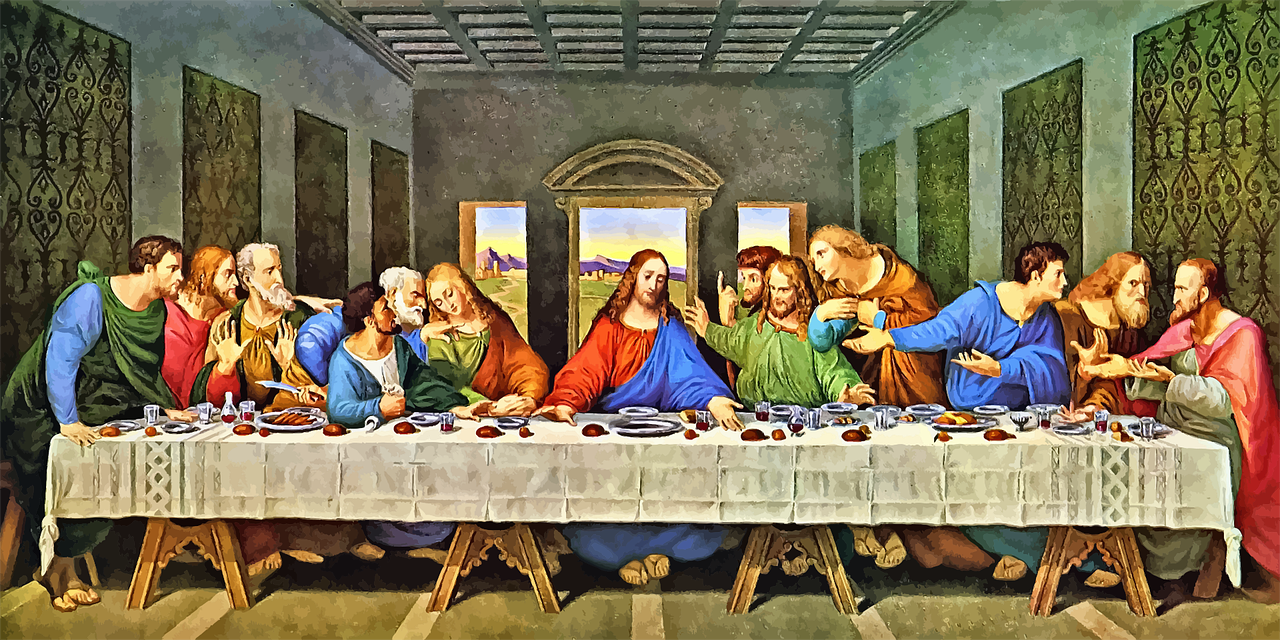
Eucharistic Blackmail

“Then he took a loaf of bread, and when he had given thanks, he broke it and gave it to them, saying, “This is my body, which is given for you. Do this in remembrance of me.” And he did the same with the cup after supper, saying, “This cup that is poured out for you is the new covenant in my blood. But see, the one who betrays me is with me, and his hand is on the table.”  (Luke 22:19-21)

I heard something from a friend this week that has left me adrift in a sea of incredulity.  Given the bitter divisions in our nation and my denomination I should not have been shocked, but I was.  This friend is a former member of a United Methodist church I used to serve.  She is one of the casualties of the great United Methodist schism of 2022-23.  She told me that a relative who still attends the now Global Methodist Church reported the following from their worship service last Sunday:  prior to communion the pastor told the congregation that anyone planning to vote for Issue One in the upcoming Ohio general election should probably not take communion.

Issue One is a constitutional amendment that will protect reproductive rights and access to abortion.  This is a very controversial and emotionally charged issue, and while I respect the opinion of those who oppose Issue One I do not think access to the Sacrament of Holy Communion should be used to persuade or intimidate anyone to vote in any particular way. 

I don’t know what the position of the Global Methodist denomination is on who may or may not receive this sacrament, but in the United Methodist Church we practice an open table.  As a pastor I would never presume to judge who is worthy or unworthy to come to the Lord’s table because it is the Lord’s table, not mine or my church’s.  The exemplar for that inclusive table is the Upper Room itself on the night before Jesus is crucified.  The Gospels make it very clear that all 12 disciples are there to celebrate the Passover with Jesus.  You can count them all in Da Vinci’s painting.

But seriously, check the Gospel accounts in Matthew 26, Mark 14, and Luke 22. 

According to all of these retellings of what transpired in the Upper Room Jesus not only knew that Judas would betray him and Peter would deny him 3 times, but also that all the other disciples would run and hide in his hour of greatest need. “Then Jesus said to them, “You will all become deserters because of me this night; for it is written, “I will strike the shepherd, and the sheep of the flock will be scattered.'(Matthew 26:31). Does that disqualify any of the 12 from sitting at the table with Jesus? No, they all are there to receive this sacrament of remembrance.

Jesus is very clear about whose job it is and isn’t to judge others – and it isn’t mine or any clergy person’s.  “Do not judge, so that you may not be judged. For with the judgment you make you will be judged, (Matthew 7:1)   Or check the parable of the weeds in the wheat in Matthew 13 where Jesus says, “Let both of them grow together until the harvest; and at harvest time I will tell the reapers, ‘Collect the weeds first and bind them in bundles to be burned, but gather the wheat into my barn.’” Or my favorite, the billboard that says, “Just love them all.  I’ll sort them out later.” –  God. 

When Jesus says, “Come to me all who are weary and heavy laden, and I will give you rest,” (Matthew 11:28) all means all; and this sinner is darn glad we are all invited to the table.  When we all get on one side of the table for a remake of Da Vinci’s picture there will be Donald Trump next to Alexandria Ocasio-Cortez, Hamas Palestinians next to Netanyahu, Putin next to Zelenskyy, and in the middle Jesus asking, “What took you so long to get here?”

And in the background John Lennon is singing:

“You may say I’m a dreamer,

But I’m not the only one.

I hope someday you’ll join us

And the world will be as one.”

Groundhog Day in Congress

Those of us who live in Jim Jordan’s home district know that his only claim to fame is that he was a champion high school and college wrestler. While I admire the discipline and determination it takes to excel in wrestling, I would l like to point out that wrestling is not a team sport. Democracy, on the other hand, is the ultimate team sport. It requires an ability to collaborate and compromise, skills which Mr. Jordan did not have to learn on the wrestling mat and which are apparently not even in his vocabulary.

For the Congressional GOP to continue to waste time by voting in Groundhog Day fashion for the same unqualified candidate is not only foolish, it is very dangerous. Our adversaries in Tehran, Moscow, and Beijing are drooling in joy over the paralysis of our government. We are the laughing stock of the world and proof to other nations that democracy doesn’t work.

Are there not enough moderate members of Congress on both sides of the aisle to join forces as adults and agree on an acceptable bi-partisan candidate to lead the House in these critical times? We need some profiles in courage who will put personal power and party loyalty aside for the greater good of our nation and world. And we need it now!

Can We Forgive Without Forgetting?

“You have heard that it was said, ‘You shall love your neighbor and hate your enemy. But I say to you, Love your enemies and pray for those who persecute you, ” Matthew 5:43-44

I was sitting in Tim Horton’s on 9/11/23 while new tires were being installed on my car. I read a couple very moving pieces on Facebook about 9/11 and began trying to figure out why I am more emotional about that awful day now, 22 years later, than I can remember being except on the day itself, and maybe not even then.

I know that like my father before me I get emotional more easily as I age. Don’t tell anyone, but I even get weepy sometimes at the oh so predictable ending of a Hallmark movie. This emotional remembrance started when my wife and I watched a very moving piece on 60 Minutes Sunday night about the 433 firefighters killed that day, and I’m embarrassed to admit it’s the first time I’ve thought about one of my very best friends who is a retired firefighter. I know without a doubt that if he could have gotten himself to New York that day he would have been one of those who died trying to reach the people trapped over 80 floors up in the towers. I can’t imagine what my life would have been like these last 22 years if I had lost his friendship.

And then I read a post from a retired American Airlines pilot who was in the air that day enroute from Venezuela to JFK. He was diverted to Miami but not given any reason for the diversion. Being a recently retired Air Force pilot he knew something awful was happening but had no idea how awful.

His moving account of how he couldn’t reach his wife or kids to let them know he was ok brought me to tears, and I have a renewed sense of empathy for what so many people who were directly affected by that tragedy in all 3 locations went and are still going through. Grief has no expiration date.

Unfortunately there also doesn’t seem to be any statute of limitations on the hate and paranoia that rose up out of the ashes of ground zero, the Pentagon, or Shanksville, PA. Every time I hear or see the phrase “Never Forget” in relation to 9/11 I cringe a bit. I understand never forgetting the pain and grief from losing a loved one in such a God awful way. I have buried enough friends, colleagues, and loved ones to know that memories never die, but to lose someone so suddenly and never have the closure of saying good bye or even having any remains to bury is truly more than I can imagine.

But here’s the part of “Never Forget” that troubles me, and it did almost immediately after the initial shock and disbelief of that unbelievable day began to wear off. I know exactly what I felt because I have it in writing and proclaimed it publicly in a sermon on September 21, 2001. That sermon is the only one I ever preached that people remembered years later. The message I felt compelled to share that day was based on the text from the Sermon on the Mount about loving our enemies. I say compelled because I didn’t want to say that while the wounds of 9/11 were so raw and the dust hadn’t even settled at Ground Zero. But I knew it needed to be said.

Here’s a part of what God spoke that day through this reluctant prophet. I titled the sermon, “How Can We Ever Do That?”

“But from the very first hours of the tragedy my greatest pain and fear was not for the damage and suffering that occurred on September 11, as unbelievably horrible as it was. My greatest pain and fear has been for the inevitable escalation and perpetuation of violence that I knew these horrible acts would generate in retaliation that will inflict more suffering on more innocent people.

A friend of mine told me just after the attacks that he had forgotten how easy it is to be a Christian in times of peace and prosperity. And he is very right. We turn to God and scripture for comfort and reassurance in times of distress, as well we must and should, but some of the most important words of scripture also challenge us and are hard to hear.

And that’s why I have been engaged in a lovers’ quarrel with Jesus for the last 12 days over what to say this morning. I have tried every trick I know to avoid the difficult words we just heard from the Sermon on the Mount–these words that are high on the list of those we wish Jesus hadn’t said, but they would not let me rest. They have forced themselves into my consciousness over and over again, pleading, demanding, and crying out to be proclaimed. 

“You have heard it said…” O, have we ever – all the public opinion polls confirm in spades that those who want revenge are legion, and I include myself in those who are angry. Getting even is a natural human reaction, and we’ve all been there many times this month. “You have heard it said, an eye for and a tooth for a tooth.” Sounds like good advice. In fact, at the time those words were written, they were designed to limit revenge; so victims would not demand two eyes for an eye, or a whole mouthful of teeth for a tooth. But as someone has said, if we follow the eye for an eye and a tooth for a tooth philosophy to its logical conclusion, we end up with a world full of blind, toothless people, and the cycle of violence and pain continues forever.

… Jesus says a bit earlier in the Sermon on the Mount, “Blessed are the peacemakers, for they shall be called children of God.” By whom? Not by their enemies or by most of their peers. Peacemakers, cheek turners, are more often called “yellow” and “coward” or “chicken,” but seldom ever “children of God.” We would much rather go with Moses on this one wouldn’t we, but are we followers of Moses or Jesus?

It is hard to find silver linings in some clouds, but even in tragedy there are some benefits. We see it in extended families that rally around each other when there is a death of illness. And in a similar fashion, the outpouring of patriotic spirit and resolve in the last two weeks has been amazing. One could certainly argue that this tragedy has created a sense of community that has been sorely lacking in our nation for many years. But Jesus asks us to take that sense of community one giant step further–to include even our enemies in the circle of God’s family.

I had a flashback to Jr. Hi youth fellowship this morning. One of those awkward moments when we were circling up to say the benediction at the end of a meeting, and I found myself next to a girl and was afraid I’d get her cooties if I had to hold her hand. And some wonderful adult counselor saw the problem and stepped in between us to close the circle. That’s just what Jesus does when he asks us to love our enemies. When we can’t bring ourselves to take that hand, Jesus steps in and completes the circle.” [The whole sermon, if you would like to read it is archived here in a post from Sept. 11, 2014.]

It was several years after 9/11 that I had an insight about how forgiveness of one’s enemies is possible. When Jesus says from the cross “Father, forgive them for they know not what they do,” (Luke 23:34) notice that he doesn’t say “I forgive them;” but instead asks God to do it. Without getting into sticky issues about the Trinity it seems very possible that being fully human Jesus was in such agony that he couldn’t practice what he had preached. He couldn’t forgive his enemies right at that gruesome moment — but he knew someone who could; and so do we.

We will never forget 9/11/2001, but with God’s help we can forgive. Amen

How Long, O God?

Oh My God, how can you stand the insanity of gun violence in this country. If you are truly omniscient and know everything then you already know about the headlines I just read detailing four separate mass shootings in four different states this weekend, and my wife told me about another that I haven’t even seen on my news feeds yet. That makes over 470 mass shootings in this country so far in less than 8 months of 2023!! That’s about two every day! It’s so common all this bloodshed doesn’t even make the news most of the time.

I know you want us to love our enemies, Lord, but I have to tell you I am having a hard time with the gun lobby folks who refuse to consider any common sense gun control legislation. They hide their greed behind the second amendment like it is some sacred edict when in fact it was produced over 200 years ago by frightened white men who feared their enslaved persons would rebel like their sisters and brothers did in Haiti a few years earlier.

Why can’t anyone see that we live in a totally different time when all the wrong people can easily get military style assault weapons. And yet we are hamstrung by a law adopted when guns were single shot muzzle loaders. And the only people who could change our antiquated laws are blinded by greed for the campaign contributions for which they have sold their souls. How can they not see the carnage their lust for power is causing?

Please, dear God, break through the denial and ignorance that are killing innocent people at parades, retail stores, and high school football games. Where can anyone go that is safe from an argument or road rage turning into a gun battle? What more can we do to raise this issue above the clamor of the political circus and the genuine tragedies of climate crisis everywhere?

Dear God, we know common sense gun laws work. They have worked here in the past, and they continue to work almost everywhere else in the world. How can we end America’s love affair with fire arms? Are we so frightened that we need deadly weapons to feel secure? If that’s the problem how can we create a just society where there is no need to feel threatened by others? I am in despair, Lord, that such a dream is even possible in our bitterly divided and broken country.

Scripture tells us that with you, Holy One, all things are possible. I want to believe that, God, I really do. Please raise up for us new leaders with the vision and courage to bind up our nation’s wounds and unite us in creating a culture of compassion where fear is no longer the driving force in our lives.

Please call and empower a new generation of visionary leaders who still believe that we can beat our AR-15’s into wind turbines, and turn our disagreements and fear into communities of collaboration. In the name of Jesus, the Prince of Peace, please, oh please hear our prayer. Amen.

Feeding the Wolves

A familiar Native American legend has been on my mind a lot recently. It’s the one about two wolves that reside in each human. One wolf is fear and the other is love. The two wolves are in constant struggle with each other to see which will control our lives. When the elders are asked which wolf wins the inner battle the answer is “The one you feed.”

I am very concerned that the steady diet of fear being fed to us by political candidates from both parties is so pervasive that the wolf of love in all of us is being starved to death. With all the dark money stoking the flames of fear on every form of media it is very tempting to just throw our hands in the air and surrender.

Dr. Brene Brown describes our situation this way: “In times of uncertainty, it is common for leaders to leverage fear and weaponize it to their advantage…If you can keep people afraid and give them an enemy who is responsible for their fear, you can get people to do just about anything.…when we are managing during times of scarcity or deep uncertainty, it is imperative that we embrace the uncertainty…We need to be available to fact-check the stories that team members may be making up, because in scarcity we invent worse-case scenarios.” 

That reminds me of a definition of fear I learned many years ago — FEAR = False Evidence Appearing Real. We all need to use our best critical thinking to not feed the fear wolf any false information. There are plenty of factual things to fear without adding bogus dishes to our diet.

The Christian church in many ways has been complicit in spreading the bad news of a fear-based theology. The misunderstanding and mistranslation of the Hebrew word “yirah” as “fear” has been used for centuries to try and literally scare the “hell” out of people, or perhaps scare people out of hell would be a better way to put it.

Fear is not a good long-term motivator of desired behavior. It only works when an external authority figure is present to enforce the threat. But fear is a fairly effective way to produce guilt in people, and that guilt technique has been used to control church members, i.e. keep them coming back to church and paying their dues. I have often said that if people really understood the Good News of grace and God’s unconditional love the church would be out of business.

The word yirah in reference to God is better understood as “awe.” We overuse he word “awesome” these days to describe anything from a sunset to a new dress, and it has lost the power of truly standing in awe of the ultimate mystery of the creative force we call God.

If we can get back to praising that Holy Mystery and the unconditional love fed to us every moment of eternity then the wolf of fear doesn’t stand a chance. That’s the life force described in I John: “There is no fear in love, but perfect love casts out fear. For fear has to do with punishment, and whoever fears has not been perfected in love.” (I John 4:18)

Being nurtured by that kind of love makes it possible for humans to obey the great commandments to love God and to love our neighbors. Without that love, we are vulnerable to unscrupulous salespeople, propagandists, and politicians who use fear-inducing rhetoric and imagery to manipulate others into buying or believing what they are promoting.

Our United Methodist District Superintendent, Rev. Tim Bias, recently wrote about the power of words in his monthly newsletter. In there he shared a wonderful story about what feeding the wolf of love looks like at the micro level of interpersonal relationships. I’ve heard the story several times before, but the end of the story still brought tears of joy to my eyes. I share it here in the hope that it will feed your love wolf with the abundance that begs to be shared with others. If we keep the faith and treat everyone we meet, (yes, even our political foes) the way we want to be treated we will make more difference in the world than we will ever know.

“There was a first-year teacher at Saint Mary’s School in Morris, Minnesota. She said she had 34 students who were all dear to her. But one student stood out. His name was Mark. She said he was one in a million. He was very neat in appearance with a happy-to-be-alive attitude that made even his occasional mischievousness delightful. There was just one thing about Mark: he talked incessantly.

She had to remind him again and again that talking without permission was not acceptable. Every time she corrected him, he responded, “Thank you for correcting me, Teacher.”

She said, “I didn’t know what to make of it at first. But before long, I became accustomed to hearing it many times a day.”

One morning her patience was growing thin when Mark talked once too often. She said, “I made a first-year teacher mistake. I looked at Mark and said, ‘If you say one more word, I am going to tape your mouth shut!’”

It wasn’t ten seconds later when one of the students blurted out, “Mark is talking again, Teacher.”  I hadn’t asked any of the students to help me watch Mark, but since I had stated the punishment in front of the class, I had to act on it.

I remember the scene as if it had occurred this morning. I walked to my desk, very deliberately opened my drawer and took out a roll of masking tape. Without saying a word, I proceeded to Mark’s desk, tore off two pieces of tape, and made a big X with them over his mouth. I then returned to the front of the room. As I glanced at Mark to see how he was doing, he winked at me. That did it! I started laughing. The class cheered as I walked back to Mark’s desk, removed the tape, and shrugged my shoulders.

His first words were, “Thank you for correcting me, Teacher.”

At the end of the year, Mark went on to fourth grade. The teacher eventually moved on to teach junior-high math. Several years passed. As Mark entered the ninth grade, Mark and the teacher met again.

She said Mark was more handsome than ever and just as polite. Since he had to listen carefully to the instruction on the “new math,” he did not talk as much. One Friday, things just didn’t feel right. The class had worked hard on a new concept all week, and the teacher sensed that the students were frowning, frustrated with themselves, and edgy with one another.

To stop the crankiness, she asked the students to put their books away and to take out two sheets of notebook paper. She then asked them to list the names of the other students in the room on their paper, leaving a space between each name. Then she asked them to think of the nicest thing they could say about each of their classmates and write it down.

It took the remainder of the class period to finish their assignment. As the students left the room, each one handed her their papers. Mark said, “Thank you for teaching me today, Teacher. Have a good weekend.”   That Saturday, she wrote down the name of each student on a separate sheet of paper and she listed what everyone else had said about that individual.

On Monday, at the beginning of the class, she gave each student his or her list. Before long, the entire class was smiling. She listened as the students said things like, “Really? I never knew that meant anything to anyone!”  “I didn’t know others liked me so much.” After a few minutes, the class went back to studying math. No one mentioned those papers in class again.

It was several years later that the teacher learned that Mark had been killed in Vietnam. She had gotten word that Mark’s family wanted her to attend his funeral. At the funeral she watched and listened. One of the soldiers who acted as pallbearer came up to her and asked, “Were you Mark’s math teacher?” She nodded. He said, “Mark talked a lot about you.”

After the funeral, most of Mark’s former classmates headed to Chuck’s farmhouse for lunch. The teacher was invited to come by. Mark’s mother and father wanted to speak with her. When she arrived, they met her at her car.

“We want to show you something,” his father said, taking a wallet out of his pocket. “They found this on Mark when he was killed. We thought you might recognize it.” Opening the billfold, he carefully removed two worn pieces of notebook paper that had obviously been taped, folded and refolded many times. She knew what it was without looking at the paper.

Mark’s mother said, “Thank you so much for doing that. As you can see, Mark treasured it.”

Mark’s classmates started to gather around. Charlie smiled rather sheepishly and said, “I still have my list. I keep it in the top drawer of my desk at home.”

Chuck’s wife said, “Chuck asked me to put his in our wedding album. I have mine too,”

Marilyn said.  “It’s in my diary.” Then Vicki reached into her pocketbook, took out her wallet and showed her worn and frazzled list to the group. “I carry this with me at all times. I take it out and look at it every time I need encouragement. We all saved our lists.””

[Story adapted an article in The Reader’s Digest written by Sister Helen Mrosla, a Franciscan nun and the teacher in the story. The story first appeared in the Topeka Capitol-Journal in 1998.]

Try this in a small town

“When he (Jesus) came to Nazareth, where he had been brought up, he went to the synagogue on the Sabbath day, as was his custom. He stood up to read, and the scroll of the prophet Isaiah was given to him.” (Luke 4:16-17)

All the discussion of country singer Jason Aldean ’s song, “Try That in a Small Town” reminded me of Jesus’ return to preach in the small town where he grew up. I flunked my first sermon in seminary preaching class, but Jesus got a much harsher response to his first message that day in Nazareth. Luke tells us Jesus read from the prophet Isaiah, and that part of his Sabbath was very well received. Verse 11 says, “All spoke well of him and were amazed at the gracious words that came from his mouth.”

But then Jesus goes ahead and interprets the text and tells his audience that the good news he brings to the captives, the blind and the oppressed is not just for them but for all of God’s children with examples of how the prophets Elijah and Elisha went specifically to minister to gentiles in Sidon and Syria instead of to those in Israel. And just like that the crowd does a 180 and turns on him. “When they heard this, all in the synagogue were filled with rage.” (Verse 28). And where the Gospels of Mark and Matthew just have Jesus leaving town at that point, Luke adds these words: “They got up, drove him out of the town, and led him to the brow of the hill on which their town was built, so that they might hurl him off the cliff. But he passed through the midst of them and went on his way.” (Vss. 29-30)

I did a lot of research in graduate school on such negative reaction to public speaking and wrote a paper I titled “They Shoot Prophets Don’t They?” I had a personal interest in that topic having come of age in the last turbulence in American history which saw the assassinations of the two Kennedy brothers and Dr. King, all within a five year period. In my research, I became impressed with the work of Lawrence Kohlberg on moral development and the role of cognitive dissonance in persuasive communication. To my great pleasure that very research was mentioned by one of my favorite author’s, Father Richard Rohr, in his book, “Everything Belongs,” which I just happened to be listening to on the very day I started thinking about this topic again. I am humbled and thrilled that Fr. Rohr’s use of Kohlberg’s theory of moral development is almost verbatim what I wrote about that research in my Ph.D. dissertation 40 years ago. The application of Kohlberg’s theories about how to effectively communicate with people who have very different moral and ethical values formed the heart of my own theory of preaching which I shared with seminary students in preaching classes over a 20 year period from 1991-2012.

I believe that theory can help us understand and bridge some of the vast divide we are experiencing in our country today. The country song controversy is very illustrative of how volatile and dangerous that divide is and has been throughout American history. I grew up in a small town and can identify with the good, bad, and ugly aspects of what that experience was and still is like. There were many positive aspects to spending the first 20 years of my life in Wapakoneta, Ohio, a small, county-seat town in very rural, very white, and very conservative northwestern Ohio. It was a very safe place where kids were free to roam all over town on our bikes. Everyone knew everyone else; so people looked out for each other’s kids. I am grateful for that age of innocence and the freedom it provided for me to enjoy a carefree childhood and adolescence.

But I am also angry about the flip side of that experience. We didn’t know what we didn’t know about the broader world outside our comfort zone. Our fathers and uncles who were survivors of the Great Depression and/or veterans of World War II certainly knew more than they shared with us about issues of race and political divisions, at least in my family. All I remember being told about why there were no people of color in our town is that “we aren’t prejudiced; those people just don’t choose to live here.” It turns out there was good reason for that. I learned many years later that one of my great uncles was a leader in the local chapter of the KKK, and just this week heard from a high school classmate that for some time there was a sign outside our town that said something to the effect “Get Your Black Ass Out of Town Before Dark.” That’s the ugly kind of small town life Aldean certainly alludes to in his song and accompanying video.

One major factor in the political chasm threatening our democracy is the rural-urban divide Aldean sings about. The life experience of small town and rural people in this country is so different from urban life that it is like living in two different countries. I addressed some of that in my post on July 18, “Culture War Games While the Planet Burns,” but I want to focus here on how to approach that reality in a constructive way. In an oversimplified description, Kohlberg’s theory of moral development I mentioned above is that there are 6 stages of moral development numbered 1-6. Stage 1 is a very self-centered stage we all start out in because that kind of selfishness is necessary for infants to survive. People in stage 1 say what is morally good is whatever is good for me. Stage 6 is the other extreme where morality is defined in a universal way to mean that moral goodness is determined by what is good for everyone and for the whole world/universe. Only people like Jesus, Mohammad, Gandhi, Mother Teresa, and Dr. King ever come close to stage 6.

Most people, and this is just fact, not judgment, never grow beyond a stage 3 or 4 in moral development, and that’s the problem prophets like Jesus have in small towns like Nazareth. Kohlberg’s research found that when there is a gap of 2 stages or greater in moral development between a speaker and an audience there is a major breakdown in communication. That gap creates so much cognitive dissonance, which is the perception of contradictory information and the mental stress it causes, that we consistency-loving humans will do whatever we can to reduce that stress. That often means simply ignoring the one causing the cognitive dissonance or, as the gap widens, arguing, disparaging or insulting the speaker, and ultimately, if the gap is too great either driving the speaker out of town as happens to Jesus, or in the most tragic situations actually killing him or her, which again finally happens to Jesus on the cross.

The major lesson for us Americans right now is to turn down the heat in our political discourse by bridging the gaps in our cultural, moral, worldviews. Kohlberg concludes that we cannot communicate with each other until the gap between us is one stage of moral development or less. In other words a speaker who is a stage 4 trying to communicate with a stage 2 or 3 person must meet that person where he or she is and communicate respectfully with that person in ways that are not threatening to them. We must find common ground to stand on before we can hope to understand one another. For example, all humans have a basic need for what Abraham Maslow calls psychological and physical security and safety. People in small towns and big cities all share that need, and to understand that we all express that need in different ways goes a long way toward bridging our differences on other values and beliefs. And when our feeling of safety is threatened by people who look, act, and think differently than we do, we need to resist the temptation to attack, blame, ridicule, or judge them. The Golden Rule to treat others as we want to be treated is always a good first step in building a bridge or tearing down a wall that separates us from others.

Unfortunately it seems our human instinct is to do just the opposite when confronted with the discomfort of cognitive dissonance. Social media is full of memes these days making fun of small town people and calling each other names instead of trying to understand where others are coming from. We live in very scary times and most of us don’t know how to express that fear. To do so makes us feel vulnerable and cowardly. It’s much easier and more fun to attack those we disagree with, but it only turns up the heat and the fear on both sides.

I had a very simple example of a change of just one word making a huge difference just last week. I try to avoid debates on social media because they are often unproductive and can seem endless in their back and forth nature. I expressed that reluctance to a friend that I felt a need to respond to by saying that I hate “arguing.” Her very helpful response to me was, “This is not an argument, it’s a discussion.” That one shift in perspective moved the conversation from a win-lose situation to a productive exploration of where we could find common ground.

We need more discussion and less arguing, more willingness to meet others where they are in a spirit of understanding. From there we can both learn and grow from each other and help each other move to a higher stage of moral development where we all strive to do what is best for everyone. The alternative is to end up like “The two cats of Kilkenny. Each thought there was one cat too many. So they fought and they fit; they clawed and they bit, until except for their nails and the tips of their tails, instead of two cats there weren’t any.”

Culture War Games While the Planet Burns

Sometimes things are so bad I just have to laugh to keep from completely losing my mind. This Monday night was one of those times. I watched way too much tv and internet news that day as I spent hours prepping and recovering from a colonoscopy. Fires, floods, scorching heat waves, mass shootings, and Putin’s madness are not the kind of news designed to improve my outlook on life after a less than chipper day.

But then came the icing on the cake from our local newscast at 10pm. With all the other problems threatening our very existence on this planet guess what critical legislation our beloved Republican Ohio legislature is spending their time and energy on? 50 of them are co-sponsors on a bill banning Drag Shows where children might be present! Our illegally gerrymandered legislature is a laughing stock, but they have outdone themselves this time.

I am not one who is likely to ever attend a drag show, but this proposed legislation, blatantly aimed at threatening the LGBTQ+ community, shows yet again how threatened so many people are about any hint of sexuality that is different or unfamiliar to them. I am frustrated but also feel empathy for those legislators and the constituents they are pandering to for votes. The world is going mad so fast that people are retreating into the armor of clinging to anything that even vaguely resembles a past that seemed stable and secure in comparison to all the frightening developments elsewhere in urban centers and around the world.

Most of our Ohio Republican legislatures come from small towns and counties where much of life still resembles a slower and simpler 20th century existence. I grew up in one of those rural counties and have served churches in two others; so I have some empathy for people who live and vote there. For the most part these people are still living with a worldview they learned in those conservative communities. Most have not been exposed to diversity in race, theology, sociology, or politics. The values they cherish have been handed down for generations and are reinforced by their political representatives and news outlets like Fox News.

People who look different, speak a different language, worship in different ways, and those who challenge even our most intimate sexual identities are a threat to a way of life that is changing at the speed of light. Politicians have learned to use the fear of change people are experiencing to manipulate them into voting for their conservative political reps and keeping them in power.

These frightened people are a minority in our country, a shrinking minority, which fans the flames of their fear, and unfortunately the right wing demagogues have outsmarted most of us by using antiquated systems of government, like gerrymandering and the Electoral College, to grab and hold power for their own benefit and especially for the benefit of their political donors.

Change is difficult, but the backlash to change we have been experiencing in this country ever since Barack Obama was elected President is truly frightening. At the heart of that backlash and the unshakeable support shown for a twice impeached and twice indicted former President I believe is the systemic racism upon which this country was founded 400 years ago. That fear of people of color is so strong that millions of people are willing to destroy our democracy over it.

We of course survived a bloody civil war over racism, but this attack from within the halls of Congress on our system of justice and our electoral procedures is far more insidious and dangerous. I write this dire post because I truly believe the next 16 months will determine the fate of American democracy. Our allies are amazed and frightened that a second Trump presidency is even a possibility. There is speculation that Putin will try to extend the war in Ukraine long enough to see his friend Trump elected and pull the rug out from under Ukraine and NATO.

Republicans like Kevin McCarthy who were sharply critical of Trump after the January 6th insurrection are now attacking the Department of Justice for investigating the traitors who staged that bloody attempted coup. Trump’s defenders are trying to convince the American people that what we all saw live on our televisions that day didn’t really happen. If that strategy works 2024 will become 1984 and the great American experiment will crash and burn like the wildfires caused in part by the deniers of climate change. If those climate change deniers regain control of our government the whole planet is toast. I am just praying that this summer of extreme weather will awaken enough voters to avert further damage to our planet and our democracy before it is too late.

Blinded by Logs and/or $ucce$$

I am still affected by the motto in my childhood home which said “If you can’t say something nice, don’t say anything at all.” But I am also a believer in what Jesus said about the truth setting us free. This post may or may not be a rant about the current state of our nation and world, and it may not be “nice;” so be forewarned.

The current extreme weather all over our country makes me wonder what more it will take before everyone can see that we and our planet are in deep do do? I just read an article about the ocean waters around Florida heating up much faster than usual this summer and threatening to kill the coral. Farmer’s Insurance is pulling out of Florida because of extreme weather threats. And what is the Governor of Florida doing to save his state? Nothing but trying to drag it back into the 19th century!! Are the fossil fuel felons of the world and the politicians they own so blinded by their wealth and profits that they can’t see the flooding in Vermont and the triple digit temperatures in the Southwest? Are they so deaf they can’t hear that the all time record for the earth’s temperatures have been broken multiple days in a row this month?

Meanwhile, in our nation’s capitol one football coach from a former Confederate state is single handedly weakening our military by holding up confirmation of hundreds of military officers because of his personal beliefs about reproductive rights. Who in the world wrote rules for the United States Senate that empower one senator out off 100 to hold the other 99 hostage?? How in God’s name is that even possible in a democratic government??

And across the pond Putin’s diabolical attack on Ukraine has now been committing war crimes for over 500 days. Yes, I’m glad NATO is stepping up and has recovered from Trump’s undermining of it, and that’s great; but at what cost in dollars and lives? And I don’t even want to think about the epidemic of gun violence in this country that just keeps getting worse. It is such a common occurrence now that mass shootings are not even headline news anymore. What in the world is the flaw in human nature that we cannot find ways to solve our differences without reverting to violence?

I had two short vacation trips recently where I visited historical sights that played key roles in American history. One was the Fort Pitt museum at the confluence of Pittsburgh’s three rivers. Being a strategic point in the 18th century for control of the land called the Northwest Territory the victory over the French at Fort Pitt is celebrated for securing the advancing settlement of that land by the British and the American pioneers who followed. The second place I visited was the Perry Monument in Lake Erie commemorating Commodore Perry’s victory over the British in the War of 1812. That victory secured American control of the Great Lakes and provided another critical commercial and settlement route into the Great Lakes region.

What struck me about both of those places was first that violence as usual was used to take control of desired territory, and second that almost no attention in the accounts offered in either place about these military victories paid any attention to the fact that there were Native Americans living on this land long before the Europeans arrived, and the might-makes-right doctrine of dominion trumped all other concerns that should be so obvious to an objective observer.

In all of these cases humans were and continue to be blinded to truth and justice by a political and economic system built on greed for power and wealth with no long-term concern for the consequences of our actions. How ironic in a country that calls itself “Christian” when the Christ we claim to follow said very clearly in the Sermon on the Mount that “You cannot serve God and wealth.” (Matthew 6:24)

I thought I would end there until it hit me like a foul ball lined into the stands—what my ancestors did to the people living here first is no different than what Putin is doing in Ukraine! My rant against the speck in Putin’s eye blinded me to the log in our own. I don’t know why I didn’t see that much earlier, but I didn’t. I need some time to sit with that, and it won’t be comfortable.

Mighty Violent Winds

“When the day of Pentecost had come, they were all together in one place. And suddenly from heaven there came a sound like the rush of a violent wind”. (Acts 2:1-2 NRSV)

“Tornadoes killed at least 11 across Midwest, South. The sprawling storm system also brought wildfires to the southern plains and blizzard conditions to the upper Midwest.” WBNS TV headline, Columbus, OH, April 1, 2023

I attended the annual Schooler Institute on Preaching at the Methodist Theological in Ohio this past week.  The lectures and preaching by Dr. Luke Powery from Duke University were excellent, but one word I heard for the first time has stuck with me.  Dr. Powery’s theme for the two day conference was “Preaching and the Holy Spirit,” and one text he preached on was the familiar Pentecost story from Acts 2. 

The “new” word for me is in the second verse of that chapter where it says “the rush of a violent wind.”  I normally use the NRSV translation, and I didn’t remember that word “violent” being in that translation.  I have always heard and read that verse describing “a mighty wind.” The word “violent” just strikes me as a strange way to describe the Holy Spirit of a gracious and loving God.  (Sure enough when I went back to both copies of the NRSV Bible that I have, one that was copyrighted in 1993, both translate that word as “violent.”  It was not till I went back to the King James Version of my youth that I found the translation that has been residing in my memory for decades.  The KJV’s translation of that verse is “a rushing mighty wind.”)  Maybe I’m in denial about the power of Holy Spirit, but I am still more comfortable with a mighty wind than a violent one.

When I think of a violent wind I don’t have to look beyond daily news stories about deadly tornados and cyclones that are a weekly occurrence this year, and that’s no April Fool.  Here in central Ohio we are under a high wind advisory again today as I write this, exactly seven days after high winds here knocked out electricity for thousands of people.  And we’re the lucky ones.  Those were “mighty” winds in Ohio but not nearly as violent as other parts of the country and world have experienced.  

The winds last week were the strongest I have ever personally experienced in my 76 years of life.  They were officially recorded at 49 MPH at John Glenn International Airport in Columbus, Ohio.  And now this weekend in addition to more deadly storms that have killed at least 22 people in seven states, a tornado touched down near my hometown of Wapakoneta in northwest Ohio.  According to the National Weather Service we have had 130 tornados in the U.S. already this year which is a150% increase over last year.  That’s what I would call some pretty violent winds.  

In her book, “Saving Us: A Climate Scientist’s Case for Hope and Healing in a Divided World,” Katharine Hayhoe describes even more violent winds like Hurricane Maria that ravaged Puerto Rico in 2017.  “It’s estimated to have caused several thousand deaths, while also destroying more than 80% of the territory’s utility poles and transmission lines.  Storm damage caused the longest blackout in U.S. history—in some places, over eleven months without power.  For many hospitals and senior citizen residences, this was a key contributor to the mounting death toll. “ (p. 178). 

Sometimes mighty or even violent winds bring positive change as they did on the Day of Pentecost. Hayhoe reports that Puerto Rico is now building solar and battery capacity that will ultimately transition the island to 100% clean energy. Unfortunately in our time of extreme political partisanship such positive change only comes after terrible storm damage.   

It was not always so. Ronald Reagan, yes that Ronald Reagan, stated in 1984, “Preservation of our environment is not a partisan challenge; it’s common sense.”  Apparently many of our current Congress people didn’t get that memo.  

In the face of all the floods, blizzards, tornados, and nor’easters we’ve already had in 2023 I am amazed that there has been almost no public outcry or discussion about the impact climate change is having as it increases the frequency and destructive force of these weather events.  How can we explain this mass avoidance of the obvious and important threat to our way of life and perhaps the long term viability of life on Earth?  

Perhaps the lack of attention to climate change is because there are plenty of other crises bombarding us for our attention, many of which are more immediate, like surviving and rebuilding after multiple natural disasters.  Such existential crises make it very hard to think about solutions to a global problem that may not be fully realized in my lifetime.  But it is coming for my children and grandchildren, and we can’t wait any longer to pay attention and do long-range planning. 

One major reason for our willful avoidance of reality is what Alastair McIntosh describes as “denialism.”  Hayhoe (p. 134) quotes McIntosh as defining it this way: “Denialism…keeps at bay what might be—fears, guilt and a sense of shame, not to mention all that lurks behind a need for CO2-belching markers of identity such as wait out in the car park.”

Hayhoe says those of us who are concerned about what’s causing the rash of deadly storms marching across our country every week may suffer from “eco-anxiety,” which the Oxford Dictionary defines as “extreme worry about current and future harm to the environment caused by human activity and climate change.” Ironically the dictionary adds that eco-anxiety is not considered to be a mental disorder since it is a “rational response to current climate science reporting.”

We have plenty of reason to be anxious and even fearful about the climate crisis that has been building to a crescendo ever since the Industrial Revolution began in the late 19th century.  Fear is not a pleasant emotion, but it can be a positive force for good if we channel our eco-anxiety into creative ways to be better stewards of God’s creation.  I’m sure the disciples were frightened by the mighty/violent win on the Day of Pentecost, but they didn’t let that fear stop them from sharing the Gospel with a crowd of people from a multitude of countries. 

May these violent winds we are experiencing in 2023 transform us and propel us into action to speed up our responses to our climate crisis.  As Kathryn Hayhoe puts it, “I believe it’s what we do with that fear that makes all the difference.”

Wailing and Loud Lamentation #67

“A voice was heard in Ramah, wailing and loud lamentation, Rachel weeping for her children; she refused to be consoled, because they were no more.”  Mass killing in Bethlehem, Mathew 2:18

67 for 45.  If that was batting average or shooting percentage or my record playing Wordle it would be truly amazing!  Unfortunately after the latest gun violence insanity 67 is the number of mass shootings in our gun-crazed country in the first 45 days of 2023.  How can we not be outraged or at least motivated to do something by this unbelievable statistic?  Because it is just that, another statistic that doesn’t move us because we have become desensitized by the frequency of these stories.  These dead and maimed young people have become just another number and not real live human beings leaving parents, grandparents, and siblings to mourn.

Even more tragic is the fact that the numbers of those who are actually killed or wounded by weapons of war are just the tip of the iceberg.  Hundreds or thousands are traumatized by living through and surviving these attacks.  Young people have seen and felt their friends and classmates bleed out in their arms.  One of the survivors last night in East Lansing had been through an active shooting nightmare in high school in Oxford, Michigan, and another almost unbelievably was a student at Sandy Hook elementary on the day the students and teachers there were used for target practice nearly 11 years ago.

And what are our brilliant “leaders” in D.C. doing about this plague?  Of course, they are taking partisan pot shots at each other over anything and everything instead of actually addressing the problem.  No matter how futile it seems I will write yet another letter to my senators and representative to let them know how I feel about this, and I would urge all who read this to do the same.  It may not make a bit of difference, but who knows when it might. 

I am especially sad about this recent incident because my father died 5 years ago this week, just two days before 17 students were gunned down at Marjory Stoneman Douglas High School in Parkland, Florida.  When I went back to read what I had written about my dad that week I also found several posts about the students at that high school and what they were doing to demand changes in gun safety legislation.  They were so articulate and passionate that I wrote hopefully about what they might do to change things that my generation has failed to address.  But five years later nothing has changed, except the killings are becoming more frequent; more than 1.5 mass shootings per day is just unacceptable.  If we keep up that pace for the rest of 2023 we will have over 1800 mass shootings this year.  That’s 152 per month!  Are those more statistics that don’t mean anything?

I know there are a majority of us in this country who are in favor of common sense gun regulations like universal background checks and reinstituting the assault weapon ban.  We live in a democracy.  If a majority of us want something done that should make a difference.  But this is a complex problem.  Until we fix gerrymandered Congressional districts; until we fix campaign financing laws so special interests like the gun lobby can’t buy senators and representatives things are not going to change.  We the people are not going to have our voices heard on Capitol Hill until Citizens United is overturned, and given the makeup of the Supreme Court I know that isn’t likely to happen in my life time, and that really pisses me off.  But beneath my anger is a spark of hope that will not be hidden under a bushel.

But I am not going to let my despair stop me from speaking up, and I hope it won’t you either.  If my words can inspire my grandchildren to help create the just society we the people deserve then I will have done my job.  How about you?