Embrace the Squiggle: “Chronic Explanitis” – Matthew 13:24-30

Diana and I took a short vacation last week to Lexington, Kentucky. When we got into some hills on back country roads we saw several road signs that reminded me of this sermon series on embracing the squiggle. They
Diana and I took a short vacation last week to Lexington, Kentucky. When we got into some hills on back country roads we saw several road signs that reminded me of this sermon series on embracing the squiggle. They were those curvy arrows that look like a snake warning drivers to slow down for some switch backs where you almost meet yourself coming back. That kind of driving, like embracing life’s squiggles, requires patience. Complaining about how slow you have to drive won’t straighten out the curves and only spoils appreciation for beautiful scenery.

Any of you have kids or grandkids who like to watch Thomas the Train? We’ve had several grandchildren go through that stage. If you haven’t seen it, it’s an animated story about a cute little blue tank engine and his friends. The show intentionally teaches values while entertaining, which is not surprising since the original book about Thomas was written by an English clergyman, Reverend W.V. Awdry. Some of the values taught in the stories are a bit dated since the original story was published in 1946, but I remember one episode in particular that I hoped my squiggly pre-school grandchildren would take to heart. It used a catchy tune to teach that “patience is a virtue.”

“Don’t get too excited, just staying calm
Thinking for a minute can save you so much harm.
Everything around you is rushing here and there;
Life can be so simple if you make time to spare.
Patience is a virtue.”

One key to being at peace in the middle of life’s squiggles is to be patient, which happens to be one lesson our parable from Matthew offers today. But you have to work a bit to get to that lesson. I welcome a good challenge from a difficult biblical text, but my patience is tried with a text like this one that is hard for this preacher to accept at face value. You see Jesus’ disciples have trouble getting the point of this parable; so Jesus has to explain it to them. If we read a bit further in Matthew 13 we find Jesus’ explanation of the weeds in the wheat:

“And his disciples approached him, saying, “Explain to us the parable of the weeds of the field.” 37He answered, “The one who sows the good seed is the Son of Man; 38the field is the world, and the good seed are the children of the kingdom; the weeds are the children of the evil one, 39and the enemy who sowed them is the devil; the harvest is the end of the age, and the reapers are angels. 40Just as the weeds are collected and burned up with fire, so will it be at the end of the age. 41The Son of Man will send his angels, and they will collect out of his kingdom all causes of sin and all evildoers, 42and they will throw them into the furnace of fire, where there will be weeping and gnashing of teeth. 43Then the righteous will shine like the sun in the kingdom of their Father. Let anyone with ears listen!”

Anna Carter Florence who teaches preaching at Columbia Seminary in Georgia asks a great question in one of her books. She says, “How do we interpret conflicting reports on the character of God that appear to counter each other, perhaps even by design? There are at least two quite tempting options,” she says. “The first is to ignore the text; the second is to defend it. Both are responses to the fear of not being able to explain it.”

My first response when I saw this parable on the menu for this week was to ignore it. Lots of other parables looked much tastier than Satan planting thistles in heaven’s 18th fairway. But then I remembered that chapter from Anna Carter Florence and, no matter how hard I tried, I could not ignore this darn parable – and I was not about to defend it. It would take Clarence Darrow and Perry Mason to defend a text that seems to contradict the very nature of the loving God we desperately want to believe in. You know, the one that is there ‘to hear our borning cry, and there when we are old.” The God who is love incarnate. The one who teaches us to love our enemies and even forgives the very devils who nail him to a cross.

O sure, there are plenty of images of an angry Yahweh in the Hebrew Scriptures. I just cringe at the one where the psalmist says God condones bashing the heads of the babies of the enemy on the rocks of Babylon – you can look it up; it’s in Psalm 137. But that image of God seems to have undergone anger management by the time we get to the New Testament. In the Gospels we meet a much kinder and gentler God who advocates turning the other cheek, and tells us that those who live by the sword will die that way. So how in tarnation can the same Jesus who teaches and lives pacifism, who says we are to love our enemies, how can that Jesus turn around and tell us the children of his enemy will be rounded up and thrown into the furnace of fire where there will be weeping and gnashing of teeth? I don’t have ears to listen to the “vengeance is mine says the lord” stuff, do you? Maybe that’s because there are enough weeds in my garden that I’m not sure I’m going to make the cut when that big harvest comes. That vengeful God scares me.

So how do we explain these contradictory images of God? Isn’t that what preachers do – make sense, provide answers, simplify the squiggles that life dishes up on a regular basis? Just explain it to us preacher – that’s what we pay you the big bucks to do, right?

Anna Carter Florence in that same chapter I quoted earlier offers this analogy to preachers with chronic explanitis. She quotes poet laureate of the United States, Billy Collins, describing his students in an introduction to poetry class.

“I ask them to take a poem
and hold it up to a light like a color slide,
or press an ear against its hive.
I say drop a mouse into a poem and
watch him probe his way out,
or walk inside the poem’s room
and feel the wall for a light switch.
I want them to water ski across the surface of a poem
waving at the author’s name on the shore.
But all they want to do is tie the poem to a chair with rope
and torture a confession out of it.
They begin beating it with a hose
to find out what it really means.”

Water skiing across the surface of a text sounds interesting!! But how do we water ski over a field of weed-infested wheat? I haven’t’ water skied for a long time, so hang on. Here we go.

When my daughter Joy was 3 or 4, she was out in the front yard with me one day when I was digging dandelions out of our lawn, and she asked me, “Why don’t you like the pretty yellow flowers daddy?” I tried to explain to her that they were weeds, but she wasn’t impressed with that argument. In her child-like naiveté she understood better than her over-educated father that ‘weed’ is a very arbitrary designation. Who decided dandelions are weeds and roses aren’t? Some company that makes poisons to save us from too much yellow? What harm do dandelions do to deserve the stigma and animosity we dump on their little yellow heads?
And those designations are subject to revision. I read recently that someone is working on a way to turn algae into a biofuel – that’ll change the way we talk about pond scum in a hurry! Who decides what a weed is and what isn’t?

Isn’t that part of what’s going on in this parable? The farmer’s slaves or servants immediately want to solve the infestation in their cash crop by rushing out with roundup to rid their wheat of illegal aliens in their midst. They want to build a gated community and fence out the riff raff. But the master says no, wait, if we try to eliminate the weeds too soon, we might accidentally harm the wheat in the process. The master knows some of those hired hands are like me – can’t tell wheat from ragweed. The master says, we’ll wait till the harvest when the wheat is mature and strong, then we can safely kill off the evil interlopers without harming the righteous.

It’s all about who is in charge. Who gets to say when and how? Remember when President Bush used to say he was “the decider?” This parable reminds us all, even presidents, that we aren’t ultimately the deciders– God is. Judgment isn’t in our job descriptions. And that’s good because it relieves us of an awful responsibility for irreversible life and death decisions. But it is also frustrating at times – because God is way too patient with the obvious weeds in life, and I want them to get their just desserts sooner rather than later. I want the drug dealers and human traffickers taken care of now.
I want cancer causing agents out of my food, air and water immediately, if not sooner. How about terrorists of all kinds or power hungry leaders who enable them? We’d be so much better off without racists, sexists and anyone who oppresses others. Come on Jesus, we’ve got plenty of very obvious weeds, when do we start chopping and burning?

I’m tired of missile-rattling politicians like Kim Jung Un and his suicidal brinkmanship! All those weeds need to be pulled now, not later. Why wait till they multiply and do even more damage!

But Thomas the train and Jesus teach us that “patience is a virtue.” God’s time is not our time. Yes, there is evil in the world, but ours is not to reason why; our job is to trust the creator to sort it all out in God’s good time. We don’t have to buy into the first-century theology of a literal Satan to know that evil is real – it just is a reality we have to deal with. The word “devil” is simply the word “evil” with a “d” in front of it.

It’s a whole different sermon that could be preached on this text, but I noticed something interesting in verse 25 of this text where it says, “While everybody was asleep an enemy came and sowed weeds among the wheat.” Wow! We can’t just blame Satan or anyone else for all the evil in the world. If we’re asleep at the switch instead of working for justice we have to take some of the blame. And that’s a tough one because most of us are living pretty well in an economic and social system that isn’t fair and just for those less fortunate.

One of the students in a preaching class I taught a few years ago helped me make some peace with this parable. Her insight was that maybe, just maybe, given enough time, our creator God can transform what we think is bad stuff, worthless junk and trash into something good or even beautiful. Who are we to deny that possibility? We know that “with God all things are possible,” right? We know it – do we really believe it?

Isn’t our problem really about trusting God’s judgment and control? Do we really want the CEOs of insurance company who are making obscene amounts of money to be redeemed? Do we want our political enemies saved? Do we want child abusers or rapists rehabilitated and living next door? Or would we rather see them weeping and gnashing their teeth? Be honest now.

But what if redemption for the worst of the worst is really possible and we are just too impatient to let it happen? Just think of the ways we transform garbage into recycled useful items. On just one web site on recycling I found furniture, pens, clipboards, recycling containers and dozens of other items, made out of stuff that just a few years ago went straight to the landfill of weeping and teeth gnashing. Or how about Alexander Fleming taking something as weed-like as mold and turning it into the life-saving miracle drug penicillin. If we mortals can work such miracles, imagine what God can do if given enough time.

So what are we to do in the meantime, before the harvest comes – just live with the weeds? Yes, and that gives us time to examine our own lives to see if we have misjudged or prejudged some “weeds” that may produce unexpected fruit or bloom with dazzling colors if they are not prematurely cut down.

We can use the extra time God gives us, before we rush to judgment, to look deeply into our own spiritual mirrors to see what kind of fruit our own seeds are producing—to truly invite our all-knowing God to “search us and know our hearts; to try us and know our thoughts; and see if there be any wicked weeds in us.”

We all need that honest spiritual inventory because when we are too quick to judge others we are often blind to our own weediness. And if we stay focused on looking for beauty and good in others and weeding out the evil in ourselves, we won’t have time to be firing up our weed whackers to go after the thistles and briars in our neighbor’s yard.

So why the inconsistent images of God? I don’t know. I can’t explain it – it’s just the nature of our finite attempts to explain an infinite God. Sometimes the answer to life’s mysteries is “I don’t know – but God does, and that’s all we need to know.” A parable points to one facet of the mystery of God, and the mystery is not there to be explained or neatly resolved in a 20 minute sermon, but for us to savor the mystery and ponder it as we water ski across it.

The question is — are we able and willing to suspend our chronic explanitis and give God as much time as needed to transform ugliness into breath-taking beauty? Can we let God be the decider about things “that God alone can see?”

One thing I do remember about water skiing – you can’t ever get up out of the water unless you trust someone else to drive the boat. We need to trust God with what we can’t explain.

Do you remember Captain Sullenberger who safely landed that crippled US Air plane on the Hudson River a few years ago? When a flock of geese flew into the engines of that plane the co-pilot was at the controls. But as soon as he realized they were in trouble Captain Sully said just two words that made it clear who was in charge from that moment on. He simply said, “My airplane” and made all the critical decisions in the next few seconds that saved the lives of 155 people.

I haven’t seen any lately but there used to be a popular bumper sticker that said “God is my Co-Pilot.” If that’s your theology for dealing with life’s squiggles, you need to trade seats and let God say, “My Airplane.”

Preached July 23, 2017 at Northwest UMC, Columbus, Ohio

Prayer for Truth that Set Us Free

O Gracious God, you have taught us that if we know the truth it will set us free. But sometimes we can’t handle the truth. We don’t like what we see in the mirror sometimes if we’re really honest with ourselves and with you. Our history as a nation and as individuals is not perfect by any measure. We have not always loved you with all our hearts. We have not always acted in loving ways toward our neighbors. We don’t even love ourselves some times.

Like St. Paul the very things we know we ought to do are not the things we do, and so we need to humbly throw ourselves on your mercy and beg forgiveness.

It’s not easy to know what the truth is, Lord. It can be so subjective and so bent out of shape by personal biases—and we all have them. And that makes it hard to trust and communicate. It makes productive dialogue difficult when we argue to win or to defend ourselves instead of seeking truth together.

Even the Good News of Christ gets distorted when we are afraid there isn’t enough for everyone – when we try to keep your grace only for ourselves and those we think are worthy. Truth is we fear judgment from you and others; so we try to make ourselves look better than we are. We think we have to earn your Grace, Lord; and that pseudo-good news won’t set anyone free.

Help us never to forget, O God of all creation, that the Good News of Christ is meant to set us all free—no matter who we are or what we’ve done. You sent Christ to show us that you are a God who says that if we dare to confess our sins you are “faithful and just and will forgive us and cleanse us from all unrighteousness.” You teach us that even if our “sins are like scarlet they will be as white as snow.”

Help us now O God to accept the truth of salvation through repentance so we are set free from sin and guilt – set free to share the good news of your eternal love with the world. May it be so.

[Scripture references: John 8:32,I John 1:9, Isaiah 1:18]

Prayer for Independence Day

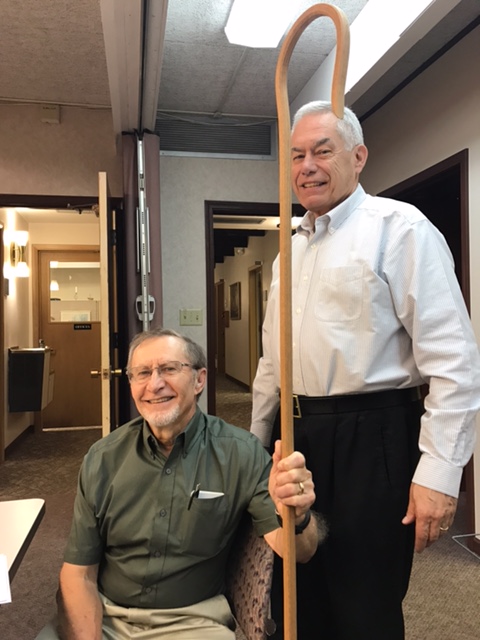
Last week I had the honor of joining the staff of Northwest United Methodist Church as a part-time Pastor of Congregational Care. In a bittersweet moment my good friend Tom Slack, who is retiring from the Northwest staff after 11 very good years of ministry, presented me with a shepherd’s staff that he received when he came to Northwest. We will all miss Tom and his wit and wisdom and caring ways. I am humbled to pick up some of the Slack (pun intended) created by Tom’s departure but know I cannot begin to fill his shoes.

Part of my responsibility will be to lead congregational prayer at Sunday worship; so I will be sharing those prayers from time to time here in my blog beginning with this one for Sunday, July 2. Please pray for Tom and me and our congregation during this time of transition.

O Giver of true freedom and joy, today we celebrate the brave founders of our country who 241 years ago pledged “their lives, their fortunes and their sacred honor” to declare the freedoms we continue to cherish and enjoy today. We give thanks for their courage and vision and for all those who have worked and sacrificed to preserve and perfect those freedoms ever since.

Our prayer today is that your spirit will come like a mighty wind to heal our divided nation and world. Give us hearts of compassion and ears willing to hear the opinions of others that differ from ours. Teach us to disagree without being disagreeable. Bless those who have taken upon themselves the heavy burden of governing in these difficult times.

We pray for peace and justice for all of your children. For those who suffer from addiction, depression, chronic pain, grief, oppression and war. Fill our hearts with the love of Christ and drive out the fear that makes us more concerned about our own freedom than the needs of our neighbors. Teach us again that freedom is not a zero sum game. In your eternal love, O God, remind us that there is a wideness in your mercy that provides healing and liberation for all of creation. When any of your children suffer, we all suffer together, and unless there is liberty and justice for all, no one is truly free.

The goal of spiritual freedom for all is a big dream and we are tempted to despair that we will ever achieve it. But then you remind us that with you all things are possible. Renew and refresh our faith and willingness to dream big dreams as we again celebrate Independence Day.

In the words of Sister Ruth Fox, we too pray that you “O God will bless us with anger at injustice, oppression, abuse, and exploitation of people, so that we will work for justice, equality, and peace.
May God bless us with tears to shed for those who suffer from pain, rejection, starvation and war, so that we will reach out our hands to comfort them and to change their pain to joy.

May God bless us with the foolishness to think we can make a difference in this world, so that we will do the things which others tell us cannot be done.

Hear our prayers O God, in the name of the young and fearless prophet Jesus Christ, Amen.

A Field of Dreams (Father’s Day Sermon), Deuteronomy 4:6-9

Back when my body would allow it, I used to play a lot of softball. I love that game in part because there’s no clock or time limit, or as Yogi Berra said, “It ain’t over till it’s over.” I learned that and another important life lesson in a softball game many years ago. Our team was down by 4 runs coming up for our last at bat. Just so you know, our team had never come back from 4 runs down ever in the history of the franchise. I was the 8th batter due up in that final inning; so I was not optimistic that I would get another at bat.

But, a few hits and a couple of errors by the other team and I suddenly realized I might be called on to hit. That was good, but the bad news was that because I didn’t expect our team to make a comeback, I hadn’t been paying as close attention to the score as I should have. Lo and behold, with two outs the batter just before me hit a triple and drove in a run and I was due up to bat. I knew the runner on 3rd base represented either the tying or the winning run, but I wasn’t sure which. Of course I could have asked the umpire or our coach, but I was too embarrassed to admit I didn’t know the score.

And it made a big difference. If the score were already tied and I made the 3rd out – we would just go to extra innings. But if we were still down a run and I messed up, the game would be over; and my out would result in our losing the game. (Just for the record – I got the game winning hit–one of the few highlights in my non-athletic career.) But the life lesson learned was more important – be sure you know the score, because you never know when you may be called on to step up to the plate with the game on the line.

Our text today from Deuteronomy is about making sure our children know the score in the game of life. In this passage Moses is like a coach giving his team final instructions because they are about to play a big away game when they cross the Jordan into the Promised Land. He tells them the most important thing is loving God always with their whole being and warns them that the prosperity they are about to enter after 40 long years of wandering in the desert is not just flowing with milk and honey. There is also the danger that when life is good for them they will forget that it is God who has delivered them and brought them to this good place. When we are going through rough times like a baseball team in a long losing streak we are likely to ask God to deliver us. But during the thrill of victory we may fall into the trap of thinking our success is because of our great skill and forget to give God the credit.

Moses goes on to stress the importance of teaching children about loving God and making sure future generations know the stories of God’s great acts of salvation. How do we do that? As Mebane said last week, it’s all about the fundamentals. First Moses says “Hear O Israel.” As players on God’s team we need to listen to God as our coach. If we are going to know how to play the game of life we need to learn how God wants us to live before we can pass that faith on to others. Moses says we do that with both our words and the example of our lives. He tells us we should recite God’s words to our children and talk about them when we are at home and away, which means everywhere.

Every sports team knows the importance of having home field advantage. You get to sleep in your own bed, eat normal meals, keep your regular routine in familiar surroundings and have the energy and enthusiasm of your fans supporting you during the game. Away games are much tougher. Traveling is tiring, most of us don’t rest as well in a strange place, you miss family and home cooking, schedules are different, and then of course there’s the problem of hostile fans when playing on the road. Championship teams are those that can overcome all those distractions and still play their best games away from home.

The game of faith is no different. It’s much easier to do daily devotions and prayer at home, to live our Christian values without the added temptations of a secular world bombarding us with lies about what it means to be successful. Especially away from the friendly confines of home we need to know the score, and coach Moses says we do that by loving God all the time, when we lie down at night wherever we are and when we rise up to face a new day. To win at the game of life we need to live in the assurance of God’s love when things are good and when we’re down 4 runs in the bottom of the ninth with two outs. That constant love is what gives us the peace that passes understanding to calmly step up to the plate and be ready for any curve ball life throws us.

How do we keep the love of God foremost in our minds and hearts? Moses says, “Bind God’s word as a sign on your hand, fix them as an emblem on your forehead, and write them on the doorposts of your house and on your gates.” For the Hebrew people these instructions literally meant to wear small leather pouches call phylacteries that contained small scrolls with the 10 commandments and other key scriptures to constantly remind themselves of God’s word. Today that verse can mean any reminder that works for you – keeping a Bible in a visible place (and actually reading it), jewelry with Christian symbols, a fish symbol on your car, a tattoo, or an image that reminds you of God on a computer screen or iPhone, a post it on the bathroom mirror, whatever works for you.

But these symbols are just meant as reminders about how God wants us to live. They are not intended to be a way to flaunt our faith or brag about what good Christians we are. If we don’t walk the walk nothing else matters. The point is to love God, not just to talk a good game. In Matthew 23 Jesus criticizes the Scribes and Pharisees because “they do all their deeds to be seen by others; for they make their phylacteries broad and their fringes long.” Anyone can talk a good game, but results are determined on the field of play.

The key to Moses’ teaching is “to love God with all your heart, soul and might.” Please note that Love is a verb not a noun. Christian love means putting faith into action. How exactly do we show our love for God? Praising God and being grateful for our blessings is one way, but even more important is how we treat others and all of God’s creation. In his parable about separating the sheep and goats Jesus repeatedly says, “What you do to the least of these you do to me.” How we treat others and how we take care of God’s creation shows our love for God or our lack of it because God’s spirit is in every living creature and person, even the most unlovable. Also a good coach doesn’t just tell players how to play the game, he or she shows them, and that is even more true in the game of life. Someone once told me “faith is caught more than it’s taught.” When I was working on this part of the sermon I was reminded of a song from “My Fair Lady” where Eliza expresses her frustration with her boyfriend Freddie this way:

“Words, words, words!
I’m so sick of words

Don’t talk of stars, burning above
If you’re in love, show me!
Tell me no dreams, filled with desire
If you’re on fire, show me!

Here we are together in the middle of the night
Don’t talk of spring, just hold me tight
Anyone who’s ever been in love will tell you that
This is no time for a chat.”

I can just hear God looking at our world full of so much chaos and hate and disregard for creation and pleading with us, “If you’re in love, show me!”

Of course we do love God, but just as we often disappoint and hurt the people we love the most we sometimes mess up on loving God too. Ever since Adam and Eve rebellion against parental authority and our Heavenly Father’s authority seems to be built into human DNA. In one of the great baseball movies of all time, “A Field of Dreams,” Ray Kinsella rebels against his father’s passion for baseball by refusing to play catch with his dad and by berating one of his father’s heroes, Shoeless Joe Jackson. Ray said Shoeless Joe was a criminal because he was one of the Chicago White Sox players accused of throwing the 1919 World Series. Ray then moves as far away from home as he can get and has to live with the regret that his father died before he could ever tell him he was sorry. When a wise mentor asks Ray why he did that his response is “I was 17.”

Many of us have been on one or both sides of that rebellion as kids or parents. And it hurts. When young people reject the values and faith practices we’ve tried to instill in them it is very painful, and thus some of the mixed emotions holidays like Father’s Day conjure up in us. My Mom was not much of a philosopher but she liked to express the concern Moses had by saying that “Christianity is only one generation from extinction.” There’s some truth in that saying even though our biblical history teaches us that God always finds a way to raise up a faithful remnant when the majority of people turn away.

Having said that, the fear of losing basic Christian and human values is very real, especially in the state our world is in today. Instead of a field of dreams we have a field of screams in our nation’s capital and a shooting in the Columbus library! And that’s just two of a dozen or more acts of violence that have been in the news this week. Reading the morning newspaper over a cup of coffee used to be one of life’s real pleasures for me, and I still do it because I want to be an informed citizen; but it has become an increasingly depressing task. But rather than throw up our hands and accept defeat, all the terrible news in our world is just more reason we need to be sure we teach and live God’s way of love more diligently.

One danger is that we panic about where the world is headed and try to force Christian values on children or others in unloving ways. Sooner or later that strategy backfires. The text we read this morning about loving God with all our being is bookended by two verses that tell us to FEAR God. I’d like you to get a picture in your head of someone you are afraid of. Got it? Do you love that person? It’s almost impossible to love something or someone if we are fearful. There’s no room for love in our hearts when we are full of fear. Unfortunately many people get turned off on because they are taught about a judgmental God that seems more like Big Brother than a loving parent.
It seems pretty significant to me that when he was asked to pick the greatest commandment, Jesus didn’t pick either of the verses in Deuteronomy 6 that teach us to fear God, he picked the one that says, “Love the Lord your God with all your heart and all your soul and all your might.” I saw a quote from another preacher recently who said her first priority is that “my children’s first knowledge of God will be that God is a God of love.” That’s a great theology.

Father’s Day is a day for appreciation and love for fathers and father-figures, but no one is perfect; so regrets, we’ve all got a few or a lot. But here’s the good news and bad news about the Yogiism that says “It ain’t over till it’s over.” Baseball games have no clock, which means they can literally go on forever or what seems like it about the 18th inning. That’s a problem for baseball’s popularity in our fast-paced 4G world, but when it comes to the game of life extra innings are great. It means more time for reconciliation and love.

That’s what happens to Ray Kinsella when he builds a baseball field in the middle of his Iowa cornfield. He had to put up with ridicule and scorn from family and friends to follow his dream. His baseball field almost led to financial ruin, but he had the support of a loving wife and daughter who could see the dream because they too believed. Ray didn’t understand what it meant when he heard a mysterious voice say, “If you build it he will come,” but he took a leap of faith and built his field of dreams and finally discovers what it all meant in the final scene from the movie.

Ray and his family have just watched Shoeless Joe Jackson and other deceased baseball stars play a game on their field and are getting ready to retire for the night when they notice Shoeless Joe hanging around. When Ray asks him what he wants Joe nods toward a young catcher who is still removing his catching gear and says, “If you build it he will come.” Ray’s jaw drops as he recognizes his father as a young man. His dad, John, introduces himself and thanks Ray and his family for building the field. After Ray introduces his dad to the daughter-in-law and granddaughter he never got to meet the two of them are left alone on the field to talk.

John says that playing there is a dream come true (because he never made it to the big leagues as a player). Then he asks, “Is this heaven?” And Ray says, “No, it’s Iowa.” Then he asks his dad “Is there a heaven?” And John says, “Oh, yes. It’s a place where dreams come true.” Ray ponders that and looks back at his wife and daughter sitting on the porch swing and says, “Then maybe this is heaven.”

John is about to walk away toward the corn beyond left field, but Ray says, “Dad, could we have a catch?” John says, “I’d like that.” And the movie ends with the two of them playing the game of catch Ray had refused to play as a teenager.

“Heaven is the place where dreams come true.” The kingdom of heaven is that place right here and now for those who love the God of love and reconciliation with all their being. That loving God will come to us wherever we are if we build it – if we build our relationship with God that is, and if we are willing as Ray was to “Go the Distance” even when others think we’re crazy.

[Preached at Northwest UMC, Columbus, Ohio, June 18, 2017]

Palace Intrigue: Samuel and James Comey

I am serving as a Bible Storyteller tonight for our Vacation Bible School and the story for tonight is the anointing of David as King of Israel (I Samuel 16:1-12). As I prepared this week to share that ancient story the news was all about the “he said, she said” back and forth drama between former FBI director James Comey and President Trump. I couldn’t help but think about the parallels between the two narratives. (Fear not, this blog is totally separate from telling the story at VBS. I will not make any partisan political points with the kids at church.)

The biblical story begins when God asks Samuel, the last of the judges who ruled Israel before they, going against God’s advice, became a monarchy, to go to Bethlehem and anoint a new king from among the sons of Jesse. Samuel is afraid that Saul will kill him if he finds out what his mission is; so God suggests a little divine diversion and tells Samuel to take a heifer with him and pretend that the purpose for his trip is to offer a sacrifice. Samuel does the Lord’s bidding and invites Jesse and his sons to “the sacrifice” where he has Jesse bring before him each of his sons to see which one God has chosen to be the new king.

First is Eliab who is strong and handsome, and Samuel is sure he has found God’s man. But God says no and explains to Samuel that God does not look on outward appearances as mortals do. Instead God “looks on the heart.” (I Sam. 16:7) So the search continues with Abinadab, then Shammah, and four more of Jesse’s sons, and each in turn is rejected by God. In frustration Samuel asks Jesse if he has any other sons and is told that there is one more, David, the youngest who is out tending his father’s sheep. Samuel insists that David be summoned and when he appears God said to Samuel, “Arise and anoint him; for this is the one.” (v. 12)

Samuel didn’t want to challenge Saul’s authority and power. We can all understand the fear of retaliation. It occurred to me that the same thoughts must have been going on in James Comey’s mind before his testimony before the Senate on Thursday. We may never know for sure what his motives are. Only God can look on Comey’s heart and judge his intent. But I am willing to entertain the possibility that like Samuel the former FBI director may have overcome his fear of retribution by the President to do what he believed was required of him as a citizen, public servant, and Christian (he’s a very faithful United Methodist).

There are those who will argue that Comey is just angry because he was fired and is trying to get even with the President, and that’s a possibility; but considering the risks involved in challenging the most powerful person in the world I think that is unlikely. If I were in Comey’s shoes the option of simply going quietly into retirement free from the stresses of Washington politics would have a great deal of appeal. My opinion is that challenging the power of the President while knowing first-hand how President Trump normally deals with those who oppose him required a great deal of courage and faith in the power of doing what one believes is the right and honorable thing in spite of fears or consequences.

Fear is a powerful motivator. Even as I write these words I am not sure I will be brave enough to post them because I know several of my dear friends and family members will strongly disagree with what I’ve said. But sometimes telling the truth is a stronger duty than fear of conflict and disapproval. I hope someday soon we will know which version of the Trump-Comey controversy is the truth. In the meantime for the good of our own peace of mind and the health of our nation we would do well to withhold any surefire opinions and judgment and remember that only God can look into our hearts.

Dueling Psalms, 130 vs. 19


No, that 130-19 is not a lopsided NBA finals basketball score! It’s the score of my attitude adjustment a few days ago when I awoke in one of those woe-is-me moods and thought of the lament known as De Profundis in Psalm 130. That’s Latin for “O crap I have to face another day of aches and pains and bad news!” My arthritis was nagging at me, my chronic back trouble was moving up the pain scale, and the news was full of more terrorist attacks and hate crimes. Reading the newspaper over my morning coffee used to be one of my favorite times of the day. I still do it out of a sense of duty to be an informed citizen, but it has become an increasingly depressing task.

Psalm 130 begins “Out of the depths I cry to you, O Lord. Lord, hear my voice! Let your ears be attentive to the voice of my supplications!” As tensions between our nation and others mount, as our president foolishly believes his own nationalistic rhetoric that we can shrug off our responsibility for climate change and go it alone, as fears of terror attacks increase, and partisan politics paralyze any attempt to address critical domestic and international issues responsibly, I often wonder if God or anyone is listening to the voice of my supplications.
Later that same morning I went out to work in our lawn and gardens still down in the depths. We are blessed to live on a beautiful property decorated with my wife’s gardening handiwork, a pond, trees and flowers. But the beauty requires hard work, especially this time of year when the grass and the weeds are being very fruitful and multiplying. It’s the work that prompts me at times to say that “yard work” is made up of two four-letter words. But the birds were in good humor that morning and serenaded me as I went forth to mow the lawn. And then I looked up at the blue sky dotted with huge languishing cotton ball clouds pictured above, a sight not seen nearly often enough in central Ohio, and my heart shifted gears from Psalm 130 to 19:

“The heavens are telling the glory of God; and the firmament proclaims God’s handiwork. Day to day pours forth speech, and night to night declares knowledge. There is no speech, nor are there words; their voice is not heard; yet their voice goes out through all the earth, and their words to the end of the world.” (Psalm 19:1-4).

In basketball 19 doesn’t beat 130, but in the game of faithful living it does. God’s presence is all around us no matter how far down in the depths we are feeling. We just have to look for it with all our senses. No, the skies are not always breathtakingly beautiful, but the loving God of all creation is always surrounding us if we have eyes to see and ears to hear. Even the author of De Profundis knew that while in the depths, and Psalm 130 ends with this statement of faith and hope:

“I wait for the Lord, my soul waits,
and in his word I hope;
my soul waits for the Lord
more than those who watch for the morning,
more than those who watch for the morning.

O Israel, hope in the Lord!
For with the Lord there is steadfast love,
and with him is great power to redeem.
It is he who will redeem Israel
from all its iniquities.”

Memorial Day Prayer

O God of Salvation History, one of the many gifts you have blessed us with is the ability to remember. Memories are cherished traces across the timelines of our lives that nothing can ever erase. This weekend we set aside time to celebrate special memories of those dearest to us.

We honor all the men and women who have made the ultimate sacrifice to preserve and protect the freedoms we too often take for granted. Flags and flowers are symbols of our gratitude for those who gave their lives in the service of their country. In a moment of holy silence we now offer our personal prayers of thanks and honor as we remember. (pause)

Many people also use Memorial Day as a time to honor the memory of other loved ones who have gone on before us–parents, grandparents and others whose sacrificial love made life possible for us in so many ways. We know life changes from generation to generation, but memories preserve the wisdom and virtues of the ages. We humbly pray that the memories we are creating for those who come after us will be worthy and true to your heavenly purposes for your people.

Lord, we also give thanks for your grace that lovingly forgives our many failures. Teach us also to forgive others and ourselves so painful memories and the burdens of guilt and regrets won’t hinder our faith journeys.
So on this Memorial Sabbath day as followers of Jesus Christ, we entrust all of those we remember and honor into your eternal care. Christ has showed us the ultimate truth that love conquers death and that sacrifice is transformed into victory in your everlasting arms.

And now remembering Christ’s sacrificial love for us we join our voices with all the saints as we pray in Christ’s name with the words he taught us. Our Father,…

(Northwest UMC, Columbus, Ohio, May 27, 2017)

The Irony of Christ’s (still) Broken Body, I Corinthians 10:16-17

Our granddaughter Audrey celebrated her first communion today, and this grandpa was especially proud that she was chosen to be the reader for the Epistle lesson, or as the bulletin for the service said, to “Proclaim” I Corinthians 10:16-17. She isn’t tall enough to see above the lectern, but she read flawlessly Paul’s words so sorely needed in our broken world, “The cup of blessing that we bless, is it not a sharing in the blood of Christ? The bread that we break, is it not a sharing in the body of Christ? Because there is one bread, we who are many are one body, for we all partake of the one bread.” There were other references to unity in the liturgy and hymns for the service, and the Monsignor did a great job of coming down into the congregation to talk directly to the young communicants. He reminded them to enjoy the celebration with family and the gifts they would receive on this important day but stressed that the real gift they were about to receive for the first time is the gift of Jesus himself.

He told them the best part is that they can receive Jesus anytime they choose to invite him into their lives. And then at the high point of the service these beautiful young children were invited to receive the sacrament of Holy Communion for the very first time, followed by the other members of the congregation. Except the invitation was not for the whole congregation. In keeping with Roman Catholic doctrine those of us who are not Catholic were not welcome at Christ’s table. We, even those of us who are devout Christians of other stripes, were excluded from receiving the gift of Jesus.

I thought I was prepared for that part of the service. I’ve been in Catholic services before, but this was different. To be able to share in that sacrament with Audrey would have been special and to be reduced to a mere spectator was painful; and the irony of it all having just heard her read that “we who are many are one body, for we all partake of the one bread” hit me harder than I expected.

Maybe it’s because I am already very discouraged and depressed about the hateful and divisive state of American society and the ratcheted up tensions between the U.S. and Russian and North Korea. Or maybe it’s just that I am still idealistic enough to believe that pious talk about Christian unity should translate into practice.

I was reminded of a wedding I helped to officiate early in my ministry. The bride was Catholic and the groom United Methodist. The marriage was celebrated in a Roman Catholic Church and the priest graciously agreed to let me share in the ceremony. We each did different parts of the marriage ritual and had agreed in planning the wedding that when it came time for Communion I would serve the groom and Father Maroon would serve the bride. We consecrated our separate Communion elements but before we served the couple Father Maroon interrupted the service to offer a commentary I’ve never forgotten. I don’t remember his exact words, but the essence of what he said was this: “It’s very sad we have to serve this sacrament from two loaves and two cups. I pray that someday we will be one and that won’t be necessary.”

That was 42 years ago, and the body of Christ is still broken. What kind of witness can the church possibly offer to a world starving for unity and peace when we Christians still can’t all feast at the same table? Please understand, I am not judging my Roman Catholic sisters and brothers, even though it probably sounds like it. This is not just a “Catholic” issue but an example of the brokenness in the church that we all must acknowledge if there is any hope of healing. As always I must remember Jesus’ advice to remove the log in my own eye before criticizing the speck in someone else’s. There are deep divisions in my own beloved United Methodist Church that may soon fracture the body of Christ yet another time. I am also painfully aware that Sunday morning remains one of the most segregated times of the week and that very few Christian congregations really reflect the rich diversity of our multicultural nation and world.

My prayer is that all of us of every faith and persuasion will be more aware of anything we do as individuals or as organizations that divide us or exclude others and keep us from being one body in practice and not just in words.

Earth Day, Science and Religion

I spent Earth Day morning participating in one of the hundreds of Marches for Science held around the world today. I am not a scientist, although there was a time when I thought I would be. I did well in science and math in high school, and inspired by the 1960’s space race and my hometown hero Neil Armstrong I began college in a pre-engineering program. All went fairly well until I hit calculus and suddenly an earlier call to ministry started feeling like a much better fit for me.

So I mingled at the Ohio Statehouse on a chilly Saturday morning (void of any global warming benefits) with a few thousand other people of all ages feeling a bit out of my element. The speakers at the rally were all from the scientific community, and except for a few mentions of God when we sang “America the Beautiful” there were no official theological overtones to the program. I was pleased to see a couple of people from my church and a theology professor from my alma mater there.

I should say that my awareness to the issue of theology and religion was heightened by the fact that I am currently reading “Why Religion Matters” by Huston Smith, a very weighty tome that explores the impact of what Smith calls the Traditional and Modern worldviews. The former for Smith represents a theological/mystical perspective and the latter a purely scientific one. I readily admit it has been too many years since I studied philosophy for me to do justice to Smith’s argument, but he makes one distinction which I found very helpful, and that is when he distinguishes between “science” and “scientism.” He describes the difference like this: “Scientism adds to science two corollaries: first, that the scientific method is, if not the only reliable method of getting truth, than at least the most reliable method; and second, that the things science deals with—material entities—are the most fundamental things that exist.” (p. 64)

Theology and religion on the other hand deal with the mysterious and more ambiguous questions of meaning and purpose that lie beyond or deeper than any knowledge scientific experiments can provide. So while my co-marchers today were chanting about “peer reviewed research” and “scientific data,” my motivation for being at the rally had more to do with the Psalmist’s assertion that “The earth is the Lord’s and all that is in it, the world, and those who live in it; for God has founded it on the seas, and established it on the rivers.” (Psalm 24:1-2) I didn’t take time to make a sign for today’s march, but if I had mine might have had a footnote that said “marching for science (not scientism) AND faith.”

I hasten to add that scientific and theological worldviews are not mutually exclusive, even though they have often been characterized as foes. Speakers at the rally today celebrated a long list of illnesses that have been eliminated by medical science; they praised improved air and water quality made possible by environmental protection initiatives. And they legitimately, in my opinion, criticized short-sighted attempts by the Trump administration to cut back on important funding for the very programs that have given us a quality of life we take for granted.

I fully support the need for the NIH and the EPA. History should teach us that unregulated capitalism and free market motives quickly give into profit over prophetic concern for the general welfare and long-term preservation of God’s creation. So the political motives for today’s marches are grounded in the very theological issues of stewardship of what is not ours but God’s. It is good and necessary to celebrate all the advances in knowledge that scientific research has provided. But science without the safety net of theology always comes to the edge of human knowledge—the edge of mystery where we must take the proverbial leap of faith and trust in the source of being itself that some of us call God.

That partnership between science and faith was captured in my favorite sign among the hundreds held by marchers today. It contained this quote from Dr. Martin Luther King, Jr.: “Science investigates; religion interprets. Science gives man knowledge, which is power; religion gives man wisdom, which is control. Science deals mainly with facts; religion deals mainly with values. The two are not rivals.”

If we are going to save our planet from human foolishness we need to join hands and work together, scientists and people of faith, government and private industry, young and old, and people of every political persuasion. There is no time or energy to waste on false battles between different perspectives or worldviews. I heard an interview on NPR this week about someone dealing with working class populations that are too consumed with just staying alive to go marching for science or the environment. The reporter said, “They don’t care about polar bears, they care about jobs.” The one to whom the earth belongs and all that is in it says we need to care about both. A nation that can eliminate polio and smallpox can figure out how to put people to work. If we can send people and spacecraft into outer space we can establish social justice and turn back climate change.

It’s a matter of priority. Those urgent human problems will not be resolved by building ugly walls or more obscene methods of mass destruction. The scientific method itself is proof that our hypothesis that war will solve human differences is blatantly false. How many times do we need to run that experiment before we realize it is a false hypothesis? All of the world’s great religions are based on a better hypothesis that the way to world peace is to love our neighbors, and that includes caring for mother earth that is our common home.

On my way to the march today I heard a piece on NPR about a woman who has started a support group for people who are suffering from anxiety about climate change and what it means for our future and especially for that of our children and grandchildren. She did it because she realized that there were lots of other people like her who were feeling isolated and powerless in the face of the forces denying the very existence of climate change. I confess I suffer from some of those same feelings and if that support group wasn’t in Utah I might join up. My own personal struggle with powerlessness took the form this week of not deciding until the last minute if I was going to the march today. My skeptic voice kept saying it won’t make any difference, your arthritis won’t like the chilly temperatures, you have too much else to do around the house. But the stronger voice was the one that argued for responsible stewardship, discipleship and citizenship, a pretty powerful combination.

And I’m very glad I went. It felt wonderful to be part of a movement that stretched far beyond downtown Columbus, to feel connected with the earth and with kindred souls who share a common purpose. That sense of belonging was summed up nicely in one of the other songs we sang at the rally before the march, John Lennon’s “Imagine:”

“Imagine all the people sharing all the world,
You may say I’m a dreamer
But I’m not the only one
I hope some day you’ll join us
And the world will be as one.”

Blinded by our expectations?

One of the most consistent  things about our interactions with Jesus is our failure to recognize who he is. We too often are caught unaware and when it’s too late we sing a sad refrain with Mahalia Jackson, “Sweet little Jesus boy, we didn’t know who you was!”  From his birth in a barn to his hanging out with sinners, to his  refusal to defend himself in the garden or before Pilate, Jesus refuses to show up how and where we expect him to. His entry into Jerusalem  is not in a stretch limo  befitting a king but in a beat up old Volkswagen beetle. The crowds who shout “Hosanna!” on Sunday change their tune to “Crucify him!” only five days later because he isn’t the conquering hero they were expecting.

Those expectations are understandable for people who were oppressed and dying for liberation.   We might guess  those strangers who lined the streets of Jerusalem had not spent time with Jesus. Their failure to recognize who he really is may be understandable.   But what about those disciples who are closest to him who had spent three years listening to his teaching and watching the way he healed the sick and comforted those who were excluded by society?   They too deny and betray and hide when their expectations are not met.  Have they never heard the words of Isaiah who tells us that the Messiah will not be a worldly ruler but a suffering servant?  (Isaiah 52:13-53:12).  Or like us have they chosen only to hear and believe what they want?  We are expecting Rambo and we get Gandhi instead!

Even Mary Magdalene who stood by Jesus at the foot of the cross and was one of the first to go to the tomb doesn’t recognize Jesus on Easter morning!   This woman who was one of the most devoted and loyal disciples  mistakes Jesus for a gardener!  (John 20:11-18).  How could someone who owed so much  to Jesus fail to recognize him at this most triumphant moment?  Is it not because of her expectations?  She went to the tomb to minister to a corpse and instead is the very first to encounter the resurrected Christ!

How often do we fail to recognize Christ in our midst, in the least of God’s children around us? Whom do we expect to encounter  when we go to the tomb this Sunday? Will we recognize the risen Christ?  What we know from past experience is that he probably won’t appear the way we expect him to. So let’s go with eyes and hearts wide open  to see what our amazing God is up to this Easter!