Hi God, it’s me again. I am so bummed. The whole mess in D.C. and Gaza/Israel is just sapping so much energy from me. I’m a pastor and writer, but I’m not sure even what can be said. The forces of violence and vengeance are so much in control of the world as usual that innocent suffering doesn’t matter. I have to tell you, Lord, the ways of peace seem so puny and weak against drones and bombs dropped on refugee camps. How can those in power be so unmoved by the suffering and death of thousands? Are they so insulated and hardened by years of power madness that the pain doesn’t reach their hearts? It is so terribly sad and discouraging since it has been this way from the beginning of time. It seems so irresponsible on my part to try and live life as usual – but then we have two good friends in nursing homes and their suffering and that of their family and friends on a different level, but still quite real. Combine that with the cold dreary weather and my own health concerns and life sucks big time. Woe is me. I’m turned in on myself and too much focused on the half empty glass. I know that, but what to do about it? I just started my 78th trip around the sun this week and should be smarter by now. Where is the wisdom that is supposed to come with age when I need it? O God, please give me patience and courage for the living of these days. Amen
Author: Steve Harsh
Eucharistic Blackmail
“Then he took a loaf of bread, and when he had given thanks, he broke it and gave it to them, saying, “This is my body, which is given for you. Do this in remembrance of me.” And he did the same with the cup after supper, saying, “This cup that is poured out for you is the new covenant in my blood. But see, the one who betrays me is with me, and his hand is on the table.” (Luke 22:19-21)
I heard something from a friend this week that has left me adrift in a sea of incredulity. Given the bitter divisions in our nation and my denomination I should not have been shocked, but I was. This friend is a former member of a United Methodist church I used to serve. She is one of the casualties of the great United Methodist schism of 2022-23. She told me that a relative who still attends the now Global Methodist Church reported the following from their worship service last Sunday: prior to communion the pastor told the congregation that anyone planning to vote for Issue One in the upcoming Ohio general election should probably not take communion.
Issue One is a constitutional amendment that will protect reproductive rights and access to abortion. This is a very controversial and emotionally charged issue, and while I respect the opinion of those who oppose Issue One I do not think access to the Sacrament of Holy Communion should be used to persuade or intimidate anyone to vote in any particular way.
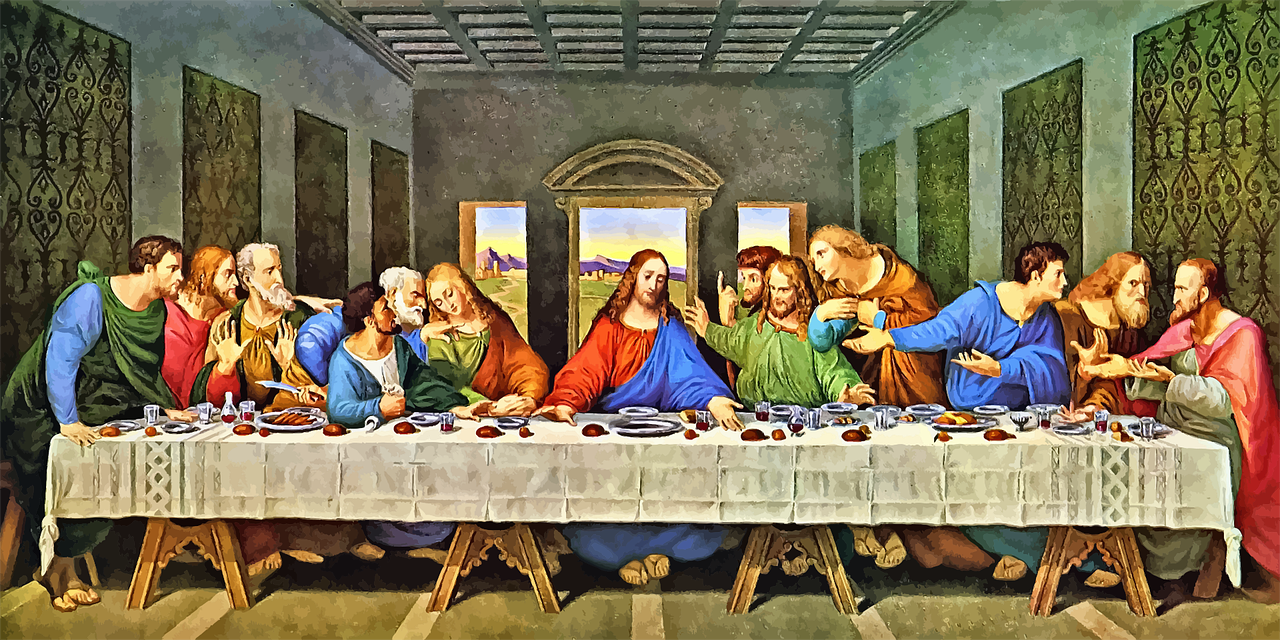
I don’t know what the position of the Global Methodist denomination is on who may or may not receive this sacrament, but in the United Methodist Church we practice an open table. As a pastor I would never presume to judge who is worthy or unworthy to come to the Lord’s table because it is the Lord’s table, not mine or my church’s. The exemplar for that inclusive table is the Upper Room itself on the night before Jesus is crucified. The Gospels make it very clear that all 12 disciples are there to celebrate the Passover with Jesus. You can count them all in Da Vinci’s painting.

But seriously, check the Gospel accounts in Matthew 26, Mark 14, and Luke 22.
According to all of these retellings of what transpired in the Upper Room Jesus not only knew that Judas would betray him and Peter would deny him 3 times, but also that all the other disciples would run and hide in his hour of greatest need. “Then Jesus said to them, “You will all become deserters because of me this night; for it is written, “I will strike the shepherd, and the sheep of the flock will be scattered.'(Matthew 26:31). Does that disqualify any of the 12 from sitting at the table with Jesus? No, they all are there to receive this sacrament of remembrance.
Jesus is very clear about whose job it is and isn’t to judge others – and it isn’t mine or any clergy person’s. “Do not judge, so that you may not be judged. For with the judgment you make you will be judged, (Matthew 7:1) Or check the parable of the weeds in the wheat in Matthew 13 where Jesus says, “Let both of them grow together until the harvest; and at harvest time I will tell the reapers, ‘Collect the weeds first and bind them in bundles to be burned, but gather the wheat into my barn.’” Or my favorite, the billboard that says, “Just love them all. I’ll sort them out later.” – God.
When Jesus says, “Come to me all who are weary and heavy laden, and I will give you rest,” (Matthew 11:28) all means all; and this sinner is darn glad we are all invited to the table. When we all get on one side of the table for a remake of Da Vinci’s picture there will be Donald Trump next to Alexandria Ocasio-Cortez, Hamas Palestinians next to Netanyahu, Putin next to Zelenskyy, and in the middle Jesus asking, “What took you so long to get here?”
And in the background John Lennon is singing:
“You may say I’m a dreamer,
But I’m not the only one.
I hope someday you’ll join us
And the world will be as one.”
Groundhog Day in Congress
Those of us who live in Jim Jordan’s home district know that his only claim to fame is that he was a champion high school and college wrestler. While I admire the discipline and determination it takes to excel in wrestling, I would l like to point out that wrestling is not a team sport. Democracy, on the other hand, is the ultimate team sport. It requires an ability to collaborate and compromise, skills which Mr. Jordan did not have to learn on the wrestling mat and which are apparently not even in his vocabulary.
For the Congressional GOP to continue to waste time by voting in Groundhog Day fashion for the same unqualified candidate is not only foolish, it is very dangerous. Our adversaries in Tehran, Moscow, and Beijing are drooling in joy over the paralysis of our government. We are the laughing stock of the world and proof to other nations that democracy doesn’t work.
Are there not enough moderate members of Congress on both sides of the aisle to join forces as adults and agree on an acceptable bi-partisan candidate to lead the House in these critical times? We need some profiles in courage who will put personal power and party loyalty aside for the greater good of our nation and world. And we need it now!
A Prayer for Peace in a World Gone Mad
Dear Holy One, my soul is weary from the weight of suffering and war hanging over the world since October 7. My mind cannot comprehend the depth of the hate that drives people to inflict such cruelty on other humans. The centuries-old hatred between Palestinians and Jews is so horrific it defies human understanding. I want to offer even a tiny bit of wisdom or hope, but the well of inspiration is dry. There simply seem to be no good solutions. When our own members of Congress cannot overcome their differences to elect a leader what hope is there for peace in the Middle East? Anger and hate veto any desire to make peace or even to limit the wrath of retribution to just one eye for an eye or one life for a life. To turn the other cheek to the evil represented by Hamas or Putin is almost laughable at worst or hopelessly naïve at best. We all live in glass houses and none dare cast stones because we are none of us without sin. My own nation’s history of genocide and racism is a log in our eyes that disqualify us from passing judgment on anyone else.
Human history is one horror saga after another full of wars, bloodshed, and tears. Out of the depths we cry peace, peace, but there is no peace. Widows in Ramah are still weeping for their children while it takes excruciating days to even open a gate to deliver food and water to starving masses in Gaza. I want to turn my mind and eyes away from the atrocities, but my heart yearns to know the awful news, even though I feel hopeless to respond. The ties of sisterhood and brotherhood that bind me to my siblings in Ukraine, Gaza, and Israel are too strong for me to just escape into apathy or hopelessness. My prayer is that when we hit the bottom of our grief we will surrender to the reality that peace is beyond our human reach. For it is only in surrender to our weakness that you can fill us with courage and strength for the living of these days. Fill my weary spirit with your eternal peace and love, O Ground of all Being, and let me be a flicker of light in the darkness. Amen
Can We Forgive Without Forgetting?
“You have heard that it was said, ‘You shall love your neighbor and hate your enemy. But I say to you, Love your enemies and pray for those who persecute you, ” Matthew 5:43-44
I was sitting in Tim Horton’s on 9/11/23 while new tires were being installed on my car. I read a couple very moving pieces on Facebook about 9/11 and began trying to figure out why I am more emotional about that awful day now, 22 years later, than I can remember being except on the day itself, and maybe not even then.
I know that like my father before me I get emotional more easily as I age. Don’t tell anyone, but I even get weepy sometimes at the oh so predictable ending of a Hallmark movie. This emotional remembrance started when my wife and I watched a very moving piece on 60 Minutes Sunday night about the 433 firefighters killed that day, and I’m embarrassed to admit it’s the first time I’ve thought about one of my very best friends who is a retired firefighter. I know without a doubt that if he could have gotten himself to New York that day he would have been one of those who died trying to reach the people trapped over 80 floors up in the towers. I can’t imagine what my life would have been like these last 22 years if I had lost his friendship.
And then I read a post from a retired American Airlines pilot who was in the air that day enroute from Venezuela to JFK. He was diverted to Miami but not given any reason for the diversion. Being a recently retired Air Force pilot he knew something awful was happening but had no idea how awful.
His moving account of how he couldn’t reach his wife or kids to let them know he was ok brought me to tears, and I have a renewed sense of empathy for what so many people who were directly affected by that tragedy in all 3 locations went and are still going through. Grief has no expiration date.
Unfortunately there also doesn’t seem to be any statute of limitations on the hate and paranoia that rose up out of the ashes of ground zero, the Pentagon, or Shanksville, PA. Every time I hear or see the phrase “Never Forget” in relation to 9/11 I cringe a bit. I understand never forgetting the pain and grief from losing a loved one in such a God awful way. I have buried enough friends, colleagues, and loved ones to know that memories never die, but to lose someone so suddenly and never have the closure of saying good bye or even having any remains to bury is truly more than I can imagine.
But here’s the part of “Never Forget” that troubles me, and it did almost immediately after the initial shock and disbelief of that unbelievable day began to wear off. I know exactly what I felt because I have it in writing and proclaimed it publicly in a sermon on September 21, 2001. That sermon is the only one I ever preached that people remembered years later. The message I felt compelled to share that day was based on the text from the Sermon on the Mount about loving our enemies. I say compelled because I didn’t want to say that while the wounds of 9/11 were so raw and the dust hadn’t even settled at Ground Zero. But I knew it needed to be said.
Here’s a part of what God spoke that day through this reluctant prophet. I titled the sermon, “How Can We Ever Do That?”
“But from the very first hours of the tragedy my greatest pain and fear was not for the damage and suffering that occurred on September 11, as unbelievably horrible as it was. My greatest pain and fear has been for the inevitable escalation and perpetuation of violence that I knew these horrible acts would generate in retaliation that will inflict more suffering on more innocent people.
A friend of mine told me just after the attacks that he had forgotten how easy it is to be a Christian in times of peace and prosperity. And he is very right. We turn to God and scripture for comfort and reassurance in times of distress, as well we must and should, but some of the most important words of scripture also challenge us and are hard to hear.
And that’s why I have been engaged in a lovers’ quarrel with Jesus for the last 12 days over what to say this morning. I have tried every trick I know to avoid the difficult words we just heard from the Sermon on the Mount–these words that are high on the list of those we wish Jesus hadn’t said, but they would not let me rest. They have forced themselves into my consciousness over and over again, pleading, demanding, and crying out to be proclaimed.
“You have heard it said…” O, have we ever – all the public opinion polls confirm in spades that those who want revenge are legion, and I include myself in those who are angry. Getting even is a natural human reaction, and we’ve all been there many times this month. “You have heard it said, an eye for and a tooth for a tooth.” Sounds like good advice. In fact, at the time those words were written, they were designed to limit revenge; so victims would not demand two eyes for an eye, or a whole mouthful of teeth for a tooth. But as someone has said, if we follow the eye for an eye and a tooth for a tooth philosophy to its logical conclusion, we end up with a world full of blind, toothless people, and the cycle of violence and pain continues forever.
… Jesus says a bit earlier in the Sermon on the Mount, “Blessed are the peacemakers, for they shall be called children of God.” By whom? Not by their enemies or by most of their peers. Peacemakers, cheek turners, are more often called “yellow” and “coward” or “chicken,” but seldom ever “children of God.” We would much rather go with Moses on this one wouldn’t we, but are we followers of Moses or Jesus?
It is hard to find silver linings in some clouds, but even in tragedy there are some benefits. We see it in extended families that rally around each other when there is a death of illness. And in a similar fashion, the outpouring of patriotic spirit and resolve in the last two weeks has been amazing. One could certainly argue that this tragedy has created a sense of community that has been sorely lacking in our nation for many years. But Jesus asks us to take that sense of community one giant step further–to include even our enemies in the circle of God’s family.
I had a flashback to Jr. Hi youth fellowship this morning. One of those awkward moments when we were circling up to say the benediction at the end of a meeting, and I found myself next to a girl and was afraid I’d get her cooties if I had to hold her hand. And some wonderful adult counselor saw the problem and stepped in between us to close the circle. That’s just what Jesus does when he asks us to love our enemies. When we can’t bring ourselves to take that hand, Jesus steps in and completes the circle.” [The whole sermon, if you would like to read it is archived here in a post from Sept. 11, 2014.]
It was several years after 9/11 that I had an insight about how forgiveness of one’s enemies is possible. When Jesus says from the cross “Father, forgive them for they know not what they do,” (Luke 23:34) notice that he doesn’t say “I forgive them;” but instead asks God to do it. Without getting into sticky issues about the Trinity it seems very possible that being fully human Jesus was in such agony that he couldn’t practice what he had preached. He couldn’t forgive his enemies right at that gruesome moment — but he knew someone who could; and so do we.
We will never forget 9/11/2001, but with God’s help we can forgive. Amen
How Long, O God?
Oh My God, how can you stand the insanity of gun violence in this country. If you are truly omniscient and know everything then you already know about the headlines I just read detailing four separate mass shootings in four different states this weekend, and my wife told me about another that I haven’t even seen on my news feeds yet. That makes over 470 mass shootings in this country so far in less than 8 months of 2023!! That’s about two every day! It’s so common all this bloodshed doesn’t even make the news most of the time.
I know you want us to love our enemies, Lord, but I have to tell you I am having a hard time with the gun lobby folks who refuse to consider any common sense gun control legislation. They hide their greed behind the second amendment like it is some sacred edict when in fact it was produced over 200 years ago by frightened white men who feared their enslaved persons would rebel like their sisters and brothers did in Haiti a few years earlier.
Why can’t anyone see that we live in a totally different time when all the wrong people can easily get military style assault weapons. And yet we are hamstrung by a law adopted when guns were single shot muzzle loaders. And the only people who could change our antiquated laws are blinded by greed for the campaign contributions for which they have sold their souls. How can they not see the carnage their lust for power is causing?
Please, dear God, break through the denial and ignorance that are killing innocent people at parades, retail stores, and high school football games. Where can anyone go that is safe from an argument or road rage turning into a gun battle? What more can we do to raise this issue above the clamor of the political circus and the genuine tragedies of climate crisis everywhere?
Dear God, we know common sense gun laws work. They have worked here in the past, and they continue to work almost everywhere else in the world. How can we end America’s love affair with fire arms? Are we so frightened that we need deadly weapons to feel secure? If that’s the problem how can we create a just society where there is no need to feel threatened by others? I am in despair, Lord, that such a dream is even possible in our bitterly divided and broken country.
Scripture tells us that with you, Holy One, all things are possible. I want to believe that, God, I really do. Please raise up for us new leaders with the vision and courage to bind up our nation’s wounds and unite us in creating a culture of compassion where fear is no longer the driving force in our lives.
Please call and empower a new generation of visionary leaders who still believe that we can beat our AR-15’s into wind turbines, and turn our disagreements and fear into communities of collaboration. In the name of Jesus, the Prince of Peace, please, oh please hear our prayer. Amen.
Ode to My Beloved Bikes

In the words of that great philosopher, Kenny Rogers, you gotta know when to hold ‘em, know when to fold ‘em and know when to walk away while you still can. I needed that wisdom this week.
I made a good but sad and hard decision to give up yet another activity I have enjoyed for about 70 years. I don’t remember exactly when I first experienced the joy of riding a two-wheel bike without training wheels, but I would guess I was 6 or 7. That had to be one of the first liberating rites of passage right up there with learning to walk and potty training.
My bike riding for the next 65 years was pretty routine. And then about four years ago I bought a step-through bike, aka a girl’s bike, because I was having trouble with my balance swinging my leg over the cross bar of my 30 plus year-old Schwinn that my father-in-law had willed to me when he could no longer ride. Almost immediately I discovered that my balance issues had more to do with my neuropathy than the kind of bike I was riding. I was still able to ride for awhile in spite of a few minor low-speed falls that happened while starting and stopping. No injuries ensued, but I gradually gave up trying to ride.
A few weeks ago I went into a bike shop in search of adult training wheels to see if I could still ride some with that kind of help. Talk about the circle of life!!! But a kind salesperson offered me an alternative that seemed to be a way out of that circle. He had me try an electric bike with a small motor which would give me a boost at start up where I had the most trouble getting up enough speed to establish my balance.
After test riding the e-bike (pictured above) in the store’s parking lot I was sold and brought it home on a trial basis. Unfortunately I discovered over the last two weeks that my balance and reflexes just aren’t up to learning the new skills required to master the e-bike. I had a couple minor falls on it, again miraculously without damaging myself or the bike. The last fall was on a short trip down our driveway to get our mail, and I sadly concluded it just isn’t worth the risk of a major injury to keep trying.
So with a heavy heart I asked my wife to help me load the bike in my SUV and returned it to the store. In addition to the sadness of adding bike riding to my growing list of things I used to be able to do, I’ve been processing how to gracefully surrender to the realities of aging without totally giving up on living.
That task is a work in progress, but I believe a piece of it is to be grateful for all the decades of good memories that bike riding has provided for me. Many of those memories are from the years before I could drive when my bike gave me the first taste of freedom to take myself to the neighborhood grocery store for a pop cycle or candy bar. It was only a block away, but the longest journey starts with a short one. That 1-speed (probably also a Schwinn) took me to Little League practice, the community swimming pool, and later every morning for a year to deliver newspapers clear on the other side of our small town. OK, it was only two miles, but on frigid January mornings at 6 a.m. in northwest Ohio if felt like 20!
The summer I was 15 my good buddy Denny Dafler and I road 200 miles on six 25-mile trips and a 50 to earn our cycling merit badges for Boy Scouts. That was also the summer of my first great love, and she lived 5 miles out in the country. My legs were never in better shape than the summer of 1962.
As an adult my biking has been more relaxed rides of 5-10 miles on bike trails near home—good exercise and sometimes a therapeutic way to burn off frustration or other unresolved emotions. My exercise bike is a poor substitute from feeling the wind of the road in my face, but it is safer and more age appropriate at this stage of my life, and no helmet hair results either.
Farewell my biking self. Thanks for the memories.
Feeding the Wolves
A familiar Native American legend has been on my mind a lot recently. It’s the one about two wolves that reside in each human. One wolf is fear and the other is love. The two wolves are in constant struggle with each other to see which will control our lives. When the elders are asked which wolf wins the inner battle the answer is “The one you feed.”
I am very concerned that the steady diet of fear being fed to us by political candidates from both parties is so pervasive that the wolf of love in all of us is being starved to death. With all the dark money stoking the flames of fear on every form of media it is very tempting to just throw our hands in the air and surrender.
Dr. Brene Brown describes our situation this way: “In times of uncertainty, it is common for leaders to leverage fear and weaponize it to their advantage…If you can keep people afraid and give them an enemy who is responsible for their fear, you can get people to do just about anything.…when we are managing during times of scarcity or deep uncertainty, it is imperative that we embrace the uncertainty…We need to be available to fact-check the stories that team members may be making up, because in scarcity we invent worse-case scenarios.”
That reminds me of a definition of fear I learned many years ago — FEAR = False Evidence Appearing Real. We all need to use our best critical thinking to not feed the fear wolf any false information. There are plenty of factual things to fear without adding bogus dishes to our diet.
The Christian church in many ways has been complicit in spreading the bad news of a fear-based theology. The misunderstanding and mistranslation of the Hebrew word “yirah” as “fear” has been used for centuries to try and literally scare the “hell” out of people, or perhaps scare people out of hell would be a better way to put it.
Fear is not a good long-term motivator of desired behavior. It only works when an external authority figure is present to enforce the threat. But fear is a fairly effective way to produce guilt in people, and that guilt technique has been used to control church members, i.e. keep them coming back to church and paying their dues. I have often said that if people really understood the Good News of grace and God’s unconditional love the church would be out of business.
The word yirah in reference to God is better understood as “awe.” We overuse he word “awesome” these days to describe anything from a sunset to a new dress, and it has lost the power of truly standing in awe of the ultimate mystery of the creative force we call God.
If we can get back to praising that Holy Mystery and the unconditional love fed to us every moment of eternity then the wolf of fear doesn’t stand a chance. That’s the life force described in I John: “There is no fear in love, but perfect love casts out fear. For fear has to do with punishment, and whoever fears has not been perfected in love.” (I John 4:18)
Being nurtured by that kind of love makes it possible for humans to obey the great commandments to love God and to love our neighbors. Without that love, we are vulnerable to unscrupulous salespeople, propagandists, and politicians who use fear-inducing rhetoric and imagery to manipulate others into buying or believing what they are promoting.
Our United Methodist District Superintendent, Rev. Tim Bias, recently wrote about the power of words in his monthly newsletter. In there he shared a wonderful story about what feeding the wolf of love looks like at the micro level of interpersonal relationships. I’ve heard the story several times before, but the end of the story still brought tears of joy to my eyes. I share it here in the hope that it will feed your love wolf with the abundance that begs to be shared with others. If we keep the faith and treat everyone we meet, (yes, even our political foes) the way we want to be treated we will make more difference in the world than we will ever know.
“There was a first-year teacher at Saint Mary’s School in Morris, Minnesota. She said she had 34 students who were all dear to her. But one student stood out. His name was Mark. She said he was one in a million. He was very neat in appearance with a happy-to-be-alive attitude that made even his occasional mischievousness delightful. There was just one thing about Mark: he talked incessantly.
She had to remind him again and again that talking without permission was not acceptable. Every time she corrected him, he responded, “Thank you for correcting me, Teacher.”
She said, “I didn’t know what to make of it at first. But before long, I became accustomed to hearing it many times a day.”
One morning her patience was growing thin when Mark talked once too often. She said, “I made a first-year teacher mistake. I looked at Mark and said, ‘If you say one more word, I am going to tape your mouth shut!’”
It wasn’t ten seconds later when one of the students blurted out, “Mark is talking again, Teacher.” I hadn’t asked any of the students to help me watch Mark, but since I had stated the punishment in front of the class, I had to act on it.
I remember the scene as if it had occurred this morning. I walked to my desk, very deliberately opened my drawer and took out a roll of masking tape. Without saying a word, I proceeded to Mark’s desk, tore off two pieces of tape, and made a big X with them over his mouth. I then returned to the front of the room. As I glanced at Mark to see how he was doing, he winked at me. That did it! I started laughing. The class cheered as I walked back to Mark’s desk, removed the tape, and shrugged my shoulders.
His first words were, “Thank you for correcting me, Teacher.”
At the end of the year, Mark went on to fourth grade. The teacher eventually moved on to teach junior-high math. Several years passed. As Mark entered the ninth grade, Mark and the teacher met again.
She said Mark was more handsome than ever and just as polite. Since he had to listen carefully to the instruction on the “new math,” he did not talk as much. One Friday, things just didn’t feel right. The class had worked hard on a new concept all week, and the teacher sensed that the students were frowning, frustrated with themselves, and edgy with one another.
To stop the crankiness, she asked the students to put their books away and to take out two sheets of notebook paper. She then asked them to list the names of the other students in the room on their paper, leaving a space between each name. Then she asked them to think of the nicest thing they could say about each of their classmates and write it down.
It took the remainder of the class period to finish their assignment. As the students left the room, each one handed her their papers. Mark said, “Thank you for teaching me today, Teacher. Have a good weekend.” That Saturday, she wrote down the name of each student on a separate sheet of paper and she listed what everyone else had said about that individual.
On Monday, at the beginning of the class, she gave each student his or her list. Before long, the entire class was smiling. She listened as the students said things like, “Really? I never knew that meant anything to anyone!” “I didn’t know others liked me so much.” After a few minutes, the class went back to studying math. No one mentioned those papers in class again.
It was several years later that the teacher learned that Mark had been killed in Vietnam. She had gotten word that Mark’s family wanted her to attend his funeral. At the funeral she watched and listened. One of the soldiers who acted as pallbearer came up to her and asked, “Were you Mark’s math teacher?” She nodded. He said, “Mark talked a lot about you.”
After the funeral, most of Mark’s former classmates headed to Chuck’s farmhouse for lunch. The teacher was invited to come by. Mark’s mother and father wanted to speak with her. When she arrived, they met her at her car.
“We want to show you something,” his father said, taking a wallet out of his pocket. “They found this on Mark when he was killed. We thought you might recognize it.” Opening the billfold, he carefully removed two worn pieces of notebook paper that had obviously been taped, folded and refolded many times. She knew what it was without looking at the paper.
Mark’s mother said, “Thank you so much for doing that. As you can see, Mark treasured it.”
Mark’s classmates started to gather around. Charlie smiled rather sheepishly and said, “I still have my list. I keep it in the top drawer of my desk at home.”
Chuck’s wife said, “Chuck asked me to put his in our wedding album. I have mine too,”
Marilyn said. “It’s in my diary.” Then Vicki reached into her pocketbook, took out her wallet and showed her worn and frazzled list to the group. “I carry this with me at all times. I take it out and look at it every time I need encouragement. We all saved our lists.””
[Story adapted an article in The Reader’s Digest written by Sister Helen Mrosla, a Franciscan nun and the teacher in the story. The story first appeared in the Topeka Capitol-Journal in 1998.]
Try this in a small town
“When he (Jesus) came to Nazareth, where he had been brought up, he went to the synagogue on the Sabbath day, as was his custom. He stood up to read, and the scroll of the prophet Isaiah was given to him.” (Luke 4:16-17)
All the discussion of country singer Jason Aldean ’s song, “Try That in a Small Town” reminded me of Jesus’ return to preach in the small town where he grew up. I flunked my first sermon in seminary preaching class, but Jesus got a much harsher response to his first message that day in Nazareth. Luke tells us Jesus read from the prophet Isaiah, and that part of his Sabbath was very well received. Verse 11 says, “All spoke well of him and were amazed at the gracious words that came from his mouth.”
But then Jesus goes ahead and interprets the text and tells his audience that the good news he brings to the captives, the blind and the oppressed is not just for them but for all of God’s children with examples of how the prophets Elijah and Elisha went specifically to minister to gentiles in Sidon and Syria instead of to those in Israel. And just like that the crowd does a 180 and turns on him. “When they heard this, all in the synagogue were filled with rage.” (Verse 28). And where the Gospels of Mark and Matthew just have Jesus leaving town at that point, Luke adds these words: “They got up, drove him out of the town, and led him to the brow of the hill on which their town was built, so that they might hurl him off the cliff. But he passed through the midst of them and went on his way.” (Vss. 29-30)
I did a lot of research in graduate school on such negative reaction to public speaking and wrote a paper I titled “They Shoot Prophets Don’t They?” I had a personal interest in that topic having come of age in the last turbulence in American history which saw the assassinations of the two Kennedy brothers and Dr. King, all within a five year period. In my research, I became impressed with the work of Lawrence Kohlberg on moral development and the role of cognitive dissonance in persuasive communication. To my great pleasure that very research was mentioned by one of my favorite author’s, Father Richard Rohr, in his book, “Everything Belongs,” which I just happened to be listening to on the very day I started thinking about this topic again. I am humbled and thrilled that Fr. Rohr’s use of Kohlberg’s theory of moral development is almost verbatim what I wrote about that research in my Ph.D. dissertation 40 years ago. The application of Kohlberg’s theories about how to effectively communicate with people who have very different moral and ethical values formed the heart of my own theory of preaching which I shared with seminary students in preaching classes over a 20 year period from 1991-2012.
I believe that theory can help us understand and bridge some of the vast divide we are experiencing in our country today. The country song controversy is very illustrative of how volatile and dangerous that divide is and has been throughout American history. I grew up in a small town and can identify with the good, bad, and ugly aspects of what that experience was and still is like. There were many positive aspects to spending the first 20 years of my life in Wapakoneta, Ohio, a small, county-seat town in very rural, very white, and very conservative northwestern Ohio. It was a very safe place where kids were free to roam all over town on our bikes. Everyone knew everyone else; so people looked out for each other’s kids. I am grateful for that age of innocence and the freedom it provided for me to enjoy a carefree childhood and adolescence.
But I am also angry about the flip side of that experience. We didn’t know what we didn’t know about the broader world outside our comfort zone. Our fathers and uncles who were survivors of the Great Depression and/or veterans of World War II certainly knew more than they shared with us about issues of race and political divisions, at least in my family. All I remember being told about why there were no people of color in our town is that “we aren’t prejudiced; those people just don’t choose to live here.” It turns out there was good reason for that. I learned many years later that one of my great uncles was a leader in the local chapter of the KKK, and just this week heard from a high school classmate that for some time there was a sign outside our town that said something to the effect “Get Your Black Ass Out of Town Before Dark.” That’s the ugly kind of small town life Aldean certainly alludes to in his song and accompanying video.
One major factor in the political chasm threatening our democracy is the rural-urban divide Aldean sings about. The life experience of small town and rural people in this country is so different from urban life that it is like living in two different countries. I addressed some of that in my post on July 18, “Culture War Games While the Planet Burns,” but I want to focus here on how to approach that reality in a constructive way. In an oversimplified description, Kohlberg’s theory of moral development I mentioned above is that there are 6 stages of moral development numbered 1-6. Stage 1 is a very self-centered stage we all start out in because that kind of selfishness is necessary for infants to survive. People in stage 1 say what is morally good is whatever is good for me. Stage 6 is the other extreme where morality is defined in a universal way to mean that moral goodness is determined by what is good for everyone and for the whole world/universe. Only people like Jesus, Mohammad, Gandhi, Mother Teresa, and Dr. King ever come close to stage 6.
Most people, and this is just fact, not judgment, never grow beyond a stage 3 or 4 in moral development, and that’s the problem prophets like Jesus have in small towns like Nazareth. Kohlberg’s research found that when there is a gap of 2 stages or greater in moral development between a speaker and an audience there is a major breakdown in communication. That gap creates so much cognitive dissonance, which is the perception of contradictory information and the mental stress it causes, that we consistency-loving humans will do whatever we can to reduce that stress. That often means simply ignoring the one causing the cognitive dissonance or, as the gap widens, arguing, disparaging or insulting the speaker, and ultimately, if the gap is too great either driving the speaker out of town as happens to Jesus, or in the most tragic situations actually killing him or her, which again finally happens to Jesus on the cross.
The major lesson for us Americans right now is to turn down the heat in our political discourse by bridging the gaps in our cultural, moral, worldviews. Kohlberg concludes that we cannot communicate with each other until the gap between us is one stage of moral development or less. In other words a speaker who is a stage 4 trying to communicate with a stage 2 or 3 person must meet that person where he or she is and communicate respectfully with that person in ways that are not threatening to them. We must find common ground to stand on before we can hope to understand one another. For example, all humans have a basic need for what Abraham Maslow calls psychological and physical security and safety. People in small towns and big cities all share that need, and to understand that we all express that need in different ways goes a long way toward bridging our differences on other values and beliefs. And when our feeling of safety is threatened by people who look, act, and think differently than we do, we need to resist the temptation to attack, blame, ridicule, or judge them. The Golden Rule to treat others as we want to be treated is always a good first step in building a bridge or tearing down a wall that separates us from others.
Unfortunately it seems our human instinct is to do just the opposite when confronted with the discomfort of cognitive dissonance. Social media is full of memes these days making fun of small town people and calling each other names instead of trying to understand where others are coming from. We live in very scary times and most of us don’t know how to express that fear. To do so makes us feel vulnerable and cowardly. It’s much easier and more fun to attack those we disagree with, but it only turns up the heat and the fear on both sides.
I had a very simple example of a change of just one word making a huge difference just last week. I try to avoid debates on social media because they are often unproductive and can seem endless in their back and forth nature. I expressed that reluctance to a friend that I felt a need to respond to by saying that I hate “arguing.” Her very helpful response to me was, “This is not an argument, it’s a discussion.” That one shift in perspective moved the conversation from a win-lose situation to a productive exploration of where we could find common ground.
We need more discussion and less arguing, more willingness to meet others where they are in a spirit of understanding. From there we can both learn and grow from each other and help each other move to a higher stage of moral development where we all strive to do what is best for everyone. The alternative is to end up like “The two cats of Kilkenny. Each thought there was one cat too many. So they fought and they fit; they clawed and they bit, until except for their nails and the tips of their tails, instead of two cats there weren’t any.”
Pastoral Prayer
Oh dear gracious God, you know every thought we have, both good and bad. You know the number of every hair on our heads, and every joy and sorrow of our hearts. There is no need for us to recite the litany of all that’s wrong in our world or in our lives. We know your big, loving heart must be breaking when you witness what humankind is doing to each other and to mother earth. So in this sacred moment help us repent of our own complicity in the materialism of our time. No matter how small or large our worship of the things of this world may be, we ask your forgiveness for all the times we pursue the idols of stuff that promise happiness but leave us hungering and thirsting for more.
Holy One, you know that Amazon Prime days and Power Ball billions will not satisfy the desire of our souls for the peace that passes human understanding. The Barbie movie, or a front row seat at a Super Bowl, or a Taylor Swift concert may be joyful experiences, but they are temporary, not the eternal peace that comes when we accept your invitation to share in the joy of your reign. That invitation comes with no price tag, but is a gift of grace, freely given. And yet it is so precious that it is worth giving up all that we are and all that we have.
We want to accept your gracious gift of eternal life, O God. We want it more than anything, but letting go of what we can see and touch for a spiritual kingdom that is unlike anything we have ever experienced is really hard. We want to trust you, God, we really do, but surrendering control of our lives to you requires a leap of faith that is scary. Remind us again today, dear Lord, of that great cloud of witnesses who have walked this way before us. Show us again we are not alone in this search for peace in the midst of the madness of a world marching to the loud beat of a drum that leads not toward your kingdom but in the opposite direction. As we ponder and pray for the childlike trust to take the hand of Jesus who is the way to eternal life, we offer heartfelt thanks for those kingdom people among us who live and breathe your Holy Spirit into those around them. They are Christ among us, and we renew our own commitment to be more like them and offer again a resounding “yes” to Jesus’ invitation to follow him. Amen
-Northwest United Methodist Church, July 23, 2023